Journal of Textile Research ›› 2025, Vol. 46 ›› Issue (09): 120-127.doi: 10.13475/j.fzxb.20241102101

• Textile Engineering • Previous Articles     Next Articles

Cotton yarn quality prediction based on one-dimensional convolutional neural network

ZHENG Xiaohu1,2,3(), DU Siqi4, LIU Yongqing5, WANG Jian5, CHEN Feng5   

  1. 1. Institute of Artificial Intelligence, Donghua University, Shanghai 201620, China
    2. Engineering Research Center of Artificial Intelligence for Textile Industry, Ministry of Education, Shanghai 201620, China
    3. Shanghai Industrial Big Data and Intelligent Systems Engineering Technology Center, Shanghai 201620, China
    4. College of Mechanical Engineering, Donghua University, Shanghai 201620, China
    5. Jingwei Textile Machinery Co., Ltd., Beijing 100176, China
  • Received:2024-11-08 Revised:2025-04-23 Online:2025-09-15 Published:2025-11-12

Abstract:

Objective The aim of this study is to address the challenges of diverse and high-dimensional data, as well as low prediction accuracy, in the multi-step and multi-variable cotton yarn production process. A feature selection method is proposed based on copula entropy (CE), combined with a one-dimensional convolutional neural network (1D-CNN) and K-nearest neighbors (KNN) algorithm, to predict four yarn quality indicators: coefficient of variation of strip stem uniformity (CVm), hairiness index (H value), thin yarns (-50%), and thick yarns (+50%). This approach emphasizes the importance and necessity of enhancing prediction accuracy and model efficiency in yarn production.

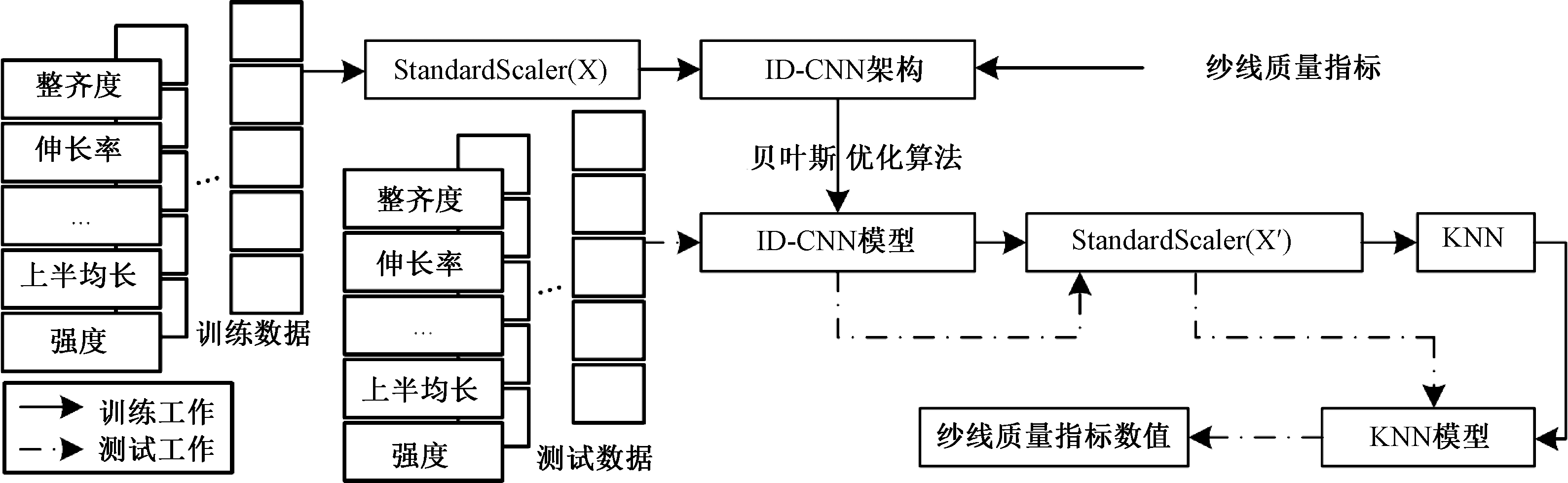
Method This study proposed a CE-based feature selection method and a yarn quality prediction model based on 1D-CNN and KNN. Initially, CE was utilized as the basis for feature selection, quantifying the relationship between variables and targets, and selecting the top seven variables with the highest correlation for input into subsequent prediction models to achieve model lightweighting. Subsequently, a 1D-CNN-KNN model was constructed, where 1D-CNN extracted features from the variables, and KNN is utilized to fit the yarn quality indicators.

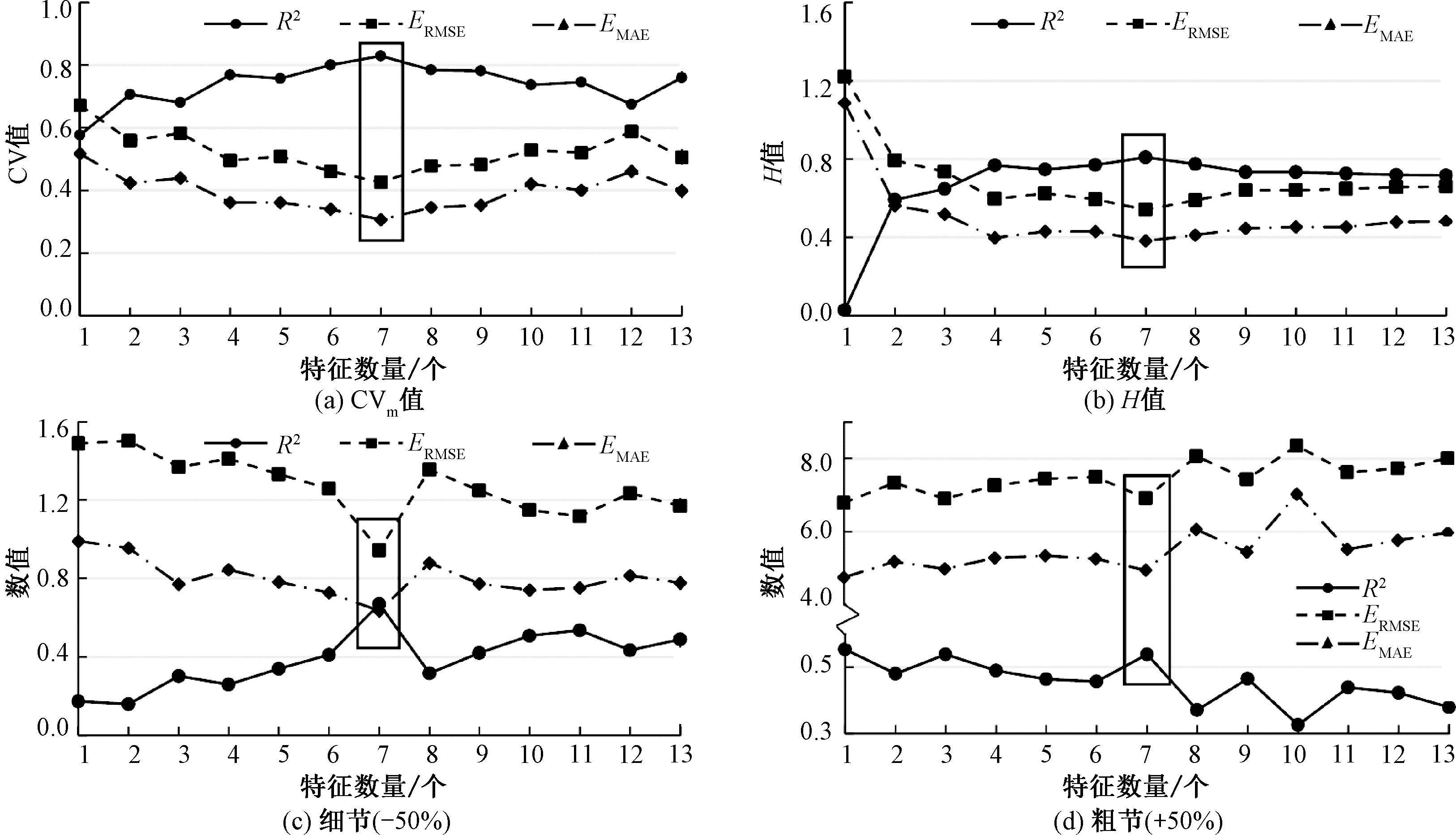
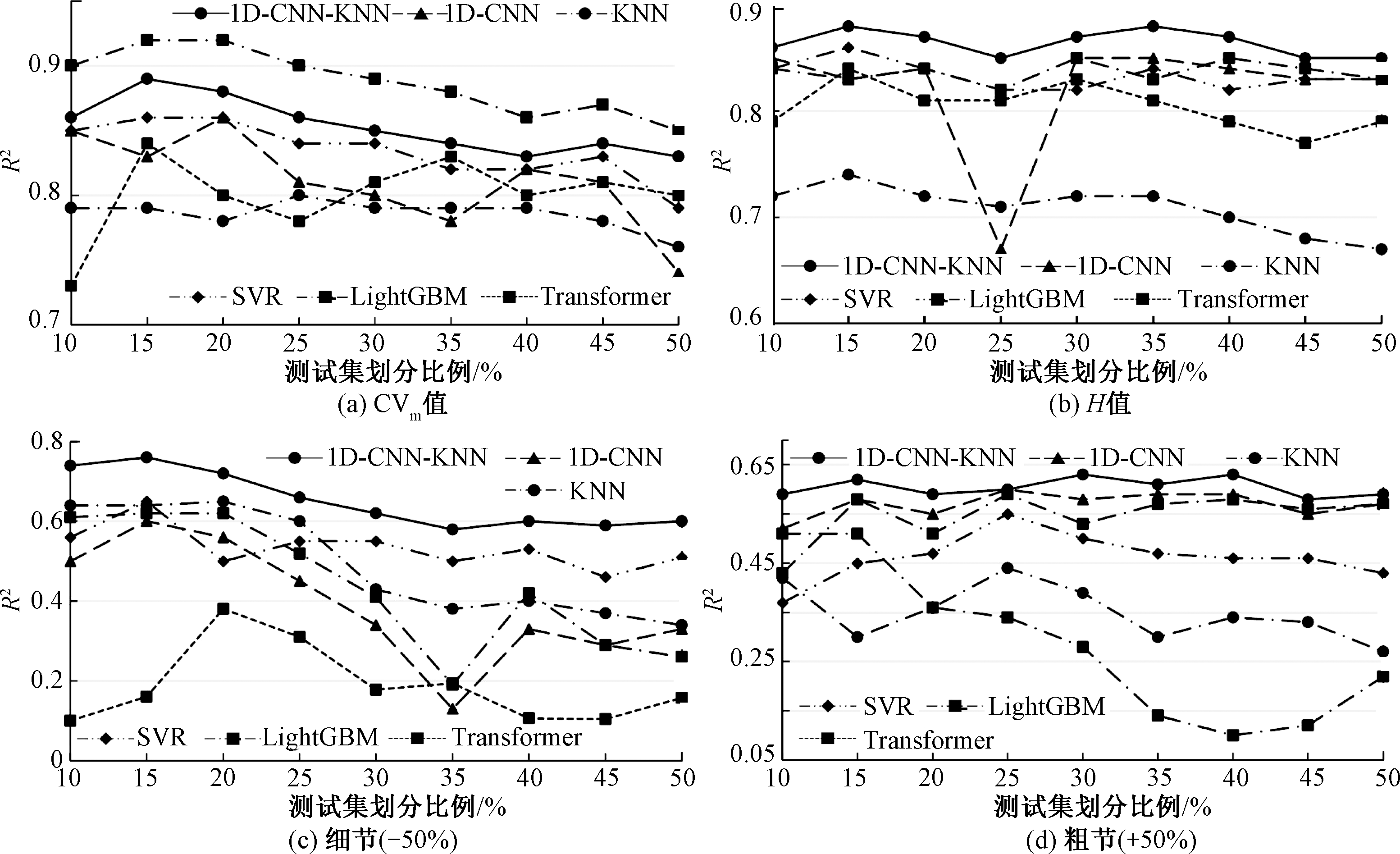
Results In order to verify the effectiveness of the proposed method, real ring spinning production data from a textile mill was used as an example. The copula entropy of raw cotton performance quantities and yarn quality indexes were calculated, and in order to determine the optimal number of features, cross-validation was adoptd to evaluate the average performance of the model with different numbers of features, and the top 7 features were finally selected as the key variables. The key variables were used as inputs to compare the performance differences between the proposed 1D-CNN-KNN and 1D-CNN, support vector regression(SVR), KNN, LightGBM, and Transformer models. The experimental results showed that the proposed model had higher prediction accuracy for yarn quality. Specifically, for the four yarn quality indicators of the mean absolute error, root mean square error, and cotticient of determination of the proposed models were improved by 18.4%, 16.5%, and 23.8%, respectively. Due to the small sample of experimental data, in order to verify the generalization performance of the proposed model, different training set samples were set to discuss the generalization ability of the model under small samples, and the experiments showed that the proposed model's comprehensive fitting ability was better than other models, and the performance was more stable. In addition, by comparing the results of different feature selection methods on the model performance, the copula entropy-based method had the highest prediction accuracy and the prediction time was shortened by 36.5% on average, improving the production prediction efficiency. Detailed analysis showed that CE-based feature selection effectively reduced the data dimensionality while retaining key information related to yarn quality. The 1D-CNN component of the model was able to capture complex patterns and features from the selected variables, which were then fitted by a KNN algorithm. The combination of these techniques produced an efficient and accurate predictive model for yarn quality metrics.

Conclusion The proposed CE-based feature selection method combined with the 1D-CNN-KNN model has proven effective in improving the prediction accuracy and efficiency of yarn quality indicators in the cotton yarn production process. This approach has the potential to contribute to the optimization of yarn production processes and the improvement of yarn quality in the textile industry. However, the current experimental data is only for cotton yarns, which can be extended to quality prediction tasks for more yarn types, such as chemical fiber and hemp, in the future. Thus, a model with better generalization can be constructed to further improve the feature selection and model training process to achieve better performance.

Key words: cotton yarn quality prediction, multidimensional feature, copula entropy, K-nearest neighborhood algorithm, one-dimensional convolutional neural network

CLC Number: 

  • TS103

Fig.1

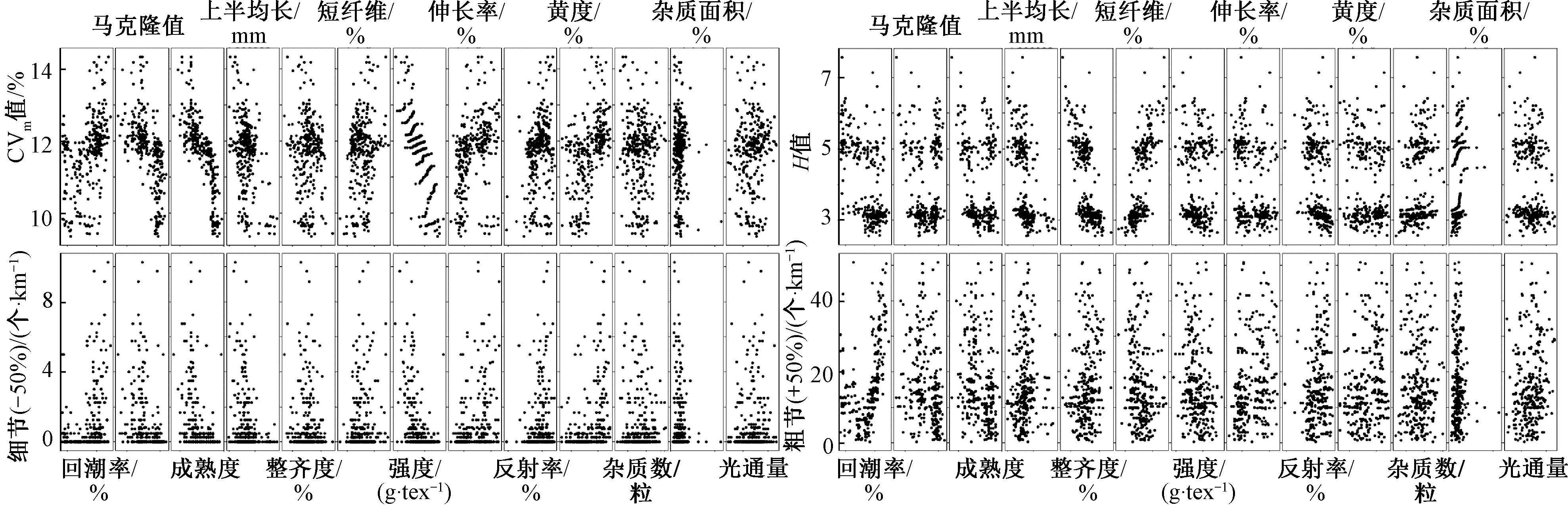
Yarn quality indicators and raw cotton properties scattered distribution"

Fig.2

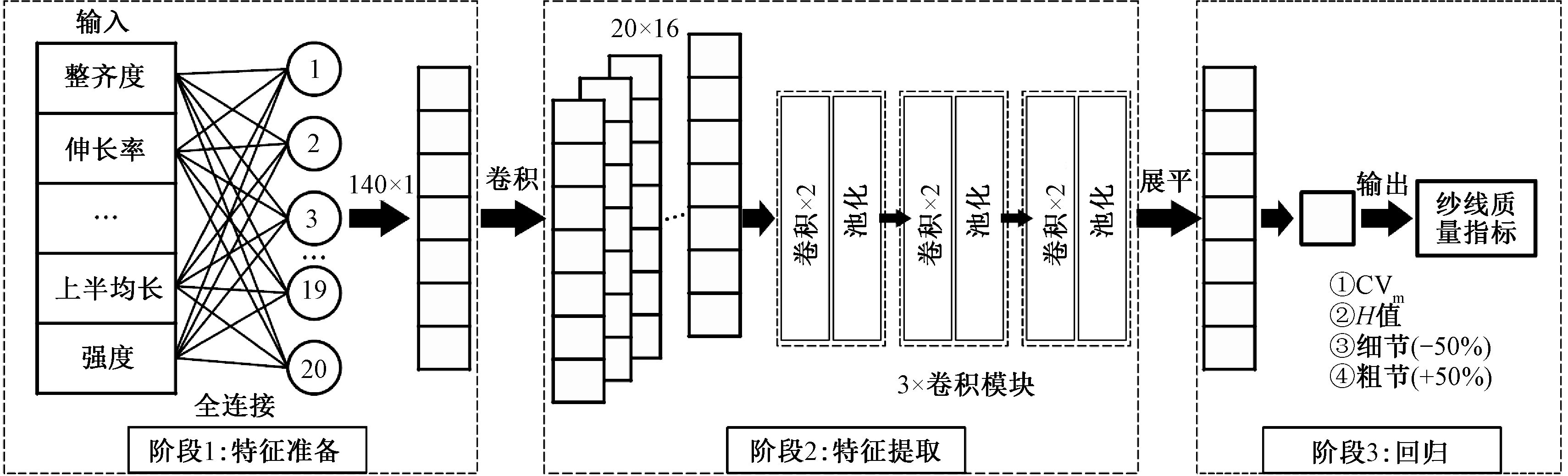
1D-CNN framework"

Tab.1

Structural information of 1D-CNN"

类别 卷积核大小 滤波器数量/个 输出尺度
Conv1x 7×1 16 20×16
Block1 3×1 16 18×16
Block2 3×1 32 16×32
Block3 3×1 64 14×64
最大池化,全连接层,线性激活函数 1×1

Fig.3

Workflow of prediction model"

Tab.2

Raw cotton performance variables and definitions"

序号 原棉性能 性能定义
1 马克隆值 棉纤维细度和成熟度的综合指标
2 成熟度 棉纤维的成熟度
3 上半均长 棉纤维长度分布中较长
一半纤维的平均长度
4 整齐度 棉纤维长度的一致性
5 短纤维 长度低于某一值的纤维所占百分比
6 强度 棉纤维的断裂强度
7 伸长率 拉伸至断裂过程中伸长的长度与
原长度的百分比
8 反射率 棉纤维表面反射光线的能力
9 回潮率 棉纤维中含有的水分含量
10 黄度 反映棉纤维的色泽
11 杂质数 每单位质量棉花中所含的杂质颗粒数量
12 杂质面积 棉花中杂质所占的面积比例
13 光通量 光的透过性

Tab.3

Yarn quality indicators and definitions"

序号 质量指标 质量指标定义
1 条干均匀度
变异系数CVm
在总测试长度内,纱条线密度的标准差
与平均线密度之比的百分数,单位为%
2 毛羽H 单位长度纱线中毛羽长度之和
与单位长度的比值,无量纲
3 细节
(-50%)
每千米纱线横截面积比正常值
减少50%,单位为个/km
4 粗节
(+50%)
每千米纱线横截面积比正常值
增加50%,单位为个/km

Fig.4

Average model performance for different numbers of feature selection. (a) CVm value; (b) H value; (c) Thin yarn (-50%); (d) Thick yarn (+50%)"

Fig.5

Different model predictions for different quality indicators.(a) CVm value; (b) Hairness H value; (c) Thin yarn (-50%); (d) Thick yarn (+50%)"

Tab.4

Performance comparison of models"

模型 CVm值/% H 细节(-50%)/(个·km-1) 粗节(+50%)/(个·km-1)
EMAE ERMSE R2 EMAE ERMSE R2 EMAE ERMSE R2 EMAE ERMSE R2
1D-CNN-KNN 0.28 0.36 0.89 0.30 0.43 0.88 0.52 0.81 0.76 4.69 6.62 0.62
1D-CNN 0.30 0.41 0.84 0.38 0.46 0.86 0.76 1.20 0.47 5.01 6.76 0.41
KNN 0.36 0.48 0.78 0.48 0.66 0.72 0.67 0.98 0.64 6.22 7.81 0.41
SVR 0.28 0.37 0.87 0.38 0.49 0.84 0.75 1.02 0.60 5.23 7.35 0.48
LightGBM 0.21 0.30 0.90 0.37 0.53 0.81 0.69 1.01 0.61 5.33 7.08 0.51
Transformer 0.32 0.45 0.81 0.38 0.52 0.82 0.74 1.28 0.39 6.14 7.88 0.40

Fig.6

Performance of model with different test set partitioning scales. (a) CVm value; (b) H value; (c) Thin yam(-50%); (d) Thick yarn (+50%)"

Tab.5

Comparison of model performance for different feature selection methods"

特征选择
方法
参数量/
kB
CVm值/% H 细节(-50%)/(个·km-1) 粗节(+50%)/(个·km-1)
预测时间/s ERMSE 预测时间/s ERMSE 预测时间/s EMSE 预测时间/s ERMSE
所有特征 100.79 0.32 0.46 0.34 0.57 0.22 1.53 0.40 7.03
P 100.41 0.22 0.48 0.20 0.76 0.19 1.32 0.21 6.95
灰色关联度 100.41 0.23 0.45 0.21 0.60 0.23 1.28 0.28 6.53
随机森林 100.41 0.23 0.49 0.24 0.57 0.27 1.33 0.24 6.77
copula熵 100.41 0.19 0.40 0.22 0.54 0.17 1.34 0.21 6.35
[1] KRUPINCOVA G. Yarn hairiness versus quality of cotton fibres[J]. Indian Journal of Fibre & Textile Research, 2013, 38(3):223-229.
[2] 谷有众, 高卫东, 卢雨正, 等. 应用遗传算法优化支持向量回归机的喷气涡流纺纱线质量预测[J]. 纺织学报, 2016, 37(7):142-148.
GU Youzhong, GAO Weidong, LU Yuzheng, et al. Prediction of vortex yarn properties based on hybrid genetic algorithm and support vector regression[J]. Journal of Textile Research, 2016, 37(7):142-148.
[3] HU Z, ZHAO Q, WANG J. The prediction model of worsted yarn quality based on CNN-GRNN neural network[J]. Neural Computing and Applications, 2019, 31(9):4551-4562.
doi: 10.1007/s00521-018-3723-7
[4] WANG M, WANG J, GAO W, et al. One-dimensional convolutional neural network with data characterization measurement for cotton yarn quality prediction[J]. Cellulose, 2023, 30(6):4025-4039.
doi: 10.1007/s10570-023-05108-9
[5] 刘智玉, 李学星, 李立轻, 等. 小样本纱线质量预测的机器学习算法适用性分析[J]. 棉纺织技术, 2024, 52(8):27-34.
LIU Zhiyu, LI Xuexing, LI Liqing, et al. Applicability analyses of machine learning algorithm for yarn quality prediction under small samples conditions[J]. Cotton Textile Technology, 2024, 52(8):27-34.
[6] 章军辉, 陈明亮, 郭晓满, 等. 基于粒子群优化支持向量机的纱线质量预测[J]. 棉纺织技术, 2024, 52(4):16-22.
ZHANG Junhui, CHEN Mingliang, GUO Xiaoman, et al. Yarn quality prediction based on support vector machine optimized by particle swarm optimization[J]. Cotton Textile Technology, 2024, 52(4):16-22.
[7] LIU Z, CHEN N, WANG J. A two-layer stacking regression model for predicting yarn quality of small samples[J]. Textile Research Journal, 2024, 94(9-10):1096-1110.
doi: 10.1177/00405175241227633
[8] SUN Y N, QIN W, XU H W, et al. A multiphase information fusion strategy for data-driven quality prediction of industrial batch processes[J]. Information Sciences, 2022, 608:81-95.
doi: 10.1016/j.ins.2022.06.057
[9] SUN Y, QIN W, ZHUANG Z. Nonparametric-copula-entropy and network deconvolution method for causal discovery in complex manufacturing systems[J]. Journal of Intelligent Manufacturing, 2021, 33(6):1-15.
doi: 10.1007/s10845-020-01641-7
[10] ZHAO N, LIN T W. A copula entropy approach to correlation measurement at the country level[J]. Applied Mathematics and Computation, 2011, 218(2):628-642.
doi: 10.1016/j.amc.2011.05.115
[11] 车畅畅, 王华伟, 倪晓梅, 等. 基于1D-CNN和Bi-LSTM的航空发动机剩余寿命预测[J]. 机械工程学报, 2021, 57(14):304-312.
doi: 10.3901/JME.2021.14.304
CHE Changchang, WANG Huawei, NI Xiaomei, et al. Residual life prediction of aeroengine based on 1D-CNN and Bi-LSTM[J]. Journal of Mechanical Engineering, 2021, 57(14): 304-312.
doi: 10.3901/JME.2021.14.304
[12] FAN D, HE H, WANG R, et al. CHLNET: a novel hybrid 1D CNN-SVR algorithm for estimating ocean surface chlorophyll-a[J]. Frontiers in Marine Science, 2022.DOI:10.3389/fmars.2022.934536.
[13] 孙长敏, 戴宁, 沈春娅, 等. 基于K-近邻算法改进粒子群-反向传播算法的织物质量预测技术[J]. 纺织学报, 2024, 45(7):72-77.
SUN Changmin, DAI Ning, SHEN Chunya, et al. Fabric quality prediction technology based on K-nearest neighbor algorithm improved particle swarm optimization-back propagation algorithm[J]. Journal of Textile Research, 2024, 45(7): 72-77.
[1] WANG Qing, JIANG Yuefu, ZHAO Tiantian, ZHAO Shihang, LIU Jiayi. Pose estimation and bobbin grasping based on deep learning methods [J]. Journal of Textile Research, 2025, 46(07): 217-226.
[2] REN Zhimo, ZHANG Wenchang, LI Zhenyi, YE He, YANG Chunliu, ZHANG Qian. Three-dimensional visual positioning method of textile cylindrical components via binocular structured light [J]. Journal of Textile Research, 2025, 46(07): 227-235.
[3] ZHANG Zeqi, ZHOU Tao, ZHOU Wenqi, FAN Zhongyao, YANG Jialei, CHEN Guoyin, PAN Shaowu, ZHU Meifang. Research progress in conductive fibers for electrophysiological signal monitoring [J]. Journal of Textile Research, 2025, 46(05): 70-76.
[4] ZHANG Jiushang, YANG Tao, ZHOU Yufeng, TIAN Xiufeng, SONG Liang, LIU Chang, LIU Jian, DU Yu. Research on tension control system of multi-warp beam let-off mechanism of 3-D fabric loom [J]. Journal of Textile Research, 2025, 46(04): 197-206.
[5] DU Chengjie, HONG Jianhan, ZHANG Kun, LIANG Kuan, XIE Guoyan, LIANG Xianjun. Analysis and optimization of transmission clearance between horn gear and carrier base of rotary circular braiding machine [J]. Journal of Textile Research, 2025, 46(04): 207-214.
[6] SHEN Min, YANG Qi, HU Feng, WANG Zhen, YANG Xuezheng, LÜ Yongfa, YU Lianqing. Optimization design of nozzle orifice structure based on response surface method [J]. Journal of Textile Research, 2025, 46(03): 196-206.
[7] ZHANG Dingtiao, WANG Qianru, QIU Fang, LI Fengyan. Simulation of flow field and fiber straightening in reconstructed fiber transport channel in rotor spinning [J]. Journal of Textile Research, 2025, 46(02): 100-105.
[8] WANG Luojun, PENG Laihu, XIONG Xuyi, LI Yang, HU Xudong. Hyper basis function-based adaptive inverse non-singular method for constant-tension yarn transport [J]. Journal of Textile Research, 2025, 46(02): 92-99.
[9] SHEN Min, OUYANG Can, XIONG Xiaoshuang, WANG Zhen, YANG Xuezheng, LÜ Yongfa, YU Lianqing. Prediction of fluctuation amplitude of weft yarns based on jet transient velocity variational modal decomposition [J]. Journal of Textile Research, 2025, 46(01): 187-196.
[10] REN Jiawei, ZHOU Qihong, CHEN Chang, HONG Wei, CEN Junhao. Detection method of position and posture of cheese yarn based on machine vision [J]. Journal of Textile Research, 2024, 45(11): 207-214.
[11] PENG Bo, WU Yujie, ZHANG Yue, LI Miaolong, MENG Xiang, LI Wei, LU Yuhao. Influence of alkyl chain length of starch alkyl carboxylic acid monoester with low substitution degree on sizing property of polyester warp yarns [J]. Journal of Textile Research, 2024, 45(10): 122-127.
[12] ZHANG Dingtiao, WANG Qianru, QIU Fang, LI Fengyan. Comparison on multi-dimensional numerical simulation of airflow field in carding and trash removal zone for rotor spinning [J]. Journal of Textile Research, 2024, 45(10): 64-71.
[13] ZHOU Qihong, CHEN Chang, REN Jiawei, HONG Wei, CEN Junhao. Tie-positioning method based on improved convex hull defect algorithm [J]. Journal of Textile Research, 2024, 45(09): 212-219.
[14] YUAN Ruwang, LI Wenhao. Modeling of rotary variable motion and shedding driving mechanism based on motion synthesis [J]. Journal of Textile Research, 2024, 45(09): 220-227.
[15] WU Jianzhong, XU Yang, SHENG Xiaowei. Tension analysis and modeling of ribbon drive process in thermal transfer printing systems [J]. Journal of Textile Research, 2024, 45(09): 228-234.
Viewed
Full text


Abstract

Cited

  Shared   
  Discussed   
No Suggested Reading articles found!