纺织学报 ›› 2025, Vol. 46 ›› Issue (10): 167-175.doi: 10.13475/j.fzxb.20241107201

• 染整工程 • 上一篇    下一篇

单色机织物数字纹理色卡的设计与评价

张子悦1, 江红霞2(), 刘基宏1   

  1. 1.江南大学 纺织科学与工程学院, 江苏 无锡 214122
    2.江南大学 数字科技与创意设计学院, 江苏 无锡 214122
  • 收稿日期:2024-11-28 修回日期:2025-06-25 出版日期:2025-10-15 发布日期:2025-10-15
  • 通讯作者: 江红霞(1974—),女,副教授,博士。主要研究方向为纺织服装数字化技术。E-mail:jhx@jiangnan.edu.cn
  • 作者简介:张子悦(2001—),女,硕士生。主要研究方向为数字化纺织。
  • 基金资助:
    江苏省产学研第一批合作项目(BY2022092)

Design and evaluation of digital texture color cards for monochromatic woven fabrics

ZHANG Ziyue1, JIANG Hongxia2(), LIU Jihong1   

  1. 1. College of Textile Science and Engineering, Jiangnan University, Wuxi, Jiangsu 214122, China
    2. College of Digital Technology and Creative Design, Jiangnan University, Wuxi, Jiangsu 214122, China
  • Received:2024-11-28 Revised:2025-06-25 Published:2025-10-15 Online:2025-10-15

摘要:

为解决传统色卡中单一颜色与带有纹理特征的真实织物颜色之间的视觉差异问题,采用数字图像处理的方法,在Lab颜色空间中,通过减去灰度平均值调整织物亮度并添加指定颜色值,得到具有纹理特征的织物数字色卡。首先分析了扫描时织物颜色对纹理的影响,接着从色差和纹理相似度2个方面对制作的数字纹理色卡进行客观评价。实验结果表明,该方法制作的纹理色卡的色差均值均小于1.0,色差在可接受的范围内;基于直方图的纹理色卡余弦相似度均值均大于0.90,纹理色卡在颜色的分布上与原织物图像具有较高的相似性;扫描织物图像的平均亮度越高,能量和相关性越高,熵和对比度越低,对应的织物纹理色卡结构相似度值低,纹理相似度较差,纹理越平滑。人眼视觉评价结果与客观评价结果基本一致,纹理色卡制作效果较好。本研究方法可基于已有织物样品生成不同颜色的数字纹理色卡。

关键词: 纹理特征, 数字纹理色卡, 图像处理, 机织物, 色差, 纹理相似度

Abstract:

Objective In the textile and apparel industry, color cards are an important communication tool between design and production. However, traditional color cards fail to represent color of textured fabrics accurately, leading to visual discrepancies between standard colors and actual fabric appearances. In order to tackle the visual difference between a single color in the traditional color card and the real fabric color with texture features, this study aims to develop a digital texture color card by fusing texture templates with specified color values through a novel algorithm.

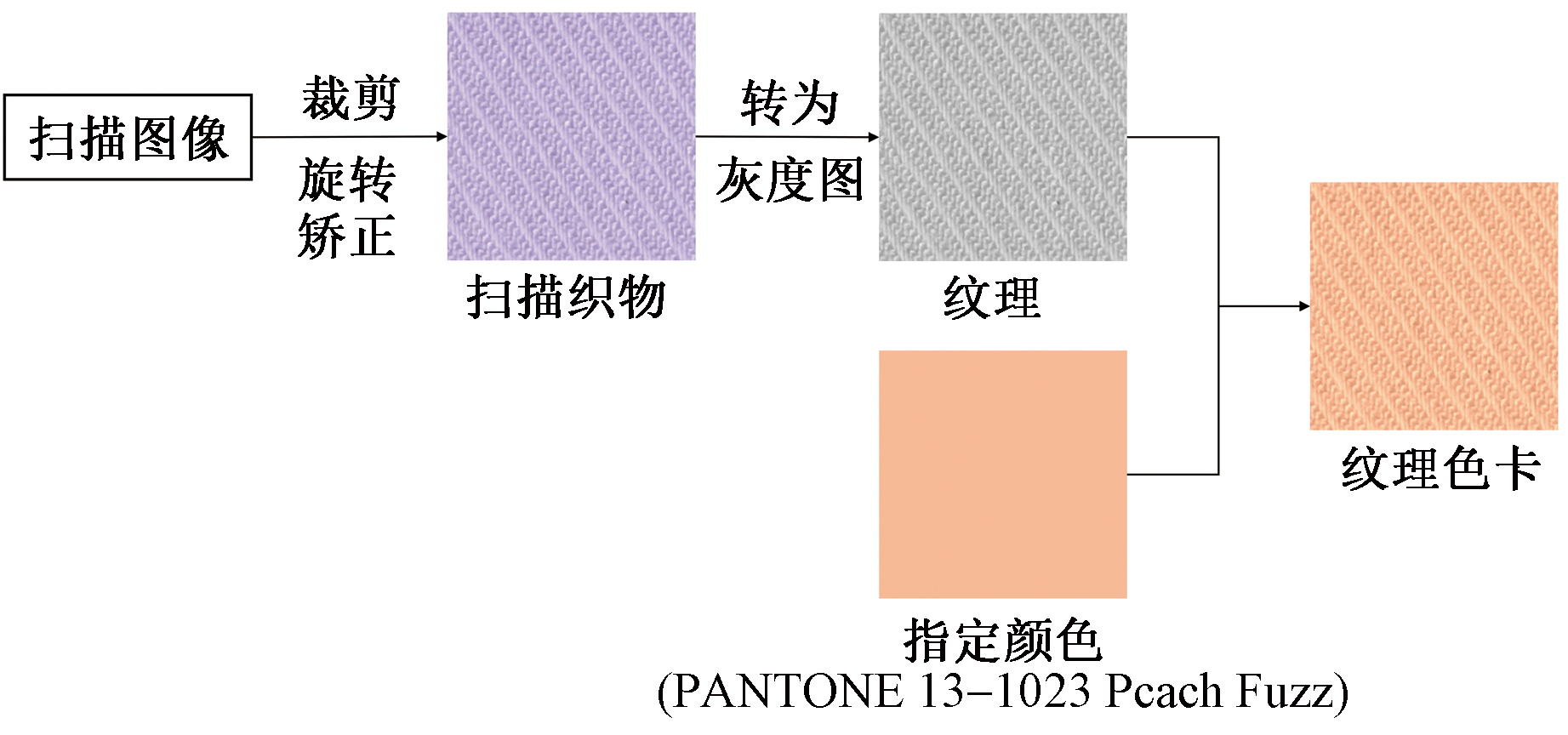
Method In the Lab color space, an algorithm of digital texture color card was proposed to adjust fabric brightness by subtracting the average gray value of L channel and superimposing the target color value of color channel. An Epson Perfection V19 scanner was used to capture fabric images at 1 200 dpi, and the images were then de-noised using median filter and geometrically corrected by fast Fourier transform and Hough transform to obtain the texture template. According to the texture color card algorithm, fabric digital texture color cards were made and human visual perception experiments designed. The influence of fabric color on texture during scanning was analyzed, and the digital texture color card was evaluated from two aspects, i.e. color difference and texture similarity.

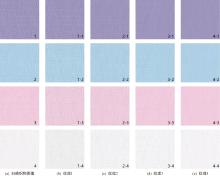
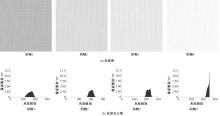
Results Four fabric images of different colors and the same texture structure were collected by using the scanner, numbered 1 to 4 according to the brightness of the fabric from low to high, and the related image processing and texture color cards were completed in MatLab R2023b. As the brightness of the fabric increases, the distribution range of gray values decreases. It was found that the gray histogram of fabrics 1 to 3 was high in the middle and low on both sides. For fabric 4, due to its high brightness, its gray histogram showed a left-low and right-high trend indicating its detail texture is not clearly visible in the scanned images. By calculating the gray co-occurrence matrix and related mean values in the four directions of the fabric, it was concluded that with the increase of fabric brightness, the energy and correlation increase, and the texture rules were uniform and the directionality was obvious. Under the above conditions, the entropy and contrast were reduced, the scanning texture was more regular, the image appeared smoother, and the texture change was not significant. CIEDE2000 color difference formula was used to calculate the color difference between the texture color card and the original fabric image to evaluate the color proximity. The results showed that the mean value of CIEDE2000ΔE between the texture color card and the original fabric was between 0.05 and 0.69, and the color difference was small. In order to verify the rationality of the method of making the texture color card, histogram cosine similarity (HCS) and structural similarity (SSIM) were used to verify the similarity between the texture color card and the scanned fabric image. The results exhibited that the mean value of texture color card HCS was above 0.90, and the similarity of color distribution was high. From the perspective of structure, the mean value of SSIM of fabrisc 1, 2 and 3 exceeded 0.8 and the texture similarity was high, while the mean value of SSIM of fabric 4 was low and the standard deviation was high relatively. This method is suitable for making fabric texture color cards with moderate brightness. In the experiment of human visual evaluation, the means of subjective scores were distributed in the range of 0.23 to 0.83, corresponding to the perceived level of visual difference ranging from "no difference" to "barely perceptible difference". Futhermore, the results of subjective evaluation were highly consistent with those of objective evaluation.

Conclusion According to the texture color card algorithm, a fabric digital color card with texture features is made to realize the presentation of different colors on the texture. It is found by scanning fabric samples with different texture images and different brightness. The higher the brightness, the smoother the scanned texture. The color difference of the texture color card is small, and the color value is consistent with the scanned image. The mean values of HCS are close to 1, and the color distribution is similar. For texture color cards with medium brightness values, SSIM mean values are above 0.8, and texture similarity is high. The results achieved high fidelity (HCS>0.90, SSIM>0.80) for test samples, demonstrating robustness for medium-brightness woven fabrics. Fabrics with extreme brightness deviations (overly high or low) should be paired with texture templates of comparable brightness levels. In the subjective evaluation, texture affects the visual perception of color. The cosine similarity index based on HCS histogram is closer to the visual characteristics of human eyes in the evaluation of texture perception. This method is currently suitable for medium-brightness fabrics. In the future, we will focus on optimizing the algorithm to improve the color visual effect with a wider range which is expected to be suitable for fabrics with different color and texture, and create a digital database of fabric texture color cards.

Key words: texture feature, digital texture color card, image processing, woven fabric, color difference, texture similarity

中图分类号: 

  • TS101.9

图1

单色机织物数字纹理色卡制作流程图"

表1

扫描织物图像颜色值"

织物编号 L a b
1 65.11 12.13 -20.49
2 83.23 -6.67 -15.11
3 86.47 17.29 -4.60
4 95.90 1.20 -1.00

图2

织物数字纹理色卡制作结果"

图3

扫描织物1~4的灰度图及其灰度直方图"

表2

织物灰度共生矩阵特征值均值"

织物编号 能量 对比度 相关性
1 0.102 2.616 0.522 0.541
2 0.150 2.185 0.342 0.864
3 0.202 1.882 0.238 1.145
4 0.462 1.039 0.119 3.090

表3

纹理色卡颜色值及色差"

扫描织物
图像
纹理
色卡
L a b ΔE2000
织物1 1-1 65.07 12.25 -20.54 0.09
2-1 65.10 12.05 -20.34 0.09
3-1 65.12 12.14 -20.52 0.01
4-1 65.11 12.15 -20.5 0.01
均值 0.05
织物2 1-2 83.17 -6.99 -14.36 0.61
2-2 83.22 -6.78 -14.82 0.23
3-2 83.29 -6.84 -14.94 0.21
4-2 83.28 -6.71 -15.17 0.06
均值 0.28
织物3 1-3 86.07 15.69 -5.04 1.35
2-3 86.18 16.48 -5.01 0.74
3-3 86.35 16.58 -4.88 0.60
4-3 86.45 17.2 -4.6 0.07
均值 0.69
织物4 1-4 94.64 0.78 -0.65 1.02
2-4 95.21 0.91 -0.75 0.62
3-4 95.49 0.88 -0.67 0.61
4-4 95.89 1.17 -1.16 0.16
均值 0.60

表4

纹理相似度指标"

原织物
纹理图像
纹理色卡 YHCS YSSIM
织物1 1-1 1.00 1.00
2-1 0.96 0.72
3-1 0.92 0.76
4-1 0.71 0.79
均值 0.90 0.82
标准差 0.11 0.11
织物2 1-2 0.95 0.81
2-2 1.00 0.99
3-2 0.98 0.89
4-2 0.79 0.91
均值 0.93 0.90
标准差 0.08 0.06
织物3 1-3 0.93 0.69
2-3 0.98 0.76
3-3 0.99 0.98
4-3 0.82 0.85
均值 0.93 0.82
标准差 0.07 0.11
织物4 1-4 0.81 0.39
2-4 0.90 0.47
3-4 0.91 0.53
4-4 1.00 0.99
均值 0.91 0.59
标准差 0.07 0.24

表5

纹理色卡的人眼视觉评价"

数字纹理色卡 明度 色相 饱和度 纹理
织物1 0.65 0.25 0.60 0.83
织物2 0.45 0.23 0.53 0.53
织物3 0.45 0.28 0.60 0.58
织物4 0.78 0.55 0.58 0.56
[1] 张为海. 纺织品数字色卡的功能和应用:纺织印花行业数字化工具三剑客之二[J]. 丝网印刷, 2023(9): 29-33.
ZHANG Weihai. The function and application of digital color card for textiles: the second of the three musketeers in the digitalization of the textile printing industry[J]. Screen Printing, 2023(9): 29-33.
[2] 任静. 织物表面纹理与主观颜色的关系[D]. 杭州: 浙江理工大学, 2015: 16-20.
REN Jing. The relation between surface textures of fabrics and subjective[D]. Hangzhou: Zhejiang Sci-Tech University, 2015: 16-20.
[3] 金佳冰, 郭明瑞, 傅佳佳, 等. 基于图像处理的纱线捻系数与明度关系研究[J]. 棉纺织技术, 2019, 47(9): 18-21.
JIN Jiabing, GUO Mingrui, FU Jiajia, et al. Study on relationship between yarn twist factor and lightness based on image processing[J]. Cotton Textile Technology, 2019, 47(9): 18-21.
[4] 刘沐黎, 袁理, 杨亚莉, 等. 色纺机织物组织结构对其呈色特性的影响[J]. 纺织学报, 2020, 41(9): 45-53.
LIU Muli, YUAN Li, YANG Yali, et al. Influence of fabric weaves on characteristics of colored patterns in color-woven fabrics[J]. Journal of Textile Research, 2020, 41(9): 45-53.
[5] FASHANDI H, AMIRSHAHI S H, TEHRAN M A, et al. Evaluation of scanner capability for measuring the color of fabrics with different textures in different setups[J]. Fibers and Polymers, 2010, 11(5): 767-774.
doi: 10.1007/s12221-010-0767-4
[6] SMYKALO K, ZAKORA O. Effect of hairiness on fabric colour characteristics[J]. TEKSTILEC, 2020, 63(4): 276-286.
doi: 10.14502/Tekstilec
[7] 潘如如, 李忠健, 唐佩君, 等. 应用纱线序列图像的色纺机织物仿真[J]. 棉纺织技术, 2019, 47(1): 16-20.
PAN Ruru, LI Zhongjian, TANG Peijun, et al. Application of yarn sequence image for the simulation of colored spun woven fabric[J]. Cotton Textile Technology, 2019, 47(1): 16-20.
[8] 张宁, 李忠健, 潘如如, 等. 采用色纺纱图像的真实感色织物模拟[J]. 纺织学报, 2017, 38(5): 37-42.
ZHANG Ning, LI Zhongjian, PAN Ruru, et al. Simulation of realistic yarn-dyed fabric using colored spun yarn images[J]. Journal of Textile Research, 2017, 38(5): 37-42.
[9] 郭宇飞, 范运舫, 付东, 等. 色纺段彩纱的呈色机理及其织物外观风格仿真设计[J]. 现代纺织技术, 2020, 28(6): 17-23.
GUO Yufei, FAN Yunfang, FU Dong, et al. Color rendering mechanism of segment colored yarn and simulation design of fabric appearance style[J]. Advanced Textile Technology, 2020, 28(6): 17-23.
[10] YUAN L, HUO D, GU Q, et al. Study on color representation model and computer simulation of colored spun fabrics based on image translation model[J]. Textile Research Journal, 2022, 92(13/14): 2379-2390.
doi: 10.1177/00405175211073784
[11] ZHANG N, HU Q, WANG L, et al. Appearance change for colored spun yarn fabric based on image color transfer[J]. Textile Research Journal, 2021, 91(13/14): 1439-1451.
doi: 10.1177/0040517520984093
[12] 杨柳, 李羽佳, 俞琰, 等. 基于纽介堡方程的色纺织物颜色预测[J]. 纺织学报, 2024, 45(1): 83-89.
YANG Liu, LI Yujia, YU Yan, et al. Color prediction of fiber-colored fabrics based on Neugebauer equa-tion[J]. Journal of Textile Research, 2024, 45(1): 83-89.
doi: 10.1177/004051757504500115
[13] 王蕾, 厉征鑫, 刘建立, 等. FFT和Hough变换在织物纹理方向检测上的应用[J]. 计算机工程与应用, 2014, 50(18): 39-43.
WANG Lei, LI Zhengxin, LIU Jianli, et al. Application of FFT and Hough transform in fabric texture directions detecting[J]. Computer Engineering and Applications, 2014, 50(18): 39-43.
[14] 晋蕊, 张亦可, 李戎. 基于Coloro色彩体系不同色深公式的颜色深度研究[J]. 纺织学报, 2021, 42(5): 90-95, 102.
JIN Rui, ZHANG Yike, LI Rong. Study on color depth based on different formulas in Coloro color system[J]. Journal of Textile Research, 2021, 42(5): 90-95, 102.
[15] 张银娟, 褚孟洋, 沈超, 等. FM100孟塞尔色觉测试系统的设计与应用[J]. 医疗卫生装备, 2016, 37(3): 14-17.
ZHANG Yinjuan, CHU Mengyang, SHEN Chao, et al. Design and application of FM100 Munsell color vision test system[J]. Chinese Medical Equipment Journal, 2016, 37(3): 14-17.
[16] LIU H, HUANG M, CUI G, et al. Color-difference evaluation for digital images using a categorical judgment method[J]. Journal of the Optical Society of America A, Optics, Image Science and Vision, 2013, 30(4): 616-626.
doi: 10.1364/JOSAA.30.000616
[1] 邱俊, 李际军. 机织物的三维真实感建模与参数化设计[J]. 纺织学报, 2025, 46(10): 95-102.
[2] 梁睿, 李众, 童维红, 叶长怀. 聚乙烯衍生炭化织物及其电磁屏蔽性能[J]. 纺织学报, 2025, 46(09): 27-35.
[3] 张涣东, 纪柏林, 钟毅, 徐红, 毛志平. 接触式预烘对纯棉针织物平幅染色预烘效率及色差的影响[J]. 纺织学报, 2025, 46(07): 154-159.
[4] 张爱丹, 王倩. 三纬组合全显结构织物的颜色预测方法[J]. 纺织学报, 2025, 46(05): 151-158.
[5] 李吉国, 景军锋, 程为, 王永波, 刘薇. 基于机器视觉的玻璃纤维纱团外观缺陷检测系统设计[J]. 纺织学报, 2025, 46(05): 243-251.
[6] 尚静雨, 蒋高明, 陈钰珊, 刘海桑, 李炳贤. 花式纱罗织物设计与三维仿真[J]. 纺织学报, 2025, 46(04): 81-88.
[7] 王浙峰, 蔡王丹, 李诗雅, 徐青艺, 张红霞, 祝成炎, 金肖克. 抗菌除臭复合功能机织物的服用性能[J]. 纺织学报, 2025, 46(03): 90-99.
[8] 马运娇, 王蕾, 潘如如. 基于双斜交平面镜的纱线条干三维仿真[J]. 纺织学报, 2025, 46(02): 86-91.
[9] 孙戬, 王彤, 陈云辉, 林何, 刘晖, 成小乐. 织物增强橡胶基复合材料本构模型及其应用[J]. 纺织学报, 2025, 46(01): 95-102.
[10] 李慧敏, 刘淑强, 杜琳琳, 张曼, 吴改红. 玄武岩/聚酰亚胺三维间隔机织物的参数化建模及高温环境传热数值模拟[J]. 纺织学报, 2025, 46(01): 87-94.
[11] 庄冰冰, 向军, 张宁, 潘如如, 张卜文. 便携式织物图像颜色测量系统开发[J]. 纺织学报, 2024, 45(10): 208-215.
[12] 蒋静, 彭来湖, 史伟民, 袁豪伟. 基于奇异值分解算法的非接触纱线张力测量[J]. 纺织学报, 2024, 45(09): 204-211.
[13] 田少萌, 张丽, 石浩轩, 徐阳. 基于ANSYS Workbench的高密机织滤料动态形变模拟与分析[J]. 纺织学报, 2024, 45(09): 63-69.
[14] 庹武, 杜聪, 陈谦, 吴超, 魏新桥, 张欣汝, 刘思雨. 基于计算机视觉与Canny算法的服装纸样轮廓提取[J]. 纺织学报, 2024, 45(05): 174-182.
[15] 杨金鹏, 景军锋, 李吉国, 王渊博. 基于机器视觉的玻璃纤维合股纱缺陷检测系统设计[J]. 纺织学报, 2024, 45(05): 193-201.
Viewed
Full text


Abstract

Cited

  Shared   
  Discussed   
No Suggested Reading articles found!