纺织学报 ›› 2026, Vol. 47 ›› Issue (05): 28-36.doi: 10.13475/j.fzxb.20250707901
王晓辉1( ), 王宇航2, 徐锦龙1, 刘金星1, 陈哲1, 谭晶2, 梅锋1, 王华平1
WANG Xiaohui1(), WANG Yuhang2, XU Jinlong1, LIU Jinxing1, CHEN Zhe1, TAN Jing2, MEI Feng1, WANG Huaping1
摘要:
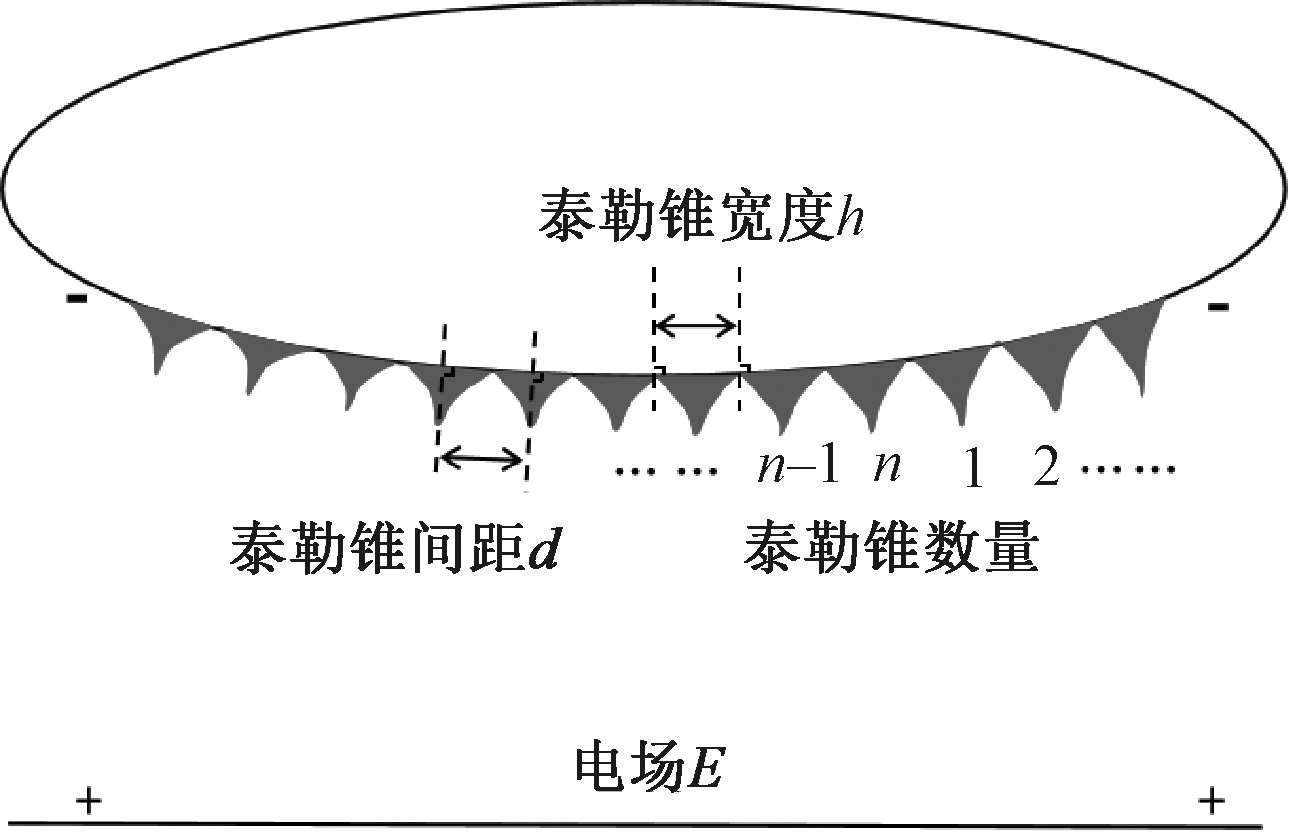
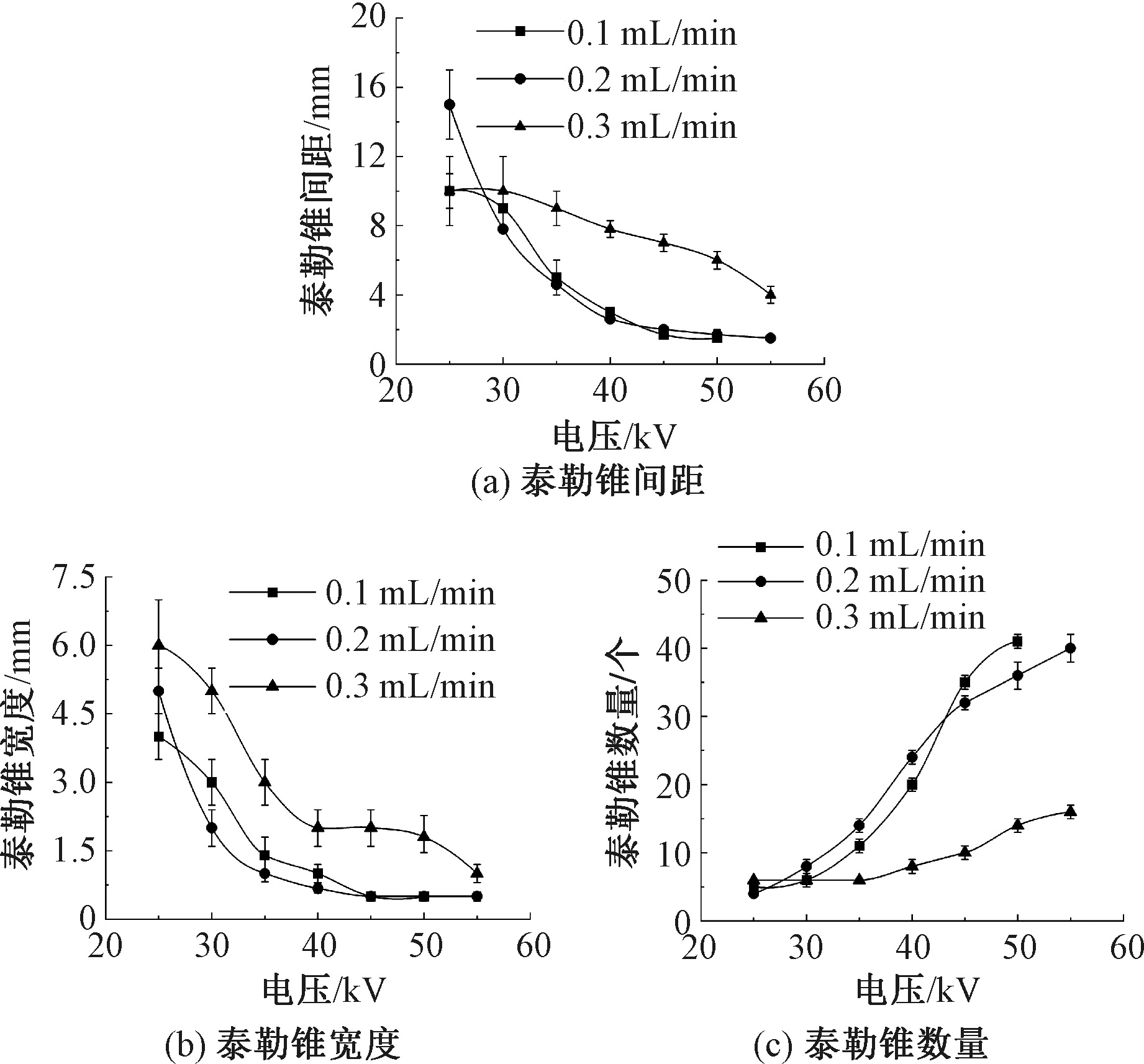
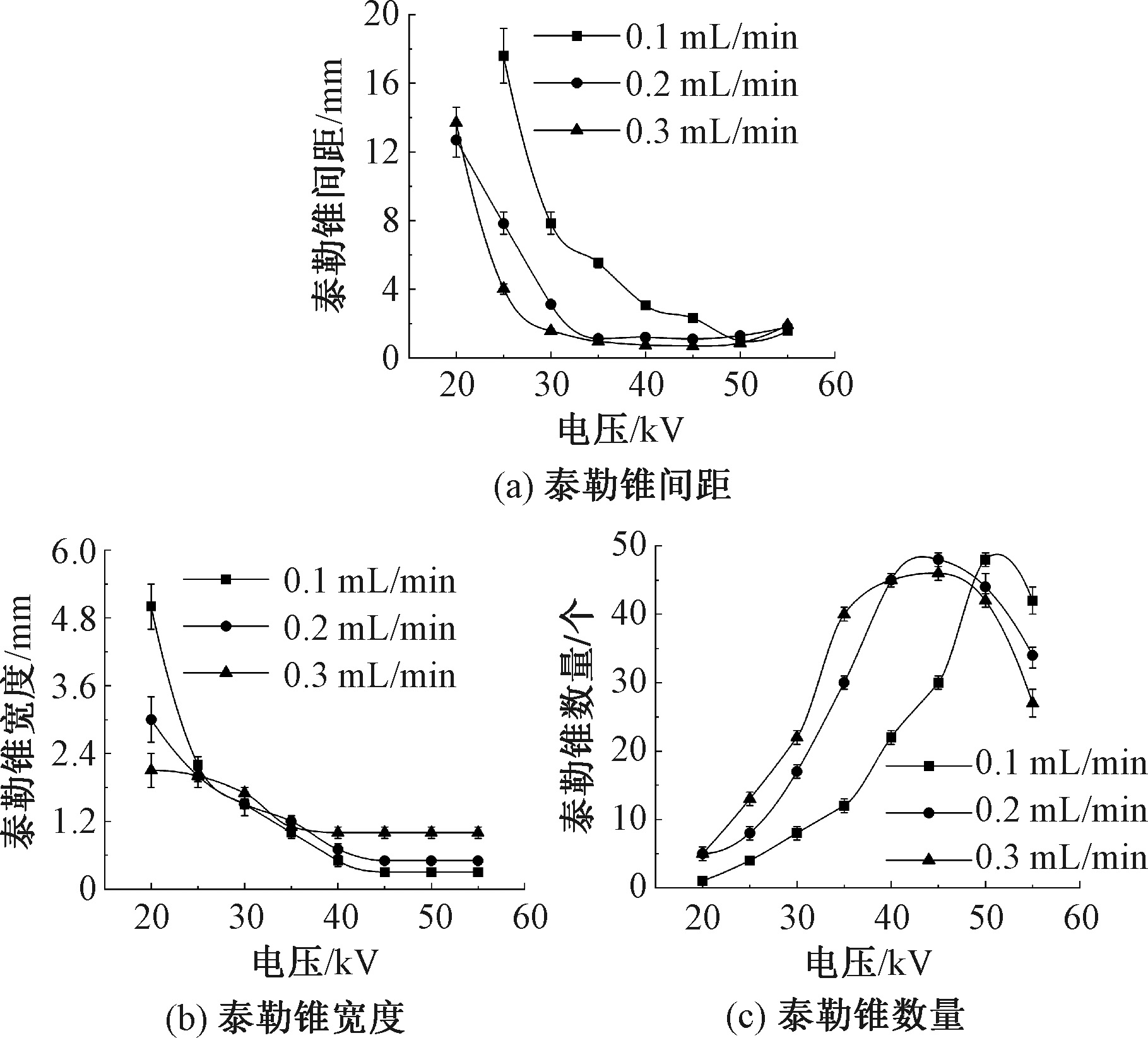
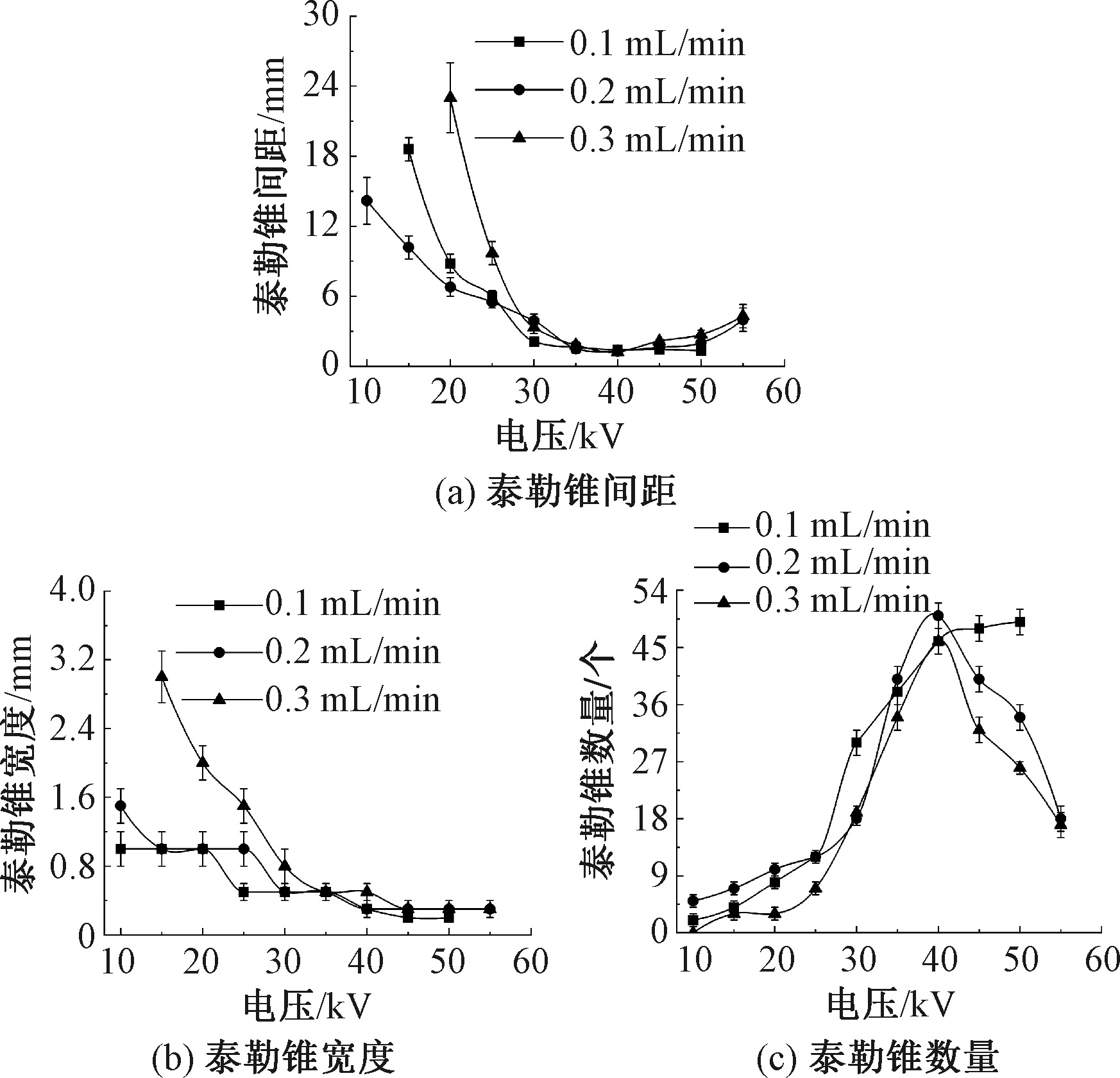
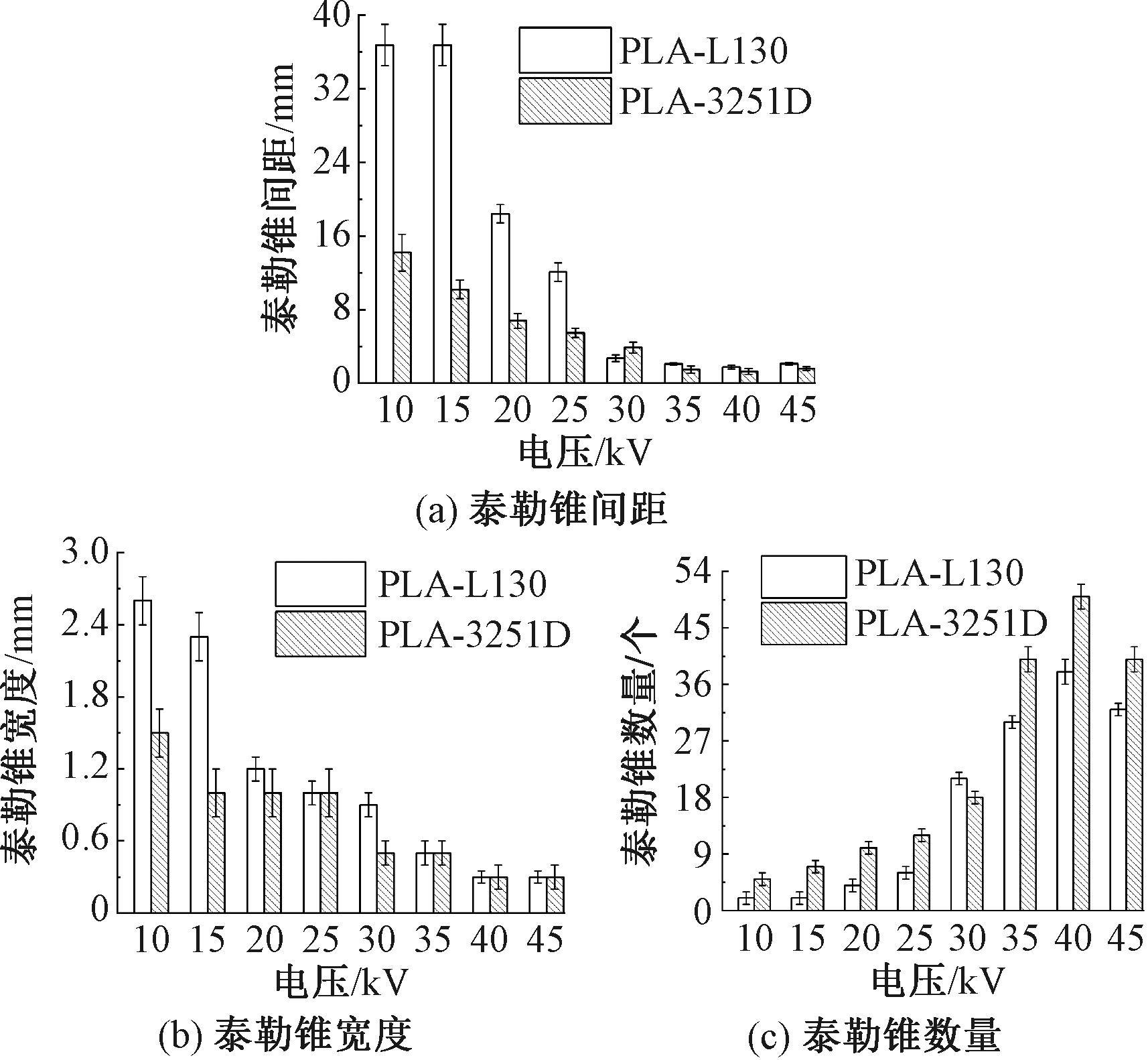
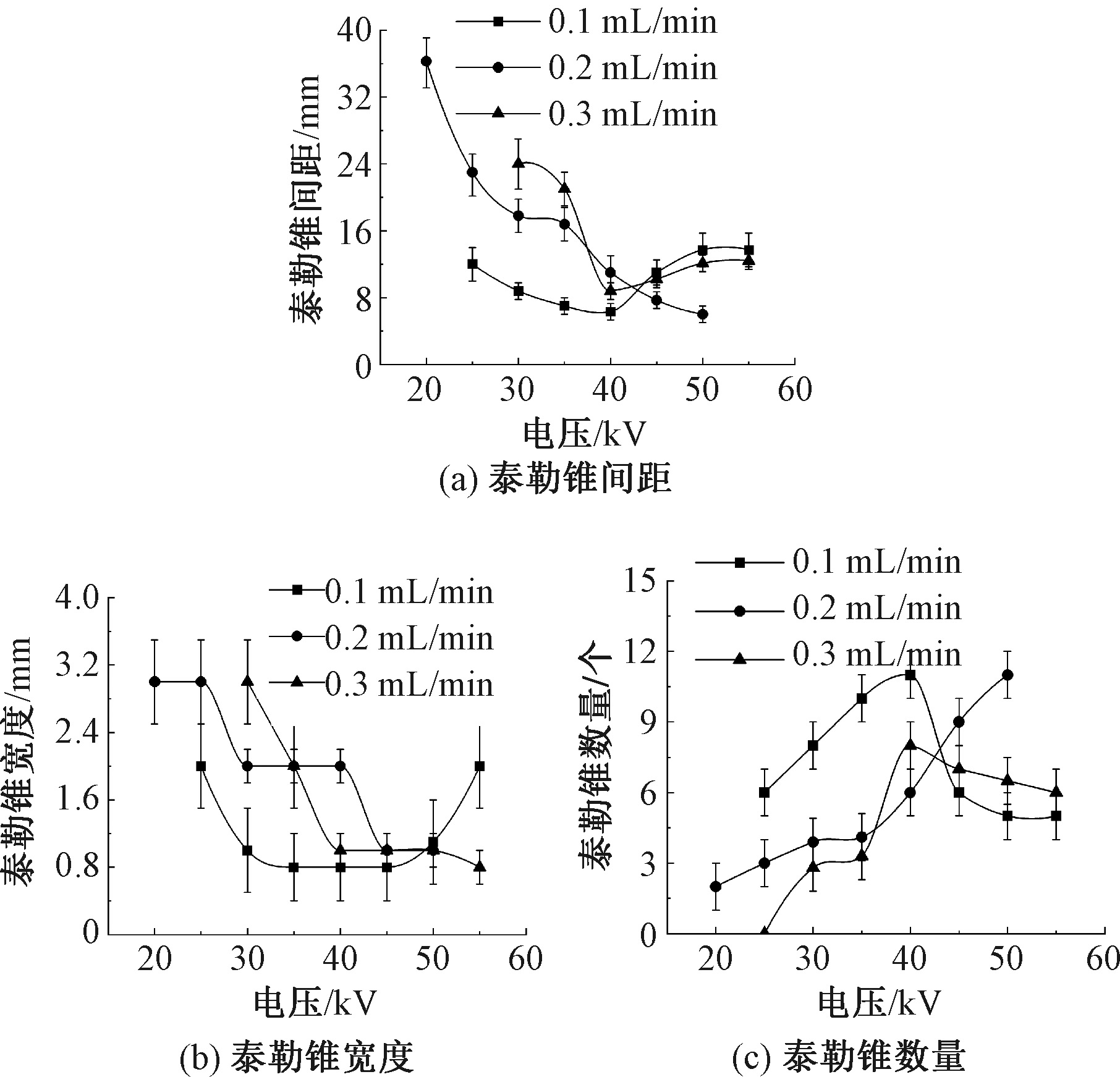
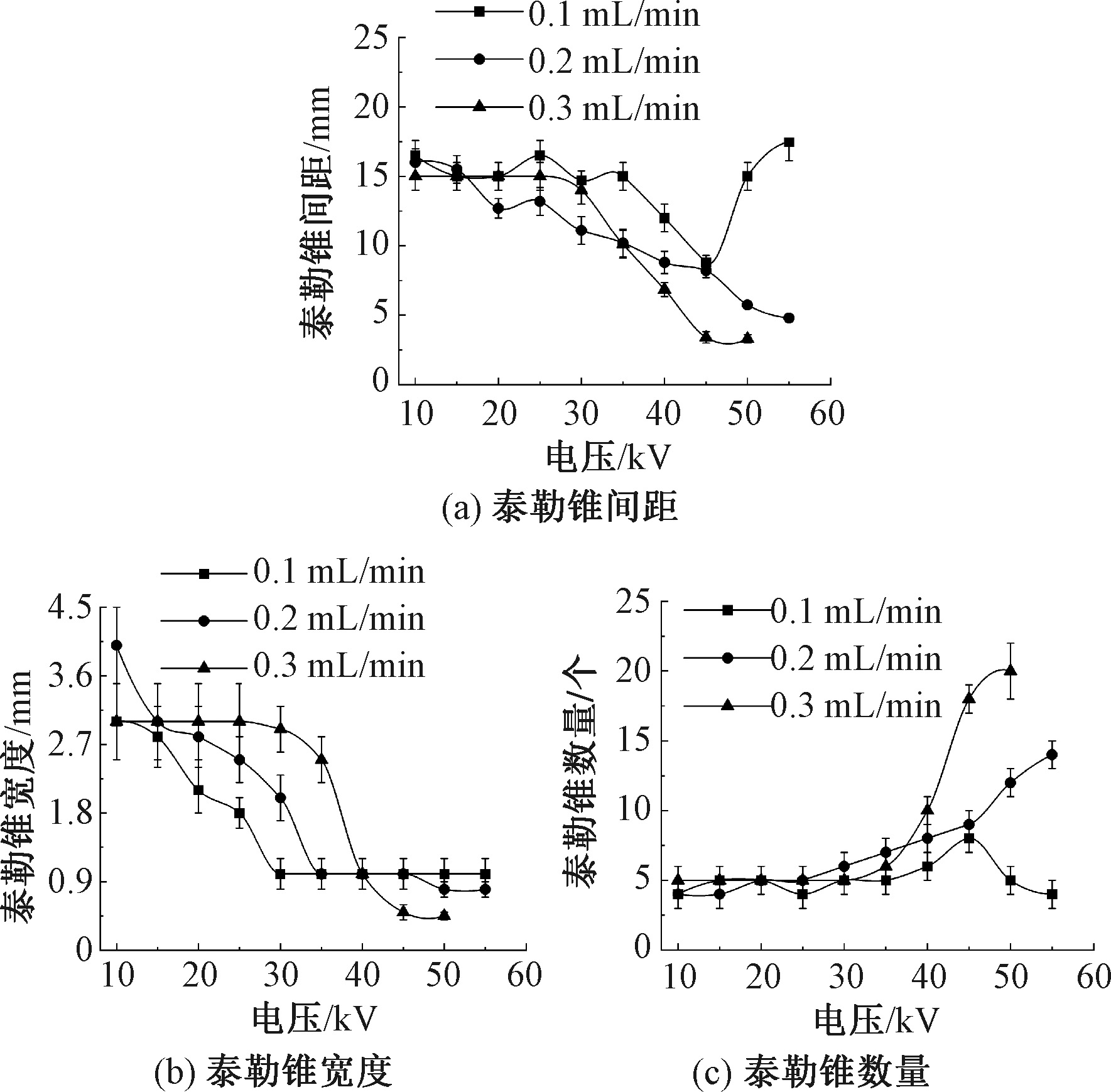
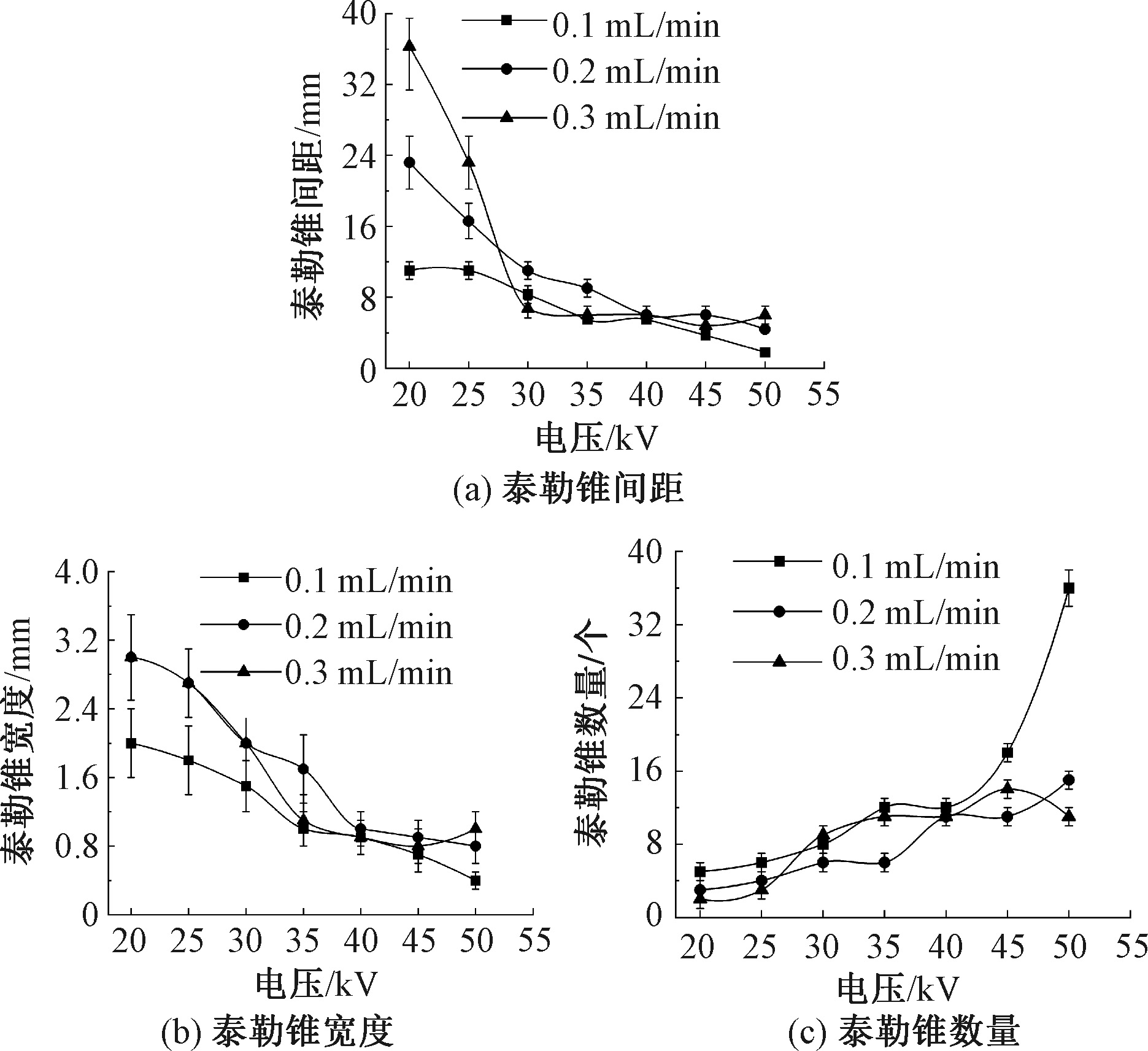
针对熔融静电纺丝过程中不同聚合物熔体在电场泰勒锥成形效果及纤维可纺性存在差异的问题,以聚丙烯(PP)、聚乳酸(PLA)、聚对苯二甲酸乙二醇酯(PET)、消光聚对苯二甲酸乙二醇酯(PET-TiO2)、聚对苯二甲酸丁二醇酯(PBT)为原料,采用熔融静电纺丝技术,研究不同分子结构聚合物泰勒锥的成形原理,分析不同电压和挤出量对熔体泰勒锥的间距、宽度及数量的影响。结果表明:聚合物分子链极性越强、刚性位阻越小,泰勒锥成形效果越好,依次为:PLA>PP>PBT>PET-TiO2>PET;聚合物熔融指数增大,熔体流动性增加,泰勒锥数量增多,间距和宽度减小;PET-TiO2中的二氧化钛(TiO2)提高了熔体诱导极化能力,泰勒锥数量增加,成形效果及可纺性均有所提高;当聚乳酸(PLA-3251D)挤出量为0.2 mL/min、电压为40 kV时,熔体在周长为7.5 cm的喷头上形成泰勒锥数量高达50根,间距和宽度最小分别为1 mm和0.2 mm,具有良好的泰勒锥成形能力,熔融静电纺丝过程中熔体泰勒锥的成形展现了不同结构聚合物在微纳米纤维制备中的应用潜力。
中图分类号:
| [1] | 肖宇扬, 冯玄圣, 黄英. 以碳布为基底的柔性超级电容器电极材料研究进展[J]. 材料开发与应用, 2021, 36(1): 87-95. |
| XIAO Yuyang, FENG Xuansheng, HUANG Ying. Research progress of electrode materials for flexible supercapacitors based on carbon cloth[J]. Development and Application of Materials, 2021, 36(1): 87-95. | |
| [2] | 闫静, 王亚倩, 刘晶晶, 等. 熔融静电纺长丝纱的制备及其在摩擦纳米发电机中的应用[J]. 纺织学报, 2025, 46(5): 23-29. |
| YAN Jing, WANG Yaqian, LIU Jingjing, et al. Preparation of melt-electrospun filament yarns and their applications in triboelectric nanogenerators[J]. Journal of Textile Research, 2025, 46(5): 23-29. | |
| [3] |
ZHANG L Y, HOU Q Z, LI H Y, et al. Investigation on the sound absorption performance of polypropylene/polyethylene glycol ultrafine fibers by melt differential electrospinning process[J]. Applied Acoustics, 2022, 200: 109056.
doi: 10.1016/j.apacoust.2022.109056 |
| [4] | 王宇航, 杨卫民, 李好义, 等. 熔体静电纺丝纤维细化技术研究进展[J]. 高分子材料科学与工程, 2024, 40(8): 174-180. |
| WANG Yuhang, YANG Weimin, LI Haoyi, et al. Development of melt electrospun fiber thining technology[J]. Polymer Materials Science & Engineering, 2024, 40(8): 174-180. | |
| [5] |
HOSSEINI RAVANDI S A, SADRJAHANI M, VALIPOURI A, et al. Recently developed electrospinning methods: a review[J]. Textile Research Journal, 2022, 92(23/24): 5130-5145.
doi: 10.1177/00405175211069880 |
| [6] |
HOU Z Z, KOBAYASHI H, TANAKA K, et al. Laser-assisted melt electrospinning of poly(L-lactide-co-ε-caprolactone): analyses on processing behavior and characteristics of prepared fibers[J]. Polymers, 2022, 14(12): 2511.
doi: 10.3390/polym14122511 |
| [7] | 陈明军, 李好义, 杨卫民. 聚合物熔体微分静电纺电场对射流的影响及其物理模型[J]. 纺织学报, 2022, 43(5): 70-76. |
| CHEN Mingjun, LI Haoyi, YANG Weimin. Physical model and effects of electric field on jets in polymer melt differential electrospinning[J]. Journal of Textile Research, 2022, 43(5): 70-76. | |
| [8] | 张凯. 熔体静电纺丝电场力作用机制的分子动力学模拟研究[D]. 北京:北京化工大学, 2020: 25-32. |
| ZHANG Kai. Molecular dynamics simulation of the mechanism of electric field force in melt electrospinning. Beijing: Beijing University of Chemical Technology, 2020: 25-32. | |
| [9] | LI H Y, CHEN H B, ZHONG X F, et al. Interjet distance in needleless melt differential electrospinning with umbellate nozzles[J]. Journal of Applied Polymer Science, 2014, 131(15): 40515. |
| [10] |
LIU K, ZHENG Y S, NEWTON M A A, et al. Multiphysics modeling and experimental verification of solidification point of melt-electrospun jet[J]. Textile Research Journal, 2023, 93(5/6): 1251-1262.
doi: 10.1177/00405175221130774 |
| [11] |
SHEORAN N, BOLAND B, THORNTON S, et al. Increasing ionic conductivity within thermoplastics via commercial additives results in a dramatic decrease in fiber diameter from melt electrospinning[J]. Soft Matter, 2021, 17(41): 9264-9279.
doi: 10.1039/D1SM01101D |
| [12] | 何曼君, 张红东, 陈维孝, 等. 高分子物理[M]. 3版. 上海: 复旦大学出版社, 2007: 220-261. |
| HE Manjun, ZHANG Hongdong, CHEN Weixiao, et al. Polymer physics[M]. 3rd ed. Shanghai: Fudan University Press, 2007: 220-261. | |
| [13] |
SHIN Y M, HOHMAN M M, BRENNER M P, et al. Experimental characterization of electrospinning: the electrically forced jet and instabilities[J]. Polymer, 2001, 42(25): 9955-9967.
doi: 10.1016/S0032-3861(01)00540-7 |
| [14] |
LI H Y, LI Y, YANG W M, et al. Needleless melt-electrospinning of biodegradable poly(lactic acid) ultrafine fibers for the removal of oil from water[J]. Polymers, 2017, 9(2): 3.
doi: 10.3390/polym9020003 |
| [15] | 闫伟涛, 党智敏, 徐海萍. 聚丙烯/聚偏氟乙烯共混复合材料的介电性能的研究[J]. 绝缘材料, 2007, 40(3): 45-47, 51. |
| YAN Weitao, DANG Zhimin, XU Haiping. Study on dielectric property of the PP/PVDF blending composites[J]. Insulating Materials, 2007, 40(3): 45-47, 51. | |
| [16] |
PAN Z Z, PAN Y P, LI L, et al. High energy density and superior charge/discharge efficiency polymer dielectrics enabled by rationally designed dipolar polarization[J]. Journal of Materiomics, 2023, 9(3): 601-608.
doi: 10.1016/j.jmat.2022.11.002 |
| [17] |
ZHANG P, CHEN L, GUO Y, et al. ″Hetero-furan unit″ drives a spontaneous leaf-vein bioinspired multiscale design for ultra-robust, lightweight, and recyclable polymers[J]. Macromolecules, 2023, 56(21): 8823-8833.
doi: 10.1021/acs.macromol.3c01054 |
| [18] |
WU D F, ZHOU C X, ZHENG H. A rheological study on kinetics of poly(butylene terephthalate) melt intercalation[J]. Journal of Applied Polymer Science, 2006, 99(4): 1865-1871.
doi: 10.1002/app.v99:4 |
| [19] | 李好义. 熔体微分静电纺丝原理、方法与设备[D]. 北京: 北京化工大学, 2014: 24-43. |
| LI Haoyi. Principle, method, and equipment of melt differential electrospinning[D]. Beijing: Beijing University of Chemical Technology, 2014: 24-43. |
| [1] | 魏建斐, 魏艳颖, 马超慧, 胡晓鹏, 邴琳涵, 樊瑜, 林彬泽, 董振峰, 朱志国, 王锐. 碳点的宏量制备及其对聚酰胺66阻燃与力学性能协同增强机制[J]. 纺织学报, 2026, 47(02): 37-46. |
| [2] | 董振峰, 张安莹, 魏建斐, 朱志国, 王锐. 阻燃左旋聚乳酸/季戊四醇磷酸酯纤维及织物的制备与性能[J]. 纺织学报, 2026, 47(01): 63-71. |
| [3] | 闫静, 王亚倩, 刘晶晶, 李好义, 杨卫民, 康卫民, 庄旭品, 程博闻. 熔融静电纺长丝纱的制备及其在摩擦纳米发电机中的应用[J]. 纺织学报, 2025, 46(05): 23-29. |
| [4] | 郭羽晴, 屈芸, 张利平, 孙洁. 芳纶纳米纤维制备及其可纺性[J]. 纺织学报, 2025, 46(04): 1-10. |
| [5] | 詹克静, 杨鑫, 张应龙, 张昕, 潘志娟. 自凝聚丝素蛋白微纳米纤维膜的制备及其力学增强[J]. 纺织学报, 2025, 46(02): 10-19. |
| [6] | 雷福旺, 冯其, 侯奥菡, 赵振鸿, 谭佳兆, 赵景, 王先锋. 聚偏氟乙烯-聚丙烯腈/SiO2单向导湿纤维膜的制备及其性能[J]. 纺织学报, 2024, 45(12): 1-8. |
| [7] | 房磊, 刘秀明, 贾娇娇, 蔺志浩, 任燕飞, 侯凯文, 巩继贤, 扈延龄. 高分子量壳聚糖皮芯结构微纳米纤维膜制备[J]. 纺织学报, 2024, 45(09): 1-9. |
| [8] | 蔺志浩, 房磊, 贾娇娇, 扈延龄, 房宽峻. 负载生长因子的微纳米纤维创面敷料的制备与应用研究进展[J]. 纺织学报, 2024, 45(09): 244-251. |
| [9] | 王清鹏, 张海艳, 王雨婷, 张涛, 赵燕. 聚环氧乙烷/Al2O3被动辐射降温膜的制备及其性能[J]. 纺织学报, 2024, 45(09): 33-41. |
| [10] | 杨培芹, 潘志娟. 丁香酚/桑皮微纳米纤维膜的制备及其性能[J]. 纺织学报, 2024, 45(08): 72-80. |
| [11] | 郑晓頔, 盛平厚, 蒋佳岑, 李睿, 焦红娟, 邱志成. 铜改性抗菌防螨聚酰胺6纤维的制备及其性能[J]. 纺织学报, 2024, 45(03): 19-27. |
| [12] | 魏义慧, 张宇静, 邓辉话, 邓庆辉, 陈浩锵, 张须臻, 于斌, 朱斐超. 高熔融指数聚乙烯母粒的制备及其红外透射熔喷材料的可纺性[J]. 纺织学报, 2024, 45(02): 28-35. |
| [13] | 陈江萍, 郭朝阳, 张琪骏, 吴仁香, 钟鹭斌, 郑煜铭. 静电纺聚酰胺6/聚苯乙烯复合纳米纤维膜制备及其空气过滤性能[J]. 纺织学报, 2024, 45(01): 56-64. |
| [14] | 刘亚, 赵晨, 庄旭品, 赵义侠, 程博闻. 基于Polyflow模拟的茂金属聚乙烯纺黏长丝制备及其性能[J]. 纺织学报, 2023, 44(12): 1-9. |
| [15] | 付征, 穆齐锋, 张青松, 张宇晨, 李玉莹, 蔡仲雨. 胶体静电纺微纳米纤维的研究进展[J]. 纺织学报, 2023, 44(10): 196-204. |
|
||
 京公网安备11010502044800号