纺织学报 ›› 2025, Vol. 46 ›› Issue (03): 256-265.doi: 10.13475/j.fzxb.20240305702
吕迎蕊1,2,3, 王朝晖1,2,3( ), 叶勤文1,2,3, 刘欢欢1,2,3, 孙月鑫1,2,3
LYU Yingrui1,2,3, WANG Zhaohui1,2,3(), YE Qinwen1,2,3, LIU Huanhuan1,2,3, SUN Yuexin1,2,3
摘要:
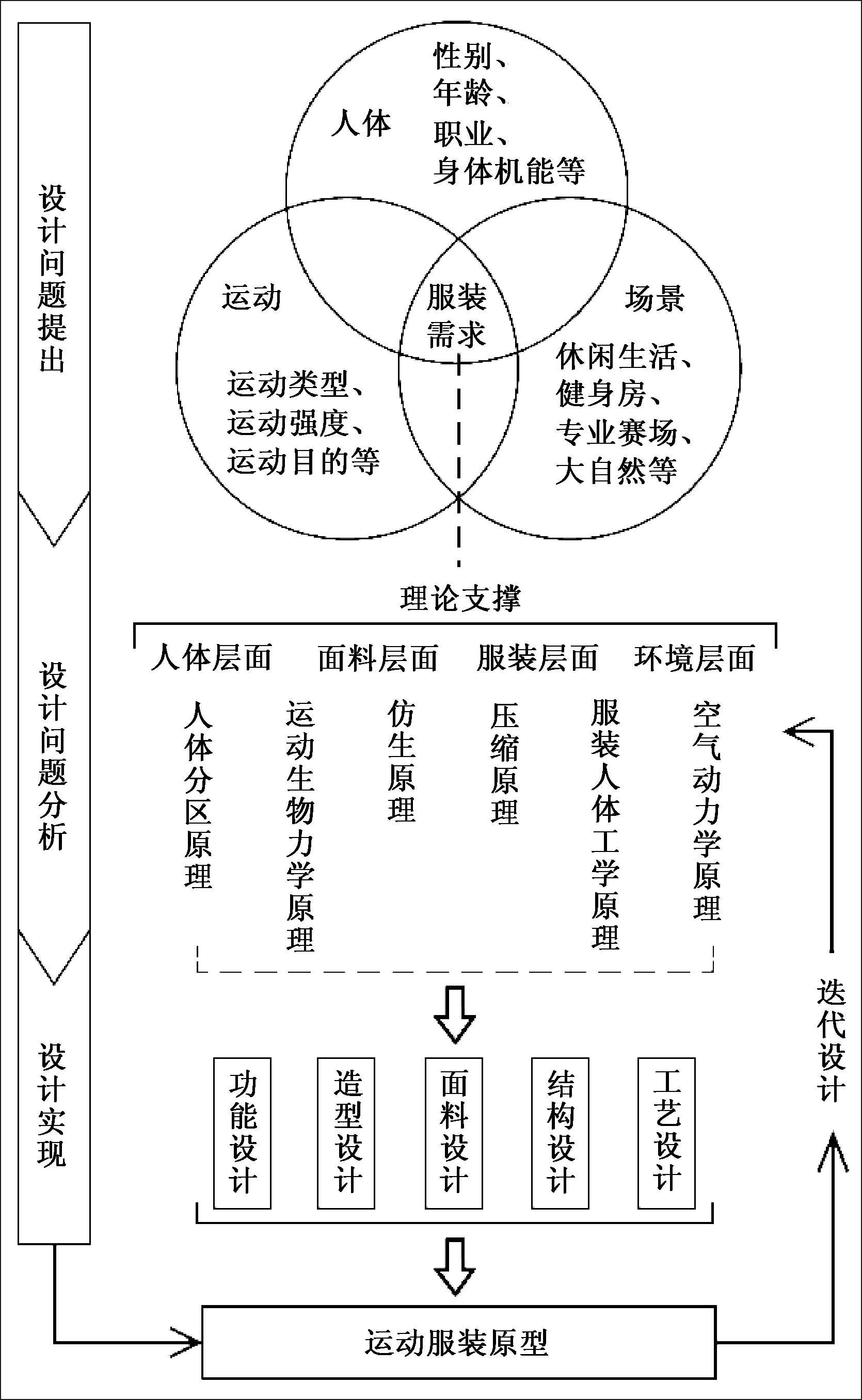
为明确运动服装设计的内在逻辑并科学指导运动服装研发,对国内外运动服装设计的相关研究进行回顾。首先,从运动场景角度归纳了运动服装的主要类型,从马斯洛需求层次角度归纳了用户对运动服装的需求;其次,从“人体-面料-服装-环境”4个层面梳理出指导运动服装设计的主要设计理论;然后,从功能设计、造型设计、面料设计、结构设计、工艺设计5个角度分析运动服装设计实现;最后,依据上述分析提出了“设计问题提出-设计问题分析-设计实现-设计原型-迭代设计”的一般运动服装设计方法。研究认为运动服装需求分析及背后科学理论的综合运用是运动服装设计的基础,面料、结构、工艺等要素的一体化设计是运动服装设计的关键,并指出多功能集成、多场景切换、智能化设计、绿色可持续是运动服装的未来发展方向。
中图分类号:
| [1] | SHISHOO R. Textiles for sportswear[M]. Cambridge: Woodhead Publishing, 2015: 3-117. |
| [2] | KUMAR B. Textiles for functional applications[M]. Rijeka: IntechOpen, 2021: 2-5. |
| [3] | 辛丽莎, 李俊, 王云仪. 防护服装功能设计模式研究[J]. 纺织学报, 2011, 32(11): 119-125. |
| XIN Lisha, LI Jun, WANG Yunyi. Research on functional design pattern of protective clothing[J]. Journal of Textile Research, 2011, 32(11): 119-125. | |
| [4] | 田苗, 李俊. 智能服装的设计模式与发展趋势[J]. 纺织学报, 2014, 35(2): 109-115. |
| TIAN Miao, LI Jun. Design mode and development tendency of smart clothing[J]. Journal of Textile Research, 2014, 35(2) : 109-115. | |
| [5] | 沈雷, 方东根, 童夏青. 安全性服装的设计模式[J]. 纺织学报, 2015, 36(5): 158-164. |
| SHEN Lei, FANG Donggen, TONG Xiaqing. Design process of security clothing[J]. Journal of Textile Research, 2015, 36(5): 158-164. | |
| [6] | HASSAN M, QASHQARY K, HASSAN H A, et al. Influence of sportswear fabric properties on the health and performance of athletes[J]. Fibres & Textiles in Eastern Europe, 2012, 93(4): 82-88. |
| [7] | DAMULURI R, BABEL S. Review of functional and protective clothing for sports[J]. The Pharma Innovation Journal, 2023, 12(2): 1887-1893. |
| [8] | 牛宏颐, 李晓英. 运动服装设计要素及其应用分析[J]. 针织工业, 2013, 41(8): 45-49. |
| NIU Hongyi, LI Xiaoying. Design element of sportswear and its application[J]. Knitting Industries, 2013, 41(8): 45-49. | |
| [9] | ZIEMELE I, ŠROMA I, KAKARĀNE A. Comfort in sportswear[J]. Key Engineering Materials, 2018, 762: 402-407. |
| [10] | LI Y. The science of clothing comfort[J]. Textile Progress, 2001, 31(1/2): 1-135. |
| [11] | CHOI J, HONG K. 3D skin length deformation of lower body during knee joint flexion for the practical application of functional sportswear[J]. Applied Ergonomics, 2015, 48(11): 186-201. |
| [12] | XIE N, MOK P Y. Investigation of full body skin surface variations under dynamic poses[J]. International Journal of Industrial Ergonomics, 2022, 87: 103237. DOI:10.1016/j.ergon.2021.103237. |
| [13] | XIAO B, HU Z, LIU Z, et al. A dynamic virtual try-on simulation framework for speed skating suits[J]. The Journal of The Textile Institute, 2023, 115(5): 713-723. |
| [14] | SMITH C, HAVENITH G. Body mapping of sweating patterns in male athletes in mild exercise-induced hyperthermia[J]. European Journal of Applied Physiology, 2010, 111(7): 1391-1404. |
| [15] | 刘程林, 郝卫亚, 霍波. 运动生物力学发展现状及挑战[J]. 力学进展, 2023, 53(1): 198-238. |
| LIU Chenglin, HAO Weiya, HUO Bo. Advances and challenges in sports biomechanics[J]. Advances in Mechanics, 2023, 53(1): 198-238. | |
| [16] | TEYEME Y, MALENGIER B, TESFAYE T, et al. A review of contemporary techniques for measuring ergonomic wear comfort of protective and sport clothing[J]. Autex Research Journal, 2020, 21(1): 32-44. |
| [17] | 汪世奎. 基于生物力学的跑步防护运动裤的研究[D]. 上海: 上海工程技术大学, 2015: 5-8. |
| WANG Shikui. Research on running protective sports trousers based on biomechanics[D]. Shanghai: Shanghai University of Engineering Science, 2015:5-8. | |
| [18] | LIANG W, CHI W, LIU C, et al. Large-scalable polar bear hair-like cellular hollow fibers with excellent thermal insulation and ductility[J]. Journal of Applied Polymer Science, 2022. DOI:10.1002/app.53018. |
| [19] | LI C, LIU X, MENG S, et al. Study on application and biosafety of nano-materials in sports engineering[C]// 2011 International Conference on Future Computer Science and Education. Xi'an: IEEE, 2011: 131-134. |
| [20] | CHEN Q, FAN J, SARKAR M, et al. Plant-based biomimetic branching structures in knitted fabrics for improved comfort-related properties[J]. Textile Research Journal, 2011, 81(10): 1039-1048. |
| [21] | XIONG Y, TAO X. Compression garments for medical therapy and sports[J]. Polymers, 2018. DOI: 10.3390/polym10060663. |
| [22] | MACRAE B, COTTER J, LAING R. Compressiongarments and exercise garment considerations, physiology and performance[J]. Sports Medicine, 2011, 41(10): 815-843. |
| [23] | WANG L, FELDER M, CAI J Y. Study of properties of medical compression fabrics[J]. Journal of Fiber Bioengineering & Informatics, 2011, 4(1): 15-22. |
| [24] | MAQSUDOV N, ERGASHEVA R. Analysis of requirements for threads and fabrics for the manufacture of compression sports products[J]. International Journal of Research in Science, 2018, 7(12): 687-689. |
| [25] |
MACINTYRE L, FERGUSON R. Pressure garment design tool to monitor exerted pressures[J]. Burns, 2013, 39(6): 1073-1082.
doi: 10.1016/j.burns.2013.05.012 pmid: 23790639 |
| [26] | GUPTA D. Functional clothing-definition and classification[J]. Indian Journal of Fibre and Textile Research, 2011, 36(4): 321-326. |
| [27] | WONG A S W, LI Y, ZHANG X. Influence of fabric mechanical property on clothing dynamic pressure distribution and pressure comfort on tight-fit sports-wear[J]. Sen-i Gakkaishi, 2004, 60(10): 293-299. |
| [28] | COLLINS P K, JOHNSON M D, HURST D W. Virtual and physical prototyping for compression sportswear[C] // 6th International Conference on Advanced Research in Virtual and Rapid Prototyping. Leiria: Taylor & Francis Group, 2014: 655-658. |
| [29] | LIN Y, CHOI K F, LUXIMON A, et al. Finite element modeling of male leg and sportswear: contact pressure and clothing deformation[J]. Textile Research Journal, 2011, 81(14): 1470-1476. |
| [30] | JIN Z, CHEN D, YANG Y. Research of effect of ergonomics on athletic shoes and costume design project[C]// International Conference on Education Technology, Management and Humanities Science (ETMHS 2015). Xi'an: Atlantis Press, 2015: 147-150. |
| [31] | FAN J, HUNTER L. Engineering apparel fabrics and garments[M]. Cambridge: Woodhead Publishing, 2009: 201-250. |
| [32] | PARRILLA E, BALLESTER A, PARRA F, et al. MOVE 4D: accurate high-speed 3D body models in motion[C] // 10th International Conference and Exhibition on 3D Body Scanning and Processing Technologies. Lugano: Hometrica Consulting, 2019: 30-32. |
| [33] | KYOSEV Y, TOMANOVA V, SCHMIDT A M. Method for automatic analysis of the clothing related body dimension changes during motion using high-speed (4D) body scanning[C]// 13th International Conference and Exhibition on 3D Body Scanning and Processing Technologies. Lugano: Hometrica Consulting, 2022. DOI: 10.15221/22.24. |
| [34] | 沈梦, 胡紫婷, 刘莉. 基于空气动力学的高山滑雪竞赛服减阻分析[J]. 冰雪运动, 2019, 41(4): 16-19,32. |
| SHEN Meng, HU Ziting, LIU Li. Analysis of drag reduction for alpine skiing competition based on aerodynamics[J]. China Winter Sports, 2019, 41(4): 16-19,32. | |
| [35] | CHOWDHURY H, ALAM F, MAINWARING D, et al. Rapid prototyping of high performance sportswear[J]. Procedia Engineering, 2012, 34: 38-43. |
| [36] | LUKES R A, CHIN S B, HAAKE S J. The understanding and development of cycling aero-dynamics[J]. Sports Engineering, 2005, 8(2): 59-74. |
| [37] | CHOWDHURY H, ALAM F, MAINWARING D. Aerodynamic study of ski jumping suits[J]. Procedia Engineering, 2011, 13: 376-381. |
| [38] | HONG S, ASAI T. Aerodynamics of cycling skinsuits focused on the surface shape of the arms[J]. Applied Sciences, 2021. DOI: 10.3390/app11052200. |
| [39] | KOGA H, HIRATSUKA M, ITO S, et al. Aerodynamic characteristics and heat radiation performance of sportswear fabrics[J]. IOP Conference Series: Materials Science and Engineering, 2017. DOI: 10.1088/1757-899X/249/1/012020. |
| [40] | DI DOMENICO I, HOFFMANN S M, COLLINS P K. The role of sports clothing in thermoregulation, comfort, and performance during exercise in the heat: a narrative review[J]. Sports Medicine, 2022, 8(58): 1-25. |
| [41] | WANG W, HONGLIAN C, DONG Z, et al. Digital design model for weft-knitted seamless yoga pants based on skin deformation[J]. Journal of Engineered Fibers and Fabrics, 2021, 16(2): 1-9. |
| [42] | GOLDSCHMIED N, FURLEY P, BUSH R. Critical review of uniform color effects in sports[J]. International Review of Sport and Exercise Psychology, 2020, 16(6): 311-336. |
| [43] | WEI H T, CHAN W S, CHOW D H K. Systematic review of selecting comfortable sportswear: predicting wearing comfort based on physiological responses and materials properties[J]. Textile Research Journal, 2023, 93(15/16): 3926-3941. |
| [44] | HU J L, IQBAL M I, SUN F X. Wool can be cool: water-actuating woolen knitwear for both hot and cold[J]. Advanced Functional Materials, 2020. DOI:10.1002/adfm.202005033. |
| [45] | LAO L, BAI H, FAN J. Water responsive fabrics with artificial leaf stomata[J]. Advanced Fiber Materials, 2023, 5(3): 1076-1087. |
| [46] | ATALIE D, TESINOVA P, TADESSE M, et al. Thermo-physiological comfort properties of sportswear with different combination of inner and outer layers[J]. Materials, 2021. DOI:10.3390/ma14226863. |
| [47] | WANG Y, ZHANG P. The effect of physical-mechanical properties on dynamic pressure of compression garment[J]. International Journal of Clothing Science and Technology, 2013, 25(2): 131-144. |
| [48] | TROYNIKOV O, WARDININGSIH W, KOPTUG A, et al. Influence of material properties and garment composition on pressure generated by sport compression garments[J]. Procedia Engineering, 2013, 60: 157-162. |
| [49] | JOVANOVIC T, PENAVA Z, VRLJIČAK Z. Impact of the elastane percentage on the elastic properties of knitted fabrics under cyclic loading[J]. Materials, 2022. DOI:10.3390/ma15196512. |
| [50] | CHANG Y, WANG X. Sweat and odor in sportswear: a review[J]. iScience, 2023. DOI: 10.1016/j.isci.2023.107067. |
| [51] |
HU X, TIAN M, XU T, et al. Multiscale disordered porous fibers for self-sensing and self-cooling integrated smart sportswear[J]. Acs Nano, 2020, 14(1): 559-567.
doi: 10.1021/acsnano.9b06899 pmid: 31855404 |
| [52] | RAZA T, TUFAIL M K, ALI A, et al. Wearable and flexible multifunctional sensor based on laser-induced graphene for the sports monitoring system[J]. Acs Applied Materials & Interfaces, 2022, 14(48): 54170-54181. |
| [53] | RAMLOW H, ANDRADE K, IMMICH A. Smart textiles: an overview of recent progress on chromic textiles[J]. The Journal of The Textile Institute, 2021, 112(1): 152-171. |
| [54] | KANG T, MA W, GUO Y, et al. Multi-weather full-body triboelectric garments for personalized moisture management and water energy acquisition[J]. Nano Energy, 2023. DOI:10.2139/ssrn.4340708. |
| [55] | ZOU Y, TAN P, SHI B, et al. A bionic stretchable nanogenerator for underwater sensing and energy harvesting[J]. Nature Communications, 2019. DOI: 10.1038/s41467-019-10433-4. |
| [56] | HONG S, GU Y, SEO J K, et al. Wearable thermoelectrics for personalized thermoregulation[J]. Science Advance, 2019. DOI:10.2139/ssrn.4340708. |
| [57] | WANG X, WAN A, ZENG D, et al. Design and properties of shape memory sports bras for comfortable pressure based on ergonomics[J]. Textile Research Journal, 2023, 93(23/24): 5461-5474. |
| [58] | WANG W, WANG S, ZHOU J, et al. Bio-inspired semi-active safeguarding design with enhanced impact resistance via shape memory effect[J]. Advanced Functional Materials, 2023. DOI:10.1126/sciadv.aaw0536. |
| [59] | SHISHOO R. Textiles in sport[M]. Cambridge: Woodhead Publishing, 2005: 25-43. |
| [60] | LINDQVIST R, THORNQUIST C. Enhanced construction technology for ergonomic clothing : a new approximation of the body and system for garment construction[C]// Ambience14. Tampere: IOS Press, 2014: 7-9. |
| [61] | SAJJADI A, HOSSEINI S A, AJELI S, et al. Multiscale finite element modeling of the viscoelastic behavior of sportswear under periodic load[J]. Clothing and Textiles Research Journal, 2020, 40(2): 107-122. |
| [62] | BEAUDETTE E, PARK H. Impact of seam types on thermal properties of athletic bodywear[J]. Textile Research Journal, 2016, 87(9): 1052-1059. |
| [63] | MAANVIZHI M C P, RAMESHBABU V. Effect of stitch density and stitch type on the moisture management properties of seams for high active sportswear application[J]. Fibres and Textiles in Eastern Europe, 2020, 28(6): 72-78. |
| [64] | 刘思寒, 许君, 马大力, 等. 服装焊接工艺的关键技术及在服装领域应用进展[J]. 纺织导报, 2020, 39(4): 76-79. |
| LIU Sihan, XU Jun, MA Dali, et al. Key technology of fusible process and its application in garments[J]. China Textile Leader, 2020, 39(4): 76-79. |
| [1] | 周莉, 樊培宏, 金玉婷, 张龙琳, 李新荣. 服装逆向造型的数字化设计方法[J]. 纺织学报, 2023, 44(12): 138-144. |
| [2] | 杨钰蝶, 李承璋, 金剑, 郑晶晶. 基于上肢活动性的灭火防护服背带的设计与评价[J]. 纺织学报, 2023, 44(11): 183-189. |
| [3] | 刘咏梅, 刘思忆, 于晓坤, 薛惠心, 张向辉. 中国东部地区中老年女性体型特征与分类[J]. 纺织学报, 2023, 44(07): 184-191. |
| [4] | 张龙琳, 石茜, 张敏, 周莉, 李新荣. 基于跑步动作肌纤维主动力仿真的下肢皮肤形变表征[J]. 纺织学报, 2023, 44(03): 195-200. |
| [5] | 陈佳, 杨聪聪, 刘军平, 何儒汉, 梁金星. 手绘草图到服装图像的跨域生成[J]. 纺织学报, 2023, 44(01): 171-178. |
| [6] | 王迪, 柯莹, 王宏付. Voronoi图形在参数化服装造型构建中的应用[J]. 纺织学报, 2021, 42(12): 131-137. |
| [7] | 金鹏, 薛哲彬, 江润恬, 刘丹宇, 张弛. 具有安全防护功能的智能盲人服设计[J]. 纺织学报, 2021, 42(08): 135-143. |
| [8] | 唐茜, 张冰冰, 郑笑雨. 婴幼儿可穿戴智能监测服装设计[J]. 纺织学报, 2021, 42(08): 156-160. |
| [9] | 徐增波, 张玲, 张艳红, 陈桂清. 基于复杂网络提取和支持向量机模型分类的服装领型研究[J]. 纺织学报, 2021, 42(06): 146-152. |
| [10] | 张恒. 基于翻领松量结构模型的翻折领结构设计方法[J]. 纺织学报, 2020, 41(11): 128-135. |
| [11] | 孙岑文捷, 倪军, 张昭华, 董婉婷. 针织运动服的通风设计与热湿舒适性评价[J]. 纺织学报, 2020, 41(11): 122-127. |
| [12] | 杨娟, 张远鹏. 服装设计知识图谱中的服装装饰工艺分类模型[J]. 纺织学报, 2020, 41(08): 95-100. |
| [13] | 刘佟. 基于人体曲面变化的服装几何空间设计[J]. 纺织学报, 2019, 40(11): 155-160. |
| [14] | 刘海桑, 董智佳, 张琦, 夏风林, 丛洪莲. 经编全成形运动套装的尺寸预测与建模[J]. 纺织学报, 2019, 40(02): 76-81. |
| [15] | 陈雁. 服装设计与工程学科发展趋势与关键议题[J]. 纺织学报, 2019, 40(01): 182-188. |
|
||
 京公网安备11010502044800号