纺织学报 ›› 2025, Vol. 46 ›› Issue (09): 128-135.doi: 10.13475/j.fzxb.20241000801

• 纺织工程 • 上一篇    下一篇

双经四纬提花结构双纬渐变显色模型构建及其显色特征

陆爽怿1,2, 王澜1,2, 陈思1,2, 周赳1,2()   

  1. 1.浙江理工大学 浙江省丝绸与时尚文化研究中心, 浙江 杭州 310018
    2.浙江理工大学嵊州创新研究院, 浙江 绍兴 312400
  • 收稿日期:2024-10-09 修回日期:2025-05-30 出版日期:2025-09-15 发布日期:2025-11-12
  • 通讯作者: 周赳(1969—),男,教授,博士。主要研究方向为纺织品设计、数智时尚。E-mail:zhoujiu34@126.com
  • 作者简介:陆爽怿(1996—),男,博士生。主要研究方向为数码纺织品设计。
  • 基金资助:
    国家社科基金艺术学项目(22BG121)

Construction and color rendering characteristics of jacquard structure model with double warps and quadruple wefts for double-weft color gradation

LU Shuangyi1,2, WANG Lan1,2, CHEN Si1,2, ZHOU Jiu1,2()   

  1. 1. Silk and Fashion Research Center of Zhejiang Province, Zhejiang Sci-Tech University, Hangzhou, Zhejiang 310018, China
    2. Zhejiang Sci-Tech University Shengzhou Innovation Research Institute, Shaoxing, Zhejiang 312400, China
  • Received:2024-10-09 Revised:2025-05-30 Published:2025-09-15 Online:2025-11-12

摘要: 针对双经四纬提花结构模型的双纬渐变显色特征未被掌握的问题,使用红、黄、绿、蓝、黑、白六原色纱线构建了2组无彩色经与4组有彩色纬形成的双经四纬提花结构双纬渐变显色模型,任一结构模型含12种结构显色类型。通过引入双层结构,为8个经纬交织位置配置规范化的经纬浮沉规律,实现织物表里层经纬的自主调控,利用影光与全显色表层显色组织构建织物表层,并从中选择里层背衬组织构建织物里层,讨论连接与分离二类表里层关系,最终通过织物模拟分析验证结构显色特征。结果表明:双经四纬提花结构双纬渐变显色模型的表层在分别使用影光组织库及任一对全显色组织库时,能实现超1032级与1022级双纬渐变显色组合组织数,试样表层使用全显色组织较使用影光组织形成的提花交织结构相邻显色纬间遮盖特征稳定,利于实现稳定结构显色。

关键词: 织物设计, 数码提花, 双经四纬, 织物结构, 双纬渐变显色, 结构显色, 配色设计

Abstract:

Objective Towards full understanding of characteristics of jacquard woven fabrics with double warps and quadruple wefts for double-weft color gradation, construction of jacquard woven fabric models are proposed involving six primary color threads (red, yellow, green, blue, black, and white), with a double-layer structure which enables independent regulation over the coloring and the backing warp and weft threads. Five key factors are taking into consideration in the development and calculation of double-weft color gradation compound weaves for color expression, namely the weave repeat number N, the step number S, the quantity of its available value ${Q}_{{S}_{N}}$QSN, the transition speed M, and the quantity of available interlacing for stitching at the stitching positions QIS. This research aims to provide insights for the color space construction and jacquard structure modeling with double warps and quadruple wefts for double-weft color gradation.

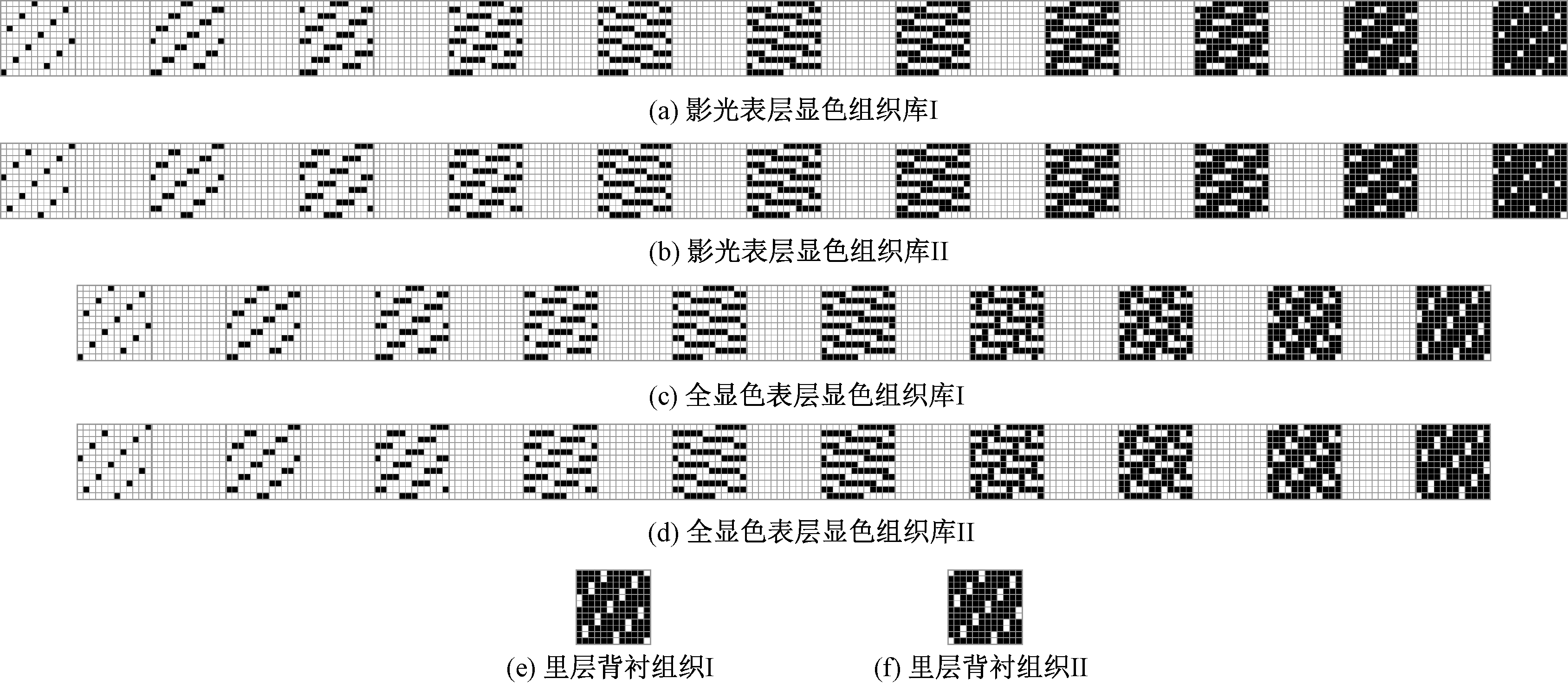
Method In order to construct the fabric model, 2 sets of achromatic threads and 4 sets of chromatic threads were placed in the warp and weft configuration, and the face and back weaves, as well as the relationship between the face and back layers were arranged to form double-weft color gradation compound weaves with their quantities calculated. Eventually, 12-thread 7-step sateen was selected as basic weave for shaded face weave-database and full-color face weave-database establishment. Double-weft color gradation compound weaves for validation were employed for the EAT sample simulation, enabling comparison and analysis of the structural coloring characteristics of jacquard structure with double warps and quadruple wefts for double-weft color gradation according to technique parameters given.

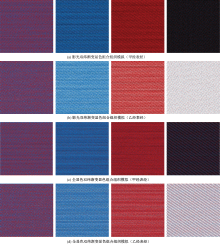
Results 720 varieties of jacquard structure model were found available with double warps and quadruple wefts based on six primary color threads. 3 warp and weft color configurations were formed according to the arrangement of achromatic and chromatic warp and weft threads, generaing 8 types of warp and weft color configuration on the face layer, and maximizing the structural coloring space, 2 sets achromatic warp and 4 sets chromatic weft were employed to the construction of jacquard structure model with double warps and quadruple wefts for double-weft color gradation. Further, 12 structural coloring series of jacquard structure model with double warps and quadruple wefts on double-weft gradation were formed under the interlacement of single achromatic warp and double chromatic weft. The maximum quantity of compound weaves applying shaded weaves is $12\times {Q}_{S{W}_{M=1}}^{4}\times [1+4({2}^{N}-1)+4({2}^{N}{-1)}^{2}]$12×QSWM=14×[1+4(2N-1)+4(2N-1)2], while that employing full-color face weaves is $12\times {2}^{4{N}^{2}-8N}\times [1+4({2}^{N}-1)+4({2}^{N}{-1)}^{2}],$12×24N2-8N×[1+4(2N-1)+4(2N-1)2], then more than 1.565×1032 and over 5.491×10²² double-weft color gradation compound weaves were obtained when weave repeat N equals to 5, and transition speed M equals to 1, respectively. Sample simulation of double-weft color gradation compound weaves were used for validation, on one hand, with the application of double-layer structure, face layer covers back layer completely, and thread interchanging within the structure makes it possible for double layer to connect without self-stitching, on the other hand, both juxtaposition and covering features expressed within the adjacent two wefts of the compound shaded weaves, while any adjacent two wefts of the compound full-color weaves juxtapose permanently, it is reducing the slippage of adjacent threads that is beneficial to the stabilization of woven structure, what's more, obvious oblique texture occurred on the sample surface because of the influence of start point and step number S of basic weave, configuration ratio of face wefts as well as lightness variation of warp and weft.

Conclusion In jacquard structure model with double warps and quadruple wefts for double-weft gradation, the application of full-color face weave-databases regulates the status of the adjacent face wefts within double-weft color gradation compound weaves, conducing to the stability of structural coloring, when weave repeat N to take the minimum value, the maximum quantity of double-weft gradation compound weaves reaches 1032 and 1022 when shaded face weave-database and full-color face weave-database are implemented respectively. What's more, the employment of full-color technical points is conductive to the juxtaposition of face wefts, thus, this study contributes to the structural coloring space construction and optimization of jacquard structure model with double warps and quadruple wefts for double-weft color gradation.

Key words: fabric design, digital jacquard, double warps and quadruple wefts, fabric structure, double-weft color gradation, structural coloring, color scheme

中图分类号: 

  • TS105.1

表1

双经四纬提花结构双纬渐变显色模型经纬色彩配置"

经纬色彩
配置类型
数量 表层显色经纬
色彩配置类型
经配置 纬配置 经配置 纬配置
无彩色
2组
有彩色
4组
${A}_{2}^{2}\times {A}_{4}^{4}=48$ 无彩色
1组
有彩色
2组
无彩
色1组
有彩
色1组
无彩
色1组
有彩
色3组
${A}_{2}^{2}{C}_{2}^{1}{C}_{4}^{1}$×
${A}_{4}^{4}$=384
无彩色1组 无彩色1组、
有彩色1组
无彩色1组 有彩色2组
有彩色1组 无彩色1组、
有彩色1组
有彩色1组 有彩色2组
有彩
色2组
无彩
色2组
有彩色
2组
${A}_{4}^{2}$×${A}_{4}^{4}$=288 有彩色1组 无彩色2组
有彩色1组 无彩色1组、
有彩色1组
有彩色1组 有彩色2组

表2

双经四纬提花结构双纬渐变显色结构类型"

双纬渐变显色
结构类型

表纬
里纬
I

J1
甲纬W1、乙纬W2

J2
丙纬W3、丁纬W4
II 甲纬W1、丙纬W3 乙纬W2、丁纬W4
III 甲纬W1、丁纬W4 乙纬W2、丙纬W3
IV 乙纬W2、丙纬W3 甲纬W1、丁纬W4
V 乙纬W2、丁纬W4 甲纬W1、丙纬W3
VI 丙纬W3、丁纬W4 甲纬W1、乙纬W2
VII

J2
甲纬W1、乙纬W2

J1
丙纬W3、丁纬W4
VIII 甲纬W1、丙纬W3 乙纬W2、丁纬W4
IX 甲纬W1、丁纬W4 乙纬W2、丙纬W3
X 乙纬W2、丙纬W3 甲纬W1、丁纬W4
XI 乙纬W2、丁纬W4 甲纬W1、丙纬W3
XII 丙纬W3、丁纬W4 甲纬W1、乙纬W2

表3

接结位置经纬浮沉规律配置种类及其数目"

配置经纬浮沉规律的
接结位置数目
接结位置的经纬浮沉规律可选数目
0 1
1 ${C}_{2}^{1}\times {Q}_{BWS}=4({2}^{N}-1)$
2 ${Q}_{BWS}^{2}=4({2}^{N}{-1)}^{2}$

图1

12枚7飞缎纹表层显色组织库与里层背衬组织示意"

图2

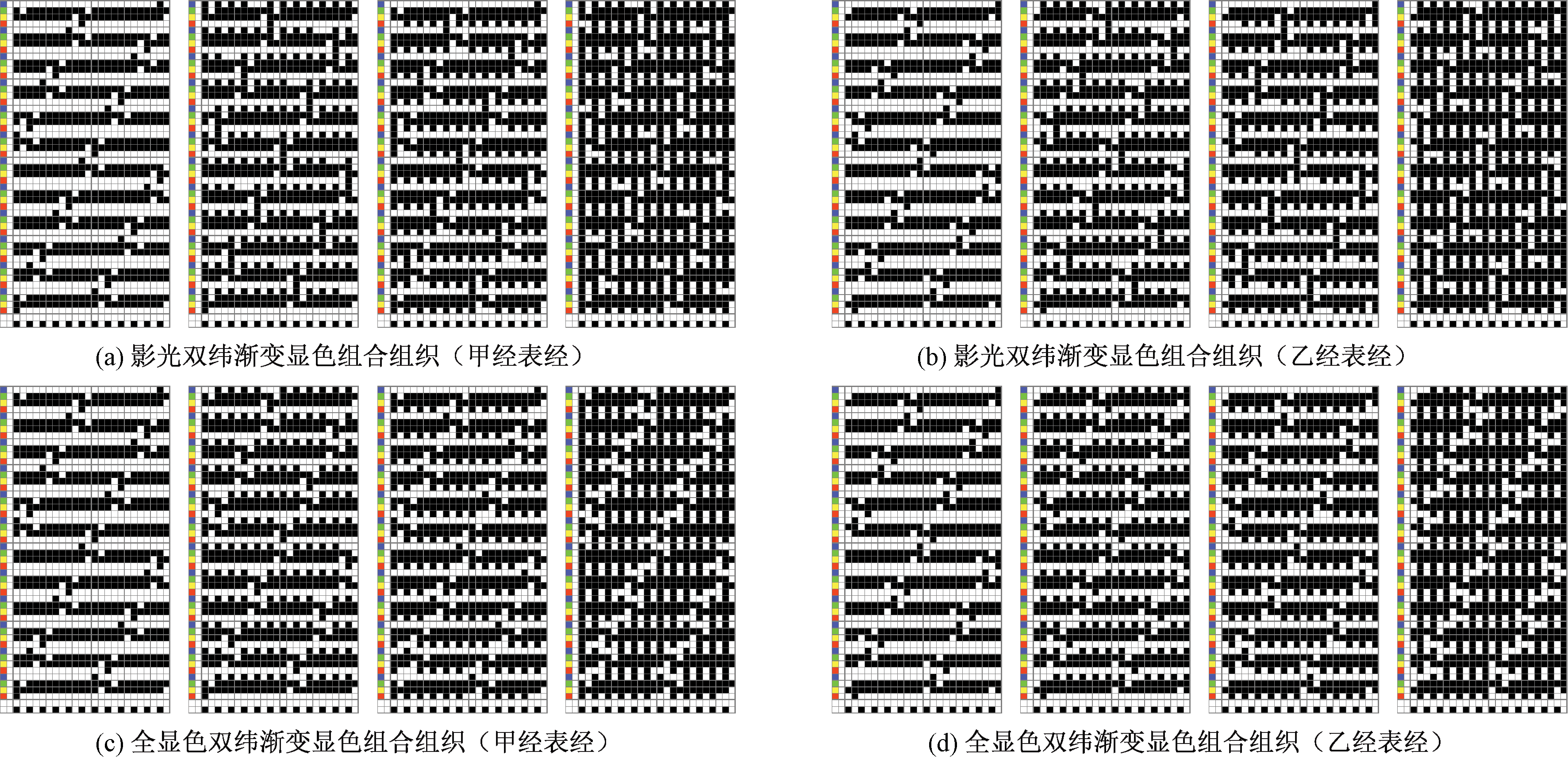
双纬渐变显色组合组织验证"

表4

EAT织物模拟技术参数"

类别 线密度/
dtex
纱线类名 纱线色彩(排列比) 总密度/
(根·(10 cm) -1)
经纬浮沉规律
经纱 55.55 EAT标准长丝 黑色∶白色(1∶1) 1 180 12枚影光表层显色组织、12枚全显色
表层显色组织、经浮长、纬浮长
纬纱 83.33 EAT标准长丝 红色∶黄色∶绿色∶蓝色(1∶1∶1∶1) 1 180

图3

双纬渐变显色组合组织模拟效果"

[1] 李加林, 陶永政. 数码仿真彩色丝织技术及其应用[J]. 纺织学报, 2004, 25(1): 123-125, 6.
LI Jialin, TAO Yongzheng. Digital emulative color silk weaving technique and application[J]. Journal of Textile Research, 2004, 25(1): 123-125, 6.
[2] 周赳, 龚素娣. 电子提花彩色像景织物的设计原理[J]. 丝绸, 2001(9): 31-33, 37.
ZHOU Jiu, GONG Sudi. The design principle of colorful woven photograph in electronic Jacquard[J]. Journal of Silk, 2001(9): 31-33, 37.
[3] SPEICH Francisco. Method of manufacturing colored patterned, aerial textile structures, system for carrying out the method and aerial textile structure formed in accordance with the method: USA, US 6,390,143[P]. 2002-05-21.
[4] 罗炳金. 棉织锦3种色彩组织模型设计与应用[J]. 纺织学报, 2012, 33(7): 39-44.
LUO Bingjin. Design and application of three models of color figured patterns for woven cotton brocade[J]. Journal of Textile Research, 2012, 33(7): 39-44.
[5] 周赳, 陆爽怿. 数码提花织物分层组合设计原理及其实践[J]. 纺织学报, 2020, 41(2): 58-63.
ZHOU Jiu, LU Shuangyi. Design principal and practice of layered-combination mode[J]. Journal of Textile Research, 2020, 41(2): 58-63.
[6] 周赳, 段丽娜, 屠永坚. 双经双纬渐变显色提花织物设计原理与方法[J]. 纺织学报, 2016, 37(6): 36-41, 47.
ZHOU Jiu, DUAN Lina, TU Yongjian. Design principle and method of color gradient expression on double-warp double-weft jacquard fabric[J]. Journal of Textile Research, 2016, 37(6): 36-41, 47.
[7] 刘志娟. 双经三纬渐变显色提花织物设计研究与实践[D]. 杭州: 浙江理工大学, 2020: 6-45.
LIU Zhijuan. Design research and practice of color gradient effect jacquard fabric with double-warps and three-wefts[D]. Hangzhou: Zhejiang Sci-Tech University, 2020: 6-45.
[8] 张爱丹, 周赳. 一纬全显织物结构设计要素与其显色规律的关系[J]. 纺织学报, 2017, 38(9): 40-44.
ZHANG Aidan, ZHOU Jiu. Relationship between design elements and color rendering law of one-weft shaded weaves[J]. Journal of Textile Research, 2017, 38(9): 40-44.
[9] 陆爽怿, 周赳. 基于双向多基色的全色域提花结构模型构建[J]. 纺织学报, 2024, 45(11): 89-99.
LU Shuangyi, ZHOU Jiu. Construction of Jacquard structure model with full gamut color spaces based on bidirectional multi-primary color[J]. Journal of Textile Research, 2024, 45(11): 88-98.
doi: 10.13475/j.fzxb.20231100301
[10] 周赳, 陆爽怿. 一种双经四纬提花织物的单纬渐变显色织造方法: 202211038913.3[P]. 2024-01-30.
ZHOU Jiu, LU Shuangyi. Method of weaving double warps and quadruple wefts on single-weft color gradation Jacquard fabric: 202211038913.3[P]. 2024-01-30.
[1] 陆爽怿, 陈思, 周赳. 双经四纬单纬渐变显色提花结构成形及其呈色特征[J]. 纺织学报, 2025, 46(08): 96-101.
[2] 张爱丹, 王倩. 三纬组合全显结构织物的颜色预测方法[J]. 纺织学报, 2025, 46(05): 151-158.
[3] 陆爽怿, 周赳. 基于双向多基色的全色域提花结构模型构建[J]. 纺织学报, 2024, 45(11): 88-98.
[4] 穆秀萍, 蒋高明, 陈钰珊, 李炳贤. 纬编多针道织物数字化设计方法[J]. 纺织学报, 2024, 45(11): 106-113.
[5] 姜绍华, 梁帅童, 裴刘军, 张红娟, 王际平. 基于概率密度函数的织物染色侵入动力学分析[J]. 纺织学报, 2023, 44(10): 90-97.
[6] 尹昂, 丛洪莲. 经编单向导湿织物设计与结构优化[J]. 纺织学报, 2023, 44(04): 86-91.
[7] 方镁淇, 王茜, 李彦, 李超婧, 黎昊, 王璐. 女性压力性尿失禁吊带的设计及其体外力学性能评价[J]. 纺织学报, 2022, 43(03): 38-43.
[8] 张萌, 周赳. 附加纬接结的双层全显色结构设计原理和方法[J]. 纺织学报, 2022, 43(03): 83-88.
[9] 彭稀, 屠永坚, 周赳. 纬排2比1纬二重渐变显色结构设计原理与方法[J]. 纺织学报, 2021, 42(12): 63-69.
[10] 黄锦波, 祝成炎, 张红霞, 洪兴华, 周志芳. 基于剑杆织机改造的三维间隔机织物工艺设计[J]. 纺织学报, 2021, 42(06): 166-170.
[11] 孟灵灵, 魏取福, 严忠杰, 仲珍珍, 王小慧, 沈佳宇, 陈洪炜. 磁控溅射Ag/ZnO纳米薄膜涤纶织物的制备及其性能[J]. 纺织学报, 2021, 42(03): 143-148.
[12] 吕庆涛, 赵世波, 杜培健, 陈利. 树脂基纺织复合材料疲劳性能表征与分析方法研究现状[J]. 纺织学报, 2021, 42(01): 181-189.
[13] 金诗怡, 周赳. 具有双层效果的提花-印花-剪花织物的设计[J]. 纺织学报, 2020, 41(06): 48-54.
[14] 李聃阳, 王瑞, 刘星, 张淑洁, 夏兆鹏, 阎若思, 代二庆. 剪切增稠液对不同结构芳纶织物防刺性能的影响[J]. 纺织学报, 2020, 41(03): 106-112.
[15] 孙婷, 吕智宁, 李艳清, 祝成炎, 田伟. 立体几何褶皱织物的成型与织造[J]. 纺织学报, 2020, 41(02): 64-68.
Viewed
Full text


Abstract

Cited

  Shared   
  Discussed   
No Suggested Reading articles found!