纺织学报 ›› 2025, Vol. 46 ›› Issue (09): 84-93.doi: 10.13475/j.fzxb.20241106601
王泓力1,2, 张辉1,2( ), 刘建宇1,2, 尉海泽1,2, 张雅宁3, 王丽丽3, 许学潮4
WANG Hongli1,2, ZHANG Hui1,2(), LIU Jianyu1,2, YU Haize1,2, ZHANG Yaning3, WANG Lili3, XU Xuechao4
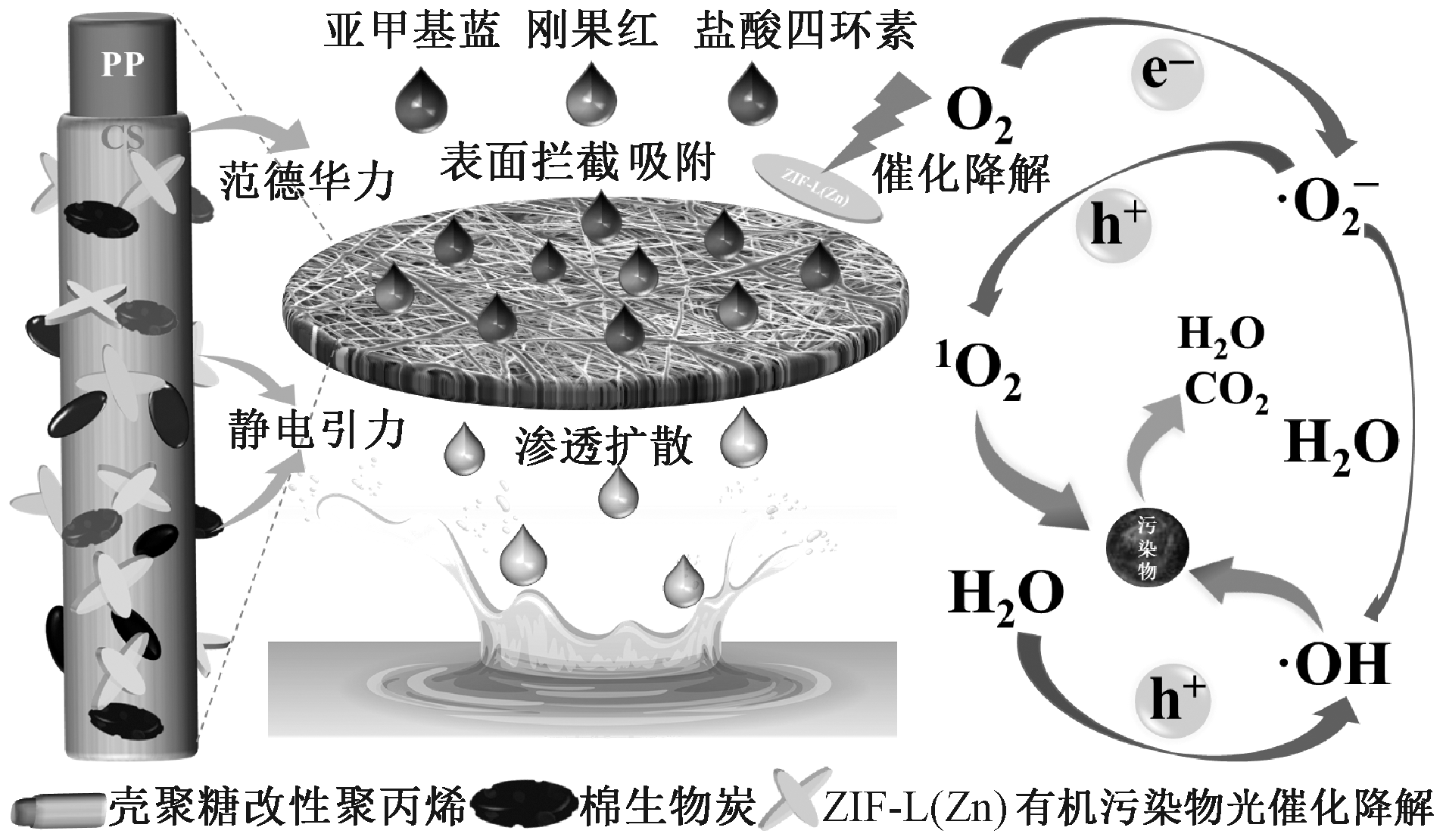
摘要: 为提高聚丙烯非织造布的亲水性和污染物去除性能,用于废水中染料和抗生素的去除,以废弃落棉为原料,经煅烧制得具有多孔结构的棉基生物炭(CB),并与二维ZIF-L(Zn)复合,制备出兼具吸附和光催化性能的CB-ZIF-L(Zn)复合粉。通过喷涂技术将该复合粉负载于壳聚糖改性的聚丙烯(CSP)非织造布表面,制得CB-ZIF-L(Zn)-CSP复合膜。采用扫描电子显微镜、X射线衍射、傅里叶变换红外光谱、拉曼光谱及热重分析对膜的微观形貌、结构组成及热稳定性进行表征,并测试其孔径分布和过滤性能。结果表明:CB与ZIF-L(Zn)前驱体的反应顺序对复合粉的结构和性能有显著影响;当CB与ZIF-L(Zn)的质量比为1∶1时,复合粉表现出最优的吸附性能和光催化活性,在可见光照射下循环使用4次,对刚果红(CR)的降解率达87.9%;通过调控模压压力和膜层数,膜的过滤通量和截留性能可实现优化调控;50 MPa模压条件下制备的5层复合膜,在15 L/h泵速下对CR的截留率达100%,重复使用5次后仍保持良好性能。此外,该复合膜对亚甲基蓝(MB)和四环素(TC)同样具有良好的去除效果。CB-ZIF-L(Zn)-CSP复合膜具有优异的污染物去除能力和光催化再生性能,在高效、可持续的废水处理领域展现出广阔应用前景。
中图分类号:
| [1] |
KIYAK Y, MAZE B, POURDEYHIMI B, et al. Microfiber nonwovens as potential membranes[J]. Separation and Purification Reviews, 2019, 48: 282-297.
doi: 10.1080/15422119.2018.1479968 |
| [2] |
CHANG W K, HU A Y J, HORNG R Y, et al. Membrane bioreactor with nonwoven fabrics as solid-liquid separation media for wastewater treatment[J]. Desalination, 2007, 202: 122-128.
doi: 10.1016/j.desal.2005.12.047 |
| [3] |
YAGOUB H, ZHU L P, SHIBRAEN M H M A, et al. Manipulating the surface wettability of polysaccharide based complex membrane for oil/water separation[J]. Carbohydrate Polymers, 2019, 225: 115231.
doi: 10.1016/j.carbpol.2019.115231 |
| [4] |
LI C, MA H Y, VENKATESWARAN S, et al. Highly efficient and sustainable carboxylated cellulose filters for removal of cationic dyes/heavy metals ions[J]. Chemical Engineering Journal, 2020, 389: 123458.
doi: 10.1016/j.cej.2019.123458 |
| [5] |
JALVO B, AGUILAR-SANCHEZ A, RUIZ-CALDAS M X, et al. Water filtration membranes based on non-woven cellulose fabrics: effect of nanopolysaccharide coatings on selective particle rejection, antifouling, and antibacterial properties[J]. Nanomaterials, 2021, 11: 1752.
doi: 10.3390/nano11071752 |
| [6] |
WANG X H, LI W, JIANG H X, et al. Heteropore covalent organic framework-based composite membrane prepared by in situ growth on non-woven fabric for sample pretreatment of food non-targeted analysis[J]. Microchimica Acta, 2021, 188: 235.
doi: 10.1007/s00604-021-04889-9 |
| [7] |
XU L J, ZHAO K Y, MIAO J P, et al. High-strength and anti-bacterial BSA/carboxymethyl chitosan/silver nanoparticles/calcium alginate composite hydrogel membrane for efficient dye/salt separation[J]. International Journal of Biological Macromolecules, 2022, 220: 267-279.
doi: 10.1016/j.ijbiomac.2022.08.096 pmid: 35985394 |
| [8] |
ABDULLAH W N A S, NAWI N S M, LAU W J, et al. Enhancing physiochemical substrate properties of thin-film composite membranes for water and wastewater treatment via engineered osmosis process[J]. Polymers, 2023, 15: 1665.
doi: 10.3390/polym15071665 |
| [9] |
YU H, CAI D J, LI S Y, et al. Tight UF membranes with ultrahigh water flux prepared by in-situ growing ZIF particles in NIPS process for greatly enhanced dye removal efficiency[J]. Journal of Membrane Science, 2023, 666: 121136.
doi: 10.1016/j.memsci.2022.121136 |
| [10] |
HAMI S S B M, AFFANDI N D N, INDRIE L, et al. Removal of Remazol Red dyes using zeolites-loaded nanofibre coated on fabric substrates[J]. Coatings, 2024, 14: 1155.
doi: 10.3390/coatings14091155 |
| [11] |
SHI L, LIU J D, GAO B, et al. Photoelectrocatalytic mechanism of PEDOT modified filtration membrane[J]. Science of the Total Environment, 2021, 813: 152397.
doi: 10.1016/j.scitotenv.2021.152397 |
| [12] |
ZHANG Y N, ZHANG H, YAO J L, et al. Pore-variable, layered-combination, and recyclable polypropylene matrix filtration membrane containing cotton-FeMoO4-ZIF-L(Co) (C-F-Z) composites for highly efficient removal of organic pollutants from wastewater[J]. Chemical Engineering Journal, 2024, 495: 153700.
doi: 10.1016/j.cej.2024.153700 |
| [13] |
ZHANG S J, MAO Y P, WEI L, et al. Full-value preparation of biochar and 2D N-doped CDs@ZIF-L from fermentation residues for sensitive sensing tetracyclines in food samples[J]. Colloids and Surfaces A: Physicochemical and Engineering Aspects, 2023, 676: 132073.
doi: 10.1016/j.colsurfa.2023.132073 |
| [14] |
HE J, ZHANG R, CHEN D, et al. Self-cleaning of metal-organic framework membranes achieved by photocatalytic ZIFs for dye and antibiotic separation[J]. Journal of Environmental Chemical Engineering, 2024, 12: 113363.
doi: 10.1016/j.jece.2024.113363 |
| [15] |
BAIG U, FAIZAN M, WAHEED A, et al. A review on super-wettable porous membranes and materials based on bio-polymeric chitosan for oil-water separation[J]. Advances in Colloid and Interface Science, 2022, 303: 102635.
doi: 10.1016/j.cis.2022.102635 |
| [16] |
ZHANG N, ZHANG H, YAO J L, et al. Coordination tuning of Fe2+ ions concentration in Fe-doped black phosphorus-carbonized cotton fiber (Fe-BP-CCF) composites to regulate photocatalysis and peroxymonosulfate (PMS) activation towards highly efficient degradation of organic pollutants[J]. Chemical Engineering Journal, 2024, 483: 149326.
doi: 10.1016/j.cej.2024.149326 |
| [17] |
KUAN J L, ZHANG H, GU H S, et al. Adsorption-enhanced photocatalytic property of Ag-doped biochar/g-C3N4/TiO2 composite by incorporating cotton-based biochar[J]. Nanotechnology, 2022, 33(34): 345402.
doi: 10.1088/1361-6528/ac705e |
| [18] |
HEN R Z, YAO J F, GU Q F, et al. A two-dimensional zeolitic imidazolate framework with a cushion-shaped cavity for CO2 adsorption.[J]. Chemical Communications, 2013, 49(82): 9500-9502.
doi: 10.1039/c3cc44342f |
| [19] | HERNANDEZ-AGUIRRE O A, NUNEZ-PINEDA A, TAPIA-TAPIA M, et al. Surface modification of polypropylene membrane using biopolymers with potential applications for metal ion removal[J]. Journal of Chemistry, 2016, 2016: 2742013. |
| [20] | MOJA T N, BUNEKAR N, MISHRA S B, et al. Melt processing of polypropylene-grafted-maleic anhydride/Chitosan polymer blend functionalized with montmorillonite for the removal of lead ions from aqueous solutions[J]. Scientific Reports, 2020. DOI: 10.1038/s41598-019-57079-2. |
| [21] | BANDARU S, MURTHY N, KULKARNI R, et al. Magnetic ferrite/carbonized cotton fiber composites for improving electromagnetic absorption properties at gigahertz frequencies[J]. Journal of Materials Science & Technology, 2021, 86: 127-138. |
| [22] |
ZOU B, QIU S L, REN X Y, et al. Combination of black phosphorus nanosheets and MCNTs via phosphorus-carbon bonds for reducing the flammability of air stable epoxy resin nanocomposites[J]. Journal of Hazardous Materials, 2020, 383: 121069.
doi: 10.1016/j.jhazmat.2019.121069 |
| [23] |
GOLSHAN M, SALAMI-KALAJAHI M, ROGHANI-MAMAQANI H, et al. Poly(propylene imine) dendrimer-grafted nanocrystalline cellulose: doxorubicin loading and release behavior[J]. Polymer, 2017, 117: 287-294.
doi: 10.1016/j.polymer.2017.04.047 |
| [24] |
DING B, WANG X B, XU Y F, et al. Hydrothermal preparation of hierarchical ZIF-L nanostructures for enhanced CO2 capture.[J]. Journal of Colloid and Interface Science, 2018, 519: 38-43.
doi: 10.1016/j.jcis.2018.02.047 |
| [25] |
WEI P, LOU H J, XU X M, et al. Preparation of PP non-woven fabric with good heavy metal adsorption performance via plasma modification and graft polymerization[J]. Applied Surface Science, 2021, 539: 148195.
doi: 10.1016/j.apsusc.2020.148195 |
| [26] | LEE H J, CHO Y, KANG S W, et al. Formation of nanochannels using polypropylene and acetylcellulose for stable separators[J]. Membranes, 2022. DOI: 10.3390/membranes12080764. |
| [27] |
RAN J H, CHEN H B, BI S G, et al. Polydopamine-induced in-situ growth of zeolitic imidazolate framework-8/TiO2 nanoparticles on cotton fabrics for photocatalytic performance[J]. Progress in Organic Coatings, 2020, 152: 106123.
doi: 10.1016/j.porgcoat.2020.106123 |
| [28] |
QI R Z, ZHANG D F, ZHOU Y W, et al. Effect of dispersant on the synthesis of cotton textile waste-based activated carbon by FeCl2 activation: characterization and adsorption properties[J]. Environmental Science and Pollution Research, 2020, 27(36): 45175-45188.
doi: 10.1007/s11356-020-10321-1 |
| [29] |
LIN X X, HONG J F, WANG C C, et al. CoZnO/C@BCN nanocomposites derived from bimetallic hybrid ZIFs for enhanced electromagnetic wave absorption[J]. Journal of Materials Chemistry A, 2023, 11(33): 17737-17747.
doi: 10.1039/D3TA03286H |
| [30] |
LI N, CHEN G Y, ZHAO J H, et al. Self-cleaning PDA/ZIF-67@PP membrane for dye wastewater remediation with peroxymonosulfate and visible light activation[J]. Journal of Membrane Science, 2019, 591: 117341.
doi: 10.1016/j.memsci.2019.117341 |
| [31] |
LIU D, YIN J L, TANG H, et al. Fabrication of ZIF-67@PVDF ultrafiltration membrane with improved antifouling and separation performance for dye wastewater treatment via sulfate radical enhancement[J]. Separation and Purification Technology, 2021, 279: 119755.
doi: 10.1016/j.seppur.2021.119755 |
| [32] |
ZHU K X, MOHAMMED S, TANG H, et al. ZIF-67/SA@PVDF ultrafiltration membrane with simultaneous adsorption and catalytic oxidation for dyes[J]. Sustainability, 2023, 15(4): 2879.
doi: 10.3390/su15042879 |
| [33] |
LIANG H C, XIE A T, NIE S H, et al. Low-pressure driving Co3O4/PAN nanofiber membrane with peroxymonosulfate activation self-cleaning for efficient wastewater purification[J]. Journal of Membrane Science, 2024, 693: 122380.
doi: 10.1016/j.memsci.2023.122380 |
| [34] |
ZHANG Z Y, LI H S, YUAN J G, et al. Preparation of highly stable ZnO/MOFs/polypropylene non-woven catalytic thin films by chitosan modification for organic wastewater treatment[J]. Journal of Alloys and Compounds, 2024, 1006: 176374.
doi: 10.1016/j.jallcom.2024.176374 |
| [35] |
WANG H, LIU X, NIU P, et al. Porous two-dimensional materials for photocatalytic and electrocatalytic applications[J]. Matter, 2020, 2(6): 1377-1413.
doi: 10.1016/j.matt.2020.04.002 |
| [36] |
SUBRAMANIAM M N, WU Z T, GOH P S, et al. The state-of-the-art development of biochar based photocatalyst for removal of various organic pollutants in wastewater[J]. Journal of Cleaner Production, 2023, 429: 139487.
doi: 10.1016/j.jclepro.2023.139487 |
| [37] |
YANG Y, MA X X, LI Z F, et al. ZIF-8 and humic acid modified magnetic corn stalk biochar: an efficient, magnetically stable, and eco-friendly adsorbent for imidacloprid and thiamethoxam removal[J]. Chemical Engineering Journal, 2023, 465: 142788.
doi: 10.1016/j.cej.2023.142788 |
| [1] | 毛泽, 高俊, 凌磊, 武丁胜, 陶云, 张春, 李申, 凤权. 聚丙烯腈/聚吡咯纳米纤维膜的制备及其对铬离子的吸附性能[J]. 纺织学报, 2025, 46(09): 57-65. |
| [2] | 左卓帆, 卢凯亮, 李倩雯, 张维. 基于铝镁合金阳极的靛蓝染色废水电絮凝处理效能优化[J]. 纺织学报, 2025, 46(09): 197-204. |
| [3] | 项文龙, 杨静冉, 肖晓珍. 铁钴双金属有机框架/稻谷壳复合材料的制备及其染料脱色性能[J]. 纺织学报, 2025, 46(06): 178-186. |
| [4] | 邱月, 杨询, 李昊, 李海东, 吴国忠, 张彩丹. 聚琥珀酰亚胺纳米纤维膜改性及其染料吸附性能[J]. 纺织学报, 2025, 46(06): 88-95. |
| [5] | 李鹏飞, 罗忆心, 张子凡, 陆宁, 陈碧泠, 许建梅. 丝素/壳聚糖/明胶栓塞微球的制备及其降解性能[J]. 纺织学报, 2025, 46(05): 116-124. |
| [6] | 王薇, 高建南, 裴笑涵, 陆鑫, 孙银银, 吴建兵. 纤维素/甲基三甲氧基硅烷气凝胶的制备及其油水分离效能[J]. 纺织学报, 2025, 46(05): 135-142. |
| [7] | 金汝诗, 陈万明, 刘国金, 刘承海, 戚栋明, 翟世民. 生物炭在印染废水处理中的应用研究进展[J]. 纺织学报, 2025, 46(04): 235-243. |
| [8] | 曹展瑞, 纪灿灿, 赫羴姗, 周丰, 向阳, 高飞, 刘轲, 王栋. 阴离子交换型乙烯-乙烯醇共聚物纳米纤维气凝胶蛋白分离材料[J]. 纺织学报, 2025, 46(04): 29-37. |
| [9] | 董子靖, 吴欣媛, 王瑞霞, 赵华祥, 钱利江, 应城唯, 孙润军. 壳聚糖改性的炭黑导电织物制备及其在人体运动监测中的应用[J]. 纺织学报, 2025, 46(04): 146-153. |
| [10] | 李逢春, 孙辉, 于斌, 谢有秀, 张德伟. 共价有机框架材料/粘胶水刺非织造布的制备及其染料吸附性能[J]. 纺织学报, 2025, 46(02): 170-179. |
| [11] | 房磊, 刘秀明, 贾娇娇, 蔺志浩, 任燕飞, 侯凯文, 巩继贤, 扈延龄. 高分子量壳聚糖皮芯结构微纳米纤维膜制备[J]. 纺织学报, 2024, 45(09): 1-9. |
| [12] | 吕子豪, 徐慧慧, 袁小红, 王清清, 魏取福. 光动力抗菌水刺棉的染整一体化制备及其性能[J]. 纺织学报, 2024, 45(08): 26-34. |
| [13] | 杨亮, 孔韩韩, 李韦霖, 祁小芬, 张天芸, 王雪梅, 李文全. 沸石咪唑酯骨架-8的制备及其对刚果红的吸附性能[J]. 纺织学报, 2024, 45(07): 140-149. |
| [14] | 武守营, 黄启超, 张开封, 张琳萍, 钟毅, 徐红, 毛志平. 铁-三联吡啶配合物活化高碘酸盐体系构建及其对染色废水的催化降解机制[J]. 纺织学报, 2024, 45(06): 105-112. |
| [15] | 冯颖, 于汉哲, 张宏, 李可心, 马标, 董鑫, 张建伟. 静电纺壳聚糖基纳米纤维的制备及其在水处理中应用研究进展[J]. 纺织学报, 2024, 45(05): 218-227. |
|
||
 京公网安备11010502044800号