纺织学报 ›› 2025, Vol. 46 ›› Issue (09): 225-231.doi: 10.13475/j.fzxb.20241202901

• 机械与设备 • 上一篇    下一篇

气流成网机风道结构及流场纤维运动轨迹分析

胡泽翰1, 崔江红1,2(), 徐航1, 范臻3, 杜庆祥3, 范岚坤1   

  1. 1.中原工学院 智能机电工程学院(工业设计学院), 河南 郑州 450007
    2.中原工学院 先进纺织装备技术省部共建协同创新中心, 河南 郑州 450007
    3.常熟万龙机械有限公司, 江苏 常熟 2155000
  • 收稿日期:2024-12-16 修回日期:2025-05-12 出版日期:2025-09-15 发布日期:2025-11-12
  • 通讯作者: 崔江红(1967—),女,教授,硕士。主要研究方向为纺织高端装备设计与制造。E-mail:cuijiangh@126.com
  • 作者简介:胡泽翰(1999—),男,硕士生。主要研究方向为非织造机械设计与仿真。
  • 基金资助:
    中国纺织工业联合会科技指导性计划项目(2024047)

Analysis of air duct structure and flow field fiber movement trajectory of airflow web forming machine

HU Zehan1, CUI Jianghong1,2(), XU Hang1, FAN Zhen3, DU Qingxiang3, FAN Lankun1   

  1. 1. School of Intelligent Mechanical and Electrical Engineering (School of Industrial Design), Zhongyuan University of Technology, Zhengzhou, Henan 450007, China
    2. Advanced Textile Equipment Technology Provincial and Ministerial Co-construction Collaborative Innovation Center, Zhongyuan University of Technology, Zhengzhou, Henan 450007, China
    3. Changshu Wanlong Machinery Co., Ltd., Changshu, Jiangsu 215500, China
  • Received:2024-12-16 Revised:2025-05-12 Published:2025-09-15 Online:2025-11-12

摘要: 气流成网机输纤风道的流场分布及纤维长度对于气流成网机能否均匀成网至关重要。为探究气流成网机风道结构对其影响并研究纤维在该风道内的运动形式,采用三维建模软件建立气流成网机风道的结构模型,采用Cradle CFD流体软件进行气流成网机风道内流场计算,建立纤维模型并与流场进行耦合计算,以研究分析气流成网机风道尾部开口对于风道流场的影响,以及在开口最佳情况下几种长度不同的纤维在流场的作用下的运动状况。结果表明:在相同条件下,气流成网机风道为10°开口时,流场分布最均匀,并以21.80 m/s的速度稳定均匀铺满风道的宽度方向;在其它条件不变时,纤维长度为15 mm相较于其它长度的纤维可以均匀地从气流成网机风道吹出,纤维分散更均匀,不会出现缠结堆积现象。

关键词: 气流成网机, 输纤风道, 流场, 结构模型, 纤维运动形态

Abstract:

Objective The uniformity of airflow inside the air duct of the airflow web forming machine affects the trajectory of fiber movement, thereby affecting the uniformity of fiber web laying. The study aims to investigate the influence of the air duct structure of the airflow web forming machine on the uniformity of air flow, improve the structure of the air duct of the airflow web forming machine, and at the same time, based on determining the optimal air duct model, study the motion of fiber length under the conditions of the optimal model, providing reference for the design and production of the air flow forming machine.

Method Finite element analysis was adupted to simulate the air duct of the airflow web forming machine. Using SolidWorks software to establish a model of the airflow web forming machine's air duct, the model was imported into the commercial software Cradle CFD for simulation calculation. Boundary conditions were set according to actual working conditions, and simulations were conducted to draw velocity and pressure cloud maps for different situations. The Choi model was adopted to describe the bending motion of fibers, and the motion trajectory cloud map of fibers was drawn. The changes in the motion trajectory of fibers with two different lengths in the flow field were compared.

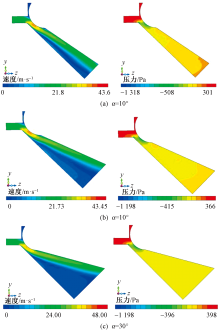
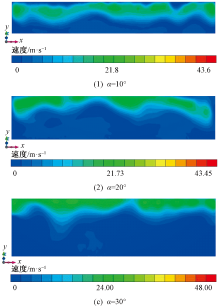
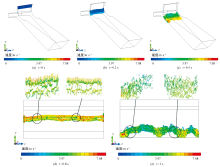
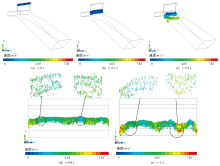
Results The analysis results indicate that the maximum velocity of the three types of air duct tail opening structures is generated at the same position, but there is a significant difference in their velocity distribution. The airflow distribution of the air duct structure with a tail opening of 10° is more uniform compared to the air duct structures with openings of 20° and 30°, and its average wind speed of 21.8 m/s occupies more than half of the duct. Meanwhile, in the comparison of the airflow velocity cloud maps at the outlet, the average velocity of the air duct model with an opening of 10° can fully cover the width direction of the air duct outlet and occupy more than two-thirds of the area. The air duct model structure with an opening of 20° does not fully occupy the width direction, while the air duct model structure with an opening of 30° has an average velocity that is also fully covered in the width direction, but occupies a smaller area. Therefore, from the above comparison, it can be concluded that the airflow situation in the air duct with an opening of 10° is better than the other two. The coupling calculation of the airflow field model with an opening degree of 10° and the fiber model of the airflow web forming machine shows that the fibers with a length of 15 mm can be uniformly dispersed without entanglement or accumulation, and remain dispersed at the outlet. Fibers with a length of 30 mm will tangle and accumulate after moving in the airflow for a period of time. This entanglement and accumulation will continue all the way to the outlet of the air duct and be blown out of the air duct in the form of entanglement and accumulation. Fibers with lengths of 45, 60 and 75 mm will also show tangling at the outlet position, and the tangling of 75 mm fibers at the outlet position is more severe.

Conclusion The distribution structure of the airflow web forming machine has a significant influence on the airflow field. Adopting an appropriate air duct structure can make the airflow field more uniform. When the opening degree of the air duct of the air flow forming machine is 10°, the airflow field is the most uniform and the outlet velocity is also more appropriate. Fibers with a length of 15 mm can be blown out more evenly from the air duct outlet compared to fibers of other lengths.

Key words: airflow web forming machine, air duct, flow field, structure model, fiber movement morphology

中图分类号: 

  • TS173.3

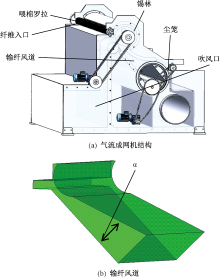
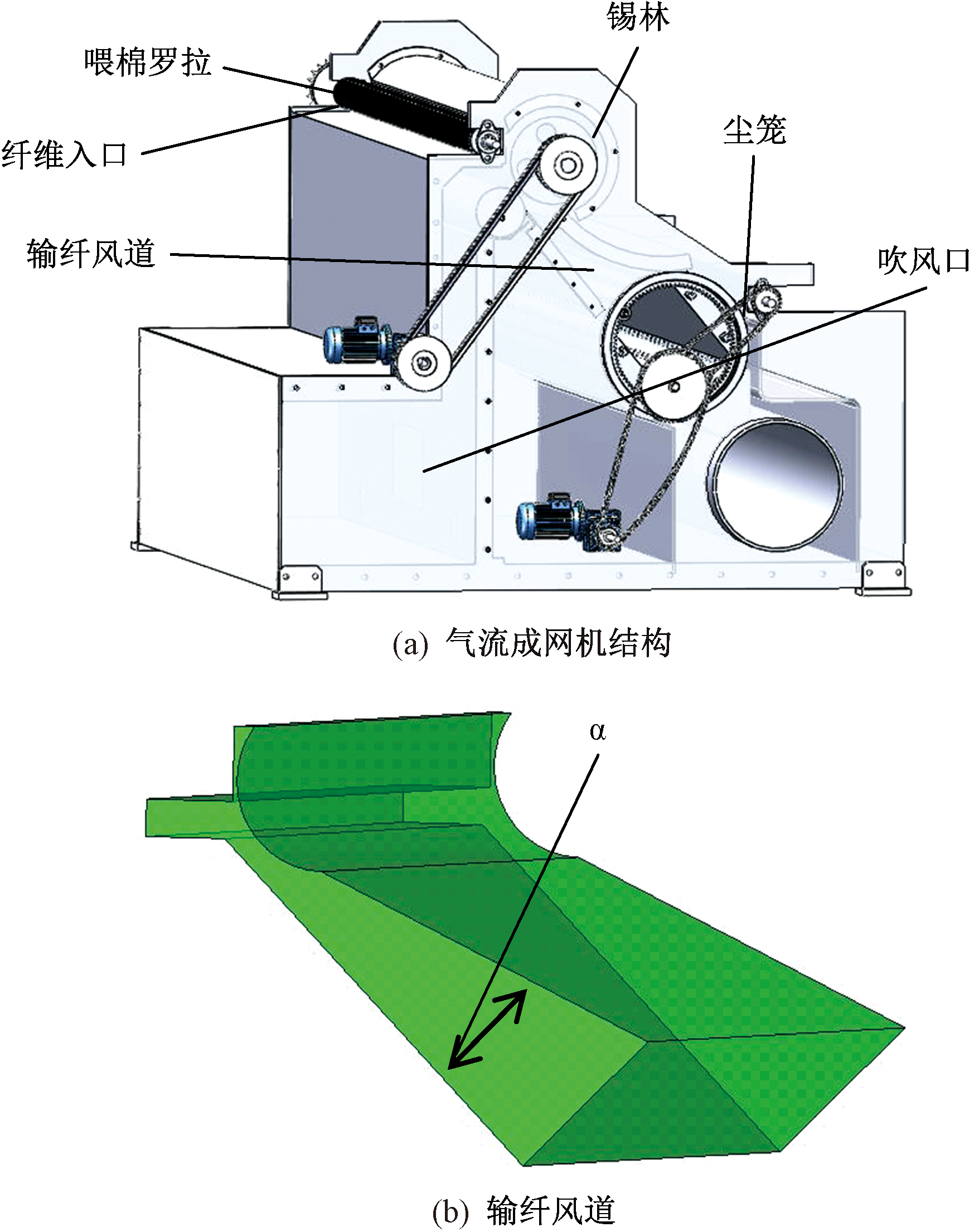
图1

气流成网机结构和输纤风道模型"

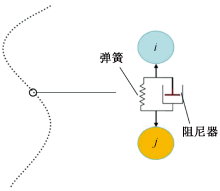
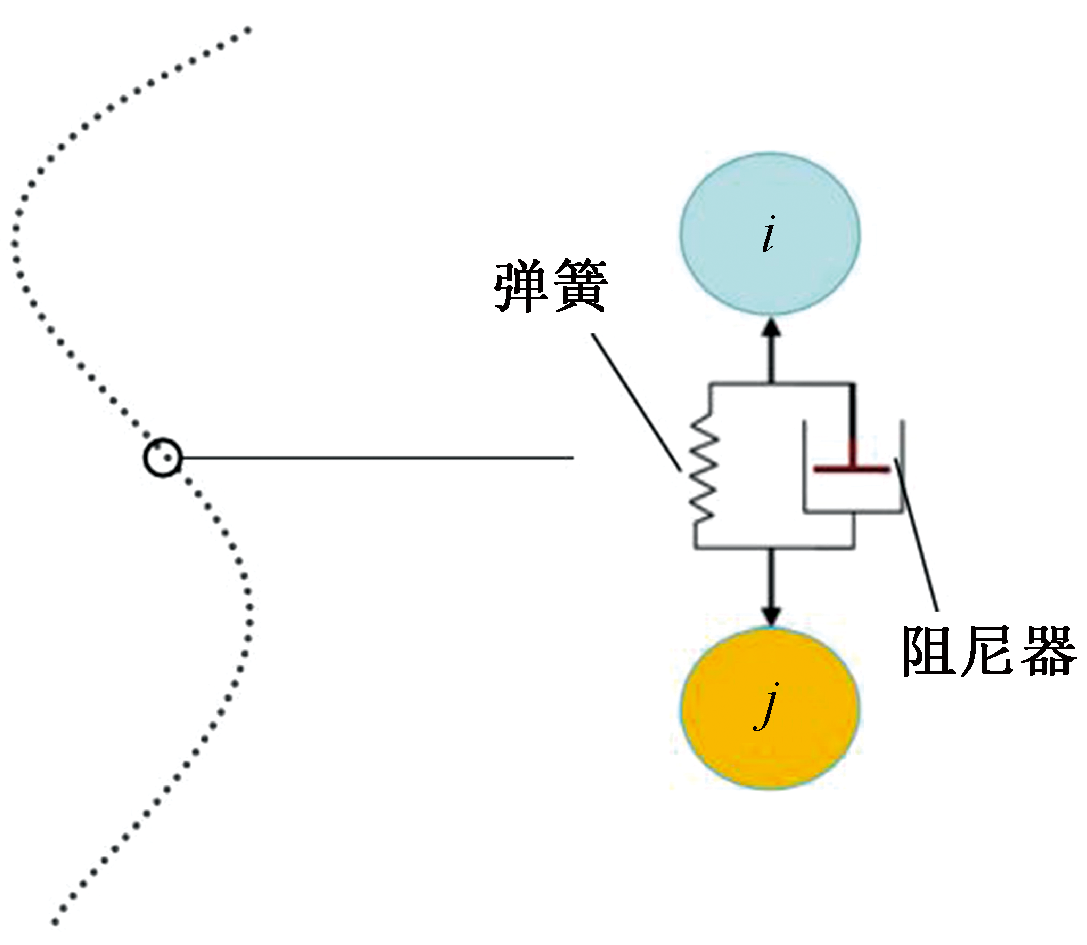
图2

纤维模型"

图3

速度与压力云图"

图4

出口处速度云图"

图5

长度30 mm纤维簇运动轨迹"

图6

长度15 mm纤维簇运动轨迹"

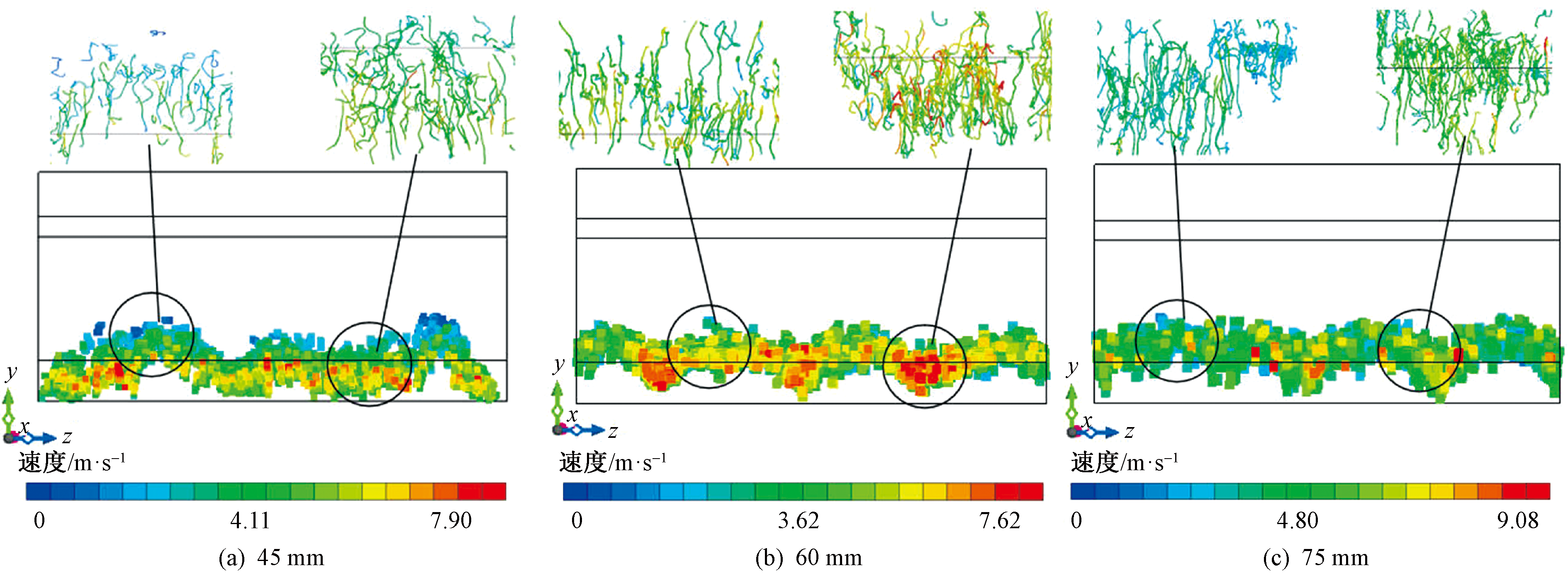
图7

3种长度纤维在出口位置的分布"

[1] 2020年: 气流成网非织造布的未来[J]. 凌莉,译.国际纺织导报, 2018, 46(2): 4.
2020: The future of airflow web nonwovens[J]. LING Li, Translating. International Textile News, 2018, 46(2): 4.
[2] 李磊. 气流成网机研制及其成网工艺研究[D]. 天津: 天津工业大学,2011:3-20.
LI Lei. Development of airflow web forming machine and research on web forming process[D]. Tianjin: Tiangong University, 2011:3-20.
[3] 王进, 程贺棚, 李帅, 等. 输毛管中流场状态对纤维丝束开松处理效果的影响[J]. 现代纺织技术, 2024, 32(3):29-37.
WANG Jin, CHENG Hepeng, LI Shuai, et al. The influence of flow field state in the capillary tube on the loosening treatment effect of fiber bundles[J] Modern Textile Technology, 2024, 32 (3): 29-37.
[4] 董关震, 姜茜, 钱晓明, 等. 基于离散元-有限元联合算法的纤维流场变形行为[J]. 毛纺科技, 2024, 52(3):14-21.
DONG Guanzhen, JIANG Qian, QIAN Xiaoming, et al. Deformation behavior of fiber flow field based on discrete element finite element joint algorithm[J] Woolen Textile Technology, 2024, 52 (3): 14-21.
[5] 王莉, 李丹丹, 杨建成. 基于ANSYS的气流成网机机架静力学分析[J]. 装备制造技术, 2018(4):82-84.
WANG Li, LI Dandan, YANG Jiancheng. Static analysis of the frame of the airflow web forming machine based on ANSYS[J]. Equipment Manufacturing Technology, 2018(4):82-84.
[6] 李笑, 杨建成, 何浩浩, 等. 基于Fluent的气流成网机输送风道流场参数对成网质量的影响[J]. 产业用纺织品, 2021, 39(2):59-65.
LI Xiao, YANG Jiancheng, HE Haohao, et al. The influence of flow field parameters in the conveying duct of an air flow forming machine based on Fluent on the quality of the formed mesh[J] Industrial Textiles, 2021, 39 (2): 59-65.
[7] 王周晶, 陈少克, 周军. 气流成网机流场三维仿真分析[J]. 制造业自动化, 2015, 37(12):4-7,14.
WANG Zhoujing, CHEN Shaoke, ZHOU Jun. Three dimensional simulation analysis of the flow field of the air flow forming machine[J] Manufacturing Automation, 2015, 37 (12): 4-7, 14.
[8] JI D, ZHANG M L, XU T G, et al. Experimental and numerical studies of the jet tube based on venturi effect[J]. Vacuum, 2015, 111:25-31.
doi: 10.1016/j.vacuum.2014.09.010
[9] BAYLAR A, OZKAN F, UNSAL M. Effect of air inlet hole diameter of venturi tube on air injection rate[J]. Ksce Journal of Civil Engineering, 2010, 14 (4): 489-492.
doi: 10.1007/s12205-010-0489-6
[10] 胡敏良, 吴雪茹. 流体力学[M].4 版. 武汉: 武汉理工大学出版社, 2008: 61-74.
HU Minliang, WU Xueru. Fluid mechanics[M]. 4th ed. Wuhan: Wuhan University of Technology Press, 2008: 61-74.
[11] CHOI K J, KO H S. Stable but responsive cloth[J]. ACM Transactions on Graphies, 2002, 21(3): 604-611.
[12] 李刚. 气流成网纤网均匀性的分析及改进措施[J]. 非织造布, 1997,(3):34-36.
LI Gang. Analysis and improvement measures of uniformity of airflow web fiber network[J] Non Woven Fabric, 1997(3): 34-36.
[1] 罗欣, 王磊, 王筱悠, 伍韬, 张贞贞, 张一帆. 丝素蛋白多级结构的自组装机制及其重构材料研究进展[J]. 纺织学报, 2025, 46(03): 225-235.
[2] 李玲, 史倩倩, 田顺, 汪军. 输纤通道对称性对双喂入双分梳转杯纺气流场以及纱线特性的影响[J]. 纺织学报, 2025, 46(02): 69-77.
[3] 张瑞成, 张文清, 吕哲, 许多, 刘可帅, 徐卫林. 基于自捻纺的嵌入式低扭矩复合纱性能分析[J]. 纺织学报, 2025, 46(02): 78-85.
[4] 沈敏, 欧阳灿, 熊小双, 王真, 杨学正, 吕永法, 余联庆. 基于射流瞬态流速变分模态分解法的纬纱波动幅度预测[J]. 纺织学报, 2025, 46(01): 187-196.
[5] 奚传智, 王家源, 王泳智, 陈革, 裴泽光. 低能耗喷气涡流纺喷嘴气流场数值模拟与纺纱实验[J]. 纺织学报, 2024, 45(12): 206-214.
[6] 吕汉明, 梁金辉, 马崇启, 端木德庆. 热风黏合烘箱有限元仿真分析与结构优化[J]. 纺织学报, 2024, 45(10): 216-223.
[7] 张定眺, 王倩茹, 邱芳, 李凤艳. 转杯纺分梳排杂区气流场的多维数值模拟对比[J]. 纺织学报, 2024, 45(10): 64-71.
[8] 王辉, 周伟, 陈一哲, 龙晚昕, 王金伙. 三角形编织工艺数字化建模方法[J]. 纺织学报, 2024, 45(06): 75-81.
[9] 张静, 丛洪莲, 蒋高明. 纬编双面移圈织物多层弹簧-质点结构模型构建与实现[J]. 纺织学报, 2024, 45(01): 106-111.
[10] 常辰玉, 王雨薇, 原旭阳, 刘锋, 卢致文. 基于交织点改进弹簧-质点模型的纬编针织物动态变形模拟[J]. 纺织学报, 2024, 45(01): 99-105.
[11] 丁彩红, 左今朝. 不停丝自动化铲板系统的集排丝技术研究[J]. 纺织学报, 2023, 44(12): 162-169.
[12] 赵俊杰, 蒋高明, 程碧莲, 李炳贤. 毛衫绞花织物的三维仿真与实现[J]. 纺织学报, 2023, 44(12): 81-87.
[13] 王青, 梁高翔, 殷俊清, 盛晓超, 吕绪山, 党帅. 新型气流牵伸通道结构模型的构建与性能分析[J]. 纺织学报, 2023, 44(11): 52-60.
[14] 吕金丹, 程隆棣. 凹槽形状对气流槽聚纺纱集聚区流场及成纱性能的影响[J]. 纺织学报, 2023, 44(01): 188-193.
[15] 韩万里, 谢胜, 王新厚, 王玉栋. 熔喷气流场中的纤维运动模拟与分析[J]. 纺织学报, 2023, 44(01): 93-99.
Viewed
Full text


Abstract

Cited

  Shared   
  Discussed   
No Suggested Reading articles found!