纺织学报 ›› 2025, Vol. 46 ›› Issue (11): 77-85.doi: 10.13475/j.fzxb.20250101901

• 纺织工程 • 上一篇    下一篇

基于包芯-包缠结构复合纱的锦纶/棉机织物服用性能

尹文博, 叶帆, 杨瑞华()   

  1. 江南大学 纺织科学与工程学院, 江苏 无锡 214122
  • 收稿日期:2025-01-08 修回日期:2025-08-26 出版日期:2025-11-15 发布日期:2025-11-15
  • 通讯作者: 杨瑞华(1981—),女,教授,博士。主要研究方向为新型纺纱方法。E-mail: yangrh@jiangnan.edu.cn
  • 作者简介:尹文博(1997—),男,硕士生。主要研究方向为新型纺纱技术。
  • 基金资助:
    国家自然科学基金面上项目(52273034)

Wearing performance of polyamide filament/cotton woven fabrics made from core spun-wrapped composite yarn

YIN Wenbo, YE Fan, YANG Ruihua()   

  1. College of Textile Science and Engineering, Jiangnan University, Wuxi, Jiangsu 214122, China
  • Received:2025-01-08 Revised:2025-08-26 Published:2025-11-15 Online:2025-11-15

摘要:

为优化复合纱品种,改善棉混纺织物在高强度作业作训及户外运动等应用场景下强力、耐磨性不足的问题,采用环锭纺纱技术开发了3种线密度为18.3 tex的包芯-包缠结构锦纶/棉复合纱,用其织制了6种平纹与斜纹组织的机织物,并与同规格包芯-包缠结构涤纶/棉复合纱和涤纶/棉(50/50)短纤混纺纱织制的4种平纹与斜纹机织物进行性能对比,通过建立模糊综合评价模型对织物的服用性能进行综合评价。结果表明:采用包芯-包缠结构锦纶/棉复合纱织制的6种机织物的强力、耐磨性和抗起毛起球性能均显著优于用涤纶/棉复合纱和涤纶/棉短纤混纺纱织制的机织物;其中采用高强锦纶6长丝为芯纱和包缠纱的斜纹机织物的综合服用性能最佳,可满足作训服、工装服、户外运动服等长时间、高强度的使用要求。

关键词: 包芯-包缠结构复合纱, 机织物, 锦纶6长丝, 服用性能, 高强耐磨织物, 环锭纺, 模糊综合评价

Abstract:

Objective Cotton fabrics used in workwear and outdoor clothing often tear or wear out due to low inherent strength and poor abrasion resistance of the cotton fiber. In order to address this limitation, a three-layer composite yarn comprising a polyamide-filament core, a cotton sheath, and an outer polyamide wrap was developed. This yarn was spun using a modified ring frame. Then influences of filament tenacity and fabric weave (plain vs. twill) on the mechanical properties and comfort performance of the resulting cotton (50%)textiles were investigated.
Method Wrap-spun polyamide 6 filaments with increasing tenacity values (41.94, 55.86, and 70.43 cN/tex) were combined with combed cotton roving (5.0 g/(10 m)) using an ring frame, producing core-wrapped yarns with a linear density of 18.3 tex. These yarns were then woven into both plain and twill fabrics. Their performance was compared to two industrial controls, i.e., a polyester/cotton core-wrapped yarn and a polyester/cotton (50/50) blend yarn, both using the same yarn linear density and thread density. Various fabric properties were evaluated, including tensile and tearing strength, Martindale abrasion resistance, pilling grade, air permeability, water vapor permeability, drape, vertical burn behavior, and tensile strength retention at -196 ℃. Overall wear performance was assessed using fuzzy comprehensive evaluation based on eight weighted indices.
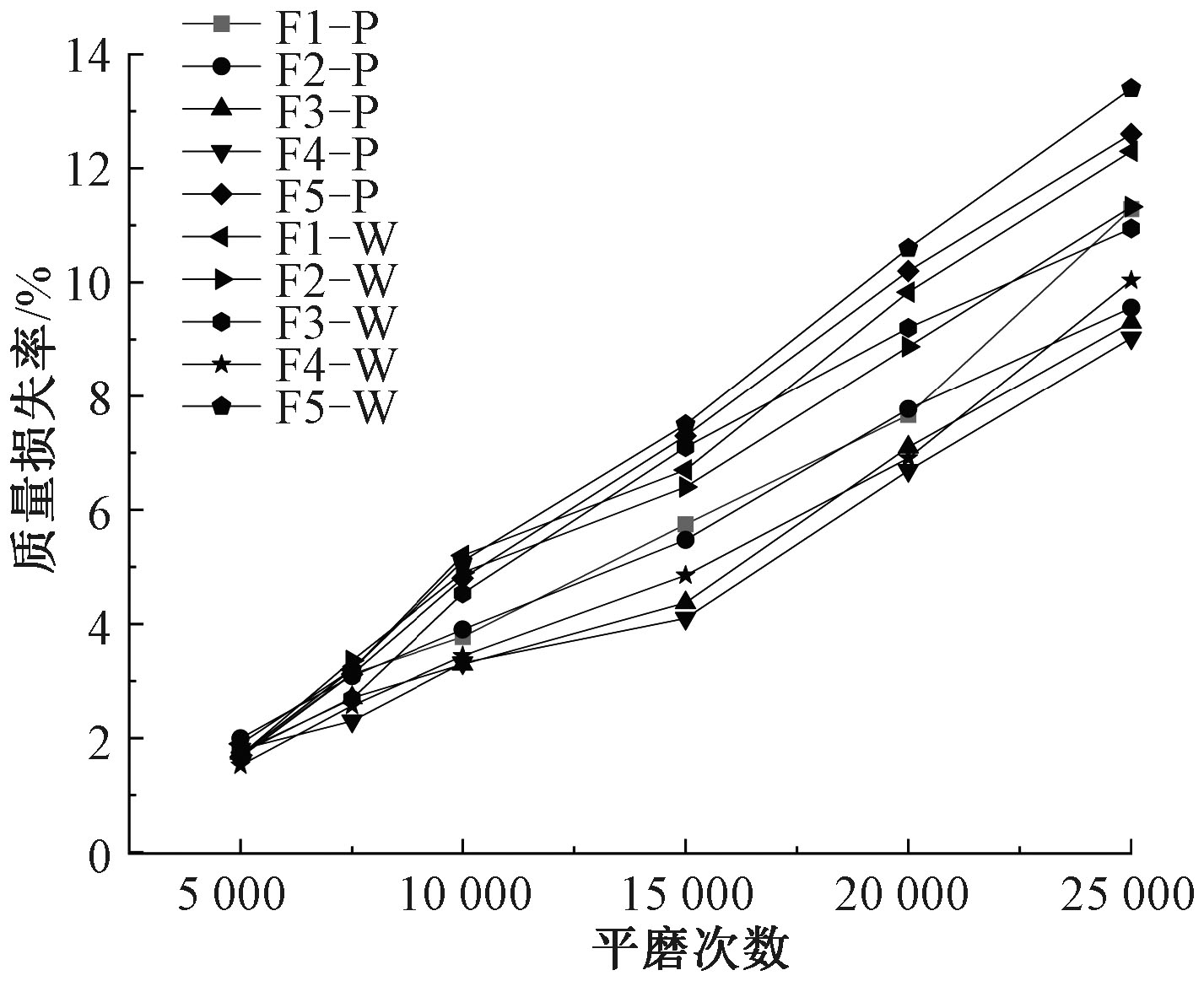
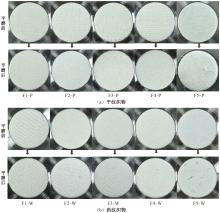
Results Composite yarns made with progressively stronger polyamide 6 filaments exhibited a near-linear increase in breaking strength, reaching 652.40 cN which is 178.4% higher than that of the polyester/cotton control. These yarns also withstood 346 abrasion cycles before failure, tripling that of the benchmark. The outer polyamide wrap not only transmitted filament strength but also reduced yarn hairiness by 53%, indicating effective confinement of the cotton fibers. When yarns of identical fineness but differing structures were woven into plain fabrics with identical warp and weft densities, the warp and weft breaking strengths of the fabric (F1P) woven from core-wrapped composite yarns increased by 50.10% and 26.42%, respectively, compared to the control group. It was also found that the high-tenacity twill (F4-W) fabric resisted forces 1.6-fold (warp) and 1.4-fold (weft) greater than the control fabric, a benefit attributed to both the filament tenacity and the longer float lengths of twill that help redistribute load. Abrasion durability under friction increased as well. After 25 000 Martindale cycles, the composite yarn fabric exhibited a lower mass loss rate than the control group, regardless of whether it was plain weave or twill weave. Macroscopic inspection revealed only sparse fuzz on the composite fabrics, in contrast to the severe pilling and fiber breakage observed in the benchmark. All composite variants achieved ISO pilling grades of 4-5. Comfort properties were primarily influenced by the fabric weave rather than filament grade. The air permeability and water vapor permeability of composite yarn fabrics showed little difference compared to the control group. Twills were consistently 1.5 to 2.7 times more permeable and demonstrated greater drapability (51.6%-66.7%) than that of the plain woven fabric. Safety testing confirmed strong thermal shock resistance across all fabrics made from the composite yarns. All fabrics exhibited carbonization without molten dripping, and warp strength loss remained below 2% after four hours at -196 ℃. Finally, fuzzy comprehensive evaluation using eight weighted indices ranked the high-tenacity polyamide twill (F4-W) the highest in overall wear performance, followed by the polyamide 6 twill (F3-W)and the polyamide 6 plain weave (F3-P).These findings confirm that filament strength and weave design act as orthogonal but synergistic factors in engineering high-strength, abrasion-resistant, cotton fabrics for workwear and outdoor sportswear.
Conclusion By tightly wrapping cotton staples with high-tenacity polyamide filaments, the use of wrapping filament in yarn making suppresses fiber slippage and hairiness while effectively transferring filament strength to the fabric. As a result, warp and weft breaking strength, tearing strength, and abrasion resistance exceed those of polyester/cotton blended fabrics. Breaking strength is primarily determined by filament tenacity, while comfort characteristics are governed by the weave structure. These findings establish high-tenacity polyamide twills as scalable, high-load solutions for workwear and outdoor apparel.

Key words: core-wrapped composite yarn, woven fabric, polyamide 6 filament yarn, wearability, high-strength wear-resistant fabric, ring spinning, fuzzy comprehensive evaluation

中图分类号: 

  • TS104

表1

原料长丝性能指标"

长丝
编号
长丝种类 线密
度/tex
断裂
强力/
cN
断裂强度/
(cN·
tex-1)
断裂
伸长
率/%
模量/
(cN·
dtex-1)
1# 涤纶长丝 4.44 132.5 29.86 24.18 43.6
2# 锦纶6长丝 4.44 186.2 41.94 45.50 29.7
3# 锦纶6长丝 4.44 248.0 55.86 18.46 19.8
4# 高强锦纶6长丝 4.44 312.7 70.43 15.48 25.1

表2

纱线的材料组分和参数"

纱线编号 纱线用材料 长丝与棉粗纱占比
Y1 芯纱:1#涤纶长丝
第1包缠纱:5.0 g/(10 m)棉粗纱 50/50
第2包缠纱:1#涤纶长丝
Y2 芯纱:2#锦纶6长丝
第1包缠纱:5.0 g/(10 m)棉粗纱 50/50
第2包缠纱:2#锦纶6长丝
Y3 芯纱:3#锦纶6长丝
第1包缠纱:5.0 g/(10 m)棉粗纱 50/50
第2包缠纱:3#锦纶6长丝
Y4 芯纱:4#高强锦纶6长丝
第1包缠纱:5.0 g/(10 m)棉粗纱 50/50
第2包缠纱:4#高强锦纶6长丝
Y5 8.0 g/(10 m)涤纶/棉混纺粗纱 50/50

图1

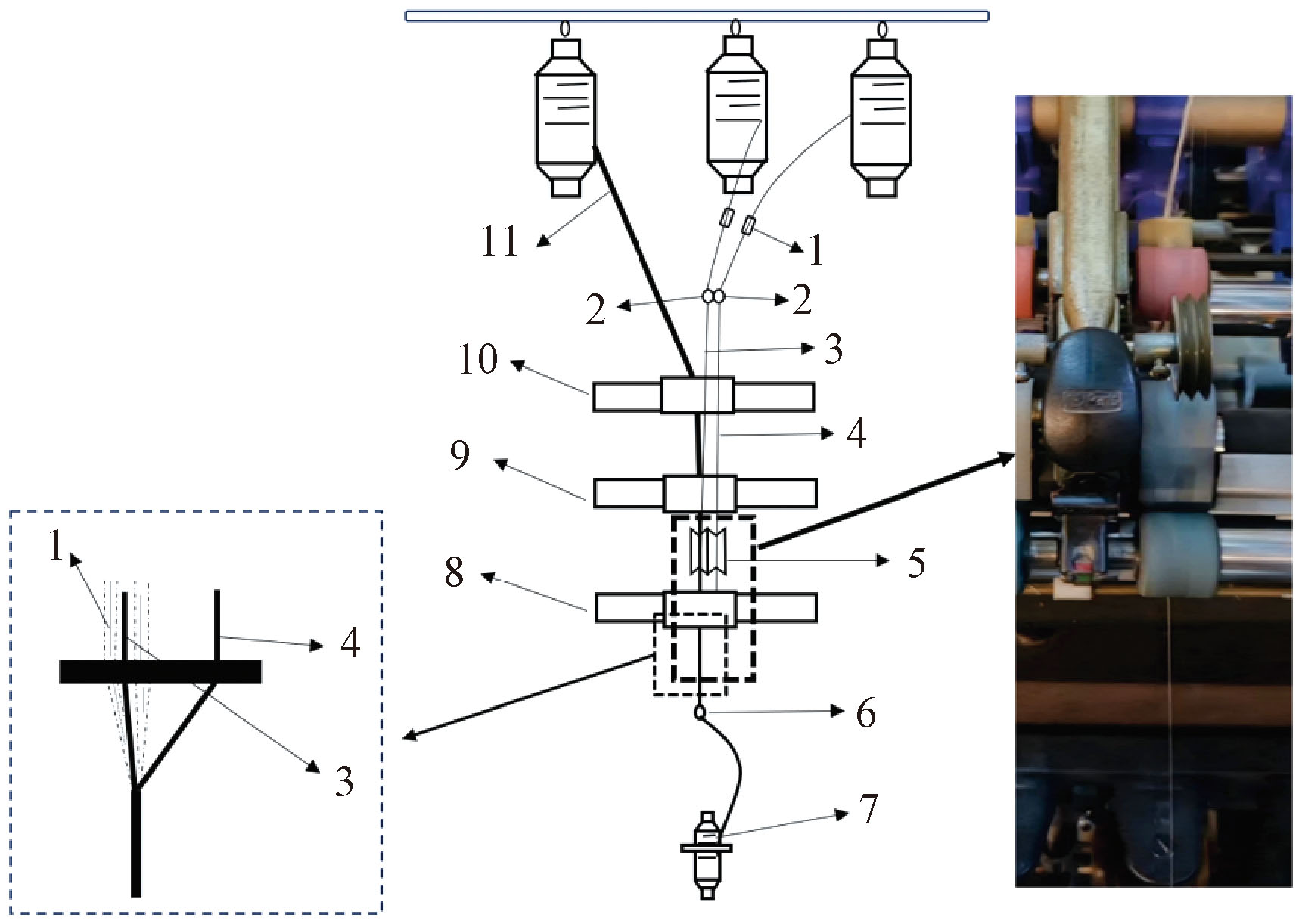
包芯包缠复合纱成纱示意图 注:1—张力器;2—分丝钩;3—芯丝;4—包缠丝;5—导丝轮;6—导纱钩;7—复合纱;8—前罗拉;9—中罗拉;10—后罗拉;11—棉粗纱。"

表3

织物基本参数"

织物
编号
经纬纱
种类
织物
组织
密度/
(根·(10 cm)-1)
面密度/
(g·m-2)
厚度/
mm
纬密 经密
F1-P 复合纱Y1 平纹 285 345 232.77 0.53
F2-P 复合纱Y2 237.72 0.56
F3-P 复合纱Y3 234.26 0.55
F4-P 复合纱Y4 238.67 0.56
F5-P 复合纱Y5 233.57 0.54
F1-W 复合纱Y1 斜纹 285 345 234.58 0.63
F2-W 复合纱Y2 230.68 0.64
F3-W 复合纱Y3 233.07 0.63
F4-W 复合纱Y4 241.01 0.65
F5-W 复合纱Y5 235.25 0.58

图2

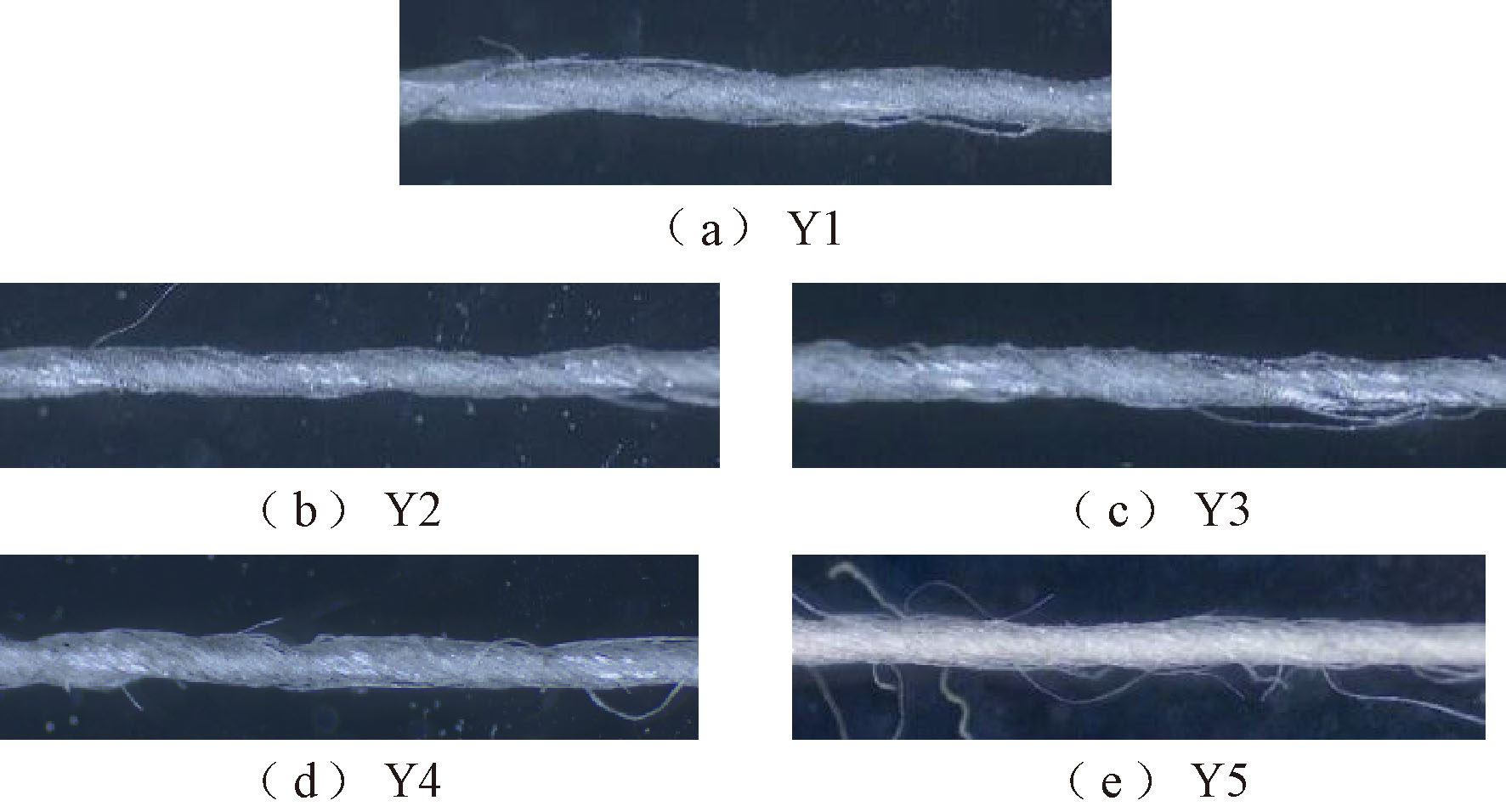
4种包芯-包缠复合纱和涤纶/棉混纺纱外观形貌"

表4

纱线性能测试结果"

编号 线密
度/tex
断裂强
力/cN
断裂伸
长率/%
条干
不匀率/
%
>3 mm毛羽
数/(根·m-1)
耐磨
次数
Y1 18.3 337.10 16.65 10.38 36 189
Y2 18.3 412.50 42.87 10.67 37 238
Y3 18.3 541.23 25.07 10.80 29 287
Y4 18.3 652.40 20.34 10.86 34 346
Y5 18.3 234.30 8.12 11.02 72 112

表5

织物主要服用性能测试结果"

织物
编号
断裂强力/N 撕破强力/N 质量
损失率/%
抗起毛
起球等级
透气率/
(mm·s-1)
透湿率/
(g·m-2·d-1)
静态悬
垂系数
纬向 经向 纬向 经向
F1-P 905.7 1 436.0 99.4 160.1 11.85 4.5 133.5 3 976.8 61.29
F2-P 1 142.1 1 743.3 120.0 172.2 9.55 4.5 123.6 3 801.6 61.47
F3-P 1 415.5 2 087.7 125.0 197.1 9.30 5 125.2 4 112.8 62.40
F4-P 1 508.0 2 198.2 131.6 210.2 9.02 5 120.1 3 709.6 64.10
F5-P 716.4 956.7 54.8 79.3 12.58 3 117.8 4 173.3 66.71
F1-W 759.5 1 307.3 107.4 173.8 12.30 4 333.3 4 290.4 55.11
F2-W 1 024.7 1 619.2 121.0 205.1 11.32 4 328.4 3 928.8 51.62
F3-W 1 226.8 1 808.2 132.9 220.8 10.34 4.5 318.2 4 156.8 57.89
F4-W 1377.8 2 074.8 143.7 229.3 10.03 5 316.8 4 324.8 58.97
F5-W 676.1 894.5 58.8 86.7 13.45 3 322.8 4 373.6 60.57

表6

冷冻处理后织物的力学性能"

织物
编号
织物
状态
断裂强力/N 撕破强力/N 冷冻前后
强力比
纬向 经向 纬向 经向
F1-P 普通状态 905.7 1 436.0 99.4 160.1 0.996
冷冻状态 894.6 1 442.1 97.6 157.4
F2-P 普通状态 1 142.1 1 743.3 120.0 172.2 0.989
冷冻状态 1 126.8 1 728.0 117.5 169.4
F3-P 普通状态 1 415.5 2 087.7 125.0 197.1 0.987
冷冻状态 1 396.6 2 064.6 123.0 190.4
F4-P 普通状态 1 508.0 2 198.2 131.6 210.2 0.987
冷冻状态 1 486.6 2 177.7 127.5 2 02.1
F5-P 普通状态 716.4 956.7 54.8 79.3 0.991
冷冻状态 704.0 956.3 55.2 74.9
F1-W 普通状态 759.5 1 307.3 107.4 173.8 0.982
冷冻状态 744.6 1 288.9 103.5 168.6
F2-W 普通状态 1 024.7 1 619.2 121.0 205.1 0.993
冷冻状态 1 007.7 1 620.8 117.4 203.3
F3-W 普通状态 1 226.8 1 808.2 132.9 220.8 0.985
冷冻状态 1 202.4 1 788.9 128.6 218.8
F4-W 普通状态 1 377.8 2 074.8 143.7 229.3 0.992
冷冻状态 1 367.8 2 065.4 137.6 224.6
F5-W 普通状态 676.1 894.5 58.8 86.7 0.979
冷冻状态 663.2 878.7 54.5 83.8

图3

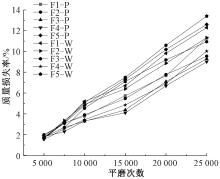
织物在不同平磨次数下的质量损失率"

图4

25 000次平磨前后平纹和斜纹织物外观对比图"

表7

织物垂直燃烧测试结果"

织物
编号
损毁
长度/cm
续燃
时间/s
阴燃
时间/s
有无
熔滴
燃烧后
特征
F1-P 30 25.4 4.6 炭化
F2-P 30 27.8 5.2 炭化
F3-P 30 26.6 5.8 炭化
F4-P 30 25.8 4.6 炭化
F5-P 30 25.4 5.4 炭化
F1-W 30 22.4 4.5 炭化
F2-W 30 23.8 4.1 炭化
F3-W 30 21.2 5.9 炭化
F4-W 30 22.1 4.5 炭化
F5-W 30 23.5 5.3 炭化
[1] 王波, 蒋志青, 鲍军方, 等. 棉纤维产地溯源技术及研究进展[J]. 纺织学报, 2024, 45(11): 244-250.
doi: 10.13475/j.fzxb.20231103002
WANG Bo, JIANG Zhiqing, BAO Junfang, et al. Research progress in geographic origin traceability technology for cotton fibers[J]. Journal of Textile Research, 2024, 45(11): 244-250.
doi: 10.13475/j.fzxb.20231103002
[2] 杨骞, 章友鹤, 张毅. 浙江纺纱产业结构调整与产品升级的几点探索[J]. 浙江纺织服装职业技术学院学报, 2024, 23(2): 5-11, 19.
YANG Qian, ZHANG Youhe, ZHANG Yi. Several explorations on the structural adjustment and product upgrade of Zhejiang's spinning industry[J]. Journal of Zhejiang Fashion Institute of Technology, 2024, 23(2): 5-11, 19.
[3] 吴佳庆, 王怡婷, 何欣欣, 等. 混纺比对生物基锦纶56短纤/棉混纺纱力学性能的影响[J]. 纺织学报, 2023, 44(3): 49-54.
WU Jiaqing, WANG Yiting, HE Xinxin, et al. Influence of blending ratio on mechanical properties of bio-polyamide 56 staple fiber/cotton blended yarn[J]. Journal of Textile Research, 2023, 44(3): 49-54.
[4] 魏艳红, 刘新金, 谢春萍, 等. 聚酯长丝/棉复合纱斜纹织物的保形性及服用性能[J]. 纺织学报, 2019, 40(12): 39-44.
doi: 10.13475/j.fzxb.20190204306
WEI Yanhong, LIU Xinjin, XIE Chunping, et al. Shape retention and wearing properties of polyester filament/cotton composite yarn twill fabrics[J]. Journal of Textile Research, 2019, 40(12): 39-44.
doi: 10.13475/j.fzxb.20190204306
[5] 宋婉萌, 王宝弘, 孙宇, 等. 兼具力学性能与高效阻燃性能粘胶织物的制备及其性能[J]. 纺织学报, 2025, 46(2): 188-196.
SONG Wanmeng, WANG Baohong, SUN Yu, et al. Preparation and performance of flame-retardant viscose fabrics with both mechanical and efficient flame-retardant properties[J]. Journal of Textile Research, 2025, 46(2): 188-196.
[6] 王太冉, 张琦, 陈超余, 等. 毛圈高度对经编毛巾织物服用性能的影响[J]. 上海纺织科技, 2023, 51(11): 6-8, 54.
WANG Tairan, ZHANG Qi, CHEN Chaoyu, et al. Effect of loops height on the wearability of warp knitted terry fabric[J]. Shanghai Textile Science & Technology, 2023, 51(11): 6-8, 54.
[7] 孙秀玲. 基于面状摩擦的织物耐磨性能测试与评价方法改进[D]. 无锡: 江南大学, 2023:34.
SUN Xiuling. Improvement of testing and evaluating method of fabric wear resistance based on surface friction[D]. Wuxi: Jiangnan University, 2023:34.
[8] 秦路路, 秦志刚. 黏胶/合纤混纺针织物的抗起毛起球性能研究[J]. 国际纺织导报, 2020, 48(6): 18-20, 22.
QIN Lulu, QIN Zhigang. Anti-pilling performance of viscose/synthetic fiber blended knitted fabrics[J]. Melliand China, 2020, 48(6): 18-20, 22.
[9] 钱娟, 谢婷, 张佩华, 等. 聚乙烯针织物的热湿舒适性能[J]. 纺织学报, 2022, 43(7): 60-66.
QIAN Juan, XIE Ting, ZHANG Peihua, et al. Thermal and moisture comfort performance of polyethylene knitted fabric[J]. Journal of Textile Research, 2022, 43(7): 60-66.
doi: 10.1177/004051757304300111
[10] 苏旭中, 梁巧敏, 王汇锋, 等. 棉/生物基弹性聚酯纤维混纺针织物的服用性能[J]. 纺织学报, 2023, 44(5): 119-124.
SU Xuzhong, LIANG Qiaomin, WANG Huifeng, et al. Wearability of knitted fabrics produced from cotton/bio-based elastic polyester fiber[J]. Journal of Textile Research, 2023, 44(5): 119-124.
[11] 郑国华. 中国古代美学思想对服装设计的启示[J]. 轻纺工业与技术, 2024, 53(2): 129-132.
ZHENG Guohua. Enlightenment of China's ancient aesthetic thought on fashion design[J]. Light and Textile Industry and Technology, 2024, 53(2): 129-132.
[12] 苏德清, 程建生, 魏廷三, 等. 基于ANP-FUZZY法的绿色办公楼工程项目管理综合评价[J]. 中国建筑金属结构, 2024(1): 176-179, 183.
SU Deqing, CHENG Jiansheng, WEI Tingsan, et al. Comprehensive evaluation of green office building project management based on ANP-FUZZY method[J]. China Construction Metal Structure, 2024(1): 176-179, 183.
[1] 郭梦瑶, 吴佳庆, 王迎. 全包覆结构聚氨酯膜条带/棉复合纱制备及其力学性能[J]. 纺织学报, 2025, 46(11): 69-76.
[2] 张子悦, 江红霞, 刘基宏. 单色机织物数字纹理色卡的设计与评价[J]. 纺织学报, 2025, 46(10): 167-175.
[3] 邱俊, 李际军. 机织物的三维真实感建模与参数化设计[J]. 纺织学报, 2025, 46(10): 95-102.
[4] 梁睿, 李众, 童维红, 叶长怀. 聚乙烯衍生炭化织物及其电磁屏蔽性能[J]. 纺织学报, 2025, 46(09): 27-35.
[5] 张爱丹, 王倩. 三纬组合全显结构织物的颜色预测方法[J]. 纺织学报, 2025, 46(05): 151-158.
[6] 尚静雨, 蒋高明, 陈钰珊, 刘海桑, 李炳贤. 花式纱罗织物设计与三维仿真[J]. 纺织学报, 2025, 46(04): 81-88.
[7] 王浙峰, 蔡王丹, 李诗雅, 徐青艺, 张红霞, 祝成炎, 金肖克. 抗菌除臭复合功能机织物的服用性能[J]. 纺织学报, 2025, 46(03): 90-99.
[8] 李慧敏, 刘淑强, 杜琳琳, 张曼, 吴改红. 玄武岩/聚酰亚胺三维间隔机织物的参数化建模及高温环境传热数值模拟[J]. 纺织学报, 2025, 46(01): 87-94.
[9] 孙戬, 王彤, 陈云辉, 林何, 刘晖, 成小乐. 织物增强橡胶基复合材料本构模型及其应用[J]. 纺织学报, 2025, 46(01): 95-102.
[10] 田少萌, 张丽, 石浩轩, 徐阳. 基于ANSYS Workbench的高密机织滤料动态形变模拟与分析[J]. 纺织学报, 2024, 45(09): 63-69.
[11] 黄智威, 石雅杰, 陆冯, 李青, 薛哲彬. 《宫乐图》中仕女服饰的数字化复原[J]. 纺织学报, 2024, 45(06): 155-164.
[12] 徐辉, 朱昊, 潘苏情, 史红艳, 应迪. 基于变截面复丝模型的机织物模拟[J]. 纺织学报, 2024, 45(05): 70-78.
[13] 丁倩, 吴俊霖, 江慧, 汪军. 阻燃腈纶/酚醛树脂纤维织物的制备及其性能[J]. 纺织学报, 2024, 45(04): 83-88.
[14] 陶静, 汪俊亮, 张洁. 数据驱动与有限元仿真融合的纱线断裂强力分析方法[J]. 纺织学报, 2024, 45(02): 238-245.
[15] 石路健, 宋亚伟, 谢汝义, 高志超, 房宽峻. 莱赛尔机织物防原纤化前处理工艺优化[J]. 纺织学报, 2023, 44(12): 96-105.
Viewed
Full text


Abstract

Cited

  Shared   
  Discussed   
No Suggested Reading articles found!