纺织学报 ›› 2026, Vol. 47 ›› Issue (07): 44-53.doi: 10.13475/j.fzxb.20260404901
• 第二十八届中国科协年会学术论文·减污降碳共性技术突破专栏· • 上一篇 下一篇
高佳鹏1,2,3, 杨雷1,2,3, 吴宇通1,2,3, 陈宏鑫1,2,3, 马昌1,2,3, 韩娜1,2,3( )
)
GAO Jiapeng1,2,3, YANG Lei1,2,3, WU Yutong1,2,3, CHEN Hongxin1,2,3, MA Chang1,2,3, HAN Na1,2,3()
摘要:
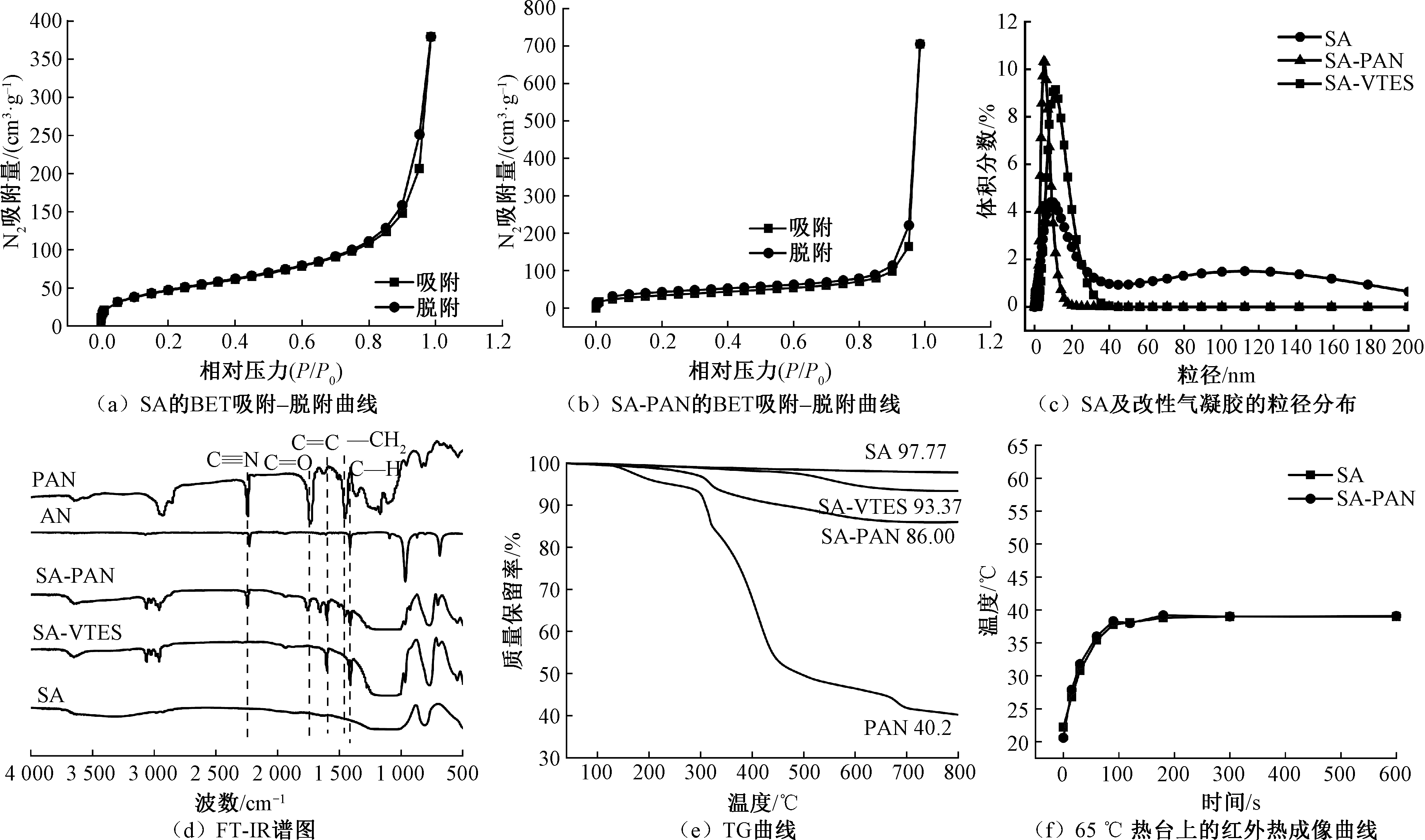
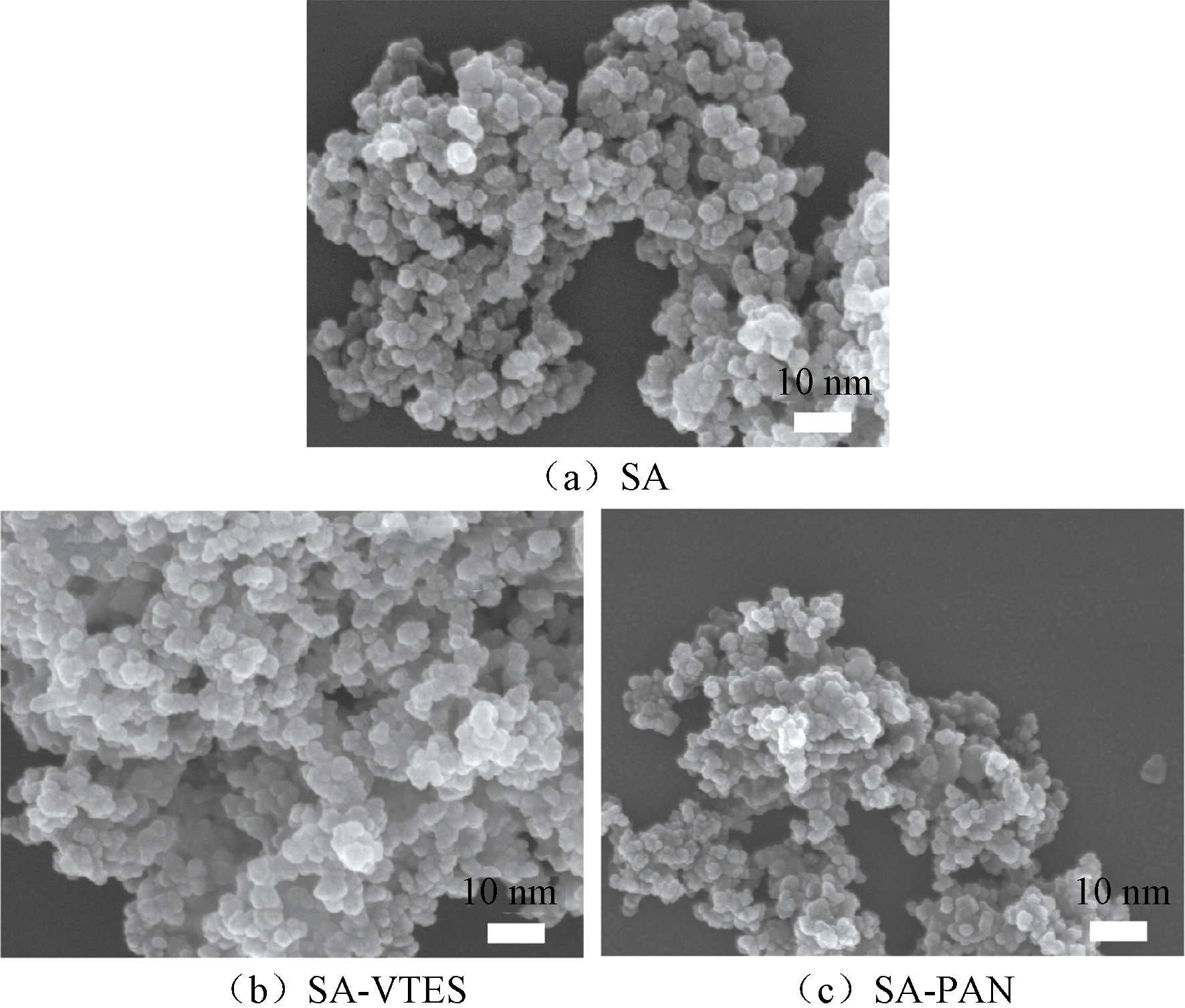
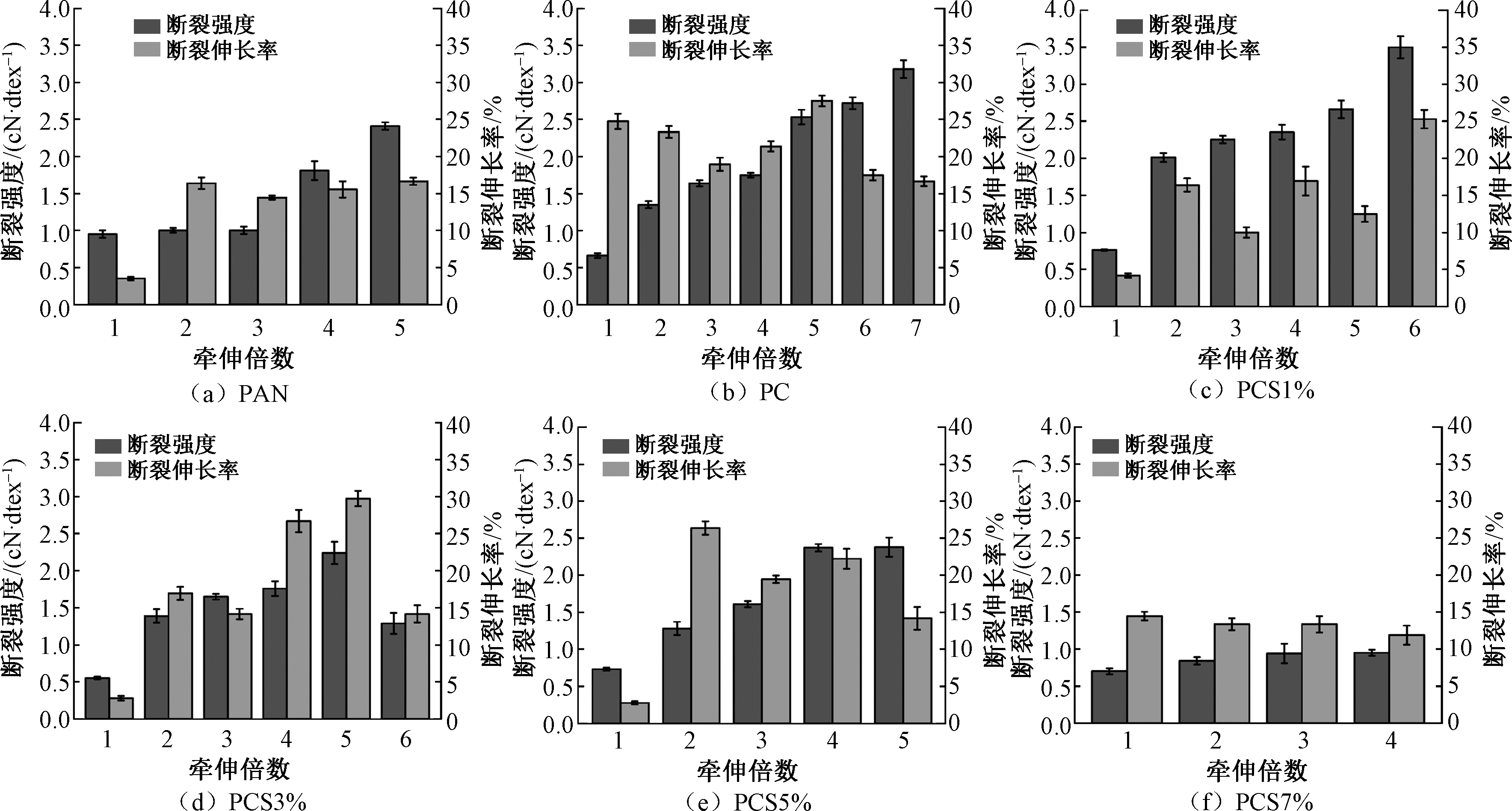
为解决传统隔热纤维隔热性能与力学性能难以兼顾以及难以实现大规模绿色纺丝成形问题,以可熔融聚丙烯腈(PAN)共聚物为原料、羧基纤维素纳米纤维(C-CNF)为相容剂、改性SiO2气凝胶(SA)为功能填料,采用熔融纺丝法制备了聚丙烯腈基隔热纤维,并系统研究了其结构与性能。通过接枝改性制备了新型SA-PAN聚合物;在乳液聚合过程中原位引入C-CNF,制得可熔融加工的PAN/C-CNF复合体系;进一步经熔融纺丝制得表面光滑、无明显缺陷且SA-PAN分散均匀的聚丙烯腈基隔热纤维。结果表明:复合改性后,纤维断裂强度由2.41 cN/dtex提高至3.18 cN/dtex,增幅约32%,断裂伸长率由3.5% 提高至24.7%,纤维韧性显著改善;SA-PAN的引入有效提升了纤维的隔热性能,热导率由0.119 9 W/(m·K)降低至0.075 3 W/(m·K),800 ℃下残炭率由9.11%提高至44.85%;当SA-PAN质量分数为 1%时,纤维断裂强度进一步提高至3.50 cN/dtex。通过C-CNF与SA-PAN的协同作用可实现PAN基复合纤维力学性能与隔热性能的协同提升,为绿色高性能隔热纤维材料的开发提供了实验依据。
中图分类号:
| [1] | KAUSAR A. Polyacrylonitrile-based nanocomposite fibers: a review of current developments[J]. Journal of Plastic Film & Sheeting, 2019, 35(3): 295-316. |
| [2] |
TAO J Z, WANG Y F, ZHENG X K, et al. A review: polyacrylonitrile as high-performance piezoelectric materials[J]. Nano Energy, 2023, 118: 108987.
doi: 10.1016/j.nanoen.2023.108987 |
| [3] |
CHERNIKOVA E V, OSIPOVA N I, PLUTALOVA A V, et al. Melt-spinnable polyacrylonitrile: an alternative carbon fiber precursor[J]. Polymers, 2022, 14(23): 5222.
doi: 10.3390/polym14235222 |
| [4] |
WANG J Y, PETIT D, REN S Q. Transparent thermal insulation silica aerogels[J]. Nanoscale Advances, 2020, 2(12): 5504-5515.
doi: 10.1039/d0na00655f pmid: 36133881 |
| [5] | DOU L Y, ZHANG X X, CHENG X T, et al. Hierarchical cellular structured ceramic nanofibrous aerogels with temperature-invariant superelasticity for thermal insulation[J]. ACS Applied Materials & Interfaces, 2019, 11(32): 29056-29064. |
| [6] |
MENECES FUERTES F C, MAZROUEI-SEBDANI Z, MICHEL S, et al. Vibration isolation performance of silica aerogel blankets and boards, fumed silica, polymer aerogel and nanofoams[J]. Construction and Building Materials, 2024, 440: 137429.
doi: 10.1016/j.conbuildmat.2024.137429 |
| [7] |
DUAN Y N, JANA S C, LAMA B, et al. Hydrophobic silica aerogels by silylation[J]. Journal of Non-Crystalline Solids, 2016, 437: 26-33.
doi: 10.1016/j.jnoncrysol.2016.01.016 |
| [8] |
XUE J H, ZHU E W, ZHU H F, et al. Dye adsorption performance of nanocellulose beads with different carboxyl group content[J]. Cellulose, 2023, 30(3): 1623-1636.
doi: 10.1007/s10570-022-04964-1 |
| [9] |
JIA D M, XIE J Y, DIRICAN M, et al. Highly smooth, robust, degradable and cost-effective modified lignin-nanocellulose green composite substrates for flexible and green electronics[J]. Composites Part B: Engineering, 2022, 236: 109803.
doi: 10.1016/j.compositesb.2022.109803 |
| [10] |
SHARMA P R, JOSHI R, SHARMA S K, et al. A simple approach to prepare carboxycellulose nanofibers from untreated biomass[J]. Biomacromolecules, 2017, 18(8): 2333-2342.
doi: 10.1021/acs.biomac.7b00544 pmid: 28644013 |
| [11] |
PASSOS DE OLIVEIRA SANTOS R, HAO J L, DANIEL DE MELLO INNOCENTINI M, et al. Composite electrospun membranes based on polyacrylonitrile and cellulose nanofibrils: relevant properties for their use as active filter layers[J]. Separation and Purification Technology, 2023, 311: 123358.
doi: 10.1016/j.seppur.2023.123358 |
| [12] |
HU X X, ZHAO Y H, MENG Y, et al. Synthesis of carboxyl cellulose nanocrystals/copper nanohybrids to endow waterborne polyurethane film with improved mechanical and antibacterial properties[J]. Journal of Polymers and the Environment, 2023, 31(7): 3040-3051.
doi: 10.1007/s10924-023-02772-7 |
| [13] |
PERDOCH W, CAO Z R, FLORCZAK P, et al. Influence of nanocellulose structure on paper reinforcement[J]. Molecules, 2022, 27(15): 4696.
doi: 10.3390/molecules27154696 |
| [14] |
HIREMATH N, EVORA M C, NASKAR A K, et al. Polyacrylonitrile nanocomposite fibers from acrylonitrile-grafted carbon nanofibers[J]. Composites Part B: Engineering, 2017, 130: 64-69.
doi: 10.1016/j.compositesb.2017.07.031 |
| [15] |
CHANG H B, LUO J, LIU H C, et al. Stabilization study of polyacrylonitrile/cellulose nanocrystals composite fibers[J]. ACS Applied Polymer Materials, 2019, 1(5): 1015-1021.
doi: 10.1021/acsapm.9b00057 |
| [16] |
KRISHNASWAMY S, TINSLEY L, MARCHANTE V, et al. Effect of extrusion and compression moulding on the thermal properties of nylon-6/silica aerogel composites[J]. Journal of Thermoplastic Composite Materials, 2018, 31(7): 992-1009.
doi: 10.1177/0892705717729198 |
| [17] |
SEDIGHI S, KHODDAMI A, IZADAN H, et al. The influence of silica aerogels on physical, mechanical, and morphological properties of melt-spun POY and DTY polyester yarns[J]. Polymer Testing, 2022, 112: 107628.
doi: 10.1016/j.polymertesting.2022.107628 |
| [18] | HAN N, ZHANG X X, WANG X C. Various comonomers in acrylonitrile based copolymers: effects on thermal behaviour[J]. Iran. Polym. J, 2010, 19(4): 243-253. |
| [19] |
HAN N, ZHANG X X, WANG X C, et al. Fabrication, structures and properties of acrylonitrile/vinyl acetate copolymers and copolymers containing microencapsulated phase change materials[J]. Macromolecular Research, 2010, 18(2): 144-152.
doi: 10.1007/s13233-009-0122-z |
| [20] |
HAN N, ZHANG X X, YU W Y, et al. Effects of copolymerization temperatures on structure and properties of melt-spinnable acrylonitrile-methyl acrylate copolymers and fibers[J]. Macromolecular Research, 2010, 18(11): 1060-1069.
doi: 10.1007/s13233-010-1115-7 |
| [21] |
THUONG N T, QUANG L D, CUONG V Q, et al. Modification of graphene oxide and its effect on properties of natural rubber/graphene oxide nanocomposites[J]. Beilstein Journal of Nanotechnology, 2024, 15: 168-179.
doi: 10.3762/bjnano.15.16 pmid: 38352717 |
| [22] | MAZROUEI-SEBDANI Z, NAEIMIRAD M, PETEREK S, et al. Multiple assembly strategies for silica aerogel-fiber combinations: a review[J]. Materials & Design, 2022, 223: 111228. |
| [23] |
ZHOU Y, LI X, YU H Y, et al. Facile fabrication of controllable zinc oxide nanorod clusters on polyacrylonitrile nanofibers via repeatedly alternating immersion method[J]. Journal of Nanoparticle Research, 2016, 18(12): 359.
doi: 10.1007/s11051-016-3678-5 |
| [24] |
SON S Y, JO A Y, JUNG G Y, et al. Accelerating the stabilization of polyacrylonitrile fibers by UV irradiation[J]. Journal of Industrial and Engineering Chemistry, 2019, 73: 47-51.
doi: 10.1016/j.jiec.2019.01.012 |
| [25] |
LIU Y L, ZHANG S F, LI L, et al. High-performance cellulose nanofibers/carbon nanotubes composite for constructing multifunctional sensors and wearable electronics[J]. Advanced Fiber Materials, 2024, 6(3): 758-771.
doi: 10.1007/s42765-024-00388-7 |
| [26] |
BUKALOV S S, LEITES L A, GOLOVESHKIN A S, et al. Structure of sp2-carbon fiber prepared by high-temperature thermomechanical treatment of polyacrylonitrile fiber: a Raman and X-ray diffraction study[J]. Russian Chemical Bulletin, 2018, 67(6): 1002-1009.
doi: 10.1007/s11172-018-2171-y |
| [27] |
CANDAU N, FERNANDES J P C, VASMER E, et al. Cellulose nanocrystals as nucleating agents for the strain induced crystallization in natural rubber[J]. Soft Matter, 2022, 18(45): 8663-8674.
doi: 10.1039/d2sm01291j pmid: 36349700 |
| [28] |
GUPTA A, SIMMONS W, SCHUENEMAN G T, et al. Lignin-coated cellulose nanocrystals as promising nucleating agent for poly(lactic acid)[J]. Journal of Thermal Analysis and Calorimetry, 2016, 126(3): 1243-1251.
doi: 10.1007/s10973-016-5657-6 |
| [29] |
HOU C, YU M, XIN B J. Characterization and mechanism analysis of flexible UV irradiated PAN-based carbon fiber membranes prepared[J]. Fibers and Polymers, 2023, 24(12): 4121-4128.
doi: 10.1007/s12221-023-00384-5 |
| [30] |
YOUSEFI AMIRI T, BARGOZIN H. Fabrication and characterization of silica aerogel blanket as an excellent thermal insulating material[J]. Bulletin of Materials Science, 2024, 47(1): 22.
doi: 10.1007/s12034-023-03102-2 |
| [1] | 冯笑琳, 魏静雯, 李旭明. 聚乳酸/聚己内酯共混纤维的制备及其性能[J]. 纺织学报, 2026, 47(05): 18-27. |
| [2] | 梁均明, 徐贤培, 费鹏飞, 狄友波, 李甫. 聚丙烯腈预氧化纳米纤维的构效关系及其应用研究进展[J]. 纺织学报, 2026, 47(05): 244-253. |
| [3] | 霍雨辰, 张帆, 翟云云, 刘海清. 纳米纤维素/聚丙烯腈复合隔膜制备及其锂枝晶抑制[J]. 纺织学报, 2026, 47(04): 61-70. |
| [4] | 林启松, 戴钧明, 查全亮, 徐涛, 吕汪洋. 聚丁二酸丁二醇酯预取向丝与牵伸丝的制备及性能[J]. 纺织学报, 2026, 47(04): 9-16. |
| [5] | 凌磊, 陈凯, 高俊, 武丁胜, 汪邓兵, 张春, 凤权. 聚丙烯腈/共价有机框架复合纳米纤维膜的制备及其对Cr(Ⅵ)的吸附性能[J]. 纺织学报, 2026, 47(01): 54-62. |
| [6] | 高俊, 凌磊, 陈缘, 武丁胜, 林韩蕾, 李振宇, 凤权. 氨基功能化聚丙烯腈纳米纤维膜的制备及其对Cr(Ⅵ)的吸附性能[J]. 纺织学报, 2025, 46(12): 57-65. |
| [7] | 孙燕燕, 张世韬, 刘衡, 李明远, 蔡正国, 孙俊芬, 陈龙. 聚丙烯/聚对苯二甲酸丁二醇酯共混纤维的制备及其流变与热性能[J]. 纺织学报, 2025, 46(10): 11-18. |
| [8] | 唐春霞, 王一帆, 毛云山, 刘健, 付少海. 电磁屏蔽用纤维素基复合材料结构设计的研究进展[J]. 纺织学报, 2025, 46(09): 36-45. |
| [9] | 毛泽, 高俊, 凌磊, 武丁胜, 陶云, 张春, 李申, 凤权. 聚丙烯腈/聚吡咯纳米纤维膜的制备及其对铬离子的吸附性能[J]. 纺织学报, 2025, 46(09): 57-65. |
| [10] | 时虎, 王赫, 王洪杰, 潘显苗. 多孔交联纳米纤维基超级电容器隔膜的设计[J]. 纺织学报, 2025, 46(08): 45-52. |
| [11] | 林玉婷, 许仕林, 胡毅. 多色彩热塑性聚氨酯/聚丙烯腈纳米纤维纱线的制备及其性能[J]. 纺织学报, 2025, 46(07): 78-86. |
| [12] | 贾陈诺瓦, 张勇, 朱威岩, 刘赛, 唐宁. 芯纱种类对聚丙烯腈纳米纤维导电包芯纱性能的影响[J]. 纺织学报, 2025, 46(07): 87-95. |
| [13] | 丁圆, 赵云霞, 靳高岭, 杨涛, 徐静, 柯福佑, 陈烨. 阻燃聚丙烯腈长丝织物的层层自组装法制备及其性能[J]. 纺织学报, 2025, 46(06): 168-177. |
| [14] | 张嘉诚, 于影, 左雨欣, 顾志清, 汤腾飞, 陈洪立, 吕勇. 聚丙烯腈/二硫化钼纤维薄膜的挠曲电效应与扭转传感特性[J]. 纺织学报, 2025, 46(06): 80-87. |
| [15] | 王薇, 高建南, 裴笑涵, 陆鑫, 孙银银, 吴建兵. 纤维素/甲基三甲氧基硅烷气凝胶的制备及其油水分离效能[J]. 纺织学报, 2025, 46(05): 135-142. |
|
||
 京公网安备11010502044800号