Journal of Textile Research ›› 2024, Vol. 45 ›› Issue (11): 88-98.doi: 10.13475/j.fzxb.20231100301

• Textile Engineering • Previous Articles     Next Articles

Construction of jacquard structure model with full gamut color spaces based on bidirectional multi-primary color

LU Shuangyi1,2, ZHOU Jiu1,2()   

  1. 1. Silk and Fashion Culture Research Center of Zhejiang Province, Zhejiang Sci-Tech University, Hangzhou, Zhejiang 310018, China
    2. Zhejiang Sci-Tech University Shengzhou Innovation Research Institute, Shaoxing, Zhejiang 312400, China
  • Received:2023-11-02 Revised:2024-05-22 Online:2024-11-15 Published:2024-12-30
  • Contact: ZHOU Jiu E-mail:zhoujiu34@126.com

Abstract:

Objective Referring to the issue of gamut color spaces for structural coloring caused by the restricted primary color configuration and selection of warp and weft for digital jacquard structure, jacquard structure with bidirectional multi-primary color was proposed under layered-combination design mode, the way how three factors namely weave repeat R, the quantity of face weft group(s) N and the transition speed M determine the quantity of warp and weft configuration, face and back layer relationship, coloring compound weave-databases and representative weaves and compound weaves for coloring of jacquard structure basic and derived model were revealed, providing theoretical reference to the construction of jacquard structure model with a finite group of primary color threads and the expansion of its structural gamut color spaces.

Method First, the construction of jacquard structure model with full gamut color spaces based on bidirectional multi-primary color referred to the structural characteristic of double-layer structure, with only face warp and face weft(s) used for coloring. Besides, the basic model with double warps and quadruple wefts and the derived model with double warps and sextuple wefts were established, 4 chromatic colors as well as 2 achromatic colors, namely red, yellow, green, blue, black, and white, were applied to the configuration of thread color, in this case, 4 groups of chromatic threads configurated weft-wised only, 2 groups of achromatic threads were arranged warp-wisely and bi-directionally, with warp threads configurated with 1∶1 ratio, while weft threads allocated under 1∶1∶1∶1 and 1∶1∶1∶1∶1∶1 ratio respectively. What's more, the quantity of coloring compound weave-databases and the quantity of representative weaves and compound weaves for coloring of jacquard structure basic and derived model were calculated and analyzed. Last but not least, the applicability of the two structure models were verified through the comparison of fabric simulation.

Results Jacquard structure model with full gamut color spaces based on bidirectional multi-primary color were illustrated, including jacquard structure basic model with double warps and quadruple wefts and jacquard structure derived model with double warps and sextuple wefts. According to the arrangement sequence of primary color threads, the warp and weft configurations were 48 and 1 440 correspondingly, based on the assignment of the quantity of face weft group(s) N , the face layer and back layer relationships were 28 and 124 respectively without stitching. To stabilize structural coloring characteristics, it is essential to avoid the juxtaposed non-backed effect generated by adjacent face wefts inserted into the same shed when full gamut shaded weaves are combined in succession to form compound weaves for coloring with the quantity of face weft group(s) N equaling or exceeding 2, then the quantity of valid coloring compound weave-databases and the quantity of representative weaves and compound weaves for coloring were obtained according to weave repeat R and the quantity of face weft group(s) N, further, the maximum quantity for total weaves and compound weaves for coloring were 3 605 139 and 84 392 722 413 respectively with 40-threads satin weave and 153 levels of gamut weaves applied for the two structure models, and the characteristics of 6 structural coloring points on fabric simulation revealed that the jacquard structure model proposed is able to adjust chromatic, purity and brightness to enlarge the gamut color spaces of structural coloring.

Conclusion The results demonstrated that achromatic threads configurated codirectionally and bidirectionally conduct to the brightness adjustment of structural coloring in jacquard structure model with bidirectional multi-primary color, besides, with chromatic threads configurated codirectionally and interlaced with achromatic threads according to gamut weaves, the quantity of structural color reaches to the level of 10 6 and 10 11 theoretically for two structure models respectively. Thus, this study contributes to the development and intelligent design research of digital jacquard fabric with full gamut color spaces.

Key words: fabric design, layered-combination design mode, digital jacquard, bidirectional multi-primary color, fabric structure, structural coloring, color scheme

CLC Number: 

  • TS105.1

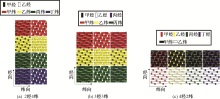
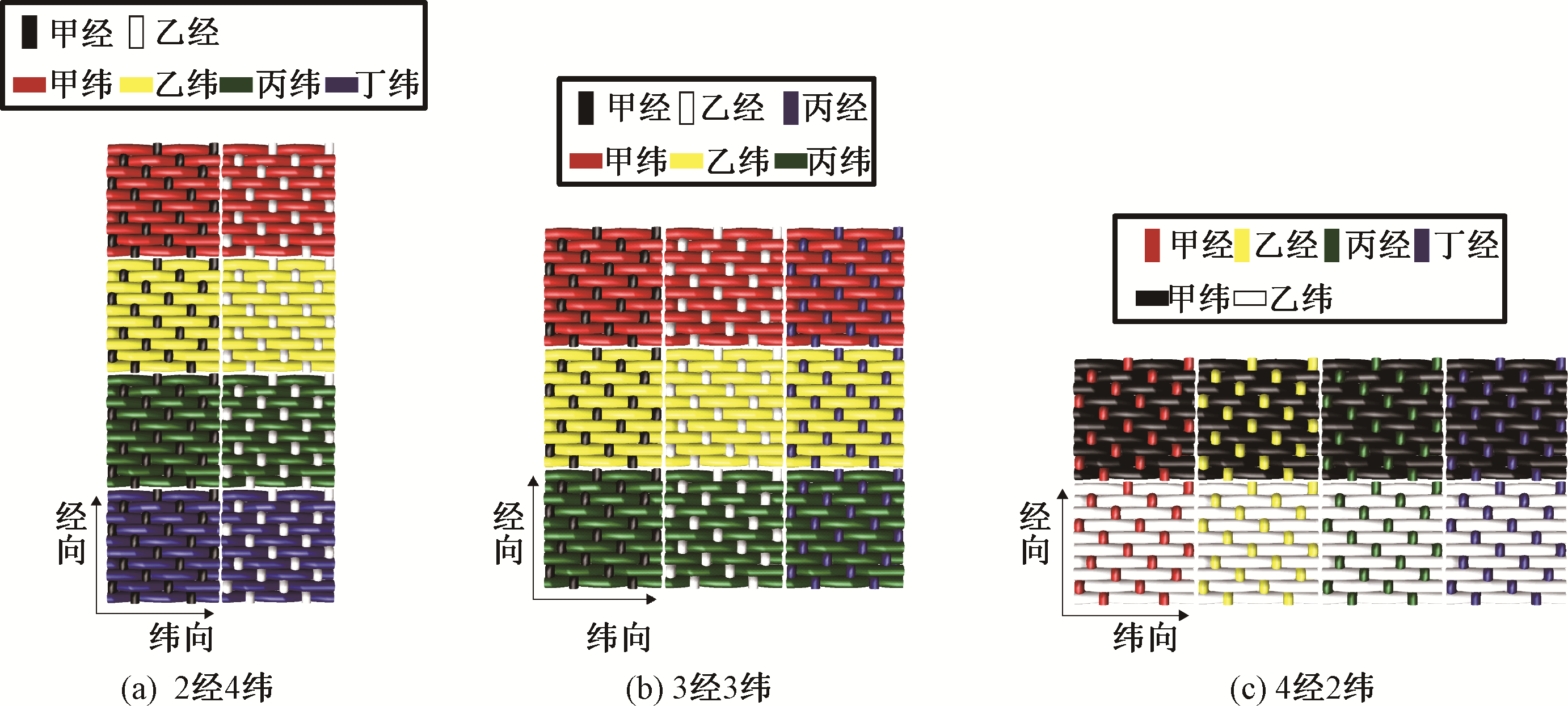
Fig.1

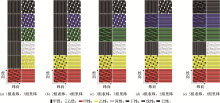
Warp and weft configuration schematic of jacquard structure basic model with bidirectional six primary color. (a) Double warps and quadruple wefts; (b) Triple warps and triple wefts; (c) Quadruple warps and double wefts"

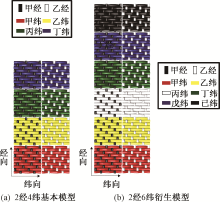
Fig.2

Selected warp and weft configuration schematic of jacquard structure basic model and derived model. (a) Basic model with double warps and quadruple wefts; (b) Derived model with double warps and sextuple wefts"

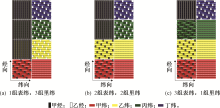
Fig.3

Face and back layer relationship schematic of jacquard structure basic model with double warps and quadruple wefts (face and back layer separate). (a) Single face weft, triple back wefts; (b) Double face wefts, double back wefts; (c) Triple face wefts, single back weft"

Fig.4

Face and back layer relationship schematic of jacquard structure derived model with double warps and sextuple wefts (face and back layer separate). (a) Single face weft, quintuple back wefts; (b) Double face wefts, quadruple back wefts; (c) Triple face wefts, triple back wefts; (d) Quadruple face wefts, double back wefts; (e) Quintuple face wefts, single back weft"

Fig.5

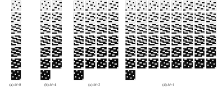
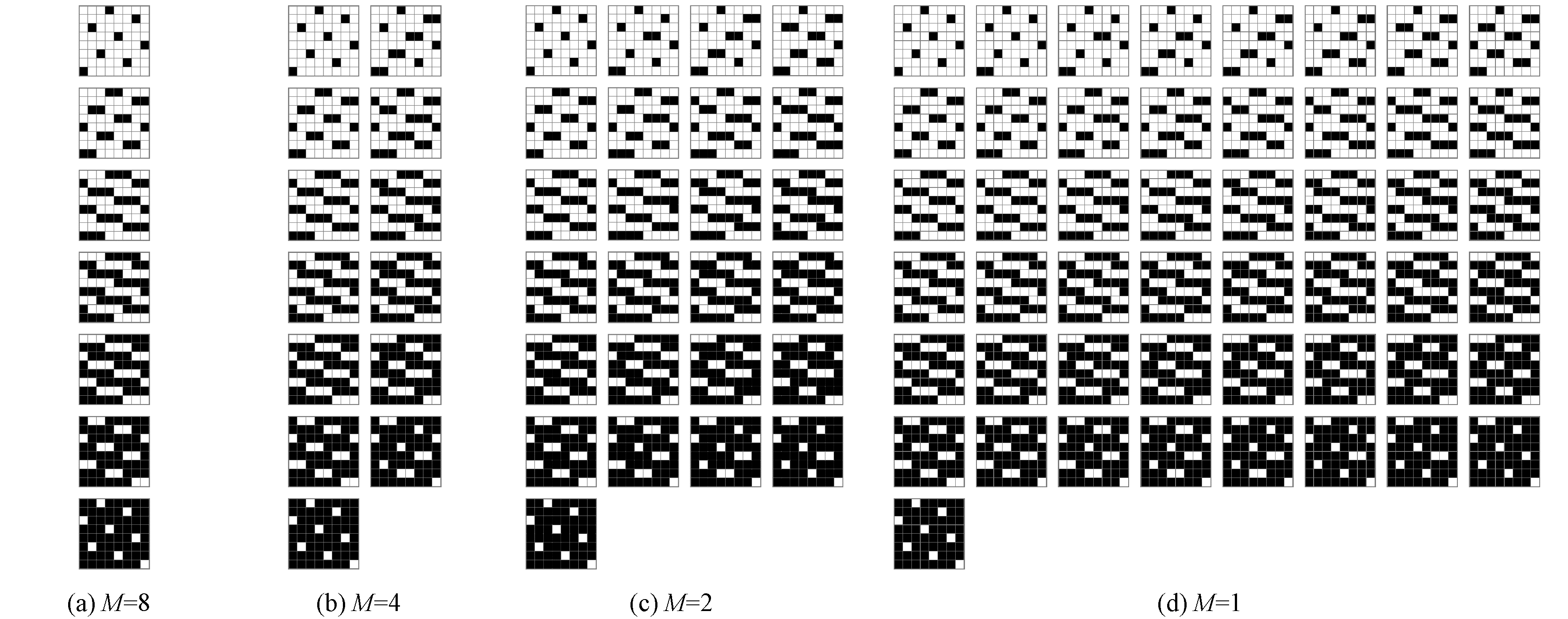
Schematic of gamut weave-database of 8-threads 5-steps satin"

Tab.1

Status and quantity of coloring compound weave-databases for basic model and derived model"

结构模型 表纬组数N 总显色组合组织数目 共口效果显色组合组织数目 非共口效果显色组合组织数目
2经4纬的基本模型
2经6纬的衍生模型
2 R 2 R - 2
3 R 2 3 ( R - 1 ) R 2 - 3 ( R - 1 )
2经6纬的衍生模型 4 R 3 R 3 - ( R - 2 ) × [ R 2 - 3 ( R - 1 ) ] ( R - 2 ) × [ R 2 - 3 ( R - 1 ) ]
5 R 4 R 4 - ( R - 2 ) × { ( R - 2 ) × [ R 2 - 3 ( R - 1 ) ] } ( R - 2 ) × { ( R - 2 ) × [ R 2 - 3 ( R - 1 ) ] }

Tab.2

Quantity of representative weaves and compound weaves for coloring based on weave repeat unit (R) of basic weave"

组织
循环
R
全息组织级别 显色组织
数目
显色组合组织数目 显色组织与
显色组合组织总数
M = R M = R / 2 M = R / 4 M = 1 单纬
渐变
双纬
渐变
三纬
渐变
四纬
渐变
五纬
渐变
2经4纬
结构
2经6纬
结构
5 4 16 16 256 4 096 65 536 1 048 576 4 368 1 118 480
8 7 13 25 49 49 2 401 117 649 5 764 801 282 475 249 120 099 288 360 149
10 9 17 33 81 81 6 561 531 441 43 046 721 3 486 784 401 538 083 3 530 369 205
12 11 21 41 121 121 14 641 1 771 561 214 358 881 25 937 424 601 1 786 323 26 153 569 805
16 15 29 57 225 57 3 249 185 193 10 556 001 601 692 057 188 499 612 436 557
20 19 37 73 361 73 5 329 389 017 28 398 241 2 073 071 593 394 419 2 101 864 253
24 23 45 89 529 89 7 921 704 969 62 742 241 5 584 059 449 712 979 5 647 514 669
32 31 61 121 961 121 14 641 1 771 561 214 358 881 25 937 424 601 1 786 323 26 153 569 805
40 39 77 153 1 521 153 23 409 3 581 577 547 981 281 83 841 135 993 3 605 139 84 392 722 413
48 47 93 185 2 209 93 8 649 804 357 74 805 201 6 956 883 693 813 099 7 032 501 993
60 59 117 233 3 481 117 13 689 1 601 613 187 388 721 21 924 480 357 1 615 419 22 113 484 497
64 63 125 249 3 969 125 15 625 1 953 125 244 140 625 30 517 578 125 1 968 875 30 763 687 625

Tab.3

Technique parameters of fabric simulation"

类别 线密度/
dtex
纱线类名 丝线色彩(配比) 总密度/
(根·(10 cm) -1)
经纬浮沉规律
经纱 55.55 EAT标准长丝 黑色∶白色(1∶1)
红色∶黄色∶绿色∶蓝色(1∶1∶1∶1)
1 180 16枚、8枚、4枚及其加强
组织、经浮长、纬浮长
纬纱 83.33 EAT标准长丝 红色∶黄色∶白色∶
绿色∶蓝色∶黑色
(1∶1∶1∶1∶1∶1)
1 180 24枚、12枚、4枚及其加强
组织、经浮长、纬浮长

Fig.6

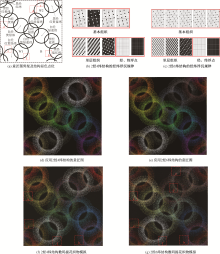
Pattern grid structural coloring points, examples of warp and weft raising and lowering diagram and fabric simulation for structure models. (a) Pattern grid framework and structural coloring points; (b) Warp and weft raising and lowering diagram for double warps and quadruple wefts structure; (c) Warp and weft raising and lowering diagram for double warps and sextuple wefts structure; (d) Pattern grid prepared for double warps and quadruple wefts structure; (e) Pattern grid prepared for double warps and sextuple wefts structure; (f) Digital jacquard fabric simulation applying double warps and quadruple wefts structure; (g) Digital jacquard fabric simulation applying double warps and sextuple wefts structure"

Fig.7

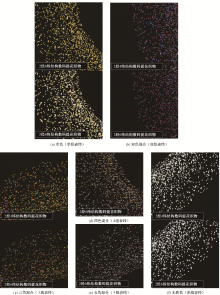
Characteristics of 6 structural coloring points. (a) Single color (single face weft); (b) Double color (double face wefts); (c) Triple color (triple face wefts); (d) Quadruple color (quadruple face wefts); (e) Quintuple color (quintuple face wefts); (f) Neutral color (single face weft)"

[1] 周赳, 龚素娣. 电子提花彩色像景织物的设计原理[J]. 丝绸, 2001 (9): 31-33, 37.
ZHOU Jiu, GONG Sudi. The design principle of colorful woven photograph in electronic Jacquard[J]. Journal of Silk, 2001 (9): 31-33, 37.
[2] 张爱丹, 周赳. 全显技术组织对三纬组合织物结构混色规律的影响[J]. 纺织学报, 2018, 39(10): 44-49.
doi: 10.13475/j.fzxb.20171010706
ZHANG Aidan, ZHOU Jiu. Influence of full-color weave on color mixing law of compound fabric structure with triple-weft[J]. Journal of Textile Research, 2018, 39(10): 44-49.
doi: 10.13475/j.fzxb.20171010706
[3] CHUNG Jih Lung. Method for manufacturing jacquard with colored image: USA, US6185475[P]. 2001-02-06.
[4] 李加林, 陶永政. 数码仿真彩色丝织技术及其应用[J]. 纺织学报, 2004, 25(1): 123-125.
LI Jialin, TAO Yongzheng. Digital emulative color silk weaving technique and application[J]. Journal of Textile Research, 2004, 25(1): 123-125.
[5] 李加林. 现代丝织像景织物及结构设计特征[J]. 丝绸, 2004(3): 11-13.
LI Jialin. Modern silk weaving photograph and its structure design features[J]. Journal of Silk, 2004(3): 11-13.
[6] SPEICH Francisco. Patterned fabric and a method for the production thereof: USA, US6994120[P]. 2006-02-07.
[7] OSAKI Keiji. Reproduction of various colors on Jacquard textiles by only eight kinds of color wefts[C]// 9th Congress of the International Colour Association. Belingham: SPIE, 2002: 740-744.
[8] NG Frankie, ZHOU Jiu. Innovative layered-combination mode for digital jacquard fabric design[J]. Textile Research Journal, 2009, 79(8): 737-743.
[9] 陆爽怿, 周赳. 单经双纬组合全显色提花织物的结构交织平衡特征[J]. 纺织学报, 2021, 42(9): 59-65.
LU Shuangyi, ZHOU Jiu. Balanced interlacement characteristics of compound full-color jacquard structure with single warp and double wefts[J]. Journal of Textile Research, 2021, 42(9): 59-65.
[10] 周赳, 胡伊丽. 等经浮长的三纬组合全显结构设计与应用[J]. 纺织学报, 2023, 44(6): 78-84.
ZHOU Jiu, HU Yili. Design and application of equal float length on full-color weave in triple-weft jacquard fabric structures[J]. Journal of Textile Research, 2023, 44(6): 78-84.
[11] 张爱丹, 郭珍妮, 汪阳子. 模块组合全显色结构提花织物设计与仿色优化比较[J]. 纺织学报, 2021, 42(10): 67-74.
doi: 10.13475/j.fzxb.20201101308
ZHANG Aidan, GUO Zhenni, WANG Yangzi. Comparative research on color simulation optimization of jacquard fabric based on modularized compound full-color structure[J]. Journal of Textile Research, 2021, 42(10): 67-74.
doi: 10.13475/j.fzxb.20201101308
[12] 张爱丹. 色彩仿真数码提花织物的纹制工艺特征分析[J]. 装饰, 2022, (6): 136-138.
ZHANG Aidan. Characteristic analysis of weave pattern production process of color simulation digital Jacquard fabric[J]. Art & Design, 2022, (6): 136-138.
[13] KIM K R, XIN J H, ZENG L. CMYK channel modification to optimize optical yarn color mixing effects for multicolored jacquard artwork reproduction[J]. Textile Research Journal, 2022, 92(13/14): 2357-2367.
[14] ZENG Lei, KIM Ken Ri, XIN John H. A feasible weave color scope inspection by using primary yarn colors to improve jacquard reproduction quality[J]. Textile Research Journal, 2022, 92(19/20): 3641-3652.
[15] HUA Tao, TANG Lau Yiu, CHIU Wing Yan, et al. Color attributes of colored-yarn mixed woven fabrics made of raw-white warps and multicolored wefts and based on weft-backed structures[J]. Polymers, 2018, 10(2): 1-8.
[16] CHAE Youngjoo. A spectral reflectance-based approach for formulating color mixing recipes for single- and multi-layered woven structures[J]. Scientific Reports, 2022, 12(1): 1-7.
[17] SPEICH Francisco. Method of manufacturing colored patterned, aerial textile structures, system for carrying out the method and aerial textile structure formed in accordance with the method: USA, US6390143[P], 2002-05-21.
[18] 罗炳金. 棉织锦3种色彩组织模型设计与应用[J]. 纺织学报, 2012, 33(7): 39-44.
LUO Bingjin. Design and application of three models of color figured patterns for woven cotton brocade[J]. Journal of Textile Research, 2012, 33(7): 39-44.
[19] MATHUR Kavita, et al.SEYAM Abdel-Fattah M, HINKS David, Towards automation of color/weave selection in Jacquard design: model verification[J]. Color Research and Application, 2009, 34(3): 225-232.
[20] 李启正. 多色经提花织物用于彩色图像表现的创新设计技术[D]. 杭州: 浙江理工大学, 2005: 10-46.
LI Qizheng. An innovative design method on multi-warp jacquard fabric to imitate color image[D]. Hangzhou: Zhejiang Sci-Tech University, 2005: 10-46.
[21] 黄伟斌, 罗来丽, 周赳. 四色经高密度数码提花丝织物的设计实践[J]. 丝绸, 2011, 48(1): 34-36.
HUANG Weibin, LUO Laili, ZHOU Jiu. Design practice on 4-color warps high density jacquard silk tapestry[J]. Journal of Silk, 2011, 48(1): 34-36.
[22] 黄伟斌, 罗来丽, 周赳. 高密度多色经提花丝织物的数码化设计[J]. 纺织学报, 2011, 32(6): 56-60.
HUANG Weibin, LUO Laili, ZHOU Jiu. Digital design of high density multicolored-warp jacquard silk brocade[J]. Journal of Textile Research, 2011, 32(6): 56-60.
[23] 周赳, 段丽娜, 屠永坚. 双经双纬渐变显色提花织物设计原理与方法[J]. 纺织学报, 2016, 37(6): 36-41, 47.
ZHOU Jiu, DUAN Lina, TU Yongjian. Design principle and method of color gradient expression on double-warp double-weft jacquard fabric[J]. Journal of Textile Research, 2016, 37(6): 36-41, 47.
[24] 刘志娟. 双经三纬渐变显色提花织物设计研究与实践[D]. 杭州: 浙江理工大学, 2020: 6-45.
LIU Zhijuan. Design research and practice of color gradient effect jacquard fabric with double-warps and three-wefts[D]. Hangzhou: Zhejiang Sci-Tech University, 2020: 6-45.
[1] MU Xiuping, JIANG Gaoming, CHEN Yushan, LI Bingxian. Digital design method for multi-needle bed weft-knitted fabric [J]. Journal of Textile Research, 2024, 45(11): 106-113.
[2] SHI Zhicheng, ZHANG Yu, YU Hong, MA Guiling, CHEN Fengxiang, XU Weilin. Research progress of biomimetic structural color technology and its application in textile field [J]. Journal of Textile Research, 2024, 45(08): 241-249.
[3] CHEN Kun, XU Jingying, ZHENG Yiqian, LI Jialin, HONG Xinghua. Conductivity and electrical heating properties of reduced graphene oxide modified silk fabric by screen printing [J]. Journal of Textile Research, 2024, 45(03): 122-128.
[4] HAN Ye, TIAN Miao, JIANG Qingyun, SU Yun, LI Jun. Three dimensional modeling and heat transfer simulation of fabric-air gap-skin system [J]. Journal of Textile Research, 2024, 45(02): 198-205.
[5] JIANG Shaohua, LIANG Shuaitong, PEI Liujun, ZHANG Hongjuan, WANG Jiping. Analysis of fabric dyeing intrusion kinetics based on probability density function [J]. Journal of Textile Research, 2023, 44(10): 90-97.
[6] YIN Ang, CONG Honglian. Design and structure optimization of warp knitted unidirectional moisture conducting fabrics [J]. Journal of Textile Research, 2023, 44(04): 86-91.
[7] WEN Jiaqi, LI Xinrong, LI Xingxing, WU Liubo. Parametrical modeling of sewing process for automatic stitching of garment fabrics [J]. Journal of Textile Research, 2023, 44(03): 158-167.
[8] XUE Baoxia, SHI Yiran, ZHANG Feng, QIN Ruihong, NIU Mei. Preparation flame retardant polyester fabric modified with halogen-free ferric oxide and its property [J]. Journal of Textile Research, 2022, 43(05): 130-135.
[9] ZHANG Meng, ZHOU Jiu. Design principle and method of double-layer full-color structure with central weft stitching [J]. Journal of Textile Research, 2022, 43(03): 83-88.
[10] FANG Meiqi, WANG Qian, LI Yan, LI Chaojing, LI Hao, WANG Lu. Design and in-vitro mechanical property analyses of sling for female stress urinary incontinence [J]. Journal of Textile Research, 2022, 43(03): 38-43.
[11] PENG Xi, TU Yongjian, ZHOU Jiu. Design principle and method for gradient weft-backed structure with 2∶1 weft arrangement [J]. Journal of Textile Research, 2021, 42(12): 63-69.
[12] HUANG Jinbo, ZHU Chengyan, ZHANG Hongxia, HONG Xinghua, ZHOU Zhifang. Design of three-dimensional spacer fabrics based on rapier looms [J]. Journal of Textile Research, 2021, 42(06): 166-170.
[13] MENG Lingling, WEI Qufu, YAN Zhongjie, ZHONG Zhenzhen, WANG Xiaohui, SHEN Jiayu, CHEN Hongwei. Preparation and properties of Ag/ZnO composite film deposited polyester fabrics by magnetron sputtering [J]. Journal of Textile Research, 2021, 42(03): 143-148.
[14] LÜ Qingtao, ZHAO Shibo, DU Peijian, CHEN Li. Research status of fatigue properties characterization and analysis methods of resin matrix composites [J]. Journal of Textile Research, 2021, 42(01): 181-189.
[15] LIU Muli, YUAN Li, YANG Yali, LIU Junping, GONG Xue, YAN Yuchen. Influence of fabric weaves on characteristics of colored patterns in color-woven fabrics [J]. Journal of Textile Research, 2020, 41(09): 45-53.
Viewed
Full text


Abstract

Cited

  Shared   
  Discussed   
No Suggested Reading articles found!