Journal of Textile Research ›› 2025, Vol. 46 ›› Issue (07): 37-45.doi: 10.13475/j.fzxb.20240803101

• Fiber Materials • Previous Articles     Next Articles

Preparation and antibacterial property of zinc oxide-silver/bio-based polyamide 56 composite nanofiber membranes

XU Liya1,2, WANG Zhen3, YANG Hongjie1, WANG Wei1()   

  1. 1 College of Materials and Textile Engineering, Jiaxing University, Jiaxing, Zhejiang 314001, China
    2 Zhejiang Taihua New Materials Co., Ltd., Jiaxing, Zhejiang 314011, China
    3 The First Hospital of Jiaxing, Affiliated Hospital of Jiaxing University, Jiaxing, Zhejiang 314001, China
  • Received:2024-08-19 Revised:2025-04-05 Online:2025-07-15 Published:2025-08-14
  • Contact: WANG Wei E-mail:zjxuwangwei@163.com

Abstract:

Objective Bio-based polypentanediamine adipate (PA56), entirely or partially synthesized from biomass feedstocks, has emerged as environmentally friendly alternative to petroleum-based counterparts and has gained considerable at traction in recent years. PA56 holds significant potential in textiles, food packaging and other fields, by virtue of its good strength and toughness with excellent fatigue resistance. Despite its promising prospects, limited studies have been given to PA56 nanofibers for biomedical applications. Hence, nano ZnO-Ag compound antibacterial agent was prepared and blended with PA56 matrix. ZnO-Ag/PA56 composite nanofiber membranes were then fabricated by electrospinning process for antibacterial applications.

Method The preparation of ZnO-Ag nano particles includes mixing a complex of silver acetate and ammonium hydroxide with nano ZnO dispersions, followed by the addition of formic acid as a reducing agent. The prepared ZnO-Ag particles were blended with PA56 matrix by melt extrusion and ZnO-Ag/PA56 composite nanofiber membranes were then fabricated by electrospinning technology. Morphologies of the ZnO-Ag particles and ZnO-Ag/PA56 nanofiber membranes were characterized with transmission electron microscopy (TEM) and scanning electron microscopy (SEM). The influences of encapsulated ZnO-Ag particles on the antibacterial activity, crystallinity, mechanical and wettability properties of the nanofiber membranes were investigated. Furthermore, the cytotoxicity and skin stimulation of the ZnO-Ag/PA56 nanofiber membranes were analyzed.

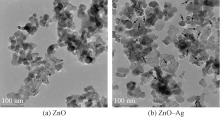
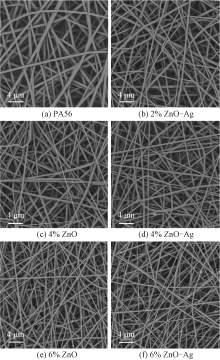
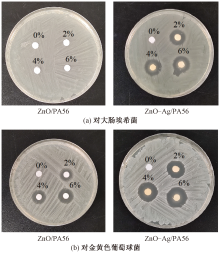
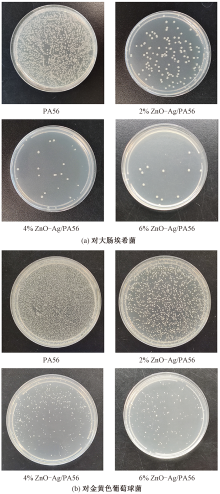
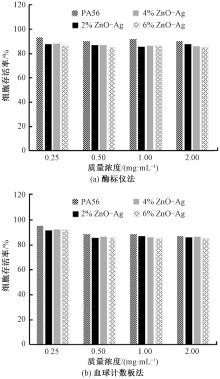
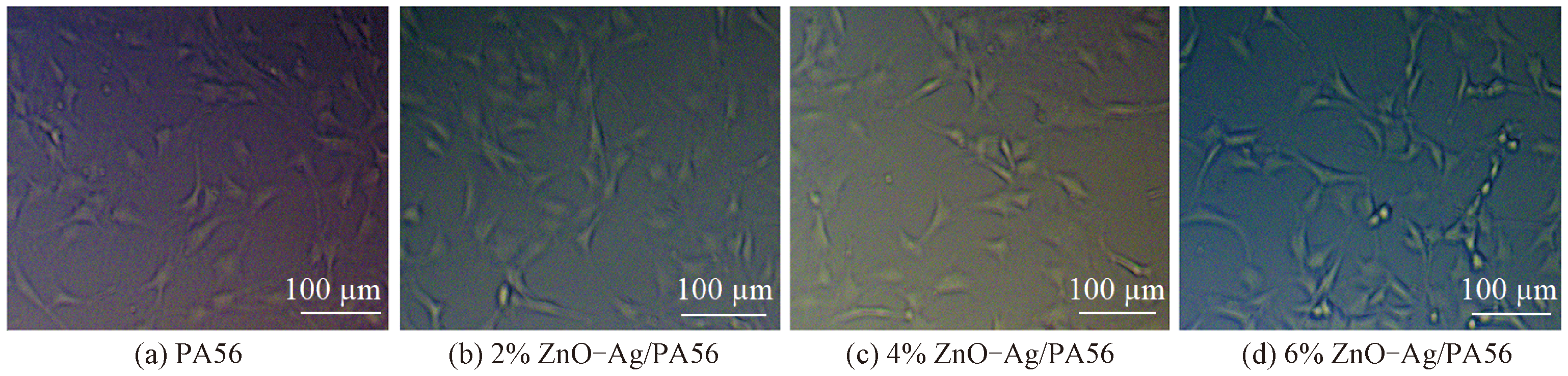
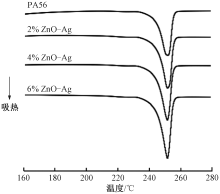
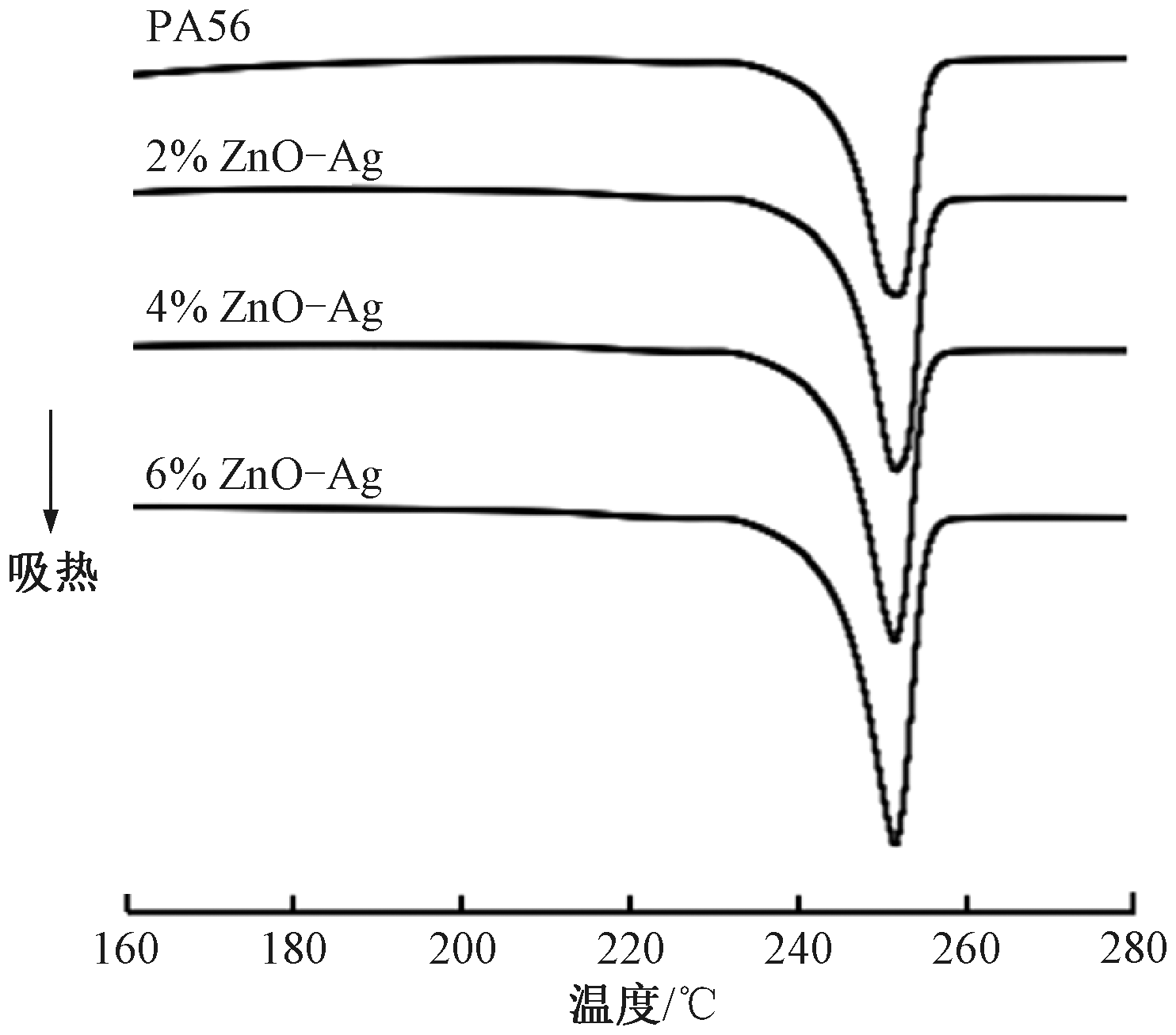
Results The average sizes of original ZnO particles are about 20-30 nm and the Ag particles embedded in the prepared ZnO-Ag compound are spherical in shape with an average diameter of 6-10 nm, which have been reported to show higher antimicrobial efficacy. Blank PA56 nanofibers have uniform morphology and smooth surface. ZnO-Ag/PA56 nanofibers have round morphology and ZnO-Ag particels distribute in the nanofibers uniformly without any obvious gathering. The average diameter of ZnO-Ag/PA56 nanofibers decreases with the increase of ZnO-Ag content. This is because that ZnO is a semiconductor and Ag is a conductor, which can increase the charge density of the spinning solution and give a strong elongation force to the ejected polymeric jet. When ZnO-Ag mass fraction is 6%, the average diameter of ZnO-Ag/PA56 nanofiber is 401.18 nm, 54.9% of the average diameter of PA56 nanofiber (731.40 nm). The results of inhibition zone test show that blank PA56 nanofiber membranes do not offer any antibacterial ability. ZnO/PA56 nanofiber membranes have antibacterial activity against Staphylococcus aureus, while have not antibacterial ability against Escherichia coli. ZnO-Ag/PA56 nanofiber membranes exhibit good antibacterial effects against Staphylococcus aureus and Escherichia coli. In order to quantify the antibacterial properties of ZnO-Ag/PA56 nanofibers, a standard plate counting approach that tracked bacterial proliferation was performed. After incubation with the bacterial suspension, Staphylococcus aureus and Escherichia coli in ZnO-Ag/PA56 nanofiber groups show lower viability than those in the PA56 groups, where bacterial colonies proliferate extensively. A sharp decrease in colony formation occurres at a mass fraction of 2% ZnO-Ag and the nanofiber membranes exhibit higher inhibition rate against Staphylococcus aureus (73.5%) than Escherichia coli (51.5%). Increasing the content of ZnO-Ag in the nanofibers significantly enhances their antibacterial capability. The nanofiber membranes containing 4% ZnO-Ag effectively suppress the bacteria growth, and the antibacterial rate is 96.1% for Staphylococcus aureus and 84.2% for Escherichia coli. When the mass fraction of ZnO-Ag are 6%, the antibacterial rate reaches 98.7% and 89.3% against Staphylococcus aureus and Escherichia coli, respectively. The NIH-3T3 cells were incubated with extract solution to check the biosafety of ZnO-Ag/PA56 nanofibers. After 48 h incubation, all the cells have normal morphology and are harvested at viability greater than 85%. In order to evaluate the potential skin inflammation caused by ZnO-Ag/PA56 nanofiber meshes, the samples were placed on the back skin of mice. After patch application for 24 h, no evidence of erythema, edema or other changes is found on the skin surface. Moreover, no conspicuous local inflammation or adverse events occurs in viable epidermis and dermis. These results suggest that the ZnO-Ag/PA56 nanofibers are biocompatible and well tolerated by the skin. The crystalline behavior of ZnO-Ag/PA56 nanofiber was characterized by differential scanning calorimetry (DSC). The addition of ZnO-Ag particles in PA56 nanofibers has no significant influence on melting temperature, while the melting peak area increases, indicating the increased crystallinity of the nanofibers with ZnO-Ag mass fraction. This is because that the growing charge density of the spinning solution promotes the stretching and orientation of the ejected polymeric jet. ZnO-Ag particles can also induce heterogeneous crystallization as nucleating agents and increase the crystallinity of polymer. As well known, a higher degree of crystallinity indicates a greater number of macromolecular chain segments being incorporated into the crystalline region, thereby enhancing deformation resistance. Therefore, the tensile strength of ZnO-Ag/PA56 nanofiber membranes increases with ZnO-Ag mass fraction. The blank PA56 nanofiber membranes present an ultimate breaking strength of 8.81 MPa, and that raises to 13.89 MPa with increasing ZnO-Ag mass fracton to 6%. The wettability of the nanofiber membranes was evaluated through water contact angle (WCA) analysis. The surface WCA of PA56 nanofiber membranes is about 88.37°, and the water droplet immerses through the membrane within 21 s. It is known that PA56 possesses hydrophilicity by virtue of the repeating units with polar amide groups (—CONH—) along the polymer chain. Because ZnO-Ag is a polar substance, the incorporation of ZnO-Ag into PA56 nanofibers improves the hydrophilicity of the membranes. When the mass fraction of ZnO-Ag is 6%, the surface WCA of the membrane is about 58.91°, and the water drop disappears quickly within 3 s.

Conclusion ZnO-Ag composite antibacterial agent containing Ag particles with a diameter of 6-10 nm was prepared and ZnO-Ag/PA56 nanofiber membranes were fabricated by electrospinning process. The ZnO-Ag/PA56 nanofibers have round morphology and ZnO-Ag particles distribute in the nanofibers uniformly without any obvious aggregation. With the increase of ZnO-Ag mass fraction, the crystallinity, tensile strength and hydrophilicity of ZnO-Ag/PA56 nanofibers increase, while the average diameter of the nanofibers decreases. The antibacterial rates of ZnO-Ag/PA56 nanofiber membranes containing 6% ZnO-Ag against Staphylococcus aureus and Escherichia coli are 98.7% and 89.3%, respectively. The ZnO-Ag/PA56 nanofiber membranes also have good biocompatibility and skin tolerability, which offers a great potential in biomedical applications.

Key words: bio-based fiber, functional fiber, bio-based polypentanediamine adipate, electrospinning, nanofiber, nano zinc oxide-silver, antibacterial property

CLC Number: 

  • TS102.6

Fig.1

TEM images of ZnO(a) and ZnO-Ag(b) nanoparticles"

Fig.2

SEM images of nanofiber membranes"

Tab.1

Average diameters and their variation coefficients of PA56, ZnO/PA56 and ZnO-Ag/PA56 nanofibers"

样品名称 平均直径/nm 直径变异系数/%
PA56 731.40 15.29
2% ZnO/PA56 641.80 11.98
2% ZnO-Ag/PA56 562.61 14.90
4% ZnO/PA56 507.39 12.18
4% ZnO-Ag/PA56 463.43 12.05
6% ZnO/PA56 432.11 16.91
6% ZnO-Ag/PA56 401.18 13.70

Fig.3

Qualitative test results of PA56, ZnO/PA56 and ZnO-Ag/PA56 nanofiber membranes against Escherichia coli (a) and Staphylococcus aureus(b)"

Tab.2

Width of bacteriostatic circles of PA56, ZnO/PA56 and ZnO-Ag/PA56 nanofiber membranes"

样品名称 抑菌带宽度/mm
对大肠埃希菌 对金黄色葡萄球菌
PA56 0 0
2% ZnO/PA56 0 3.79
2% ZnO-Ag/PA56 4.48 5.17
4% ZnO/PA56 0 4.24
4% ZnO-Ag/PA56 4.83 5.92
6% ZnO/PA56 0 4.50
6% ZnO-Ag/PA56 5.02 6.58

Fig.4

Quantitative test results of PA56 and ZnO-Ag/PA56 nanofiber membranes against Escherichia coli (a) and Staphylococcus aureus (b)"

Fig.5

Cell viability after 48 h incubation with extract solutions at different concentrations. (a)Enzyme labeling method; (b) Blood cell counting plate method"

Fig.6

Microscope images of NIH-3T3 cells after incubation with different extracting solutions"

Fig.7

Real (a) and micrograph images (b) of mice back skin after 24 h application with PA56 or ZnO-Ag/PA56 nanofiber membranes"

Fig.8

DSC curves of PA56 and ZnO-Ag/PA56 nanofiber membranes under heating"

Tab.3

Crystallinity and breaking strength of PA56 and ZnO-Ag/PA56 nanofiber membranes"

样品名称 结晶度/% 断裂强度/MPa
PA56 35.82 8.81
2% ZnO-Ag/PA56 37.93 9.68
4% ZnO-Ag/PA56 40.46 11.37
6% ZnO-Ag/PA56 44.68 13.89

Tab.4

Hydrophilicity of PA56 and ZnO-Ag/PA56 nanofiber membranes"

样品名称 初始接触角/(°) 完全浸润时间/s
PA56 88.37 21
2% ZnO-Ag/PA56 82.04 12
4% ZnO-Ag/PA56 72.45 8
6% ZnO-Ag/PA56 58.91 3
[1] 孙朝续, 刘修才. 生物基聚酰胺56纤维在纺织领域的应用研究进展[J]. 纺织学报, 2021, 42(4): 26-32.
SUN Chaoxu, LIU Xiucai. Research progress on applications of bio-based polyamide 56 fibers in textile fields[J]. Journal of Textile Research, 2021, 42(4): 26-32.
[2] YANG H Y, LIU W T. Bio-based polyamide 56: recent advances in basic and applied research[J]. Polymer Engineering and Science, 2023, 63(8): 2484-2497.
[3] 张施岚. 生物基聚酰胺56织物染色性能研究[D]. 上海: 东华大学, 2020: 5-8.
ZHANG Shilan. Study on dyeing properties of bio-based polyamide 56 fabric[D]. Shanghai: Donghua University, 2002:4-8.
[4] WANG Z, KANG H L, LIN N, et al. Bio-based polyamide 56 fibers by one-step melt-spinning: process, structure and properties[J]. Journal of Applied Polymer Science, 2023. DOI: 10.1002/app.53856.
[5] 黄连香, 王祥荣, 侯学妮, 等. 茜草色素对生物基聚酰胺56的染色性能[J]. 纺织学报, 2024, 45(7): 94-101.
HUANG Lianxiang, WANG Xiangrong, HOU Xueni, et al. Dyeing properties of madder pigment on bio-based polyamide 56[J]. Journal of Textile Research, 2024, 45(7): 94-101.
[6] 丁照轩. 生物基PA56静电纺纳米纤维网形貌调控及其应用[D]. 大连: 大连工业大学, 2021: 52-65.
DING Zhaoxuan. Morphology control and application of bio-based PA56 electro-spun nano-fiber network[D]. Dalian: Dalian Polytechnic University, 2021: 52-65.
[7] XU Yuhan, WANG Jinheng, WANG Zihao, et al. Bio-based polyamide fibers prepared by mussel biomimetic modification of hydroxyapatite[J]. European Polymer Journal, 2023. DOI: 10.1016/j.eurpolymj.2023.111913.
[8] KASTNER J, FAURY T, AUSSERHUBER H M, et al. Silver-based reactive ink for inkjet-printing of conductive lines on textiles[J]. Microelectronic Engineering, 2017, 176: 84-88.
[9] WALKER S B, LEWIS J A. Reactive silver inks for patterning high-conductivity features at mild temperatures[J]. Journal of the American Chemical Society, 2012, 134(3): 1419-1421.
doi: 10.1021/ja209267c pmid: 22220580
[10] MA W, LI L, LIN X H, et al. Novel ZnO/n-halamine-mediated multifunctional dressings as quick antibacterial agent for biomedical applications[J]. ACS Applied Materials & Interfaces, 2019, 11(34): 31411-31420.
[11] 渠赟, 马维, 刘颖, 等. 可光降解聚羟基丁酸酯/聚己内酯基抗菌纤维膜的制备及其性能[J]. 纺织学报, 2022, 43(6): 29-36.
QU Yun, MA Wei, LIU Ying, et al. Antibacterial fiber membrane with photodegradation function based on polyhydroxybutyrate/polycaprolactone[J]. Journal of Textile Research, 2022, 43(6): 29-36.
[12] BHATTARAI R S, BACHU R D, BODDU S H S, et al. Biomedical applications of electrospun nanofibers: drug and nanoparticle delivery[J]. Pharmaceutics, 2019. DOI: 10.3390/pharmaceutics11010005.
[13] ZHENG K Y, SETYAWATI M I, LEONG D T, et al. Antimicrobial silver nanomaterials[J]. Coordination Chemistry Reviews, 2018, 357: 1-17.
[14] XUE C F, HSU K M, CHIU C Y, et al. Fabrication of bio-based polyamide 56 and antibacterial nanofiber membrane from cadaverine[J]. Chemosphere, 2021. DOI: 10.1016/j.chemosphere.2020.128967.
[15] YAN Y R, GOONEIE A, YE H X, et al. Morphology and crystallization of biobased polyamide 56 blended with polyethylene terephthalate[J]. Macromolecular Materials and Engineering, 2018. DOI: 10.1002/mame.201800214.
[16] PUIGGALÍ J, FRANCO L, ALEMÁN C, et al. Crystal structures of nylon 5,6: a model with two hydrogen bond directions for nylons derived from odd diamines[J]. Macromolecules, 1998, 31(24): 8540-8548.
[17] 王宇. 生物基聚酰胺56的共混改性及其结晶性能研究[D]. 上海: 东华大学, 2020: 28-30.
WANG Yu. Study on blending modification and crystallization properties of bio-based polyamide 56[D]. Shanghai: Donghua University, 2020: 28-30.
[18] 王宇, 胡红梅, 朱瑞淑, 等. 纳米粉体改性生物基尼龙56的等温结晶动力学[J]. 东华大学学报(自然科学版), 2020, 46(5): 703-711.
WANG Yu, HU Hongrnei, ZHU Ruishu, et al. Isothermal crystallization kinetics of nano-powder modified bio-based nylon 56[J]. Journal of Donghua University (Natural Science Edition), 2020, 46(5): 703-711.
[19] ELTAHIR Y A, SAEED H A M, XIA Y, et al. Mechanical properties, moisture absorption, and dyeability of polyamide 5,6 fibers[J]. Journal of the Textile Institute, 2015, 107(2): 208-214.
[1] ZHANG Liping, GUO Yuqing, DING Bo, SUN Jie. Preparation and properties of aramid nanofibers/thermoplastic polyurethane composite microporous membrane and respirable coated fabric [J]. Journal of Textile Research, 2025, 46(07): 19-27.
[2] ZHU Lei, LI Xiaojun, CHENG Chunzu, XU Jigang, DU Xinyu. Influences of sodium tetraborate/tannic acid cross-linking on structure and properties of calcium alginate fibers [J]. Journal of Textile Research, 2025, 46(07): 28-36.
[3] LIN Yuting, XU Shilin, HU Yi. Preparation and performance of multi-color thermoplastic urethane/polyacrylonitrile nanofiber yarns [J]. Journal of Textile Research, 2025, 46(07): 78-86.
[4] JIA Chennuowa, ZHANG Yong, ZHU Weiyan, LIU Sai, TANG Ning. Influence of core types on performance of conductive core-spun yarn prepared from polyacrylonitrile nanofibers [J]. Journal of Textile Research, 2025, 46(07): 87-95.
[5] CHEN Yajuan, GUO Hanyu, ZHANG Chentian, LI Xinxin, ZHANG Xueping. Preparation and hygroscopic properties of polyvinyl alcohol/sodium alginate/polyamide 66 composite hydrogel core-spun yarns [J]. Journal of Textile Research, 2025, 46(06): 103-110.
[6] DING Zhenhua, YUAN Kaiyu, ZHOU Jing, YE Dongdong. Research progress in cellulose nanofluid systems for osmotic energy harvesting [J]. Journal of Textile Research, 2025, 46(06): 56-62.
[7] WANG Chunxiang, LI Jiao, XIE Kaifang, XUE Hongkun, XU Guangbiao. Preparation and properties of gastrodia elata polysaccharide/polyvinyl alcohol antibacterial food-wrap membrane by electrospinning [J]. Journal of Textile Research, 2025, 46(06): 73-79.
[8] ZHANG Jiacheng, YU Ying, ZUO Yuxin, GU Zhiqing, TANG Tengfei, CHEN Hongli, LÜ Yong. Torsional sensing characteristics of polyacrylonitrile/MoS2 fiber membranes based on flexoelectric effect [J]. Journal of Textile Research, 2025, 46(06): 80-87.
[9] QIU Yue, YANG Xun, LI Hao, LI Haidong, WU Guozhong, ZHANG Caidan. Modification of polysuccinimide nano fibrous membrane and its dye adsorption properties [J]. Journal of Textile Research, 2025, 46(06): 88-95.
[10] SUN Jie, GUO Yuqing, QU Yun, ZHANG Liping. Preparation and performance of aramid nanofibers/MXene coaxial fiber electrodes [J]. Journal of Textile Research, 2025, 46(05): 125-134.
[11] WANG Wei, GAO Jiannan, PEI Xiaohan, LU Xin, SUN Yinyin, WU Jianbing. Fabrication and oil-water separation efficiency of cellulose/methyltrimethoxysilane aerogel [J]. Journal of Textile Research, 2025, 46(05): 135-142.
[12] SHI Xiaocong, CHEN Li, DU Xun. Preparation of alizarin-polylactic acid/collagen nanofiber membrane and its ammonia detection performance [J]. Journal of Textile Research, 2025, 46(05): 143-150.
[13] YAN Jing, WANG Yaqian, LIU Jingjing, LI Haoyi, YANG Weimin, KANG Weimin, ZHUANG Xupin, CHENG Bowen. Preparation of melt-electrospun filament yarns and their applications in triboelectric nanogenerators [J]. Journal of Textile Research, 2025, 46(05): 23-29.
[14] ZHANG Zeqi, ZHOU Tao, ZHOU Wenqi, FAN Zhongyao, YANG Jialei, CHEN Guoyin, PAN Shaowu, ZHU Meifang. Research progress in conductive fibers for electrophysiological signal monitoring [J]. Journal of Textile Research, 2025, 46(05): 70-76.
[15] GUO Jieyan, XU Yingwen, DING Fang, REN Xuehong. Research progress in the applications of N-halamine antibacterial agents and their modified fibers [J]. Journal of Textile Research, 2025, 46(04): 255-263.
Viewed
Full text


Abstract

Cited

  Shared   
  Discussed   
No Suggested Reading articles found!