Journal of Textile Research ›› 2025, Vol. 46 ›› Issue (09): 128-135.doi: 10.13475/j.fzxb.20241000801

• Textile Engineering • Previous Articles     Next Articles

Construction and color rendering characteristics of jacquard structure model with double warps and quadruple wefts for double-weft color gradation

LU Shuangyi1,2, WANG Lan1,2, CHEN Si1,2, ZHOU Jiu1,2()   

  1. 1. Silk and Fashion Research Center of Zhejiang Province, Zhejiang Sci-Tech University, Hangzhou, Zhejiang 310018, China
    2. Zhejiang Sci-Tech University Shengzhou Innovation Research Institute, Shaoxing, Zhejiang 312400, China
  • Received:2024-10-09 Revised:2025-05-30 Online:2025-09-15 Published:2025-11-12
  • Contact: ZHOU Jiu E-mail:zhoujiu34@126.com

Abstract:

Objective Towards full understanding of characteristics of jacquard woven fabrics with double warps and quadruple wefts for double-weft color gradation, construction of jacquard woven fabric models are proposed involving six primary color threads (red, yellow, green, blue, black, and white), with a double-layer structure which enables independent regulation over the coloring and the backing warp and weft threads. Five key factors are taking into consideration in the development and calculation of double-weft color gradation compound weaves for color expression, namely the weave repeat number N, the step number S, the quantity of its available value ${Q}_{{S}_{N}}$QSN, the transition speed M, and the quantity of available interlacing for stitching at the stitching positions QIS. This research aims to provide insights for the color space construction and jacquard structure modeling with double warps and quadruple wefts for double-weft color gradation.

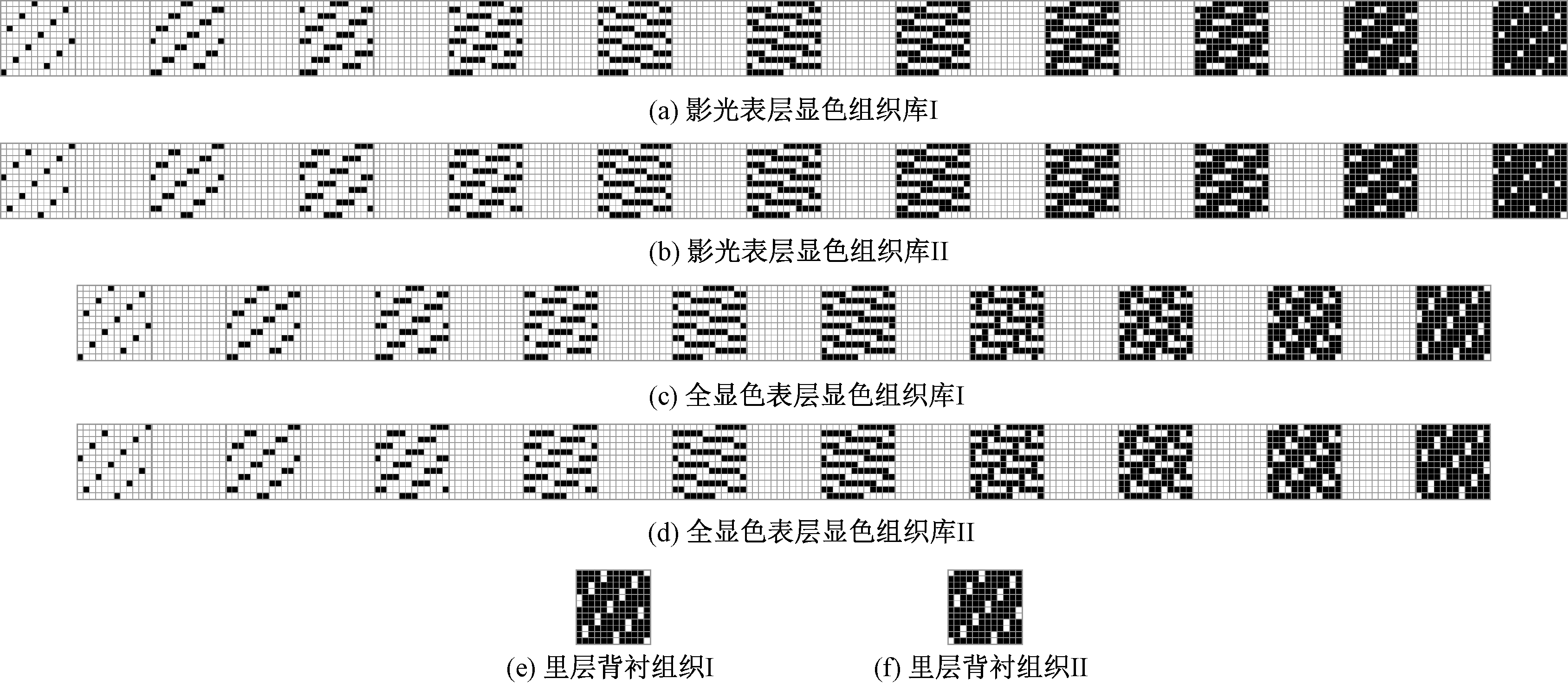
Method In order to construct the fabric model, 2 sets of achromatic threads and 4 sets of chromatic threads were placed in the warp and weft configuration, and the face and back weaves, as well as the relationship between the face and back layers were arranged to form double-weft color gradation compound weaves with their quantities calculated. Eventually, 12-thread 7-step sateen was selected as basic weave for shaded face weave-database and full-color face weave-database establishment. Double-weft color gradation compound weaves for validation were employed for the EAT sample simulation, enabling comparison and analysis of the structural coloring characteristics of jacquard structure with double warps and quadruple wefts for double-weft color gradation according to technique parameters given.

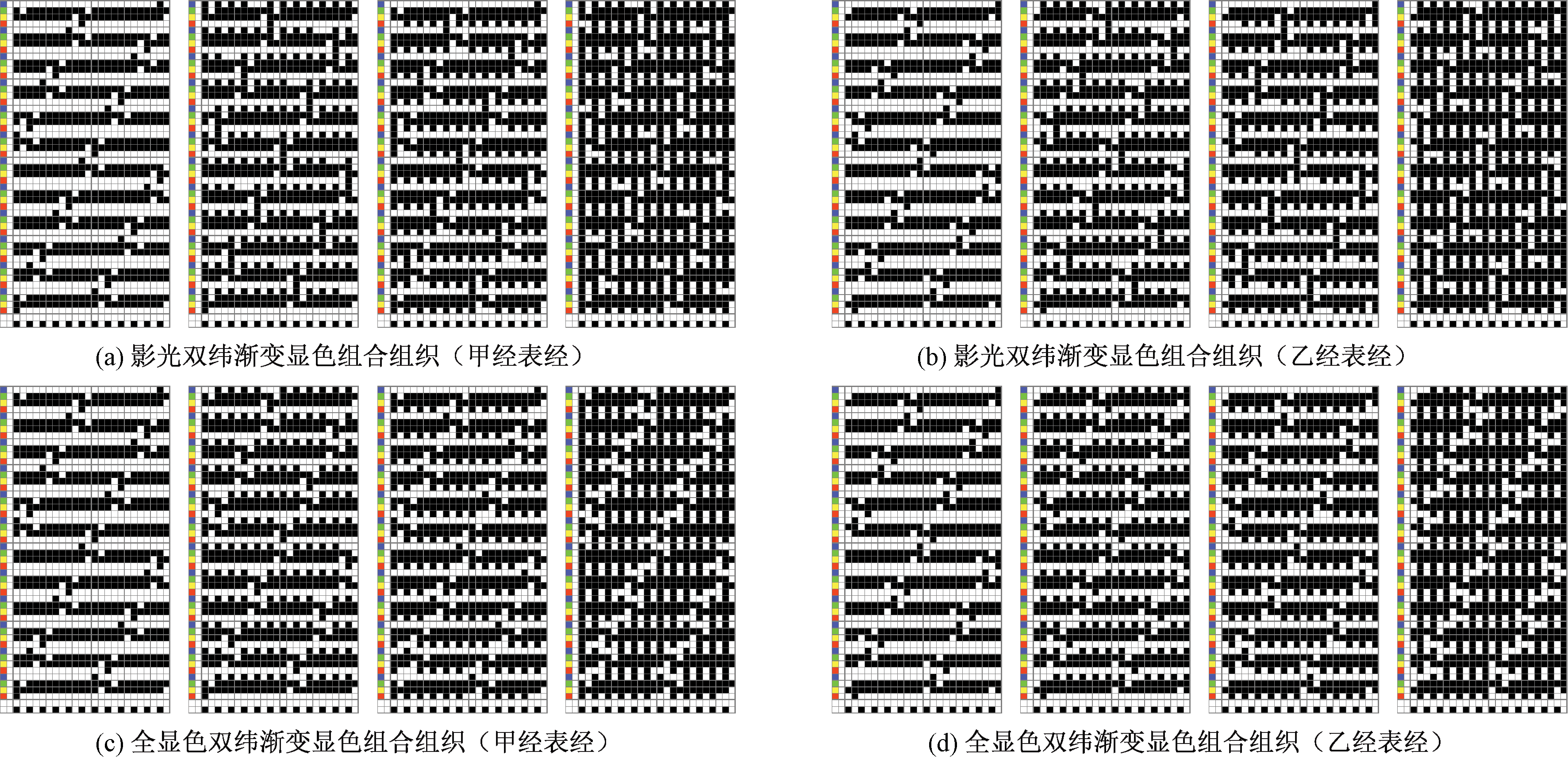
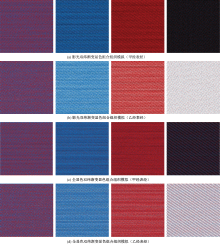
Results 720 varieties of jacquard structure model were found available with double warps and quadruple wefts based on six primary color threads. 3 warp and weft color configurations were formed according to the arrangement of achromatic and chromatic warp and weft threads, generaing 8 types of warp and weft color configuration on the face layer, and maximizing the structural coloring space, 2 sets achromatic warp and 4 sets chromatic weft were employed to the construction of jacquard structure model with double warps and quadruple wefts for double-weft color gradation. Further, 12 structural coloring series of jacquard structure model with double warps and quadruple wefts on double-weft gradation were formed under the interlacement of single achromatic warp and double chromatic weft. The maximum quantity of compound weaves applying shaded weaves is $12\times {Q}_{S{W}_{M=1}}^{4}\times [1+4({2}^{N}-1)+4({2}^{N}{-1)}^{2}]$12×QSWM=14×[1+4(2N-1)+4(2N-1)2], while that employing full-color face weaves is $12\times {2}^{4{N}^{2}-8N}\times [1+4({2}^{N}-1)+4({2}^{N}{-1)}^{2}],$12×24N2-8N×[1+4(2N-1)+4(2N-1)2], then more than 1.565×1032 and over 5.491×10²² double-weft color gradation compound weaves were obtained when weave repeat N equals to 5, and transition speed M equals to 1, respectively. Sample simulation of double-weft color gradation compound weaves were used for validation, on one hand, with the application of double-layer structure, face layer covers back layer completely, and thread interchanging within the structure makes it possible for double layer to connect without self-stitching, on the other hand, both juxtaposition and covering features expressed within the adjacent two wefts of the compound shaded weaves, while any adjacent two wefts of the compound full-color weaves juxtapose permanently, it is reducing the slippage of adjacent threads that is beneficial to the stabilization of woven structure, what's more, obvious oblique texture occurred on the sample surface because of the influence of start point and step number S of basic weave, configuration ratio of face wefts as well as lightness variation of warp and weft.

Conclusion In jacquard structure model with double warps and quadruple wefts for double-weft gradation, the application of full-color face weave-databases regulates the status of the adjacent face wefts within double-weft color gradation compound weaves, conducing to the stability of structural coloring, when weave repeat N to take the minimum value, the maximum quantity of double-weft gradation compound weaves reaches 1032 and 1022 when shaded face weave-database and full-color face weave-database are implemented respectively. What's more, the employment of full-color technical points is conductive to the juxtaposition of face wefts, thus, this study contributes to the structural coloring space construction and optimization of jacquard structure model with double warps and quadruple wefts for double-weft color gradation.

Key words: fabric design, digital jacquard, double warps and quadruple wefts, fabric structure, double-weft color gradation, structural coloring, color scheme

CLC Number: 

  • TS105.1

Tab.1

Color thread configuration of jacquard structure model with double warps and quadruple wefts for double-weft color gradation"

经纬色彩
配置类型
数量 表层显色经纬
色彩配置类型
经配置 纬配置 经配置 纬配置
无彩色
2组
有彩色
4组
${A}_{2}^{2}\times {A}_{4}^{4}=48$ 无彩色
1组
有彩色
2组
无彩
色1组
有彩
色1组
无彩
色1组
有彩
色3组
${A}_{2}^{2}{C}_{2}^{1}{C}_{4}^{1}$×
${A}_{4}^{4}$=384
无彩色1组 无彩色1组、
有彩色1组
无彩色1组 有彩色2组
有彩色1组 无彩色1组、
有彩色1组
有彩色1组 有彩色2组
有彩
色2组
无彩
色2组
有彩色
2组
${A}_{4}^{2}$×${A}_{4}^{4}$=288 有彩色1组 无彩色2组
有彩色1组 无彩色1组、
有彩色1组
有彩色1组 有彩色2组

Tab.2

Structural series of jacquard structure model with double warps and quadruple wefts for double-weft color gradation"

双纬渐变显色
结构类型

表纬
里纬
I

J1
甲纬W1、乙纬W2

J2
丙纬W3、丁纬W4
II 甲纬W1、丙纬W3 乙纬W2、丁纬W4
III 甲纬W1、丁纬W4 乙纬W2、丙纬W3
IV 乙纬W2、丙纬W3 甲纬W1、丁纬W4
V 乙纬W2、丁纬W4 甲纬W1、丙纬W3
VI 丙纬W3、丁纬W4 甲纬W1、乙纬W2
VII

J2
甲纬W1、乙纬W2

J1
丙纬W3、丁纬W4
VIII 甲纬W1、丙纬W3 乙纬W2、丁纬W4
IX 甲纬W1、丁纬W4 乙纬W2、丙纬W3
X 乙纬W2、丙纬W3 甲纬W1、丁纬W4
XI 乙纬W2、丁纬W4 甲纬W1、丙纬W3
XII 丙纬W3、丁纬W4 甲纬W1、乙纬W2

Tab.3

Types and quantities of warp and weft interlacing configuration at stitching position"

配置经纬浮沉规律的
接结位置数目
接结位置的经纬浮沉规律可选数目
0 1
1 ${C}_{2}^{1}\times {Q}_{BWS}=4({2}^{N}-1)$
2 ${Q}_{BWS}^{2}=4({2}^{N}{-1)}^{2}$

Fig.1

Schematic of face coloring weave-database and back weaves of 12-threads 7-steps satin. (a) Shaded face weave-database I for coloring; (b) Shaded face weave-database II for coloring; (c) Full-color face weave-database I for coloring; (d) Full-color face weave-database II for coloring; (e) Back weave I; (f) Back weave II"

Fig.2

Validation of double-weft color gradation compound weaves. (a) Double-weft color gradation compound shaded weave with face warp J1; (b) Double-weft color gradation compound shaded weave with face warp J2; (c) Double-weft color gradation compound full-color weave with face warp J1; (d) Double-weft color gradation compound full-color weave with face warp J2"

Tab.4

Technique parameters of simulation for EAT fabric"

类别 线密度/
dtex
纱线类名 纱线色彩(排列比) 总密度/
(根·(10 cm) -1)
经纬浮沉规律
经纱 55.55 EAT标准长丝 黑色∶白色(1∶1) 1 180 12枚影光表层显色组织、12枚全显色
表层显色组织、经浮长、纬浮长
纬纱 83.33 EAT标准长丝 红色∶黄色∶绿色∶蓝色(1∶1∶1∶1) 1 180

Fig.3

Simulation of double-weft color gradation compound weaves. (a) Simulation of double-weft color gradation compound shaded weave with face warp J1; (b) Simulation of double-weft color gradation compound shaded weave with face warp J2; (c) Simulation of double-weft color gradation compound full-color weave with face warp J1; (d) Simulation of double-weft color gradation compound full-color weave with face warp J2"

[1] 李加林, 陶永政. 数码仿真彩色丝织技术及其应用[J]. 纺织学报, 2004, 25(1): 123-125, 6.
LI Jialin, TAO Yongzheng. Digital emulative color silk weaving technique and application[J]. Journal of Textile Research, 2004, 25(1): 123-125, 6.
[2] 周赳, 龚素娣. 电子提花彩色像景织物的设计原理[J]. 丝绸, 2001(9): 31-33, 37.
ZHOU Jiu, GONG Sudi. The design principle of colorful woven photograph in electronic Jacquard[J]. Journal of Silk, 2001(9): 31-33, 37.
[3] SPEICH Francisco. Method of manufacturing colored patterned, aerial textile structures, system for carrying out the method and aerial textile structure formed in accordance with the method: USA, US 6,390,143[P]. 2002-05-21.
[4] 罗炳金. 棉织锦3种色彩组织模型设计与应用[J]. 纺织学报, 2012, 33(7): 39-44.
LUO Bingjin. Design and application of three models of color figured patterns for woven cotton brocade[J]. Journal of Textile Research, 2012, 33(7): 39-44.
[5] 周赳, 陆爽怿. 数码提花织物分层组合设计原理及其实践[J]. 纺织学报, 2020, 41(2): 58-63.
ZHOU Jiu, LU Shuangyi. Design principal and practice of layered-combination mode[J]. Journal of Textile Research, 2020, 41(2): 58-63.
[6] 周赳, 段丽娜, 屠永坚. 双经双纬渐变显色提花织物设计原理与方法[J]. 纺织学报, 2016, 37(6): 36-41, 47.
ZHOU Jiu, DUAN Lina, TU Yongjian. Design principle and method of color gradient expression on double-warp double-weft jacquard fabric[J]. Journal of Textile Research, 2016, 37(6): 36-41, 47.
[7] 刘志娟. 双经三纬渐变显色提花织物设计研究与实践[D]. 杭州: 浙江理工大学, 2020: 6-45.
LIU Zhijuan. Design research and practice of color gradient effect jacquard fabric with double-warps and three-wefts[D]. Hangzhou: Zhejiang Sci-Tech University, 2020: 6-45.
[8] 张爱丹, 周赳. 一纬全显织物结构设计要素与其显色规律的关系[J]. 纺织学报, 2017, 38(9): 40-44.
ZHANG Aidan, ZHOU Jiu. Relationship between design elements and color rendering law of one-weft shaded weaves[J]. Journal of Textile Research, 2017, 38(9): 40-44.
[9] 陆爽怿, 周赳. 基于双向多基色的全色域提花结构模型构建[J]. 纺织学报, 2024, 45(11): 89-99.
LU Shuangyi, ZHOU Jiu. Construction of Jacquard structure model with full gamut color spaces based on bidirectional multi-primary color[J]. Journal of Textile Research, 2024, 45(11): 88-98.
doi: 10.13475/j.fzxb.20231100301
[10] 周赳, 陆爽怿. 一种双经四纬提花织物的单纬渐变显色织造方法: 202211038913.3[P]. 2024-01-30.
ZHOU Jiu, LU Shuangyi. Method of weaving double warps and quadruple wefts on single-weft color gradation Jacquard fabric: 202211038913.3[P]. 2024-01-30.
[1] LU Shuangyi, CHEN Si, ZHOU Jiu. Construction and color rendering characteristics of jacquard structure model with double warps and quadruple wefts for single-weft color gradation [J]. Journal of Textile Research, 2025, 46(08): 96-101.
[2] MING Yuhao, ZHANG Ning, XIANG Jun, PAN Ruru. Research on content-based interactive fabric image recommendation [J]. Journal of Textile Research, 2025, 46(06): 135-142.
[3] ZHANG Aidan, WANG Qian. Color prediction method of triple-weft fabric with full-color compound structure [J]. Journal of Textile Research, 2025, 46(05): 151-158.
[4] LYU Yingrui, WANG Zhaohui, YE Qinwen, LIU Huanhuan, SUN Yuexin. Design methods and development tendency of sportswear [J]. Journal of Textile Research, 2025, 46(03): 256-265.
[5] LU Shuangyi, ZHOU Jiu. Construction of jacquard structure model with full gamut color spaces based on bidirectional multi-primary color [J]. Journal of Textile Research, 2024, 45(11): 88-98.
[6] MU Xiuping, JIANG Gaoming, CHEN Yushan, LI Bingxian. Digital design method for multi-needle bed weft-knitted fabric [J]. Journal of Textile Research, 2024, 45(11): 106-113.
[7] SHI Zhicheng, ZHANG Yu, YU Hong, MA Guiling, CHEN Fengxiang, XU Weilin. Research progress of biomimetic structural color technology and its application in textile field [J]. Journal of Textile Research, 2024, 45(08): 241-249.
[8] CHEN Kun, XU Jingying, ZHENG Yiqian, LI Jialin, HONG Xinghua. Conductivity and electrical heating properties of reduced graphene oxide modified silk fabric by screen printing [J]. Journal of Textile Research, 2024, 45(03): 122-128.
[9] HAN Ye, TIAN Miao, JIANG Qingyun, SU Yun, LI Jun. Three dimensional modeling and heat transfer simulation of fabric-air gap-skin system [J]. Journal of Textile Research, 2024, 45(02): 198-205.
[10] JIANG Shaohua, LIANG Shuaitong, PEI Liujun, ZHANG Hongjuan, WANG Jiping. Analysis of fabric dyeing intrusion kinetics based on probability density function [J]. Journal of Textile Research, 2023, 44(10): 90-97.
[11] YIN Ang, CONG Honglian. Design and structure optimization of warp knitted unidirectional moisture conducting fabrics [J]. Journal of Textile Research, 2023, 44(04): 86-91.
[12] WEN Jiaqi, LI Xinrong, LI Xingxing, WU Liubo. Parametrical modeling of sewing process for automatic stitching of garment fabrics [J]. Journal of Textile Research, 2023, 44(03): 158-167.
[13] XUE Baoxia, SHI Yiran, ZHANG Feng, QIN Ruihong, NIU Mei. Preparation flame retardant polyester fabric modified with halogen-free ferric oxide and its property [J]. Journal of Textile Research, 2022, 43(05): 130-135.
[14] ZHANG Meng, ZHOU Jiu. Design principle and method of double-layer full-color structure with central weft stitching [J]. Journal of Textile Research, 2022, 43(03): 83-88.
[15] FANG Meiqi, WANG Qian, LI Yan, LI Chaojing, LI Hao, WANG Lu. Design and in-vitro mechanical property analyses of sling for female stress urinary incontinence [J]. Journal of Textile Research, 2022, 43(03): 38-43.
Viewed
Full text


Abstract

Cited

  Shared   
  Discussed   
No Suggested Reading articles found!