纺织学报 ›› 2025, Vol. 46 ›› Issue (01): 52-61.doi: 10.13475/j.fzxb.20230806601

• 纺织工程 • 上一篇    下一篇

四轴系喂入包覆纱的复合结构与性能

敖利民1,2(), 潘柳菲3, 唐雯4, 方瑞峰1   

  1. 1.嘉兴大学 材料与纺织工程学院, 浙江 嘉兴 314001
    2.浙江省纱线材料成形与复合加工技术研究重点实验室,浙江 嘉兴 314001
    3.浙江理工大学 纺织科学与工程学院(国际丝绸学院), 浙江 杭州 310018
    4.嘉兴大学 商学院, 浙江 嘉兴 314001
  • 收稿日期:2023-08-30 修回日期:2024-06-29 出版日期:2025-01-15 发布日期:2025-01-15
  • 作者简介:敖利民(1969—),男,教授,博士。主要研究方向为纺织新工艺、新技术与新产品。E-mail:aolimin@126.com
  • 基金资助:
    浙江省纱线材料成形与复合加工技术研究重点实验室开放基金项目(MTC-2022-01)

Composite structures and properties of quadratically-fed covered yarns

AO Limin1,2(), PAN Liufei3, TANG Wen4, FANG Ruifeng1   

  1. 1. College of Materials and Textile Engineering, Jiaxing University, Jiaxing, Zhejiang 314001, China
    2. Key Laboratory of Yarn Material Forming and Composite Processing Technology, Jiaxing, Zhejiang 314001, China
    3. College of Textile Science and Engineering (International Institute of Silk), Zhejiang Sci-Tech University, Hangzhou, Zhejiang 310018, China
    4. College of Business, Jiaxing University, Jiaxing, Zhejiang 314001, China
  • Received:2023-08-30 Revised:2024-06-29 Published:2025-01-15 Online:2025-01-15

摘要: 为指导多根纱线复合结构的设计,探讨采用空心锭包覆技术对多根纱线进行包缠复合时可采用的复合方式及其对应的复合结构,以及复合结构对复合纱性能的影响,以四轴系喂入为例,分析了不同空心锭使用数量、不同纱线喂入方式和不同包缠捻向配置情况下,可产生的复合方式与结构;以4种异色涤纶低弹长丝纱为原料,分别纺制了不同复合结构的包覆纱,并对其外观、拉伸性能和结构稳定性进行测试和比较分析。结果表明:4根纱线喂入可产生三芯单包、双芯双包、衬芯双包和单芯三包4类共9种复合结构,复合结构不同,复合纱的外观、拉伸性能和结构稳定性均存在较大差异;通过复合方式的选择,辅以必要的包缠捻度优化,可获得满足不同要求的复合结构与性能。

关键词: 包覆纱, 复合方式, 复合结构, 四轴系喂入, 拉伸性能, 结构稳定性

Abstract:

Objective This research investigates the combination patterns and corresponding composite multi-yarns that can be produced using hollow spindle wrapping technology. It explores the techniques for achieving diverse combination patterns, as well as the influence of these composite structures on the appearance, tensile properties, and structural stability of the resulting composite yarn.

Method Beginning with the mechanism exploration of the hollow spindle system for preparing wrapping composites, the study analyzes feeding requirements and methods. It also examines the twist direction when utilizing multiple sets of hollow spindles, aiming to diversify the composite structures through varied feeding methods and twist direction adjustments. By taking four yarns as an example, the research analyzes the combination patterns and structures produced under various configurations of hollow spindle numbers, yarn feeding methods, and wrapping twist directions. Four different colored polyester textured yarns served as raw materials to create covered yarns with distinct composite structures, which were subsequently tested and compared concerning their appearance, tensile properties, and structural stability.

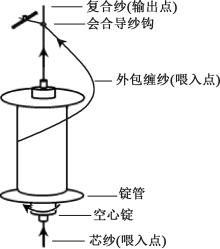
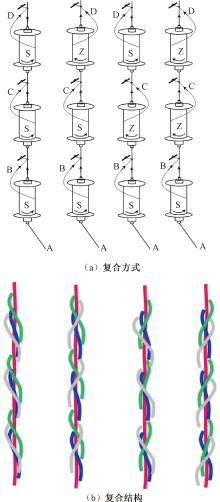
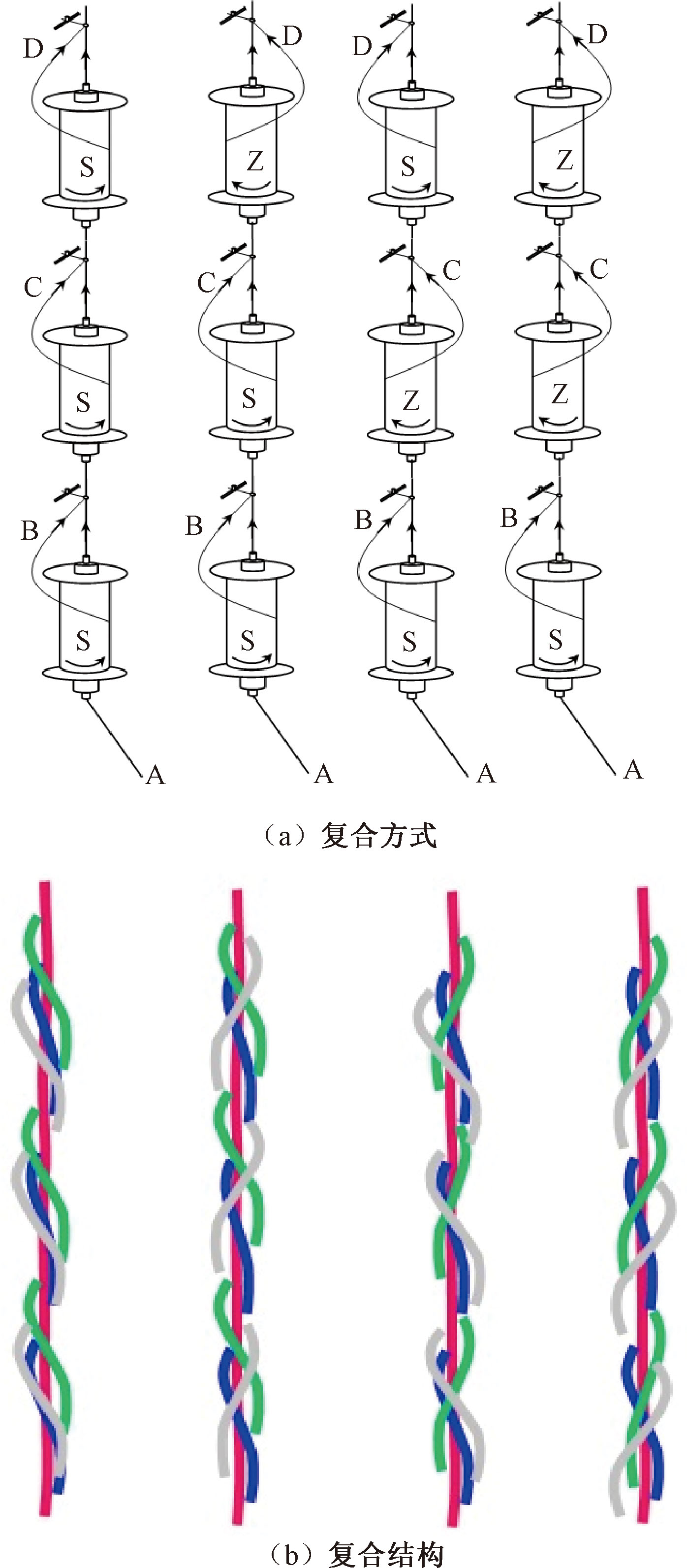
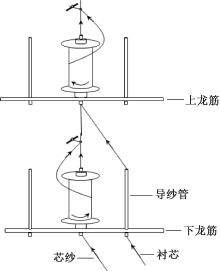
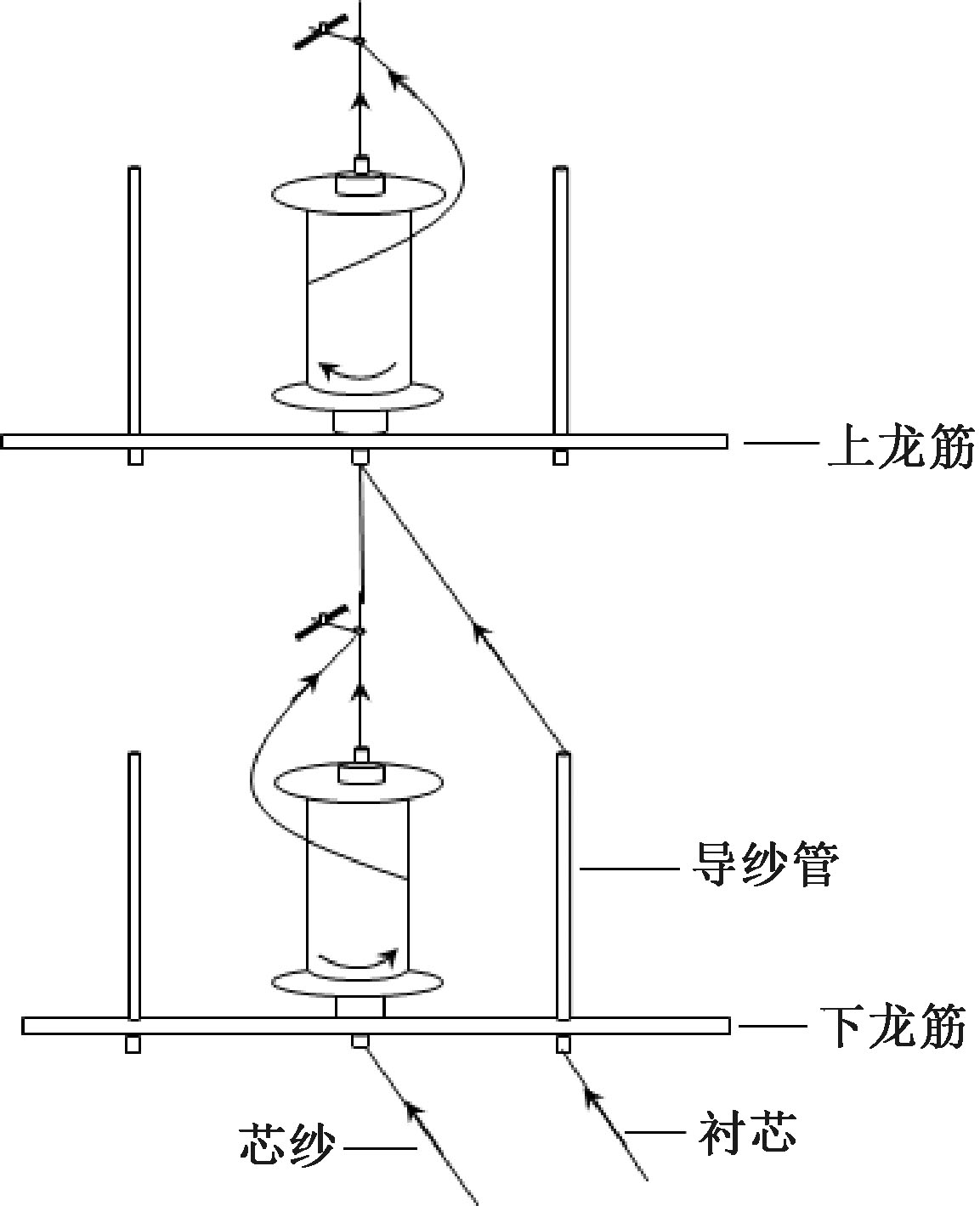
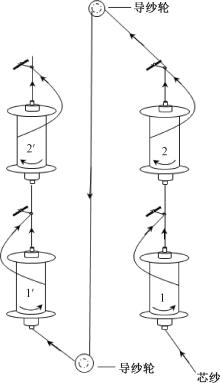
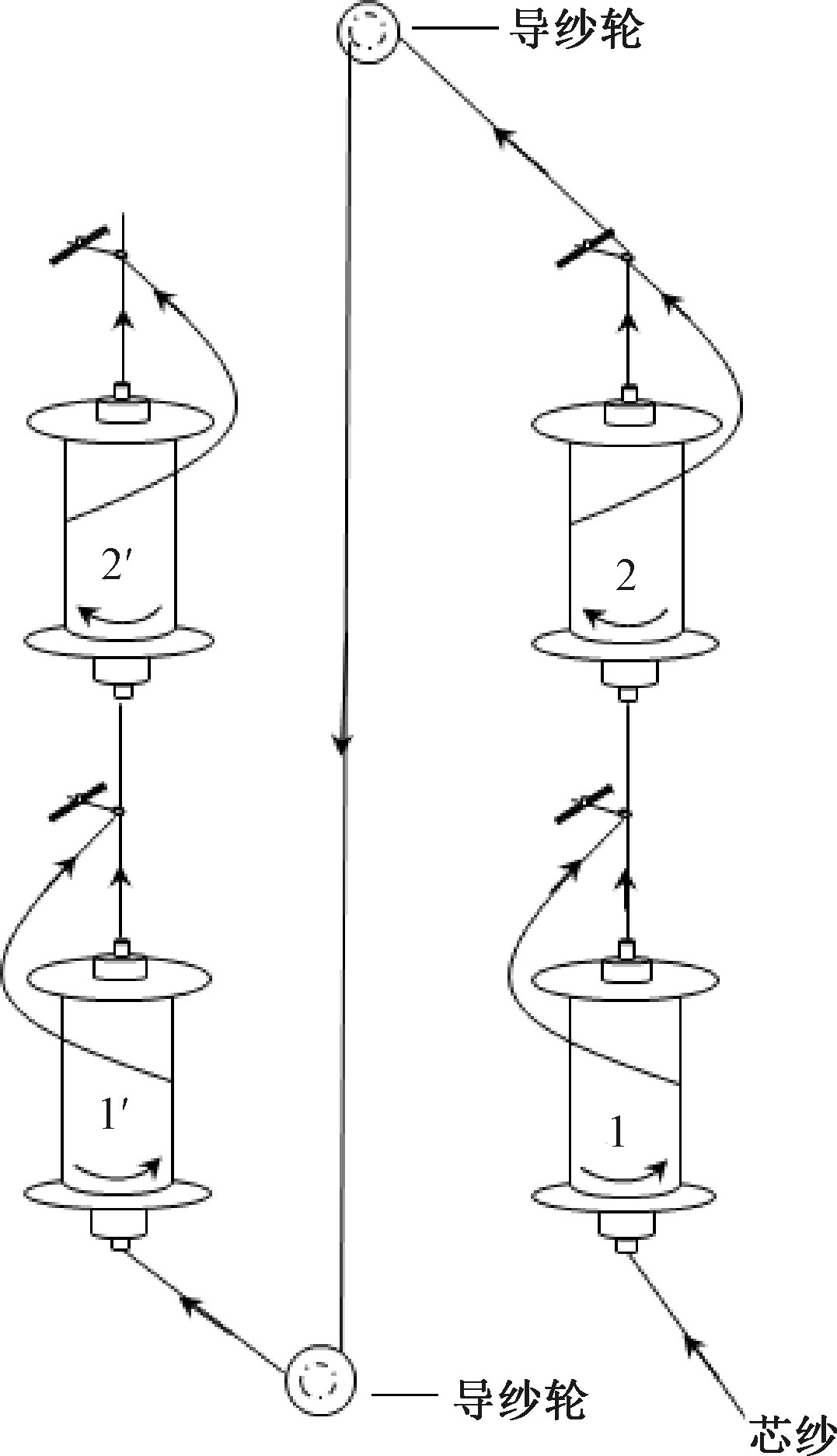
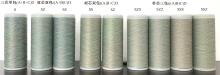
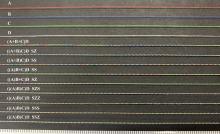
Results The analysis of the feeding and output characteristics of the hollow spindle system revealed performance requirements for both the core and outer wrapping of a cover yarn, and two basic rules regarding yarn feeding were derived: 1) the feeding of the core yarn was not limited to a single strand; 2) additional core yarn could be introduced after the first set of hollow spindles. The study presented methods for expressing combination patterns and structures based on varying wrapping times, feeding methods, and twist directions. Four combination patterns and nine distinct composite structures were identified, including ″three-core single-wrapping″, ″two-core twice-wrapping″, ″additional-core twice-wrapping″, and ″single-core triple-wrapping″. These structures were produced by employing different yarn feeding techniques and configurations of wrapping twist direction when utilizing one, two, or three sets of hollow spindles. Additionally, methodologies for feeding additional core yarns and guiding the yarn for achieving triple wraps were provided using existing hollow spindle covering machines, enabling the production of nine specified composite yarn structures. A comparative analysis of appearance and color mixing characteristics, along with covering effects, was conducted based on photographs of the yarn bobbins and the nine composite yarns. The tensile performance results and snarl indexes of both the four types of raw yarns and the nine kinds of composite yarns were presented and analyzed.

Conclusion The hollow spindle covering technology allows for wrapping multiple yarns in a single processing. By varying the number of hollow spindles, yarn feeding methods, and twist direction configurations, a range of composite methods and structures have been achieved, resulting in composite yarns with distinct appearances (covering effects) and properties. The first set of hollow spindles can accommodate one or multiple core yarns, while the subsequent spindles may also introduce ″additional core yarns″, thus facilitating greater structural diversity. Owing to the differences in composite structures, significant variations exist in the appearance, tensile performance, and structural stability of the composite yarns. Feeding more than one core yarn and additional core yarn can produce a segmented color effect, although wrapped twice may diminish this characteristic. Additionally, the strength utilization rate of composite yarns with the ″single-core triple-wrapping″ is lower than that of other structural configurations, while those with the last two wraps twisting in opposing directions demonstrate stable structures and low snarl indexes. By carefully selecting combination patterns and optimizing wrapping twists, it is possible to achieve composite structures and performance that meet diverse requirements.

Key words: covered yarn, combination pattern, combination structure, quadratically-fed, tensile property, structural stability

中图分类号: 

  • TS104.1

图1

空心锭包缠复合系统"

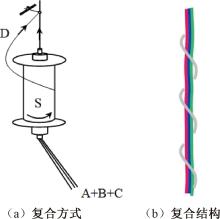
图2

三芯单包复合方式与结构"

图3

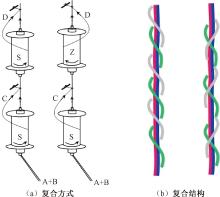
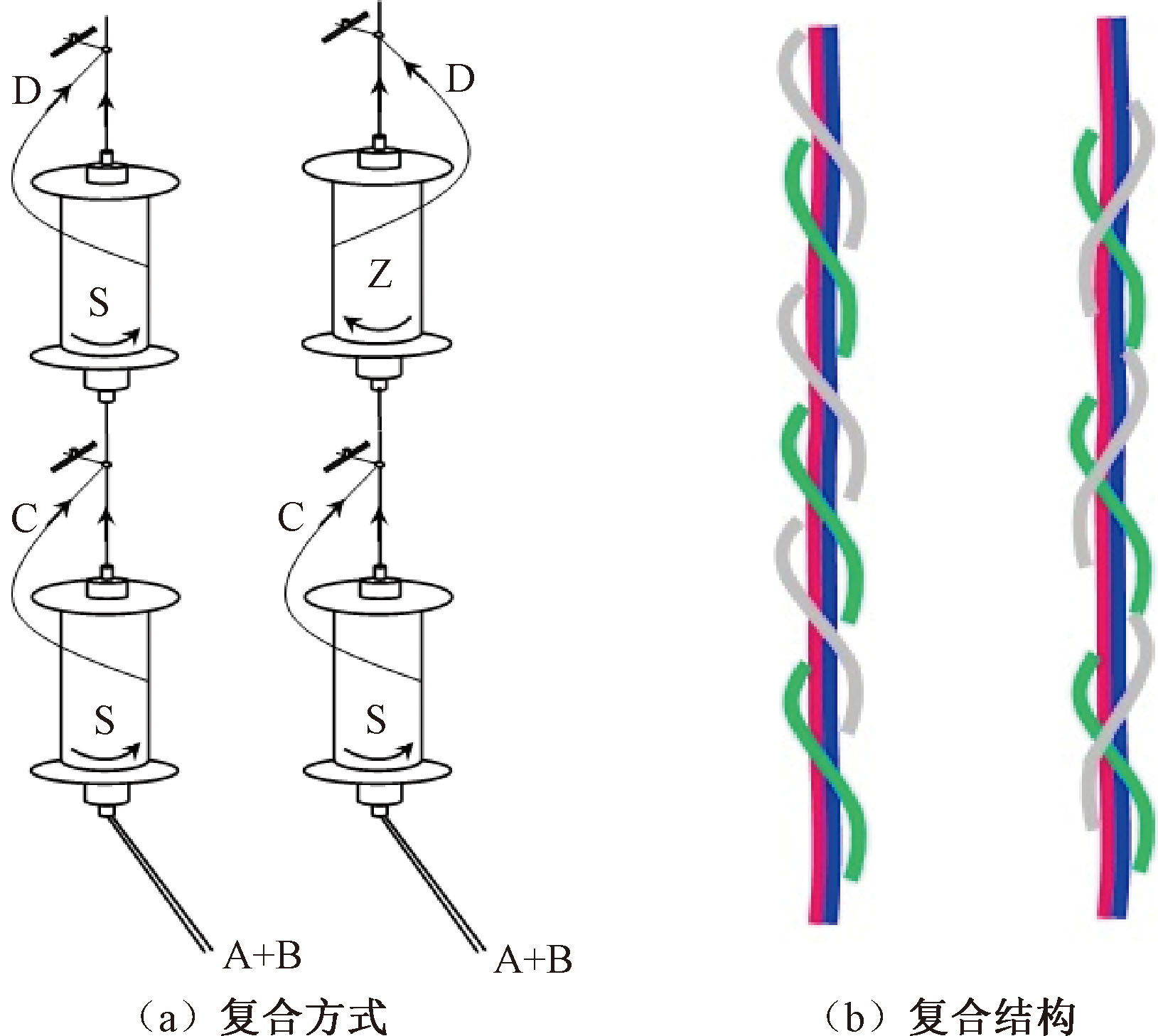
双芯双包复合方式与结构"

图4

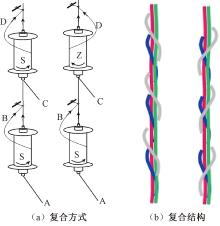
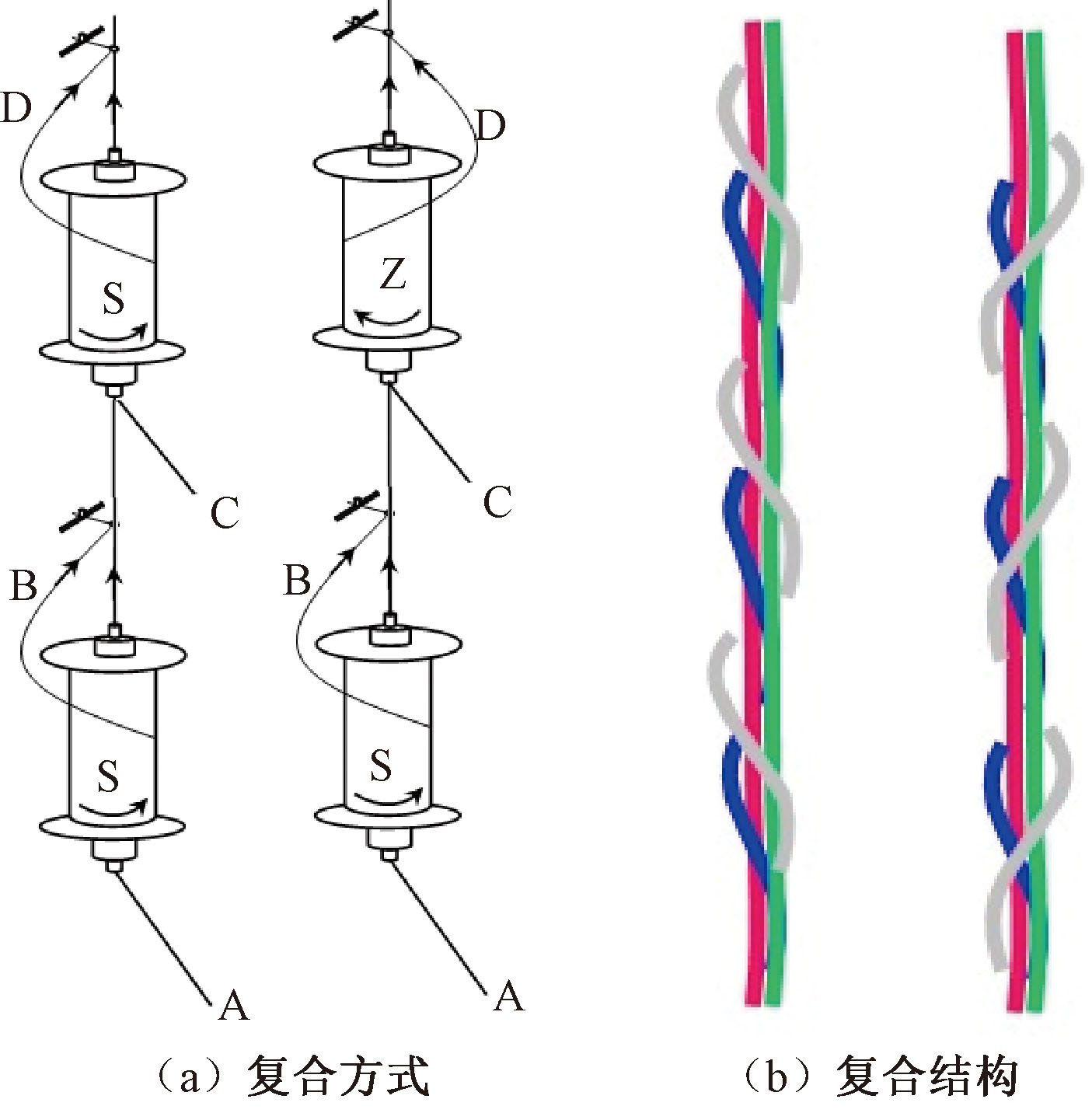
衬芯双包复合方式与结构"

图5

单芯三包复合方式与结构"

表1

纱线编号"

纱线编号 复合方式/结构 捻向配置
1# 三芯单包(A+B+C)D S
2# 双芯双包((A+B)C)D SZ
3# SS
4# 衬芯双包((A)B+C)D SS
5# SZ
6# 单芯三包(((A)B)C)D SZS
7# SZZ
8# SSS
9# SSZ

图6

衬芯的喂入方法"

图7

3次包缠的引纱方法"

图8

复合纱管纱照片"

图9

原料纱和复合纱照片"

表2

复合纱拉伸力学性能测试结果"

纱线
编号
断裂
强力/cN
断裂强力
CV值/%
强力
利用率
断裂
伸长率/%
断裂伸长
率CV值/%
A 381 3.16 22.88 5.96
B 367 3.49 23.35 5.86
C 516 2.50 21.54 4.99
D 398 3.65 21.18 6.86
1# 1 736 2.59 1.04 27.84 6.51
2# 1 640 4.76 0.99 26.52 10.88
3# 1 729 4.41 1.04 28.96 9.93
4# 1 758 2.26 1.06 29.00 6.47
5# 1 683 4.21 1.01 26.65 10.58
6# 1 507 5.16 0.91 25.32 13.17
7# 1 517 2.72 0.91 25.57 11.90
8# 1 569 4.09 0.94 27.99 11.12
9# 1 554 4.28 0.93 28.35 10.25

表3

复合纱扭结指数测试结果"

纱线
编号
扭结指数均值/
(捻·(250 mm)-1)
CV值/% 扭结捻向
1# 20.7 1.9 Z
2# 0.2 0.4 S
3# 38.8 3.8 Z
4# 31.5 1.1 Z
5# 11.5 0.9 S
6# 1.9 0.4 Z
7# 23.6 2.2 S
8# 37.2 3.9 Z
9# 4.0 0.6 Z
[1] 于伟东. 纺织材料学[M]. 2版. 北京: 中国纺织出版社,2018:210-212.
YU Weidong. Textile material[M]. 2nd ed. Beijing: China Textile & Apparel Press, 2018: 210-212.
[2] 郁崇文. 纺纱学[M]. 3版. 北京: 中国纺织出版社,2019:211.
YU Chongwen. Spinning[M]. 3rd ed. Beijing: China Textile & Apparel Press, 2019: 211.
[3] 敖利民, 唐雯, 姜银玲. 亚麻长麻/涤纶长丝复合纱的纺制及其性能比较[J]. 纺织学报, 2019, 40(11):38-44.
AO Limin, TANG Wen, JIANG Yinling. Spinning and performance comparison of line flax/polyester multifilament composite yarns[J]. Journal of Textile Research, 2019, 40(11): 38-44.
[4] 敖利民, 唐雯. 空心锭包覆纺纱的顺向包缠作用特征[J]. 纺织学报, 2021, 42(11):39-45.
AO Limin, TANG Wen. Characteristics of forward wrapping of hollow spindle covered spinning[J]. Journal of Textile Research, 2021, 42(11): 39-45.
[5] 敖利民, 楼焕, 唐雯. 空心锭包覆纺纱的芯纱残留捻回及其应用[J]. 纺织学报, 2022, 43(7):41-46.
AO Limin, LOU Huan, TANG Wen. Residual twist of core yarn and its application in hollow spindle cover spinning[J]. Journal of Textile Research, 2022, 43(7): 41-46.
[6] 敖利民, 唐雯. 捻度和捻向配置对双包包覆纱性能的影响[J]. 纺织学报, 2023, 44(7):50-56.
AO Limin, TANG Wen. Effects of twist and twist direction arrangement on properties of double covered yarns[J]. Journal of Textile Research, 2023, 44(7): 50-56.
[7] 盛翠红, 张一心, 潘峰, 等. 一种纱线捻度稳定性测试装置及方法研究[J]. 棉纺织技术, 2014, 42(2):59-62.
SHENG Cuihong, ZHANG Yixin, PAN Feng, et al. One yarn twist stability test instrument and method research[J]. Cotton Textile Technology, 2014, 42(2): 59-62.
[8] 王增喜. 短纤维纱线捻度稳定性的评价及其影响因素的研究[J]. 化纤与纺织技术, 2014, 43(4):22-27.
WANG Zengxi. Study on evaluation and influencing factors of yarn twist stability of staple fiber[J]. Chemical Fiber & Textile Technology, 2014, 43 (4):22-27.
[9] 敖利民, 唐雯.一种包缠复合混色段彩长丝纱的加工方法及长丝纱及装置:201810728810.7[P]. 2019-09-20.
AO Limin, TANG Wen.A processing method and filament yarn and device for wrapping composite mixed color segment colored filament yarn: 201810728810.7[P]. 2019-09-20.
[10] 黄伟, 汪军. 复合纱线结构对单纱强力利用率的影响与分析[J]. 纺织学报, 2017, 38(2):99-105.
HUANG Wei, WANG Jun. Influence of composite yarn's structures on yarn strength efficiency[J]. Journal of Textile Research, 2017, 38 (2): 99-105.
[1] 江文杰, 郭明瑞, 高卫东. 环锭纺棉/涤短纤皮芯纱的皮芯层捻度分布[J]. 纺织学报, 2024, 45(12): 58-66.
[2] 张琦, 屠佳妮, 张燕婷, 丁宁宇, 郝佳姝, 彭诗语. 经编贾卡间隔鞋面材料提花层结构对其拉伸性能的影响[J]. 纺织学报, 2024, 45(08): 150-157.
[3] 贾冰凡, 敖利民, 唐雯, 郑元生, 尚珊珊. 毛纱/锦纶长丝包覆纱的纺制及其性能与应用[J]. 纺织学报, 2023, 44(12): 58-66.
[4] 骆春旭, 龚浩然, 吴敏勇, 黄丛, 刘可帅. 特种玄武岩缝纫线的制备工艺及其性能[J]. 纺织学报, 2023, 44(11): 61-66.
[5] 王雅倩, 万爱兰, 曾登, 吴光军, 祁倩. 形状记忆氨纶/锦纶包覆纱的制备及其压力袜性能[J]. 纺织学报, 2023, 44(10): 53-59.
[6] 李久刚, 金鑫鹏, 邓文韬, 秦雪, 张贺, 黄丛, 刘可帅. 氧化铝纱线的合股数与捻度对其强度的影响[J]. 纺织学报, 2023, 44(10): 48-52.
[7] 张华, 刘帅, 杨瑞华. 长丝包覆复合包芯纱拉伸性能建模研究[J]. 纺织学报, 2023, 44(08): 57-62.
[8] 周濛濛, 蒋高明. 玻璃纤维衬经衬纬纬编管状织物的制备及其拉伸性能[J]. 纺织学报, 2023, 44(07): 132-140.
[9] 敖利民, 唐雯. 捻度和捻向配置对双包包覆纱性能的影响[J]. 纺织学报, 2023, 44(07): 50-56.
[10] 成悦, 左涵, 安琪, 李大伟, 张伟, 付译鋆. 非可吸收倒刺缝合线握持力及其影响因素[J]. 纺织学报, 2023, 44(06): 66-71.
[11] 胡蝶飞, 王琰, 姚菊明, 祝国成. 纳米纤维复合结构空气过滤材料性能研究[J]. 纺织学报, 2023, 44(05): 77-83.
[12] 陈小明, 任志鹏, 郑宏伟, 吴凯杰, 苏星兆, 陈利. 基于预/主刺协同的针刺织物力学性能提升方法[J]. 纺织学报, 2023, 44(04): 100-107.
[13] 楚艳艳, 李施辰, 陈超, 刘莹莹, 黄伟韩, 张越, 陈晓钢. 柔性抗冲击纺织材料及其结构的研究进展[J]. 纺织学报, 2022, 43(12): 203-212.
[14] 孙晓伦, 陈利, 张一帆, 李默涵. 开孔三维机织复合材料的拉伸性能[J]. 纺织学报, 2022, 43(08): 74-79.
[15] 周筱雅, 马定海, 胡铖烨, 洪剑寒, 刘永坤, 韩潇, 闫涛. 涤纶/聚酰胺6纳米纤维包覆纱的连续制备及其应用[J]. 纺织学报, 2022, 43(02): 110-115.
Viewed
Full text


Abstract

Cited

  Shared   
  Discussed   
No Suggested Reading articles found!