纺织学报 ›› 2026, Vol. 47 ›› Issue (06): 1-8.doi: 10.13475/j.fzxb.20251004001
• 纤维材料 • 下一篇
袁会敏1, 林晓静1, 毛迎1,2( ), 武观1,2, 陈文兴1,2, 吕汪洋1,2
YUAN Huimin1, LIN Xiaojing1, MAO Ying1,2(), WU Guan1,2, CHEN Wenxing1,2, LÜ Wangyang1,2
摘要:
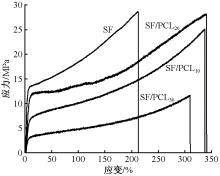
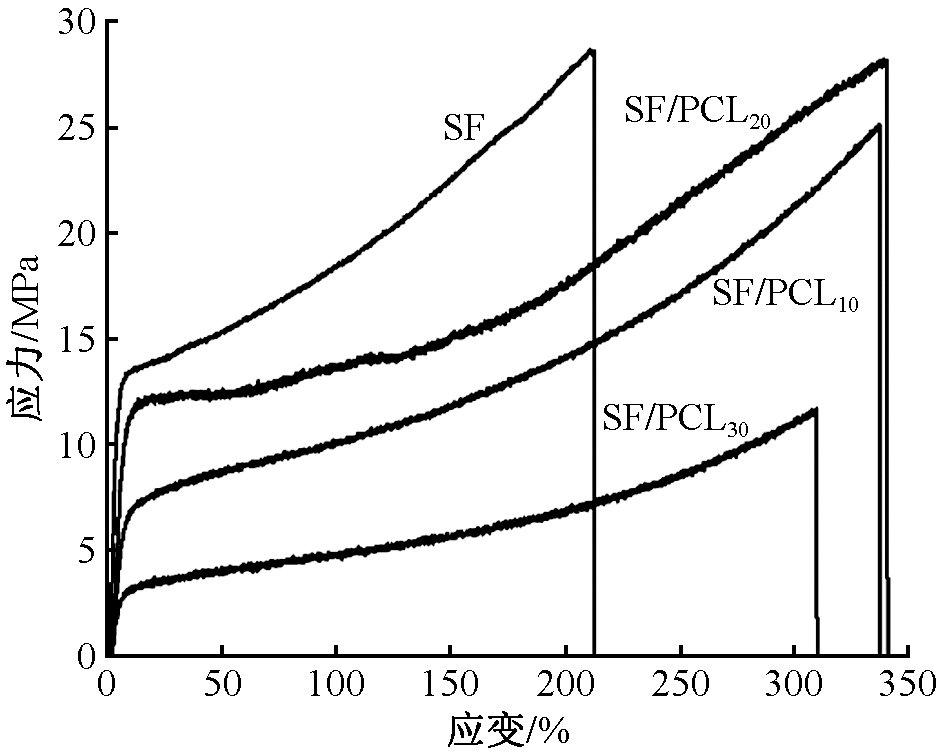
丝素蛋白(SF)虽然具备优良的生物相容性与细胞亲和性,但是其力学性能(如强度与韧性)在纯态下往往难以满足组织工程支架的长期力学支撑要求。为改善SF纤维的力学性能,拓展其在生物医用纤维领域的应用,结合聚己内酯(PCL)的可生物降解性、优良可纺性和力学强度,以及SF的力学可调控性和良好生物相容性,采用湿法纺丝技术制备了高强高韧的SF基复合纤维,重点探讨了SF与PCL质量比对复合纤维微观结构和力学性能的影响。利用扫描电子显微镜、傅里叶变换红外光谱仪和X射线衍射仪等手段对复合纤维的形貌、结构与性能进行表征。结果表明:所制备的复合纤维直径均匀,为(315.38 ± 3.32) μm,断裂强度达(27.86 ± 0.54) MPa;当PCL质量分数达到20%时,复合纤维的断裂伸长率和韧性相比较于SF纤维分别提高了53.18%和48.43%。PCL的引入有效改善了SF纤维的力学性能,所得复合纤维在延展性和韧性方面均获得显著增强,展现出其在医用缝合线、组织工程支架等生物医用纤维领域良好的应用前景。
中图分类号:
| [1] | 杨振北. 丝素纤维基骨仿生复合支架的构建及其成骨性能[D]. 苏州: 苏州大学, 2023: 1-5. |
| YANG Zhenbei. Construction and performance of silk fibrous based bone-like scaffold[D]. Suzhou: Soochow University, 2023: 1-5. | |
| [2] | 武郭敏. 改良丝素蛋白/聚己内酯纳米纤维膜的制备及其皮肤再生或骨再生性能的研究[D]. 武汉: 武汉大学, 2020: 11-30. |
| WU Guomin. Preparation of modified SF/PCL nanofibrous mats and their applications in skin or bone engineering[D]. Wuhan: Wuhan University, 2020: 11-30. | |
| [3] | 卢松. 改性纳米铁酸锌丝素蛋白杂化纤维的制备与应用[D]. 镇江: 江苏科技大学, 2024: 1-5. |
| LU Song. Modified zinc ferrate nanoparticles hybridized silk protein preparation and application of fibers[D]. Zhenjiang: Jiangsu University of Science and Technology, 2024: 1-5. | |
| [4] | 肖垚. 微流控湿法纺丝制备高强高韧再生丝素蛋白纤维及其应用研究[D]. 杭州: 浙江大学, 2024: 60-70. |
| XIAO Yao. Preparation and application of high-strength and high-toughness regenerated silk fibroin fibers via microfluidic wet spinning technology[D]. Hangzhou: Zhejiang University, 2024: 60-70. | |
| [5] | GONG R X, DONG Y J, GE D, et al. Wet spinning fabrication of robust and uniform intrinsically conductive cellulose nanofibril/silk conductive fibers as bifunctional strain/humidity sensor in potential smart dressing[J]. Advanced Fiber Materials, 2024, 6(4): 993-1007. |
| [6] | DING Y Q, WANG X C, LIU J G, et al. A reduced graphene oxide-coated conductive surgical silk suture targeting microresistance sensing changes for wound healing[J]. Science China Technological Sciences, 2024, 67(11): 3499-3512. |
| [7] | MA K, WU Z F, CHEN K Z, et al. Application of silk fibroin-based composite films in biomedicine and biotechnology[J]. Journal of Materials Chemistry B, 2025, 13(11): 3494-3515. |
| [8] | 刘政. 湿法纺丝制备胶原复丝及其交联改性研究[D]. 上海: 东华大学, 2025: 18-26. |
| LIU Zheng. Study on preparation of collagen multifilament by wet spinning and its crosslinking modification[D]. Shanghai: Donghua University, 2025: 18-26. | |
| [9] | 冯屹楠, 冯雪凌, 荣立夺, 等. 基于磷酸溶解的干湿法纺丝构建高强高韧甲壳素/丝素复合再生纤维[J]. 印染, 2025, 51(12): 11-15. |
| FENG Yinan, FENG Xueling, RONG Liduo, et al. Construction of high tensile strength and toughness chitin/silk fibroin composite regenerated fiber based on phosphoric acid dissolution by dry-wet spinning[J]. China Dyeing and Finishing, 2025, 51(12): 11-15. | |
| [10] | COTRIM M, ORÉFICE R. Tailoring polycaprolactone/silk electrospun nanofiber yarns by varying compositional and processing parameters[J]. Polymer Bulletin, 2024, 81(1): 593-610. |
| [11] | ZHANG Z X, DONG Q Q, LI Z B, et al. Bi-phasic integrated silk fibroin/polycaprolactone scaffolds for osteochondral regeneration inspired by the native joint tissue and interface[J]. Materials Today Bio, 2025, 32: 101737. |
| [12] | KıLıÇOǦLU M, BAT E, GÜNDÜZ G, et al. Fibers of thermoplastic polymer blends activate multiple interlayer toughening mechanisms[J]. Composites Part A: Applied Science and Manufacturing, 2022, 158: 106982. |
| [13] | 徐诺, 潘治寿, 王泽涛, 等. 聚乳酸/聚己内酯共混体系增韧改性研究[J]. 当代化工研究, 2025(11): 81-83. |
| XU Nuo, PAN Zhishou, WANG Zetao, et al. Toughening modification of polylactic acid/polycaprolactone blending system[J]. Modern Chemical Research, 2025(11): 81-83. | |
| [14] | OJHA A K, RAJASEKARAN R, HANSDA A K, et al. Biodegradable multi-layered silk fibroin-PCL stent for the management of cervical atresia: in vitro cytocompatibility and extracellular matrix remodeling in vivo[J]. ACS Applied Materials & Interfaces, 2023, 15(33): 39099-39116. |
| [15] | NAZEER M A, YILGOR E, YILGOR I. Electrospun polycaprolactone/silk fibroin nanofibrous bioactive scaffolds for tissue engineering applications[J]. Polymer, 2019, 168: 86-94. |
| [16] | LI X F, FAN Q M, ZHANG Q, et al. Freezing-induced silk I crystallization of silk fibroin[J]. Cryst Eng Comm, 2020, 22(22): 3884-3890. |
| [17] | 张钰禄, 胡谦, 叶倩, 等. 甲壳素/丝素蛋白复合薄膜结晶特性变化研究[J]. 材料导报, 2022, 36(11): 209-214. |
| ZHANG Yulu, HU Qian, YE Qian, et al. Study on the variation of crystal properties of chitin/silk fibroin biocomposite films[J]. Materials Review, 2022, 36(11): 209-214. |
| [1] | 刘佳兴, 王伟, 郝新敏, 宫玉梅. 生物基聚酰胺56的抗紫外线老化改性及其纤维性能[J]. 纺织学报, 2026, 47(07): 111-119. |
| [2] | 陈佳慧, 李梦鑫, 张旋, 刘龙翔, 阳惠珍, 王文, 于风芹, 王栋. 非对称结构聚乙烯醇湿驱动纤维的制备及其应用[J]. 纺织学报, 2026, 47(07): 120-127. |
| [3] | 施永明, 崔宁, 石双友, 吴鹏飞, 朱金唐, 史贤宁, 吴伟鑫, 金小培. 热退火对热致液晶聚芳酯纤维性能及凝聚态结构的影响[J]. 纺织学报, 2026, 47(06): 9-18. |
| [4] | 冯笑琳, 魏静雯, 李旭明. 聚乳酸/聚己内酯共混纤维的制备及其性能[J]. 纺织学报, 2026, 47(05): 18-27. |
| [5] | 王曙东, 严谨, 沈志高, 王可, 马倩, 戚玉. 挤出3D打印丝素蛋白/明胶软骨支架的制备及其性能[J]. 纺织学报, 2026, 47(05): 65-71. |
| [6] | 任莹莹, 李倩倩, 罗梦颖, 王栋, 李沐芳. 自修复聚氨酯离子凝胶纤维基柔性传感材料的制备及其性能[J]. 纺织学报, 2026, 47(05): 9-17. |
| [7] | 赵美宁, 李博, 孙艳丽, 武海良, 田诗溢. 具备光热转化性再生羊毛角蛋白基复合纤维的开发[J]. 纺织学报, 2026, 47(04): 17-25. |
| [8] | 赵立环, 闫子妍, 张蓉, 袁明珠, 聂秀雯, 刘新蕊. 海岛长丝合成革基布的碱减量工艺及其力学性能[J]. 纺织学报, 2026, 47(04): 154-162. |
| [9] | 周佳丽, 李玉峰, 武会会. 碱凝胶在生丝织物脱胶印花工艺中的应用[J]. 纺织学报, 2026, 47(04): 180-188. |
| [10] | 孟思雨, 韩宇进, 谭文丽, 马博谋, 袁久刚. 无醛交联剂改性羊毛角蛋白/海藻酸钠气凝胶复合材料的制备及其性能[J]. 纺织学报, 2026, 47(03): 18-25. |
| [11] | 林晓静, 毛迎, 陈文兴, 吕汪洋. 载姜黄素静电纺丝纤维膜的制备及其抗菌与抗氧化性能[J]. 纺织学报, 2026, 47(03): 217-224. |
| [12] | 易珊, 王丽芳, 陈黎, 邱虹, 唐一卡, 张国清, 王美英, 高艳春, 葛秀敏, 刘丽芳. 纳米纤维素基pH响应型抗菌抗氧化伤口敷料的制备及其性能[J]. 纺织学报, 2026, 47(03): 26-34. |
| [13] | 薛宝霞, 冯佳昕, 邵子洋, 路佳鑫, 刘晶, 牛梅, 张利. 预交联铜离子对羧甲基纤维素抗菌气凝胶纤维结构与性能的影响[J]. 纺织学报, 2026, 47(03): 52-59. |
| [14] | 李好义, 田鑫哲, 张毅, 牟文英, 张超, 赵千龙, 杨卫民. 导电各向异性复合心脏补片的熔体静电纺丝/直写构建及体外评价[J]. 纺织学报, 2026, 47(03): 70-76. |
| [15] | 刘金枝, 赵回汇, 吴焕友, 张建明, 高晶. 壳聚糖/聚己内酯取向纳米纤维膜的结构调控与物理引导作用[J]. 纺织学报, 2026, 47(03): 9-17. |
|
||
 京公网安备11010502044800号