纺织学报 ›› 2022, Vol. 43 ›› Issue (02): 140-148.doi: 10.13475/j.fzxb.20210702709
史晟1,2,3, 王彦1,2, 李飞2,4, 唐建东2,3, 高翔宇4, 侯文生1,2, 郭红1,2( ), 王淑花1,2, 姬佳奇1,2
SHI Sheng1,2,3, WANG Yan1,2, LI Fei2,4, TANG Jiandong2,3, GAO Xiangyu4, HOU Wensheng1,2, GUO Hong1,2(), WANG Shuhua1,2, JI Jiaqi1,2
摘要:
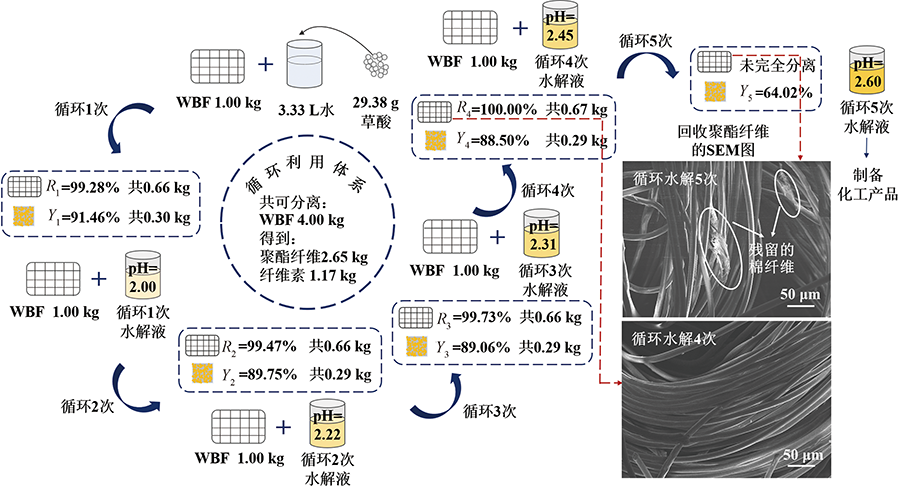
针对废旧纺织品循环利用中聚酯纤维、棉纤维混纺纱线结构紧密缠绕,难以分离而无法加工的问题,采用环境友好的草酸体系选择性水解混纺织物中的棉纤维,从而释放聚酯纤维实现有效分离,并对草酸体系分离工艺进一步优化。研究表明:与无机酸相比,在相同反应条件下,草酸可达到与盐酸相当的分离效果且所得聚酯纤维形态更完整,棉纤维水解程度更低,水解产物分布更窄;在草酸浓度为0.07 mol/L、反应温度为130 ℃、反应时间为3 h的条件下,聚酯/棉混纺织物的分离效果最优;其中棉纤维水解为纤维素材料,得率为91.46%,另有小部分水解为葡萄糖或低聚糖;聚酯纤维回收率高达99.28%,且保留了原有聚酯纤维的性能,可直接生产加工;该反应体系可循环利用多次,实现了废旧聚酯/棉混纺织物的高效综合利用。
中图分类号:
| [1] |
MÄÄTTÄNEN Marjo, GUNNARSSON Maria, WEDIN Helena, et al. Pre-treatments of pre-consumer cotton-based textile waste for production of textile fibres in the cold NaOH(aq) and cellulose carbamate processes[J]. Cellulose, 2021, 28(6): 3869-3886.
doi: 10.1007/s10570-021-03753-6 |
| [2] |
LI Xin, WANG Laili, DING Xuemei. Textile supply chain waste management in China[J]. Journal of Cleaner Production, 2021, 289:125147.
doi: 10.1016/j.jclepro.2020.125147 |
| [3] |
GUO Zengwei, ERIKSSON Mikael, DE LA MOTTE Hanna, et al. Circular recycling of polyester textile waste using a sustainable catalyst[J]. Journal of Cleaner Production, 2021, 283:124579.
doi: 10.1016/j.jclepro.2020.124579 |
| [4] |
HUANG Beijia, ZHAO Juan, GENG Yong, et al. Energy-related GHG emissions of the textile industry in China[J]. Resources, Conservation and Recycling, 2017, 119:69-77.
doi: 10.1016/j.resconrec.2016.06.013 |
| [5] |
DE SILVA Rasike, WANG Xungai, BYRNE Nolene. Recycling textiles: the use of ionic liquids in the separation of cotton polyester blends[J]. RSC Advances, 2014, 4(55): 29094-29098.
doi: 10.1039/C4RA04306E |
| [6] |
LING Chen, SHI Sheng, HOU Wensheng, et al. Separation of waste polyester/cotton blended fabrics by phosphotungstic acid and preparation of terephthalic acid[J]. Polymer Degradation and Stability, 2019, 161:157-165.
doi: 10.1016/j.polymdegradstab.2019.01.022 |
| [7] |
YOUSEF Samy, TATARIANTS Maksym, TICHONOVAS Martynas, et al. Sustainable green technology for recovery of cotton fibers and polyester from textile waste[J]. Journal of Cleaner Production, 2020, 254:120078.
doi: 10.1016/j.jclepro.2020.120078 |
| [8] |
SUN Xunwen, LU Canhui, ZHANG Wei, et al. Acetone-soluble cellulose acetate extracted from waste blended fabrics via ionic liquid catalyzed acetylation[J]. Carbohydrate Polymers, 2013, 98(1): 405-411.
doi: 10.1016/j.carbpol.2013.05.089 pmid: 23987361 |
| [9] |
SUBRAMANIAN Karpagam, CHOPRA Shauhrat S, CAKIN Ezgi, et al. Environmental life cycle assessment of textile bio-recycling-valorizing cotton-polyester textile waste to PET fiber and glucose syrup[J]. Resources Conservation and Recycling, 2020, 161:104989.
doi: 10.1016/j.resconrec.2020.104989 |
| [10] |
SHEN Fei, XIAO Wenxiong, LIN Lili, et al. Enzymatic saccharification coupling with polyester recovery from cotton-based waste textiles by phosphoric acid pretreatment[J]. Bioresource Technology, 2013, 130:248-255.
doi: 10.1016/j.biortech.2012.12.025 |
| [11] | KUO Chiahung, LIN Poju, LEE Chengkang. Enzymatic saccharification of dissolution pretreated waste cellulosic fabrics for bacterial cellulose production by gluconacetobacter xylinus[J]. Journal of Chemical Technology and Biotechnology, 2010, 85(10): 1346-1352. |
| [12] |
GHOLAMZAD Elahe, KARIMI Keikhosro, MASOOMI Mahmood. Effective conversion of waste polyester-cotton textile to ethanol and recovery of polyester by alkaline pretreatment[J]. Chemical Engineering Journal, 2014, 253:40-45.
doi: 10.1016/j.cej.2014.04.109 |
| [13] |
JIANG Shuai, XIA Zhaopeng, FAROOQ Amjad, et al. Efficient recovery of the dyed cotton-polyester fabric: cellulose nanocrystal extraction and its application in composite films[J]. Cellulose, 2021, 28(5): 3235-3248.
doi: 10.1007/s10570-021-03738-5 |
| [14] |
SANCHISSEBASTIÁ Miguel, RUUTH Edvin, STIGSSON Lars, et al. Novel sustainable alternatives for the fashion industry: a method of chemically recycling waste textiles via acid hydrolysis[J]. Waste Management, 2021, 121:248-254.
doi: 10.1016/j.wasman.2020.12.024 |
| [15] |
OUCHI Akihiko, TOIDA Tatsuo, KUMARESAN Subramanian, et al. A new methodology to recycle polyester from fabric blends with cellulose[J]. Cellulose, 2010, 17(1): 215-222.
doi: 10.1007/s10570-009-9358-1 |
| [16] |
HOU Wensheng, LING Chen, SHI Sheng, et al. Separation and characterization of waste cotton/polyester blend fabric with hydrothermal method[J]. Fibers and Polymers, 2018, 19(4): 742-750.
doi: 10.1007/s12221-018-7735-9 |
| [17] |
CHOTIROTSUKON Chayanon, RAITA Marisa, CHAMPREDA Verawat, et al. Fractionation of sugarcane trash by oxalic-acid catalyzed glycerol-based organosolv followed by mild solvent delignification[J]. Industrial Crops and Products, 2019, 141:111753.
doi: 10.1016/j.indcrop.2019.111753 |
| [18] |
LEE Jae Won, JEFFRIES Thomas W. Efficiencies of acid catalysts in the hydrolysis of lignocellulosic biomass over a range of combined severity factors[J]. Bioresource Technology, 2011, 102(10): 5884-5890.
doi: 10.1016/j.biortech.2011.02.048 pmid: 21377872 |
| [19] |
LACERDA Talita M, ZARNBON Marcia D, FROLLINI Elisabete. Oxalic acid as a catalyst for the hydrolysis of sisal pulp[J]. Industrial Crops and Products, 2015, 71:163-172.
doi: 10.1016/j.indcrop.2015.03.072 |
| [20] |
GÜRÜ Metin, BILGESÜ Ali Y, PAMUK Vecihi. Production of oxalic acid from sugar beet molasses by formed nitrogen oxides[J]. Bioresource Technology, 2001, 77(1): 81-6.
doi: 10.1016/S0960-8524(00)00122-X |
| [21] |
LU Yulin, MOSIER Nathan S. Biomimetic catalysis for hemicellulose hydrolysis in corn stover[J]. Biotechnology Progress, 2007, 23(1): 116-123.
pmid: 17269678 |
| [22] |
LI Xun, LI Mingfei, BIAN Jing, et al. Hydrothermal carbonization of bamboo in an oxalic acid solution: effects of acid concentration and retention time on the characteristics of products[J]. RSC Advances, 2015, 5(94): 77147-77153.
doi: 10.1039/C5RA15063A |
| [23] |
SEGAL L, CREELY J J, MARTIN J A. An empirical method for estimating the degree of crystallinity of native cellulose using the X-Ray diffractometer[J]. Textile Research Journal, 1959, 29(10): 786-794.
doi: 10.1177/004051755902901003 |
| [24] |
SHI Sheng, ZHANG Meiling, ZHANG Suying, et al. Evolution of physicochemical structure of waste cotton fiber (hydrochar) during hydrothermal carbonation[J]. Autex Research Journal, 2020, 20(3): 319-326.
doi: 10.2478/aut-2019-0041 |
| [25] |
JIANG Yijun, LI Xiutao, WANG Xicheng, et al. Effective saccharification of lignocellulosic biomass over hydrolysis residue derived solid acid under microwave irradiation[J]. Green Chemistry, 2012, 14(8): 2162-2167.
doi: 10.1039/c2gc35306g |
| [26] |
QIANG Dandan, ZHANG Meiyun, LI Jinbao, et al. Selective hydrolysis of cellulose for the preparation of microcrystalline cellulose by phosphotungstic acid[J]. Cellulose, 2016, 23(2): 1199-1207.
doi: 10.1007/s10570-016-0858-5 |
| [27] |
MURTHY N S, CORREALE S T, MINOR H. Structure of the amorphous phase in crystallizable polymers: poly(ethylene terephthalate)[J]. Macromolecules, 1991, 24(5): 1185-1189.
doi: 10.1021/ma00005a033 |
| [28] |
LU Ping, HSIEH You Lo. Preparation and properties of cellulose nanocrystals: rods, spheres, and network[J]. Carbohydrate Polymers, 2010, 82(2): 329-336.
doi: 10.1016/j.carbpol.2010.04.073 |
| [29] |
MO Zunli, ZHAO Zhongli, CHEN Hong, et al. Heterogeneous preparation of cellulose-polyaniline conductive composites with cellulose activated by acids and its electrical properties[J]. Carbohydrate Polymers, 2009, 75(4): 660-664.
doi: 10.1016/j.carbpol.2008.09.010 |
| [30] |
SHI Sheng, ZHANG Meiling, LING Chen, et al. Extraction and characterization of microcrystalline cellulose from waste cotton fabrics via hydrothermal method[J]. Waste Management, 2018, 82:139-146.
doi: S0956-053X(18)30641-X pmid: 30509575 |
| [31] |
XU Wenyang, GRÉNMAN Henrik, LIU Jun, et al. Mild oxalic-acid-catalyzed hydrolysis as a novel approach to prepare cellulose nanocrystals[J]. Chemnanomat, 2017, 3(2): 109-119.
doi: 10.1002/cnma.201600347 |
| [32] |
YU Houyong, YAN Chenfeng, LEI Xiaoxia, et al. Novel approach to extract thermally stable cellulose nanospheres with high yield[J]. Materials Letters, 2014, 131:12-15.
doi: 10.1016/j.matlet.2014.05.159 |
| [33] |
WADA Masahisa, HEUX Laurent, SUGIYAMA Junji. Polymorphism of cellulose I family: reinvestigation of cellulose IVI[J]. Biomacromolecules, 2004, 5(4): 1385-1391.
pmid: 15244455 |
| [34] |
LUO Jing, HUANG Kaixuan, XU Yong, et al. A comparative study of lignocellulosic nanofibrils isolated from celery using oxalic acid hydrolysis followed by sonication and mechanical fibrillation[J]. Cellulose, 2019, 26(9): 5237-5246.
doi: 10.1007/s10570-019-02454-5 |
| [35] |
MANCINI Sandro Donnini, ZANIN Maria. Post consumer PET depolymerization by acid hydrolysis[J]. Polymer:Plastics Technology and Engineering, 2007, 46(2): 135-144.
doi: 10.1080/03602550601152945 |
| [36] |
SINHA Vijaykumar, PATEL Mayank R, PATEL Jigar V. PET waste management by chemical recycling: areview[J]. Journal of Polymers and the Environment, 2010, 18(1): 8-25.
doi: 10.1007/s10924-008-0106-7 |
| [37] |
WANG Xin, LV Tao, WU Minghui, et al. Aluminum doped solid acid with suitable ratio of bronsted and Lewis acid sites synthesized by electric-flocculation of phosphotungstic acid via hydrothermal treatment for producing 5-hydroxymethylfurfural from glucose[J]. Applied Catalysis A: General, 2019, 574:87-96.
doi: 10.1016/j.apcata.2019.02.005 |
| [38] |
RAMLI Nur Aainaa Syahirah, AMIN Nor Aishah Saidina. A new functionalized ionic liquid for efficient glucose conversion to 5-hydroxymethyl furfural and levulinic acid[J]. Journal of Molecular Catalysis A: Chemical, 2015, 407:113-121.
doi: 10.1016/j.molcata.2015.06.030 |
| [1] | 周大旺, 乌婧, 杨建平, 陈烨, 吉鹏, 王华平. 纤维微塑料的研究现状及其削减策略[J]. 纺织学报, 2021, 42(06): 8-17. |
| [2] | 郑振荣, 智伟, 邢江元, 杜换福, 徐子健. 大麻纤维草酸铵-酶联合脱胶工艺[J]. 纺织学报, 2019, 40(11): 88-93. |
| [3] | 李龙 张胜靖. 棉秆皮纤维的草酸软化处理工艺[J]. 纺织学报, 2016, 37(3): 21-24. |
| [4] | 戴细春 高梅 殷珉扬 王祥荣. 应用草酸的天然染料印花织物白地上媒染剂的去除[J]. 纺织学报, 2014, 35(10): 85-0. |
| [5] | 于永玲;吕丽华;赵玉萍;魏春艳;崔靖;陈超. 日本纤维循环利用现状及发展趋势[J]. 纺织学报, 2010, 31(10): 151-154. |
|
 京公网安备11010502044800号