纺织学报 ›› 2025, Vol. 46 ›› Issue (08): 28-36.doi: 10.13475/j.fzxb.20241101401
马超慧1, 崔童然1, 邴琳涵1, 朱志国1, 王锐1,2,3, 魏建斐1,2,3( )
)
MA Chaohui1, CUI Tongran1, BING Linhan1, ZHU Zhiguo1, WANG Rui1,2,3, WEI Jianfei1,2,3()
摘要:
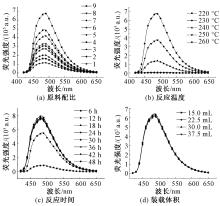
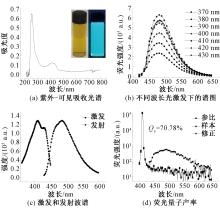
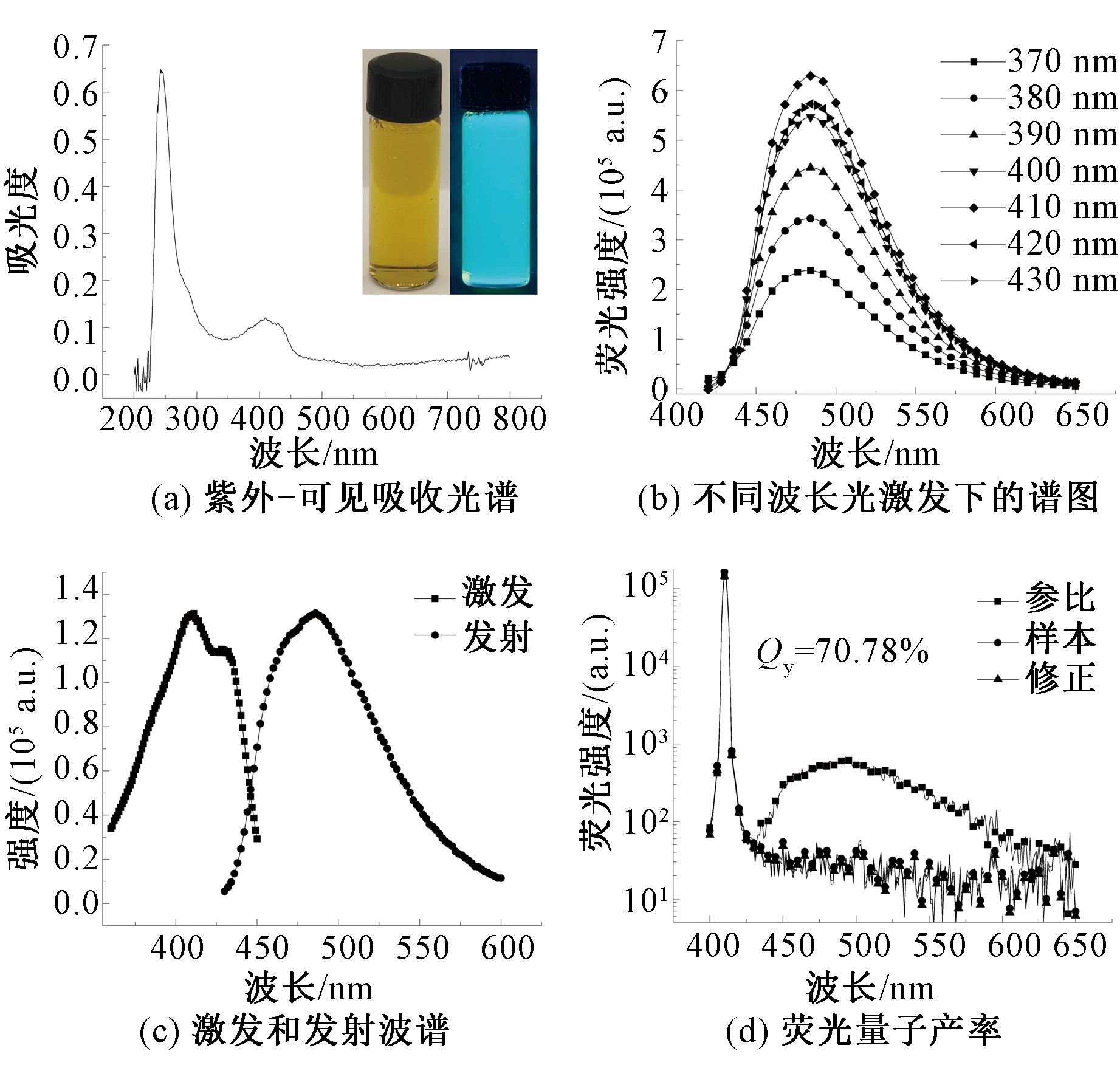
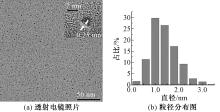
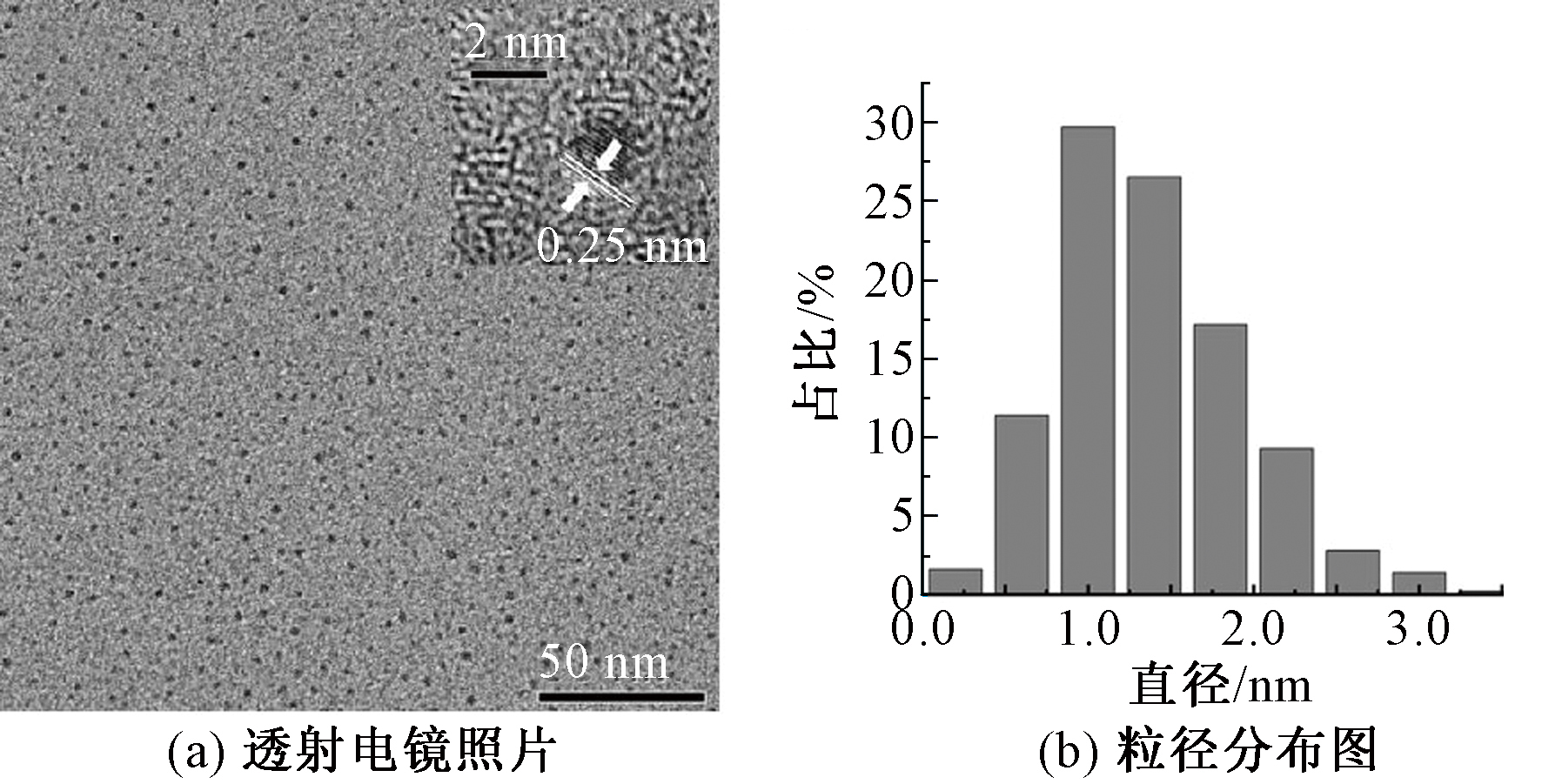
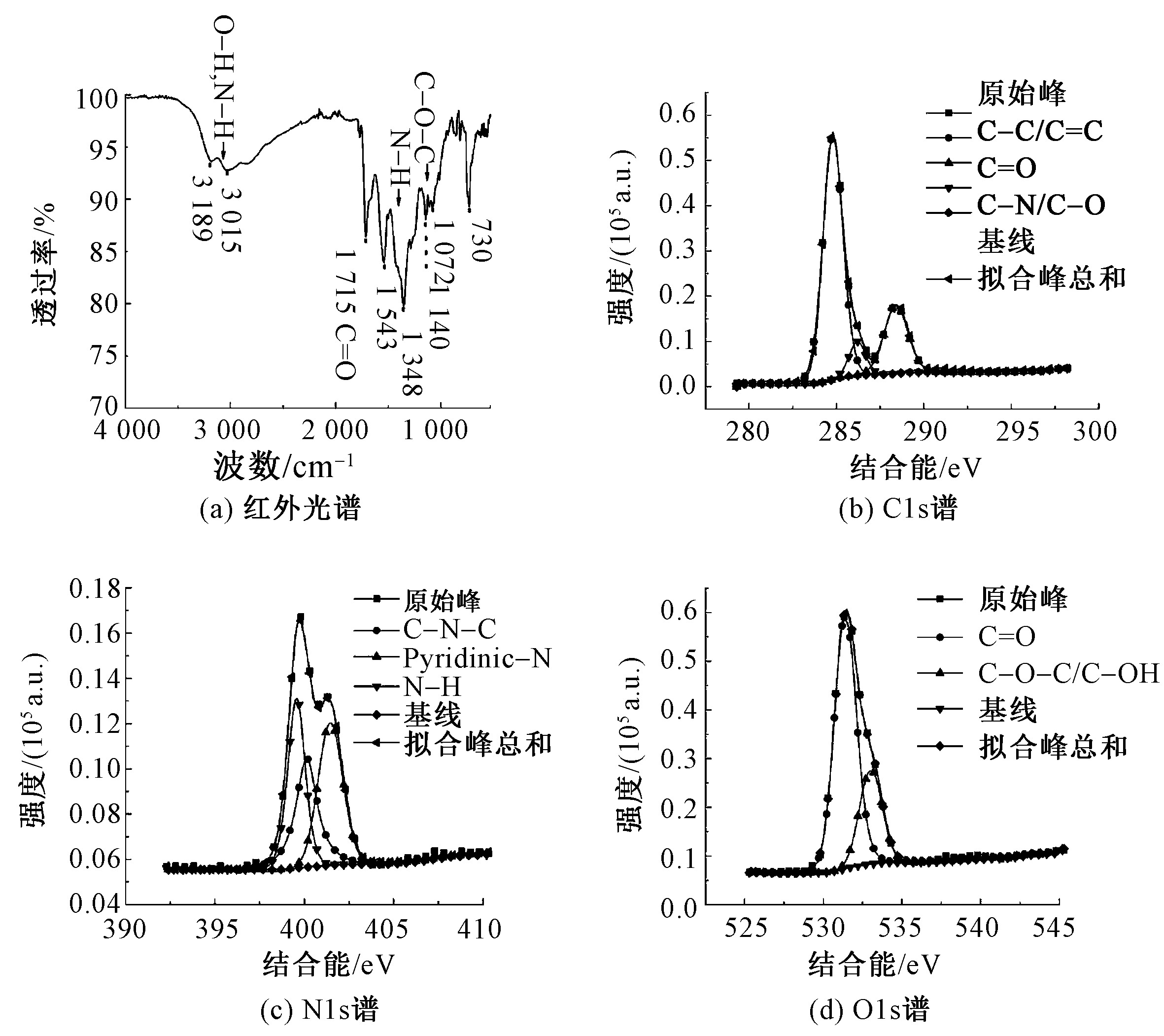
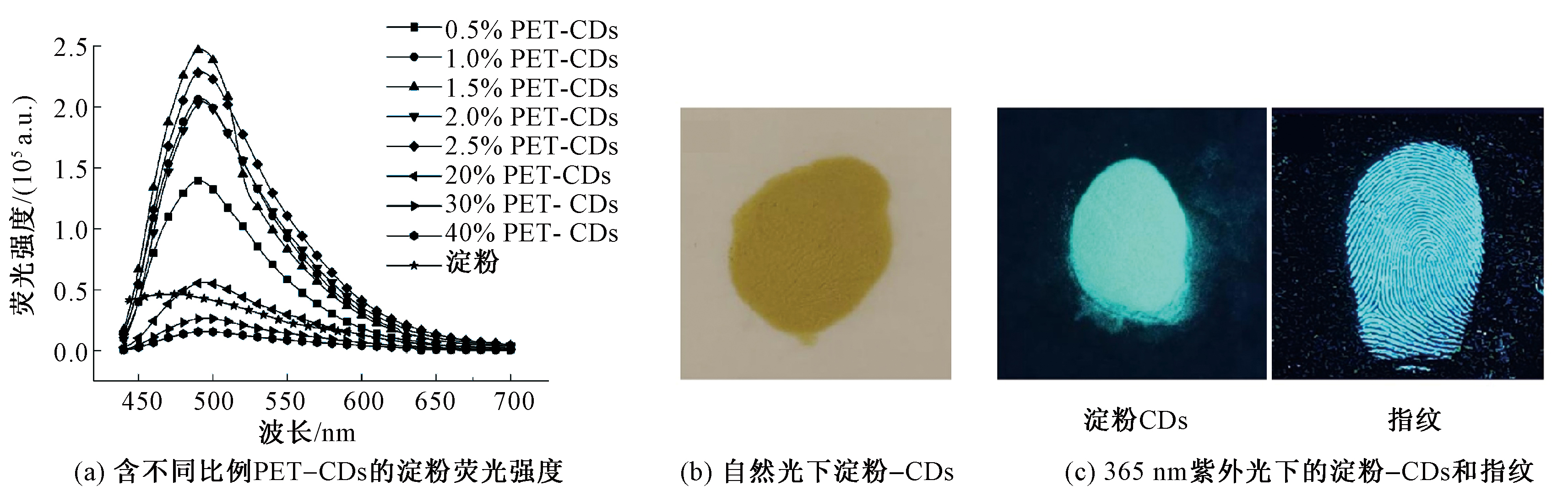
为实现聚对苯二甲酸乙二醇酯(PET)的高效回收,基于聚对苯二甲酸乙二醇酯(PET)低聚物、尿素及均苯四甲酸(PMA)利用水热法高效制备PET基碳点(PET-CDs),得到较佳工艺条件:3 g PET低聚物、5 g PMA、4 g尿素、15 mL H2O,260 ℃反应18 h。此外经研究发现,装载体积对PET基碳点(PET-CDs)荧光强度影响不大,可等比例放大至5 L反应釜中进行批量制备。对批量制备的PET-CDs进行表征,结果表明:PET-CDs为表面富含羟基、氨基的球形结构,平均粒径为1.37 nm;荧光为非激发波长依赖型,最佳激发波长为410 nm,最佳发射波长为485 nm,荧光量子产率高达70.78%。应用研究表明,将PET-CDs应用于聚己二酰己二胺(PA66)的共混阻燃改性时,PET-CDs的添加质量分数为4%时,极限氧指数达到28%,试样的第1次余焰时间从188.7 s降到5.2 s。PET-CDs荧光可被Fe3+(0~10 μmol/L)特异性猝灭,因此可采用PET-CDs为荧光探针对Fe3+进行定量检测。所制备的PET-CDs还可用于防伪和指纹检测。
中图分类号:
| [1] | 王婧茹, 严娟, 许铭育, 等. 利用废弃聚对苯二甲酸乙二醇酯制备共聚酯PBCAT[J]. 高分子材料科学与工程, 2024, 40(9): 9-18. |
| WANG Jingru, YAN Juan, XU Mingyu, et al. Preparation of copolyester PBCAT using waste polyethylene terephthalate[J]. Polymer Materials Science and Engineering, 2024, 40(9): 9-18. | |
| [2] | 陈汇凯, 黄锦圳, 鲁国强, 等. 碳点缓蚀剂的研究进展[J]. 材料研究与应用, 2024, 18(4): 538-549. |
| CHEN Huikai, HUANG Jinzhen, LU Guoqiang, et al. Research progress on carbon dot corrosion inhibi-tors[J]. Materials Research and Application, 2024, 18(4): 538-549. | |
| [3] | XU Yuanlin, WANG Boyang, ZHANG Mingming, et al. Carbon dots as a potential therapeutic agent for the treatment of cancer-related anemia[J]. Advanced Materials, 2022, 34(19): e2200905-e2200905. |
| [4] | WU Zhaofan, WANG Baojuan, NI Jiawen, et al. Green fluorescent Carbon dots with critically controlled surface states: make silk shine via feeding silkworms[J]. Nano Letters, 2024, 24(31): 9675-9682. |
| [5] | 刘俊, 张熙荣, 熊焕明. 荧光碳点在指纹检测中的应用[J]. 发光学报, 2021, 42(8):1095-1113. |
| LIU Jun, ZHANG Xirong, XIONG Huanming. Application of fluorescent carbon dots in fingerprint detection[J]. Journal of Luminescence, 2021, 42(8): 1095-1113. | |
| [6] | WANG Linjie, JI Yang, CHEN Yixin, et al. Recent research progress of fluorescence biosensors based on carbon dots in early diagnosis of diseases[J]. Trends in Analytical Chemistry, 2024, 180: 117962. |
| [7] | NGUYEN Vannghia, PHAM Hoanglong, NGUYEN Xuantruong. Recent progress in organic carbon dot-based photosensitizers for photodynamic cancer therapy[J]. Dyes and Pigments, 2024, 230: 112359-112359. |
| [8] |
邴琳涵, 王锐, 吴雨航, 等. 聚对苯二甲酸乙二醇酯基碳点热解法制备及其在阻燃改性中的应用[J]. 纺织学报, 2024, 45(10):1-8.
doi: 10.13475/j.fzxb.20230708301 |
|
BING Linhan, WANG Rui, WU Yuhang, et al. Preparation of PET-based carbon dots by pyrolysis and its application in PET flame retardancy[J]. Journal of Textile Research, 2024, 45(10):1-8.
doi: 10.13475/j.fzxb.20230708301 |
|
| [9] | 王锐, 刘彦麟, 刘蕴钰, 等. 以聚对苯二甲酸乙二醇酯为前驱体的碳点制备及其应用[J]. 纺织学报, 2022, 43(2): 10-18. |
| WANG Rui, LIU Yanlin, LIU Yunyu, et al. Preparation and application of carbon point using polyethylene terephthalate as precursor[J]. Journal of Textile Research, 2022, 43(2): 10-18. | |
| [10] | LIU Jiahui, LI Deyu, HE Jiahui, et al. Polarity-sensitive polymer carbon dots prepared at room-temperature for monitoring the cell polarity dynamics during autophagy[J]. ACS Applied Materials & Interfaces, 2020, 12(4): 4815-4820. |
| [11] |
JIANG Yongjian, LIN Min, YANG Tong, et al. Nitrogen and phosphorus doped polymer carbon dots as a sensitive cellular mapping probe of nitrite[J]. Journal of Materials Chemistry B, 2019, 7(12): 2074-2080.
doi: 10.1039/c8tb02998a pmid: 32254811 |
| [12] | GUO Zhenli, BIAN Yanfang, ZHANG Longyan, et al. Multi-stimuli-responsive carbon dots with intrinsic photochromism and in situ radical afterglow[J]. Advanced Materials, 2024, 36(45): e2409361. |
| [13] | QU Dan, ZHENG Min, ZHANG Ligong, et al. Formation mechanism and optimization of highly luminescent N-doped graphene quantum dots[J]. Scientific Reports, 2014, 4(1): 5294. |
| [14] |
DING Hui, WEI Jishi, XIONG Huanming. Nitrogen and sulfur co-doped carbon dots with strong blue luminescence[J]. Nanoscale, 2014, 6(22): 13817-13823.
doi: 10.1039/c4nr04267k pmid: 25297983 |
| [15] |
HOU Juan, WANG Wei, ZHOU Tianyu, et al. Synthesis and formation mechanistic investigation of nitrogen-doped carbon dots with high quantum yields and yellowish-green fluorescence[J]. Nanoscale, 2016, 8(21): 11185-11193.
doi: 10.1039/c6nr02701f pmid: 27180833 |
| [16] | WANG Min, HOU Aiying, YANG Dou, et al. Application of carbon dots synthesized with amino acid as precursor in the detection of phloroglucinol[J]. Microchemical Journal, 2024, 204: 111099. |
| [17] | XU Quan, LIU Yao, GAO Chun, et al. Synthesis, mechanistic investigation, and application of photoluminescent sulfur and nitrogen co-doped carbon dots[J]. Journal of Materials Chemistry C, 2015, 3(38): 9885-9893. |
| [18] | 刘举, 廖明磊, 邓德元, 等. 微硅粉改性耐热低烟无卤阻燃电缆复合材料的制备及性能研究[J]. 聚酯工业, 2024, 37(5):1-4. |
| LIU Ju, LIAO Minglei, DENG Deyuan, et al. Preparation and performance study of micro silicon powder modified heat resistant low smoke zero halogen flame retardant cable composite materials[J]. Polyester Industry, 2024, 37 (5): 1-4. | |
| [19] | 薛宝霞, 张铭铄, 杨色, 等. 一种碳点阻燃聚对苯二甲酸乙二醇酯的性能[J]. 高分子材料科学与工程, 2022, 38(7):53-59. |
| XUE Baoxia, ZHANG Mingshuo, YANG Se, et al. Properties of a carbon dot flame retardant polyethylene terephthalate[J]. Polymer Materials Science and Engineering, 2022, 38 (7): 53-59. | |
| [20] | CAI Huijuan, ZHU Yalin, XU Huilin, et al. Fabrication of fluorescent hybrid nanomaterials based on carbon dots and its applications for improving the selective detection of Fe (Ⅲ) in different matrices and cellular imaging[J]. Spectrochimica Acta Part A: Molecular and Biomolecular Spectroscopy, 2021, 246: 119033. |
| [21] | 冯瑞琪. 荧光碳点的制备及在Fe3+检测, 指纹检测和光电材料中的应用[D]. 天津: 河北工业大学, 2019: 1-65. |
| FENG Ruiqi. Preparation of fluorescent carbon dots and their applications in Fe3+ detection, fingerprint detection and photoelectric materials[D]. Tianjin: Hebei University of Technology, 2019: 1-65. |
| [1] | 高闻语, 陈诚, 奚晓玮, 邓林红, 刘杨. 改性丝素蛋白纤维增强胶原基角膜修复材料的制备及其性能[J]. 纺织学报, 2025, 46(08): 1-9. |
| [2] | 许云凯, 宋婉萌, 张旭, 刘云. 单宁酸基高效阻燃Lyocell织物的制备及其性能[J]. 纺织学报, 2025, 46(08): 145-153. |
| [3] | 陈展毓, 俞森龙, 周家良, 朱丽萍, 周哲, 相恒学, 朱美芳. 有机膦酸改性聚乳酸织物的制备及其性能[J]. 纺织学报, 2025, 46(08): 154-163. |
| [4] | 刘旭东, 宋政吉, 陈世昌, 陈文兴. 改性环氧树脂涂覆聚酰亚胺纤维的表面性能[J]. 纺织学报, 2025, 46(08): 18-27. |
| [5] | 林科, 胡万锦, 王小凤, 周思婕, 夏良君, 徐卫林. 丙纶颜色构建方法的研究进展[J]. 纺织学报, 2025, 46(08): 236-244. |
| [6] | 任天翔, 陈江炳, 房涛荣, 詹莹韬, 洪玉洁, 许志强, 徐煜东, 占海华. 聚苯硫醚薄膜的制备与改性及其应用研究进展[J]. 纺织学报, 2025, 46(08): 245-253. |
| [7] | 贾潞, 周苏秦, 郭龙灿, 刘淑强, 张瑜. 负载MXene的棉/氨纶导电包芯纱制备及其传感性能[J]. 纺织学报, 2025, 46(07): 96-102. |
| [8] | 丁圆, 赵云霞, 靳高岭, 杨涛, 徐静, 柯福佑, 陈烨. 阻燃聚丙烯腈长丝织物的层层自组装法制备及其性能[J]. 纺织学报, 2025, 46(06): 168-177. |
| [9] | 林思伶, 刘赋瑶, 张成, 侯琳, 徐炎炎, 付冉迁, 樊威. 双向调温阻燃防静电纺织品的制备及其性能[J]. 纺织学报, 2025, 46(06): 38-44. |
| [10] | 王薇, 高建南, 裴笑涵, 陆鑫, 孙银银, 吴建兵. 纤维素/甲基三甲氧基硅烷气凝胶的制备及其油水分离效能[J]. 纺织学报, 2025, 46(05): 135-142. |
| [11] | 金汝诗, 陈万明, 刘国金, 刘承海, 戚栋明, 翟世民. 生物炭在印染废水处理中的应用研究进展[J]. 纺织学报, 2025, 46(04): 235-243. |
| [12] | 郭洁琰, 徐颖雯, 丁放, 任学宏. 卤胺抗菌剂及其改性纤维的应用研究进展[J]. 纺织学报, 2025, 46(04): 255-263. |
| [13] | 孙靖宇, 张建伟, 杨超, 佘希林, 刘嘉麒. 连续玄武岩纤维专用浸润剂体系的研究进展[J]. 纺织学报, 2025, 46(03): 245-255. |
| [14] | 廖喜林, 曾媛, 刘淑萍, 李亮, 李淑静, 刘让同. 磷/氮/硅复配协效阻燃棉织物制备及其性能[J]. 纺织学报, 2025, 46(03): 151-157. |
| [15] | 郭庆, 毛阳顺, 任亚杰, 刘济民, 王怀芳, 朱平. 基于漆酶一步催化法的羊毛织物原位染色及阻燃功能化[J]. 纺织学报, 2025, 46(02): 161-169. |
|
||
 京公网安备11010502044800号