纺织学报 ›› 2025, Vol. 46 ›› Issue (09): 188-196.doi: 10.13475/j.fzxb.20241202701
刘美1,2, 崔丽娜1, 关福旺1, 李甫3, 费鹏飞3, 马驰4, 王华平2( )
)
LIU Mei1,2, CUI Li'na1, GUAN Fuwang1, LI Fu3, FEI Pengfei3, MA Chi4, WANG Huaping2()
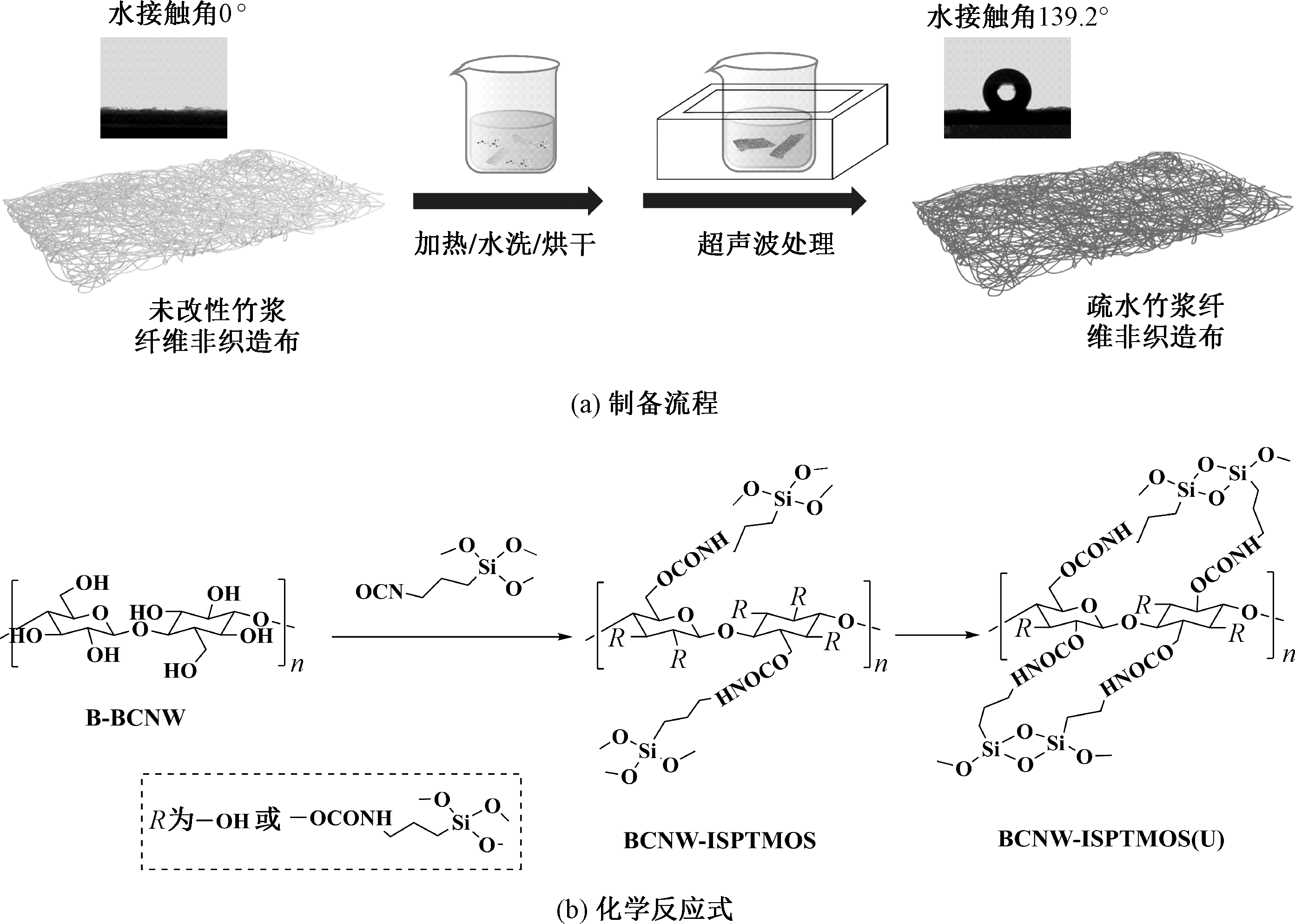
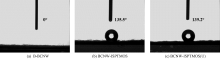
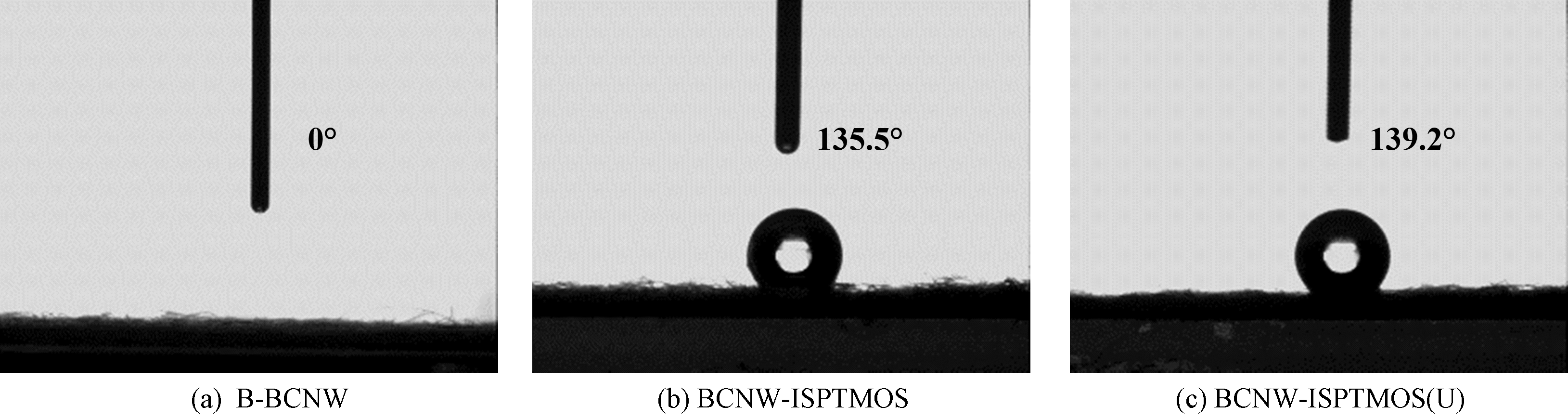
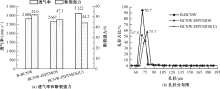
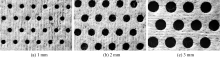
摘要: 针对传统吸收性卫生用品中不可降解高分子材料引发的纤维微塑料环境污染问题,基于可再生纤维素基材的表面修饰与结构调控,开发了具有环境友好特性的新型一次性卫生用非织造材料。利用含硅氧烷基疏水官能团的3-异氰酸酯基丙基三甲氧基硅烷(ISPTMOS)与纤维素的一步氨酯化反应对竹浆纤维水刺非织造布(BCNW)表面进行疏水改性,通过引入疏水性官能团封闭羟基实现超亲水到高疏水的转变。探究了改性前后非织造布的结构与疏水性、透气性、力学性能,并对不同网孔的疏水竹浆纤维水刺非织造布样品的液体穿透性和抗返湿性进行测试。结果表明:经改性和进一步超声波水化反应后,所得竹浆纤维水刺非织造布样品的水接触角由0°提升至139.2°,同时兼具良好的透气性(透气率达3 122 mm/s);当网孔孔径为2 mm时,疏水竹浆纤维网孔非织造材料的单向导液性优良,其液体穿透时间为2.84 s,返湿量为0.012 g,滑移量为1.403 g。
中图分类号:
| [1] | AJMERI J R, AJMERI C J. Developments in the use of nonwovens for disposable hygiene products[C]// Advances in technical nonwovens. Amsterdam: Elsevier, 2016: 473-496. |
| [2] |
TAKAYA C A, COOPER I, BERG M, et al. Offensive waste valorisation in the UK: assessment of the potentials for absorbent hygiene product (AHP) recycling[J]. Waste Management, 2019, 88: 56-70.
doi: S0956-053X(19)30154-0 pmid: 31079651 |
| [3] |
ZHOU D W, WANG L, ZHANG F Z, et al. Feasible degradation of polyethylene terephthalate fiber-based microplastics in alkaline media with Bi2O3@N-TiO2 Z-scheme photocatalytic system[J]. Advanced Sustainable Systems, 2022, 6(5): 2100516.
doi: 10.1002/adsu.v6.5 |
| [4] |
LIU Y, SHAO H, LIU J N, et al. Transport and transformation of microplastics and nanoplastics in the soil environment: a critical review[J]. Soil Use and Management, 2021, 37(2): 224-242.
doi: 10.1111/sum.v37.2 |
| [5] |
CAPEZZA A J, NEWSON W R, MUNEER F, et al. Greenhouse gas emissions of biobased diapers containing chemically modified protein superabsorbents[J]. Journal of Cleaner Production, 2023, 387: 135830.
doi: 10.1016/j.jclepro.2022.135830 |
| [6] |
BASHARI A, ROUHANI SHIRVAN A, SHAKERI M. Cellulose-based hydrogels for personal care products[J]. Polymers for Advanced Technologies, 2018, 29(12): 2853-2867.
doi: 10.1002/pat.v29.12 |
| [7] |
GÜZDEMIR Ö, BERMUDEZ V, KANHERE S, et al. Melt-spun poly(lactic acid) fibers modified with soy fillers: toward environment-friendly disposable nonwovens[J]. Polymer Engineering & Science, 2020, 60(6): 1158-1168.
doi: 10.1002/pen.v60.6 |
| [8] |
AL HOSNI A S, PITTMAN J K, ROBSON G D. Microbial degradation of four biodegradable polymers in soil and compost demonstrating polycaprolactone as an ideal compostable plastic[J]. Waste Management, 2019, 97: 105-114.
doi: S0956-053X(19)30512-4 pmid: 31447017 |
| [9] |
DENG C, SEIDI F, YONG Q, et al. Antiviral/antibacterial biodegradable cellulose nonwovens as environmentally friendly and bioprotective materials with potential to minimize microplastic pollution[J]. Journal of Hazardous Materials, 2022, 424: 127391.
doi: 10.1016/j.jhazmat.2021.127391 |
| [10] |
ABDUL KHALIL H P S, BHAT A H, IREANA YUSRA A F. Green composites from sustainable cellulose nanofibrils: a review[J]. Carbohydrate Polymers, 2012, 87(2): 963-979.
doi: 10.1016/j.carbpol.2011.08.078 |
| [11] | DAS D. Composite nonwovens in absorbent hygiene products[C]// Composite non-woven materials. Amsterdam: Elsevier, 2014: 74-88. |
| [12] | 蔡露. 多全氟烷基化功能材料的制备及结构性能研究[D]. 苏州: 苏州大学, 2016:3-14. |
| CAI Lu. Synthesis, structure and properties research of functional materials with multi-perfluoroalkyl chains[D]. Suzhou: Soochow University, 2016:3-14. | |
| [13] | 杜姗, 魏云航, 谭宇浩, 等. 棉织物的硅溶胶/短链含氟聚丙烯酸酯复合拒水整理[J]. 纺织学报, 2023, 44(9): 153-160. |
| DU Shan, WEI Yunhang, TAN Yuhao, et al. Water-repellent finishing of cotton fabrics with silica Sol and short-chain fluorinated polyacrylic ester[J]. Journal of Textile Research, 2023, 44(9): 153-160. | |
| [14] |
XU Q B, WANG L J, FU F Y, et al. Fabrication of fluorine-free superhydrophobic cotton fabric using fumed silica and diblock copolymer via mist modification[J]. Progress in Organic Coatings, 2020, 148: 105884.
doi: 10.1016/j.porgcoat.2020.105884 |
| [15] |
GUAN F X, SONG Z P, XIN F R, et al. Preparation of hydrophobic transparent paper via using polydimethylsiloxane as transparent agent[J]. Journal of Bioresources and Bioproducts, 2020, 5(1): 37-43.
doi: 10.1016/j.jobab.2020.03.004 |
| [16] |
WANG L Y, HUI L F, SU W Y. Superhydrophobic modification of nanocellulose based on an octadecylamine/dopamine system[J]. Carbohydrate Polymers, 2022, 275: 118710.
doi: 10.1016/j.carbpol.2021.118710 |
| [17] |
XU L H, PAN H, WANG L M, et al. Preparation of fluorine-free superhydrophobic cotton fabric with polyacrylate/SiO2 nanocomposite[J]. Journal of Nanoscience and Nanotechnology, 2020, 20(4): 2292-2300.
doi: 10.1166/jnn.2020.17317 |
| [18] | 齐国瑞, 柯勤飞, 李祖安, 等. 纯棉水刺非织造材料的单向导水无氟整理[J]. 纺织学报, 2019, 40(7): 119-127. |
| QI Guorui, KE Qinfei, LI Zu'an, et al. Single-guide water non-fluorinated finishing of cotton spunlace non-woven materials[J]. Journal of Textile Research, 2019, 40(7): 119-127. | |
| [19] | 卢雪, 刘秀明, 房宽峻, 等. 锦纶/棉混纺织物的耐久无氟拒水整理[J]. 纺织学报, 2021, 42(3): 14-20. |
|
LU Xue, LIU Xiuming, FANG Kuanjun, et al. Durable fluoride-free water-repellent finishing of polyamide/cotton blended fabric[J]. Journal of Textile Research, 2021, 42(3): 14-20.
doi: 10.1177/004051757204200104 |
|
| [20] |
LIU W, SUN F F, JIANG L, et al. Surface structure patterning for fabricating non-fluorinated superhydrophobic cellulosic membranes[J]. ACS Applied Polymer Materials, 2019, 1(5): 1220-1229.
doi: 10.1021/acsapm.9b00215 |
| [21] |
XU D X, GONG M H, LI S S, et al. Fabrication of superhydrophobic/oleophilic membranes by chemical modification of cellulose filter paper and their application trial for oil-water separation[J]. Cellulose, 2020, 27(11): 6093-6101.
doi: 10.1007/s10570-020-03261-z |
| [22] |
ZHAO J, ZHU W X, WANG X F, et al. Fluorine-free waterborne coating for environmentally friendly, robustly water-resistant, and highly breathable fibrous textiles[J]. ACS Nano, 2020, 14(1): 1045-1054.
doi: 10.1021/acsnano.9b08595 pmid: 31877025 |
| [23] |
LIU M, MA C, ZHOU D W, et al. Hydrophobic, breathable cellulose nonwoven fabrics for disposable hygiene applications[J]. Carbohydrate Polymers, 2022, 288: 119367.
doi: 10.1016/j.carbpol.2022.119367 |
| [24] | 张长森, 胡志超, 王旭, 等. 硅烷偶联剂/偏高岭土基地聚合物水化热及动力学研究[J]. 材料导报, 2020, 34(14): 14105-14109. |
| ZHANG Changsen, HU Zhichao, WANG Xu, et al. Hydration heat and hydration kinetics of silane coupling agent/metakaolin based geopolymers[J]. Materials Reports, 2020, 34(14): 14105-14109. | |
| [25] |
MENG J Q, ZHANG X, NI L, et al. Antibacterial cellulose membrane via one-step covalent immobilization of ammonium/amine groups[J]. Desalination, 2015, 359: 156-166.
doi: 10.1016/j.desal.2014.12.032 |
| [26] | 张莹, 马晓光, 易世雄, 等. 硅烷偶联剂对复合相变材料性能的影响[J]. 纺织学报, 2009, 30(3): 76-81. |
| ZHANG Ying, MA Xiaoguang, YI Shixiong, et al. Effect of silicane coupling agent on properties of composite phase change materials[J]. Journal of Textile Research, 2009, 30(3): 76-81. | |
| [27] |
MONDAL M I H, ISLAM M K, AHMED F. Effect of silane coupling agents on cotton fibre finishing[J]. Journal of Natural Fibers, 2022, 19(13): 5451-5464.
doi: 10.1080/15440478.2021.1875382 |
| [28] |
HE X H, CHEN T T, JIANG T Y, et al. Preparation and adsorption properties of magnetic hydrophobic cellulose aerogels based on refined fibers[J]. Carbohydrate Polymers, 2021, 260: 117790.
doi: 10.1016/j.carbpol.2021.117790 |
| [29] |
DA SILVA B L, ABUÇAFY M P, MANAIA E B, et al. Relationship between structure and antimicrobial activity of zinc oxide nanoparticles: an overview[J]. International Journal of Nanomedicine, 2019, 14: 9395-9410.
doi: 10.2147/IJN.S216204 pmid: 31819439 |
| [30] |
LI H, HE Y Q, YANG J, et al. Fabrication of food-safe superhydrophobic cellulose paper with improved moisture and air barrier properties[J]. Carbohydrate Polymers, 2019, 211: 22-30.
doi: S0144-8617(19)30120-1 pmid: 30824083 |
| [31] |
THAKUR M K, GUPTA R K, THAKUR V K. Surface modification of cellulose using silane coupling agent[J]. Carbohydrate Polymers, 2014, 111: 849-855.
doi: 10.1016/j.carbpol.2014.05.041 pmid: 25037424 |
| [32] |
LIU K S, YAO X, JIANG L. Recent developments in bio-inspired special wettability[J]. Chemical Society Reviews, 2010, 39(8): 3240-3255.
doi: 10.1039/b917112f pmid: 20589267 |
| [33] |
LIU M, MA C, CHEN Y, et al. Cellulose nonwoven with fast liquid-discharging and anti-return properties: a microplastic-free surface layer for disposable absorbent hygiene products[J]. Chemical Engineering Journal, 2024, 490: 151291.
doi: 10.1016/j.cej.2024.151291 |
| [34] |
LIU M, XIE R M, MA C, et al. Microplastic-free, single-layered functional surface with localized liquid-discharging molecular channels for disposable hygiene products[J]. Chemical Engineering Journal, 2024, 494: 153145.
doi: 10.1016/j.cej.2024.153145 |
| [35] |
SHIN Y, YOO D I, MIN K. Antimicrobial finishing of polypropylene nonwoven fabric by treatment with chitosan oligomer[J]. Journal of Applied Polymer Science, 1999, 74(12): 2911-2916.
doi: 10.1002/(SICI)1097-4628(19991213)74:12<2911::AID-APP16>3.0.CO;2-2 |
| [1] | 唐春霞, 王一帆, 毛云山, 刘健, 付少海. 电磁屏蔽用纤维素基复合材料结构设计的研究进展[J]. 纺织学报, 2025, 46(09): 36-45. |
| [2] | 刘婧瑜, 史晟, 胡晓睿, 李小燕, 张美玲, 高承永, 王华. 纤维素的溶解体系及废旧棉纤维循环再生研究进展[J]. 纺织学报, 2025, 46(07): 236-243. |
| [3] | 余厚咏, 黄程玲, 陈毅, 高智英. 天然纤维素的多维结构演变及其功能材料研究进展[J]. 纺织学报, 2025, 46(06): 45-55. |
| [4] | 丁振华, 袁开宇, 周敬, 叶冬冬. 面向渗透能收集的纤维素纳米流体系统研究进展[J]. 纺织学报, 2025, 46(06): 56-62. |
| [5] | 王薇, 高建南, 裴笑涵, 陆鑫, 孙银银, 吴建兵. 纤维素/甲基三甲氧基硅烷气凝胶的制备及其油水分离效能[J]. 纺织学报, 2025, 46(05): 135-142. |
| [6] | 李亿鸿, 蔡君怡, 诸葛晓洁, 吴东芮, 滕德英, 俞建勇, 丁彬, 李召岭. 羧基化纳米纤维素增强的柔性透明导电弹性体[J]. 纺织学报, 2025, 46(04): 11-19. |
| [7] | 符芬, 王钰涵, 丁凯, 赵帆, 李超靖, 王璐, 曾泳春, 王富军. 纤维素基止血材料的研究进展[J]. 纺织学报, 2025, 46(04): 226-234. |
| [8] | 李一, 张恒宇, 郭雯卓, 陈剑英, 王妮, 肖红. 阻抗阶跃渐变层结构纤维素/Ti3C2Tx气凝胶材料的制备及其吸波性能[J]. 纺织学报, 2025, 46(03): 17-26. |
| [9] | 张帆, 程春祖, 郭翠彬, 张东, 程敏, 李婷, 徐纪刚. Lyocell纤维直接成网工艺优化与性能分析[J]. 纺织学报, 2025, 46(03): 34-40. |
| [10] | 赵登, 张燚, 郑梦杰, 毕曙光, 冉建华. 基于液相剥离石墨烯的可见-近红外光隐身锦纶织物[J]. 纺织学报, 2025, 46(02): 153-160. |
| [11] | 李逢春, 孙辉, 于斌, 谢有秀, 张德伟. 共价有机框架材料/粘胶水刺非织造布的制备及其染料吸附性能[J]. 纺织学报, 2025, 46(02): 170-179. |
| [12] | 杨露, 孟家光, 陈雨青, 支超. 基于废旧纺织品的湿度响应纤维素/聚氨酯复合材料的制备及其性能[J]. 纺织学报, 2025, 46(02): 26-34. |
| [13] | 王恩奇, 郭萌生, 胥茹柳, 陈凤祺, 樊威, 苗亚萍. 氧原子掺杂对纤维素电子态的调控[J]. 纺织学报, 2025, 46(02): 43-50. |
| [14] | 包新军, 王兴, 张卓, 蒋辛伟, 解开放, 陈情, 何斌, 周衡书. La3+协同催化芦苇基醋酸纤维素的制备及其机制[J]. 纺织学报, 2024, 45(11): 10-20. |
| [15] | 卢道坤, 王仕飞, 董倩, 史纳蔓, 李思琦, 干露露, 周爽, 沙莎, 张如全, 罗磊. 基于MXene的导电织物构筑及其多功能应用[J]. 纺织学报, 2024, 45(09): 137-145. |
|
||
 京公网安备11010502044800号