纺织学报 ›› 2025, Vol. 46 ›› Issue (09): 250-257.doi: 10.13475/j.fzxb.20241105302
杜菁, 周安琪, 石颖欣, 王悦, 刘其霞, 单浩如, 于彩娇, 葛建龙( )
)
DU Jing, ZHOU Anqi, SHI Yingxin, WANG Yue, LIU Qixia, SHAN Haoru, YU Caijiao, GE Jianlong()
摘要:
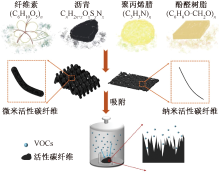
针对吸附法治理挥发性有机化合物(VOCs)污染迫切需求新型高效吸附分离材料的问题,活性碳纤维因具有比表面积大、孔道短直、结构稳定且易于使用等特点,成为VOCs吸附应用领域的研究热点。为能更好地了解当前VOCs吸附用活性碳纤维的发展现状,综述了现有微/纳米活性碳纤维在VOCs吸附应用方面的研究工作;重点介绍了不同聚合物前驱体微/纳米活性碳纤维的制备方法、结构特点及其应用性能;总结了现有微/纳米活性碳纤维在VOCs吸附应用中的优势和不足,并对其未来发展趋势进行了展望;认为需要结合前驱体纤维优选、开发低结构损伤改性/活化方法、加深吸附机制等方面的研究来进一步提高所得微/纳米活性碳纤维的综合应用性能。
中图分类号:
| [1] | LI D, SU R, MA X, et al. Porous carbon for oxygenated and aromatic VOCs adsorption by molecular simulation and experimental study: effect pore structure and functional groups[J]. Applied Surface Science, 2022. DOI: 10.1016/j.apsusc.2022.154708. |
| [2] |
ZHAO Q, LI Y, CHAI X, et al. Interaction of inhalable volatile organic compounds and pulmonary surfactant: potential hazards of VOCs exposure to lung[J]. Journal of Hazardous Materials, 2019, 369: 512-520.
doi: S0304-3894(19)30111-6 pmid: 30807991 |
| [3] |
MONTECCHIO F, BÄBLER M U, ENGVALL K. Development of an irradiation and kinetic model for UV processes in volatile organic compounds abatement applications[J]. Chemical Engineering Journal, 2018, 348: 569-582.
doi: 10.1016/j.cej.2018.05.009 |
| [4] | WU P, ZHAO S, JIN X, et al. Acid activated layered δ-MnO2 promotes VOCs combustion[J]. Applied Surface Science, 2022. DOI: 10.1016/j.apsusc.2021.151707. |
| [5] | WEI T, MA C, WEN Y, et al. An integrated biological system for air pollution control in wet plants and interaction between NO reduction and toluene oxida-tion[J]. Journal of Cleaner Production, 2022. DOI:10.1016/j.jclepro.2022.131792. |
| [6] | SU C, GUO Y, CHEN H, et al. VOCs adsorption of resin-based activated carbon and bamboo char: porous characterization and nitrogen-doped effect[J]. Colloids and Surfaces A: Physicochemical and Engineering Aspects, 2020. DOI:10.1016/j.colsurfa.2020.124983. |
| [7] |
HAO X, XIAFAN X, LIUBIAO C, et al. A complementary VOCs recovery system based on cryogenic condensation and low-temperature adsorp-tion[J]. International Journal of Refrigeration, 2023, 153: 222-230.
doi: 10.1016/j.ijrefrig.2023.06.016 |
| [8] | YE G, WANG Y, ZHU W, et al. Preparing hierarchical porous carbon with well-developed microporosity using alkali metal-catalyzed hydrothermal carbonization for VOCs adsorption[J]. Chemosphere, 2022. DOI:10.1016/j.chemosphere.2022.134248. |
| [9] | GAO G, LIAO Y, LI W, et al. Active surface RuO species originating from size-driving self-dispersion process for toluene catalytic combustion[J]. Chemical Engineering Journal, 2022. DOI:10.1016/j.cej.2022.136127. |
| [10] | 李文钊. 催化燃烧法在喷漆有机废气非甲烷总烃处理中的应用[J]. 中国资源综合利用, 2021, 39(4): 176-178. |
| LI Wenzhao. Application of catalytic combustion method in the treatment of nonmethane total hydrocarbons from paint spraying organic waste gas[J]. China Resources Comprehensive Utilization, 2021, 39(4): 176-178. | |
| [11] | MALAKAR S, SAHA P D, BASKARAN D, et al. Comparative study of biofiltration process for treatment of VOCs emission from petroleum refinery wastewater: a review[J]. Environmental Technology & Innovation, 2017, 8: 441-461. |
| [12] | LI X, MA J, LING X. Design and dynamic behaviour investigation of a novel VOC recovery system based on a deep condensation process[J]. Cryogenics, 2020. DOI:10.1016/j.cryogenics.2020.103060. |
| [13] | 苏晓濛, 汤昊洋, 吕伟, 等. 活性炭吸附法在挥发性有机物治理中的应用研究进展[J]. 化工管理, 2022(6): 38-40. |
| SU Xiaomeng, TANG Haoyang, LV Wei, et al. Progress in the application of activated carbon adsorption methods in the treatment of volatile organic com-pounds[J]. Chemical Engineering Management, 2022(6): 38-40. | |
| [14] | 李彦琼. 活性炭吸附法在挥发性有机物治理中的运用[J]. 当代化工研究, 2019(8): 112-113. |
| LI Yanqiong. Application of activated carbon adsorption in the treatment of volatile organic com-pounds[J]. Modern Chemical Research, 2019(8): 112-113. | |
| [15] | 张琰, 李好管. 挥发性有机物(VOCs)治理:技术进展及政策探析[J]. 煤化工, 2022, 50(6): 1-10,15. |
| ZHANG Yan, LI Haoguan. Volatile organic com-pounds (VOCs) treatment: technology progress and policy analysis[J]. Coal Chemical Industry, 2022, 50(6): 1-10,15. | |
| [16] | 党小庆, 王琪, 曹利, 等. 吸附法净化工业VOCs的研究进展[J]. 环境工程学报, 2021, 15(11): 3479-3492. |
| DANG Xiaoqing, WANG Qi, CAO Li, et al. Research progress on purification of VOCs in industrial gas by adsorption[J]. Chinese Journal of Environmental Engineering, 2021, 15(11): 3479-3492. | |
| [17] |
SHU Q, SUN Z, ZHU G, et al. Highly efficient synthesis of ZSM-5 zeolite by one-step microwave using desilication solution of coal gasification coarse slag and its application to VOCs adsorption[J]. Process Safety and Environmental Protection, 2022, 167: 173-183.
doi: 10.1016/j.psep.2022.08.068 |
| [18] | LU Y, LI Y, LIU D, et al. Adsorption of benzene vapor on natural silicate clay minerals under different moisture contents and binary mineral mixtures[J]. Colloids and Surfaces A: Physicochemical and Engineering Aspects, 2020. DOI: 10.1016/j.colsurfa.2019.124072. |
| [19] | CAO J, WU F, WEN M, et al. Adsorption mechanism of typical VOCs on pristine and Al-modified MnO2 monolayer[J]. Applied Surface Science, 2021. DOI: 10.1016/j.apsusc.2020.148164. |
| [20] | SHEN Y. Biomass-derived porous carbons for sorption of volatile organic compounds (VOCs)[J]. Fuel, 2023. DOI: 10.1016/j.fuel.2022.126801. |
| [21] | 潘新颖, 南辉, 韦浩民, 等. 静电纺丝法制备碳纳米纤维及其吸附性能[J]. 稀有金属材料与工程, 2020, 49(2): 567-571. |
| PAN Xinying, NAN Hui, WEI Haomin, et al. Preparation of carbon nanofibers via electrospinning technique and its adsorption properties[J]. Rare Metal Materials and Engineering, 2020, 49(2): 567-571. | |
| [22] | 郑艳军, 张菁菁, 马红霞, 等. 活性碳纤维的应用现状及前景[J]. 高科技纤维与应用, 2017, 42(2): 21-26,45. |
| ZHENG Yanjun, ZHANG Jingjing, MA Hongxia. Present situation and prospect of application of activated carbon fiber[J]. Hi-Tech Fiber & Application, 2017, 42(2): 21-26,45. | |
| [23] | ZHU L, SHEN D, LUO K H. A critical review on VOCs adsorption by different porous materials: species, mechanisms and modification methods[J]. Journal of Hazardous Materials, 2020. DOI: 10.1016/j.jhazmat.2020.122102. |
| [24] | 熊珂以, 王瑛, 唐波, 等. 活性碳纤维综述[J]. 合成纤维, 2020, 49(10): 15-19. |
| XIONG Keyi, WANG Ying, TANG Bo, et al. Review of activated carbon fiber[J]. Synthetic Fiber in China. 2020, 49(10): 15-19. | |
| [25] |
WANG J, ZHANG Z, ZHANG Q, et al. Preparation and adsorption application of carbon nanofibers with large specific surface area[J]. Journal of Materials Science, 2018, 53(24): 16466-16475.
doi: 10.1007/s10853-018-2772-8 |
| [26] | 董玉灿. 基于玉米秸秆制备多孔炭和复合碳纳米纤维的工艺及性能研究[D]. 甘肃: 兰州理工大学, 2019: 7-12. |
| DONG Yucan. Study on process and properties of preparation of porous carbon and composite carbon nanofibers prepared based on corn-straw[D]. Gansu: Lanzhou University of Technology, 2019: 7-12. | |
| [27] | ACHARYA S, LIYANAGE S, PARAJULI P, et al. Utilization of cellulose to its full potential: a review on cellulose dissolution, regeneration, and applic-ations[J]. Polymers (Basel), 2021. DOI: 10.3390/polym13244344. |
| [28] | CHEN J, LIU J, YUAN T, et al. Comparison of cellulose and chitin nanocrystals for reinforcing regenerated cellulose fibers[J]. Journal of Applied Polymer Science, 2017. DOI: 10.1002/app.44880. |
| [29] |
MANIMARAN P, PILLAI G P, VIGNESH V, et al. Characterization of natural cellulosic fibers from nendran banana peduncle plants[J]. International Journal of Biological Macromolecules, 2020, 162: 1807-1815.
doi: 10.1016/j.ijbiomac.2020.08.111 pmid: 32814104 |
| [30] | GE Y, AKPINAR I, LI Z, et al. Porous structured cotton-based ACF for the adsorption of benzen[J]. Chemosphere, 2021. DOI: 10.1016/j.chemosphere.2021.131110. |
| [31] | YAN M, RONG Y, WU F, et al. Micro-mesoporous graphitized carbon fiber as hydrophobic adsorbent that removes volatile organic compounds from air[J]. Chemical Engineering Journal, 2023. DOI: 10.1016/j.cej.2022.139184. |
| [32] |
XUE Y, GE Z, LI F, et al. Modified asphalt properties by blending petroleum asphalt and coal tar pitch[J]. Fuel, 2017, 207: 64-70.
doi: 10.1016/j.fuel.2017.06.064 |
| [33] |
QIAO W M, YOON S H, MOCHIDA I, et al. Waste polyvinylchloride derived pitch as a precursor to develop carbon fibers and activated carbon fibers[J]. Waste Management, 2007, 27(12): 1884-1890.
pmid: 17157493 |
| [34] |
YUE Z, VAKILI A, WANG J. Activated carbon fibers from meltblown isotropic pitch fiber webs for vapor phase adsorption of volatile organic compounds[J]. Chemical Engineering Journal, 2017, 330: 183-190.
doi: 10.1016/j.cej.2017.07.150 |
| [35] |
YOSHIKAWA Y, TESHIMA K, FUTAMURA R, et al. Structural adsorption mechanism of chloroform in narrow micropores of pitch-based activated carbon fibres[J]. Carbon, 2021, 171: 681-688.
doi: 10.1016/j.carbon.2020.08.020 |
| [36] |
LU A H, ZHENG J T. Study of microstructure of high-surface-area polyacrylonitrile activated carbon fibers[J]. Journal of Colloid and Interface Science, 2001, 236(2): 369-374.
doi: 10.1006/jcis.2000.7425 |
| [37] | 姜林妤. 高比表面积活性碳材料的制备及其吸附处理VOCs的研究[D]. 北京: 清华大学, 2015:1-88. |
| JIANG Linyu. The preparation of activated carbonf ibers with high specific surface areasand their adsorption of VOCs[D]. Beijing: Tsinghua University, 2015:1-88. | |
| [38] | 姜林好, 黎维彬. 高比表面积聚丙烯腈基活性炭纤维的制备及其吸附正己烷的研究[J]. 中国材料科技与设备, 2015, 11(4): 4. |
| JIANG Linhao, LI Weibin. Preparation of PAN-based activated carbon fiber with high specific surface area and its adsorption of n-hexane[J]. Chinese Materials Science Technology & Equipment, 2015, 11(4):4. | |
| [39] | 张彤. 酚醛基活性碳纤维的制备及吸附性能研究[D]. 上海: 东华大学,2022: 1-66. |
| ZHANG Tong. Preparation and adsorption properties of phenolic-based activated carbon fiber[D]. Shanghai: Donghua University, 2022: 1-66. | |
| [40] |
MANGUN C L, DALEY M A, BRAATZ R D, et al. Effect of pore size on adsorption of hydrocarbons in phenolic-based activated carbon fibers[J]. Carbon, 1998, 36(1/2): 123-129.
doi: 10.1016/S0008-6223(97)00169-3 |
| [41] |
WANG L, LI J, GAN G, et al. Activated carbon fibers prepared by one-step activation with CuCl2 for highly efficient gas adsorption[J]. Industrial & Engineering Chemistry Research, 2020, 59(44): 19793-19802.
doi: 10.1021/acs.iecr.0c02699 |
| [42] |
WANG G, WANG Z, LEE B, et al. Polymerization-induced self-assembly of acrylonitrile via ICAR ATRP[J]. Polymer, 2017, 129: 57-67.
doi: 10.1016/j.polymer.2017.09.029 |
| [43] | YU D G, WANG M, LI X, et al. Multi-fluid electrospinning for the generation of complex nanostructures[J]. Wiley Interdisciplinary Reviews-Nanomedicine and Nanobiotechnology, 2020. DOI:10.1002/wnan.1601. |
| [44] |
LEE K J, SHIRATORI N, LEE G H, et al. Activated carbon nanofiber produced from electrospun polyacrylonitrile nanofiber as a highly efficient formaldehyde adsorbent[J]. Carbon, 2010, 48(15): 4248-4255.
doi: 10.1016/j.carbon.2010.07.034 |
| [45] | YANG X, WU X, CHEN Z, et al. Hierarchically porous N-doped carbon nanofibers derived from ZIF-8/PAN composites for benzene adsorption[J]. Journal of Applied Polymer Science, 2020. DOI: 10.1002/app.50431. |
| [46] |
BAI Y, HUANG Z, KANG F. Electrospun preparation of microporous carbon ultrafine fibers with tuned diameter, pore structure and hydrophobicity from phenolic resin[J]. Carbon, 2014, 66: 705-712.
doi: 10.1016/j.carbon.2013.09.074 |
| [47] |
BAI Y, HUANG Z, ZHANG Z, et al. Ultrafine hierarchically porous carbon fibers and their adsorption performance for ethanol and acetone[J]. New Carbon Materials, 2019, 34(6): 533-538.
doi: 10.1016/S1872-5805(19)60029-6 |
| [48] | AWAD R, HAGHIGHAT M, BOLUK Y, et al. Synthesis and characterization of electrospun PAN-based activated carbon nanofibers reinforced with cellulose nanocrystals for adsorption of VOCs[J]. Chemical Engineering Journal, 2021. DOI: 10.1016/j.cej.2021.128412. |
| [49] |
JU Y, OH G. Behavior of toluene adsorption on activated carbon nanofibers prepared by electrospinning of a polyacrylonitrile-cellulose acetate blending solut-ion[J]. Korean Journal of Chemical Engineering, 2017, 34(10): 2731-2737.
doi: 10.1007/s11814-017-0171-5 |
| [50] |
ZHOU A, DU J, SHI Y, et al. Hierarchical porous carbon nanofibrous membranes with elaborated chemical surfaces for efficient adsorptive removal of volatile organic compounds from air[J]. Journal of Colloid and Interface Science, 2024, 673: 860-873.
doi: 10.1016/j.jcis.2024.06.126 pmid: 38908285 |
| [1] | 刘微, 田振川, 沈朝阳, 梅润. 金属-有机框架应用于纤维/织物功能化改性的研究进展[J]. 纺织学报, 2024, 45(12): 215-224. |
| [2] | 郑康, 龚文丽, 鲍杰, 刘琳. 两性纤维素多孔凝胶球的制备及其动态吸附性能[J]. 纺织学报, 2024, 45(05): 102-112. |
| [3] | 刘其霞, 张天昊, 季涛, 葛建龙, 单浩如. 锆基金属有机骨架材料/活性碳纤维复合材料的制备及其降解性能[J]. 纺织学报, 2023, 44(09): 134-143. |
| [4] | 丁娟, 刘阳, 张晓飞, 郝克倩, 宗蒙, 孔雀. Fe/C多孔碳材料制备及其涂层棉织物的吸波性能[J]. 纺织学报, 2023, 44(02): 191-198. |
| [5] | 王静, 娄娅娅, 王春梅. 铁基金属–有机框架材料/活性碳纤维复合材料的制备及其对染料的脱色[J]. 纺织学报, 2022, 43(08): 126-131. |
| [6] | 程绿竹, 王宗乾, 王邓峰, 申佳锟, 李长龙. 高中空生物质活性碳纤维制备及其对亚甲基蓝的吸附性能[J]. 纺织学报, 2021, 42(02): 129-134. |
| [7] | 沈岳, 蒋高明, 刘其霞. 梯度结构活性碳纤维毡吸声性能分析[J]. 纺织学报, 2020, 41(10): 29-33. |
| [8] | 杨凯, 张啸梅, 焦明立, 贾万顺, 刁泉, 李咏, 张彩云, 曹健. 高邻位酚醛基纳米活性碳纤维制备及其吸附性能[J]. 纺织学报, 2020, 41(08): 1-8. |
| [9] | 李树锋, 程博闻, 罗永莎, 王辉, 徐经伟. 聚丙烯腈基活性中空碳纳米纤维制备及其性能[J]. 纺织学报, 2019, 40(10): 1-6. |
| [10] | 徐威 夏磊 周兴海 西鹏 程博闻. 纺丝工艺及预氧化条件对离心纺聚丙烯腈基纳米碳纤维的影响[J]. 纺织学报, 2016, 37(2): 7-12. |
| [11] | 曾凡龙 刘占莲 韩芹 曹谦芝 仲林 肖婷婷. 活性炭纤维/NiO/MnO2复合电极的结构及其电化学性能[J]. 纺织学报, 2013, 34(10): 1-0. |
| [12] | 张秀林 张越 刘庆生 邓炳耀. TiO2/ACF光催化材料的制备与特性[J]. 纺织学报, 2011, 32(8): 21-24. |
| [13] | 李全明;万雅波;陈东生. 活性碳纤维的制备及性能表征[J]. 纺织学报, 2004, 25(02): 9-10. |
| [14] | 李永贵;葛明桥. 活性碳纤维处理印染废水的研究[J]. 纺织学报, 2003, 24(05): 68-69. |
| [15] | 李永贵;高卫东;陈东生;敖玉辉. 聚丙烯腈基活性碳纤维非织造布的研制[J]. 纺织学报, 2002, 23(02): 65-66. |
|
||
 京公网安备11010502044800号