纺织学报 ›› 2025, Vol. 46 ›› Issue (11): 155-163.doi: 10.13475/j.fzxb.20250300701
龙红霞1, 吴伟1, 刘娅岚1, 徐红1,2,3,4, 毛志平1,2,3,4( )
)
LONG Hongxia1, WU Wei1, LIU Yalan1, XU Hong1,2,3,4, MAO Zhiping1,2,3,4()
摘要:
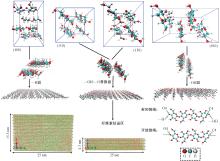
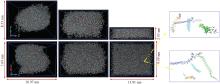
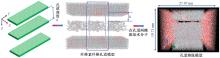
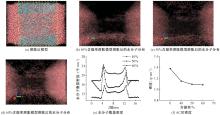
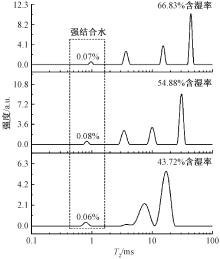
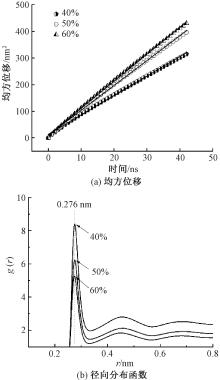
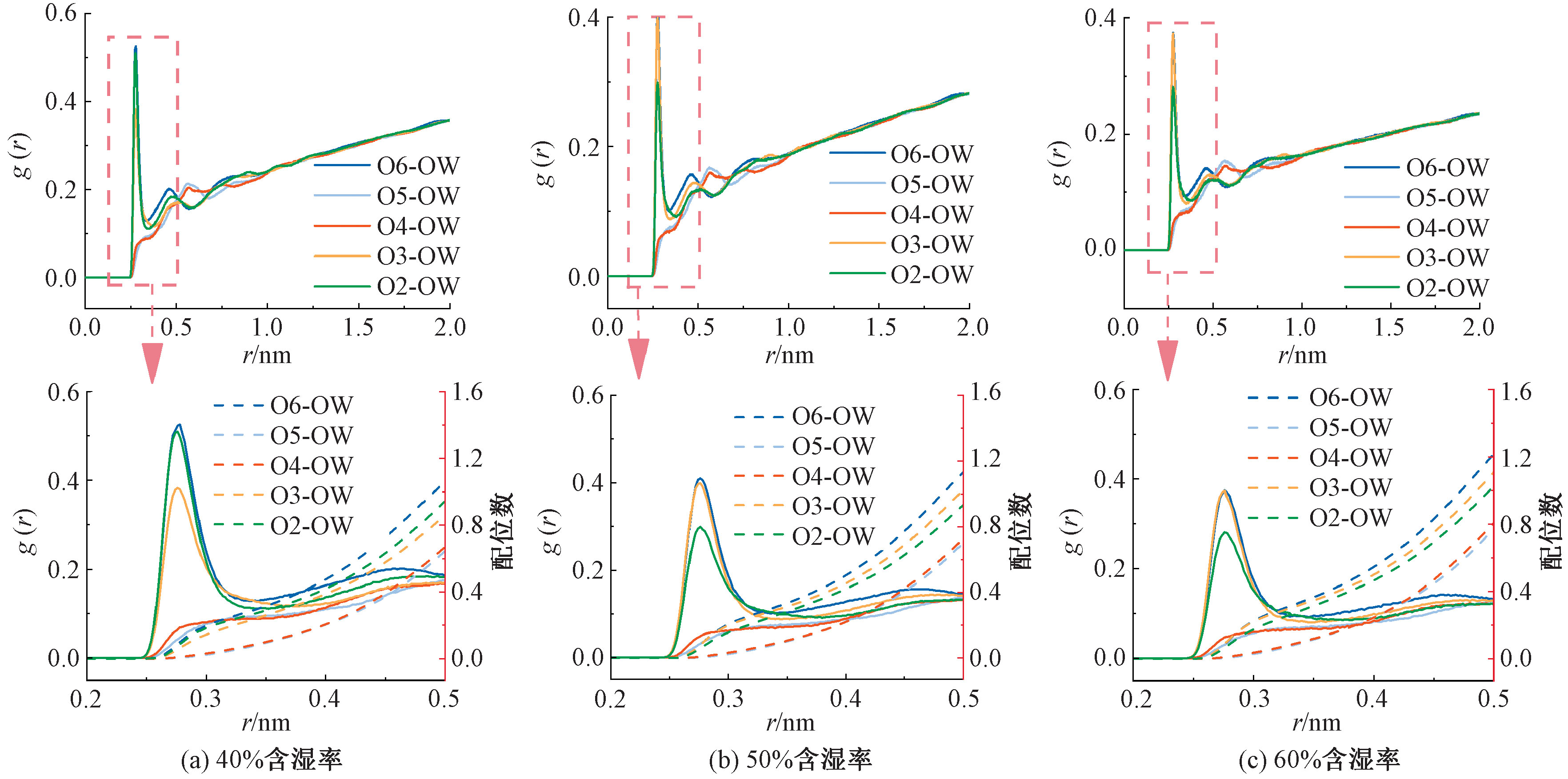
为揭示高湿度环境下纤维素纤维溶胀过程中水分布的微观机制,为纤维素纤维活性染料染色时织物含湿率的控制提供理论支持,采用分子动力学模拟方法,构建了经时域核磁实验验证的纤维素纤维孔道模型,系统分析了不同含湿率下孔道的动态溶胀行为。结果表明:水分子优先在晶区与非晶区的界面孔道形成纵向梯度密度分布,并在非晶区均匀渗透;40%~50%含湿率是纤维素结构从孤立孔隙向三维渗透网络转变的临界区间;高含湿率能增强孔道连通性,提高对水分子传质效率,促使其扩散系数呈非线性增长,因此控制织物带液率小于40%能有效抑制活性染料因纤维内部自由水增多而加剧的水解;时域核磁实验与模拟结果一致,显示纤维内部的强结合水比例稳定在0.07%左右,证实了模型的可靠性;低含湿率时,O6/O4位点主导水合作用,而溶胀引发的结构松弛促使低亲和力O2/O3位点的水分子吸附比例显著提高。
中图分类号:
| [1] | 舒大武, 房宽峻, 刘秀明, 等. 活性染料无盐连续轧-蒸与冷轧堆染色效果的比较[J]. 纺织学报, 2018, 39(4): 77-81. |
| SHU Dawu, FANG Kuanjun, LIU Xiuming, et al. Comparison on dyeing effect of reactive dyes by salt-free continuous pad-steam dyeing and cold pad-batch dyeing[J]. Journal of Textile Research, 2018, 39(4): 77-81. | |
| [2] |
CONTI A, PALOMBO M, PARMENTIER A, et al. Two-phase water model in the cellulose network of paper[J]. Cellulose, 2017, 24(8): 3479-3487.
doi: 10.1007/s10570-017-1338-2 |
| [3] | 赵涛. 染整工艺与原理[M]. 北京: 中国纺织出版社, 2009: 20-24. |
| ZHAO Tao. Dyeing and finishing technology and principles[M]. Beijing: China Textile & Apparel Press, 2009: 20-24. | |
| [4] | 胡蝶, 张婷婷, 胡涵昌, 等. 活性染料在棉纤维上的扩散性能及其影响因素研究[J]. 纤维素科学与技术, 2020, 28(4): 38-45. |
| HU Die, ZHANG Tingting, HU Hanchang, et al. Diffusion performance of reactive dyes on cotton fiber and the influencing factors[J]. Journal of Cellulose Science and Technology, 2020, 28(4): 38-45. | |
| [5] |
SALEM K S, NAITHANI V, JAMEEL H, et al. A systematic examination of the dynamics of water-cellulose interactions on capillary force-induced fiber collapse[J]. Carbohydrate Polymers, 2022, 295: 119856.
doi: 10.1016/j.carbpol.2022.119856 |
| [6] | 高振华, 顾继友, 李志国. 利用DSC研究异氰酸酯与纤维素的反应机理[J]. 林业科学, 2005, 41(3): 115-120. |
| GAO Zhenhua, GU Jiyou, LI Zhiguo. The DSC study on the reaction mechanism of isocyanate with cellu-lose[J]. Scientia Silvae Sinicae, 2005, 41(3): 115-120. | |
| [7] |
MAO Z P, YU H, WANG Y F, et al. States of water and pore size distribution of cotton fibers with different moisture ratios[J]. Industrial & Engineering Chemistry Research, 2014, 53(21): 8927-8934.
doi: 10.1021/ie501071h |
| [8] | 陶德亨, 李新宇, 刘文静, 等. 利用核磁共振技术研究热处理中密度纤维板的吸水性[J]. 安徽农业大学学报, 2018, 45(4): 645-649. |
| TAO Deheng, LI Xinyu, LIU Wenjing, et al. Water adsorption of heat-treatment medium density fiberboard studied by TD-NMR technique[J]. Journal of Anhui Agricultural University, 2018, 45(4): 645-649. | |
| [9] |
LIU Y L, WU W, XU H, et al. A fast and effective way to measure the inner pore size distributions of wetted cotton fibers and their pretreatment performance using time-domain nuclear magnetic resonance[J]. International Journal of Biological Macromolecules, 2024, 271: 132781.
doi: 10.1016/j.ijbiomac.2024.132781 |
| [10] |
SALMÉN L, STEVANIC J S, HOLMQVIST C, et al. Moisture induced straining of the cellulosic micro-fibril[J]. Cellulose, 2021, 28(6): 3347-3357.
doi: 10.1007/s10570-021-03712-1 |
| [11] | 陈玉, 江学为. 基于分子动力学模拟的纤维素Ⅱ扩散性质研究[J]. 服饰导刊, 2019, 8(3): 26-30. |
| CHEN Yu, JIANG Xuewei. Research on diffusion properties of cellulose Ⅱ based on molecular dynamics simulation[J]. Fashion Guide, 2019, 8(3): 26-30. | |
| [12] |
刘刚, 张恒, 孙恒, 等. 碱/脲水溶液体系中纤维素包合物构型及纤维素与溶剂分子间相互作用力的分子动力学模拟[J]. 高等学校化学学报, 2018, 39(4): 714-720.
doi: 10.7503/cjcu20170683 |
|
LIU Gang, ZHANG Heng, SUN Heng, et al. Molecular dynamics simulation on the structure of cellulose inclusion complexes and interactions between cellulose chains and solvent molecules in alkali/urea aqueous solution[J]. Chemical Journal of Chinese Universities, 2018, 39(4): 714-720.
doi: 10.7503/cjcu20170683 |
|
| [13] |
WANG Y X, KIZILTAS A, BLANCHARD P, et al. Surface-grafted cellulose in water: interfacial retention and dynamical ingress of moisture[J]. ACS Applied Polymer Materials, 2022, 4(10): 6985-6993.
doi: 10.1021/acsapm.2c00901 |
| [14] |
DAN L Y, HUANG Z Y, LI J, et al. Molecular dynamics simulations of performance degradation of cellulose nanofibers (CNFs) under hygrothermal environments[J]. Molecular Simulation, 2020, 46(15): 1172-1180.
doi: 10.1080/08927022.2020.1807541 |
| [15] |
SAHPUTRA I H, ALEXIADIS A, ADAMS M J. Effects of moisture on the mechanical properties of microcrystalline cellulose and the mobility of the water molecules as studied by the hybrid molecular mechanics-molecular dynamics simulation method[J]. Journal of Polymer Science Part B: Polymer Physics, 2019, 57(8): 454-464.
doi: 10.1002/polb.v57.8 |
| [16] | 王雷, 楼雨寒, 童志函, 等. 水合金属盐低共熔溶剂室温溶解纤维素的分子动力学机制[J]. 林业工程学报, 2022, 7(4): 64-71. |
| WANG Lei, LOU Yuhan, TONG Zhihan, et al. Molecular dynamics mechanism of metal salt hydrate-based deep eutectic solvent to dissolve cellulose at room temperature[J]. Journal of Forestry Engineering, 2022, 7(4): 64-71. | |
| [17] |
WANG Y X, KIZILTAS A, DREWS A R, et al. Dynamical water ingress and dissolution at the amorphous-crystalline cellulose interface[J]. Biomacromolecules, 2021, 22(9): 3884-3891.
doi: 10.1021/acs.biomac.1c00690 pmid: 34337937 |
| [18] |
MATTHEWS J F, SKOPEC C E, MASON P E, et al. Computer simulation studies of microcrystalline cellulose Iβ[J]. Carbohydrate Research, 2006, 341(1): 138-152.
doi: 10.1016/j.carres.2005.09.028 |
| [19] |
VAN DER SPOEL D, LINDAHL E, HESS B, et al. GROMACS: fast, flexible, and free[J]. Journal of Computational Chemistry, 2005, 26(16): 1701-1718.
doi: 10.1002/jcc.20291 pmid: 16211538 |
| [20] |
GOMES T C F, SKAF M S. Cellulose-Builder: a toolkit for building crystalline structures of cellulose[J]. Journal of Computational Chemistry, 2012, 33(14): 1338-1346.
doi: 10.1002/jcc.22959 pmid: 22419406 |
| [21] |
MARTÍNEZ L, ANDRADE R, BIRGIN E G, et al. PACKMOL: a package for building initial configurations for molecular dynamics simulations[J]. Journal of Computational Chemistry, 2009, 30(13): 2157-2164.
doi: 10.1002/jcc.21224 pmid: 19229944 |
| [22] |
WOODS R J, DWEK R A, EDGE C J, et al. Molecular mechanical and molecular dynamic simulations of glycoproteins and oligosaccharides. 1. GLYCAM_93 parameter development[J]. The Journal of Physical Chemistry, 1995, 99(11): 3832-3846.
doi: 10.1021/j100011a061 |
| [23] |
JORGENSEN W L, CHANDRASEKHAR J, MADURA J D, et al. Comparison of simple potential functions for simulating liquid water[J]. The Journal of Chemical Physics, 1983, 79(2): 926-935.
doi: 10.1063/1.445869 |
| [24] | ZHIVOTOVSKII L A. Computer models of quantitative characteristics in genetics: communication II. dynamics of the frequency of alleles with different types of selection[J]. Soviet Genetics, 2004, 87: 937-941. |
| [25] |
DASHTIMOGHADAM E, BAHLAKEH G, SALIMI-KENARI H, et al. Rheological study and molecular dynamics simulation of biopolymer blend thermogels of tunable strength[J]. Biomacromolecules, 2016, 17(11): 3474-3484.
pmid: 27766854 |
| [26] |
HESS B, BEKKER H, BERENDSEN H J C, et al. LINCS: a linear constraint solver for molecular simulations[J]. Journal of Computational Chemistry, 1997, 18(12): 1463-1472.
doi: 10.1002/(ISSN)1096-987X |
| [27] |
DARDEN T, YORK D, PEDERSEN L. Particle mesh Ewald: an N·log(N) method for Ewald sums in large systems[J]. The Journal of Chemical Physics, 1993, 98(12): 10089-10092.
doi: 10.1063/1.464397 |
| [28] |
MAZEAU K. The hygroscopic power of amorphous cellulose: a modeling study[J]. Carbohydrate Polymers, 2015, 117: 585-591.
doi: 10.1016/j.carbpol.2014.09.095 pmid: 25498674 |
| [29] |
MAO X D, ZHONG Y, XU H, et al. A novel low add-on technology of dyeing cotton fabric with reactive dyestuff[J]. Textile Research Journal, 2018, 88(12): 1345-1355.
doi: 10.1177/0040517517700195 |
| [1] | 张帆, 蔡再生, 刘慧景, 陆少锋, 黄旭明. 高牢固光致变色棉织物的点击化学法制备及其性能[J]. 纺织学报, 2025, 46(11): 196-202. |
| [2] | 王子涵, 李勇, 陈晓川, 汪军, 梁凌杰. 废旧棉织物破碎加工过程的建模与仿真[J]. 纺织学报, 2025, 46(07): 136-143. |
| [3] | 赵强强, 王韩星, 张奉轩, 何瑾馨, 周俊, 周兆昌, 董霞. 聚六亚甲基双胍盐酸盐改性对棉织物耐日晒色牢度的影响[J]. 纺织学报, 2025, 46(04): 109-118. |
| [4] | 黄春月, 黄鑫, 杜海娟, 徐文杰, 杨雪梅, 万科研, 李旭, 高杰. 钼氧簇复合物整理剂制备及其整理棉织物的防紫外线性能[J]. 纺织学报, 2025, 46(04): 138-145. |
| [5] | 廖喜林, 曾媛, 刘淑萍, 李亮, 李淑静, 刘让同. 磷/氮/硅复配协效阻燃棉织物制备及其性能[J]. 纺织学报, 2025, 46(03): 151-157. |
| [6] | 张洁, 郭鑫源, 关晋平, 程献伟, 陈国强. 磷/氮阻燃剂原位沉积对棉织物的耐久阻燃改性[J]. 纺织学报, 2025, 46(02): 180-187. |
| [7] | 袁华彬, 王沂沨, 王家朋, 向永翾, 陈国强, 邢铁玲. 基于山嵛酸和ZIF-8改性的超疏水防结冰棉织物[J]. 纺织学报, 2025, 46(02): 197-206. |
| [8] | 巢探宇, 叶韵, 李娜, 廖思含, 马琪凯, 崔莉. 基于脂肪酶固定化的棉织物易去油污整理及其应用[J]. 纺织学报, 2025, 46(01): 130-137. |
| [9] | 武浩, 周嫦娥, 高振清, 冯嘉禾. 基于还原-氧化体系的活性染料染色棉织物剥色[J]. 纺织学报, 2024, 45(12): 128-136. |
| [10] | 王心雨, 郭明明, 张乐乐, 郑伟杰, AMJAD Farooq, 王宗乾. 耐久性抗菌超疏水棉织物的制备及其性能[J]. 纺织学报, 2024, 45(11): 170-177. |
| [11] | 肖渊, 童垚, 胡呈安, 武贤军, 杨磊鹏. 导电复合材料涂覆式全织物基柔性压阻传感器制备[J]. 纺织学报, 2024, 45(10): 152-160. |
| [12] | 张应秀, 徐丽慧, 潘虹, 姚程健, 赵红, 窦梅冉, 沈勇, 赵诗怡. 基于甘蔗渣多孔碳的超疏水棉织物制备及其性能[J]. 纺织学报, 2024, 45(10): 161-169. |
| [13] | 赵强, 刘正江, 高晓平, 张云婷, 张宏. 蒙脱土协同TiO2整理棉织物的功能性[J]. 纺织学报, 2024, 45(09): 121-128. |
| [14] | 刘慧, 李平, 朱平, 刘云. γ-脲基丙基三乙氧基硅烷/苯基膦酸阻燃抗菌棉织物的制备及其性能[J]. 纺织学报, 2024, 45(08): 205-214. |
| [15] | 赵攀, 谭文丽, 赵心蕊, 付金凡, 刘成显, 袁久刚. 基于离子液体微溶焊接的可降解薄膜制备及其性能[J]. 纺织学报, 2024, 45(08): 89-98. |
|
||
 京公网安备11010502044800号