纺织学报 ›› 2025, Vol. 46 ›› Issue (11): 94-101.doi: 10.13475/j.fzxb.20250103801

• 纺织工程 • 上一篇    下一篇

户外仿生结构功能面料的开发及其性能

徐丽丽, 腾燕飞, 马丕波, 万爱兰()   

  1. 江南大学 针织技术教育部工程研究中心, 江苏 无锡 214122
  • 收稿日期:2025-01-14 修回日期:2025-07-11 出版日期:2025-11-15 发布日期:2025-11-15
  • 通讯作者: 万爱兰(1976—),女,副教授,博士。主要研究方向为纺织材料与智能纺织品。E-mail: ailan.wan@jiangnan.edu.cn
  • 作者简介:徐丽丽(1998—),女,硕士生。主要研究方向为功能性针织产品开发。
  • 基金资助:
    中央高校基本科研业务费专项资金资助项目(JUSRP123005);江苏省科技计划重点研发项目(BE2022131)

Development and performance of outdoor functional fabrics with bionic structures

XU Lili, TENG Yanfei, MA Pibo, WAN Ailan()   

  1. Engineering Research Center for knitting Technology, Ministry of Education,Jiangnan University, Wuxi, Jiangsu 214122, China
  • Received:2025-01-14 Revised:2025-07-11 Published:2025-11-15 Online:2025-11-15

摘要:

为改善户外功能衣在人体运动后因细菌滋生和汗液挥发产生的异味,以及提升其热湿舒适性,以王莲叶脉的结构为仿生原理,采用消臭氨纶/丙纶包覆纱作为地纱,羊毛作为添纱设计并开发了8款仿生结构面料。对8款面料的消臭、热湿舒适性及服用性能进行测试。结果表明: 叶片泡状结构面料消臭性能高达99.50%,适用于腋下、前胸等易产生异味的部位;次叶脉结构面料克罗值达0.723 7 clo,适用于腹部及膝关节等需重点保暖部位;主叶脉结构面料透气率为390.78 mm/s、透湿率为454.77 g/(m2·h),主次叶脉小方格面料单向传递指数为409.610,适用于胸背部等出汗量大的部位;以上仿生结构面料经7 000次摩擦后起毛起球等级仍达5级,适用于羊毛户外功能衣面料。

关键词: 仿生结构, 羊毛, 户外功能衣, 功能面料, 仿生针织面料, 消臭氨纶, 消臭性能, 热湿舒适性

Abstract:

Objective With the booming development of outdoor sports, people's demand for functional sportswear continued to grow. Heavy clothing led to poor perspiration, seriously affecting comfort with risk of hypothermia, and was easy to gather odor causing embarrassment and discomfort in a complex autumn and winter outdoor environment. Current research on the base layer of outdoor functional fabrics is primarily focused on single-function characteristics, neglecting consumers' demand for multifunctional properties combining odor elimination and thermal-moisture comfort. Therefore, it is urgent to develop outdoor functional fabrics with deodorizing performance and thermal-moisture comfort.
Method In order to develop outdoor functional fabrics that concurrently exhibit deodorizing and thermal-moisture comfort properties, eight fabric types were developed based on the biomimetic principle of Victoria amazonica leaf venation structure with the use of wool as plating yarn and odor-eliminating polyurethane/polypropylene covered yarn as the ground yarn. A deodorizing performance testing device was established to evaluate the deodorizing capabilities of these outdoor functional fabrics. The deodorizing performance and thermal-moisture comfort were assessed by testing the air permeability, moisture permeability, and moisture management properties. Additionally, the service performance of the outdoor functional fabrics was scrutinized.
Results The results of the deodorizing performance test indicated that among the 9 fabric samples, the maximum ammonia elimination rate was 99.50%, and the minimum was 85.11%. The maximum acetic acid elimination rate was 94.55%, and the minimum was 80.36%. All fabric samples exhibited excellent deodorizing efficacy, with both ammonia and acetic acid elimination rates exceeded 80%. Notably, bubble structured fabric demonstrated significantly superior deodorizing performance compared to the plain knit fabric. In terms of thermal insulation, with the exception of the leaf small pore fabric, all other fabric samples outperformed the plain knit fabric, with the secondary vein fabric achieved the best thermal insulation performance. The cardinal vein fabric exhibited the highest air permeability, while the branching structureⅡfabric demonstrated the lowest. For water vapor permeability, with the exception of the leaf small pore, branching structure I and the bubble structure fabrics, all other fabric samples outperformed the plain knit fabric. All 8 biomimetic fabric samples had a unidirectional transport index greater than 300, indicating excellent moisture absorption and wicking properties. Specifically, vein small grid and bubble structure fabrics showed markedly superior moisture management performance compared to the plain knit fabric. The serviceability assessment suggested that it was evident that all eight biomimetic fabric samples met the service performance requirements for outdoor functional apparel. In terms of pilling resistance, the cardinal vein, secondary vein, vein small grid, bubble structure, and the branching structureⅡfabrics performed the best, with the fabric surface remaining clear and intact after 7 000 cycles of abrasion. The branching structureⅠfabric showed the best bursting strength and bursting height, demonstrating exceptional bursting performance. With respect to the tensile properties, the weft-breaking strength and breaking elongation of all 8 biomimetic fabric samples were greater than those in the warp direction. In the weft direction, the secondary vein fabric had the highest breaking strength, and the branching structureⅡfabric had the highest breaking elongation.
Conclusion The comparative analysis of eight fabric samples and plain-knit fabrics demonstrated that incorporating wool and deodorizing polyurethane fibers significantly improved the fabrics' deodorizing performance. The bioinspired structural design was also found to substantially enhance thermal-moisture comfort, offering valuable guidance for developing outdoor functional apparel that combines both deodorizing performance and comfort. However, challenges remained regarding how to effectively implement zonal designs using these bioinspired structures in outdoor garments, as well as how to establish appropriate evaluation methods for assessing the performance of such functional clothing, indicating important directions for future research.

Key words: bionic structure, wool, outdoor functional garment, functional fabric, bionic knitting fabric, deodorizing polyurethane fiber, deodorizing performance, thermal-moisture comfort

中图分类号: 

  • TS186.3

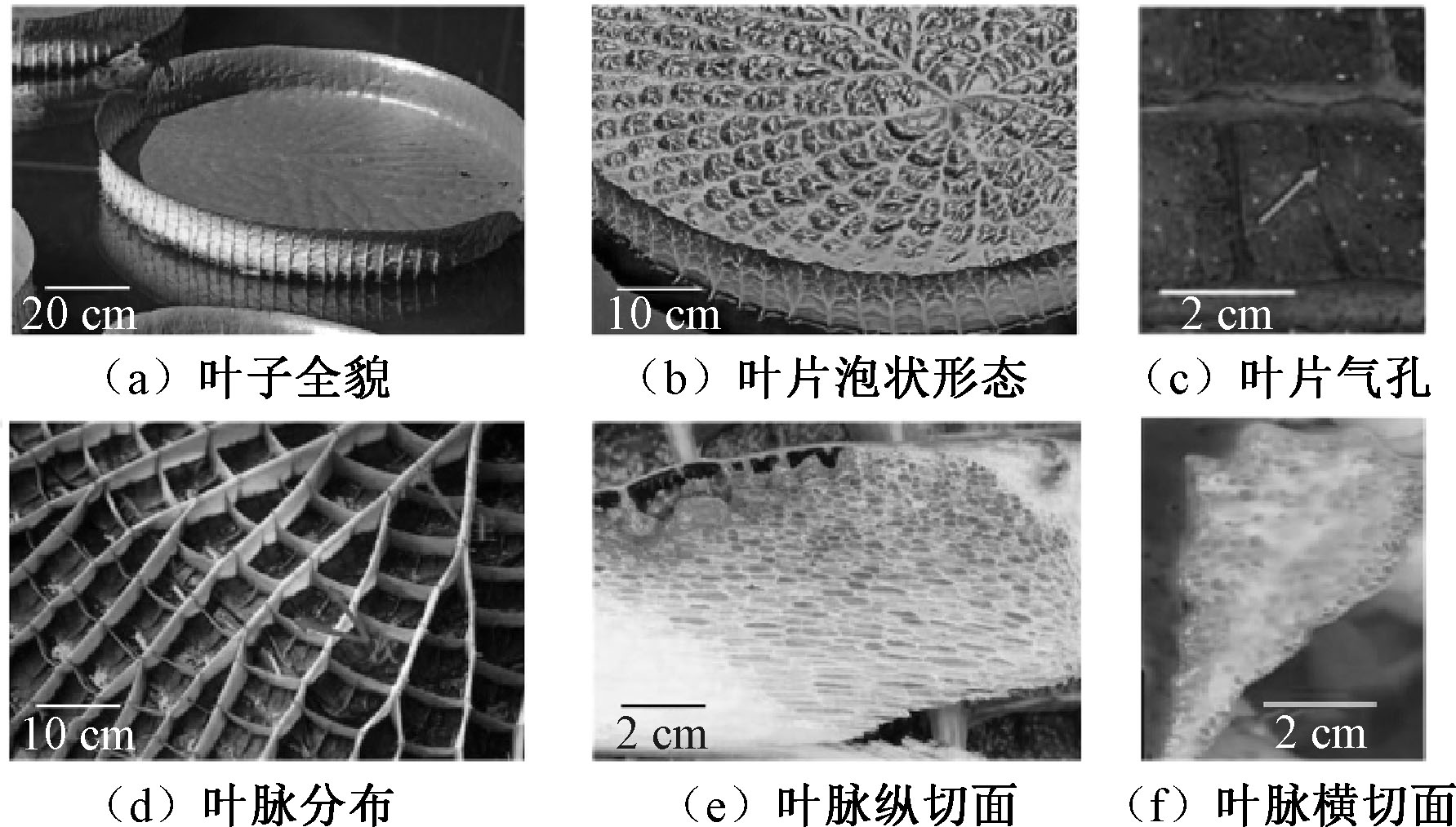
图1

王莲的叶片和叶脉形态"

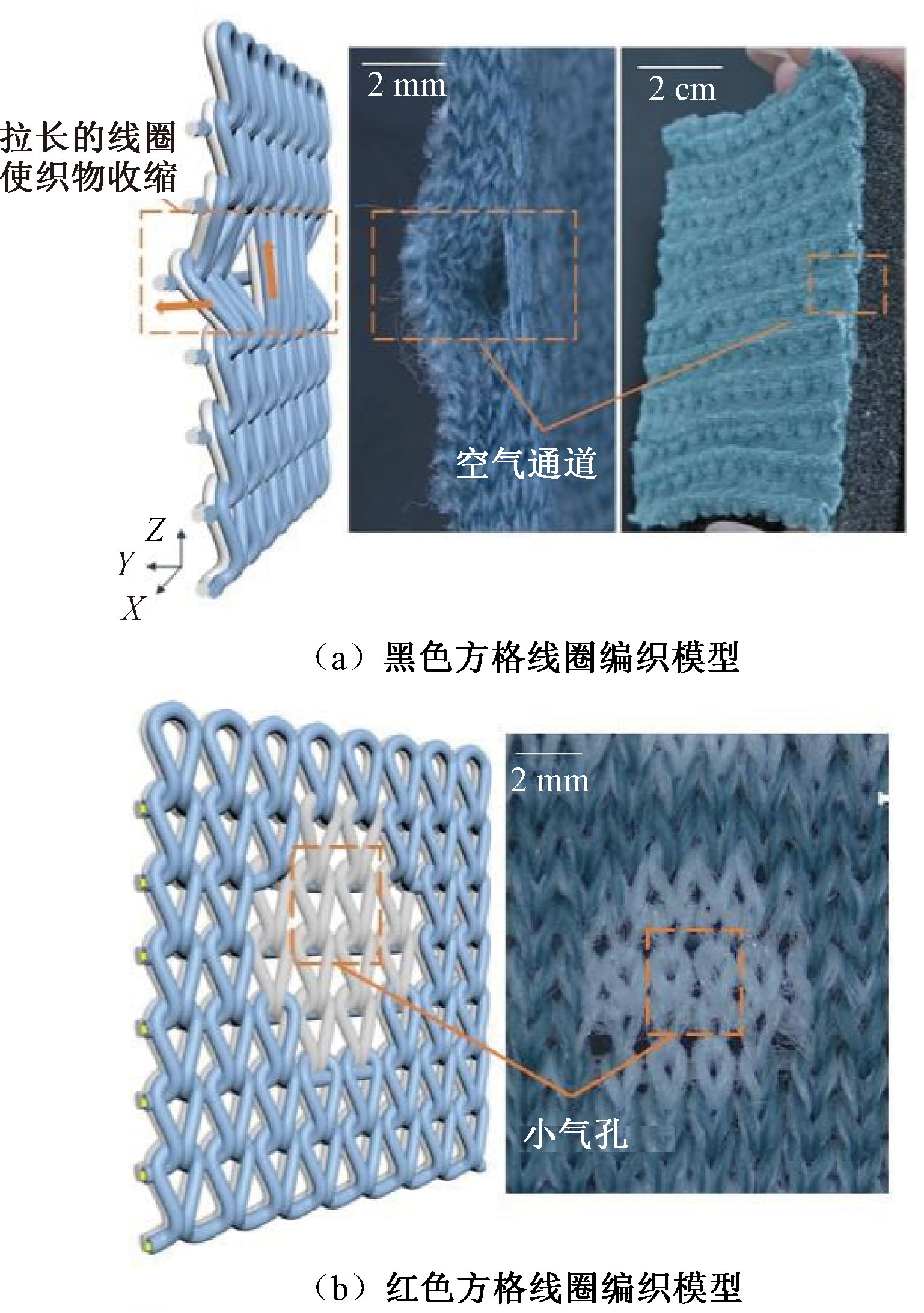
图2

线圈模型图"

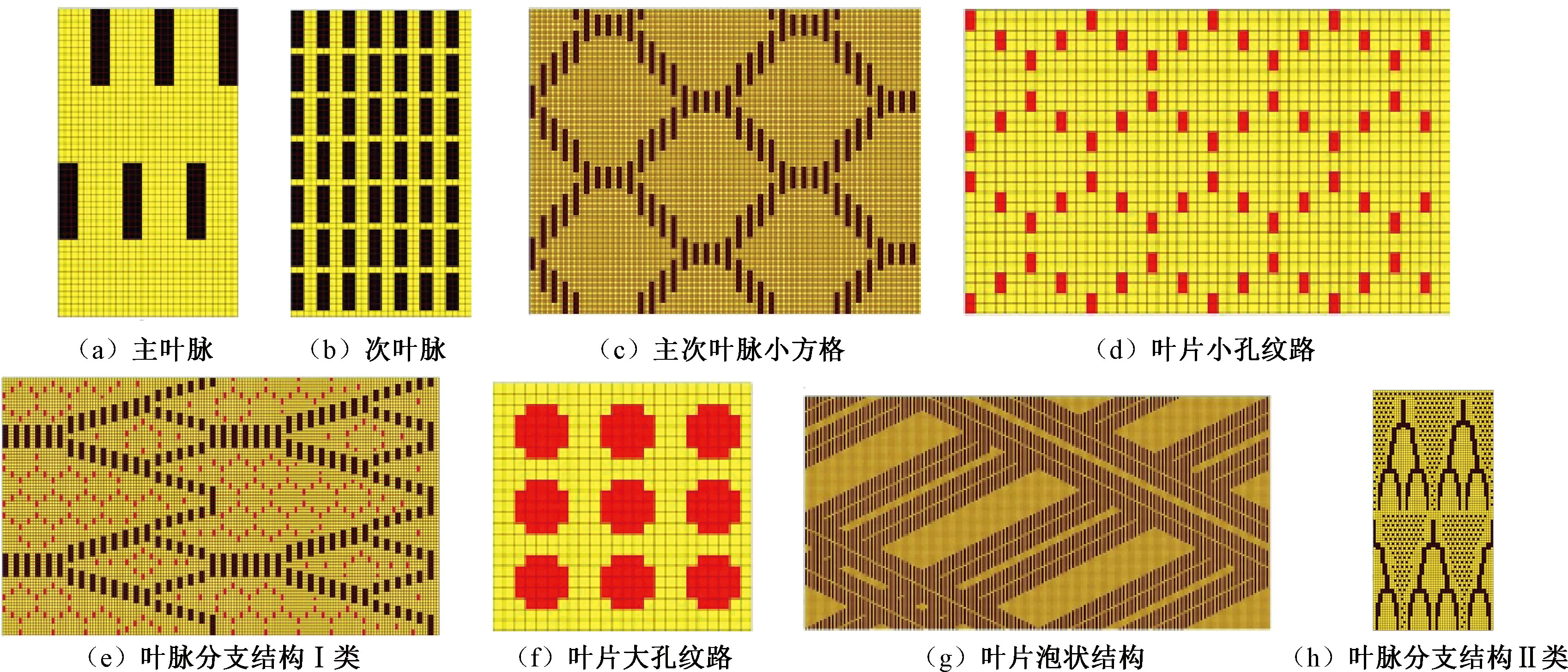
图3

仿生叶脉结构面料编织工艺PAT图"

表1

面料规格和结构参数"

结构名称 面料
编号
面密度/
(g·m-2)
厚度/
mm
密度/(线圈数·(5 cm)-1) 消臭氨纶
含量/%
羊毛
含量/%
横密 纵密
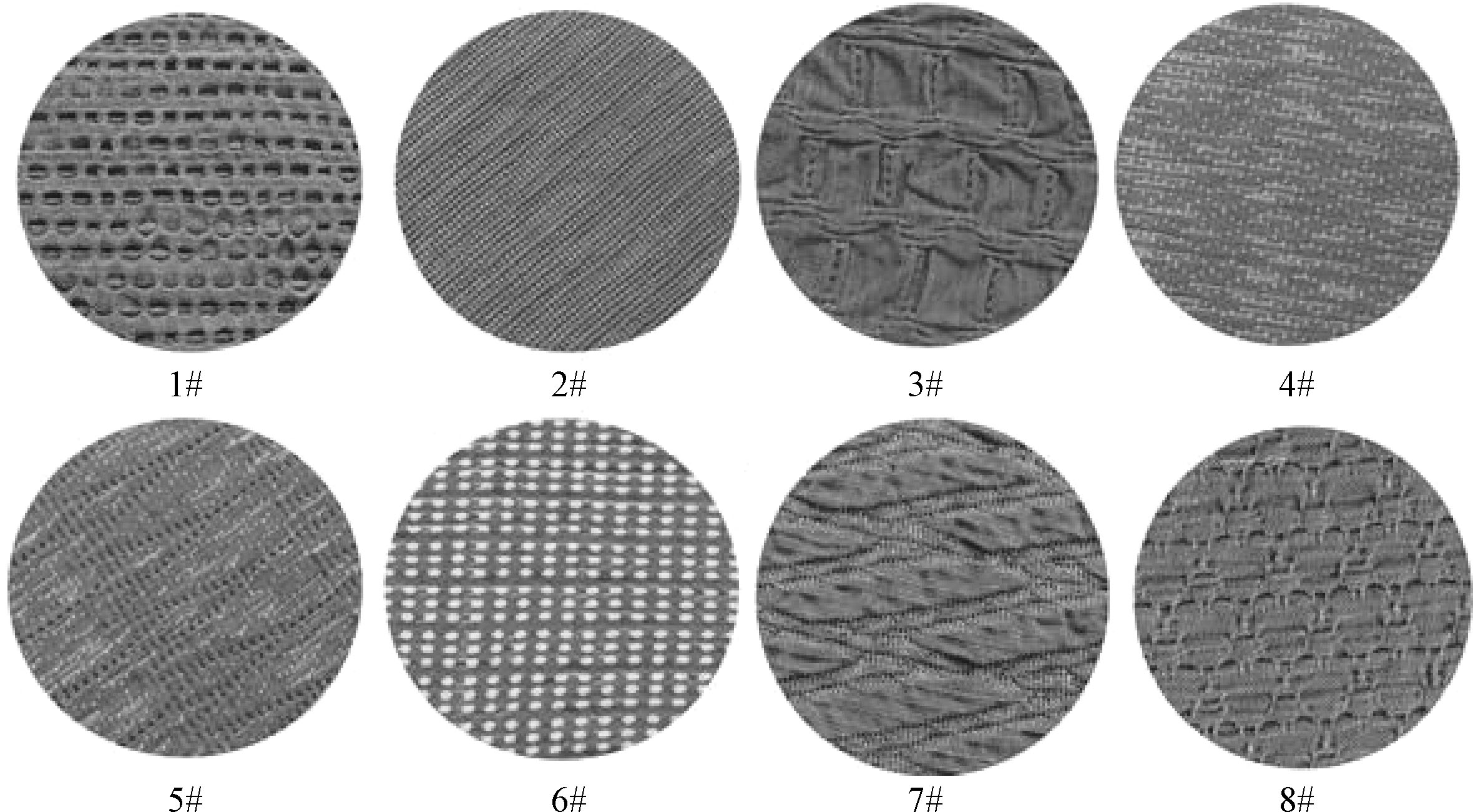
主叶脉 1# 339 2.28 95 165 12.93 60.64
次叶脉 2# 326 1.44 100 245 12.81 60.54
主次叶脉小方格 3# 340 2.23 75 185 11.65 64.50
叶片小孔纹路 4# 218 0.83 80 145 13.59 58.39
叶脉分支结构Ⅰ类 5# 252 1.50 70 165 12.97 60.29
叶片大孔纹路 6# 199 0.96 80 145 14.85 54.60
叶片泡状结构 7# 442 2.17 90 220 12.70 61.19
叶脉分支结构Ⅱ类 8# 331 1.89 85 195 12.78 60.85
纬平针 0# 310 1.06 95 155 12.37 62.14

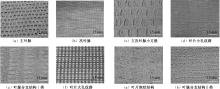
图4

仿叶脉结构面料实物图"

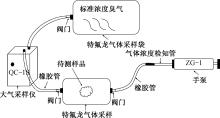
图5

消臭性能检测装备"

表2

仿生针织面料的消臭性能"

面料
编号
氨气 醋酸
初始浓度/
(μL·L-1)
2 h后浓度/(μL·L-1) 消除率/
%
初始浓度/
(μL·L-1)
2 h后浓度/(μL·L-1) 消除率/%
样品A 空白B 样品A 空白B
1# 100.00 5.50 98.00 94.39 30.00 3.00 28.50 89.47
2# 100.00 7.50 98.00 92.35 30.00 4.00 29.00 86.21
3# 100.00 5.00 94.00 94.68 30.00 2.50 28.50 91.23
4# 100.00 13.50 96.00 85.94 30.00 5.00 27.00 81.48
5# 100.00 11.00 94.00 88.30 30.00 4.50 27.50 83.64
6# 100.00 14.00 94.00 85.11 30.00 5.50 28.00 80.36
7# 100.00 0.50 92.00 99.50 30.00 1.50 27.50 94.55
8# 100.00 6.50 95.00 93.16 30.00 3.50 28.50 87.72
0# 100.00 4.50 72.00 93.75 30.00 2.00 28.00 92.86

表3

仿生针织面料的保暖性"

面料
编号
热阻/
(10-3m2·K·W-1)
传热系数/
(W·(m2·℃)-1)
克罗值/
clo
1# 74.100 13.550 0.478 0
2# 112.233 9.073 0.723 7
3# 71.675 13.995 0.462 3
4# 42.633 24.290 0.275 0
5# 51.733 19.407 0.333 7
6# 44.950 22.338 0.289 6
7# 95.967 10.670 0.618 7
8# 53.475 18.678 0.344 8
0# 43.200 23.273 0.263 0

表4

仿生针织面料的单向传递指数与评级"

面料编号 单向传递指数 等级
1# 324.210 5
2# 369.700 5
3# 409.610 5
4# 381.250 5
5# 377.620 5
6# 385.240 5
7# 405.930 5
8# 365.710 5
0# 402.550 5

表5

仿生针织面料在多次摩擦后的起毛起球性能"

面料编号 不同摩擦次数下的起毛起球等级
125次 500次 1 000次 2 000次 5 000次 7 000次
1# 5 5 5 5 5 5
2# 5 5 5 5 5 5
3# 5 5 5 5 5 5
4# 5 5 5 5 4.5 4
5# 5 5 5 5 5 4.5
6# 5 5 5 5 4.5 4
7# 5 5 5 5 5 5
8# 5 5 5 5 5 5

图6

摩擦7 000次后织物的图像"

表6

仿生针织面料的顶破性能"

面料编号 顶破强力/N 顶破高度/mm 顶破功/J
1# 404.50 58.405 1.27
2# 427.85 32.535 0.68
3# 359.65 51.895 1.10
4# 494.30 47.440 1.01
5# 510.20 62.295 1.27
6# 353.05 48.000 0.85
7# 317.40 56.160 0.92
8# 377.35 46.125 0.89

表7

仿生针织面料的拉伸性能"

面料编号 拉伸方向 断裂强力/N 断裂伸长率/%
1# 纵向 41.65 200.55
横向 97.61 241.34
2# 纵向 58.39 97.80
横向 113.34 203.26
3# 纵向 44.04 171.45
横向 82.25 256.26
4# 纵向 45.15 146.25
横向 55.54 265.69
5# 纵向 35.06 158.84
横向 55.13 274.59
6# 纵向 39.77 152.60
横向 43.08 225.08
7# 纵向 33.24 137.00
横向 101.89 248.13
8# 纵向 44.86 238.63
横向 101.34 280.42
[1] 蒋全虎, 陈家起, 高奎亭, 等. 新时代我国户外运动产业高质量发展思考[J]. 体育文化导刊, 2023(9): 76-83, 90.
JIANG Quanhu, CHEN Jiaqi, GAO Kuiting, et al. High-quality development of China's outdoor sports industry in the new era[J]. Sports Culture Guide, 2023(9): 76-83, 90.
[2] LEYDEN J J, MCGINLEY K J, HÖLZLE E, et al. The microbiology of the human axilla and its relationship to axillary odor[J]. Journal of Investigative Dermatology, 1981, 77(5): 413-416.
doi: 10.1111/1523-1747.ep12494624 pmid: 7288207
[3] 李佳怡, 卢业虎, 叶鑫, 等. 智能发热户外防寒服装研制与性能评价[J]. 东华大学学报(自然科学版), 2018, 44(1): 80-86.
LI Jiayi, LU Yehu, YE Xin, et al. Performance evaluation of outdoor cold protective clothing with smart heating function[J]. Journal of Donghua University (Natural Science), 2018, 44(1): 80-86.
[4] 冯爱芬, 张永久. 纳米三防羽绒服面料的研制[J]. 纺织学报, 2004, 25(2): 77-79, 5-6.
FENG Aifen, ZHANG Yongjiu. The development of nanometer three-proof down jacket fabric[J]. Journal of Textile Research, 2004, 25(2): 77-79, 5-6.
[5] 陈丽华. 不同种类防水透湿织物的性能及发展[J]. 纺织学报, 2012, 33(7): 151-158.
CHEN Lihua. Properties and development trends of different kinds of waterproof and moisture permeable fabrics[J]. Journal of Textile Research, 2012, 33(7): 151-158.
[6] 李智勇, 周惠敏, 夏鑫. 含氟聚氨酯/聚氨酯纳米纤维膜复合织物的制备及其防水透湿性能[J]. 纺织学报, 2016, 37(10): 83-88.
LI Zhiyong, ZHOU Huimin, XIA Xin. Preparation and waterproof and water-permeable properties of electrospun fluorinated polyurethanel polyurethane nanofiber membrane composite fabrics[J]. Journal of Textile Research, 2016, 37(10): 83-88.
[7] 沈雷, 任祥放, 刘皆希, 等. 保暖充电老年服装的设计与开发[J]. 纺织学报, 2017, 38(4): 103-108.
SHEN Lei, REN Xiangfang, LIU Jiexi, et al. Design and development of warm clothing for the elderly[J]. Journal of Textile Research, 2017, 38(4): 103-108.
doi: 10.1177/004051756803800112
[8] 苏文桢, 宋文芳, 卢业虎, 等. 充气防寒服的保暖性能[J]. 纺织学报, 2020, 41(2): 115-118, 124.
SU Wenzhen, SONG Wenfang, LU Yehu, et al. Thermal insulation of air inflatable cold protective clothing[J]. Journal of Textile Research, 2020, 41(2): 115-118, 124.
[9] 方雪明, 董智佳, 丛洪莲, 等. 单面纬编织物变化孔隙率结构设计与透气导湿性能评价[J]. 纺织学报, 2024, 45(5): 51-59.
FANG Xueming, DONG Zhijia, CONG Honglian, et al. Design of variable porosity structure and evaluation of permeablity and moisture conductivity of single side weft knitted fabric[J]. Journal of Textile Research, 2024, 45(5): 51-59.
[10] 钱娟, 谢婷, 张佩华, 等. 聚乙烯针织物的热湿舒适性能[J]. 纺织学报, 2022, 43(7):60-66.
QIAN Juan, XIE Ting, ZHANG Peihua, et al. Thermal and moisture comfort performance of polyethylene knitted fabric[J]. Journal of Textile Research, 2022, 43(7):60-66.
doi: 10.1177/004051757304300111
[11] 吴志明, 赵敏. 基于压力舒适性的经编无缝上衣贾卡分区设计[J]. 纺织学报, 2012, 33(2): 89-93.
WU Zhiming, ZHAO Min. Jacquard partition design of warp knitted seamless upper outer garment based on pressure comfort[J]. Journal of Textile Research, 2012, 33(2): 89-93.
[12] WANG J P, ZHANG B J, YAO X F, et al. Single-sided jacquard knit fabric development and seamless ski underwear zoning design based on body mapping sportswear[J]. AUTEX Research Journal, 2023, 23(4): 483-494.
doi: 10.2478/aut-2022-0033
[13] 杨玉芳. β-环糊精用于羊毛织物防臭整理研究[D]. 上海: 东华大学, 2010: 1-2.
YANG Yufang. Study on deodorizing finishing of wool fabric with β-cyclodextrin[D]. Shanghai: Donghua University, 2010: 1-2.
[14] 丁雪婷, 王建萍, 潘婷, 等. 仿蜻蜓翅膀结构的冬季针织面料研发及其性能[J]. 纺织学报, 2023, 44(9):75-83.
DING Xueting, WANG Jianping, PAN Ting, et al. Development and performance of dragonfly wing structure like winter knitted fabrics[J]. Journal of Textile Research, 2023, 44(9):75-83.
doi: 10.1177/004051757404400113
[15] SASAKI K, TENJIMBAYASHI M, MANABE K, et al. Asymmetric superhydrophobic/superhydrophilic cotton fabrics designed by spraying polymer and nanoparticles[J]. ACS Applied Materials & Interfaces, 2016, 8(1): 651-659.
[16] CHEN Y M, LI S J, LI X L, et al. Liquid transport and real-time dye purification via lotus petiole-inspired long-range-ordered anisotropic cellulose nanofibril aerogels[J]. ACS Nano, 2021, 15(12): 20666-20677.
doi: 10.1021/acsnano.1c10093
[17] BOX F, ERLICH A, GUAN J H, et al. Gigantic floating leaves occupy a large surface area at an economical material cost[J]. Science Advances, 2022, 8(6): eabg3790.
[1] 王司宇, 王峰, 王鸿博, 苏静. L-半胱氨酸/菠萝蛋白酶协同一浴法羊毛织物防毡缩整理[J]. 纺织学报, 2025, 46(10): 152-158.
[2] 许微辉, 朱婷婷, 万爱兰, 马丕波. 基于仿生结构的抗菌无缝瑜伽服研发及其热湿舒适性[J]. 纺织学报, 2025, 46(10): 187-196.
[3] 刘楚, 张向辉, 张昭华, 牛文鑫, 王诗潭. 皮肤湿感觉的神经传导与脑区响应研究现状[J]. 纺织学报, 2025, 46(10): 247-254.
[4] 朱耀麟, 李政, 张强, 陈鑫, 陈锦妮, 张洪松. 基于近红外光谱和多特征网络的羊毛和羊绒定量检测[J]. 纺织学报, 2025, 46(09): 104-111.
[5] 罗玉玲, 杨喜竹, 王星岚, 郑晓慧, 赵胜男, 常素芹. 以相变包为冷源的冷却服研究进展[J]. 纺织学报, 2025, 46(07): 253-261.
[6] 韩智慧, 万爱兰, 洪亮, 高丽忠, 夏风林. 羊毛纱经编整经损伤及其有限元模拟[J]. 纺织学报, 2025, 46(07): 103-110.
[7] 腾燕飞, 万爱兰. 消臭运动袜的研发及其性能[J]. 纺织学报, 2025, 46(06): 120-126.
[8] 朱梦慧, 葛美彤, 董智佳, 丛洪莲, 马丕波. 纬编双面羊毛/涤纶交织物的结构与热湿性能评价[J]. 纺织学报, 2025, 46(05): 179-185.
[9] 朱大全, 崔志华, 高普, 朱杰, 张斌, 朱跃文, 陈维国. 丝光羊毛的芳伯胺化修饰及其室温重氮偶合染色[J]. 纺织学报, 2025, 46(05): 186-194.
[10] 杨琪, 周晓钰, 季静, 戴宏钦. 化学防护服内湿度调节装置的设计与性能评价[J]. 纺织学报, 2025, 46(05): 262-269.
[11] 朱文硕, 薛元, 孙显强, 薛惊理, 金光. 基于七基色纤维的羊毛混色纱全色域配色[J]. 纺织学报, 2025, 46(04): 71-80.
[12] 李欢, 孟文俊, 张京, 姜哲, 卫艺敏, 周曼, 王强. 低共熔溶剂体系中的羊毛靛蓝染料染色[J]. 纺织学报, 2025, 46(03): 123-130.
[13] 郭庆, 毛阳顺, 任亚杰, 刘济民, 王怀芳, 朱平. 基于漆酶一步催化法的羊毛织物原位染色及阻燃功能化[J]. 纺织学报, 2025, 46(02): 161-169.
[14] 赵珂, 张恒, 程文胜, 甄琪, 步青云, 崔景强. 类蒲叶结构聚乳酸熔喷非织造材料的制备及其性能[J]. 纺织学报, 2025, 46(02): 51-60.
[15] 巫晓雯, 方蕾妹, 江昆, 丛洪莲. 基于热湿舒适性的横编全成形运动内衣的分区设计[J]. 纺织学报, 2024, 45(12): 172-179.
Viewed
Full text


Abstract

Cited

  Shared   
  Discussed   
No Suggested Reading articles found!