纺织学报 ›› 2026, Vol. 47 ›› Issue (06): 170-177.doi: 10.13475/j.fzxb.20251104701

• 服装工程 • 上一篇    下一篇

基于用户体型约束扩散模型的连衣裙逆向开发方法

申鸿, 段庆贵, 孟虎()   

  1. 四川大学 轻工科学与工程学院四川 成都 610065
  • 收稿日期:2025-11-18 修回日期:2026-04-02 出版日期:2026-06-15 发布日期:2026-08-19
  • 通讯作者: 孟虎(1993—),男,特聘副研究员,博士。主要研究方向为时尚管理与消费者行为、服装设计与工程等。E-mail:menghu@scu.edu.cn
  • 作者简介:申鸿(1974—),女,副教授,硕士。主要研究方向为服饰工程、服装结构设计等。
  • 基金资助:
    四川省自然科学基金项目(2025NSFSC1983);四川大学引进人才科研启动经费资助项目(YJ202251)

Reverse engineering method of dresses using diffusion model with body shape constraints

SHEN Hong, DUAN Qinggui, MENG Hu()   

  1. College of Biomass Science and EngineeringSichuan University, ChengduSichuan 610065, China
  • Received:2025-11-18 Revised:2026-04-02 Published:2026-06-15 Online:2026-08-19

摘要:

针对传统服装制版对专业经验依赖度高、人才培养周期长,以及生成式 AI 辅助设计流程中创意难以落地的问题,提出一种基于用户体型约束扩散模型的服装逆向开发方法。以连衣裙为研究对象,首先通过参数化人体建模构建基础服装模型,并进行个性化人体模型服装迁移;其次将服装模型的多角度视图转化为 ControlNet 约束,利用 Stable Diffusion 扩散模型生成带有分割线结构信息的连衣裙效果图;最后将效果图中的分割线映射至三维服装模型并基于质点-弹簧模型进行展开,获取二维板片。结合实测原型制图法逆向分析不同结构线设计下板片的变形规律,通过多组不同体型、不同款式的虚拟试衣与成衣制作完成验证。结果表明,生成的服装虚拟试穿压力值处于1.2~2.0 kPa的人体舒适范围,成衣关键尺寸与设计尺寸平均误差低于1.5%。为实现低专业门槛的数字化服装结构设计提供了可行的参考路径,同时为中小服装企业快速定制开发提供技术支撑。

关键词: 服装制版, 连衣裙, 结构设计, 扩散模型, 逆向开发

Abstract:

Objective Traditional garment pattern-making relies heavily on expert knowledge and long-term training, while generative artificial intelligence designs often lack structural information for production. This study aims to develop an engineering method method for dresses that integrates user-specific body shape constraints with a diffusion model, enabling direct transformation of three-dimensional body data into manufacturable two-dimensional patterns. The approach is expected to reduce professional barriers and supports rapid customization for small and medium-sized enterprises.

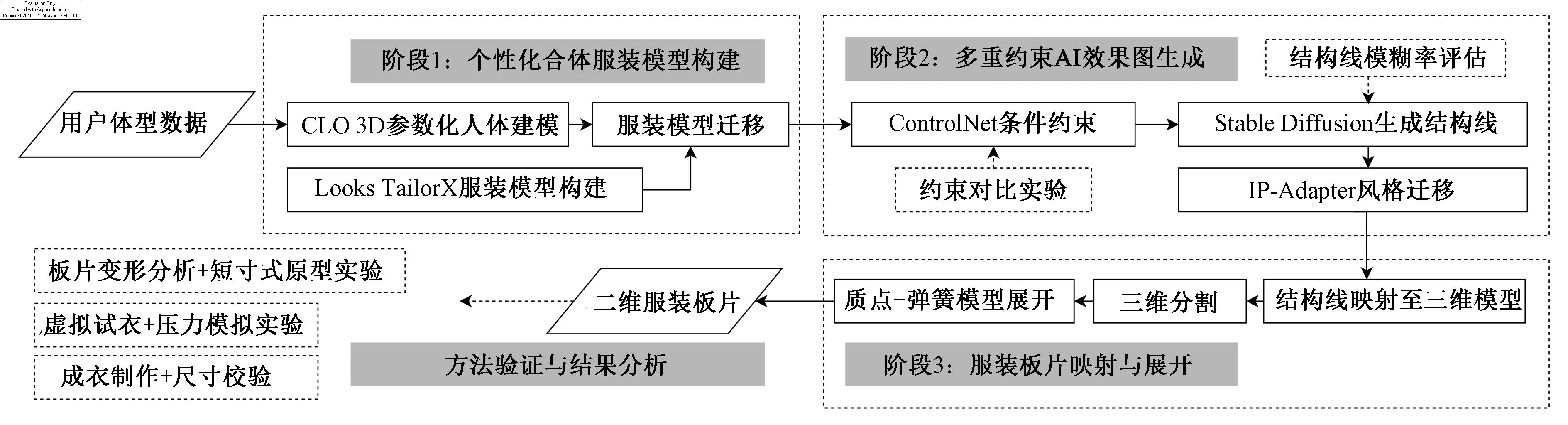
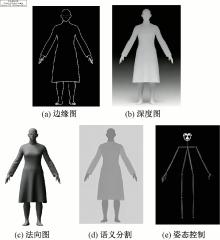
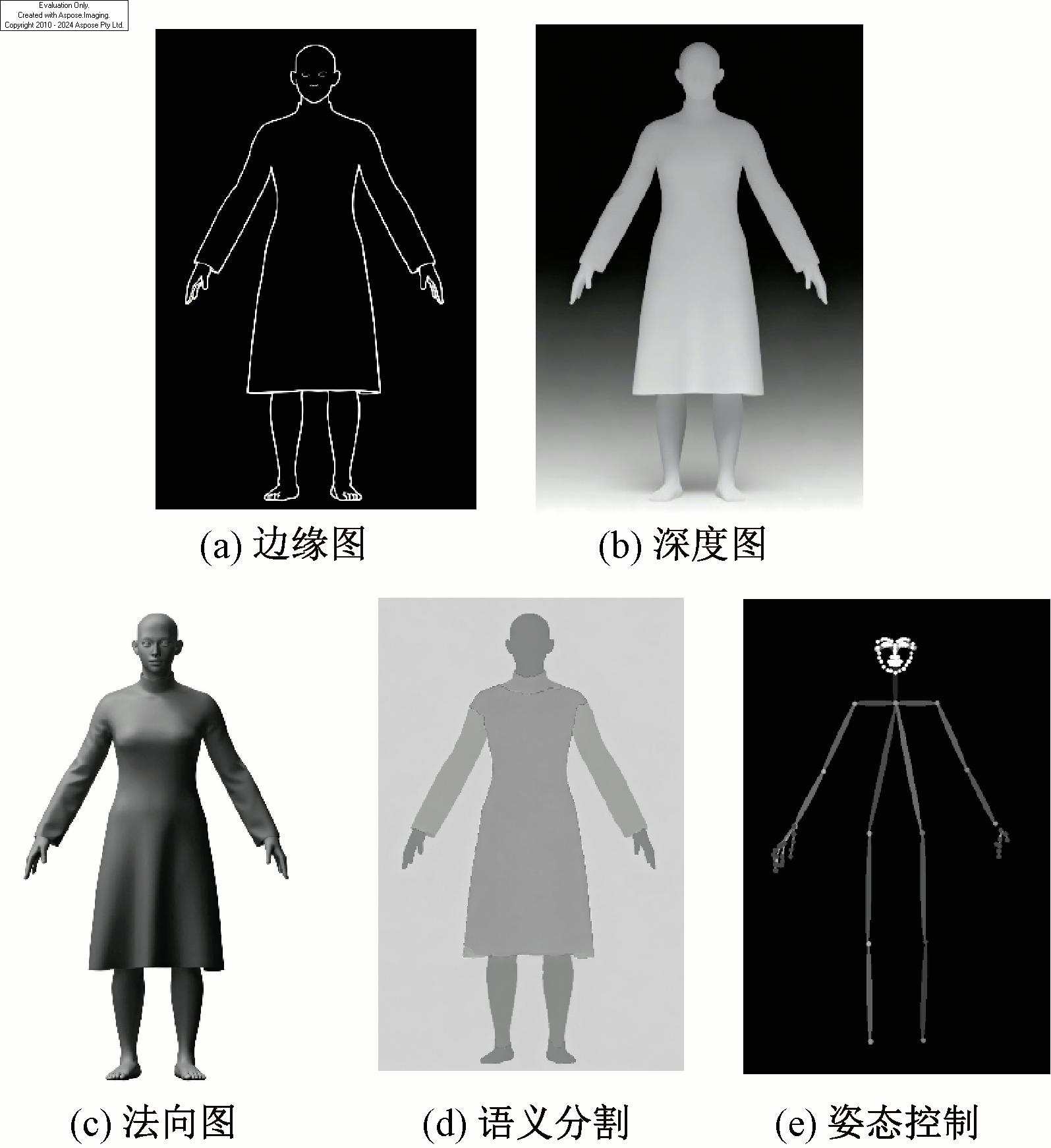
Method A three-stage workflow was established. First, a parametric human model and base garment model were built, before being transferred to nine personalized body shapes via landmark-based registration and mesh deformation. Second, multi-angle views of the three-dimensional garment were converted into Canny and Depth constraints using ControlNet, to guide a Stable Diffusion model for generating design images with clear structural lines. Finally, structural lines were mapped onto the three-dimensional garment, which was segmented and unfolded into two-dimensional patterns using a mass-spring system.

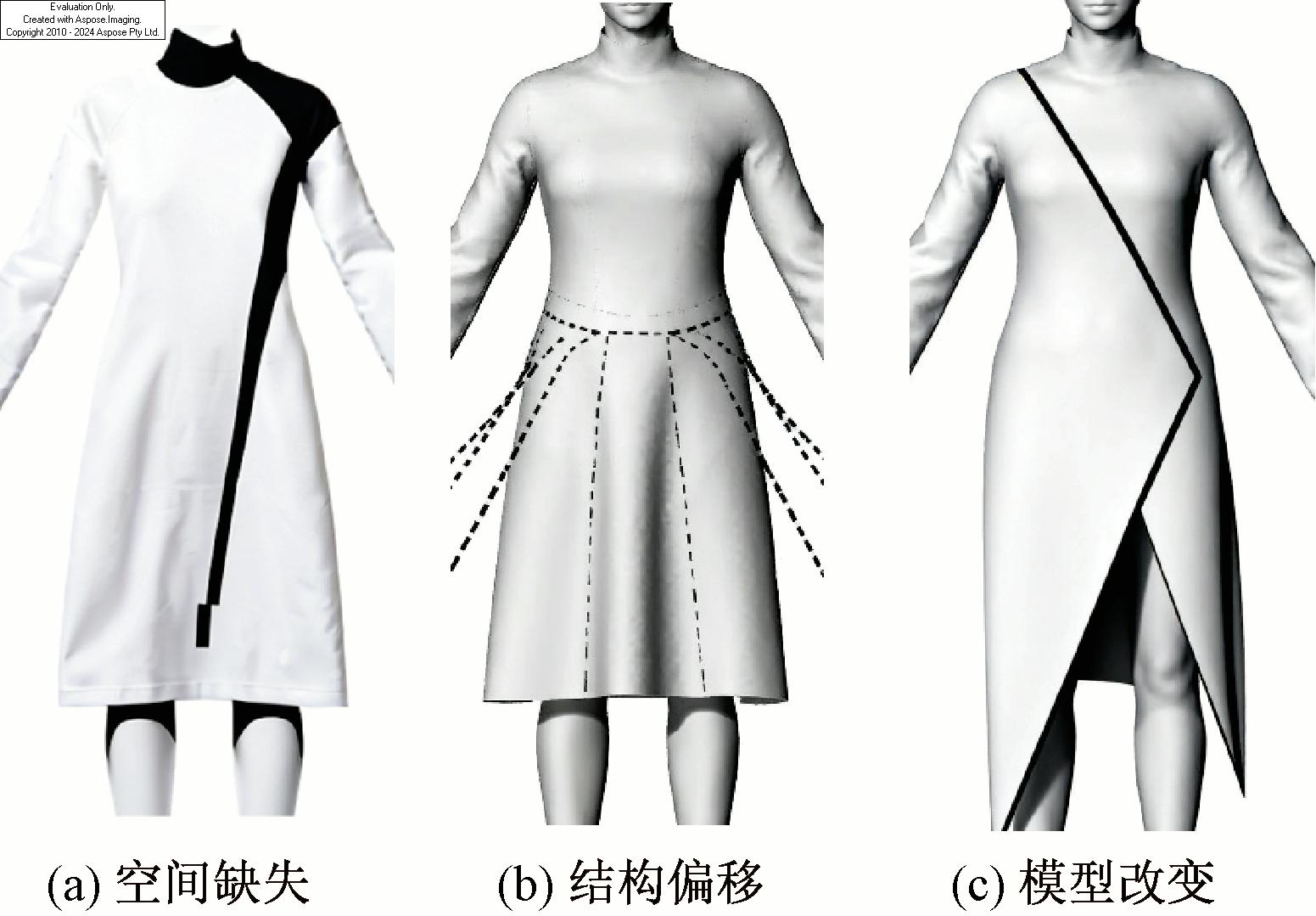
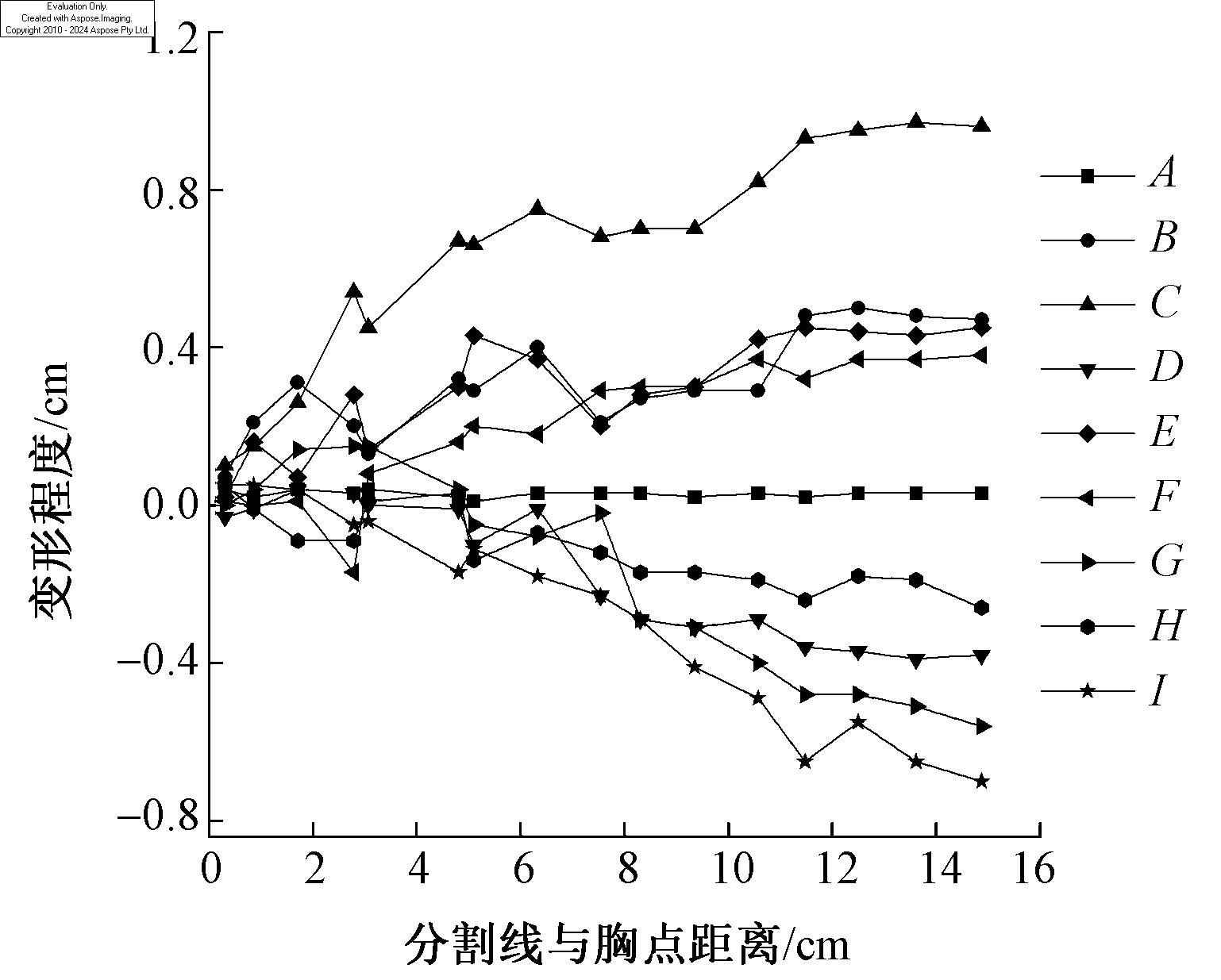
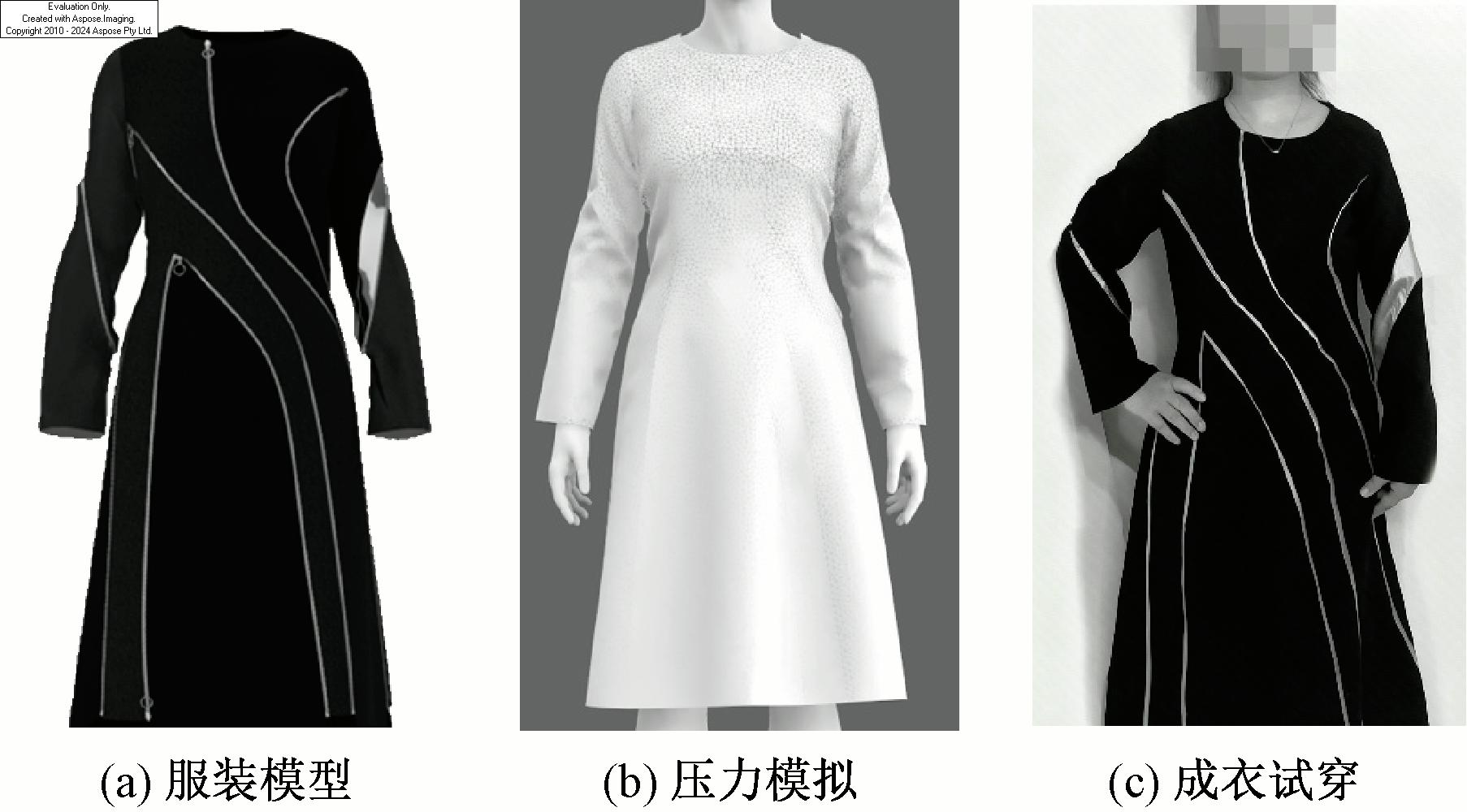
Results Single-factor experiments showed that the Canny and Depth dual-constraint scheme minimized blurriness of the structural lines and produced the most natural lines, with form deviation below one centimeter in fitted areas. Single constraints often caused spatial reduction or structural deviation, while posture control alone lacked garment structure information. Unfolding deformation was quantified across nine key dimensions using reverse analysis based on the short-measure prototype method. Shoulder width exhibited high stability with a standard deviation of 0.02, whereas the side-neck-to-bust-point length and front-armpit-to-waistline length were more sensitive to partition line placement, with standard deviations of 0.28 and 0.27 respectively. Placing partition lines near the bust point, where Gaussian curvature is high, reduced overall deformation energy during unfolding. Deformation was not uniform but concentrated in areas opposite the partition lines. Virtual fitting in CLO 3D software demonstrated that the final garments fitted the parametric models well, with smooth contour lines and appropriate ease. Simulated garment pressure ranged from 1.2 to 2.0 kPa, within the human comfort range. Physical garment validation confirmed feasibility: key measurements including bust and waist circumference showed an average error below 1.5% relative to design specifications. The ready-to-wear garment exhibited good fit without excessive tightness or wrinkles, and the wearer reported sufficient freedom for routine movements.

Conclusion A digital workflow integrating parametric modeling, controllable diffusion models, and physical unfolding was established for reverse garment engineering. It bridges generative artificial intelligence visual concepts and producible structural patterns while maintaining fit accuracy and style integrity. The method reduces reliance on traditional pattern-making expertise and enables efficient personalized customization, particularly for small and medium-sized enterprises. However, the approach faces challenges with highly complex structures such as multi-layered or densely gathered designs. A rigorous mathematical model to quantify the influence of segmentation line placement on deformation rates has not yet been developed. Future work should focus on building a quantitative relationship between segmentation lines and surface deformation energy, expanding the fabric physical parameter database, and introducing curvature maps to guide segmentation line generation near key body points, combined with material-specific compensation strategies. These improvements will enhance the method's general

Key words: garment pattern-making, dress, structural design, diffusion model, reverse engineering

中图分类号: 

  • TS941.2

图1

连衣裙逆向开发流程图"

图2

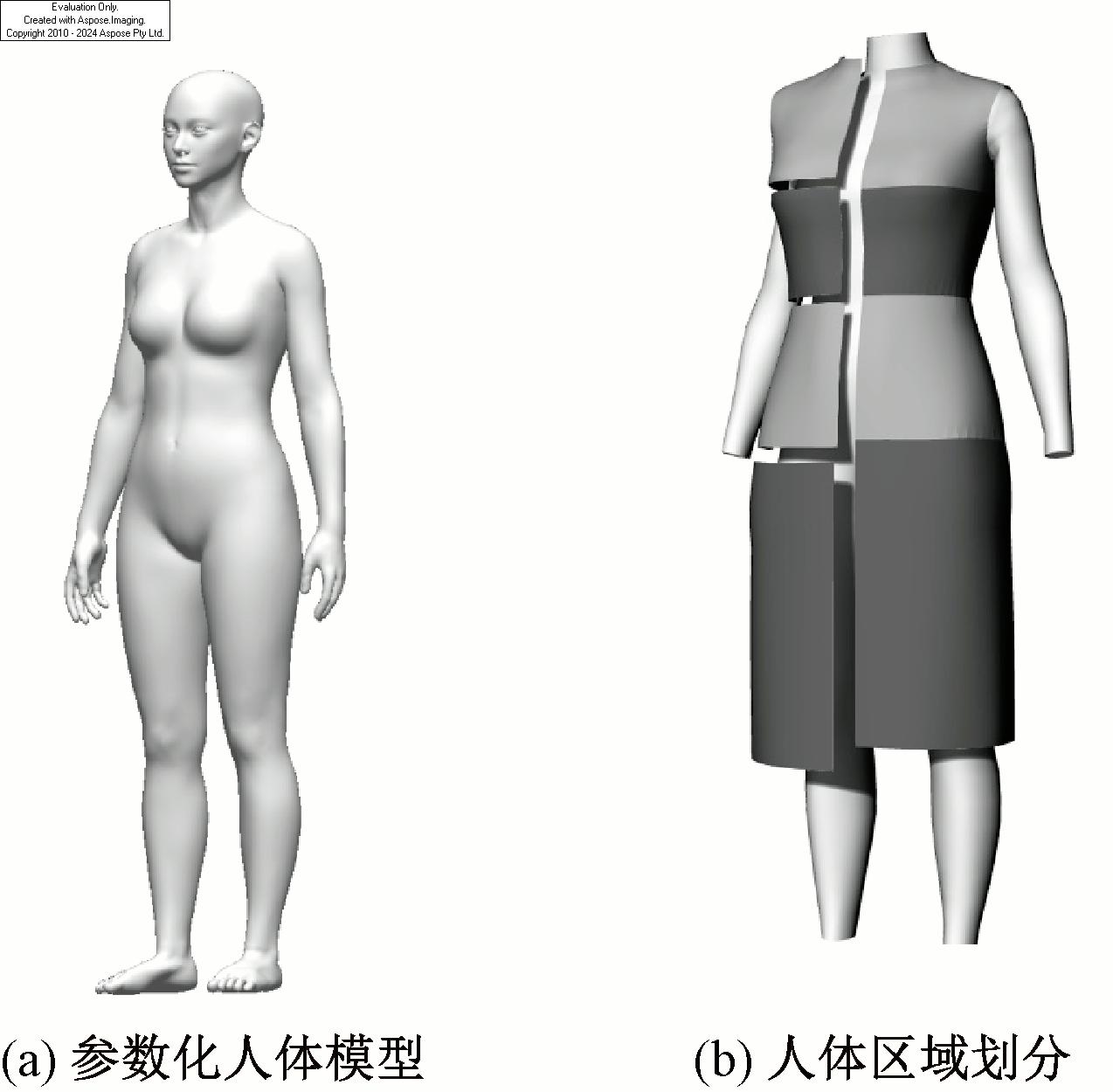
人体模型与区域划分"

图3

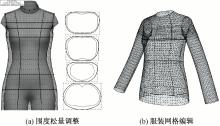
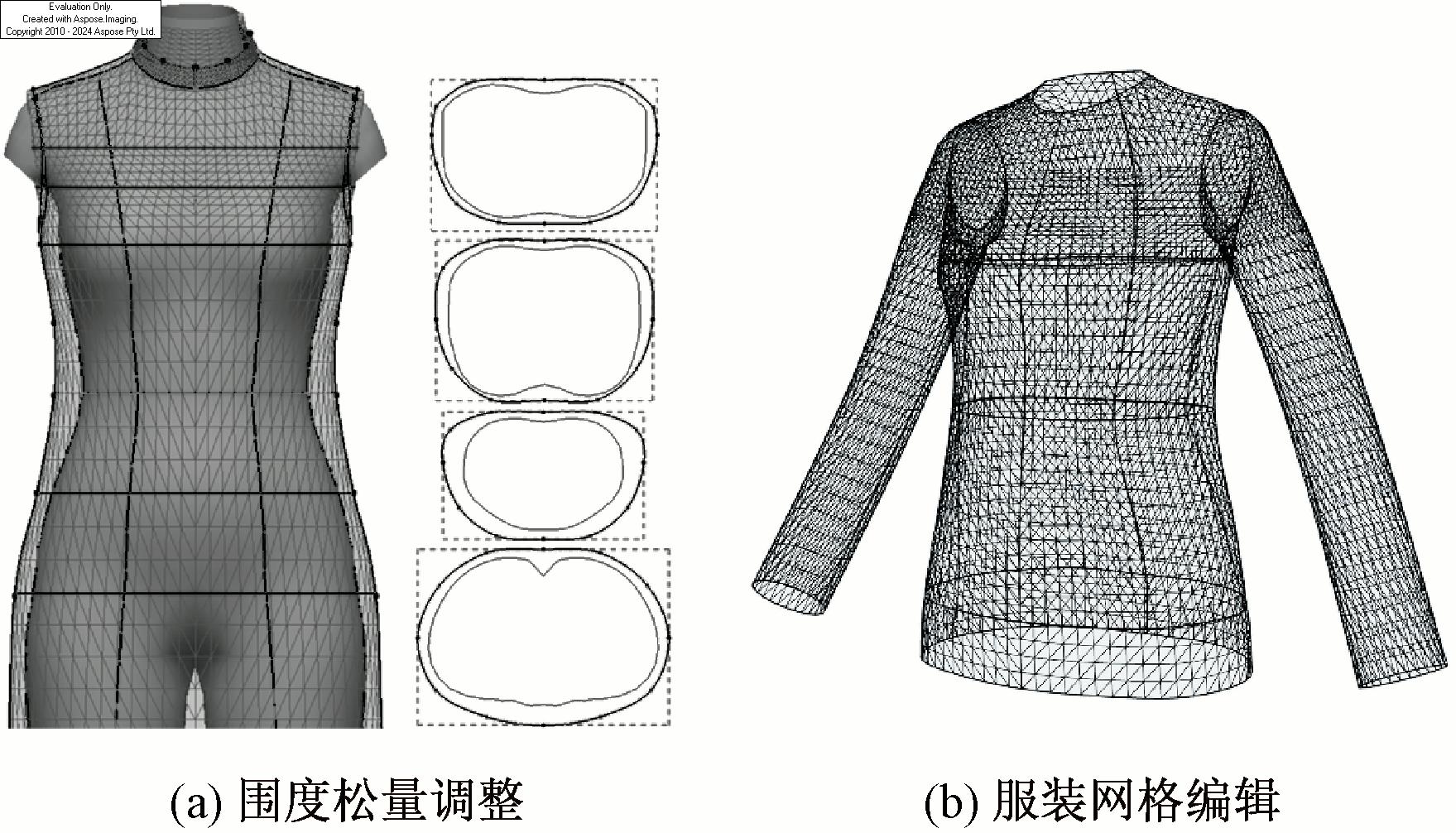
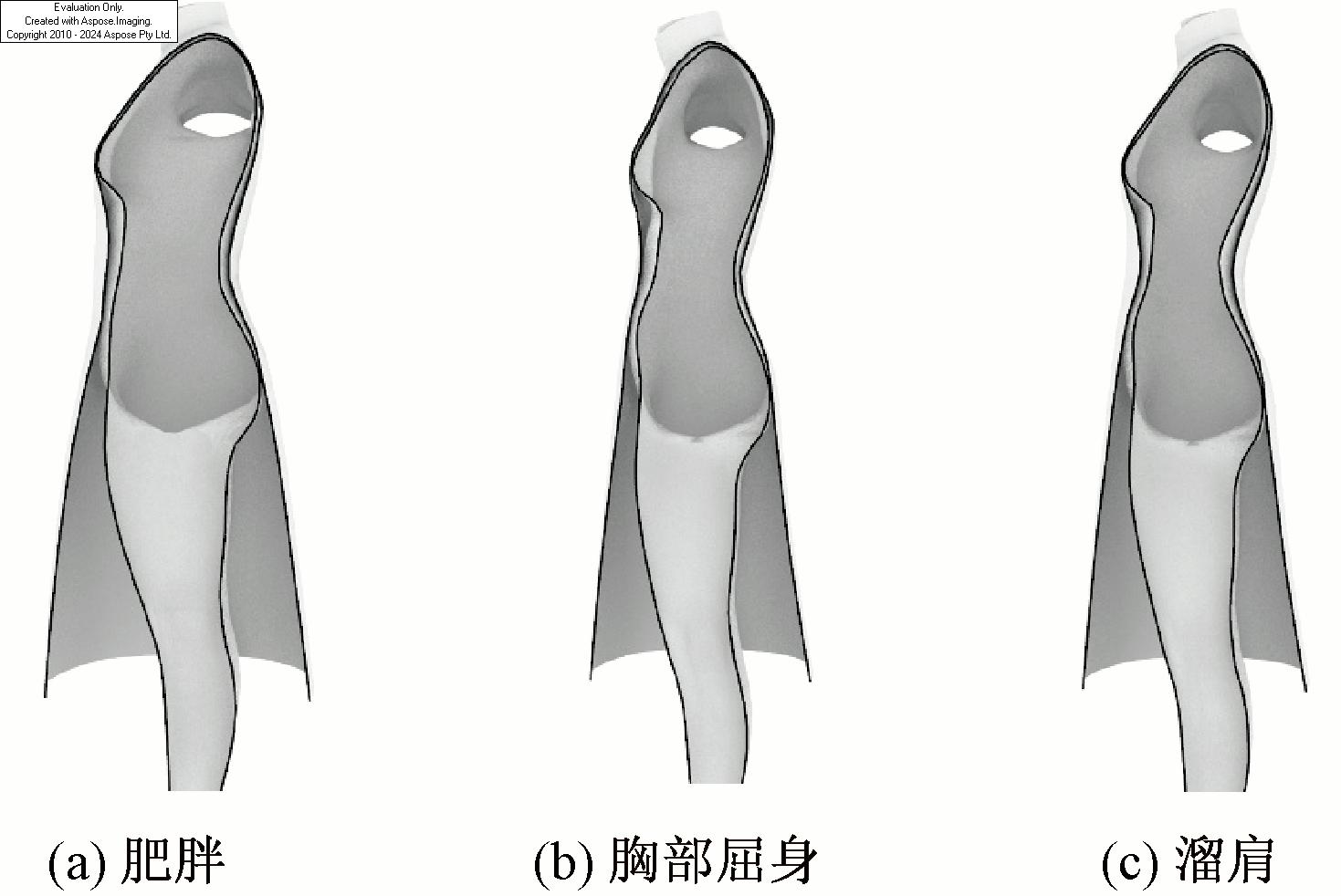
服装模型关键部位编辑 注:图(a) 横截面中,外圈为服装截面,内圈为人体模型截面。"

图4

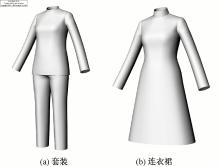
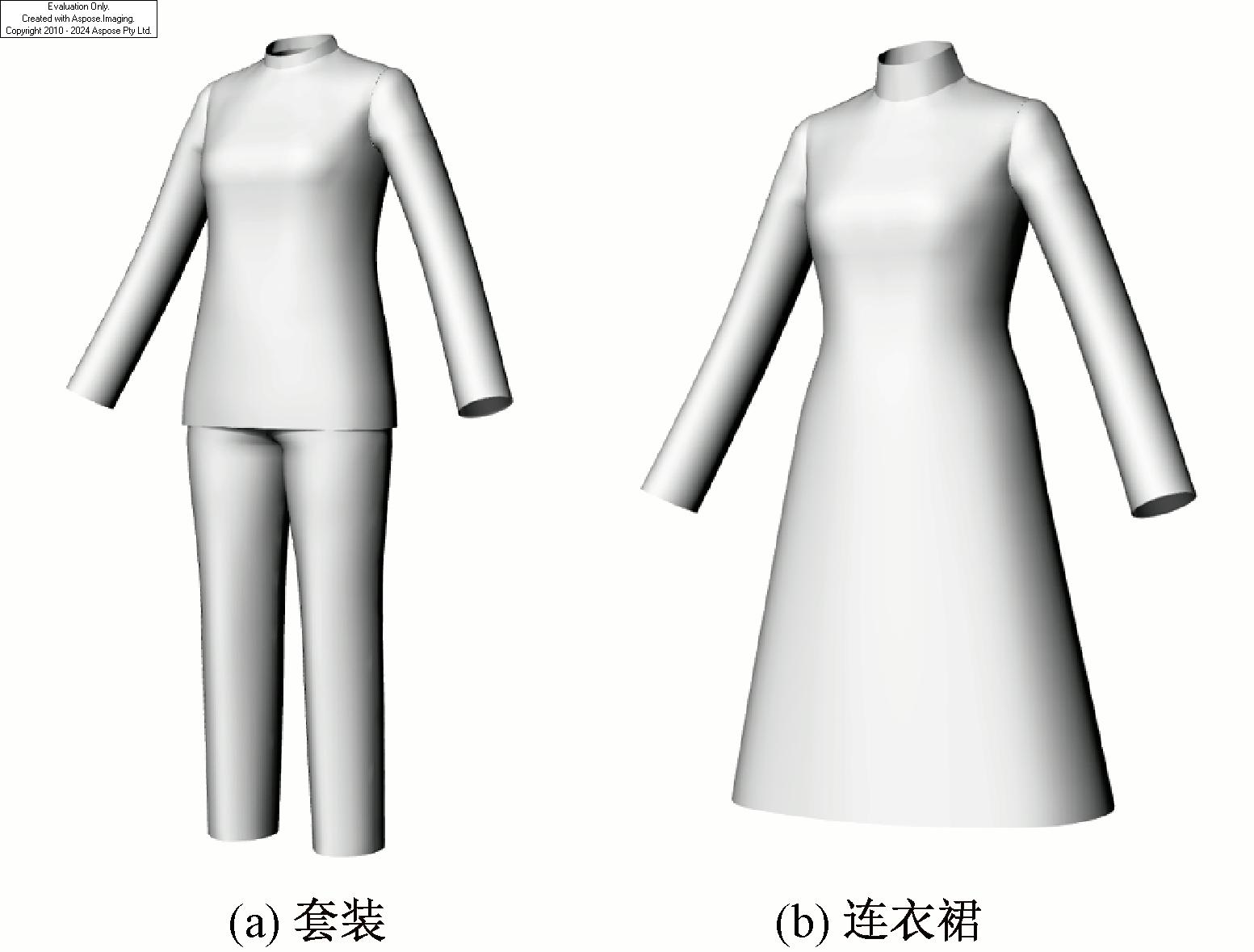
系列基础服装模型"

图5

不同体型基础服装模型"

图6

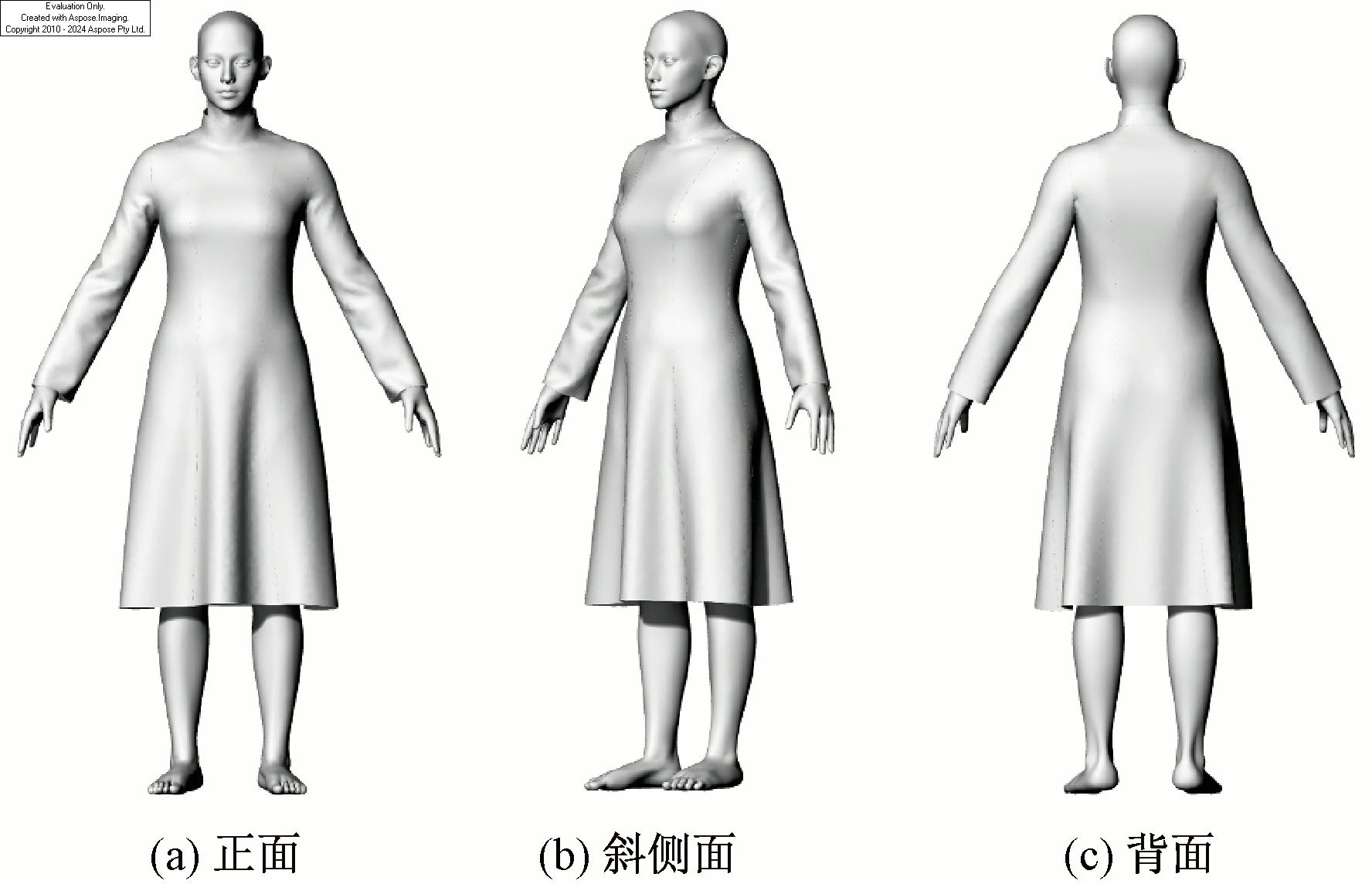
多角度服装模型"

图7

不同约束组控制图"

图8

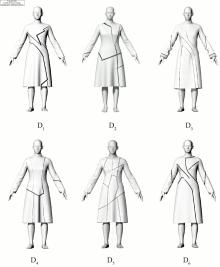
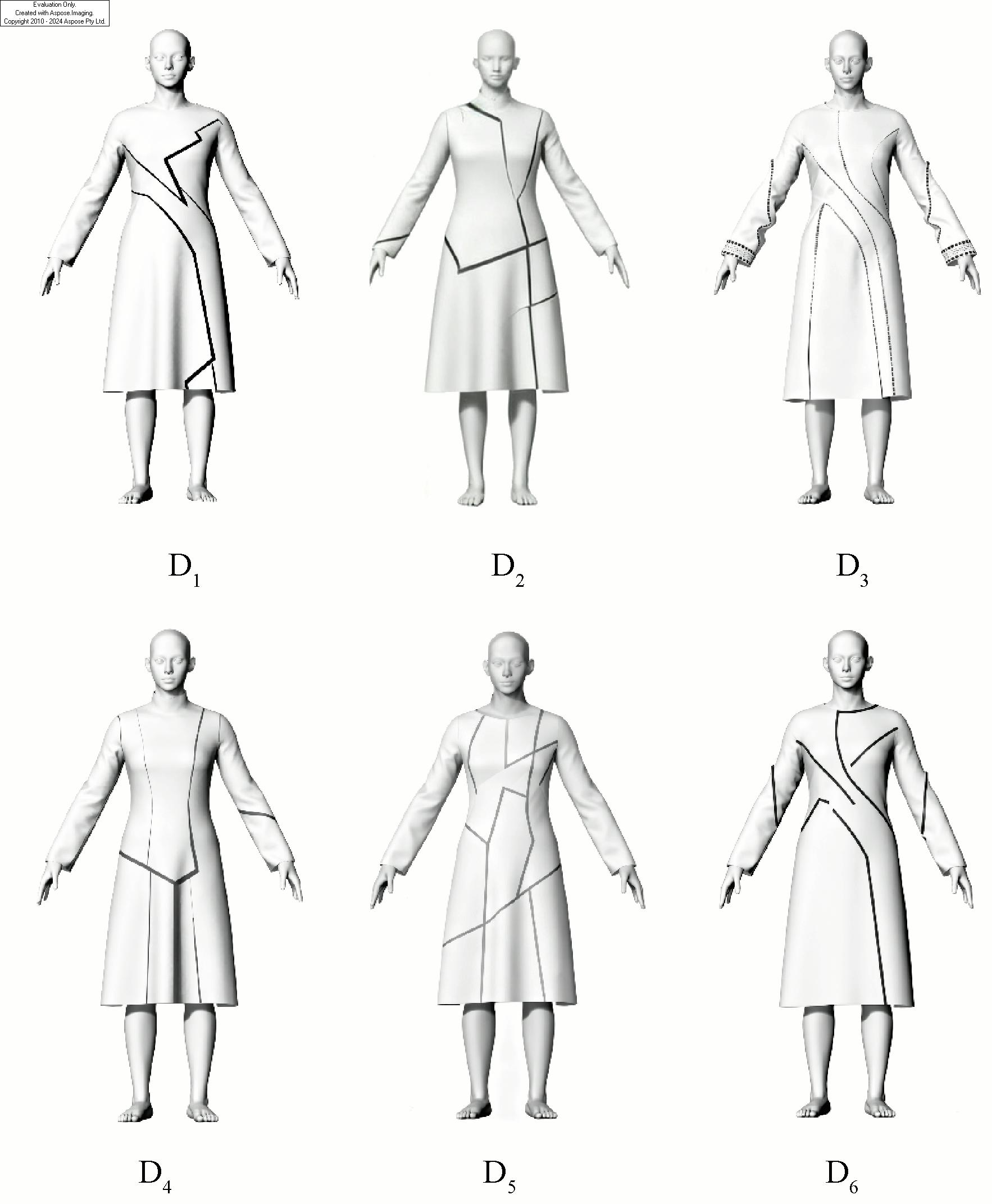
服装结构设计图 注:D1~D6为不同分割线结构设计方案的服装效果图。"

图9

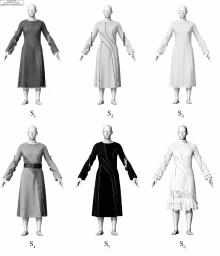
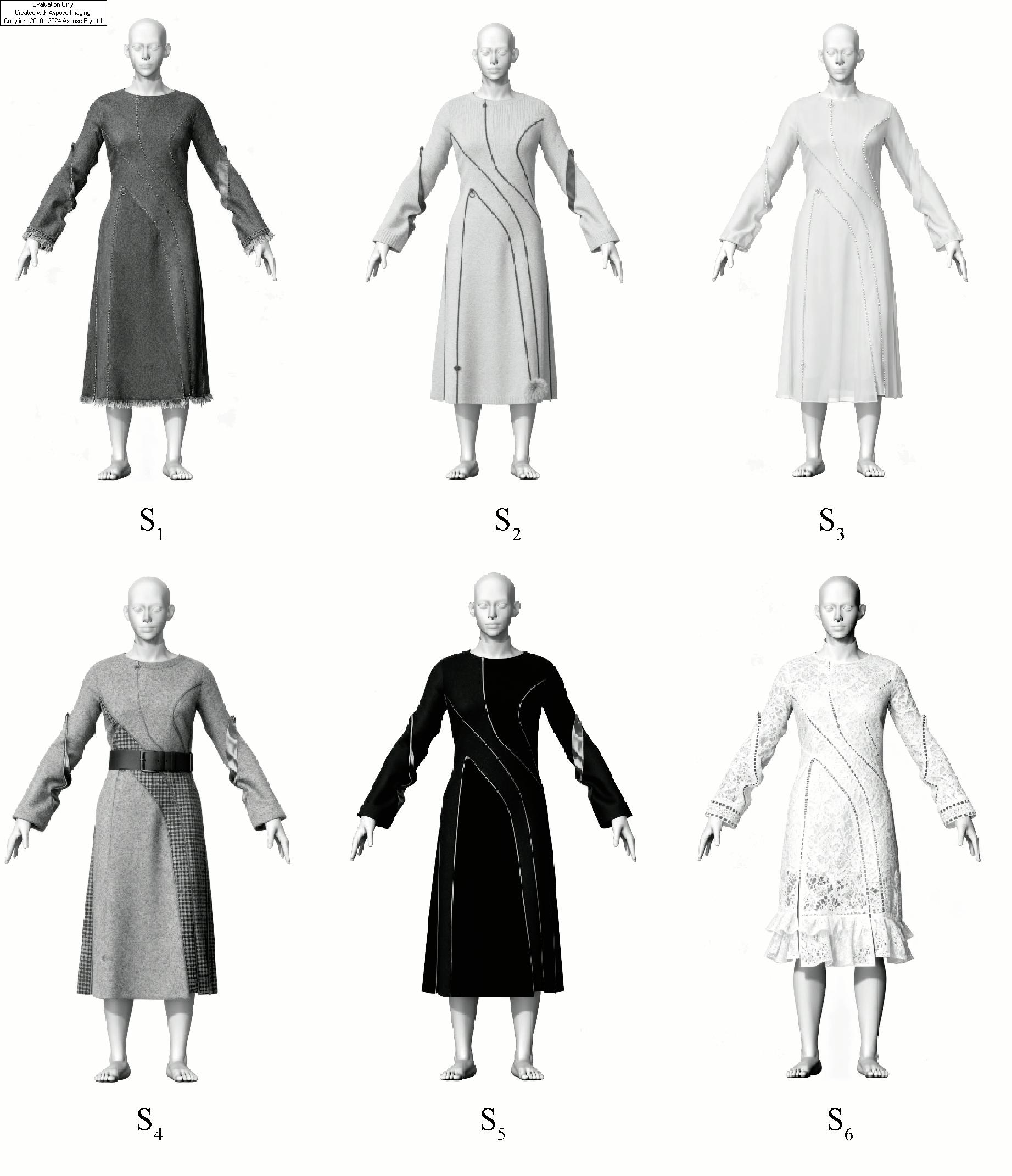
服装款式图 注:S1~S6为不同材质与风格的服装款式效果图。"

图10

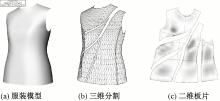
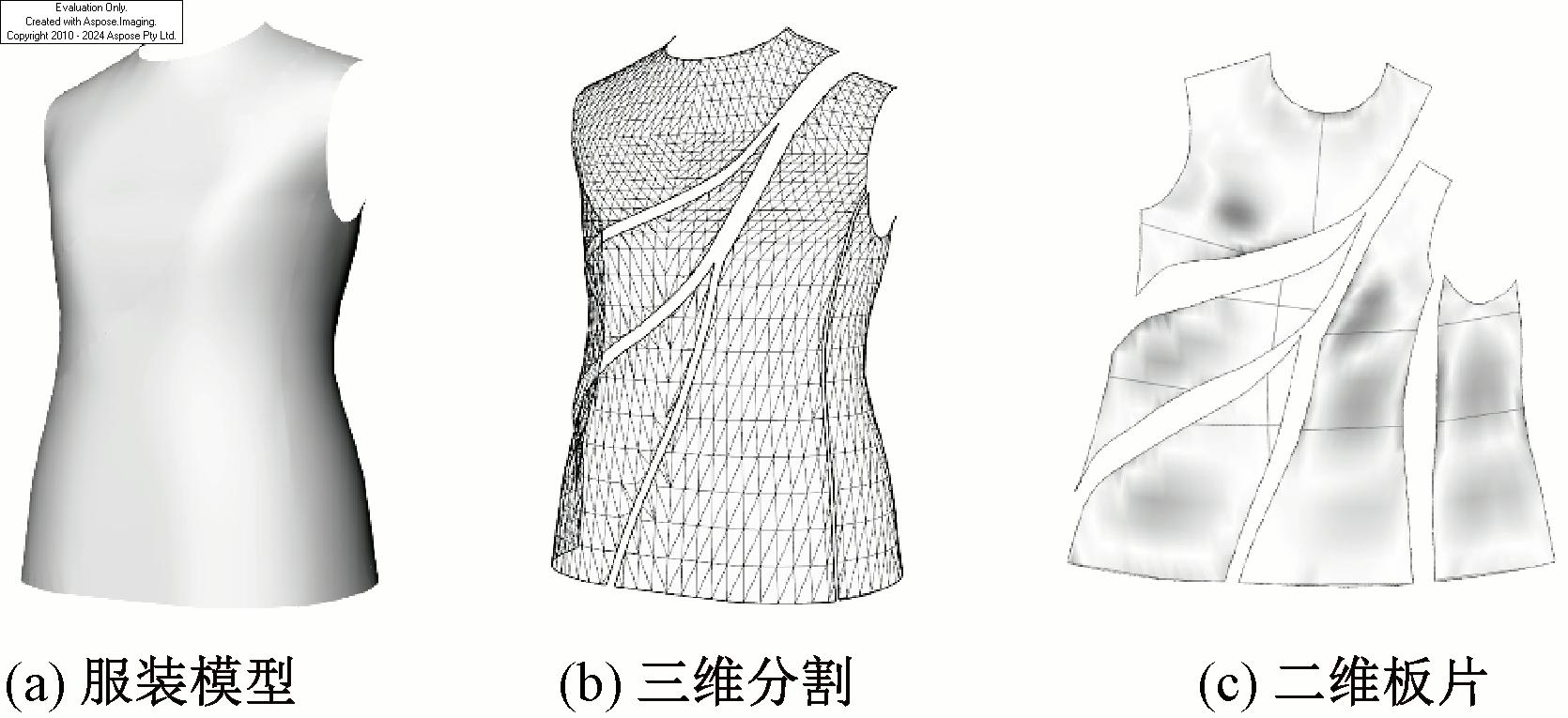
服装模型展开"

图11

图像质量问题"

表1

关键测量测量部位定义"

测量测量部位名称 符号 尺寸定义
肩宽 A 颈侧至肩峰点的距离
前肩斜长 B 肩峰点至胸点的距离
乳点侧长 C 颈侧至胸点的距离
胸肩宽 D 颈侧至前颈点的距离
前领口斜长 E 肩峰点至前颈点的距离
半胸点间距 F 左右胸点间距的二分之一
前袖窿弧线长 G 前袖窿弧线长度
前肩点长 H 肩峰点至前腋点的距离
前腋点至腰围线长 I 前腋点至腰围线的距离

表2

关键测量部位数据概览表"

符号 最小值 最大值 平均值 标准差
A 10.39 10.44 10.40 0.02
B 22.54 22.97 22.73 0.13
C 24.34 25.21 24.67 0.28
D 17.42 17.85 17.63 0.17
E 19.03 19.46 19.18 0.14
F 8.28 8.83 8.46 0.17
G 18.91 19.62 19.23 0.26
H 10.74 11.05 10.90 0.09
I 21.88 22.63 22.20 0.27

图12

服装板片变形程度"

图13

服装对比图"

[1] 解晓溪, 曲洪建, TING Chi. 服装产品在线个性化定制要素对消费者购买意愿的影响[J]. 毛纺科技, 2025, 53(4): 71-77.
XIE Xiaoxi, QU Hongjian, TING Chi. Influence of online personalized customization elements of clothing products on consumer purchase intention[J]. Wool Textile Journal, 2025, 53(4): 71-77.
[2] CHEN H, LEI S, ZHANG S G, et al. Man-algorithm cooperation intelligent design of clothing products in multi links[J]. Fibres and Textiles in Eastern Europe, 2022, 30(1): 59-66.
[3] LIU K X, ZHU C, TAO X Y, et al. Parametric design of garment pattern based on body dimensions[J]. International Journal of Industrial Ergonomics, 2019, 72: 212-221.
[4] 胡佳琪, 宋莹. 基于CLO3D虚拟试衣技术的旗袍着装效果评价研究[J]. 丝绸, 2021, 58(12): 73-79.
HU Jiaqi, SONG Ying. Research on the dressing effect evaluation of Qipao based on CLO 3D virtual fitting technology[J]. Journal of Silk, 2021, 58(12): 73-79.
[5] 纪梦琪, 何瑛, 马咏倩. 基于三维试衣的凸肚体男西裤样板的优化[J]. 纺织学报, 2025, 46(6): 187-195.
JI Mengqi, HE Ying, MA Yongqian. Optimization of trousers patterns for men with protruding abdomen based on three-dimensional fitting[J]. Journal of Textile Research, 2025, 46(6): 187-195.
[6] 冀艳波, 王玲丽, 刘凯旋. 基于数字化三维人体模型的旗袍定制设计[J]. 纺织学报, 2021, 42(1): 133-137, 144.
JI Yanbo, WANG Lingli, LIU Kaixuan. Custom design of cheongsam based on digital 3-D human model[J]. Journal of Textile Research, 2021, 42(1): 133-137, 144.
[7] ZHANG J, INNAMI N, KIM K, et al. Upper garment 3D modeling for pattern making[J]. International Journal of Clothing Science and Technology, 2015, 27(6): 852-869.
[8] 曹晓璐, 卢富男, 朱翔, 等. 基于草图的兼容性服装生成方法[J]. 浙江大学学报(工学版), 2023, 57(5): 939-947.
CAO Xiaolu, LU Funan, ZHU Xiang, et al. Sketch-based compatible clothing image generation[J]. Journal of Zhejiang University (Engineering Science), 2023, 57(5): 939-947.
[9] 朱伟明, 于家蓓. 基于微调扩散模型的智能化衬衫款式图生成[J]. 服装学报, 2025, 10(3): 260-267.
ZHU Weiming, YU Jiabei. Intelligent shirt style drawing generation based on fine-tuned diffusion model[J]. Journal of Clothing Research, 2025, 10(3): 260-267.
[10] TAO W J. Application of garment customization system based on AR somatosensory interactive recognition imaging technology[J]. Advances in Multimedia, 2022, 2022: 7174889.
[11] ZHU Y X, PENG Y J, BOODAGHIAN ASL A. Dual adaptive adjustment for customized garment pattern[J]. Scientific Programming, 2019, 2019: 8069373.
[12] WANG T Y, CEYLAN D, POPOVIC J, et al. Learning a shared shape space for multimodal garment design[J]. ACM Transactions on Graphics, 2018, 37(6): 1-13.
[13] 王伟, 张静宜, 温玉辉, 等. 基于神经网络的图像风格迁移算法综述[J]. 电子学报, 2025, 53(5): 1692-1712.
WANG Wei, ZHANG Jingyi, WEN Yuhui, et al. Neural network based image style transfer: a survey[J]. Acta Electronica Sinica, 2025, 53(5): 1692-1712.
[14] 肖伯祥, 张悦, 胡志远, 等. 速度滑冰比赛服个性化样板生成方法[J]. 纺织学报, 2024, 45(9): 146-153.
XIAO Boxiang, ZHANG Yue, HU Zhiyuan, et al. Individualized pattern generation method of speed skating competition suit[J]. Journal of Textile Research, 2024, 45(9): 146-153.
[1] 李廨晨, 郑小虎, 胡俊. 基于YOLOv8关键点检测与尺寸驱动的T恤制版图自动生成方法[J]. 纺织学报, 2026, 47(07): 228-238.
[2] 郭俊滔, 包伟, 刘典波. 用于个人热管理的湿响应针织物研究进展[J]. 纺织学报, 2026, 47(07): 247-253.
[3] 张惠, 周璇, 王骏巍, 邓咏梅, 张凯兵. 交叉注意力激励的纺织数码印花图案色彩语义一致性生成[J]. 纺织学报, 2026, 47(01): 176-185.
[4] 石彬琳, 董智佳, 马丕波, 丛洪莲, 吴光军, 刘博. 机器人颈关节包覆用针织全成形织物结构设计[J]. 纺织学报, 2025, 46(12): 116-122.
[5] 尹俏琳, 倪沈伊嘉, 郑琪, 何瑛. 基于体型特征的连衣裙综合评价模型的构建和应用[J]. 纺织学报, 2025, 46(12): 198-207.
[6] 贺辛亥, 冯温柔, 王博, 刘菲, 梁军浩, 孙勇. 复合材料三维预制体整体穿刺虚拟样机设计[J]. 纺织学报, 2025, 46(12): 224-232.
[7] 王二南, 何玉灿, 刘海桑, 董智佳, 丛洪莲. 经编全成形连帽式连体骑行服结构设计与工艺实现[J]. 纺织学报, 2025, 46(11): 203-210.
[8] 唐春霞, 王一帆, 毛云山, 刘健, 付少海. 电磁屏蔽用纤维素基复合材料结构设计的研究进展[J]. 纺织学报, 2025, 46(09): 36-45.
[9] 杨子田, 王诗琪, 雷梦洁. 马面裙坠感指数及结构解析[J]. 纺织学报, 2025, 46(07): 186-192.
[10] 陈晓真, 吴莹, 杨叶, 鲁礼豪. 基于三维虚拟模特转换的女士连体长裤参数化纸样生成[J]. 纺织学报, 2025, 46(07): 193-201.
[11] 纪梦琪, 何瑛, 马咏倩. 基于三维试衣的凸肚体男西裤样板的优化[J]. 纺织学报, 2025, 46(06): 187-195.
[12] 王惠婷, 陈宇鉴, 刘诗仪, 张显涛, 陆斌, 邹专勇, 王建, 张寅江. 海藻酸盐基非织造医用敷料的研究进展[J]. 纺织学报, 2025, 46(06): 240-249.
[13] 施佳, 李梦珠, 肖伯祥. 竞速滑冰功能性服装技术研究进展[J]. 纺织学报, 2025, 46(06): 250-260.
[14] 朱梦慧, 葛美彤, 董智佳, 丛洪莲, 马丕波. 纬编双面羊毛/涤纶交织物的结构与热湿性能评价[J]. 纺织学报, 2025, 46(05): 179-185.
[15] 李润, 常梓洋, 张如范. 碳纳米管功能纤维的可控制备与性能调控研究进展[J]. 纺织学报, 2025, 46(05): 30-40.
Viewed
Full text


Abstract

Cited

  Shared   
  Discussed   
No Suggested Reading articles found!