纺织学报 ›› 2026, Vol. 47 ›› Issue (1): 98-105.doi: 10.13475/j.fzxb.20250303501

• 纺织工程 • 上一篇    下一篇

芯纱实时反捻法无扭结包覆纱的技术原理与实验

徐浩文, 敖利民()   

  1. 嘉兴大学 材料与纺织工程学院, 浙江 嘉兴 314001
  • 收稿日期:2025-03-21 修回日期:2025-11-18 出版日期:2026-01-15 发布日期:2026-01-15
  • 通讯作者: 敖利民(1969—),男,教授,博士。主要研究方向为纺纱新技术与新产品。E-mail:aolimin@126.com
  • 作者简介:徐浩文(2001—),男,硕士。主要研究方向为纱线复合加工技术与产品。

Technical principle and experiment of real-time core yarn reverse twisting method for snarl-free covered yarns

XU Haowen, AO Limin()   

  1. College of Materials and Textile Engineering, Jiaxing University, Jiaxing, Zhejiang 314001, China
  • Received:2025-03-21 Revised:2025-11-18 Published:2026-01-15 Online:2026-01-15

摘要:

为解决非弹力单包包覆纱因包缠内应力导致的扭结问题,提出采用芯纱实时反向加捻再包覆的技术方法,即对芯纱进行捻向与包缠捻向相反的实时加捻,通过芯纱加捻的反捻力矩抵消外包缠纱包缠产生的反捻力矩,实现包覆纱的无扭结效果。探讨了2种在空心锭包覆机上进行芯纱实时加捻的技术:空心锭机构加捻与倍捻机构加捻,给出2种芯纱加捻的技术原理,并分析了各自优缺点和适用性;明确了芯纱加捻的捻向匹配原则:长丝芯纱可自由选择加捻捻向,短纤芯纱因具有初始捻度,芯纱进行再加捻的捻向须与原捻向相同。利用2种芯纱加捻机构分别纺制了包缠捻度为500捻/m的涤纶长丝混色包覆纱和包缠捻度为800捻/m的毛/涤纶混色包覆纱,并对不同芯纱反向加捻捻度下包覆纱的扭结指数和拉伸性能进行了测试。结果表明,芯纱反向加捻可显著降低包覆纱的扭结,当涤纶长丝芯纱反向加捻至400捻/m时,扭结指数下降超90%;毛/涤纶包覆纱芯纱捻度达200捻/m时,扭结接近完全消除。芯纱加捻改变了包覆纱的结构,故对复合纱的性能会有所影响,对于不同芯纱和外包缠纱配置,以及不同芯纱反向加捻捻度,断裂强力和伸长率的变化趋势有所不同。

关键词: 包覆纱, 无扭结, 芯纱反向加捻, 空心锭机构, 倍捻机构, 捻向匹配, 扭结指数

Abstract:

Objective In order to address the snarl problem of non-elastic covered yarns caused by the internal stress generated by the outer yarn wrapping, a real-time core yarn reverse twisting method is proposed, aiming at offsetting the reverse twisting moment generated by the outer yarn wrapping through the reverse twisting moment generated by the reverse twisting of the core yarn, so as to achieve a stable structure of snarl-free covered yarns. The core tasks include the verification of the feasibility of two core yarn twisting technologies, i.e. hollow spindle mechanism and doubling twisting mechanism, the clarification of the principle of twist direction matching, and the exploration of the influence of the reverse twisting twist of the core yarn on the snarl index of the covered yarn with a given wrapping twist.

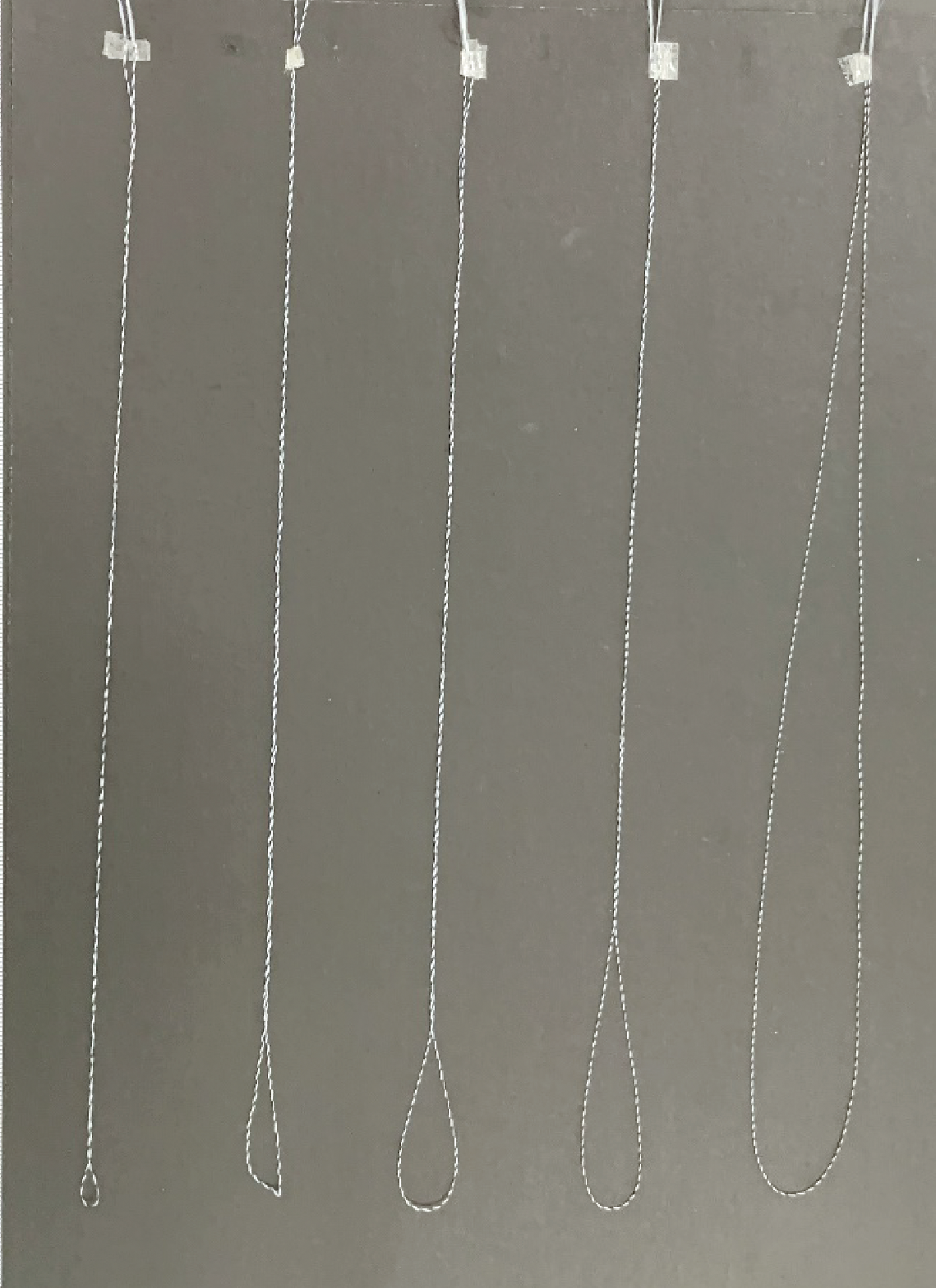
Method Two technologies for realizing the twisting of the core yarn on the hollow spindle covering machine were adopted. The first is twisting by the hollow spindle mechanism, where based on the technical feature of the hollow spindle mechanism of wrapping when in the presence of a core, and twisting when in the absence of a no core, the original hollow spindle components of the equipment were utilized, and the reverse twisting of the core yarn was achieved through the series configuration of the upper-row and lower-row. The second is twisting by the doubling twisting mechanism. The doubling twisting mechanism was utilized to replace the lower-row of hollow spindle mechanisms to achieve the real-time twisting of the core yarn. The advantages and disadvantages of the two twisting methods were analyzed. Polyester filament covered yarns with different levels of core yarn twisting were spun using the hollow spindle twisting mechanism (core yarn 167 dtex, outer wrapping yarn 83 dtex, wrapping twist 500 twists/m); wool/polyester covered yarns with different core yarn twists were spun using the doubling twisting mechanism (28 tex wool yarn as the core yarn, 111 dtex polyester filament as the outer wrapping yarn, and the wrapping twist of 800 twists/m). The closed-loop method (GB/T 7960.6—2013) was adopted to measure the snarl index of the covered yarns, and the influence of twist matching on torque offset was analyzed. The tensile properties were tested by CRE method (GB/T 3916—2013) to investigate the influences of the core yarn twist on covered yarns.

Results For polyester filament covered yarns, when the reverse twist of the core yarn increased from 0 to 400 twists/m, the average value of the snarl index decreased from 140.0 twists/m to 11.6 twists/m, representing a decrease of over 90%. The increase in the twist significantly reduced the self-twisting snarl, and the yarn tended to be stable. For wool/polyester mixed-color covered yarns, as the reverse twist of the core yarn increased, the snarl index of the covered yarn decreased. When the core yarn twist reached 200 twists/m, the snarl index is close to zero (-0.2 twists/m), indicating that the reverse twisting moment was completely offset. For polyester filament covered yarns, the breaking strength increased first and then decreased with the increase of twist of the core yarn, and the elongation at break of the covered yarn was higher than that of the core yarn without twisting, but the change with the twist of the core yarn was not significant. For wool/polyester mixed-color covered yarns, the breaking strength decreased with the increase of twist of the core yarn, and the elongation at break of the covered yarn was lower than that of the core yarn without twisting, but no significant change occurred with the increasing twist of the core yarn.

Conclusion The anti-twisting torque generated by the outer wrapping yarn when wrapping the core yarn causes the non-elastic single-covered yarn to exhibit a snarling phenomenon similar to yarn twisting. By using a twisting mechanism to first apply real-time twisting to the core yarn in a direction opposite to the wrapping twist direction, followed by the covering process, the anti-twisting torque from the core yarn twisting can offset the anti-twisting torque produced by the outer wrapping yarn during covering. This achieves torque balance inside the covered yarn and produces non-snarling covered yarn. Core yarn twisting can be achieved using a hollow spindle mechanism, leveraging its characteristic of wrapping when in the presence of core and twisting when in the absence of a core, or it can be realized with a general-purpose double-twisting mechanism. The former has a smaller core yarn package capacity and is more suitable for core yarns with smaller linear density. The latter, however, requires the core yarn to have higher strength to overcome processing tension, but it can achieve high twist at low speed. For filament core yarns, the twisting direction of the core yarn and the wrapping twist direction only need to meet the requirement of being in opposite configurations. For staple fiber core yarns, due to their inherent initial twist, the reverse twisting direction of the core yarn must be the same as its initial twist direction, while the wrapping twist direction must be opposite to the initial twist direction of the core yarn. The snarl index of the covered yarn decreases as the reverse twist level of the core yarn increases, until the non-snarling state is achieved. The required reverse twist level of the core yarn to achieve non-snarling covered yarn varies depending on the configurations of the core yarn and outer wrapping yarn, as well as the wrapping twist level of the outer wrapping yarn. It must be determined through experiments on the variation of the core yarn's reverse twist level. Twisting the core yarn changes the structure of the covered yarn, which in turn leads to changes in its properties. For different combinations of core yarn and outer wrapping yarn, as well as different wrapping twist configurations, the variation trends of the covered yarn's performance indicators will differ with changes in the core yarn's twist level. Specific analysis through experiments is therefore required.

Key words: covered yarn, snarl-free, reverse twisting of core yarn, hollow spindle mechanism, doubling twisting mechanism, twist direction matching, snarl index

中图分类号: 

  • TS104.1

图1

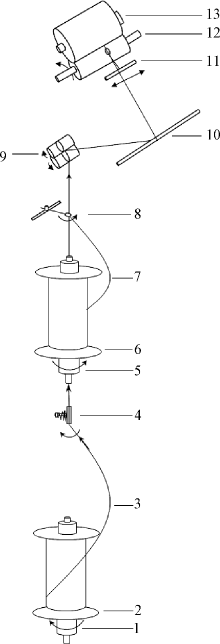
空心锭机构加捻-包覆技术原理 1—下排空心锭;2—锭管;3—芯纱;4—张力装置;5—上排空心锭;6—锭管;7—外包缠纱;8—会合导纱钩;9—引纱辊;10—导纱杆;11—横动导纱器;12—卷绕辊;13—纱管(管纱)。"

图2

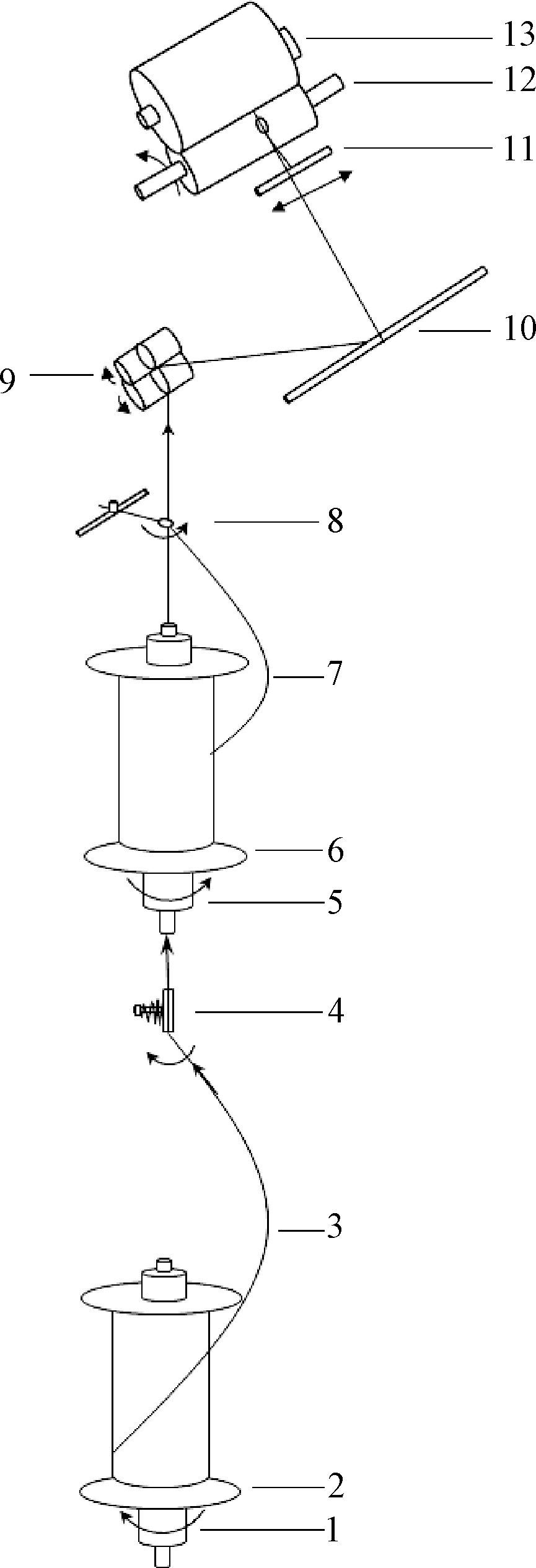
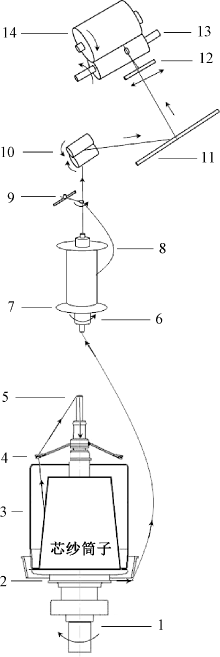
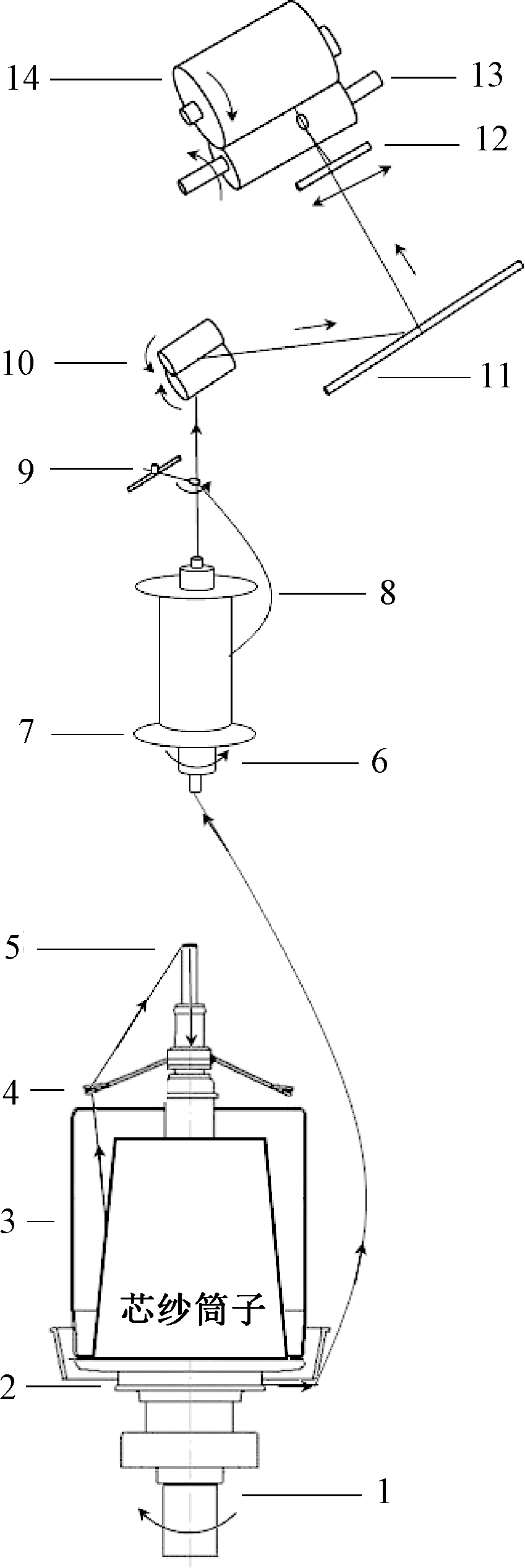
倍捻机构加捻-包覆技术原理 1—倍捻锭子;2—加捻盘;3—纺纱杯;4—导纱钩;5—倍捻空心锭;6—空心锭;7—锭管;8—外包缠纱;9—会合导纱钩;10—引纱辊;11—导纱杆;12—横动导纱器;13—卷绕辊;14—纱管(管纱)。"

表1

空心锭转速与芯纱加捻捻度"

下排空心锭转速/(r·min-1) 芯纱反向加捻捻度/(捻·m-1)
0 0
2 400 100
4 800 200
7 200 300
9 600 400

表2

倍捻锭子转速与芯纱加捻捻度"

下排设定转速/(r·min-1) 芯纱加捻捻度/(捻·m-1)
0 0
525 50
1 050 100
1 575 150
2 100 200

图3

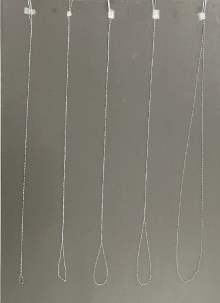
5种涤纶长丝包覆纱对折自捻后形态"

表3

不同芯纱捻度涤纶长丝包覆纱扭结指数"

芯纱捻度/
(捻·m-1)
平均扭结指数/
(捻·m-1)
扭结指数
CV值/%
0 140.0 6.51
100 116.1 13.12
200 64.4 10.80
300 37.1 6.62
400 11.6 5.06

图4

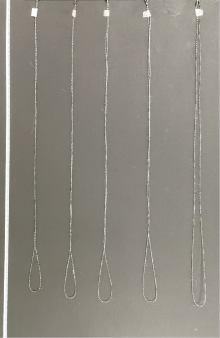
5种毛/涤纶包覆纱的对折自捻后形态"

表4

不同芯纱捻度毛/涤纶包覆纱扭结指数"

芯纱捻度/
(捻·m-1)
平均扭结指数/
(捻·m-1)
扭结指数
CV值/%
0 29.6 8.78
50 18.0 10.54
100 17.4 3.78
150 10.4 3.10
200 -0.2 1.14

表5

不同芯纱捻度涤纶长丝包覆纱拉伸性能"

芯纱捻度/
(捻·m-1)
断裂强力 断裂伸长率
平均值/cN CV值/% 平均值/% CV值/%
0 976.4 1.6 27.2 4.7
100 944.3 1.8 29.5 3.5
200 979.9 0.8 29.3 2.5
300 989.7 1.4 29.2 4.2
400 915.2 1.2 29.7 3.9

表6

不同芯纱捻度毛/涤纶包覆纱拉伸性能"

芯纱捻度/
(捻·m-1)
断裂强力 断裂伸长率
平均值/cN CV值/% 平均值/% CV值/%
0 652.8 5.2 14.0 4.7
50 582.2 8.1 11.8 9.7
100 591.9 10.9 11.7 9.8
150 540.6 8.5 11.8 9.7
200 567.1 10.9 11.6 11.9
[1] 敖利民, 唐雯. 捻度和捻向配置对双包包覆纱性能的影响[J]. 纺织学报, 2023, 44(7): 50-56.
AO Limin, TANG Wen. Influences of twist and twist direction arrangement on properties of double covered yarns[J]. Journal of Textile Research, 2023, 44(7): 50-56.
[2] 敖利民, 潘柳菲, 唐雯, 等. 四轴系喂入包覆纱的复合结构与性能[J]. 纺织学报, 2025, 46(1): 52-61.
AO Limin, PAN Liufei, TANG Wen, et al. Composite structures and properties of quadratically-fed covered yarns[J]. Journal of Textile Research, 2025, 46(1): 52-61.
[3] 王增喜. 短纤维纱线捻度稳定性的评价及其影响因素的研究[J]. 化纤与纺织技术, 2014, 43(4): 22-27.
WANG Zengxi. Study on evaluation and influencing factors of yarn twist stability of staple fiber[J]. Chemical Fiber & Textile Technology, 2014, 43(4): 22-27.
[4] 汪泽幸, 苏雅君, 李洪登, 等. 常用纱线定捻法及其定捻效果评价[J]. 湖南工程学院学报(自然科学版), 2015, 25(4): 62-65.
WANG Zexing, SU Yaun, LI Hongdeng, et al. Experimental investigation and evaluation of common yarn twist setting[J]. Journal of Hunan Institute of Engineering ( Natural Science Edition), 2015, 25(4):62-65.
[5] 张瑞成, 张文清, 吕哲, 等. 基于自捻纺的嵌入式低扭矩复合纱性能分析[J]. 纺织学报, 2025, 46(2): 78-85.
ZHANG Ruicheng, ZHANG Wenqing, LÜ Zhe, et al. Performance analysis of embedded low-torque composite yarns based on self-twisting spinning[J]. Journal of Textile Research, 2025, 46(2):78-85.
[6] 吴济宏, 陈晓林, 范江涛, 等. 一种针织用扭力平衡的复合纱的制作方法: 201310181677.5[P].2015-10-21.
WU Jihong, CHEN Xiaolin, FAN Jiangtao, et al. Method for producing torque-balanced composite yarn for knitting applications: 201310181677.5[P]. 2015-10-21.
[7] 朱杰, 杨明惠, 王武, 等. 一种毛纺复合纱线生产设备:202322246203.6[P].2024-04-05.
ZHU Jie, YANG Minghui, WANG Wu, et al. Manufacturing equipment for woolen composite yarn manufacturing: 202322246203.6[P]. 2024-04-05.
[8] NK Palaniswamy, AP Mohamed. Balanced two-ply cotton yarn[J]. Indian Journal of Fibre & Textile Research, 2005, 30(3): 32-36.
[9] NK Palaniswamy, AS Mohamed, PW Robert. Balanced two-ply cotton rotor yarn[J]. Indian Journal of Fibre & Textile Research, 2007, 32(6): 169-172.
[10] FRASER W B, STUMP D M. Twist in balanced-ply structures[J]. The Journal of the Textile Institute, 1998, 89(3): 485-497.
doi: 10.1080/00405009808658635
[11] 沈新华. 特种包覆纱的工艺及其产品: 201010160931.X[P]. 2010-08-25.
SHEN Xinhua. Manufacturing method and end-use products for technical covered yarns: 201010160931.X[P]. 2010-08-25.
[12] 徐浩文, 敖利民, 唐雯, 等. 一种无扭结包覆线的制备方法及装置: 202411867805.6[P]. 2025-02-11.
XU Haowen, AO Limin, TANG Wen, et al. A preparation method and device for snarl-free covered yarn: 202411867805.6[P]. 2025-02-11.
[1] 石彬琳, 董智佳, 马丕波, 丛洪莲, 吴光军, 刘博. 机器人颈关节包覆用针织全成形织物结构设计[J]. 纺织学报, 2025, 46(12): 116-122.
[2] 王小虎, 包安娜, 魏静雯, 赵晓曼, 韩潇, 洪剑寒. 基于静电纺丝-静电喷涂协同工艺的跨尺度传感纱一步法制备及其应用[J]. 纺织学报, 2025, 46(12): 101-109.
[3] 张逸飞, 万玥, 暨若云, 付少举, 王璐, 关国平. 蚕丝/氨纶医用压力臂套服用性能评价[J]. 纺织学报, 2025, 46(07): 111-118.
[4] 腾燕飞, 万爱兰. 消臭运动袜的研发及其性能[J]. 纺织学报, 2025, 46(06): 120-126.
[5] 岳欣琰, 邵剑波, 王小虎, 韩潇, 赵晓曼, 洪剑寒. 基于镀银锦纶/锦纶/水性聚氨酯复合纱的一维结构柔性电容传感器[J]. 纺织学报, 2025, 46(03): 82-89.
[6] 敖利民, 潘柳菲, 唐雯, 方瑞峰. 四轴系喂入包覆纱的复合结构与性能[J]. 纺织学报, 2025, 46(01): 52-61.
[7] 贾冰凡, 敖利民, 唐雯, 郑元生, 尚珊珊. 毛纱/锦纶长丝包覆纱的纺制及其性能与应用[J]. 纺织学报, 2023, 44(12): 58-66.
[8] 骆春旭, 龚浩然, 吴敏勇, 黄丛, 刘可帅. 特种玄武岩缝纫线的制备工艺及其性能[J]. 纺织学报, 2023, 44(11): 61-66.
[9] 王雅倩, 万爱兰, 曾登, 吴光军, 祁倩. 形状记忆氨纶/锦纶包覆纱的制备及其压力袜性能[J]. 纺织学报, 2023, 44(10): 53-59.
[10] 敖利民, 唐雯. 捻度和捻向配置对双包包覆纱性能的影响[J]. 纺织学报, 2023, 44(07): 50-56.
[11] 周筱雅, 马定海, 胡铖烨, 洪剑寒, 刘永坤, 韩潇, 闫涛. 涤纶/聚酰胺6纳米纤维包覆纱的连续制备及其应用[J]. 纺织学报, 2022, 43(02): 110-115.
[12] 熊祥章, 裴泽光, 陈革. 基于形状记忆合金丝包覆纱的针织物致动器研究[J]. 纺织学报, 2020, 41(05): 50-57.
Viewed
Full text


Abstract

Cited

  Shared   
  Discussed   
No Suggested Reading articles found!