纺织学报 ›› 2025, Vol. 46 ›› Issue (03): 49-55.doi: 10.13475/j.fzxb.20240100201

• 纺织工程 • 上一篇    下一篇

棉/涤纶短纤皮芯纱及其织物的力学性能

江文杰, 郭明瑞, 高卫东()   

  1. 江南大学 纺织科学与工程学院, 江苏 无锡 214122
  • 收稿日期:2024-01-02 修回日期:2024-04-09 出版日期:2025-03-15 发布日期:2025-04-16
  • 通讯作者: 高卫东(1959—),男,教授,博士。主要研究方向为纺织技术。E-mail: gaowd@163.com
  • 作者简介:江文杰(1996—),男,博士生。主要研究方向为纺纱技术。
  • 基金资助:
    国家自然科学基金项目(52003105)

Mechanical properties of cotton/polyester staple sheath-core yarns and its corresponding fabrics

JIANG Wenjie, GUO Mingrui, GAO Weidong()   

  1. College of Textile Science and Engineering, Jiangnan University, Wuxi, Jiangsu 214122, China
  • Received:2024-01-02 Revised:2024-04-09 Published:2025-03-15 Online:2025-04-16

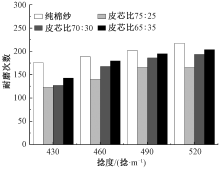
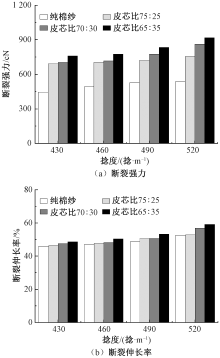
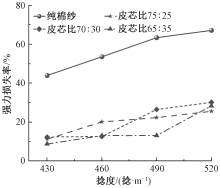
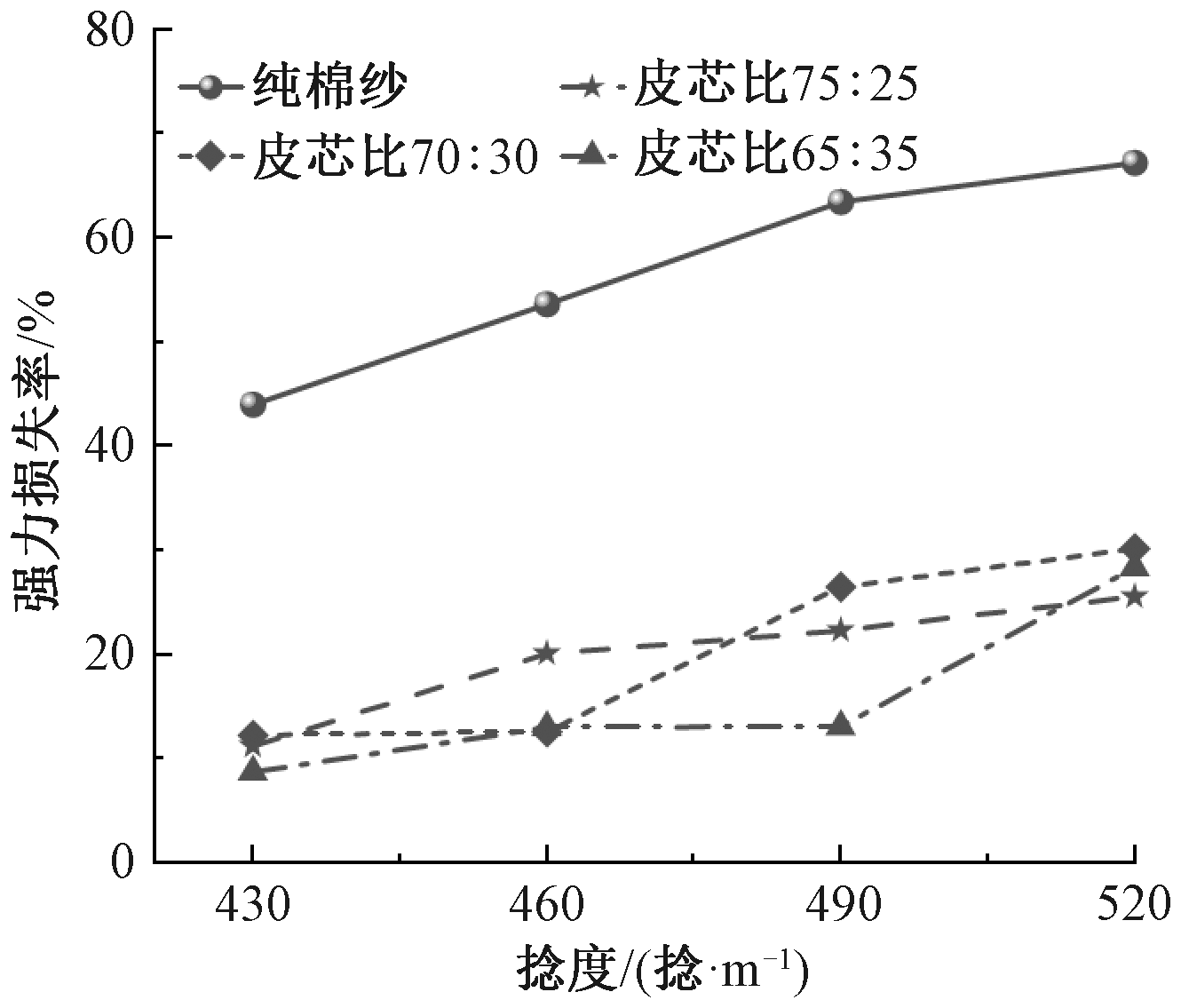
摘要: 为弥补纯棉牛仔纱线性能缺陷,通过开发棉/涤纶皮芯结构短纤纱来保持纯棉纱的触感,并提高纱线性能。为此,提出了一种新型短纤皮芯纱的纺纱方法,通过改进环锭细纱机牵伸机构,实现2根纤维束在前罗拉钳口异速输出,在纺纱张力和加捻作用下,快速纤维束以螺旋线状包缠在慢速纤维束表面,从而形成皮芯结构。重点研究了纱线捻度与皮芯比例对棉/涤纶短纤皮芯纱及其织物的拉伸性能和耐磨性能的影响。结果表明:棉/涤纶短纤皮芯纱及其织物的拉伸性能均好于纯棉环锭纱及其织物,并在捻度为520、皮芯比为65∶35时取得最大断裂强度和断裂伸长率;纯棉环锭纱的耐磨性能优于棉/涤纶短纤皮芯纱。以捻度为430为例,纯棉的耐磨次数分别比皮芯比为75∶25、70∶30和65∶35的棉/涤纶短纤皮芯纱高43.1%、38.6%和23.1%。在捻度为430时,织物的强度损失率最小,纯棉织物的强度损失率分别比皮芯比为75∶25、70∶30和65∶35的棉/涤纶短纤皮芯纱所织成织物的强度损失率高291.1%、259.8%和400.5%。

关键词: 新型纺纱技术, 棉/涤纶短纤皮芯纱, 同轴异径前罗拉, 皮芯比, 拉伸性能, 耐磨性能, 纬编针织物

Abstract:

Objective In order to give full play to the performance advantages of composite staple yarn, a new method of spinning staple sheath-core yarn based on ring spinning machine was developed. Meanwhile, tensile properties and abrasion resistance are important evaluation indicators of textiles, which are directly related to production efficiency and product quality. Therefore, the tensile properties and abrasion resistance of pure cotton ring-spun yarns and cotton-polyester staple sheath-core yarns and their corresponding fabrics were also compared.

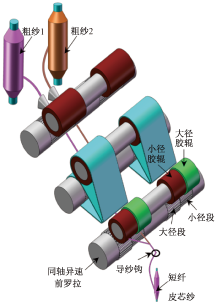
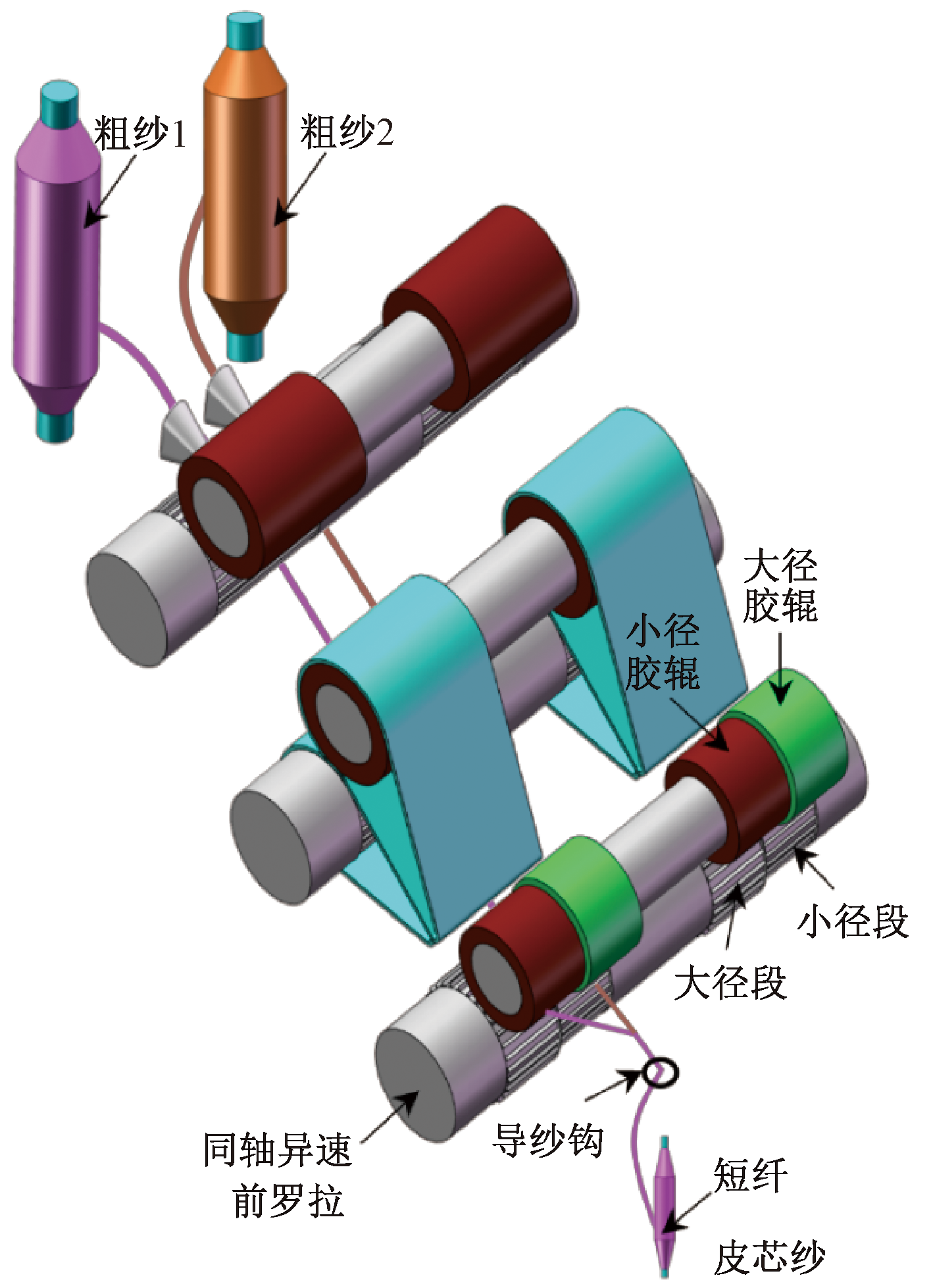
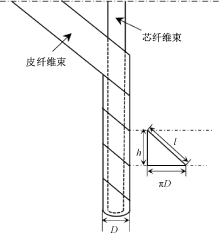
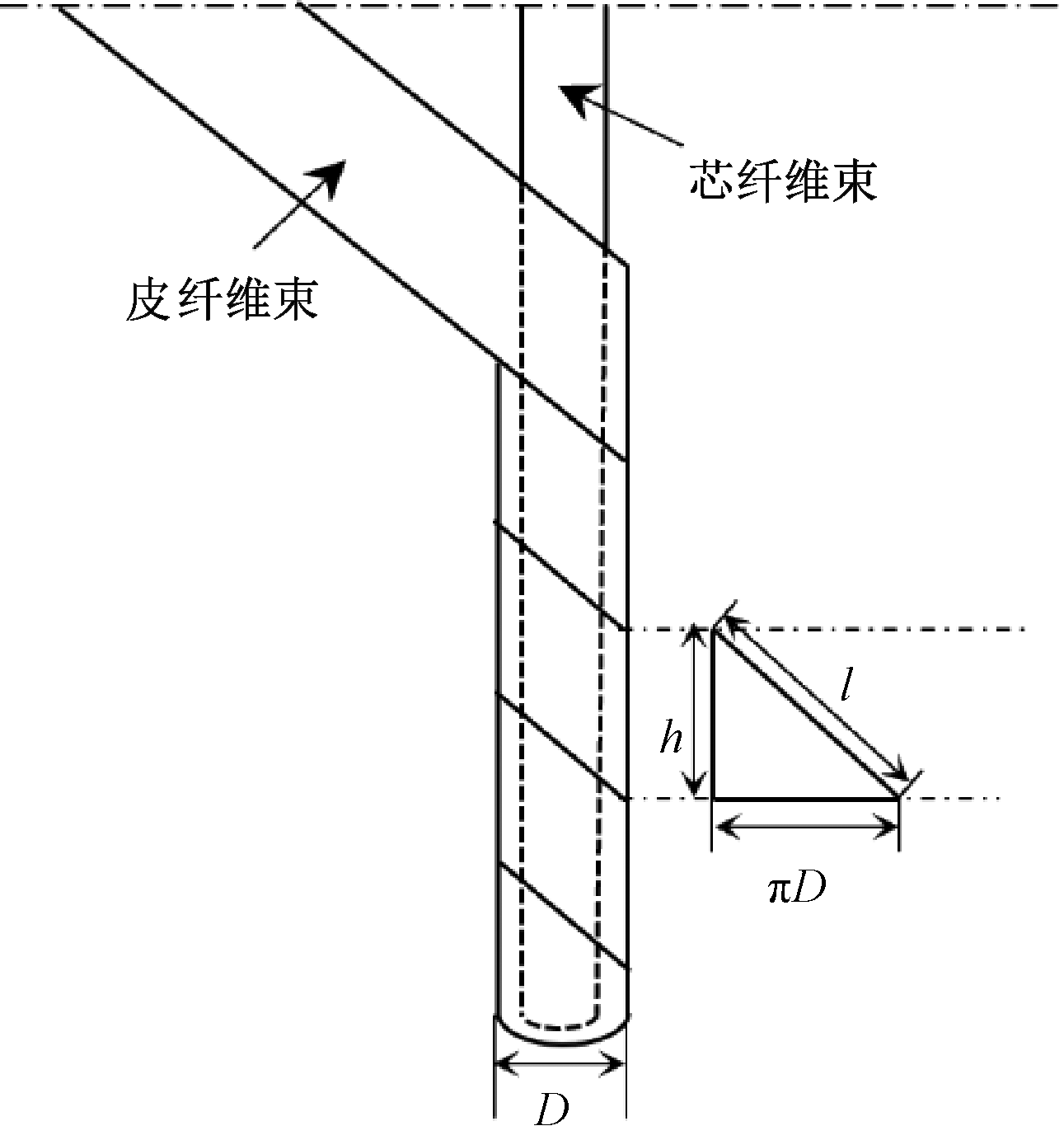
Method The conventional front roller was replaced with the coaxial front roller of different diameters. The two fiber bundles were simultaneously fed into the back roller. After drafting, they were output with different speeds at the front roller nip. Under the action of spinning tension, the slow fiber bundle was output perpendicular to the front roller nip, while the fast fiber bundle was output from the front roller nip at a certain inclination angle and converged with the slow fiber bundle at the twisting point. As the twist was transferred to the spinning triangle, the slow fiber bundle was twisted around its axis, while the fast fiber bundle was spirally wrapped around the outside of the slow fiber bundle, thus forming staple sheath-core yarn.

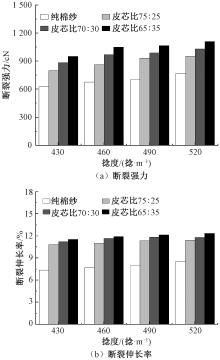
Results The breaking strength and breaking elongation of the cotton-polyester staple sheath-core yarn are better than those of the ring-spun cotton yarn. And as the core proportion increases, the breaking strength and breaking elongation of the staple sheath-core yarn increase. This is because the tensile properties of polyester fiber are better than those of cotton fiber. As the core proportion increases, the polyester fiber content increases, so the tensile properties of the sheath-core yarn are improved. The tensile properties of staple fiber sheath-core yarn and ring-spun cotton yarn improve as the twist increases. Meanwhile, the abrasion resistance of ring-spun cotton yarn is better than that of cotton-polyester sheath-core yarn. The reason is that internal and external transfer exist between the fibers of ring-spun cotton yarn, and the binding force between fibers is strong and difficult to be extracted. While, the sheath-core yarn has an obvious layered structure, and the cohesive force between the core layer and the sheath layer is insufficient, making the fibers easier to peel off. Therefore, the abrasion resistance of cotton-polyester staple sheath-core yarn is worse than that of ring-spun cotton yarn. Similar to the law of yarn tensile properties, the tensile properties of knitted fabrics woven from polyester-cotton staple sheath-core yarns are superior to than those woven from ring-spun cotton yarns. This is because the fiber strength determines the tensile properties of the yarn, which in turn affects the tensile properties of the fabric. Therefore, an increase in the polyester fiber content is beneficial to improving the tensile breaking strength and breaking elongation of the knitted fabric. The strength loss proportion of the knitted fabric woven form ring-spun cotton yarn is much greater than that woven from sheath-core yarn fabric. This is because the strength of the sheath-core yarn is mainly provided by the core layer. During friction, the core layer is covered by the sheath layer and suffers little friction, resulting in less strength loss of the sheath-core yarn. Therefore, the strength loss proportion of the knitted fabric woven from staple sheath-core yarn is much smaller than that woven from ring-spun cotton yarn.

Conclusion A new method of spinning staple sheath-core yarn based on ring spinning machine was developed. the two fiber bundles were output at different speeds at the nip of the front roller by modifying the front roller on the ring spinning machine. Under the action of spinning tension and twisting, the slow fiber bundle was covered by the fast fiber bundle, forming a sheath-core structure. This method has the advantages of high spinning efficiency and good yarn spun properties. In addition, the tensile properties and abrasion resistance of ring-spun cotton yarn and cotton-polyester sheath-core staple fiber yarn were compared. The results show that the tensile properties of cotton-polyester staple sheath-core yarn were better than those of ring-spun cotton yarn; However, the abrasion resistance of cotton-polyester staple sheath-core yarn is worse than that of ring-spun cotton yarn; and the tensile properties of knitted fabric woven from cotton-polyester staple sheath-core yarn were better than that woven from ring-spun cotton yarn.

Key words: new spinning technology, cotton/polyester staple sheath-core yarn, coaxial front roller of different diameters, sheath-core proportion, tensile property, abrasion resistance property, weft-knitted fabric

中图分类号: 

  • TS104.1

图1

纺纱装置示意图"

图2

短纤皮芯纱展开图"

表1

纺纱实验方案"

纱线类型 皮芯比 粗纱定量/
(g·(10 m)-1)
捻度/(捻·m-1)
皮层 芯层
棉/涤纶短纤
皮芯纱
75∶25 12.3 3.8 430/460/490/520
70∶30 9.6 3.8
65∶35 7.6 3.8
纯棉环锭纱 / 9.6

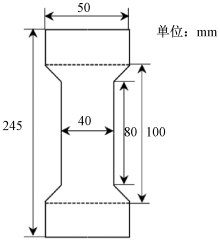
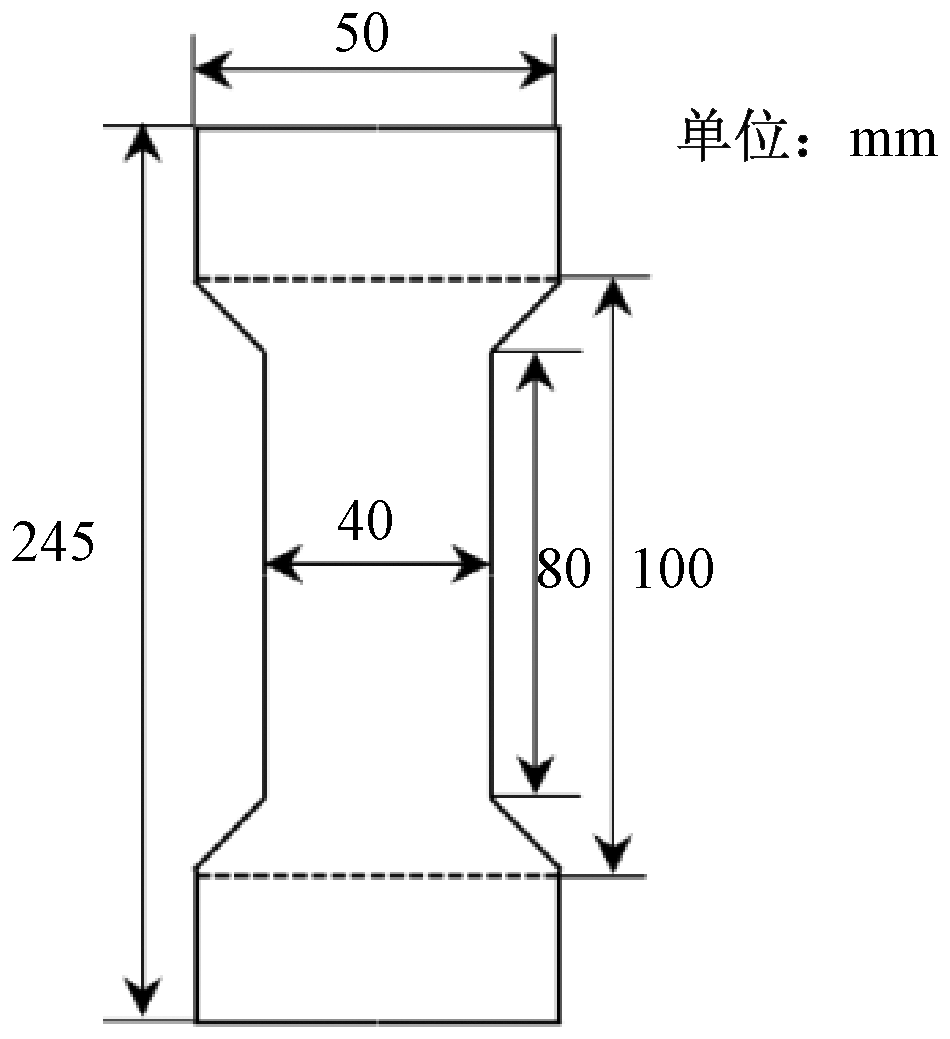
图3

针织物试样尺寸图"

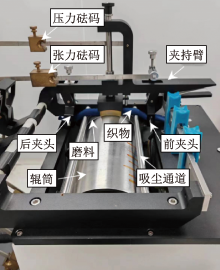
图4

威士伯织物耐磨仪外观图"

图5

棉纱与不同皮芯比下的棉/涤纶短纤皮芯纱拉伸性能对比"

图6

棉纱与不同皮芯比下的棉/涤纶短纤皮芯纱耐磨性能对比"

图7

织物拉伸性能对比"

图8

织物强力损失率对比"

[1] 周蛟, 王际平, 冯新星, 等. 线密度和组织结构对牛仔面料保型性的影响[J]. 纺织学报, 2010, 31(1):44-47.
ZHOU Jiao, MANG Jiping, FENG Xinxing, et al. Jean fabric shape retention as affected by yarn linear density and fabric structure[J]. Journal of Textile Research, 2010, 31(1):44-47.
[2] 蒋志青, 马延涛, 郭亚, 等. 仿针织牛仔面料的开发及性能评价[J]. 纺织学报, 2018, 39(3): 45-49.
JIANG Zhiqing, MA Yantao, GUO Ya, et al. Development and property evaluation of fake knitted denim fabric[J]. Journal of Textile Research, 2018, 39(3): 45-49.
[3] 万爱兰, 缪旭红, 蒋高明. 纬编牛仔面料的设计及其弹性回复性[J]. 纺织学报, 2017, 38(10): 38-43.
doi: 10.13475/j.fzxb.20161105606
WAN Ailan, MIAO Xuhong, JIANG Gaoming. Structure design and elastic resilience of weft knitted denim fabric[J]. Journal of Textile Research, 2017, 38(10): 38-43.
doi: 10.13475/j.fzxb.20161105606
[4] 张海焕, 张毅, 童胜昊, 等. 牛仔布用多芯包芯纱强伸性能研究[J]. 棉纺织技术, 2023, 51(4): 53-56.
ZHANG Haihuan, ZHANG Yi, TONG Shenghao, et al. Study on tensile property of multi-core spun yarn for denim[J]. Cotton Textile Technology, 2023, 51(4): 53-56.
[5] 肖红, 齐元章, 施楣梧, 等. 棉涤包芯纱衬衣面料低负荷下的力学性能研究[J]. 棉纺织技术, 2013, 41(1): 21-25.
XIAO Hong, QI Yuanzhang, SHI Meiwu, et al. Cotton polyester core spun yarn shirt fabric under lower load[J]. Cotton Textile Technology, 2013, 41(1): 21-25.
[6] 倪俊瑶, 李煜斌, 范杰, 等. 含涤纶长丝包芯纱织物的折痕回复性能[J]. 毛纺科技, 2021, 49(7): 1-6.
NI Junyao, LI Yubin, FAN Jie, et al. Crease recovery performance of fabric with polyester filament core-spun yarn[J]. Wool Textile Journal, 2021, 49(7): 1-6.
[7] XIA Z, GUO Q, YE W, et al. Comparative study of fiber trapping by filaments in conventional and diagonal sirofil systems[J]. Textile Research Journal, 2018, 88(14): 1581-1592.
[8] 郭明瑞, 顾银华, 高卫东. 棉/涤皮芯结构粗纱参数对其细纱结构与性能的影响[J]. 纺织学报, 2022, 43(6): 57-62.
GUO Mingrui, GU Yinhua, GAO Weidong. Influencen of cotton/polyester sheath-core structure roving parameters on structure and performance of spun yarn[J]. Journal of Textile Research, 2022, 43(6): 57-62.
[9] SAWHNEY A, ROBERT K, RUPPENICKER G. Device for producing staple-core / cotton-wrap ring spun yarns[J]. Textile Research Journal, 1989, 59(9): 519-524.
[10] SAWHNEY A, ROBERT K, RUPPENICKER G, et al. Improved method of producing a cotton covered/polyester staple-core yarn on a ring spinning frame[J]. Textile Research Journal, 1992, 62(1): 21-25.
[1] 敖利民, 潘柳菲, 唐雯, 方瑞峰. 四轴系喂入包覆纱的复合结构与性能[J]. 纺织学报, 2025, 46(01): 52-61.
[2] 杨雨琪, 高兴忠, 高世萱, 陈宏, 刘涛. 三维超高分子量聚乙烯纤维/苎麻混杂轮胎防滑织物的设计与制备[J]. 纺织学报, 2024, 45(10): 72-79.
[3] 韩炜, 邢晓梦, 张海宝, 姜茜, 刘天威, 卢佳浩, 闫志强, 巩继贤, 吴利伟. 基于粒子群算法对纬编针织物Johnson-Champoux-Allard模型参数反分析研究[J]. 纺织学报, 2024, 45(10): 103-112.
[4] 张琦, 屠佳妮, 张燕婷, 丁宁宇, 郝佳姝, 彭诗语. 经编贾卡间隔鞋面材料提花层结构对其拉伸性能的影响[J]. 纺织学报, 2024, 45(08): 150-157.
[5] 胡旭东, 汤炜, 曾志发, 汝欣, 彭来湖, 李建强, 王博平. 基于轻量化卷积神经网络的纬编针织物组织结构分类[J]. 纺织学报, 2024, 45(05): 60-69.
[6] 常辰玉, 王雨薇, 原旭阳, 刘锋, 卢致文. 基于交织点改进弹簧-质点模型的纬编针织物动态变形模拟[J]. 纺织学报, 2024, 45(01): 99-105.
[7] 李久刚, 金鑫鹏, 邓文韬, 秦雪, 张贺, 黄丛, 刘可帅. 氧化铝纱线的合股数与捻度对其强度的影响[J]. 纺织学报, 2023, 44(10): 48-52.
[8] 张华, 刘帅, 杨瑞华. 长丝包覆复合包芯纱拉伸性能建模研究[J]. 纺织学报, 2023, 44(08): 57-62.
[9] 周濛濛, 蒋高明. 玻璃纤维衬经衬纬纬编管状织物的制备及其拉伸性能[J]. 纺织学报, 2023, 44(07): 132-140.
[10] 成悦, 左涵, 安琪, 李大伟, 张伟, 付译鋆. 非可吸收倒刺缝合线握持力及其影响因素[J]. 纺织学报, 2023, 44(06): 66-71.
[11] 陈小明, 任志鹏, 郑宏伟, 吴凯杰, 苏星兆, 陈利. 基于预/主刺协同的针刺织物力学性能提升方法[J]. 纺织学报, 2023, 44(04): 100-107.
[12] 孙晓伦, 陈利, 张一帆, 李默涵. 开孔三维机织复合材料的拉伸性能[J]. 纺织学报, 2022, 43(08): 74-79.
[13] 汝欣, 朱婉珍, 史伟民, 彭来湖. 密度非均匀分布纬编针织物的变形预测及仿真[J]. 纺织学报, 2022, 43(06): 63-69.
[14] 解开放, 罗凤香, 包新军, 周衡书, 徐广标. 高耐磨性复合涂层涤纶通丝的制备及其性能[J]. 纺织学报, 2022, 43(03): 123-131.
[15] 郭敏, 高卫东, 朱博, 刘建立, 郭明瑞. 模拟织造状态下的浆纱耐磨性能测试方法[J]. 纺织学报, 2021, 42(11): 46-50.
Viewed
Full text


Abstract

Cited

  Shared   
  Discussed   
No Suggested Reading articles found!