纺织学报 ›› 2025, Vol. 46 ›› Issue (06): 23-30.doi: 10.13475/j.fzxb.20250104001

• 纤维新材料与纺织绿色发展青年科学家沙龙专栏 • 上一篇    下一篇

镍掺杂液态金属复合纤维的连续制备及其应用

王旭1, 李环宇1, 付凡1, 杨伟峰2, 龚维1,3()   

  1. 1.安徽农业大学 材料与化学学院, 安徽 合肥 230036
    2.苏黎世联邦理工学院 健康科学与技术系, 瑞士 苏黎世 8008
    3.安徽农业大学 安徽省汽车用高功能性纤维制品工程研究中心, 安徽 合肥 230036
  • 收稿日期:2025-01-16 修回日期:2025-03-20 出版日期:2025-06-15 发布日期:2025-07-02
  • 通讯作者: 龚维(1992—),男,教授,博士。主要研究方向为功能纤维。E-mail: gongw@ahau.edu.cn
  • 作者简介:王旭(2003—),男,硕士生。主要研究方向为导电纤维材料。
  • 基金资助:
    国家自然科学基金项目(52403260);第十届中国科协青年人才托举工程项目(科协办发组字[2025]7号);中国纺织工业联合会应用基础研究项目(J202410);安徽省自然科学基金项目(2308085QE147);安徽省高等学校科学研究项目(2023AH051006)

Continuous preparation and application of nickel-doped liquid metal composite fibers

WANG Xu1, LI Huanyu1, FU Fan1, YANG Weifeng2, GONG Wei1,3()   

  1. 1. School of Materials and Chemistry, Anhui Agricultural University, Hefei, Anhui 230036, China
    2. Department of Health Sciences and Technology, ETH Zurich, Zurich 8008, Swiss Confederation
    3. Anhui Engineering Research Center for Automotive Highly Functional Fiber Products, Anhui Agricultural University, Hefei, Anhui 230036, China
  • Received:2025-01-16 Revised:2025-03-20 Published:2025-06-15 Online:2025-07-02

摘要: 基于液态金属的导电纤维具有优异的导电性和良好的生物相容性,是智能服装的核心组成单元,但受限于液态金属高的表面张力,导致液态金属基导电纤维的连续化制备难以实现。通过镍粉的掺杂改性,制备了具有低表面张力的液态金属复合膏体,改善了液态金属在镀银聚酰胺纤维表面的润湿性能和涂覆能力,从而实现了液态金属复合纤维(LMC纤维)的连续化制备。结果表明:当镍粉质量分数为0.4%时,复合膏体在镀银聚酰胺纤维表面具有优异的涂覆性能,可制备得到电导率高达4.8×10⁵ S/m的LMC纤维,其电导率与初始镀银聚酰胺纤维相比提升了728%;此外,LMC纤维具有优异的抗弯折能力和耐用性,在水中浸泡1 h后其电阻仅下降1.9%;同时可将其作为电热纤维,在1.62 V的低电压通电状态下迅速达到热平衡状态。

关键词: 智能服装, 导电纤维, 液态金属, 复合膏体, 连续化制备

Abstract:

Objective Liquid metal-based conductive fibers offer several advantages, such as excellent electrical conductivity, and high stretchability, making them highly promising for smart textile applications. To enable the continuous fabrication of this kind of fiber, it is crucial to reduce the surface tension of the liquid metal and improve its interface adhesion. In this study, a liquid metal modification and fiber coating process was developed. Moreover the adhesion properties of the modified liquid metal composite paste were examined, as well as the electrical and mechanical properties of the resulting liquid metal composite fibers.

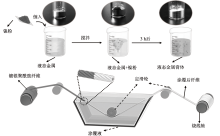
Method Nickel powder doping modification was used to prepare the liquid metal composite (LMC) paste with low surface tension and strong adhesion. This paste was then applied to the surface of silver-plated polyamide fibers through a coating process, enabling the continuous fabrication of LMC fibers. The morphology of these fibers was characterized, and their adhesion, mechanical, oxidation resistance, electrical, and electrothermal conversion properties were systematically investigated.

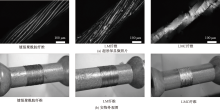
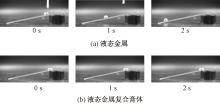
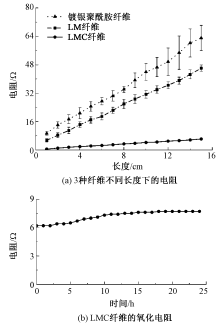
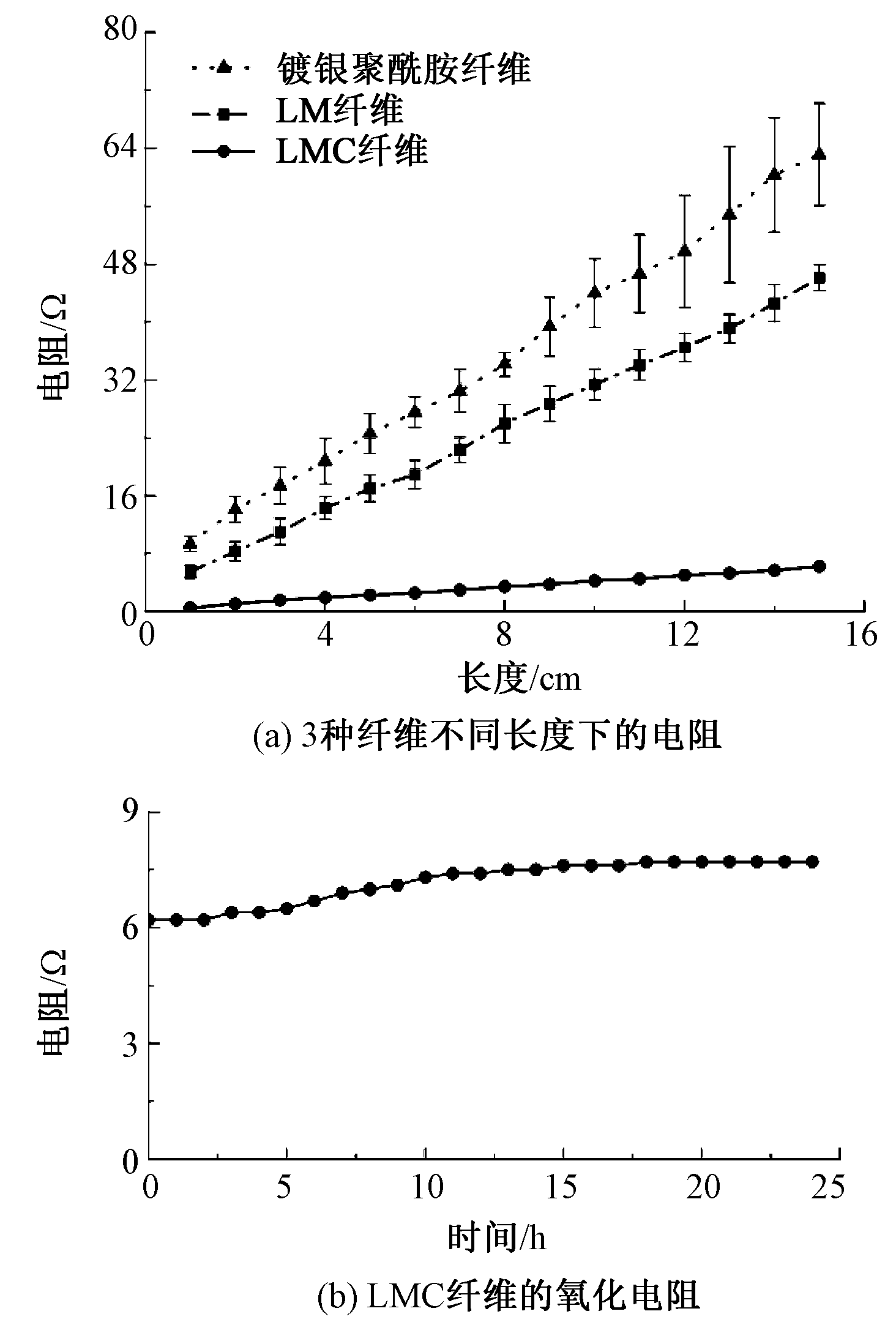
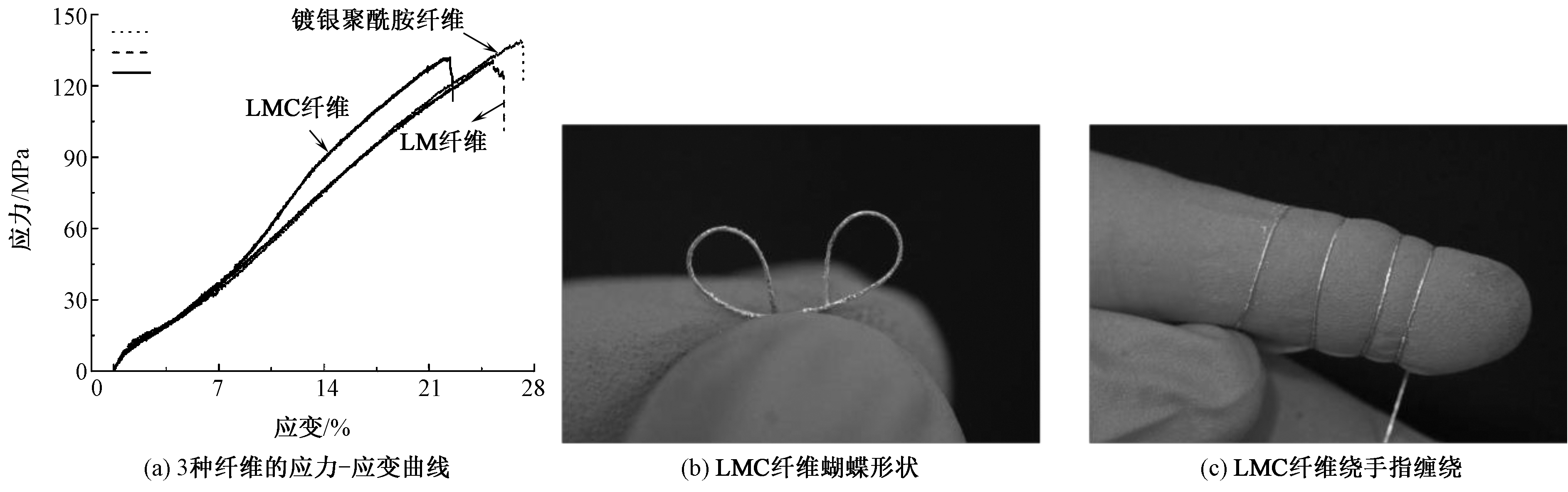
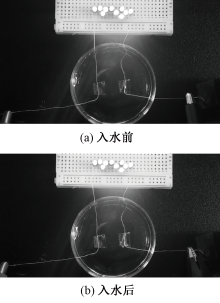
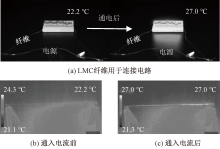
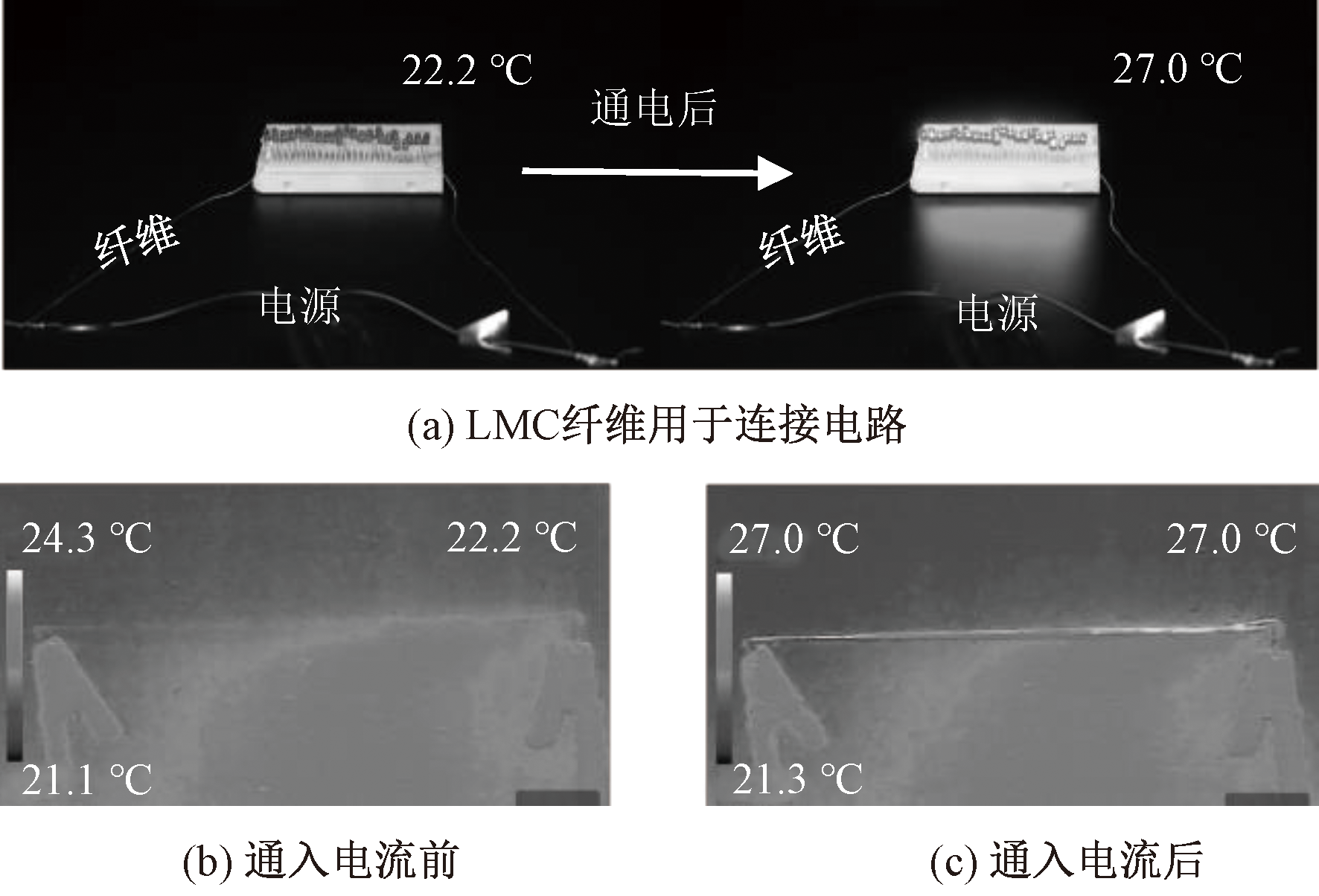
Results The surface morphology of three types of fibers(silver-plated polyamide fibers, liquid metal fibers(LM fibers), and LMC fibers)was examined using a super ultra-depth-of-field microscope. The experimental outcomes demonstrated that under identical coating procedures, the LM fibers had minute liquid metal droplets on their surfaces. In sharp contrast, the surfaces of the LMC fibers were uniformly covered with a compact layer of liquid metal composite paste. As a direct consequence of this coating, the diameter of the LMC fibers experienced a subtle augmentation, rising from an initial 223 μm to 248 μm. This study also investigated the effect of incorporating nickel powder into the liquid metal on its adhesion properties. When liquid metal and liquid metal composite paste were dropped onto the surface of an inclined glass plate, the liquid metal droplets slid off, while the liquid metal composite paste remained firmly in place. This suggests that the liquid metal modified with nickel powder has significantly improved adhesion properties. After coating the silver-plated polyamide fibers with the liquid metal composite paste, their electrical conductivity was greatly enhanced, achieving a conductivity of 4.8 × 10⁵ S/m,an impressive 728% increase compared to the uncoated silver-plated polyamide fibers. Moreover, the LMC fibers demonstrated excellent stability across various environments. When immersed in water for 1 h, or bent at different angles, the increase in resistance was only 1.9% and 0%, respectively, indicating that the LMC fibers possess strong environmental adaptability and stability. Stress-strain analysis of the three types of fibers revealed that the LMC fibers showed a slight reduction in tensile extensibility, but their overall performance remained comparable to that of the silver-plated polyamide fibers. These findings demonstrate that the coating of silver-plated polyamide fibers with liquid metal composite paste significantly improves their electrical conductivity and stability, while having minimal impact on their mechanical properties. Additionally, in three cycles of heating and cooling tests at a low voltage of 1.62 V, the fibers heated from 22.2 ℃ to 27.0 ℃ in just 15 s, further highlighting their excellent thermal responsiveness.

Conclusion This study successfully achieved the dynamic renewal of the surface oxide layer of liquid metal through nickel doping technology, resulting in a liquid metal composite paste with enhanced electrical conductivity and strong adhesion. By applying this paste to the surface of silver-plated polyamide fibers, LMC fibers with outstanding electrical conductivity and good flexibility were produced. The electrical conductivity of the LMC fibers reached 4.8×10⁵ S/m, with only 285 g of paste required to produce 10 km of fiber. Stress-strain tests demonstrated that coating the fiber surface with the liquid metal composite paste did not significantly compromise the mechanical properties of the fibers, ensuring their structural stability and reliability for practical applications. Additionally, the LMC fibers exhibited excellent stability in both bent states and underwater environments. Leveraging their electrothermal properties, these fibers can also be utilized as a solution for thermal management. In conclusion, the LMC fibers hold significant promise for applications in the field of smart clothing.

Key words: smart clothing, conductive fiber, liquid metal, composite paste, continuous preparation

中图分类号: 

  • TB 333

图1

LMC纤维的制备流程"

图2

3种纤维的超景深显微照片及实物外观"

表1

纤维规格参数"

试样名称 长度/km 质量/kg
镀银聚酰胺纤维 10 0.285
LMC纤维 10 0.570

图3

液态金属和液态金属复合膏体滴落在玻璃板上的运动状态"

图4

纤维的电学性能"

图5

3种纤维的应力-应变曲线和LMC纤维的造型图"

图6

LMC纤维的弯曲性能图"

图7

LMC纤维入水前后的导电性能"

图8

LMC纤维的电加热图"

[1] 罗梦颖, 陈慧君, 夏明, 等. 弹性导电复合纤维的制备及其应变与温度传感性能[J]. 纺织学报, 2024, 45(10): 9-15.
doi: 10.13475/j.fzxb.20230706201
LUO Mengying, CHEN Huijun, XIA Ming, et al. Preparation of elastic conductive composite fibers and their strain and temperature sensing properties[J]. Journal of Textile Research, 2024, 45(10): 9-15.
doi: 10.13475/j.fzxb.20230706201
[2] 吴帆, 梁凤玉, 肖奕葶, 等. 聚(3,4-乙撑二氧噻吩):聚苯乙烯磺酸基复合导电纤维的制备及其性能[J]. 纺织学报, 2024, 45(8): 99-106.
WU Fan, LIANG Fengyu, XIAO Yiyao, et al. Preparation and properties of poly(3,4-ethylpropodoxythiophene): polystyrene sulfonic acid-based composite conductive fiber[J]. Journal of Textile Research, 2024, 45(8): 99-106.
[3] 贺芃鑫, 蒲海红, 宋柏青, 等. 聚氨酯/导电炭黑复合纤维的制备及其柔性电热性能[J]. 纺织高校基础科学学报, 2022, 35(1):74-80.
HE Pengxin, PU Haihong, SONG Baiqing, et al. Preparation of polyurethane/conductive carbon black composite fiber and its flexible electrothermal proper-ties[J]. Journal of Basic Science of Textile Universities, 2022, 35(1):74-80.
[4] MA L, NIE Y, LIU Y, et al. Preparation of core/shell electrically conductive fibers by efficient coating carbonnanotubes on polyester[J]. Advanced Fiber Materials, 2021, 3(3): 180-191.
[5] 方剑, 任松, 张传雄, 等. 智能可穿戴纺织品用电活性纤维材料[J]. 纺织学报, 2021, 42(9): 1-9.
FANG Jian, REN Song, ZHANG Chuanxiong, et al. Electroactive fiber materials for smart wearable textiles[J]. Journal of Textile Research, 2021, 42(9): 1-9.
[6] CHATTERJEE K, TABOR J, GHOSH T K. Electrically conductive coatings for fiber-based e-textiles[J]. Fibers, 2019. DOI: 10.3390/fib706051.
[7] CHOI B, LEE J, HAN H, et al. Highly conductive fiber with waterproof and self-cleaning properties for textile electronics[J]. ACS Applied Materials & Interfaces, 2018, 10(42): 36094-36101.
[8] LAN L, JIANG C, YAO Y, et al. A stretchable and conductive fiber for multifunctional sensing and energy harvesting[J]. Nano Energy, 2021.DOI:10.1016/j.nanoen.2021.105954.
[9] ZHANG Y, HE Y, NIU L, et al. Enhanced sensing performance of superelastic thermally drawn liquid metal fibers through helical architecture while eliminating directional signal errors[J]. Journal of Materials Science & Technology, 2024, 195: 136-145.
[10] WANG H, LI R, CAO Y, et al. Liquid metal fibers[J]. Advanced Fiber Materials, 2022, 4(5): 987-1004.
[11] LAI Y C, LU H W, WU H M, et al. Elastic multifunctional liquid-metal fibers for harvesting mechanical and electromagnetic energy and as self-powered sensors[J]. Advanced Energy Materials, 2021.DOI:10.1002/aenm.20.2100411.
[12] 杨金平, 孙润军, 程雪, 等. 碳纳米管/热塑性聚氨酯弹性导电复合纤维的制备及性能[J]. 纺织高校基础科学学报, 2024, 37(5): 20-27.
YANG Jinping, SUN Runjun, CHENG Xue, et al. Preparation and properties of carbon nanotube/thermoplastic polyurethane elastic conductive composite fibers[J]. Journal of Basic Science of Textile Universities, 2024, 37(5): 20-27.
[13] GUO R, WANG H, CHEN G, et al. Smart semiliquid metal fibers with designed mechanical properties for room temperature stimulus response and liquid welding[J]. Applied Materials Today, 2020. DOI:10.1016/j.apnt.2020.100738.
[14] LI H, QU R, MA Z, et al. Permeable and patternable super-stretchable liquid metal fiber for constructing high-integration-density multifunctional electronic fibers[J]. Advanced Functional Materials, 2024. DOI:10.1002/adfm.2308120.
[15] CHANG H, GUO R, SUN Z, et al. Direct writing and repairable paper flexible electronics using nickel-liquid metal ink[J]. Advanced Materials Interfaces, 2018.DOI:10.1002/adfm.1800571.
[16] CHEN W, TANG Q, ZHONG W, et al. Directly printable and adhesive liquid metal ink for wearable devices[J]. Advanced Functional Materials, 2025.DOI:10.1002/adfm.2411647.
[1] 张泽祺, 周涛, 周文琪, 范中尧, 杨佳蕾, 陈国印, 潘绍武, 朱美芳. 生理电信号监测用导电纤维及其研究进展[J]. 纺织学报, 2025, 46(05): 70-76.
[2] 王军, 殷晓玉, 周晓琪, 王思远. 智能矫姿服装设计[J]. 纺织学报, 2025, 46(04): 179-186.
[3] 严艺, 朱达辉. 老年智能服装研究现状与发展趋势[J]. 纺织学报, 2025, 46(04): 244-254.
[4] 刘锦锋, 杜康存, 肖畅, 付少海, 张丽平. 多孔MXene/热塑性聚氨酯纤维的制备及其应力应变传感性能[J]. 纺织学报, 2025, 46(03): 41-48.
[5] 侯煜杰, 刘欢欢, 王朝晖. 智能坐姿矫正服装研究现状与发展趋势[J]. 纺织学报, 2024, 45(08): 250-258.
[6] 吴帆, 梁凤玉, 肖奕葶, 杨智博, 王文婷, 樊威. 聚(3,4-乙撑二氧噻吩):聚苯乙烯磺酸基复合导电纤维的制备及其性能[J]. 纺织学报, 2024, 45(08): 99-106.
[7] 王建萍, 朱妍西, 沈津竹, 张帆, 姚晓凤, 于卓灵. 软体机器人在服装领域的应用进展[J]. 纺织学报, 2024, 45(05): 239-247.
[8] 王馨雨, 田明伟. 具有距离监测与辅助提示功能的自闭症儿童智能服装设计[J]. 纺织学报, 2024, 45(03): 156-162.
[9] 王中昱, 苏云, 王云仪. 机器学习建立的个体热舒适模型及其在服装领域的应用展望[J]. 纺织学报, 2023, 44(05): 228-236.
[10] 赵智伟, 王子希, 杨世玉, 胡毅. 基于锦纶滤膜喷墨印花制备镓-铟合金液态金属电路[J]. 纺织学报, 2022, 43(12): 102-108.
[11] 王晨露, 马金星, 杨雅晴, 韩潇, 洪剑寒, 占海华, 杨施倩, 姚绍芳, 刘姜乔娜. 聚苯胺涂层经编织物的应变传感性能及其在呼吸监测中的应用[J]. 纺织学报, 2022, 43(08): 113-118.
[12] 薛超, 朱浩, 杨晓川, 任煜, 刘婉婉. 聚氨酯基碳纳米管-液态金属导电纤维的制备及其性能[J]. 纺织学报, 2022, 43(07): 29-35.
[13] 黄锐, 肖爱民. 基于温湿度传感器的特护失禁内裤的研发[J]. 纺织学报, 2022, 43(07): 141-148.
[14] 林文君, 缪旭红. 光导纤维在发光织物上的应用研究进展[J]. 纺织学报, 2021, 42(07): 169-174.
[15] 李一飞, 郑敏, 常朱宁子, 李丽艳, 曹元鸣, 翟旺宜. 二维过渡金属碳化物(Ti3C2Tx)对棉针织物的功能整理及其性能分析[J]. 纺织学报, 2021, 42(06): 120-127.
Viewed
Full text


Abstract

Cited

  Shared   
  Discussed   
No Suggested Reading articles found!