纺织学报 ›› 2025, Vol. 46 ›› Issue (05): 70-76.doi: 10.13475/j.fzxb.20241204502
张泽祺1,2, 周涛1,2, 周文琪1,2, 范中尧1,2, 杨佳蕾1,2, 陈国印1,2( ), 潘绍武1,2, 朱美芳1,2
ZHANG Zeqi1,2, ZHOU Tao1,2, ZHOU Wenqi1,2, FAN Zhongyao1,2, YANG Jialei1,2, CHEN Guoyin1,2(), PAN Shaowu1,2, ZHU Meifang1,2
摘要:
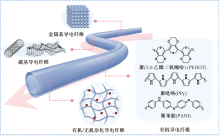
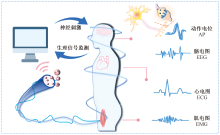
导电纤维具有轻量化、高比表面积、结构可设计性及导电性优异等优点,可用于生理电信号的监测,从而在生物医用领域获得了广泛关注。为此,基于材料科学和制备技术的发展革新,概述了无机导电纤维、有机导电纤维和有机/无机杂化导电纤维在成形方法及理化性质方面的研究进展,总结了体表穿戴、体内服役等场景下导电纤维对心电、脑电、肌电等生理电信号的监测能力及其适用性。并展望了该领域所面临的挑战以及未来发展方向,为高精度信号采集用导电纤维的结构、功能设计及其在医疗领域应用等方面提供一定的参考。
中图分类号:
| [1] | CHENG L, LI J, GUO A Y, et al. Recent advances in flexible noninvasive electrodes for surface electromyography acquisition[J]. Flexible Electronics, 2023. DOI: 10.1038/s41528-023-00273-0. |
| [2] | SHI J D, FANG Y. Flexible and implantable microelectrodes for chronically stable neural inter-faces[J]. Advanced Materials, 2019. DOI: 10.1002/adma.201804895. |
| [3] | WON C H, JEONG U J, LEE S H, et al. Mechanically tissue-like and highly conductive au nanoparticles embedded elastomeric fiber electrodes of brain-machine interfaces for chronic in vivo brain neural record-ing[J]. Advanced Functional Materials, 2022. DOI: 10.1002/adfm.202205145. |
| [4] |
LIN S, JIANG J J, HUANG K, et al. Advanced electrode technologies for noninvasive brain-computer interfaces[J]. ACS Nano, 2023, 17(24): 24487-24513.
doi: 10.1021/acsnano.3c06781 pmid: 38064282 |
| [5] | GAO Q, AGARWAL S, GREINER A, et al. Electrospun fiber-based flexible electronics: fiber fabrication, device platform, functionality integration and applications[J]. Progress in Materials Science, 2023. DOI: 10.1016/j.pmatsci.2023.101139. |
| [6] | ZHU M J, WANG H M, LI S, et al. Flexible electrodes for in vivo and in vitro electrophysiological signal recording[J]. Advanced Healthcare Materials, 2021. DOI: 10.1002/adhm.202100646. |
| [7] | JONATHAN R, WANG H L, FENNO L, et al. Next-generation probes, particles, and proteins for neural interfacing[J]. Science Advances, 2017. DOI: 10.1126/sciadv.1601649. |
| [8] | KIM Y T, MARIOI R O. Material considerations for peripheral nerve interfacing[J]. MRS Bulletin, 2012, 37(6): 573-580. |
| [9] | CHEN X M, FENG Y H, ZHANG P, et al. Hydrogel fiber-based biointerfacing[J]. Advanced Materials, 2024. DOI:10.1002/adma.202413476. |
| [10] | CAO P L, WANG Y, YANG J, et al. Scalable layered heterogeneous hydrogel fibers with strain-induced crystallization for tough, resilient, and highly conductive soft bioelectronics[J]. Advanced Materials, 2024. DOI: 10.1002/adma.202409632. |
| [11] |
WEI L Q, WANG S S, SHAN M Q, et al. Conductive fibers for biomedical applications[J]. Bioactive Materials, 2023, 22: 343-364.
doi: 10.1016/j.bioactmat.2022.10.014 pmid: 36311045 |
| [12] | WU P Q, GU J F, LIU X, et al. A robust core-shell nanofabric with personal protection, health monitoring and physical comfort for smart sportswear[J]. Advanced Materials, 2024. DOI: 10.1002/adma.202411131. |
| [13] | WU H, CHAI S S, ZHU L F, et al. Wearable fiber-based visual strain sensors with high sensitivity and excellent cyclic stability for health monitoring and thermal management[J]. Nano Energy, 2024. DOI: 10.1016/j.nanoen.2024.110300. |
| [14] | ZHU Z G, SONG W H, BURUGAPALLI K, et al. Nano-yarn carbon nanotube fiber based enzymatic glucose biosensor[J]. Nanotechnology, 2010. DOI: 10.1088/0957-4484/21/16/165501. |
| [15] | DUYGU K, TAKANO H, SHIM E, et al. Transparent and flexible low noise graphene electrodes for simultaneous electrophysiology and neuroimaging[J]. Nature Communications, 2014. DOI: 10.1038/ncomms6259. |
| [16] | OH J M, VENTERS C C, CHAO D, et al. U1 snRNP regulates cancer cell migration and invasion in vitro[J]. Nature Communications, 2020. DOI: 10.1038/s41467-019-13993-7. |
| [17] | WANG K, FREWIN C L, ESRAFILZADEH D, et al. High-performance graphene-fiber-based neural recording microelectrodes[J]. Advanced Materials, 2019. DOI: 10.1002/adma.201805867. |
| [18] |
FLAVIA V, SUMMERSON S, AAZHANG B, et al. Neural stimulation and recording with bidirectional, soft carbon nanotube fiber microelectrodes[J]. ACS Nano, 2015, 9(4): 4465-4474.
doi: 10.1021/acsnano.5b01060 pmid: 25803728 |
| [19] |
LU L L, FU X F, LIEW Y J, et al. Soft and mRI compatible neural electrodes from carbon nanotube fibers[J]. Nano Letters, 2019, 19(3): 1577-1586.
doi: 10.1021/acs.nanolett.8b04456 pmid: 30798604 |
| [20] | QIAN G, YU Y Y, KANG L X, et al. Modulus-tailorable, stretchable, and biocompatible carbonene fiber for adaptive neural electrode[J]. Advanced Functional Materials, 2022. DOI: 10.1002/adfm.202107360. |
| [21] | LU B Y, YUK H, LIN S T, et al. Pure PEDOT:PSS hydrogels[J]. Nature Communications, 2019. DOI: 10.1038/s41467-019-09003-5. |
| [22] | XU T C, JI W L, WANG X F, et al. Support-free PEDOT:PSS fibers as multifunctional microelectrodes for in vivo neural recording and modulation[J]. Angewandte Chemie International Edition, 2022. DOI: 10.1002/anie.202115074. |
| [23] | XU T C. Well-modulated interfacial ion transport enables D-sorbitol/PEDOT:PSS fibers to sense brain electrophysiological signals in vivo[J]. Chemical Communications, 2024, 60(63): 8244-8247. |
| [24] | ZHAO W Q, SHAO F, SUN F Q, et al. Neuron-inspired sticky artificial spider silk for signal transmission[J]. Advanced Materials, 2023. DOI: 10.1002/adma.202300876. |
| [25] | BAO Q L, ZHANG H, YANG J X, et al. Graphene-polymer nanofiber membrane for ultrafast photonics[J]. Advanced Functional Materials, 2010, 20(5): 782-791. |
| [26] | LÜ T, YAO Y, LI N, et al. Wearable fiber-shaped energy conversion and storage devices based on aligned carbon nanotubes[J]. Nano Today, 2016, 11(5): 644-660. |
| [27] | MANTHIRIYAPPAN S, HYO Y N, AHN K H, et al. Conductive nanocomposites based on polystyrene microspheres and silver nanowires by latex blending[J]. ACS Applied Materials & Interfaces, 2015, 7(1): 756-764. |
| [28] | LU C, PARK S J, RICHNER T, et al. Flexible and stretchable nanowire-coated fibers for optoelectronic probing of spinal cord circuits[J]. Science Advances, 2017. DOI: 10.1126/sciadv.1600955. |
| [29] | WON C H, JEONG U J, LEE S H, et al. Mechanically tissue-like and highly conductive AU nanoparticles embedded elastomeric fiber electrodes of brain-machine interfaces for chronic in vivo brain neural recording[J]. Advanced Functional Materials, 2022. DOI: 10.1002/adfm.202205145. |
| [30] | TANG C Q, XIE S L, WANG M Y, et al. A fiber-shaped neural probe with alterable elastic moduli for direct implantation and stable electronic-brain inter-faces[J]. Journal of Materials Chemistry B, 2020, 8(20): 4387-4394. |
| [31] | HUANG S Z, LIU X Y, LIN S T, et al. Control of polymers' amorphous-crystalline transition enables miniaturization and multifunctional integration for hydrogel bioelectronics[J]. Nature Communications, 2024. DOI: 10.1038/s41467-024-47988-w. |
| [32] | DAWIT H, ZHAO Y W, WANG J, et al. Advances in conductive hydrogels for neural recording and stimul-ation[J]. Biomaterials Science, 2024, 12(11): 2786-2800. |
| [33] | GAO K P, YANG H J, WANG X L, et al. Soft pin-shaped dry electrode with bristles for EEG signal measurements[J]. Sensors and Actuators A: Physical, 2018, 283: 348-361. |
| [34] | CHANG B Y, LUO J B, LIU J, et al. A high-performance composite fiber with an organohydrogel sheath for electrocardiogram monitoring[J]. Journal of Materials Chemistry C, 2024, 12(32): 12413-12421. |
| [35] | CHANG B Y, LUO J B, XIA J, et al. Conductive elastic composite electrode and its application in electrocardiogram monitoring clothing[J]. ACS Applied Electronic Materials, 2023, 5(4): 2026-2036. |
| [36] | DRISCOLL N, ANTONINI M J, CANNON T M, et al. Multifunctional neural probes enable bidirectional electrical, optical, and chemical recording and stimulation in vivo[J]. Advanced Materials, 2024. DOI: 10.1002/adma.202408154. |
| [37] | CHEN J W, FANG Y, FENG J Y, et al. Fast-response fiber organic electrochemical transistor with vertical channel design for electrophysiological monitoring[J]. Journal of Materterials Chemistry B, 2024, 12(37): 9206-9212. |
| [38] | HU S F, SONG J Y, TIAN Q, et al. Mechanically and conductively robust eutectogel fiber produced by continuous wet spinning enables epidermal and implantable electrophysiological monitoring[J]. Advanced Fiber Materials, 2024, 6(6): 1980-1991. |
| [39] | WANG L C, XI Y, XU Q D, et al. Multifunctional IrOx neural probe for in situ dynamic brain hypoxia evalu-ation[J]. ACS Nano, 2023, 17(22): 22277-22286. |
| [40] | TANG C Q, HAN Z Q, LIU Z W, et al. A soft-fiber bioelectronic device with axon-like architecture enables reliable neural recording in vivo under vigorous activi-ties[J]. Advanced Materials, 2024. DOI: 10.1002/adma.202407874. |
| [1] | 朱梦慧, 葛美彤, 董智佳, 丛洪莲, 马丕波. 纬编双面羊毛/涤纶交织物的结构与热湿性能评价[J]. 纺织学报, 2025, 46(05): 179-185. |
| [2] | 李润, 常梓洋, 张如范. 碳纳米管功能纤维的可控制备与性能调控研究进展[J]. 纺织学报, 2025, 46(05): 30-40. |
| [3] | 陈枭, 赵继忠, 董凯. 基于接触起电效应的新型机电转化纤维性能提升策略[J]. 纺织学报, 2025, 46(05): 41-48. |
| [4] | 符芬, 王钰涵, 丁凯, 赵帆, 李超靖, 王璐, 曾泳春, 王富军. 纤维素基止血材料的研究进展[J]. 纺织学报, 2025, 46(04): 226-234. |
| [5] | 郭洁琰, 徐颖雯, 丁放, 任学宏. 卤胺抗菌剂及其改性纤维的应用研究进展[J]. 纺织学报, 2025, 46(04): 255-263. |
| [6] | 王菁, 董智佳, 郑飞, 黄守东, 彭会涛, 吴光军, 马丕波. 横编全成形鞋体的结构设计与工艺实现[J]. 纺织学报, 2025, 46(04): 89-95. |
| [7] | 刘锦锋, 杜康存, 肖畅, 付少海, 张丽平. 多孔MXene/热塑性聚氨酯纤维的制备及其应力应变传感性能[J]. 纺织学报, 2025, 46(03): 41-48. |
| [8] | 詹克静, 杨鑫, 张应龙, 张昕, 潘志娟. 自凝聚丝素蛋白微纳米纤维膜的制备及其力学增强[J]. 纺织学报, 2025, 46(02): 10-19. |
| [9] | 刘微, 田振川, 沈朝阳, 梅润. 金属-有机框架应用于纤维/织物功能化改性的研究进展[J]. 纺织学报, 2024, 45(12): 215-224. |
| [10] | 欧宗权, 于金超, 潘志娟. 光致变色聚乳酸/聚3-羟基丁酸酯共混纤维的纺制及其结构与性能[J]. 纺织学报, 2024, 45(12): 9-17. |
| [11] | 郭琦, 吴宁, 孟影, 安达, 黄建龙, 陈利. 变厚度头锥体织物的工艺设计与验证[J]. 纺织学报, 2024, 45(12): 98-108. |
| [12] | 姚思宏, 董智佳, 蒋高明, 王二南. 零裁耗经编成形翻领T恤结构设计与建模[J]. 纺织学报, 2024, 45(11): 178-184. |
| [13] | 陈钰珊, 蒋高明, 李炳贤. 基于双扎口的纬编管状无缝织物三维仿真[J]. 纺织学报, 2024, 45(10): 95-102. |
| [14] | 吴帆, 梁凤玉, 肖奕葶, 杨智博, 王文婷, 樊威. 聚(3,4-乙撑二氧噻吩):聚苯乙烯磺酸基复合导电纤维的制备及其性能[J]. 纺织学报, 2024, 45(08): 99-106. |
| [15] | 王遵钦, 刘东炎, 王晓旭, 张典堂. 机织角联锁变密度复合材料的面外压缩力学特性[J]. 纺织学报, 2024, 45(07): 63-71. |
|
||
 京公网安备11010502044800号