纺织学报 ›› 2025, Vol. 46 ›› Issue (10): 237-246.doi: 10.13475/j.fzxb.20250301402
刘琳1, 夏菲菲2, 徐晓禹3, 赵柳涛4, 叶翔宇5, 俞森龙6, 邵钰7, 吴跃7, 张兴宏8, 朱斐超1,8( )
)
LIU Lin1, XIA Feifei2, XU Xiaoyu3, ZHAO Liutao4, YE Xiangyu5, YU Senlong6, SHAO Yu7, WU Yue7, ZHANG Xinghong8, ZHU Feichao1,8()
摘要:
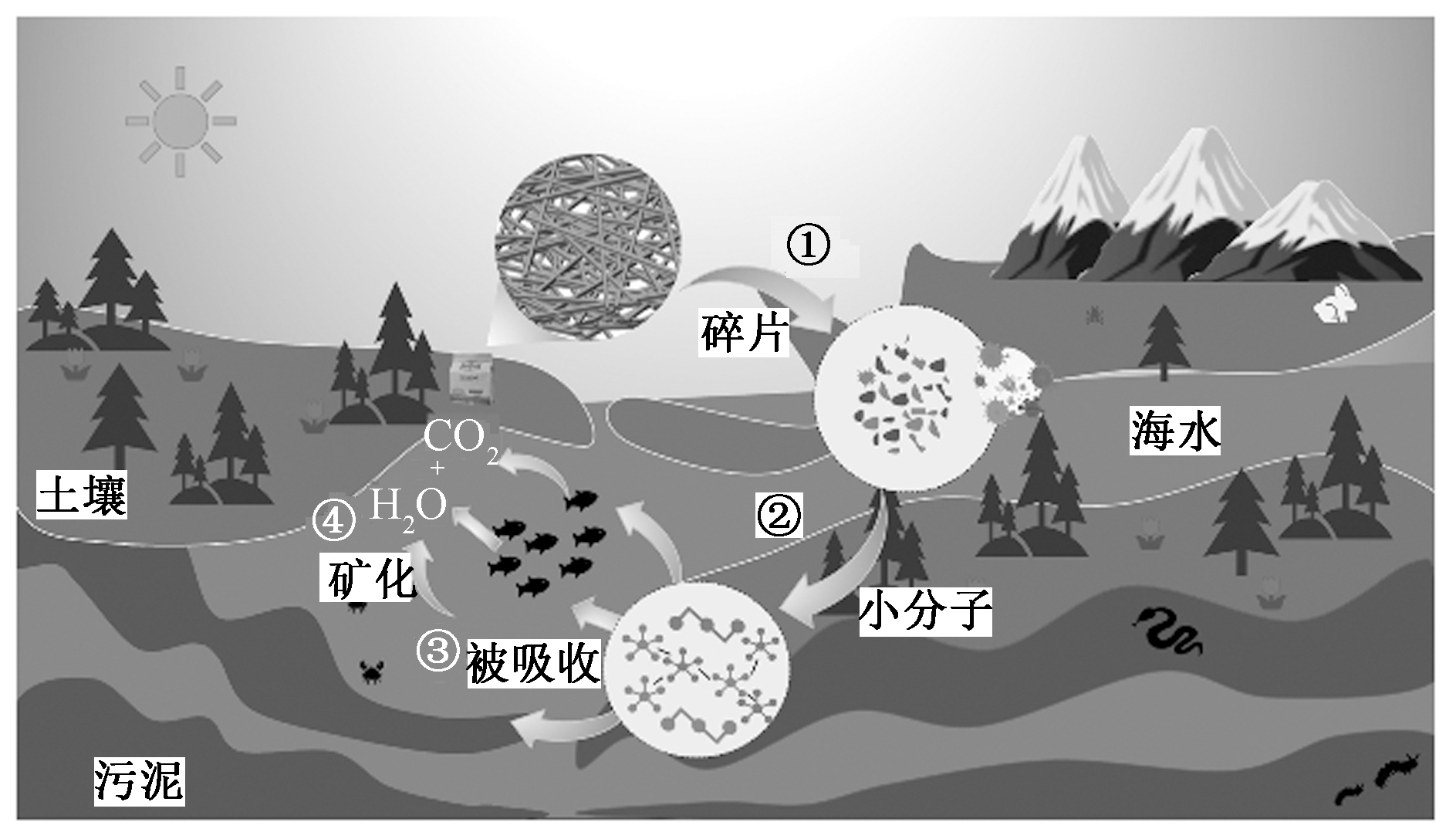
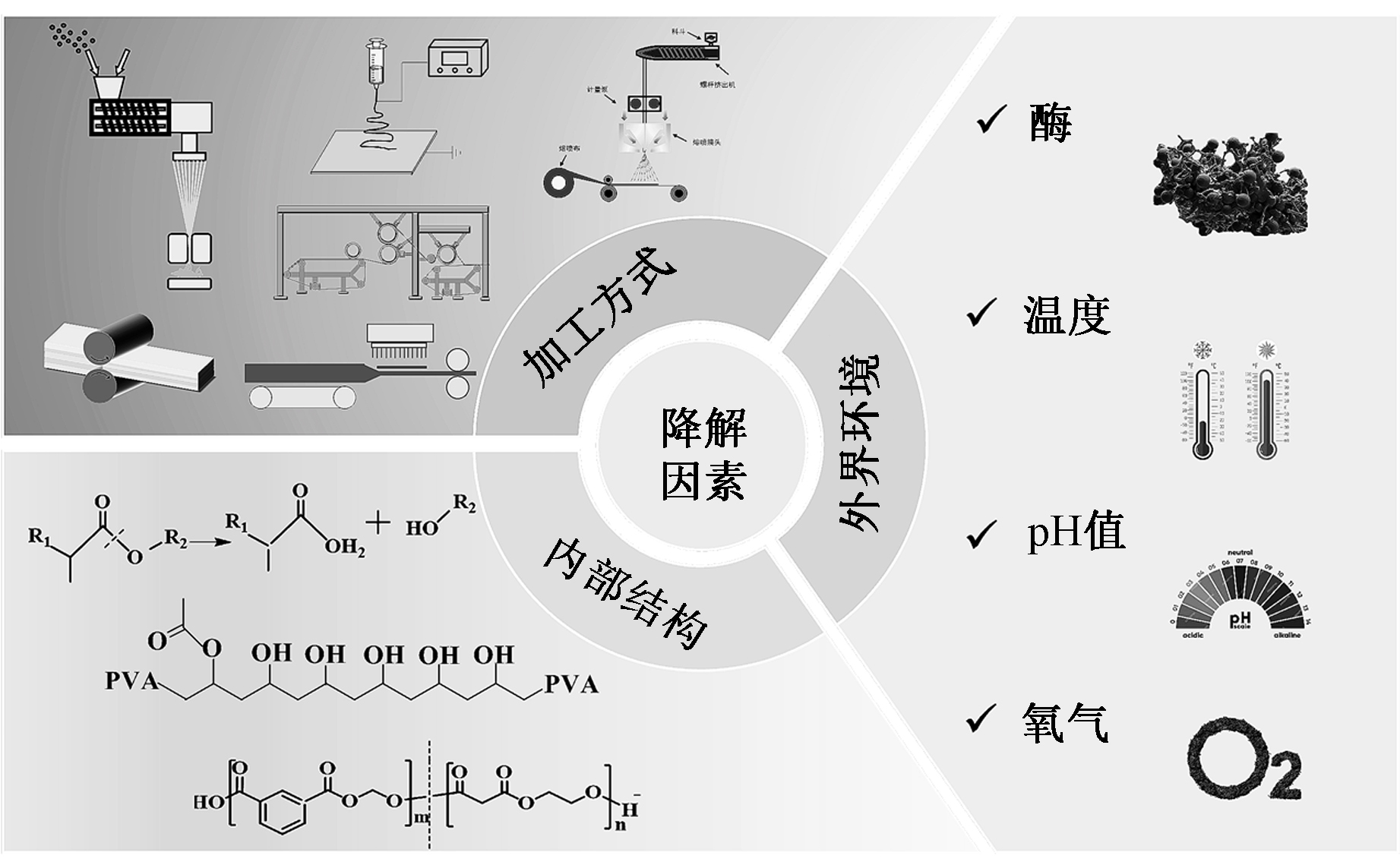
生物降解聚合物非织造材料因其良好的生物相容性与可降解性,成为绿色低碳纺织材料的重要发展方向。然而,其降解行为受多种因素影响,评价体系尚不统一。为此,聚焦聚乳酸(PLA)、聚乙烯醇(PVA)、聚羟基脂肪酸酯(PHA)、聚己内酯(PCL)、聚对苯二甲酸-己二酸丁二醇酯(PBAT)、聚对苯二甲酸-共-丁二酸丁二醇酯(PBST)等材料,综述其通过纺黏、熔喷、针刺、水刺等工艺制备的非织造材料在土壤、堆肥、海水、污泥等环境中的生物降解机制及降解性能,包括主链断裂、侧基氧化等路径,以及脂肪酶、蛋白酶、角质酶等关键酶的作用。总结了影响材料降解速率的内部因素(分子结构、结晶度、分子量、侧基类型等)及外部因素(温/湿度、pH值、氧气、微生物群落和加工方式等)。旨在系统梳理生物降解非织造材料的降解性能与机制,分析影响因素及国内外标准现状,为其规范化应用与标准体系构建提供理论支持。
中图分类号:
| [1] |
ZAABA N F, JAAFAR M. A review on degradation mechanisms of polylactic acid: hydrolytic, photodegradative, microbial, and enzymatic degrada-tion[J]. Polymer Engineering & Science, 2020, 60(9): 2061-2075.
doi: 10.1002/pen.v60.9 |
| [2] |
MOSHOOD T D, NAWANIR G, MAHMUD F, et al. Sustainability of biodegradable plastics: new problem or solution to solve the global plastic pollution?[J]. Current Research in Green and Sustainable Chemistry, 2022, 5: 100273.
doi: 10.1016/j.crgsc.2022.100273 |
| [3] |
LYU L, BAGCHI M, NG K T W, et al. The degradation of polylactic acid face mask components in different environments[J]. Journal of Environmental Management, 2024, 370: 122731.
doi: 10.1016/j.jenvman.2024.122731 |
| [4] | 金琰, 蔡凡凡, 王立功, 等. 生物可降解塑料在不同环境条件下的降解研究进展[J]. 生物工程学报, 2022, 38(5): 1784-1808. |
| JIN Yan, CAI Fanfan, WANG Ligong, et al. Research progress on the degradation of biodegradable plastics under different environmental conditions[J]. Chinese Journal of Bioengineering, 2022, 38 (5): 1784-1808. | |
| [5] |
JIA H, ZHANG M, WENG Y, et al. Degradation of poly (butylene adipate-co-terephthalate) by Stenotrophomonas sp. YCJ1 isolated from farmland soil[J]. Journal of Environmental Sciences, 2021, 103: 50-58.
doi: 10.1016/j.jes.2020.10.001 |
| [6] |
LIM B K H, SAN Thian E. Biodegradation of polymers in managing plastic waste: a review[J]. Science of the Total Environment, 2022, 813: 151880.
doi: 10.1016/j.scitotenv.2021.151880 |
| [7] |
GHOSH S K, PAL S, RAY S. Study of microbes having potentiality for biodegradation of plastics[J]. Environmental Science and Pollution Research, 2013, 20: 4339-4355.
doi: 10.1007/s11356-013-1706-x |
| [8] |
HAIDER T P, VÖLKER C, KRAMM J, et al. Plastics of the future? the impact of biodegradable polymers on the environment and on society[J]. Angewandte Chemie International Edition, 2019, 58(1): 50-62.
doi: 10.1002/anie.v58.1 |
| [9] |
SATTI S M, SHAH A A. Polyester-based biodegradable plastics: an approach towards sustainable development[J]. Letters in Applied Microbiology, 2020, 70(6): 413-430.
doi: 10.1111/lam.13287 pmid: 32086820 |
| [10] |
SU A, SHIRKE A, BAIK J, et al. Immobilized cutinases: preparation, solvent tolerance and thermal stability[J]. Enzyme and Microbial Technology, 2018, 116: 33-40.
doi: S0141-0229(18)30181-9 pmid: 29887014 |
| [11] |
MARASOVIC P, KOPITAR D, BRUNŠEK R, et al. Performance and degradation of nonwoven mulches made of matural fibres and PLA polymer: open field study[J]. Polymers, 2023, 15(22): 4447.
doi: 10.3390/polym15224447 |
| [12] | BRUNSEK R, JUGOV N, MARASOVIC P, et al. Biodegradation properties of natural fibers for agro textile nonwovens production[C]// IOP Conference Series: Materials Science and Engineering. Bristol: IOP Publishing Ltd, 2023, 1266: 012017. |
| [13] | 赵燕芳, 钟美玲, 唐奥奇, 等. 基于PVA物理交联构建具有分级结构的一体化支架[J]. 高分子通报, 2024, 37(3): 385-394. |
|
ZHAO Yanfang, ZHONG Meiling, TANG Aoqi, et al. Construction of an integrated scaffold with a hierarchical structure based on PVA physical crosslinking[J]. Polymer Bulletin, 2024, 37 (3): 385-394.
doi: 10.1007/BF00318072 |
|
| [14] |
LIU Y, DENG Y, CHEN P, et al. Biodegradation analysis of polyvinyl alcohol during the compost burial course[J]. Journal of Basic Microbiology, 2019, 59(4): 368-374.
doi: 10.1002/jobm.201800468 pmid: 30693540 |
| [15] |
OLKHOV A A, MASTALYGINA E E, OVCHINNIKOV V A, et al. Biological and oxidative degradation of ultrathin-fibrous nonwovens based on poly (lactic acid)/poly (3-hydroxybutyrate) blends[J]. International Journal of Molecular Sciences, 2023, 24(9): 7979.
doi: 10.3390/ijms24097979 |
| [16] |
MA J, CAO Y, FAN L, et al. Degradation characteristics of polybutylene adipate terephthalic acid (PBAT) and its effect on soil physicochemical properties: a comparative study with several polyethy-lene (PE) mulch films[J]. Journal of Hazardous Materials, 2023, 456: 131661.
doi: 10.1016/j.jhazmat.2023.131661 |
| [17] |
PLOHL O, ERJAVEC A, ZEMLJIČ L F, et al. Morphological, surface and thermal properties of polylactic acid foils, melamine-etherified resin, and polyethylene terephthalate fabric during (bio) degradation in soil[J]. Journal of Cleaner Production, 2023, 421: 138554.
doi: 10.1016/j.jclepro.2023.138554 |
| [18] | SHI J, ZHANG L, XIAO P, et al. Biodegradable PLA nonwoven fabric with controllable wettability for efficient water purification and photocatalysis degradation[J]. ACS Sustainable Chemistry & Engineering, 2018, 6(2): 2445-2452. |
| [19] | 詹志城. 模拟自然环境下聚乳酸非织造布加速生物降解行为研究[D]. 广州: 华南理工大学, 2015: 16-35. |
| ZHAN Zhicheng. Research on accelerated biodegradation behavior of polylactic acid nonwovens in simulated natural environment[D]. Guangzhou: South China University of Technology, 2015: 16-35. | |
| [20] |
HABLOT E, DHARMALINGAM S, HAYES D G, et al. Effect of simulated weathering on physicochemical properties and inherent biodegradation of PLA/PHA nonwoven mulches[J]. Journal of Polymers and the Environment, 2014, 22: 417-429.
doi: 10.1007/s10924-014-0697-0 |
| [21] |
LIU Y, ZHAN Z, YE H, et al. Accelerated biodegradation of PLA/PHB-blended nonwovens by a microbial community[J]. RSC Advances, 2019, 9(18): 10386-10394.
doi: 10.1039/C8RA10591J |
| [22] |
PUCHALSKI M, SIWEK P, PANAYOTOV N, et al. Influence of various climatic conditions on the structural changes of semicrystalline PLA spun-bonded mulching nonwovens during outdoor composting[J]. Polymers, 2019, 11(3): 559.
doi: 10.3390/polym11030559 |
| [23] |
TOKIWA Y, KAWABATA G, JARERAT A. A modified method for isolating poly (vinyl alcohol)-degrading bacteria and study of their degradation pat-terns[J]. Biotechnology letters, 2001, 23: 1937-1941.
doi: 10.1023/A:1013785817554 |
| [24] |
KIM B C, SOHN C K, LIM S K, et al. Degradation of polyvinyl alcohol by Sphingomonas sp. SA3 and its symbiote[J]. Journal of Industrial Microbiology and Biotechnology, 2003, 30(1): 70-74.
doi: 10.1007/s10295-002-0010-4 |
| [25] |
宋静雯, 程慧鹏, 朱亚楠, 等. 防护用PVA复合材料的制备及性能研究[J]. 化工新型材料, 2024, 52(1): 189-193.
doi: 10.19817/j.cnki.issn1006-3536.2024.01.043 |
|
SONG Jingwen, CHENG Huipeng, ZHU Yanan, et al. Preparation and properties of PVA composites for protection[J]. New Chemical Materials, 2024, 52(1): 189-193.
doi: 10.19817/j.cnki.issn1006-3536.2024.01.043 |
|
| [26] |
VACLAVKOVA T, RUZICKA J, JULINOVA M, et al. Novel aspects of symbiotic (polyvinyl alcohol) biodegradation[J]. Applied Microbiology and Biotechnology, 2007, 76: 911-917.
pmid: 17594087 |
| [27] | 张欣, 刘畅, 陈惠, 等. 降解聚乙烯醇的尖孢镰刀菌鉴定与性能研究[J]. 江西农业学报, 2024, 36(10): 47-53. |
| ZHANG Xin, LIU Chang, CHEN Hui, et al. Identification and properties of Fusarium oxysporum for polyvinyl alcohol degradation[J]. Chinese Journal of Jiangxi Agriculture, 2024, 36 (10): 47-53. | |
| [28] |
SÓJKA-LEDAKOWICZ J, ŁATWIŃSKA M, KUDZIN M, et al. A study on obtaining nonwovens using polyhydroxyalkanoates and the melt-blown technique[J]. E-Polymers, 2014, 14(5): 373-380.
doi: 10.1515/epoly-2014-0089 |
| [29] |
OLKHOV A A, MASTALYGINA E E, OVCHINNIKOV V A, et al. Thermo-oxidative destruction and biodegradation of nanomaterials from composites of poly(3-hydroxybutyrate) and chitosan[J]. Polymers, 2021, 13(20): 3528.
doi: 10.3390/polym13203528 |
| [30] | IRIZAR A, AMORIM M J B, FULLER K P, et al. Environmental fate and effect of biodegradable electro-spun scaffolds (biomaterial): a case study[J]. Journal of Materials Science(Materials in Medicine), 2018, 29: 1-10. |
| [31] |
OZTEMUR J, OZDEMIR S, TEZCAN-UNLU H, et al. Investigation of biodegradability and cellular activity of PCL/PLA and PCL/PLLA electrospun webs for tissue engineering applications[J]. Biopolymers, 2023, 114(11): e23564.
doi: 10.1002/bip.v114.11 |
| [32] | HEIMOWSKA A, MORAWSKA M, BOCHO-JANISZEWSKA A. Biodegradation of poly (ε-caprolactone) in natural water environments[J]. Polish Journal of Chemical Technology, 2017, 19(1): 120-126. |
| [33] | 王格侠, 黄丹, 张维, 等. 典型生物降解聚酯在海水中的降解性能[J]. 功能高分子学报, 2020, 33(5): 492-499. |
| WANG Gexia, HUANG Dan, ZHANG Wei, et al. Degradation properties of typical biodegradable polyesters in seawater[J]. Journal of Functional Polymers, 2020, 33 (5): 492-499. | |
| [34] |
和玉光, 郝思嘉, 田俊鹏, 等. PBAT含量对PLA基可降解共混切片及复合熔喷非织造布性能的影响[J]. 材料工程, 2024, 52(3): 82-89.
doi: 10.11868/j.issn.1001-4381.2022.001080 |
| HE Yuguang, HAO Sijia, TIAN Junpeng, et al. Effect of PBAT content on the properties of PLA-based degradable blend slices and composite meltblown nonwovens[J]. Materials Engineering, 2024, 52 (3): 82-89. | |
| [35] | 刘庆玉. TPS共混改性生物可降解PBAT及其纺丝成形[D]. 上海: 东华大学, 2022: 13-15. |
| LIU Qingyu. TPS blending modified biodegradable PBAT and its spinning forming[D]. Shanghai: Donghua University, 2022: 13-15. | |
| [36] | 陈咏, 乌婧, 王朝生, 等. 生物可降解聚己二酸-对苯二甲酸丁二醇酯纤维的制备及其环境降解性能[J]. 纺织学报, 2022, 43(2): 37-43. |
| CHEN Yong, WU Jing, WANG Chaosheng, et al. Preparation and environmental degradation properties of biodegradable polyadipate-butylene terephthalate fibers[J]. Journal of Textile Research, 2022, 43 (2): 37-43. | |
| [37] | 鲁伟涛, 靳向煜. PBST纺黏土工排水板滤膜的可降解性能[J]. 东华大学学报(自然科学版), 2014, 40(2): 213-219. |
| LU Weitao, JIN Xiangyu. Degradability of PBST spinning clay drainage plate filter membrane[J]. Journal of Donghua University (Natural Science Edition), 2014, 40 (2): 213-219. | |
| [38] | 李婷婷. 生物可降解聚丁二酸丁二醇—共—对苯二甲酸丁二醇酯 (PBST) 纤维的制备及其性能研究[D]. 上海: 东华大学, 2007: 71-81. |
| LI Tingting. Preparation and properties of biodegradable polybutylene succinate-co-butylene terephthalate(PBST) fibers[D]. Shanghai: Donghua University, 2007: 71-81. | |
| [39] |
PANG W, LI B, WU Y, et al. Optimization of degradation behavior and conditions for the protease K of polylactic acid films by simulation[J]. International Journal of Biological Macromolecules, 2023, 253: 127496.
doi: 10.1016/j.ijbiomac.2023.127496 |
| [40] |
SATTI S M, SHAH A A, AURAS R, et al. Isolation and characterization of bacteria capable of degrading poly(lactic acid) at ambient temperature[J]. Polymer Degradation and Stability, 2017, 144: 392-400.
doi: 10.1016/j.polymdegradstab.2017.08.023 |
| [41] |
SOLARO R, CORTI A, CHIELLINI E. Biodegradation of poly (vinyl alcohol) with different molecular weights and degree of hydrolysis[J]. Polymers for Advanced Technologies, 2000, 11(8-12): 873-878.
doi: 10.1002/(ISSN)1099-1581 |
| [42] | 戴国雄. 高性能海洋防污材料: 主链降解-侧基水解高分子的研究[D]. 广州: 华南理工大学, 2021: 25-38. |
| DAI Guoxiong. Study on high performance marine antifouling material: backbone degradation-side group hydrolysis polymer[D]. Guangzhou: South China University of Technology, 2021: 25-38. | |
| [43] |
储星宇, 方芳, 徐润泽, 等. 聚羟基脂肪酸酯在不同条件下的生物降解研究进展[J]. 中国塑料, 2025, 39(4): 84-91.
doi: 10.19491/j.issn.1001-9278.2025.04.015 |
|
CHU Xingyu, FANG Fang, XU Runze, et al. Progress of biodegradation of polyhydroxy fatty acid esters under different conditions[J]. China Plastics, 2025, 39(4): 84-91.
doi: 10.19491/j.issn.1001-9278.2025.04.015 |
|
| [44] |
MEEREBOER K W, MISRA M, MOHANTY A K. Review of recent advances in the biodegradability of polyhydroxyalkanoate(PHA) bioplastics and their composites[J]. Green Chemistry, 2020, 22(17): 5519-5558.
doi: 10.1039/D0GC01647K |
| [45] |
LAYCOCK B, NIKOLIĆ M, COLWELL J M, et al. Lifetime prediction of biodegradable polymers[J]. Progress in Polymer Science, 2017, 71: 144-189.
doi: 10.1016/j.progpolymsci.2017.02.004 |
| [46] |
TOKIWA Y, CALABIA B P, UGWU C U, et al. Biodegradability of plastics[J]. International Journal of Molecular Sciences, 2009, 10(9): 3722-3742.
doi: 10.3390/ijms10093722 pmid: 19865515 |
| [47] |
FERNANDES M, SALVADOR A F, VICENTE A A. Biodegradation of PHB/PBAT films and isolation of novel PBAT biodegraders from soil microbiomes[J]. Chemosphere, 2024, 362: 142696.
doi: 10.1016/j.chemosphere.2024.142696 |
| [48] |
DÍAZ A, KATSARAVA R, PUIGGALÍ J. Synthesis, properties and applications of biodegradable polymers derived from diols and dicarboxylic acids: from polyesters to poly (ester amide)s[J]. International Journal of Molecular Sciences, 2014, 15(5): 7064-7123.
doi: 10.3390/ijms15057064 |
| [49] | 林晓珊. 聚乳酸(PLA)非织造材料加速降解微生物作用体系的初步建立[D]. 广州: 华南理工大学, 2020: 70-78. |
| LIN Xiaoshan. Preliminary establishment of microbial action system for accelerated degradation of polylactic acid (PLA) nonwovens[D]. Guangzhou: South China University of Technology, 2020: 70-78. | |
| [50] | 张惠琴, 吴改红, 刘霞, 等. 生物可降解聚乳酸防护口罩的开发及性能评估[J]. 纺织学报, 2025, 46(3): 116-122. |
| ZHANG Huiqin, WU Gaihong, LIU Xia, et al. Development and performance evaluation of biodegradable polylactic acid protective masks[J]. Chinese Journal of Textiles, 2025, 46 (3): 116-122. | |
| [51] |
LOTTO N T, CALIL M R, GUEDES C G F, et al. The effect of temperature on the biodegradation test[J]. Materials Science and Engineering: C, 2004, 24(5): 659-662.
doi: 10.1016/j.msec.2004.08.009 |
| [52] |
GIL-CASTELL O, ANDRES-PUCHE R, DOMINGUEZ E, et al. Influence of substrate and temperature on the biodegradation of polyester-based materials: polylactide and poly (3-hydroxybutyrate-co-3-hydroxyhexanoate) as model cases[J]. Polymer Degradation and Stability, 2020, 180: 109288.
doi: 10.1016/j.polymdegradstab.2020.109288 |
| [53] |
ŁATWIŃSKA M, SÓJKA-LEDAKOWICZ J, KUDZIN M. Influence of poly (3-hydroxybutyrate) addition on the properties of poly (lactic acid) nonwoven obtained by the melt-blown technique[J]. Polimery, 2015, 60(7/8): 486-491.
doi: 10.14314/polimery |
| [54] |
GUICHERD M, BEN KHALED M, GUÉROULT M, et al. An engineered enzyme embedded into PLA to make self-biodegradable plastic[J]. Nature, 2024, 631: 884-890.
doi: 10.1038/s41586-024-07709-1 |
| [1] | 王浩鹏, 张佳文, 牛云蔚, 柯勤飞, 赵奕. 芳香抗菌双包络结构芳樟醇/聚酰胺/玉米醇溶蛋白微纳米非织造材料[J]. 纺织学报, 2025, 46(09): 94-103. |
| [2] | 侯颖慧, 刘肖燕, 柳东辰, 郝矿荣, 邹婷. 基于体外降解的输尿管支架管的多目标优化[J]. 纺织学报, 2025, 46(09): 154-162. |
| [3] | 张新宇, 金小培, 朱金唐, 崔华帅, 吴鹏飞, 崔宁, 史贤宁. 聚乳酸熔喷非织造布热尺寸稳定性提升方法[J]. 纺织学报, 2025, 46(08): 127-135. |
| [4] | 陈展毓, 俞森龙, 周家良, 朱丽萍, 周哲, 相恒学, 朱美芳. 有机膦酸改性聚乳酸织物的制备及其性能[J]. 纺织学报, 2025, 46(08): 154-163. |
| [5] | 谭文萍, 张硕, 张倩, 张寅, 刘润政, 黄晓卫, 明津法. 聚乳酸纤维气凝胶制备及其辐射制冷性能[J]. 纺织学报, 2025, 46(06): 63-72. |
| [6] | 时晓聪, 陈莉, 杜迅. 茜素-聚乳酸/胶原蛋白纳米纤维膜的制备及其氨气检测性能[J]. 纺织学报, 2025, 46(05): 143-150. |
| [7] | 张惠琴, 吴改红, 刘霞, 刘淑强, 赵恒, 刘涛. 生物可降解聚乳酸防护口罩的开发及性能评估[J]. 纺织学报, 2025, 46(03): 116-122. |
| [8] | 乔思杰, 邢桐贺, 童爱心, 史芷丞, 潘恒, 刘可帅, 余豪, 陈凤翔. 不同聚乳酸材料的性能对比[J]. 纺织学报, 2025, 46(03): 27-33. |
| [9] | 赵珂, 张恒, 程文胜, 甄琪, 步青云, 崔景强. 类蒲叶结构聚乳酸熔喷非织造材料的制备及其性能[J]. 纺织学报, 2025, 46(02): 51-60. |
| [10] | 王容容, 周洲, 冯祥, 申莹, 刘峰, 邢剑. 聚酯纤维与聚乙烯/聚丙烯双组分纤维多孔吸声材料的制备及其性能[J]. 纺织学报, 2025, 46(02): 61-68. |
| [11] | 左红梅, 高敏, 阮芳涛, 邹梨花, 徐珍珍. MXene-氧化石墨烯改性碳纤维/聚乳酸复合材料制备及其力学性能[J]. 纺织学报, 2025, 46(01): 9-15. |
| [12] | 夏梦, 成悦, 刘蓉, 李大伟, 付译鋆. 普鲁士蓝涂层非织造材料在细菌检测中的应用[J]. 纺织学报, 2024, 45(12): 166-171. |
| [13] | 刘霞, 吴改红, 闫子豪, 王彩柳. 智能相变调温聚乳酸纤维膜的制备及其性能[J]. 纺织学报, 2024, 45(12): 18-24. |
| [14] | 欧宗权, 于金超, 潘志娟. 光致变色聚乳酸/聚3-羟基丁酸酯共混纤维的纺制及其结构与性能[J]. 纺织学报, 2024, 45(12): 9-17. |
| [15] | 闫迪, 王雪芳, 谭文萍, 高国金, 明津法, 宁新. 富咪唑型多孔左旋聚乳酸纳米纤维膜制备及其双重净水性能[J]. 纺织学报, 2024, 45(08): 116-126. |
|
||
 京公网安备11010502044800号