纺织学报 ›› 2026, Vol. 47 ›› Issue (04): 71-79.doi: 10.13475/j.fzxb.20250804401
李守振1,2, 查田田3, 周伟涛3, 斯阳4( )
)
LI Shouzhen1,2, ZHA Tiantian3, ZHOU Weitao3, SI Yang4()
摘要:
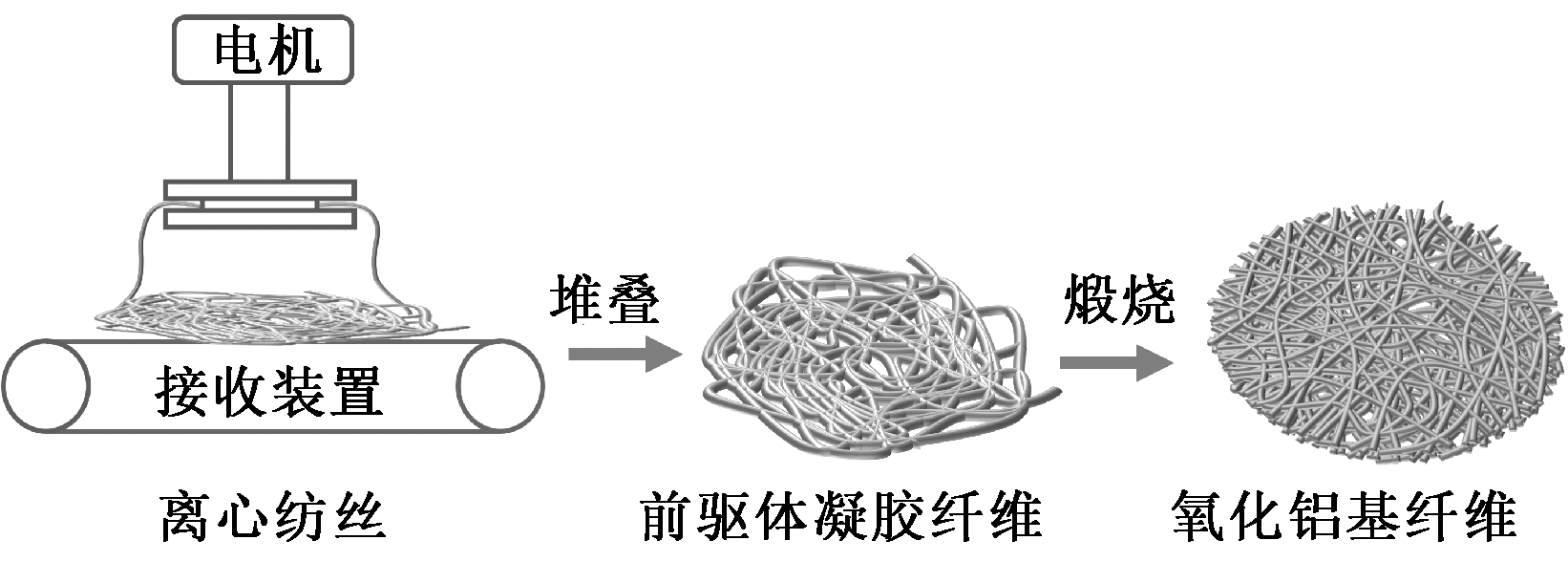
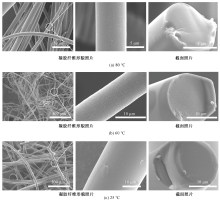
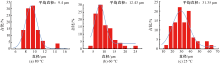
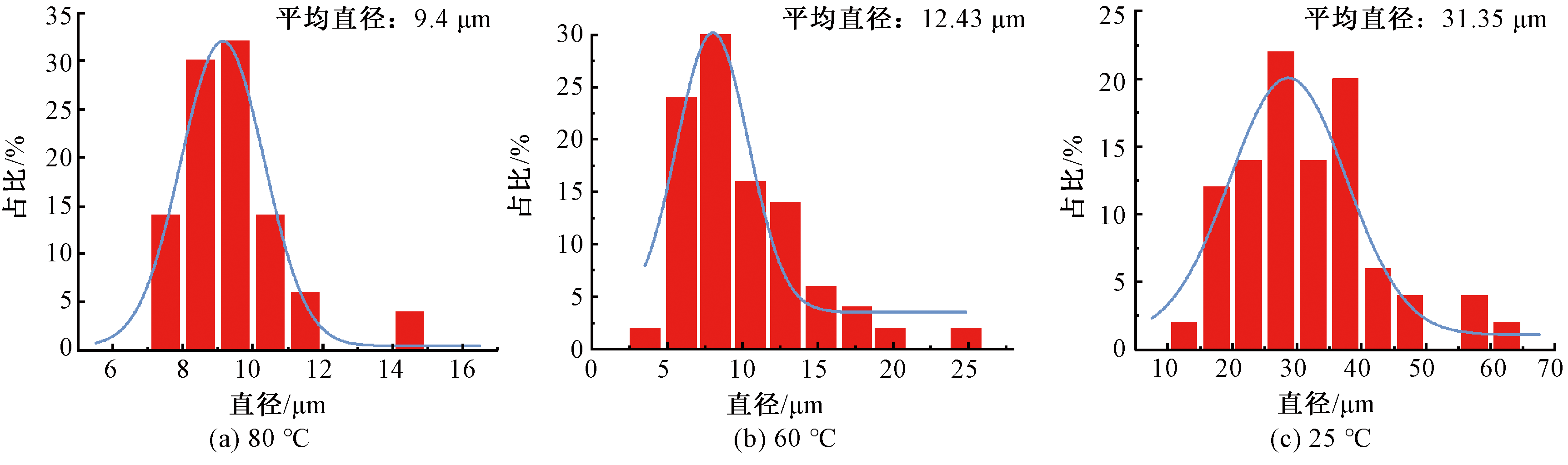
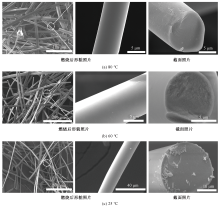
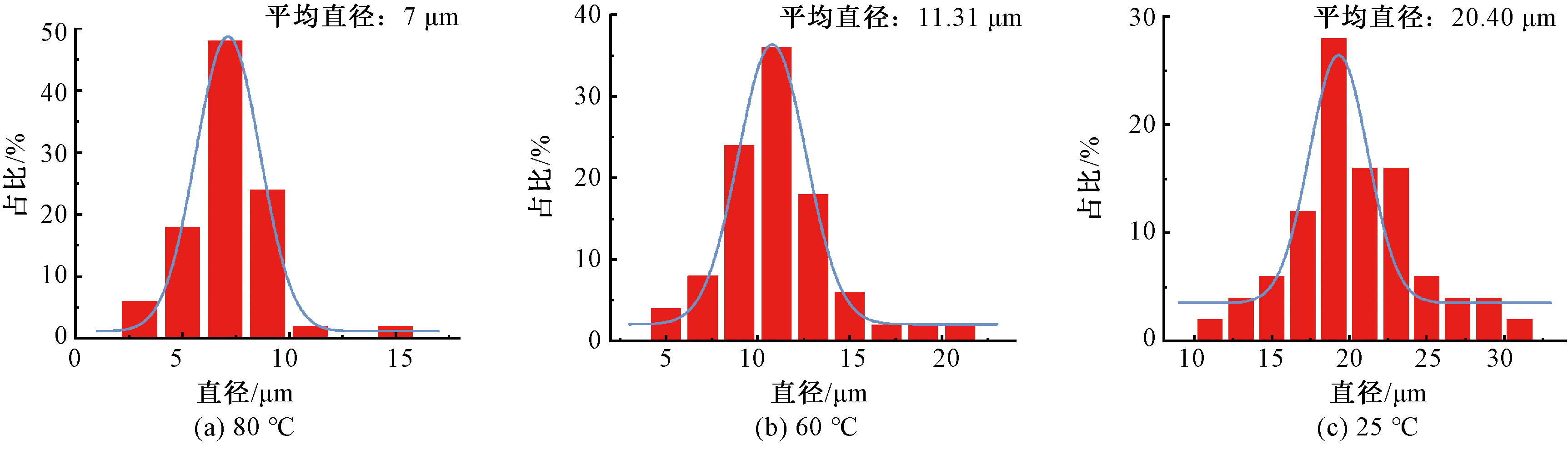
为实现氧化铝基陶瓷纤维的制备,首先通过调控氧化铝前驱体溶液的组分,利用聚合物、旋蒸工艺及纺丝液温度调控前驱体纺丝液的流变性能,并通过离心纺丝制备氧化铝前驱体凝胶纤维,研究了氧化铝基陶瓷纤维的制备流程,利用煅烧工艺去除凝胶纤维中有机组分,得到具有细小晶粒尺寸的氧化铝基纤维。最后对纤维形貌和晶体结构进行分析。结果表明:当固含量为25.7%时,纺丝液具有可纺性,随着纺丝液温度的上升,凝胶纤维直径由25 ℃时的31.35 μm减小至80 ℃时的9.4 μm,此外,纺丝液温度影响了纤维的内部结构,当纺丝液温度较低时,在煅烧时纤维出现较多缺陷,内部出现空洞。本研究为新型陶瓷纤维材料的开发提供新途径。
中图分类号:
| [1] |
徐汇, 张培垣, 徐娜娜, 等. 耐高温SiO2/ZrO2纳米纤维膜的力学和隔热性能[J]. 材料研究学报, 2024, 38(5): 365-372.
doi: 10.11901/1005.3093.2023.232 |
|
XU Hui, ZHANG Peiyuan, XU Nana, et al. Mechanical property and thermal insulation performance of SiO2/ZrO2 nanofiber membranes with high thermal stability[J]. Chinese Journal of Materials Research, 2024, 38(5): 365-372.
doi: 10.11901/1005.3093.2023.232 |
|
| [2] |
孙敬伟, 王洪磊, 杨蕊, 等. 热处理环境对Al2O3纤维力学性能及微观结构的影响[J]. 材料工程, 2023, 51(8): 110-119.
doi: 10.11868/j.issn.1001-4381.2023.000146 |
|
SUN Jingwei, WANG Honglei, YANG Rui, et al. Effect of heat treatment environment on mechanical properties and microstructure of alumina fibers[J]. Journal of Materials Engineering, 2023, 51(8): 110-119.
doi: 10.11868/j.issn.1001-4381.2023.000146 |
|
| [3] |
WANG H X, CHENG L D, YU J Y, et al. Biomimetic Bouligand chiral fibers array enables strong and superelastic ceramic aerogels[J]. Nature Communications, 2024, 15: 336.
doi: 10.1038/s41467-023-44657-2 pmid: 38184664 |
| [4] |
LI L, ZHOU Y Q, GAO Y, et al. Large-scale assembly of isotropic nanofiber aerogels based on columnar-equiaxed crystal transition[J]. Nature Communications, 2023, 14: 5410.
doi: 10.1038/s41467-023-41087-y pmid: 37670012 |
| [5] |
罗萌, 向阳, 彭志航, 等. 纤维多孔陶瓷的研究进展[J]. 材料工程, 2022, 50(11): 63-72.
doi: 10.11868/j.issn.1001-4381.2021.000742 |
|
LUO Meng, XIANG Yang, PENG Zhihang, et al. Research progress of fibrous porous ceramic[J]. Journal of Materials Engineering, 2022, 50(11): 63-72.
doi: 10.11868/j.issn.1001-4381.2021.000742 |
|
| [6] | 高晨光, 孙晓亮, 陈君, 等. 基于湿法纺丝技术的SiBCN-rGO陶瓷纤维的组织结构、力学和吸波性能[J]. 无机材料学报, 2025, 40(3): 290-296. |
|
GAO Chenguang, SUN Xiaoliang, CHEN Jun, et al. SiBCN-rGO ceramic fibers based on wet spinning technology: microstructure, mechanical and microwave-absorbing properties[J]. Journal of Inorganic Materials, 2025, 40(3): 290-296.
doi: 10.15541/jim20240391 |
|
| [7] |
LI L, JIA C, LIU Y, et al. Nanograin-glass dual-phasic, elasto-flexible, fatigue-tolerant, and heat-insulating ceramic sponges at large scales[J]. Materials Today, 2022, 54: 72-82.
doi: 10.1016/j.mattod.2022.02.007 |
| [8] |
YUAN L, LIU Z L, TIAN C, et al. Synthesis and characterization of mullite-ZrO2 porous fibrous ceramic for highly efficient oil-water separation[J]. Ceramics International, 2021, 47(16): 22709-22716.
doi: 10.1016/j.ceramint.2021.04.286 |
| [9] |
LI X L, QIU R X, SUN Y X, et al. Study on the preparation and properties of zirconium ceramic fiber toughened composite lightweight alkali-activated slag-based high performance thermal insulation material[J]. Construction and Building Materials, 2025, 484: 141875.
doi: 10.1016/j.conbuildmat.2025.141875 |
| [10] |
DAI J, WU F, LIU H L, et al. Achieving robust α-alumina nanofibers by ligand confinement coupled with local disorder tuning[J]. ACS Nano, 2024, 18(52): 35418-35428.
doi: 10.1021/acsnano.4c12568 pmid: 39688462 |
| [11] | 崔婧妍, 魏英, 尹洪峰, 等. 静电纺丝法制备微纳含硼SiC纤维及其电磁波吸收性能[J]. 复合材料学报, 2026, 43(1): 268-280. |
| CUI Jingyan, WEI Ying, YIN Hongfeng, et al. Fabrication of micro-nano boron-containing SiC fibers by electrospinning and its electromagnetic wave absorption properties[J]. Acta Materiae Compositae Sinica, 2026, 43(1): 268-280. | |
| [12] | XU L, RAN P, ZHOU W Q, et al. All-inorganic metafabric scintillators for conformally flexible and wearable X-ray detection and imaging[J]. Science Advances, 2025, 11(26): eadv5537. |
| [13] |
LIU H L, HUO X D, ZHAO P L, et al. Confined gelation synthesis of flexible barium aluminate nanofibers as a high-performance refractory material[J]. ACS Nano, 2024, 18(42): 29273-29281.
doi: 10.1021/acsnano.4c11854 pmid: 39377726 |
| [14] | 贾玉娜, 曹旭, 焦秀玲, 等. 无机酸铝体系氧化铝连续纤维的制备技术研究[J]. 无机材料学报, 2023, 38(11): 1257-1264. |
|
JIA Yuna, CAO Xu, JIAO Xiuling, et al. Preparation of alumina ceramic continuous fibers with inorganic acidic aluminum sol as precursor[J]. Journal of Inorganic Materials, 2023, 38(11): 1257-1264.
doi: 10.15541/jim20230153 |
|
| [15] |
DAI C H, ZHANG Z H, WANG T C. Preparation and heat-insulating properties of Al2O3-ZrO2(Y2O3) hollow fibers derived from cogon using an orthogonal experimental design[J]. RSC Advances, 2019, 9(20): 11305-11311.
doi: 10.1039/C9RA01176E |
| [16] |
SU L, WANG H J, JIA S H, et al. Highly stretchable, crack-insensitive and compressible ceramic aerogel[J]. ACS Nano, 2021, 15(11): 18354-18362.
doi: 10.1021/acsnano.1c07755 pmid: 34766747 |
| [17] | LI Z W, CUI Z W, ZHAO L H, et al. High-throughput production of kilogram-scale nanofibers by Kármán vortex solution blow spinning[J]. Science Advances, 2022, 8(11): eabn3690. |
| [18] |
陈博文, 王敬晓, 姜佑霖, 等. 基于离心纺丝技术制备稳定的碳化锆纤维[J]. 无机材料学报, 2020, 35(12): 1385-1390.
doi: 10.15541/jim20200031 |
|
CHEN Bowen, WANG Jingxiao, JIANG Youlin, et al. Stable zirconium carbide fibers fabricated by centrifugal spinning technique[J]. Journal of Inorganic Materials, 2020, 35(12): 1385-1390.
doi: 10.15541/jim20200031 |
|
| [19] |
XI C, LIU X Y, WANG T C, et al. Heat-insulating properties of hollow Al2O3-ZrO2(CeO2)fibers fabricated using pampas grass as the template[J]. Ceramics International, 2021, 47(2): 2000-2007.
doi: 10.1016/j.ceramint.2020.09.031 |
| [20] |
GUO P F, SU L, PENG K, et al. Additive manufacturing of resilient SiC nanowire aerogels[J]. ACS Nano, 2022, 16(4): 6625-6633.
doi: 10.1021/acsnano.2c01039 |
| [21] |
LI L, FANG B, REN D S, et al. Thermal-switchable, trifunctional ceramic-hydrogel nanocomposites enable full-lifecycle security in practical battery systems[J]. ACS Nano, 2022, 16(7): 10729-10741.
doi: 10.1021/acsnano.2c02557 |
| [22] | 吴红, 刘呈坤, 毛雪, 等. 柔性ZrO2纳米纤维膜的制备及其应用研究现状[J]. 纺织学报, 2020, 41(7): 167-173. |
|
WU Hong, LIU Chengkun, MAO Xue, et al. Research progress in preparation and application of flexible zirconia nanofibers by electrospinning[J]. Journal of Textile Research, 2020, 41(7): 167-173.
doi: 10.1177/004051757104100213 |
|
| [23] |
SHAO W L, YUE W L, REN L B, et al. Al2O3/SiO2 sponges with a three-dimensional lamellar structure based on solution blow spinning for superior thermal insulation and high temperature filtration[J]. Separation and Purification Technology, 2025, 376: 134088.
doi: 10.1016/j.seppur.2025.134088 |
| [24] |
范红娜, 许西庆, 李鑫, 等. 氧化铝改性硅基陶瓷型芯制备及结晶动力学[J]. 材料工程, 2024, 52(5): 212-217.
doi: 10.11868/j.issn.1001-4381.2022.001057 |
|
FAN Hongna, XU Xiqing, LI Xin, et al. Preparation and crystallization kinetics of silica-based ceramic cores modified by alumina[J]. Journal of Materials Engineering, 2024, 52(5): 212-217.
doi: 10.11868/j.issn.1001-4381.2022.001057 |
|
| [25] | 彭雨晴, 牟世伟, 韩克清, 等. 高性能SiBN(C)陶瓷纤维的热稳定性能及透波性能[J]. 复合材料学报, 2016, 33(2): 358-365. |
| PENG Yuqing, MOU Shiwei, HAN Keqing, et al. Thermal stability and wave permeability of high performance SiBN(C) ceramic fibers[J]. Acta Materiae Compositae Sinica, 2016, 33(2): 358-365. | |
| [26] |
MA D H, LIU B X, JIN X T, et al. Rheologic behaviors and continuously dry spinning of polyacetylacetonatozirconium fibers[J]. Materials Letters, 2020, 258: 126824.
doi: 10.1016/j.matlet.2019.126824 |
| [27] | 陆瑶瑶, 叶俊涛, 阮承祥, 等. 二氧化钛/多孔碳纳米纤维复合材料的制备及其光催化性能[J]. 纺织学报, 2024, 45(4): 67-75. |
|
LU Yaoyao, YE Juntao, RUAN Chengxiang, et al. Preparation and photocatalytic performance of titanium dioxide/porous carbon nanofibers composite material[J]. Journal of Textile Research, 2024, 45(4): 67-75.
doi: 10.1177/004051757504500112 |
|
| [28] |
CALISIR M D, KILIC A. A comparative study on SiO2 nanofiber production via two novel non-electrospinning methods: centrifugal spinning vs solution blowing[J]. Materials Letters, 2020, 258: 126751.
doi: 10.1016/j.matlet.2019.126751 |
| [29] | XIA L, JU J G, XU W, et al. Preparation and characterization of hollow Fe2O3 ultra-fine fibers by centrifugal spinning[J]. Materials & Design, 2016, 96: 439-445. |
| [30] |
HROMÁDKO L, MOTOLA M, ČIČMANCOVÁ V, et al. Facile synthesis of WO3 fibers via centrifugal spinning as an efficient UV- and VIS-light-driven photocatalyst[J]. Ceramics International, 2021, 47(24): 35361-35365.
doi: 10.1016/j.ceramint.2021.09.079 |
| [31] |
GUO J R, FU S B, DENG Y P, et al. Hypocrystalline ceramic aerogels for thermal insulation at extreme conditions[J]. Nature, 2022, 606(7916): 909-916.
doi: 10.1038/s41586-022-04784-0 |
| [32] | XU L, RAN P, ZHOU W Q, et al. All-inorganic metafabric scintillators for conformally flexible and wearable X-ray detection and imaging[J]. Science Advances, 2025, 11(26): eadv5537. |
| [33] |
GAO Y, YU P H, ZHANG J, et al. Compressible piezoelectric ceramic nanofiber aerogels with multifunction[J]. Advanced Fiber Materials, 2025, 7(3): 937-949.
doi: 10.1007/s42765-025-00535-8 |
| [1] | 孔珂欣, 张怡帆, 卢哲, 王哲. 载钴钌原子无机微纳米纤维的制备及其电催化水分解性能[J]. 纺织学报, 2026, 47(02): 26-36. |
| [2] | 齐梦园, 肖国威, 杜金梅, 许长海, 杨红英. 水性聚氨酯/纳米二氧化硅改性玄武岩纤维织物制备及其性能[J]. 纺织学报, 2026, 47(02): 172-180. |
| [3] | 史芷丞, 陈凤翔, 王梦云, 白洁, 李娟, 白濛, 伏广伟, 徐卫林. 面向空天应用的高性能无机纤维及制品发展现状及趋势[J]. 纺织学报, 2025, 46(12): 233-242. |
| [4] | 魏朋, 李志强, 李娇娇, 李俊慧, 刘东, 耿嘉骏. 固相聚合对萘环液晶聚芳酯结构与性能的影响[J]. 纺织学报, 2024, 45(09): 50-55. |
| [5] | 于雯, 邓南平, 唐湘泉, 康卫民, 程博闻. 静电溶吹微纳无机纤维制备技术及其应用进展[J]. 纺织学报, 2024, 45(07): 230-239. |
| [6] | 王瑞丰, 李敏, 田安丽, 王春霞, 付少海. 分散黄6GSL晶型与其分散体热稳定性的关系[J]. 纺织学报, 2021, 42(05): 96-102. |
| [7] | 元伟, 姚勇波, 张玉梅, 王华平. 制备Lyocell纤维用纤维素浆粕的碱性酶处理工艺[J]. 纺织学报, 2020, 41(07): 1-8. |
| [8] | 吴清涛 王北福 姜洪涛 聂立宏. 超声时间对聚偏氟乙烯/SiO2平板膜性能和结构的影响[J]. 纺织学报, 2016, 37(07): 28-33. |
| [9] | 梁列峰;翁杰. 蚕丝纤维作载体的磷酸钙陶瓷纤维的制备[J]. 纺织学报, 2005, 26(4): 14-16. |
|
||
 京公网安备11010502044800号