纺织学报 ›› 2026, Vol. 47 ›› Issue (02): 26-36.doi: 10.13475/j.fzxb.20250907101
孔珂欣1, 张怡帆1, 卢哲1, 王哲1,2( )
)
KONG Kexin1, ZHANG Yifan1, LU Zhe1, WANG Zhe1,2()
摘要:
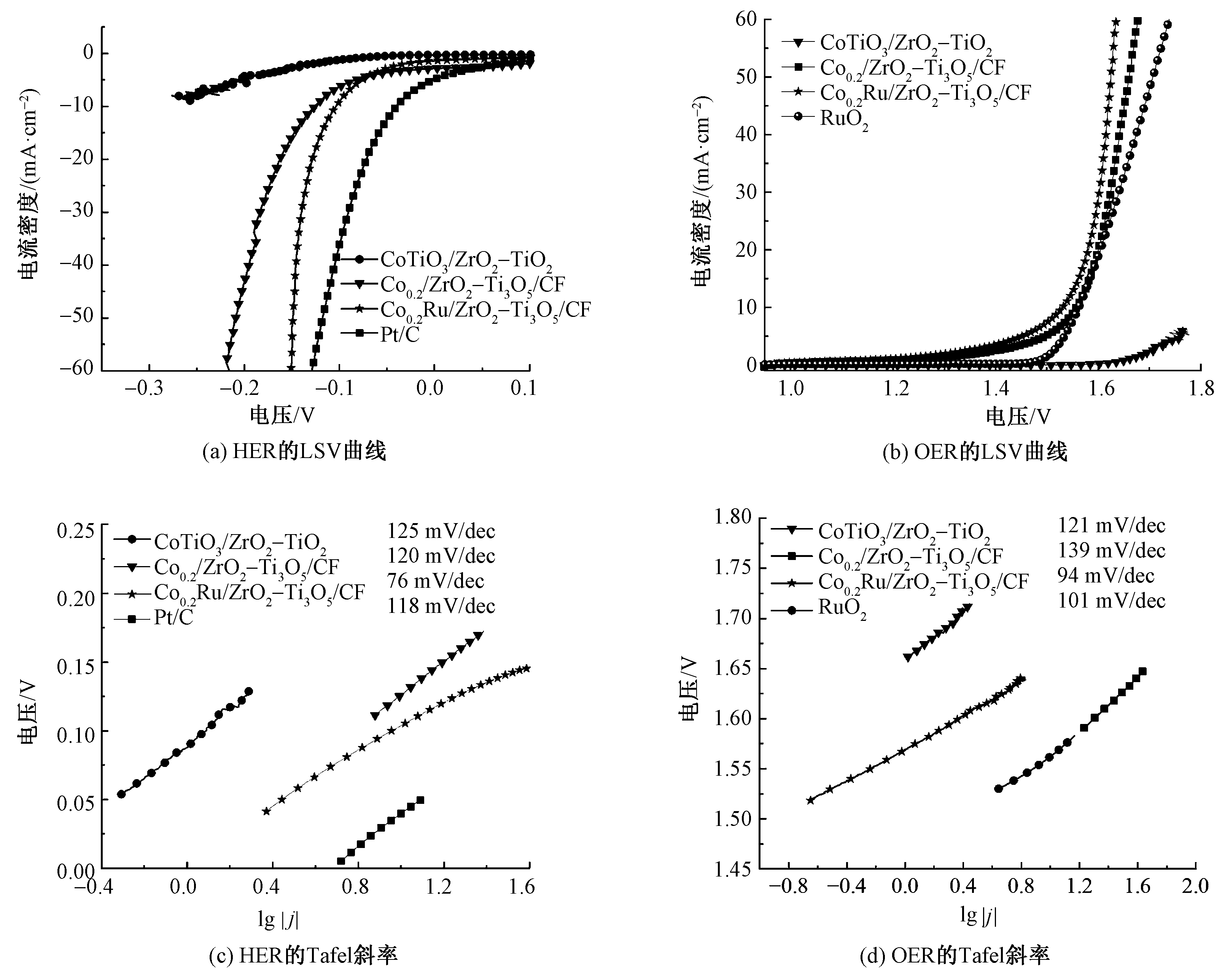
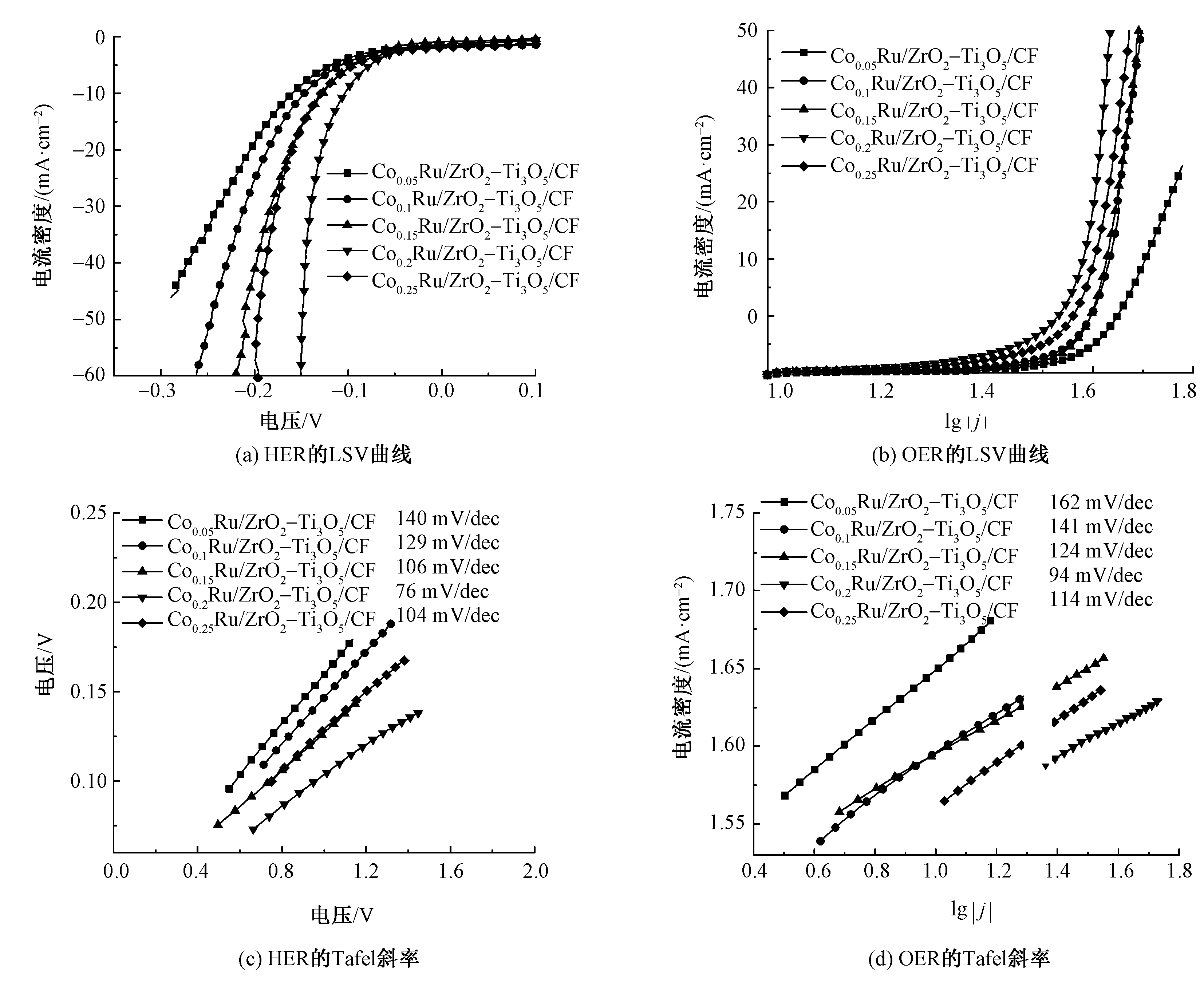
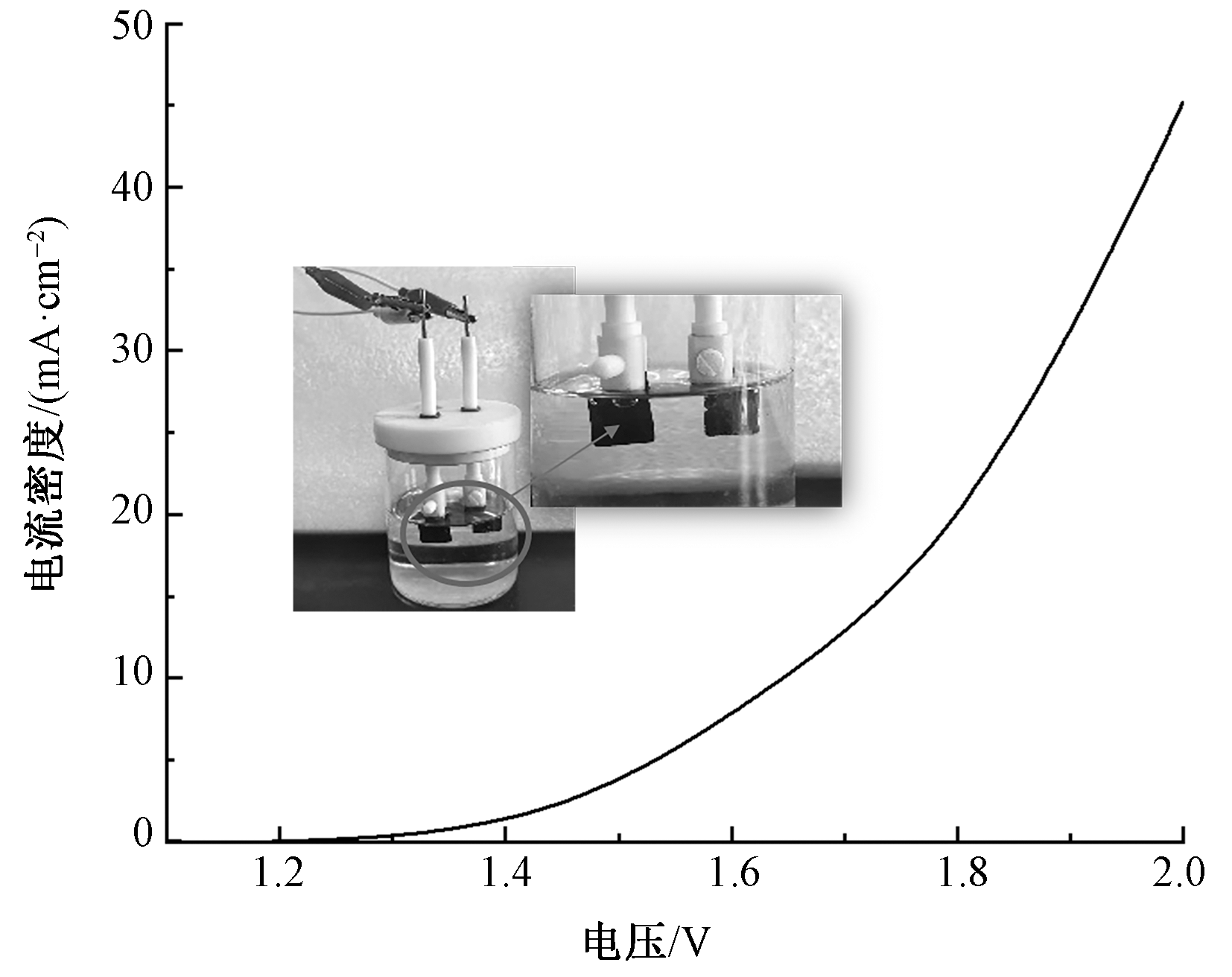
电催化水分解是制备绿氢最有效的策略之一,然而,现有析氢(HER)和析氧(OER)电催化剂存在催化动力学缓慢及耐酸/碱电解液稳定性差等瓶颈。为此,构建了一种具有HER和OER高催化活性和稳定性的柔性无机微纳米纤维膜电极。首先,利用静电纺丝技术及高温煅烧制备出柔性氧化钛钴/氧化锆-二氧化钛(CoTiO3/ZrO2-TiO2)陶瓷纳米纤维膜;然后,通过浸渍吸附和化学气相沉积(CVD),将钴(Co)、钌(Ru)金属原子和碳纳米管层原位锚定在氧化锆-五氧化三钛陶瓷纳米纤维(CoRu/ZrO2-Ti3O5/CF)上;探究了Co、Ru金属载量对柔性纤维膜电极形貌、微纳结构和HER/OER催化性能的影响机制。其中,构建的Co0.2Ru/ZrO2-Ti3O5/CF自支撑纤维膜电极在电流密度为10 mA/cm2时的HER过电位为103 mV,OER电位为1.531 V,优于商用贵金属二氧化钌催化剂。本研究可为柔性HER/OER双功能催化剂的制备提供新思路。
中图分类号:
| [1] |
CASSOL G S, SHANG C, AN A K, et al. Ultra-fast green hydrogen production from municipal wastewater by an integrated forward osmosis-alkaline water electrolysis system[J]. Nature Communications, 2024, 15(1): 2617.
doi: 10.1038/s41467-024-46964-8 pmid: 38521862 |
| [2] |
YOU B, SUN Y J. Innovative strategies for electrocatalytic water splitting[J]. Accounts of Chemical Research, 2018, 51(7): 1571-1580.
doi: 10.1021/acs.accounts.8b00002 pmid: 29537825 |
| [3] | DE KLEIJNE K, HUIJBREGTS M A J, KNOBLOCH F, et al. Worldwide greenhouse gas emissions of green hydrogen production and transport[J]. Nature Energy, 2024: 1563. |
| [4] |
LUO C L, LIU X J, YANG K, et al. Coordination structure engineering of Cu-based electrocatalysts for electrocatalytic water splitting[J]. Coordination Chemistry Reviews, 2024, 516: 215936.
doi: 10.1016/j.ccr.2024.215936 |
| [5] |
LI X, ZHAO L L, YU J Y, et al. Water splitting: from electrode to green energy system[J]. Nano-Micro Letters, 2020, 12(1): 131.
doi: 10.1007/s40820-020-00469-3 pmid: 34138146 |
| [6] |
ZENG Y, ZHAO M T, HUANG Z H, et al. Surface reconstruction of water splitting electrocatalysts[J]. Advanced Energy Materials, 2022, 12(33): 2201713.
doi: 10.1002/aenm.v12.33 |
| [7] |
YANG L Y, LI F, XIANG Q J. Advances and challenges in the modification of photoelectrode materials for photoelectrocatalytic water splitting[J]. Materials Horizons, 2024, 11(7): 1638-1657.
doi: 10.1039/D4MH00020J |
| [8] |
JOO J, KIM T, LEE J, et al. Morphology-controlled metal sulfides and phosphides for electrochemical water splitting[J]. Advanced Materials, 2019, 31(14): 1806682.
doi: 10.1002/adma.v31.14 |
| [9] |
XU C S, HONG Y, LI Z, et al. Transition metal-based heterojunctions for alkaline electrocatalytic water splitting[J]. Coordination Chemistry Reviews, 2025, 523: 216287.
doi: 10.1016/j.ccr.2024.216287 |
| [10] |
LIANG J, LI Z X, HE X, et al. Electrocatalytic seawater splitting: nice designs, advanced strategies, challenges and perspectives[J]. Materials Today, 2023, 69: 193-235.
doi: 10.1016/j.mattod.2023.08.024 |
| [11] |
DING H, SU C J, WU J B, et al. Highly crystalline iridium-nickel nanocages with subnanopores for acidic bifunctional water splitting electrolysis[J]. Journal of the American Chemical Society, 2024, 146(11): 7858-7867.
doi: 10.1021/jacs.4c01379 pmid: 38457662 |
| [12] |
LAKHAN M N, HANAN A, HUSSAIN A, et al. Transition metal-based electrocatalysts for alkaline overall water splitting: advancements, challenges, and perspectives[J]. Chemical Communications, 2024, 60(39): 5104-5135.
doi: 10.1039/D3CC06015B |
| [13] |
LI Y J, SUN Y J, QIN Y N, et al. Recent advances on water-splitting electrocatalysis mediated by noble-metal-based nanostructured materials[J]. Advanced Energy Materials, 2020, 10(11): 1903120.
doi: 10.1002/aenm.v10.11 |
| [14] |
REN F F, XU J Y, FENG L G. An effective bimetallic oxide catalyst of RuO2-Co3O4 for alkaline overall water splitting[J]. Nano Research, 2024, 17(5): 3785-3793.
doi: 10.1007/s12274-023-6316-4 |
| [15] |
ZOU Y Z, ZHANG W D, CHEN M, et al. Ligand-engineered Ru-doped cobalt oxides derived from metal-organic frameworks for large-current-density water splitting[J]. Journal of Colloid and Interface Science, 2024, 653: 11-19.
doi: 10.1016/j.jcis.2023.09.040 pmid: 37708727 |
| [16] |
CUI H, LIAO H X, WANG Z L, et al. Synergistic electronic interaction between ruthenium and nickel-iron hydroxide for enhanced oxygen evolution reaction[J]. Rare Metals, 2022, 41(8): 2606-2615.
doi: 10.1007/s12598-022-02003-3 |
| [17] |
YU W L, CHEN Z, XIAO W P, et al. Phosphorus doped two-dimensional CoFe2O4 nanobelts decorated with Ru nanoclusters and Co-Fe hydroxide as efficient electrocatalysts toward hydrogen generation[J]. Inorganic Chemistry Frontiers, 2022, 9(8): 1847-1855.
doi: 10.1039/D2QI00086E |
| [18] |
LIN X L, LIU J L, QIU X Q, et al. Ru-FeNi alloy heterojunctions on lignin-derived carbon as bifunctional electrocatalysts for efficient overall water splitting[J]. Angewandte Chemie International Edition, 2023, 62(33): e202306333.
doi: 10.1002/anie.v62.33 |
| [19] |
LIANG Q R, LI Q Z, XIE L, et al. Superassembly of surface-enriched Ru nanoclusters from trapping-bonding strategy for efficient hydrogen evolution[J]. ACS Nano, 2022, 16(5): 7993-8004.
doi: 10.1021/acsnano.2c00901 pmid: 35394286 |
| [20] | 陈江萍, 郭朝阳, 张琪骏, 等. 静电纺聚酰胺6/聚苯乙烯复合纳米纤维膜制备及其空气过滤性能[J]. 纺织学报, 2024, 45(1): 56-64. |
| CHEN Jiangping, GUO Chaoyang, ZHANG Qijun, et al. Preparation and air filtration performance of electrospun polyamide 6/polystyrene composite membranes[J]. Journal of Textile Research, 2024, 45(1): 56-64. | |
| [21] | 刘嘉炜, 季东晓, 覃小红. 空气过滤用静电纺纳米纤维材料研究进展[J]. 纺织学报, 2024, 45(8): 35-43. |
| LIU Jiawei, JI Dongxiao, QIN Xiaohong. Research progress in electrospun nanofiber materials for air filtration[J]. Journal of Textile Research, 2024, 45(8): 35-43. | |
| [22] |
ZHANG Y Y, LIU S J, YAN J H, et al. Superior flexibility in oxide ceramic crystal nanofibers[J]. Advanced Materials, 2021, 33(44): 2105011.
doi: 10.1002/adma.v33.44 |
| [1] | 张曼琦, 孙艳丽, 张晓茹, 李博, 刘哲. 共轭静电纺双模态调温织物的制备及其性能[J]. 纺织学报, 2026, 47(02): 153-161. |
| [2] | 齐梦园, 肖国威, 杜金梅, 许长海, 杨红英. 水性聚氨酯/纳米二氧化硅改性玄武岩纤维织物制备及其性能[J]. 纺织学报, 2026, 47(02): 172-180. |
| [3] | 王世杰, 孙辉, 于斌. 聚乙烯醇/牡丹皮提取物复合纳米静电纺丝膜的制备及其抗菌性能[J]. 纺织学报, 2026, 47(02): 56-64. |
| [4] | 孔艳辉, 张琳萍, 毛志平, 徐红. 甲基丙烯酰化明胶纤维膜的制备及其止血性能[J]. 纺织学报, 2026, 47(01): 1-10. |
| [5] | 赵婧雯, 袁香楠, 高晶, 王璐. 聚丙烯腈-普鲁士蓝/月桂酸/环丙沙星光热响应性抗菌敷料的制备及其性能[J]. 纺织学报, 2026, 47(01): 20-28. |
| [6] | 王世豪, 徐晓禹, 郑挺, 王金星, 姚德刚, 王俊, 叶翔宇, 田慧, 李婷, 朱斐超. 碳纤维非织造材料的研究应用及展望[J]. 纺织学报, 2026, 47(01): 240-249. |
| [7] | 罗家俊, 何耀权, 赵振鸿, 黎锦稻, 赵景, 黄钢, 王先锋. 苯乙烯-乙烯-丁烯-苯乙烯/氟化聚酰亚胺防水透湿纤维膜的制备及其性能[J]. 纺织学报, 2026, 47(01): 38-45. |
| [8] | 凌磊, 陈凯, 高俊, 武丁胜, 汪邓兵, 张春, 凤权. 聚丙烯腈/共价有机框架复合纳米纤维膜的制备及其对Cr(Ⅵ)的吸附性能[J]. 纺织学报, 2026, 47(01): 54-62. |
| [9] | 刘轲, 王雨曦, 程盼, 朱丽萍, 夏明, 梅涛, 向阳, 周丰, 高飞, 王栋. 多孔磺化氢化苯乙烯-丁二烯嵌段共聚物纤维膜制备及其吸附性能[J]. 纺织学报, 2025, 46(12): 1-10. |
| [10] | 王小虎, 包安娜, 魏静雯, 赵晓曼, 韩潇, 洪剑寒. 基于静电纺丝-静电喷涂协同工艺的跨尺度传感纱一步法制备及其应用[J]. 纺织学报, 2025, 46(12): 101-109. |
| [11] | 史芷丞, 陈凤翔, 王梦云, 白洁, 李娟, 白濛, 伏广伟, 徐卫林. 面向空天应用的高性能无机纤维及制品发展现状及趋势[J]. 纺织学报, 2025, 46(12): 233-242. |
| [12] | 高俊, 凌磊, 陈缘, 武丁胜, 林韩蕾, 李振宇, 凤权. 氨基功能化聚丙烯腈纳米纤维膜的制备及其对Cr(Ⅵ)的吸附性能[J]. 纺织学报, 2025, 46(12): 57-65. |
| [13] | 张慧杰, 李登宇, 周轩, 李秀艳, 汪滨, 徐泉. 磺化聚醚醚酮基铁铬液流电池隔膜的制备及其性能[J]. 纺织学报, 2025, 46(12): 83-91. |
| [14] | 胡新阳, 王宏志. 聚偏氟乙烯-三氟乙烯共聚物摩擦纳米发电织物制备及其输出功率提升[J]. 纺织学报, 2025, 46(12): 92-100. |
| [15] | 冯娅桐, 姜玥瑶, 王萍, 张岩. 前驱体形式对丝素基碳材料电催化性能的影响[J]. 纺织学报, 2025, 46(11): 170-177. |
|
||
 京公网安备11010502044800号