Journal of Textile Research ›› 2025, Vol. 46 ›› Issue (09): 112-119.doi: 10.13475/j.fzxb.20241000901

• Textile Engineering • Previous Articles     Next Articles

Influence of air-jet vortex spinning process on properties of three-component blended yarns

MIAO Lulu1,2, GU Jiahua3, TAO Huaguan4, SUN Guojun4, ZOU Zhuanyong1,2,3()   

  1. 1. Key Laboratory of Clean Dyeing and Finishing Technology in Zhejiang Province, Shaoxing University, Shaoxing, Zhejiang 312000, China
    2. Shaoxing Key Laboratory of High Performance Fibers & Products, Shaoxing University, Shaoxing, Zhejiang 312000, China
    3. College of Textile Science and Engineering, Jiangnan University, Wuxi, Jiangsu 214122, China
    4. Shaoxing Guozhou Textile New Material Co., Ltd., Shaoxing, Zhejiang 312000, China
  • Received:2024-10-09 Revised:2025-06-19 Online:2025-09-15 Published:2025-09-15
  • Contact: ZOU Zhuanyong E-mail:zouzhy@usx.edu.cn

Abstract:

Objective This study investigates the influences of key spinning parameters on the performance of polyester fiber/dyed cotton fiber/ PHBV-based polyester fiber (50/35/15) air-jet vortex spinning blended yarn.By optimizing spinning conditions, the research aims to enhance yarn quality, thus providing scientific guidance for industrial parameter settings and improving the efficiency and sustainability of blended yarn manufacturing.

Method Based on Box-Behnken Design (BBD) and response surface model analysis, the influences of delivery speed, nozzle pressure and the reciprocal of yarn linear density on the break strength, elongation at break, breaking work, evenness CV value and hairiness H value of blended yarn were studied.

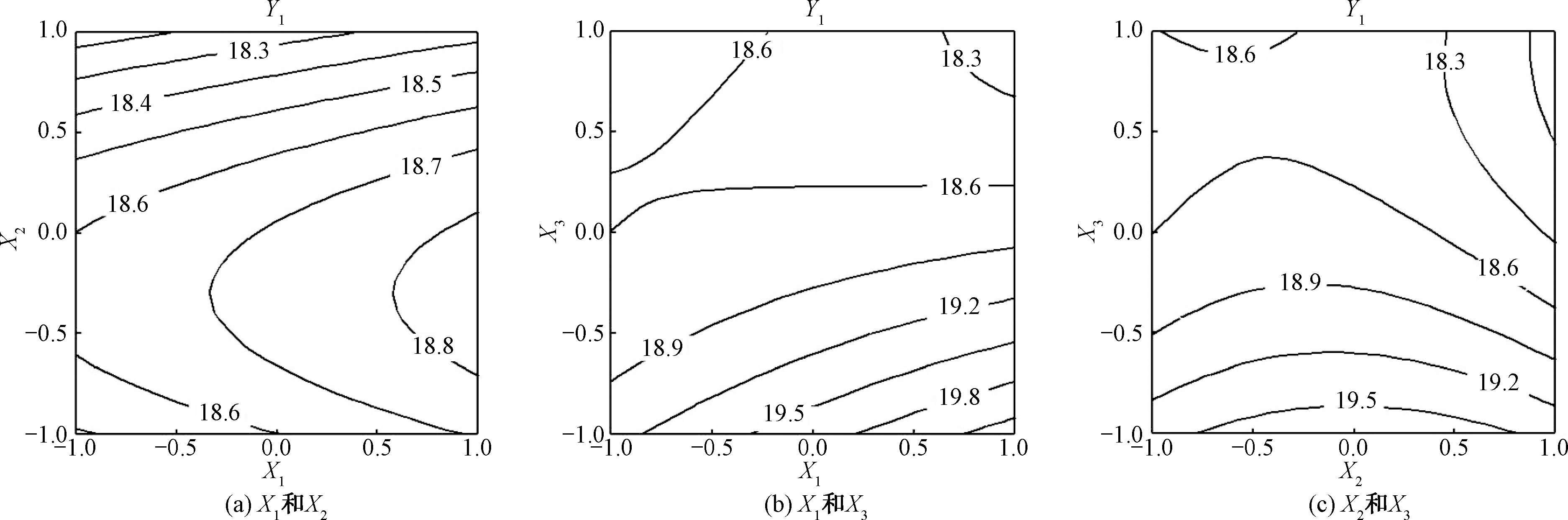
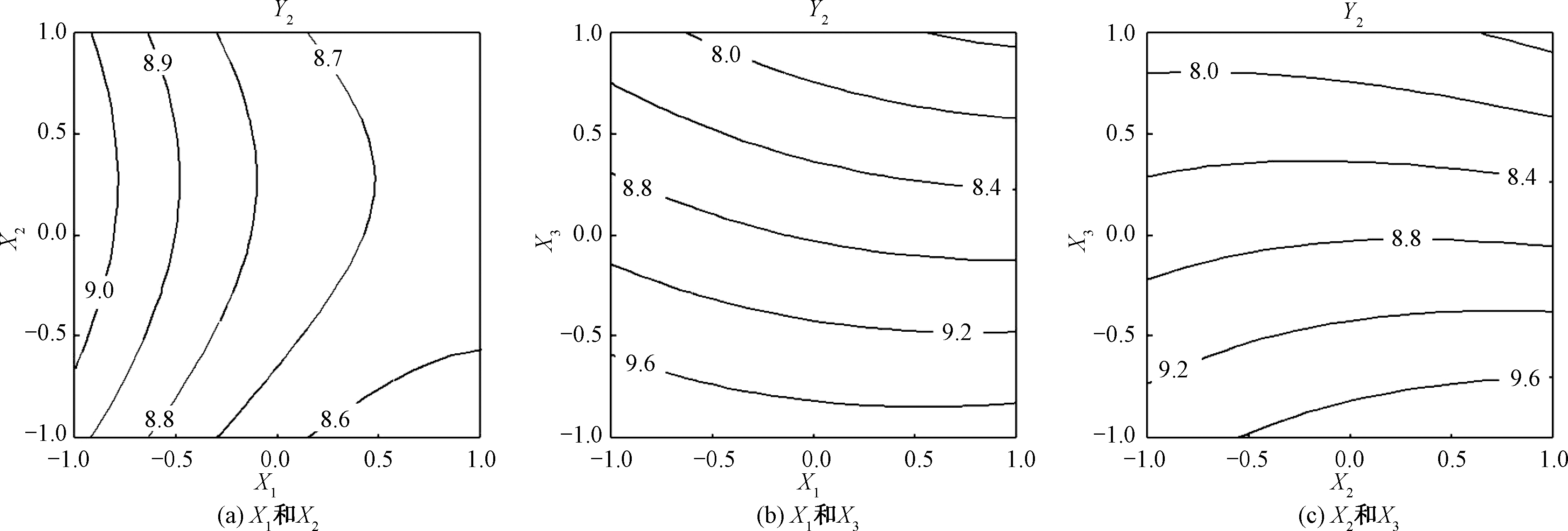
Results Statistical analysis of the test results indicated that the delivery speeds, nozzle pressure and the reciprocal of yarn linear density had significant effect on the yarn tenacity, elongation at break, breaking work and hairiness H value, and the reciprocal of yarn linear density has a significant effect on the yarn evenness CV value. Through the change of yarn break strength, it was found that the yarn break strength exhibited an increase and then followed by a decrease with the increase of nozzle pressure, and demonstrated a decreasing trend with the increase of the reciprocal of yarn linear density. The yarn break strength increased slowly with the change of the delivery speed, and this change became obvious when the reciprocal of yarn linear density was on small values (i.e. with thicker yarns). The elongation at break of the yarn decreases with higher reciprocal of yarn linear density and delivery speeds, primarily due to reduced fiber slippage in the yarn. The elongation at break of the yarn increased slowly with the increase of the nozzle pressure. The yarn breaking work was related to the change of yarn tenacity and break elongation, and it was most affected by the reciprocal of yarn linear density in such a way that yarn breaking work would increase with the decrease of the reciprocal of yarn linear density. The yarn evenness CV value demonstrated increase with the increase of the reciprocal of yarn linear density. It was found that that the yarn hairiness H value decreased with the increase of the reciprocal of yarn linear density and nozzle air pressure, and decreased with the decrease of delivery speed.

Conclusion In the spinning process, increasing the delivery speed properly can reduce the fiber loss in the twisting chamber enhancing the fiber wrapping effect, which is beneficial to the yarn break strength. Increasing the delivery speed would reduce the probability of fiber slippage within the yarn, leading to reduced elongation at break of the yarn. The change of delivery speed has little effect on yarn breaking work, because the trend of yarn and breaking elongation is opposite. The result showed that the yarn was prone to hair formation with the increase of delivery speed. For polyester fiber/dyed cotton fiber/PHBV-based polyester fiber (the blend ratio of 50∶35∶15) air-jet spinning blended yarn, when the nozzle pressure is set near 0.55 MPa, the yarn can obtain satisfactory breaking work. With the increase of the nozzle pressure, the twisting degree of the wrapped fiber increases and the yarn hairiness decreases. The yarn evenness CV value is mainly affected by the yarn linear density. When the yarn is finer, it is easy to form draft fluctuations, resulting in yarn evenness variation.

Key words: air-jet vortex spinning, blended yarn, yarn forming process, yarn performance, response surface model

CLC Number: 

  • TS104.5

Tab.1

Factor level table of spinning process"

水平 因素
纺纱速度
X1/(m·min-1)
喷嘴气压
X 2/MPa
1/纱线线密度
X 3/tex-1
-1 320 0.48 0.034
0 370 0.55 0.051
1 420 0.62 0.068

Tab.2

Experimental plans based on BBD"

试样
编号
纺纱速度
X1/(m·min-1)
喷嘴气压
X 2/MPa
1/纱线线密度
X 3/tex-1
1 -1 -1 0
2 1 -1 0
3 -1 1 0
4 1 1 0
5 -1 0 -1
6 1 0 -1
7 -1 0 1
8 1 0 1
9 0 -1 -1
10 0 1 -1
11 0 -1 1
12 0 1 1
13 0 0 0
14 0 0 0
15 0 0 0

Tab.3

Performance test results of yarn samples"

试验
编号
断裂强度Y1/
(cN·tex-1)
断裂伸长率
Y2/%
断裂功Y3/
(cN·mm)
条干CV
Y4/%
毛羽H
Y5
1 18.39 8.98 8 342.54 19.58 3.52
2 18.74 8.42 8 085.20 21.37 4.07
3 18.22 9.07 8 343.30 20.40 3.26
4 18.39 8.66 8 033.49 17.64 3.65
5 19.10 9.93 13 773.82 13.76 3.57
6 20.20 9.83 14 456.10 13.98 3.89
7 18.94 8.13 6 015.42 19.64 3.20
8 18.20 7.54 5 430.31 20.60 3.76
9 19.46 9.43 13 296.43 13.96 3.86
10 19.40 9.93 14 039.67 14.00 3.55
11 18.58 7.87 5 745.24 16.02 3.57
12 17.80 7.45 5 250.45 20.22 3.47
13 18.70 8.69 8 087.82 21.26 3.68
14 18.71 8.86 8 204.67 21.26 3.58
15 18.69 8.79 8 183.33 21.59 3.78

Tab.4

Response surface quadratic model regression analysis of each response of yarn"

来源 断裂强度Y1/(cN·tex-1) 断裂伸长率Y2/% 断裂功Y3/(cN·mm) 条干CV值Y4/% 毛羽HY5
系数 p 系数 p 系数 p 系数 p 系数 p
常数项 18.711 0 0.000* 8.770 8 0.000* 8 158.6 0.000* 21.162 0.000* 3.627 6 0.000*
X1 0.109 9 0.003* -0.207 6 0.000* -58.7 0.244 0.027 0.951 0.227 6 0.000*
X2 -0.170 8 0.000* 0.050 3 0.098 24.7 0.607 0.166 0.704 -0.137 5 0.001*
X3 -0.578 9 0.000* -1.017 1 0.000* -4 140.6 0.000* 2.598 0.000* -0.108 4 0.003*
${X}_{1}^{2}$ - - 0.094 7 0.044* 189.2 0.030* - - - -
${X}_{2}^{2}$ -0.284 5 0.000* -0.092 6 0.048* -146.7 0.071 -1.259 0.080 - -
${X}_{3}^{2}$ 0.392 5 0.000* - - 1 571.1 0.000* -4.009 0.000* - -
X1X2 - - - - - - -1.137 0.096 - -
X1X3 -0.459 6 0.000* -0.123 2 0.013* -316.8 0.003* - - - -
X2X3 -0.181 1 0.001* -0.232 0 0.000* -309.5 0.003* 1.039 0.123 - -

Tab.5

Quadratic response model regression equation and determination coefficient R2 of each response"

性能指标 二次响应模型回归方程 决定系数R2
断裂强度Y1/(cN·tex-1) Y1=18.711 0+0.109 9 X1-0.170 8 X2-0.578 9 X3-0.284 5 ${{X}_{2}}^{2}$+
0.392 5 ${{X}_{3}}^{2}$-0.459 6 X1X3-0.181 1 X2X3
0.992 8
断裂伸长率Y2/% Y2=8.770 8-0.207 6 X1+0.050 3 X2 - 1.017 1 X3+0.094 7 ${{X}_{1}}^{2}$-
0.092 6 ${{X}_{2}}^{2}$-0.123 2 X1X3-0.232 0 X2X3
0.995 7
断裂功Y3/(cN·mm) Y3=8 158.6-58.7 X1+24.7 X2-4 140.6 X3+189.2 ${{X}_{1}}^{2}$-146.7 ${{X}_{2}}^{2}$+
1 571.1 ${{X}_{3}}^{2}$-316.8 X1X3-309.5 X2X3
0.999 3
条干CV值Y4/% Y4=21.162+0.027 X1+0.166 X2+2.598 X3-1.259 ${{X}_{2}}^{2}$-4.009 ${{X}_{3}}^{2}$-
1.137 X1X2+ 1.039 X2X3
0.928 2
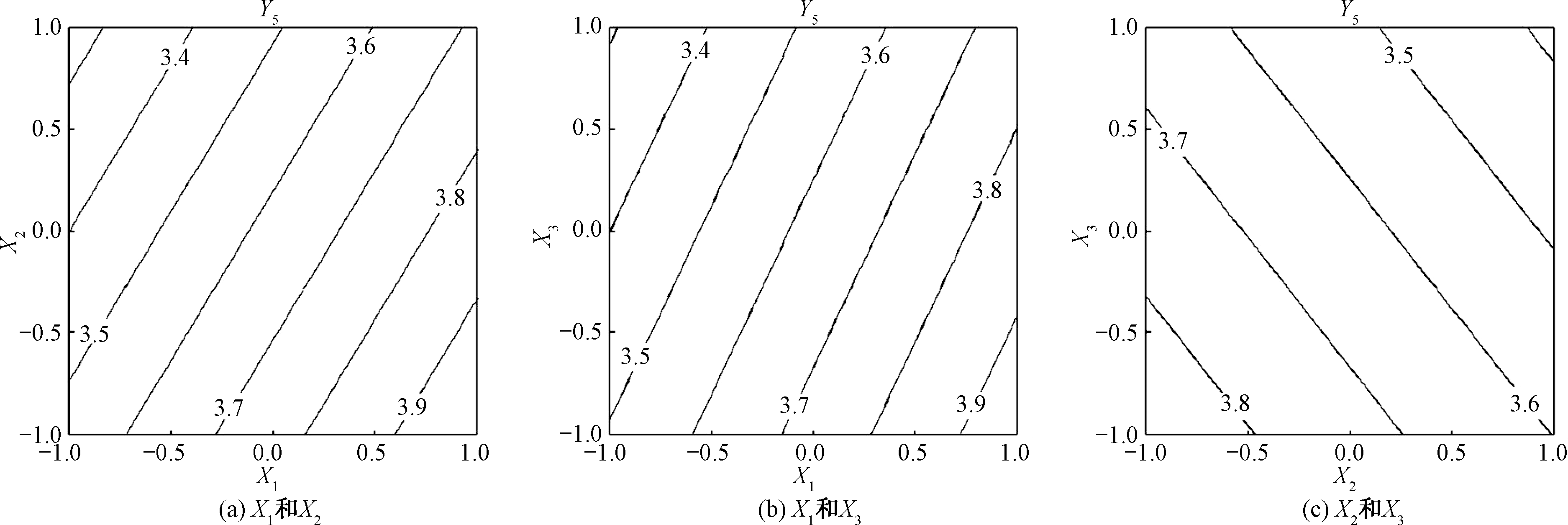
毛羽HY5 Y5=3.627 6+0.227 6 X1-0.137 5 X2-0.108 4 X3 0.899 0

Fig.1

Contour plots of relationship between yarn response value Y1 (break strength) and yarn formation process. (a) X1 and X2; (b) X1 and X3; (c) X2 and X3"

Fig.2

Contour plots of relationship between yarn response value Y2 (elongation at break) and yarn formation process. (a) X1 and X2; (b) X1 and X3; (c) X2 and X3"

Fig.3

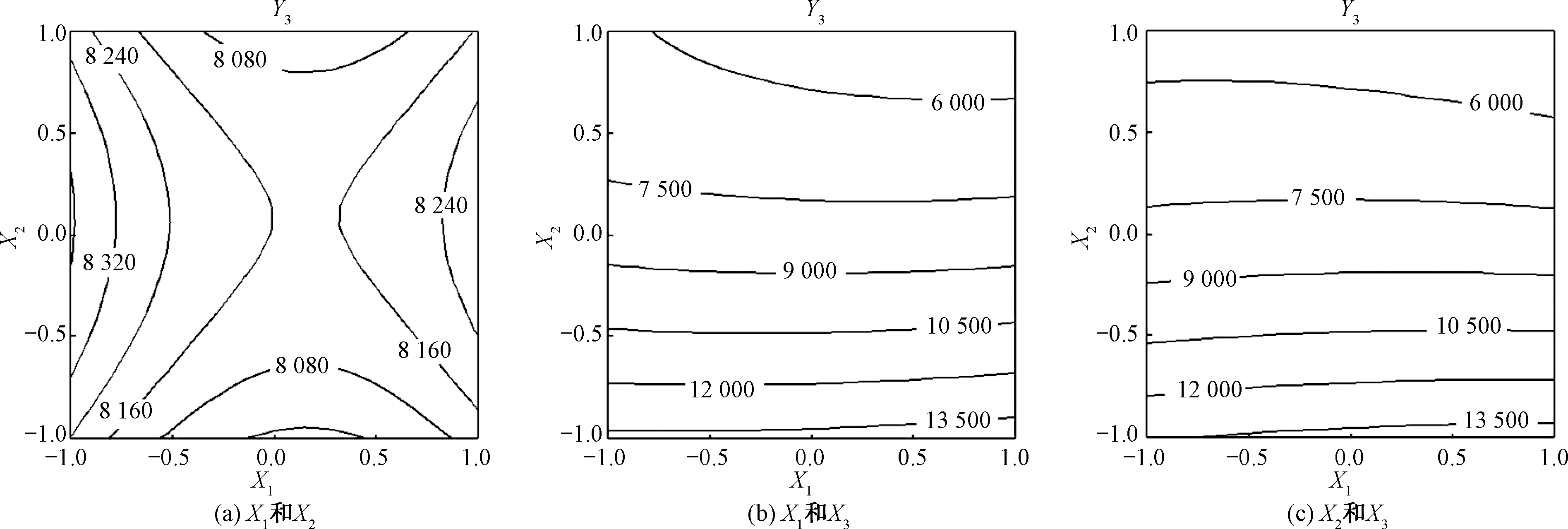
Contour plots of relationship between yarn response value Y3 (breaking work) and yarn formation process. (a) X1 and X2; (b) X1 and X3; (c) X2 and X3"

Fig.4

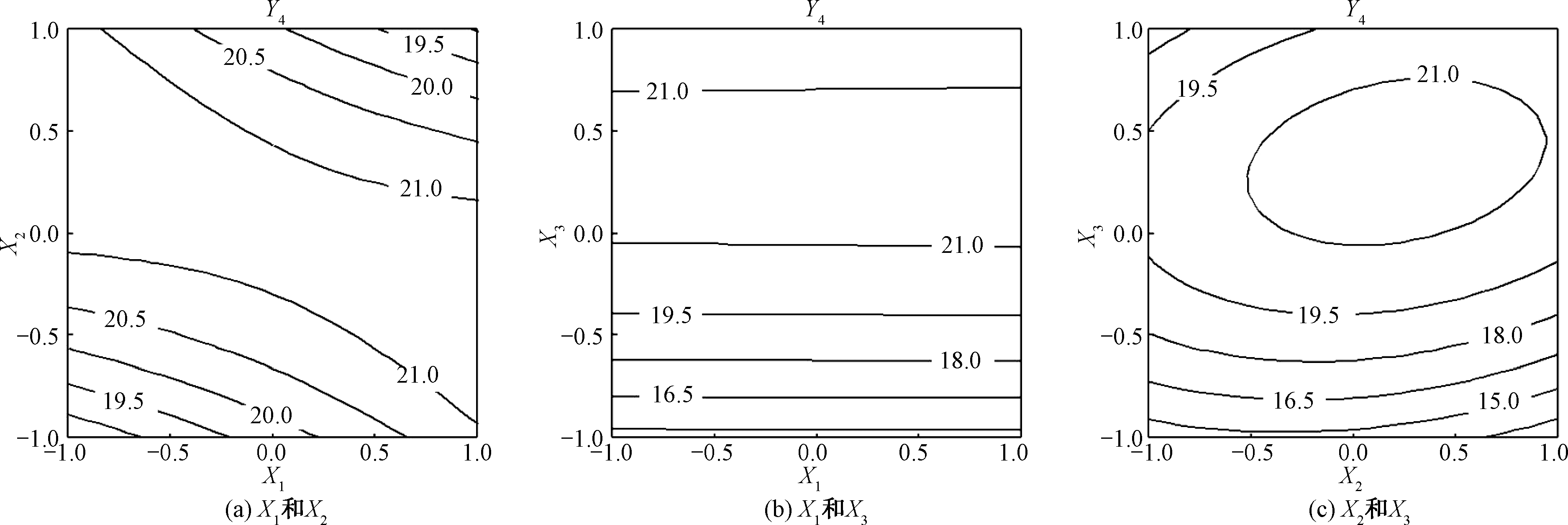
Contour plots of the relationship between yarn response value Y4 (evenness CV value) yarn formation process. (a) X1 and X2; (b) X1 and X3; (c) X2 and X3"

Fig.5

Contour plots of relationship between yarn response value Y5 (hairiness H value) and yarn formation process. (a) X1 and X2; (b) X1 and X3; (c) X2 and X3"

[1] 刘建林, 郑磊. 喷气涡流纺色纺纱的开发与生产实践[J]. 纺织导报, 2022(4): 36-39.
LIU Jianlin, ZHENG Lei. Development and practice of air-jet vortex colored spun yarn[J]. China Textile Leader, 2022(4): 36-39.
[2] 杨瑞华, 潘博, 郭霞, 等. 环锭纺及转杯纺和喷气涡流纺混色纱的纤维混合效果研究[J]. 纺织学报, 2021, 42(7): 76-81,88.
YANG Ruihua, PAN Bo, GUO Xia, et al. Study on fiber mixing effect in ring spun,rotor and air-jet-vortex spun color blended yarns[J]. Journal of Textile Research, 2021, 42(7): 76-81,88.
[3] MA L, ZHANG Z, LI J, et al. A new antimicrobial agent: poly(3-hydroxybutyric acid) oligomer[J]. Macromolecular Bioscience, 2019, 19(5): 1800432.
doi: 10.1002/mabi.v19.5
[4] CHENG Z, GAO J, LIU Q, et al. The effect of alkyl chain length of (R)-3-hydroxybutyric alkyl ester on antibacterial activity and its antibacterial mechanism[J]. Journal of Biomaterials Applications, 2022, 37(2): 275-286.
[5] 邹专勇. 喷气涡流纺成纱工艺对竹浆纤维色纺纱性能的影响[J]. 纺织学报, 2014, 35(2):23-28,38.
ZOU Zhuanyong. Influence of yarn formation process on properties of bamboo pulp fiber colored spun yarn using air-jet vortex spinning[J]. Journal of Textile Research, 2014, 35(2):23-28,38
[6] TRIPATHI L, JAIN M, ISHTIAQUE S M. Properties of air-vortex blended yarn influenced by spinning process parameters[J]. Indian Journal of Fibre & Textile Research, 2021, 46(3): 225-240.
[7] MOUCKOVA E, URSINY P, JIRASKOVA P, et al. Analysis of formation of mass irregularity in drafting device during yarn spinning from sliver[J]. Vlakna a Textil, 2019, 3(26): 23-30.
[8] ERDUMLU N, OZIPEK B. Effect of the draft ratio on the properties of vortex spun yarn.[J]. Fibres & Textiles in Eastern Europe, 2010, 18(3): 38-42.
[9] 邹专勇, 缪璐璐, 董正梅, 等. 喷气涡流纺工艺对粘胶/涤纶包芯纱性能的影响[J]. 纺织学报, 2022, 43(8): 27-33.
ZOU Zhuanyong, MIAO Lulu, DONG Zhengmei, et al. Effect of air-jet vortex spinning process on properties of viscose/polyester core-spun yarns[J]. Journal of Textile Research, 2022, 43(8): 27-33.
[1] ZHU Wenshuo, XUE Yuan, SUN Xianqiang, XUE Jingli, JIN Guang. Full color gamut matching of wool blended yarn based on seven primary color fibers [J]. Journal of Textile Research, 2025, 46(04): 71-80.
[2] MIAO Lulu, MENG Xiaoyi, DONG Zhengmei, PENG Qian, HE Linwei, ZOU Zhuanyong. Effect of heat treatment on mechanical property of core-spun yarn from low melting point polyester filament made by air-jet vortex spinning [J]. Journal of Textile Research, 2024, 45(11): 73-79.
[3] LIU Ting, YAN Tao, PAN Zhijuan. Preparation and properties of banana stem fiber/antibacterial fiber blended yarn [J]. Journal of Textile Research, 2024, 45(10): 48-54.
[4] YANG Ruihua, SHAO Qiu, WANG Xiang. Spinning performance of recycled cotton and polyester fibers and fabric characteristics [J]. Journal of Textile Research, 2024, 45(08): 127-133.
[5] SHAO Yinghai, ZHAO Yeping, HAN Xianguo, CAO Jipeng, ZHANG Mingguang, CHEN Wen. Progress of research and application in air-jet vortex spinning machine and key technologies [J]. Journal of Textile Research, 2024, 45(03): 209-218.
[6] MIAO Lulu, DONG Zhengmei, ZHU Fanqiang, RONG Hui, HE Linwei, ZHENG Guoquan, ZOU Zhuanyong. Influence of core filament type and delivery speed on performance of air-jet vortex spun core-spun yarns [J]. Journal of Textile Research, 2023, 44(12): 50-57.
[7] SU Xuzhong, LIANG Qiaomin, WANG Huifeng, ZHANG Di, CUI Yihuai. Wearability of knitted fabrics produced from cotton/bio-based elastic polyester fiber [J]. Journal of Textile Research, 2023, 44(05): 119-124.
[8] WU Jiaqing, WANG Yiting, HE Xinxin, GUO Yafei, HAO Xinmin, WANG Ying, GONG Yumei. Influence of blending ratio on mechanical properties of bio-polyamide 56 staple fiber/cotton blended yarn [J]. Journal of Textile Research, 2023, 44(03): 49-54.
[9] LIU Hao, MA Wanbin, LUAN Yiming, ZHOU Lan, SHAO Jianzhong, LIU Guojin. Preparation and properties of structural colored carbon fiber/polyester blended yarns based on photonic crystals [J]. Journal of Textile Research, 2023, 44(02): 159-167.
[10] YU Xuezhi, ZHANG Mingguang, CAO Jipeng, ZHANG Yue, WANG Xiaoyan. Influence of twist on quality indexes of polyamide/cotton blended yarns [J]. Journal of Textile Research, 2023, 44(01): 106-111.
[11] ZOU Zhuanyong, MIAO Lulu, DONG Zhengmei, ZHENG Guoquan, FU Na. Effect of air-jet vortex spinning process on properties of viscose/polyester core-spun yarns [J]. Journal of Textile Research, 2022, 43(08): 27-33.
[12] MIN Xiaobao, PAN Zhijuan. Quality and performance of biomass fiber/pineapple leaf fiber multi-component blended yarn [J]. Journal of Textile Research, 2022, 43(01): 74-79.
[13] YANG Ruihua, PAN Bo, GUO Xia, WANG Lijun, LI Jianwei. Study on fiber mixing effect in ring spun, rotor and air-jet-vortex spun color blended yarns [J]. Journal of Textile Research, 2021, 42(07): 76-81.
[14] NI Jie, YANG Jianping, YU Chongwen. Effect of ratio of strands twist factor to single yarn twist factor on properties of viscose plied yarns [J]. Journal of Textile Research, 2021, 42(05): 46-50.
[15] LI Hao, XING Mingjie, SUN Zhihao, WU Yao. Exploration of image-based testing method for yarn twist in air-jet vortex spinning [J]. Journal of Textile Research, 2021, 42(02): 60-64.
Viewed
Full text


Abstract

Cited

  Shared   
  Discussed   
No Suggested Reading articles found!