纺织学报 ›› 2025, Vol. 46 ›› Issue (05): 17-22.doi: 10.13475/j.fzxb.20241204101

• 特约专栏: 智能纤维与织物器件 • 上一篇    下一篇

智能发热服装用柔性碳纳米管电加热元件的制备及应用

孙晚红(), 张鹏飞, 陈勇, 张林, 潘跃山, 宋飞虎, 刘恩星, 王玉萍   

  1. 国家先进功能纤维创新中心, 江苏 苏州 215200
  • 收稿日期:2024-12-19 修回日期:2025-01-22 出版日期:2025-05-15 发布日期:2025-06-18
  • 作者简介:孙晚红(1996—),女,硕士。主要研究方向为碳纳米管导电薄膜。E-mail:3197017262@qq.com

Preparation and application of flexible carbon nanotube electric heating element for intelligent heating clothing

SUN Wanhong(), ZHANG Pengfei, CHEN Yong, ZHANG Lin, PAN Yueshan, SONG Feihu, LIU Enxing, WANG Yuping   

  1. National Advanced Functional Fiber Innovation Center, Suzhou, Jiangsu 215200, China
  • Received:2024-12-19 Revised:2025-01-22 Published:2025-05-15 Online:2025-06-18

摘要:

针对传统电加热保暖服装柔韧性、舒适性差等问题,需开发一种用于服装的可加热、轻柔、耐水洗的电加热元件。碳纳米管因轻质、高导电、高红外发射率等特点在柔性电热材料中的应用受到广泛关注。为此,通过真空抽滤法制备湿法碳纳米管导电薄膜,采用涂层法制备了碳纳米管复合皮芯导电纤维,并制成织物,进而将膜和织物分别作为加热元件,将其发热和可穿戴性能与传统的电阻丝加热元件和化学气相沉积法制备的碳纳米管膜对比。结果表明:同功率下碳纳米管导电薄膜升温速率快,高达1.96 ℃/s(电阻丝最低,为0.53 ℃/s),柔性好,比电阻丝高350%;碳纳米管导电织物升温温度最高,达121.54 ℃(电阻丝最低,为56.87 ℃),柔性比电阻丝高150%~335%,相比于其它电加热元件具有透气性(透气率为463 mm/s);碳纳米管系列加热元件均耐水洗,水洗2次后质量变化最大为7.1%,电阻变化最大为3.8%;在发热服装的应用中,碳纳米管导电薄膜和导电织物因其优异功能,可满足智能发热服装的多元化市场要求。

关键词: 碳纳米管, 导电薄膜, 导电织物, 电加热元件, 智能发热服装

Abstract:

Objective In order to meet the demand for warmth and comfort of warm clothing in cold environment, intelligent warm clothing was developed. Carbon nanotube (CNT) is a new type of conductive material with high thermal conductivity, high strength and high electrical conductivity, and its excellent performance makes it widely applicable to the preparation of flexible heat-generating electronic devices. In this research, two types of heating elements are made of CNT materials, including CNT conductive film heating element and CNT conductive fabric heating element. The heating module is the core of heating clothing, aiming to meet the needs of wearing and heating.
Method CNT were dispersed by grinding and then mixed with waterborne polyurethane (WPU) to obtain CNT conductive slurry. CNT conductive films were prepared from the CNT slurry by vacuum filtration. CNT conductive fibers were prepared by coating the CNT slurry on the surface of polyester fibers using sizing and weaving the CNT conductive fibers into fabrics. The film and fabric were prepared, respectively, as simple heating elements, and compared with conventional resistance wire heating elements and CVD-CNT films prepared by CVD method to analyze its heating performance and wearability such as washability, permeability, flexibility and perspective.
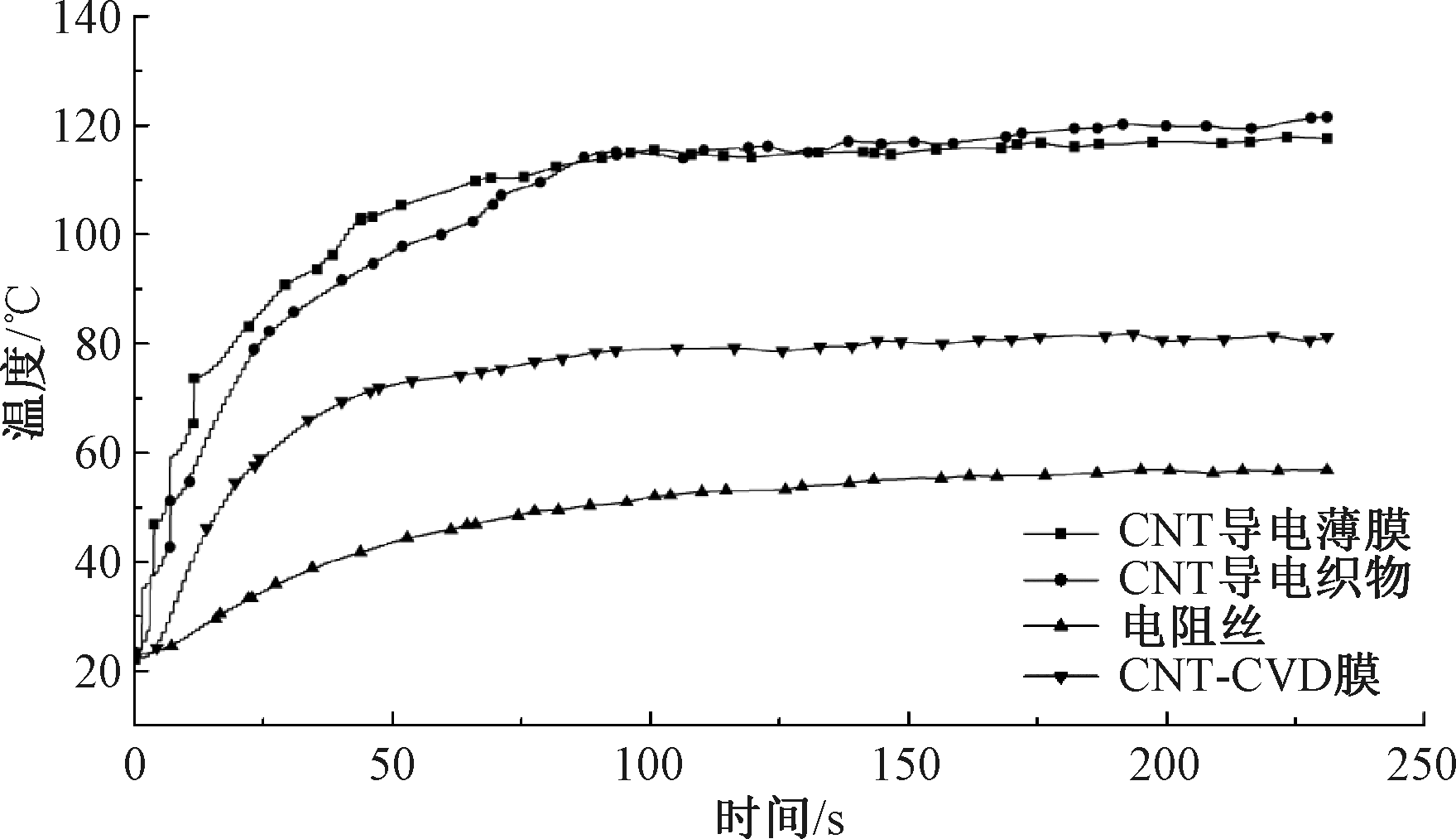
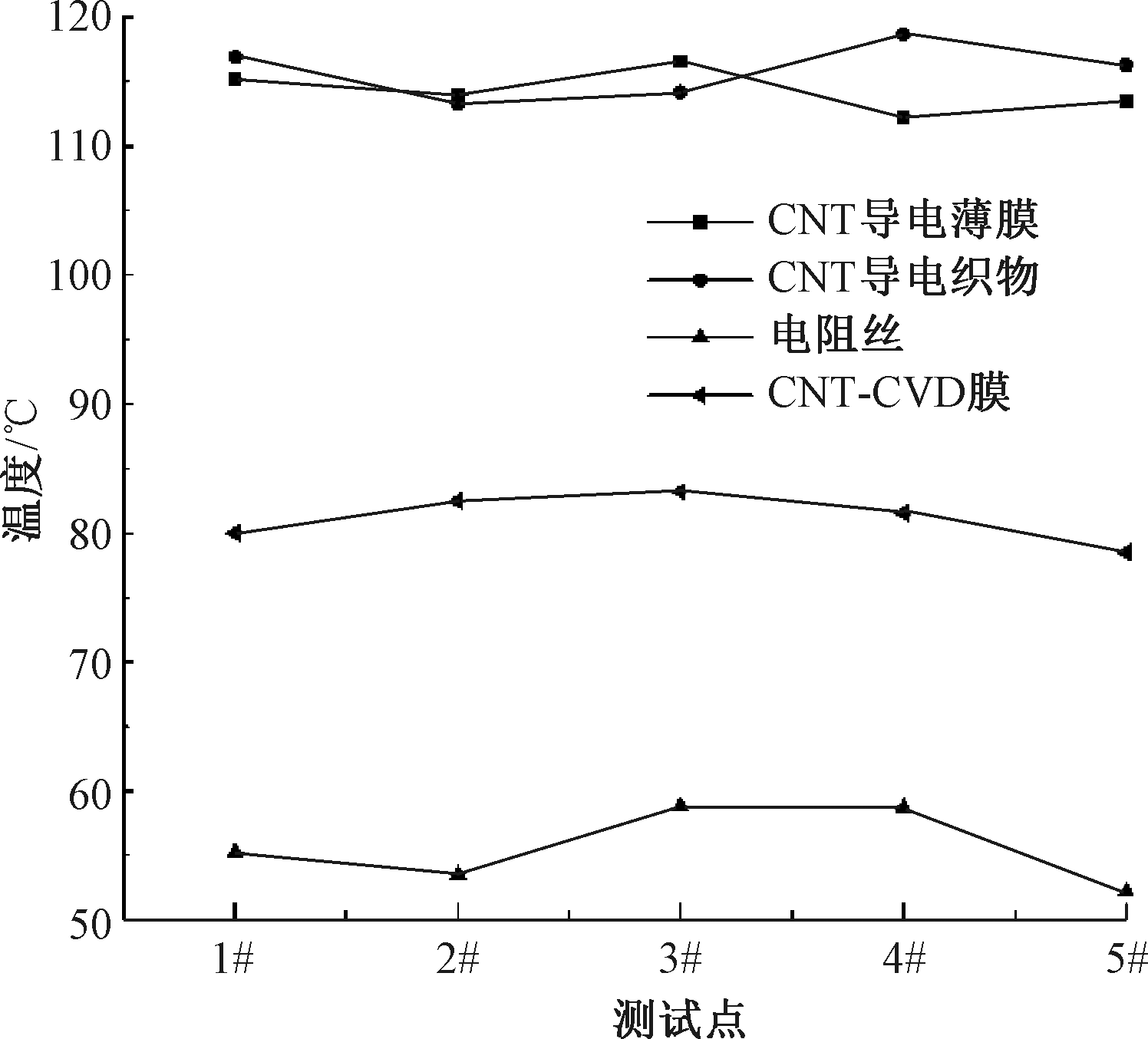
Results In the heating test (with the power of the four electric heating elements set to 31 W by adjusting the heating area and voltage), the heating rate of CNT conductive film was found to be the highest, up to 1.96 ℃/s (the resistance wire was the lowest, 0.53 ℃/s). The heating temperature of CNT conductive fabric was the highest, up to 121.54 ℃ (the lowest temperature of resistance wire was 56.87 ℃). It showed that the thermal image of the resistance wire during heating was a curve, while the images of the other three of thermal images were two-dimensional planes. The washability test showed, that the heating elements made of CNT conductive film, CVD-CNT film and CNT conductive fabric were washable. After two washing cycles, the mass of CVD-CNT film was reduced the most, by 7.1%, and the resistance was increased the most, by 3.8%, while the resistance wire heating elements were not washable. The air permeability test showed that CNT fabric has air permeability of 463 mm/s, and other heating elements had no air permeability. The flexibility test showed that the flexibility of CNT conductive film, CVD-CNT film and CNT fabric (the test direction is radial) was almost the same, which was above 300% higher than that of resistance wire and above 60% higher than that of CNT fabric (the test direction is weft). Finally, the moisture permeability of four electric heating elements was tested. The results showed that the moisture permeability of CNT conductive film was 2 980 g/(m2·24 h), that of CNT-CVD film was 2 880 g/(m2·24 h) and that of CNT conductive fabric was 3 970 g/(m2·24 h). Obviously, CNT conductive fabric has good moisture permeability. Because the effective working area of resistance wire heating elements was a curve, the moisture permeability could not be tested.
Conclusion The successfully prepared CNT conductive films and CNT conductive fabrics can be assembled into electric heating elements and tested for heating performance. The results indicate that CNT conductive films not only generate heat quickly, but also exhibit excellent flexibility. CNT fabric has a high heating temperature, good permeability and certain flexibility. Introducing CNT into the heating module not only solves the problem of missing heating elements in intelligent heating clothing, but also expands the market application of CNT, proving the feasibility of CNT as a heating element and providing strong reference for the design of subsequent CNT heating systems.

Key words: carbon nanotube, conductive film, conductive fabric, electric heating fabric, intelligent heating clothing

中图分类号: 

  • TS941

图1

不同材料的SEM照片"

图2

4种发热试样的升温情况对比"

表1

4种导电试样的升温速率对比"

材料
种类
最高温度/
最高温度
的90%/℃
升温至最高
温度90%的
时间/s
升温速率/
(℃·s-1)
CNT导电薄膜 117.84 106.06 54.0 1.96
CNT导电织物 121.54 109.39 77.9 1.40
电阻丝 56.87 51.18 97.0 0.53
CNT-CVD膜 81.75 73.58 56.9 1.29

图3

4种加热试样的表面温度"

表2

4种加热试样的表面温度平均值与方差"

材料种类 温度平均值/℃ 温度方差
CNT导电薄膜 114.32 2.71
CNT导电织物 115.88 4.66
电阻丝 55.68 8.98
CNT-CVD膜 81.16 3.64

图4

4种导电试样的热成像照片"

表3

CNT导电薄膜与CNT导电织物水洗前后的质量变化"

材料种类 水洗前后质量/g
水洗前 水洗1次 水洗2次
CNT导电薄膜 0.017 0.017 0.016
CNT导电织物 0.036 0.034 0.034
CNT-CVD膜 0.014 0.013 0.013

表4

CNT导电薄膜与CNT导电织物水洗前后的电阻变化值"

材料种类 水洗前后电阻/Ω
水洗前 水洗1次 水洗2次
CNT导电薄膜 6.64 6.81 6.88
CNT导电织物 4.05 4.11 4.12
CNT-CVD膜 41.69 40.50 40.11
[1] 曾祥鹤, 任海东, 郭浩. 中老年智能可穿戴自加热服装设计[J]. 开封大学学报, 2023, 37: 89-93.
ZENG Xianghe, REN Haidong, GUO Hao. Design of smart heated clothing for middle-aged and elderly people[J]. Journal of Kaifeng University, 2023, 37: 89-93.
[2] 李琳琳, 宣臻. 户外智能电加热运动服的设计研究[J]. 丝网印刷, 2023(19):32-34.
LI Linlin, XUAN Zhen. Design research of outdoor smart electric heating sportswear[J]. Screen Printing, 2023(19):32-34.
[3] YE C, ZHAO L, YANG S, et al. Recent research on preparation and application of smart joule heating fabrics[J]. Small, 2023. DOI: 10.1002/SMLL.202309027.
[4] 邹玲玲, 王晓云, 李雅芳, 等. 柔性电加热织物的研究进展[J]. 材料科学与工艺, 2021, 29: 74-88.
ZOU Lingling, WANG Xiaoyun, LI Yafang, et al. Research progress on flexible electric heating fabrics[J]. Materials Science and Engineering, 2021, 29: 74-88.
[5] 梁冰. 几种调温型电热毯的安全保护特性分析[J]. 家电科技, 2016(4): 40-41.
LIANG Bing. Analysis on safety protection characteristics of several temperature-controlled electric blankets[J]. Home Appliance Science and Technology, 2016(4): 40-41.
[6] GUO Z, SUN C, WANG J, et al. High-performance laminated fabric with enhanced photothermal conversion and joule heating effect for personal thermal manage-ment[J]. ACS Appl Mater Interfaces, 2021. DOI: 10.1021/ACSAMI.0C23123.
[7] JIAO T, DENG Q, JING G, et al. Enhanced thermal conductivity of liquid metal composite with lower surface tension as thermal interface materials[J]. Journal of Materials Research and Technology, 2023. DOI: 10.1016/J.JMRT.2023.04.006.
[8] LI X Q, CHANG L, ZHAO S L, et al. Research on carbon-based electrode materials for super-capacitors[J]. Acta Physico-Chimica Sinica, 2017. DOI: 10.3866/PKU.WHXB201609012.
[9] SHAN B, YUAN G, LI H, et al. Preparation of graphene/aligned carbon nanotube array composite films for thermal packaging applications[J]. Japanese Journal of Applied Physics, 2019. DOI: 10.7567/1347-4065/ab1bd0.
[1] 李润, 常梓洋, 张如范. 碳纳米管功能纤维的可控制备与性能调控研究进展[J]. 纺织学报, 2025, 46(05): 30-40.
[2] 董子靖, 吴欣媛, 王瑞霞, 赵华祥, 钱利江, 应城唯, 孙润军. 壳聚糖改性的炭黑导电织物制备及其在人体运动监测中的应用[J]. 纺织学报, 2025, 46(04): 146-153.
[3] 廖昙倩, 李文雅, 杨晓宇, 赵静娜, 张骁骅. 碳纳米管/聚乙二醇复合相变纤维的制备及其热性能[J]. 纺织学报, 2025, 46(03): 9-16.
[4] 张蕊, 叶苏娴, 王建, 邹专勇. 全织物型离电式柔性压力传感器的制备及其性能[J]. 纺织学报, 2025, 46(02): 113-121.
[5] 张喆, 王瑞, 蔡涛. 图案化耐久水性聚氨酯/碳纳米管涂层多功能抗静电复合织物的高效经济制备[J]. 纺织学报, 2025, 46(02): 207-217.
[6] 赵方, 邵光伟, 邵慧奇, 毕思伊, 李明昊, 海文清, 张鑫, 姜子洋, 蒋金华, 陈南梁. 镍/铜/镍-碳纳米管复合纱线的制备及其性能[J]. 纺织学报, 2024, 45(12): 144-151.
[7] 张蕊, 应迪, 陈冰冰, 田欣, 郑莹莹, 王建, 邹专勇. 碳纳米管修饰三维纤维网非织造布传感器的制备及其性能[J]. 纺织学报, 2024, 45(11): 46-54.
[8] 卢道坤, 王仕飞, 董倩, 史纳蔓, 李思琦, 干露露, 周爽, 沙莎, 张如全, 罗磊. 基于MXene的导电织物构筑及其多功能应用[J]. 纺织学报, 2024, 45(09): 137-145.
[9] 王楠, 孙辉, 于斌, 许磊, 朱祥祥. 基于熔喷非织造材料的温度传感器制备及其传感性能[J]. 纺织学报, 2024, 45(05): 138-146.
[10] 贾笑娅, 王蕊宁, 孙润军. SiO2/聚乙二醇200/碳纳米管剪切增稠液浸渍芳纶织物及其复合材料防刺性能[J]. 纺织学报, 2024, 45(04): 151-159.
[11] 宋功吉, 王煜煜, 王善龙, 王建南, 许建梅. 碳纳米管掺杂高聚物制备人工神经导管的研究进展[J]. 纺织学报, 2023, 44(11): 232-239.
[12] 葛佳慧, 毛志平, 张琳萍, 钟毅, 隋晓锋, 徐红. 基于二维碳化钛材料修饰的功能棉针织物制备及其性能[J]. 纺织学报, 2023, 44(04): 132-138.
[13] 张少月, 岳江昱, 杨家乐, 柴晓帅, 冯增国, 张爱英. 环境友好聚己内酯基复合相变纤维膜的制备及其性能[J]. 纺织学报, 2023, 44(03): 11-18.
[14] 万爱兰, 沈新燕, 王晓晓, 赵树强. 聚多巴胺修饰还原氧化石墨烯/聚吡咯导电织物的制备及其传感响应特性[J]. 纺织学报, 2023, 44(01): 156-163.
[15] 蒲海红, 贺芃鑫, 宋柏青, 赵丁莹, 李欣峰, 张天一, 马建华. 纤维素/碳纳米管复合纤维的制备及其功能化应用[J]. 纺织学报, 2023, 44(01): 79-86.
Viewed
Full text


Abstract

Cited

  Shared   
  Discussed   
No Suggested Reading articles found!