纺织学报 ›› 2026, Vol. 47 ›› Issue (05): 114-122.doi: 10.13475/j.fzxb.20250700601
孙哲茹1, 李奕萱2,3, 丁泽龙2,3, 王瑜4, 惠苗4, 夏鑫2,3( )
)
SUN Zheru1, LI Yixuan2,3, DING Zelong2,3, WANG Yu4, HUI Miao4, XIA Xin2,3()
摘要:
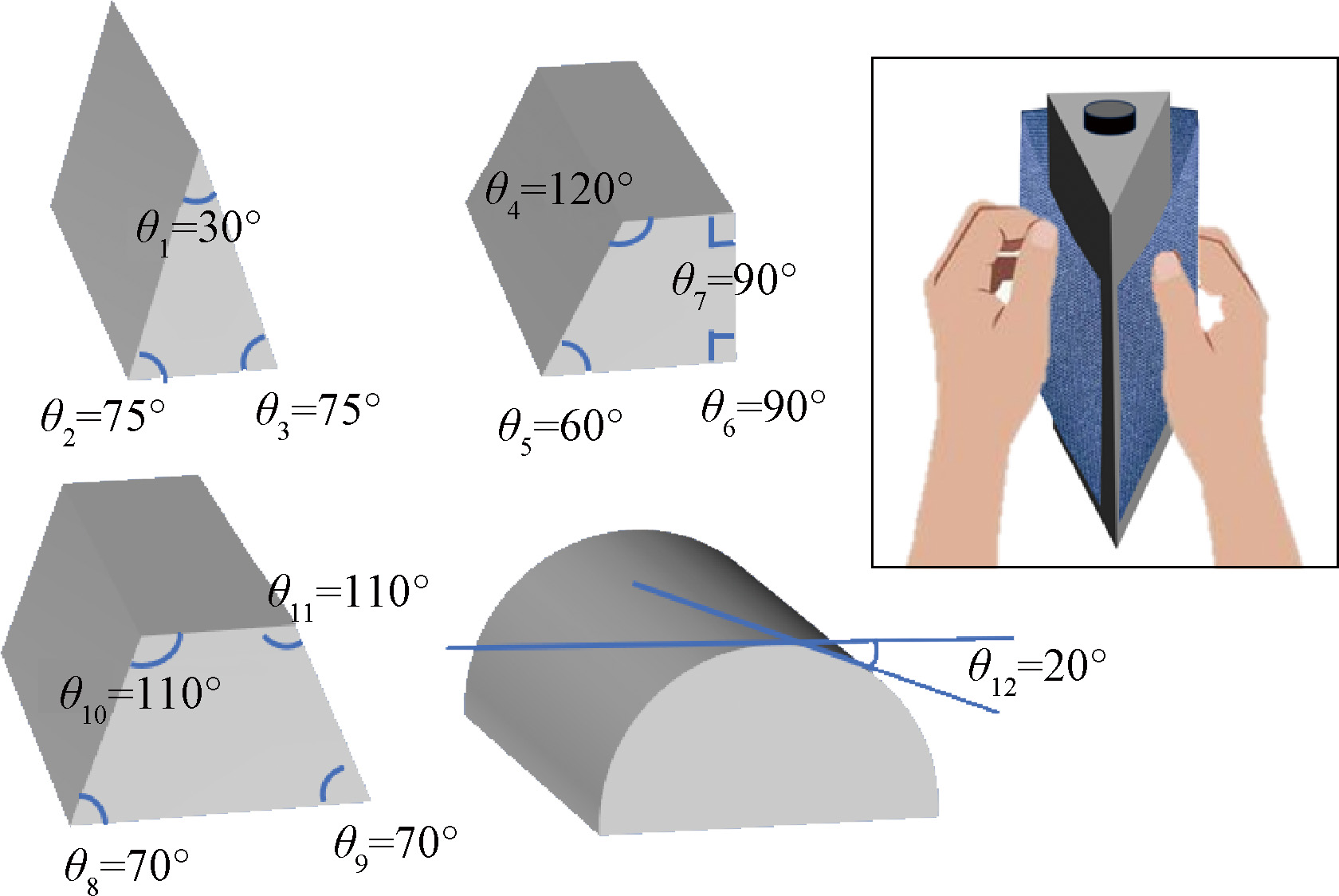
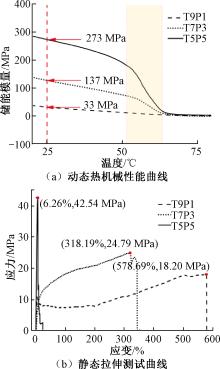
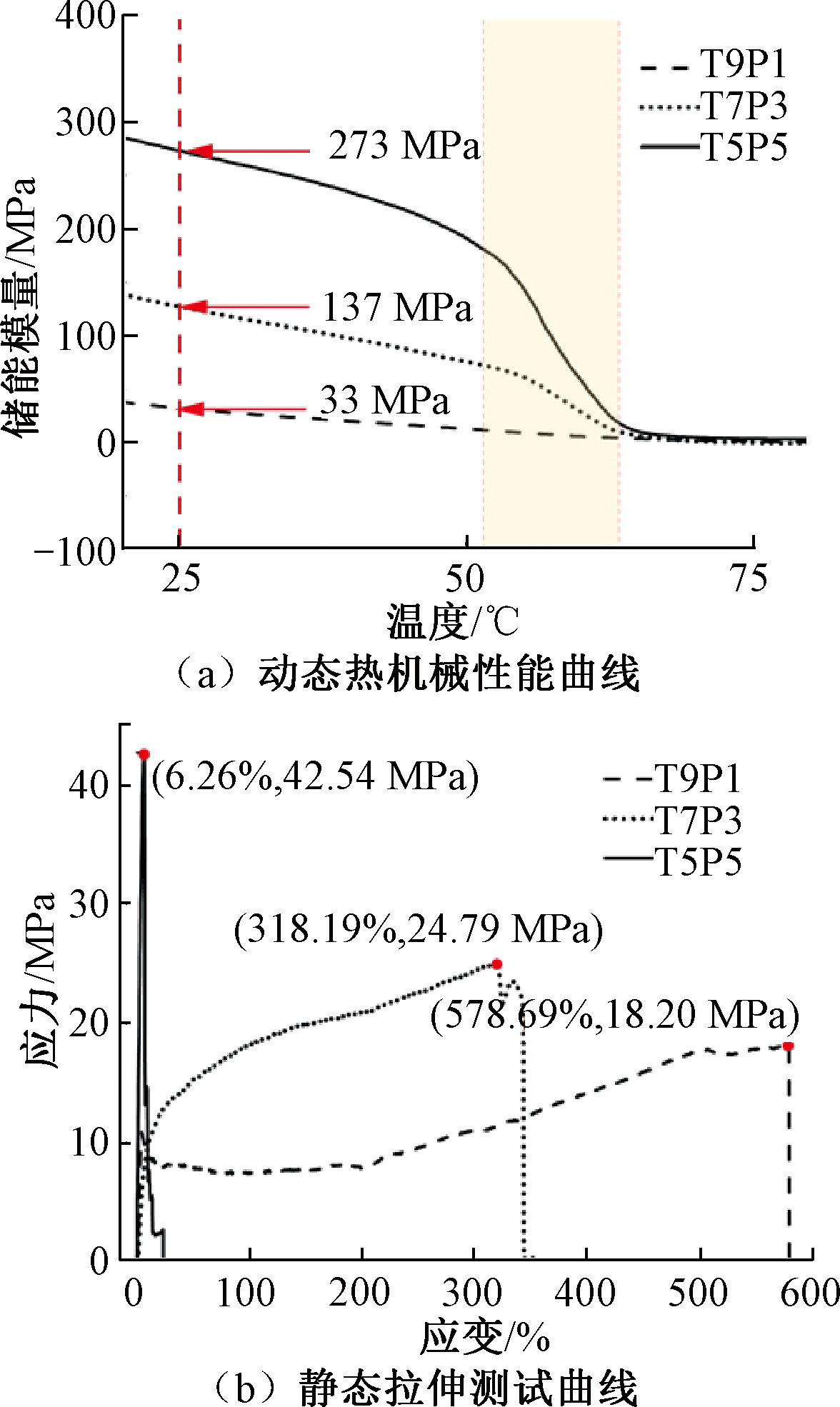
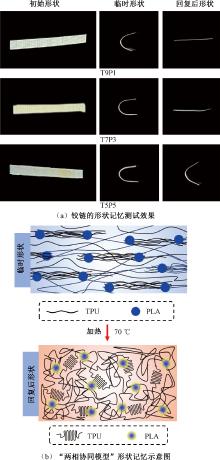
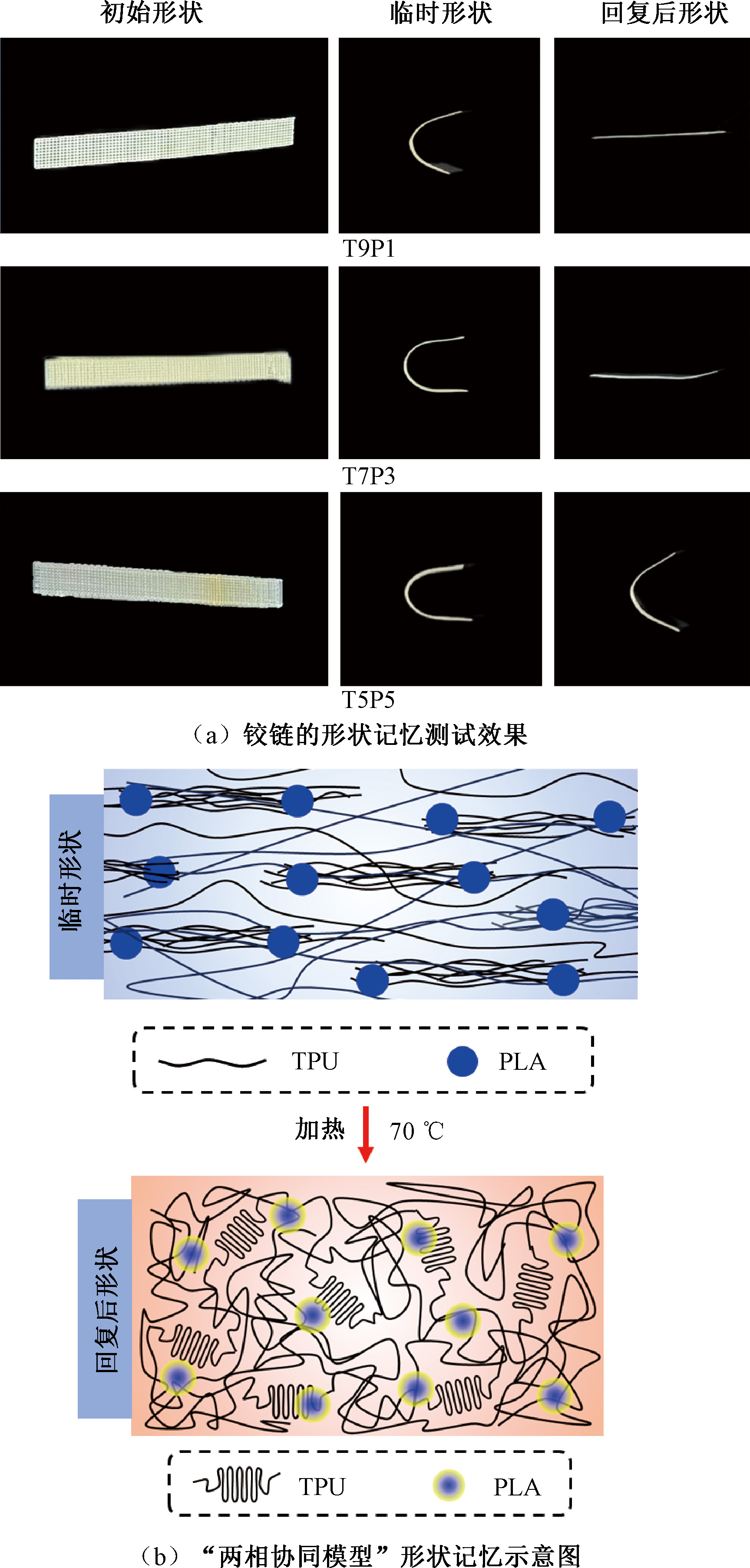
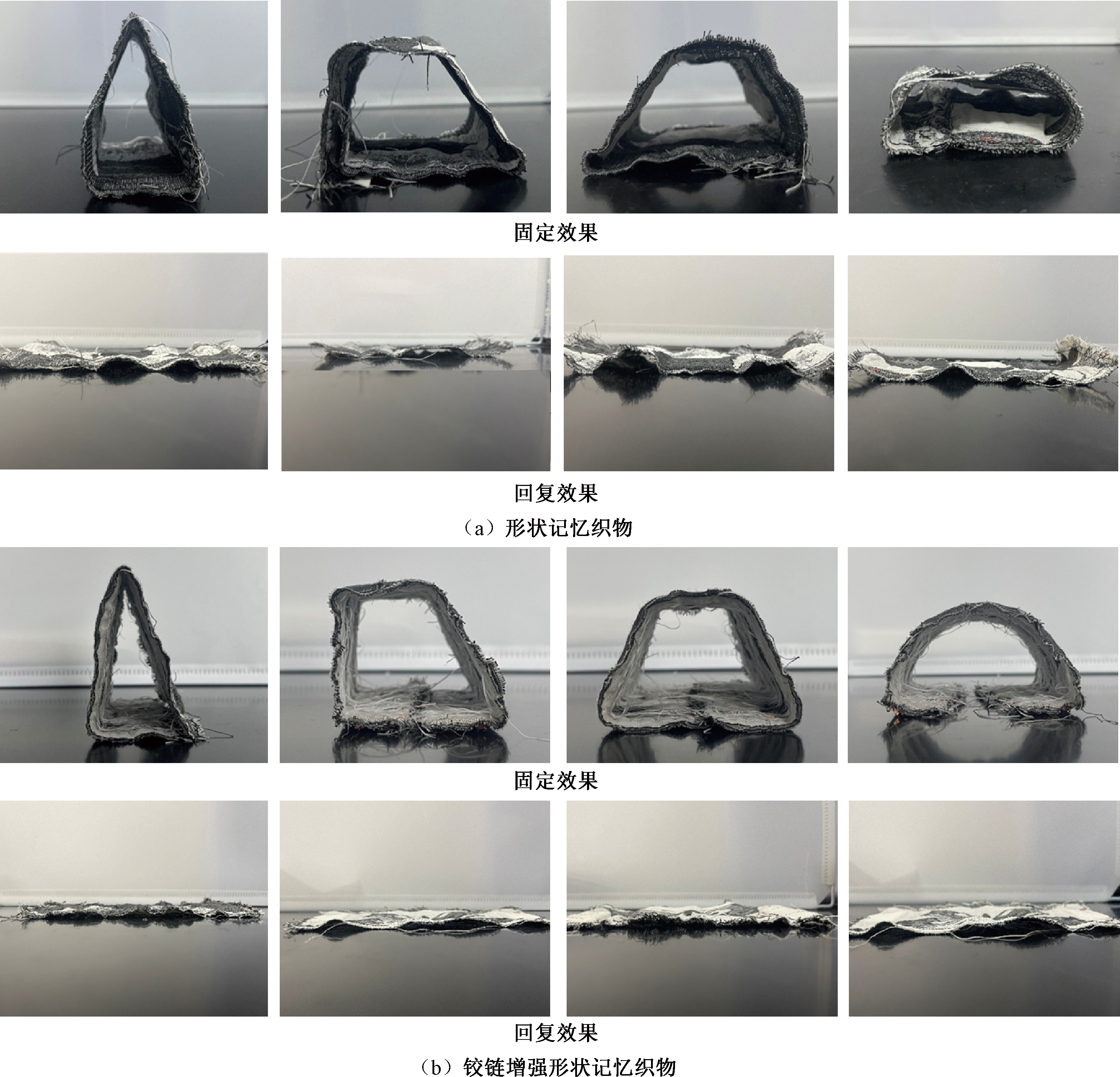
为增强形状记忆纺织品在多形状下的形状固定及回复效果,构建了铰链增强的复合织物体系。使用3D打印技术制备了聚氨酯(TPU)与聚乳酸(PLA)共混的形状记忆铰链,通过改变铰链中TPU与PLA的质量比,研究了其对材料微观结构、热力学性能的影响规律,进而调控铰链的形状记忆行为。结果表明,当TPU与PLA质量比为7∶3时,两相间通过氢键形成有效界面结合,PLA结晶度适中,材料在室温下具备较高的储能模量(137 MPa)与良好的延展性(断裂伸长率318.19%),实现了刚-韧平衡,从而获得最优的形状记忆性能(固定率95%,回复率95.6%)。在此基础上,采用提花织造工艺将优化后的铰链嵌入织物双层结构中,成功制备出结构-功能一体化的复合织物。该铰链增强织物在多种几何形变中均表现出优异的形状固定精度(角度偏差<5°)与回复完整性,显著优于无铰链织物。本研究从多尺度阐明TPU/PLA体系的协同机制,为开发高性能、可编程形状记忆纺织品提供了有效的材料设计与结构集成方案。
中图分类号:
| [1] |
JANG S Y, CHUNG C, HA J. A comparative study on the fashion design process utilizing shape memory textiles and conventional textiles: implications for the industry and education[J]. Fashion and Textiles, 2025, 12(1): 12.
doi: 10.1186/s40691-025-00421-2 |
| [2] | 刘仁义, 杨琴, 孙宝忠, 等. 织物增强复合材料的电热驱动形状记忆回复行为[J]. 纺织学报, 2025, 46(1): 72-79. |
| LIU Renyi, YANG Qin, SUN Baozhong, et al. Electrically and thermally driven shape memory recovery behavior of fabric-reinforced composites[J]. Journal of Textile Research, 2025, 46(1): 72-79. | |
| [3] |
GARG H, MOHANTY J, GUPTA P, et al. Effect of heat-set temperature on the crease recovery behavior of cotton fabric dip-coated with shape memory polyurethane[J]. Materials Chemistry and Physics, 2023, 294: 126952.
doi: 10.1016/j.matchemphys.2022.126952 |
| [4] |
GARG H, MOHANTY J, DAS A, et al. Influence of curing temperature on shape memory performance of polyethylenimine-based shape memory polymer coated cotton fabric[J]. Journal of Applied Polymer Science, 2024, 141(44): e56185.
doi: 10.1002/app.v141.44 |
| [5] |
FENG W, ZHANG Y S, SHAO Y W, et al. Coaxial electrospun membranes with thermal energy storage and shape memory functions for simultaneous thermal/moisture management in personal cooling textiles[J]. European Polymer Journal, 2021, 145: 110245.
doi: 10.1016/j.eurpolymj.2020.110245 |
| [6] |
KE J, CHEN L, GAO J, et al. Improving the dynamic stiffness and vibration characteristics of 3D orthogonal woven by implanting SMA instead of a warp yarn[J]. Composite Structures, 2023, 307: 116637.
doi: 10.1016/j.compstruct.2022.116637 |
| [7] |
NAITO Y, NISHIKAWA M, HOJO M. Effect of reinforcing layer on shape fixity and time-dependent deployment in shape-memory polymer textile composites[J]. Composites Part A: Applied Science and Manufacturing, 2015, 76: 316-325.
doi: 10.1016/j.compositesa.2015.06.011 |
| [8] |
崔成志, 曹金星, 刘建兰, 等. 聚乳酸/热塑性聚氨酯共混材料研究进展[J]. 中国塑料, 2023, 37(9): 75-82.
doi: 10.19491/j.issn.1001-9278.2023.09.011 |
|
CUI Chengzhi, CAO Jinxing, LIU Jianlan, et al. Research progress in poly(lactic acid)/thermoplastic polyurethane blends[J]. China Plastics, 2023, 37(9): 75-82.
doi: 10.19491/j.issn.1001-9278.2023.09.011 |
|
| [9] |
HAMIDI M N, ABDULLAH J, SHUIB R K, et al. 4D printing of polylactic acid (PLA)/thermoplastic polyurethane (TPU) shape memory polymer: a review[J]. Engineering Research Express, 2024, 6(1): 012402.
doi: 10.1088/2631-8695/ad337e |
| [10] |
XIE T. Recent advances in polymer shape memory[J]. Polymer, 2011, 52(22): 4985-5000.
doi: 10.1016/j.polymer.2011.08.003 |
| [11] |
ZHOU H M, XIA Y, MU G Q, et al. The preparation and characterization of biodegradable PCL/PLA shape memory blends[J]. Journal of Macromolecular Science, Part A, 2021, 58(10): 669-676.
doi: 10.1080/10601325.2021.1921598 |
| [12] |
ZHENG Y L, LIN J M, CAI J X, et al. Preparation and properties of polylactic acid-based shape memory composites[J]. Journal of Applied Polymer Science, 2025, 142(20): e56890.
doi: 10.1002/app.v142.20 |
| [1] | 王曙东, 严谨, 沈志高, 王可, 马倩, 戚玉. 挤出3D打印丝素蛋白/明胶软骨支架的制备及其性能[J]. 纺织学报, 2026, 47(05): 65-71. |
| [2] | 史芷丞, 陈凤翔, 王梦云, 白洁, 李娟, 白濛, 伏广伟, 徐卫林. 面向空天应用的高性能无机纤维及制品发展现状及趋势[J]. 纺织学报, 2025, 46(12): 233-242. |
| [3] | 费旌源, 徐乃库, 肖长发. 水可溃散砂质芯模设计及其在中空异形碳纤维复合材料成型中的应用[J]. 纺织学报, 2025, 46(11): 137-146. |
| [4] | 吕婧, 刘增伟, 程青青, 张学同. 芳纶纳米纤维气凝胶的研究进展[J]. 纺织学报, 2023, 44(06): 10-20. |
| [5] | 顾力文, 阮艳雯, 李浩. 基于柔性选择性激光烧结3D打印技术的服装研发[J]. 纺织学报, 2023, 44(04): 154-164. |
| [6] | 程燕婷, 孟家光, 薛涛, 支超. 3D打印纬平针面料的制备[J]. 纺织学报, 2022, 43(09): 115-119. |
| [7] | 姜雨淋, 王卉, 张克勤. 生物3D打印用丝素蛋白基凝胶墨水的研究进展[J]. 纺织学报, 2021, 42(11): 1-8. |
| [8] | 杨露, 薛涛, 孟家光, 杨豆豆. 3D打印柔性服装面料的负离子功能整理及其性能[J]. 纺织学报, 2021, 42(08): 102-108. |
| [9] | 宋星, 金肖克, 祝成炎, 蔡冯杰, 田伟. 玻璃纤维/光敏树脂复合材料的3D打印及其力学性能[J]. 纺织学报, 2021, 42(01): 73-77. |
| [10] | 王曙东, 马倩, 王可, 瞿才新, 戚玉. 蚕丝蛋白/明胶复合水凝胶的结构与生物相容性[J]. 纺织学报, 2020, 41(11): 41-47. |
| [11] | 张晓会, 杨曈, 马丕波. 基于3D打印的竹节结构中空单丝制备及其压缩性能[J]. 纺织学报, 2019, 40(12): 32-38. |
| [12] | 宋星, 祝成炎, 蔡冯杰, 吕智宁, 田伟. 碱处理对涤纶/光敏树脂复合材料力学性能的影响[J]. 纺织学报, 2019, 40(07): 97-102. |
| [13] | 蔡冯杰 祝成炎 田伟 吕智宁 申晓. 3D打印成型的玻璃纤维增强聚乳酸基复合材料[J]. 纺织学报, 2017, 38(10): 13-18. |
| [14] | 邱海飞. 3D打印技术在织机打纬−开口机构中的应用[J]. 纺织学报, 2017, 38(01): 140-146. |
| [15] | 黄双 郗欣甫 徐洋 孙以泽. 簇绒地毯织机耦联轴系的铰链间隙对毯面绒高的影响[J]. 纺织学报, 2016, 37(08): 132-137. |
|
||
 京公网安备11010502044800号