纺织学报 ›› 2026, Vol. 47 ›› Issue (03): 208-216.doi: 10.13475/j.fzxb.20250901602
王业飞1, 许子傲1, 俞建勇2, 丁彬2, 李召岭1,2( )
)
WANG Yefei1, XU Ziao1, YU Jianyong2, DING Bin2, LI Zhaoling1,2()
摘要:
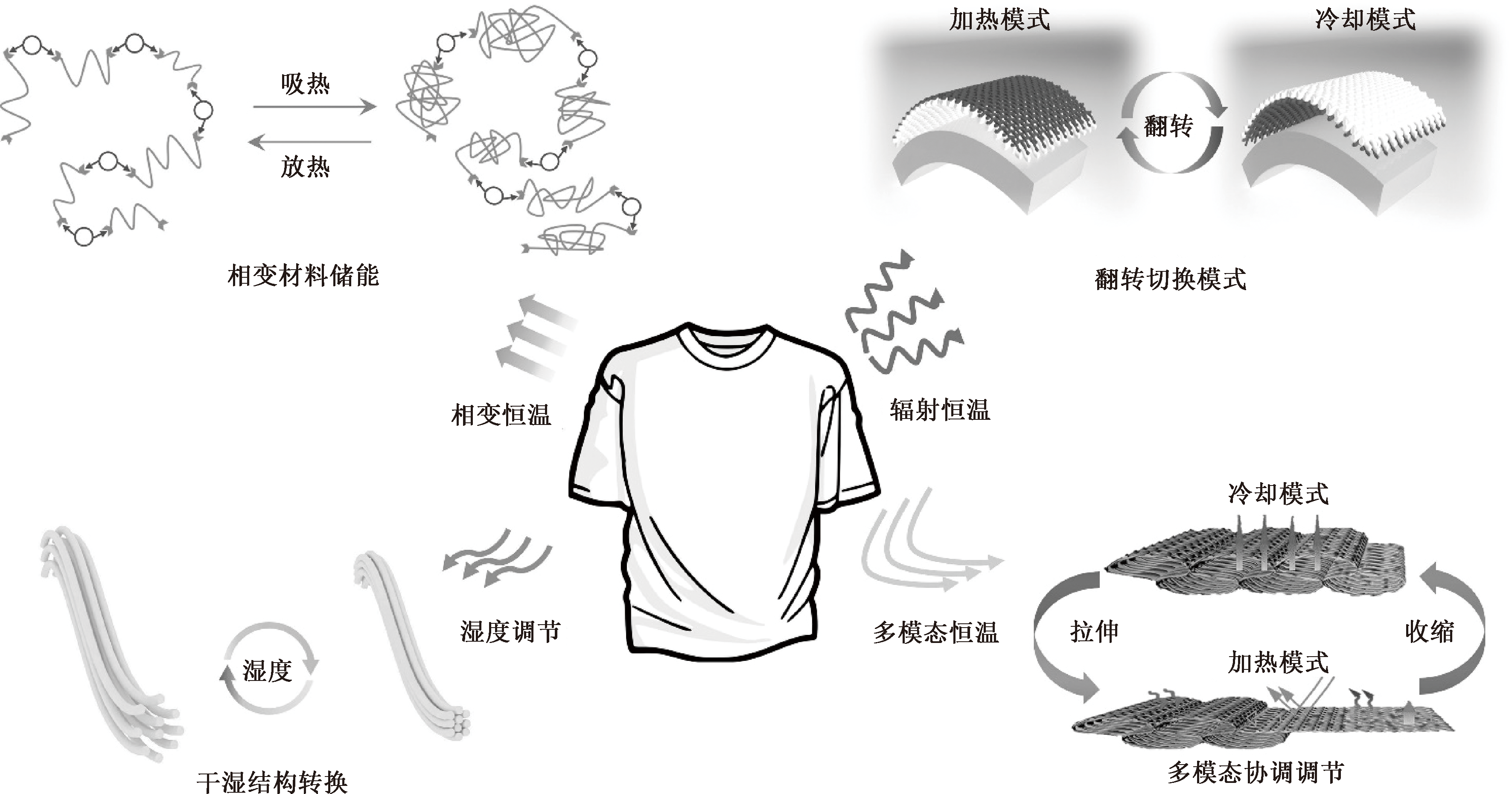
为系统梳理恒温热管理织物的最新研究进展,揭示织物与人体微气候稳态之间的关系,基于实现恒温的不同内在逻辑,综述了相变恒温、辐射恒温、湿度调节恒温和多模态恒温4种类型恒温热管理织物的调温机制与研究现状。探讨这4类织物的核心挑战和发展方向,并归纳总结了该领域中的现有难题和未来趋势。分析认为:相变恒温热管理织物具有自适应性,可自主切换吸收或释放潜热;辐射恒温热管理织物展现出与电磁屏蔽等功能相结合的潜力;湿度调节恒温热管理织物协同调节人体温湿度,间接实现体感温度的平衡与舒适;多模态恒温热管理织物集成多种热管理机制,拓宽了调温范围。未来,恒温热管理织物将通过跨学科合作,解决现有热管理织物的舒适性与功能性难平衡、多功能集成技术不成熟等普适性问题,实现自适应闭环调温系统。
中图分类号:
| [1] |
PARMESAN C. Ecological and evolutionary responses to recent climate change[J]. Annual Review of Ecology, Evolution, and Systematics, 2006, 37: 637-669.
doi: 10.1146/ecolsys.2006.37.issue-1 |
| [2] |
ZHAO L, LEE X, SMITH R B, et al. Strong contributions of local background climate to urban heat islands[J]. Nature, 2014, 511(7508): 216-219.
doi: 10.1038/nature13462 |
| [3] |
KOVATS R S, HAJAT S. Heat stress and public health: a critical review[J]. Annual Review of Public Health, 2008, 29: 41-55.
pmid: 18031221 |
| [4] |
HSU P C, SONG A Y, CATRYSSE P B, et al. Radiative human body cooling by nanoporous polyethylene textile[J]. Science, 2016, 353(6303): 1019-1023.
doi: 10.1126/science.aaf5471 |
| [5] |
PENG Y C, CUI Y. Advanced textiles for personal thermal management and energy[J]. Joule, 2020, 4(4): 724-742.
doi: 10.1016/j.joule.2020.02.011 |
| [6] |
TURK E E. Hypothermia[J]. Forensic Science, Medicine, and Pathology, 2010, 6(2): 106-115.
doi: 10.1007/s12024-010-9142-4 pmid: 20151230 |
| [7] |
XU X T, XING Y M, YIN Y J, et al. Flexible wearable fabrics for solar thermal energy storage and release in on-demand environments[J]. Chemical Engineering Journal, 2023, 466: 143175.
doi: 10.1016/j.cej.2023.143175 |
| [8] |
XU H J, CAO B, GAO L J, et al. Personal cooling garments with phase change material packages: a critical review of challenges, solutions and recent progress[J]. Building and Environment, 2024, 250: 111169.
doi: 10.1016/j.buildenv.2024.111169 |
| [9] | 胡博, 王婧宁, 王瑞雅, 等. “双碳”背景下个人热管理新型材料研究进展[J]. 北京服装学院学报(自然科学版), 2024, 44(4): 10-21. |
| HU Bo, WANG Jingning, WANG Ruiya, et al. Research progress on new materials for personal thermal management[J]. Journal of Beijing Institute of Fashion Technology (Natural Science Edition), 2024, 44(4): 10-21. | |
| [10] |
LI X L, DU Y, SHENG M J, et al. Scalable fabrication of multifunctional polylactic acid fibrous membranes with enhanced superhydrophobicity and radiative cooling performance[J]. Journal of Cleaner Production, 2024, 459: 142455.
doi: 10.1016/j.jclepro.2024.142455 |
| [11] |
ZHAO J J, ZHOU J H, LI H, et al. Ti3C2Tx MXene and cellulose-based aerogel phase change composite decorated laminated fabric with excellent electro/solar-thermal conversion and high latent heat[J]. Carbohydrate Polymers, 2023, 316: 121031.
doi: 10.1016/j.carbpol.2023.121031 |
| [12] |
ZUO X W, ZHANG X J, QU L J, et al. Smart fibers and textiles for personal thermal management in emerging wearable applications[J]. Advanced Materials Technologies, 2023, 8(6): 2201137.
doi: 10.1002/admt.v8.6 |
| [13] |
ATINAFU D G, YUN B Y, YANG S, et al. Structurally advanced hybrid support composite phase change materials: architectural synergy[J]. Energy Storage Materials, 2021, 42: 164-184.
doi: 10.1016/j.ensm.2021.07.022 |
| [14] |
LUO Z, LI B X, SUN H, et al. Dual-functional reduced graphene oxide decorated nanoporous polytetrafluoroethylene metafabrics for radiative cooling and solar-heating[J]. Journal of Materials Chemistry A, 2023, 11(31): 16595-16604.
doi: 10.1039/D3TA03683A |
| [15] |
LIN Y Y, CHENG N B, MENG N, et al. A patterned knitted fabric with reversible gating stability for dynamic moisture management of human body[J]. Advanced Functional Materials, 2023, 33(44): 2304109.
doi: 10.1002/adfm.v33.44 |
| [16] | ZHU K X, YAO H Z, SONG J J, et al. Temperature-adaptive dual-modal photonic textiles for thermal management[J]. Science Advances, 2024, 10(41): eadr2062. |
| [17] | LIU H Q, ZHANG X Y, ZHANG S H, et al. Intrinsically flexible phase change fibers for intelligent thermal regulation[J]. Angewandte Chemie International Edition, 2024, 63(40): e202408857. |
| [18] |
LUO H, ZHU Y N, XU Z Q, et al. Outdoor personal thermal management with simultaneous electricity generation[J]. Nano Letters, 2021, 21(9): 3879-3886.
doi: 10.1021/acs.nanolett.1c00400 |
| [19] |
XI J F, LOU Y L, MENG L C, et al. Smart cellulose-based Janus fabrics with switchable liquid transportation for personal moisture and thermal management[J]. Nano-Micro Letters, 2024, 17(1): 14.
doi: 10.1007/s40820-024-01510-5 pmid: 39325227 |
| [20] |
ZHANG X H, GU Y H, CHAO X J, et al. All-weather 3D self-folding fabric for adaptive personal thermoregulation[J]. Nano-Micro Letters, 2025, 17(1): 290.
doi: 10.1007/s40820-025-01812-2 pmid: 40500485 |
| [21] |
HAWLADER M N A, UDDIN M S, KHIN M M. Microencapsulated PCM thermal-energy storage system[J]. Applied Energy, 2003, 74(1/2): 195-202.
doi: 10.1016/S0306-2619(02)00146-0 |
| [22] |
LIU Y C, ZOU M M, XIAO S K, et al. Nano-silver@polydopamine carbonized melamine foam supported polyethylene glycol phase change materials: with simultaneous improved photo-thermal conversion ability[J]. Solar Energy Materials and Solar Cells, 2024, 269: 112762.
doi: 10.1016/j.solmat.2024.112762 |
| [23] | 杨小静, 葛迎锋, 杨晨曦, 等. 聚氨酯型固-固相变材料研究进展[J]. 上海纺织科技, 2025, 53(7): 32-35. |
| YANG Xiaojing, GE Yingfeng, YANG Chenxi, et al. Research progress of polyurethane solid-solid phase change materials[J]. Shanghai Textile Science & Technology, 2025, 53(7): 32-35. | |
| [24] |
GAO Y, LIU H, GUI H G, et al. Solid-liquid phase change materials microcapsules: synthesis strategies, thermal storage and beyond[J]. Progress in Natural Science: Materials International, 2024, 34(4): 615-631.
doi: 10.1016/j.pnsc.2024.06.011 |
| [25] |
WANG W, LI D S, WU J B, et al. Enhanced thermal performance of octadecane/PMMA microcapsules incorporating high thermal conductivity Si3N4 fillers: fabrication, characterization, and application in temperature-adaptable textiles[J]. Applied Thermal Engineering, 2025, 258: 124636.
doi: 10.1016/j.applthermaleng.2024.124636 |
| [26] |
李韩, 王海霞, 张旭, 等. 基于聚乙烯醇缩丁醛/聚乙二醇的同轴纳米纤维膜储热织物制备及其热管理性能[J]. 纺织学报, 2024, 45(11): 37-45.
doi: 10.13475/j.fzxb.20240101001 |
|
LI Han, WANG Haixia, ZHANG Xu, et al. Preparation and thermal management performance of thermoregulated fabric based on polyvinyl butyral/polyethylene glycol coaxial nanofiber membrane[J]. Journal of Textile Research, 2024, 45(11): 37-45.
doi: 10.13475/j.fzxb.20240101001 |
|
| [27] | WANG C W, DONG H S, CHENG C X, et al. Flexible and biocompatible silk fiber-based composite phase change material for personal thermal management[J]. ACS Sustainable Chemistry & Engineering, 2022, 10(49): 16368-16376. |
| [28] |
BAO Y Q, LYU J, LIU Z W, et al. Bending stiffness-directed fabricating of Kevlar aerogel-confined organic phase-change fibers[J]. ACS Nano, 2021, 15(9): 15180-15190.
doi: 10.1021/acsnano.1c05693 pmid: 34423639 |
| [29] |
SOO X Y D, MUIRURI J K, YEO J C C, et al. Polyethylene glycol/polylactic acid block co-polymers as solid-solid phase change materials[J]. SmartMat, 2023, 4(3): e1188.
doi: 10.1002/smm2.v4.3 |
| [30] | 朱晓荣, 向攸慧, 何佳臻, 等. 低辐射热条件下附加相变材料织物的蓄放热双重特性[J]. 纺织学报, 2023, 44(6): 152-160. |
|
ZHU Xiaorong, XIANG Youhui, HE Jiazhen, et al. Thermal storage and discharge performance of fabrics with phase change material under low-level radiant heat exposure[J]. Journal of Textile Research, 2023, 44(6): 152-160.
doi: 10.1177/004051757404400211 |
|
| [31] |
XIE L, WANG X C, BAI Y G, et al. Fast-developing dynamic radiative thermal management: full-scale fundamentals, switching methods, applications, and challenges[J]. Nano-Micro Letters, 2025, 17(1): 146.
doi: 10.1007/s40820-025-01676-6 pmid: 39960573 |
| [32] | 俞世雄, 林参天, 祝顺天, 等. 辐射热管理织物及其红外光谱设计的研究进展[J]. 纺织学报, 2025, 46(5): 96-104. |
| YU Shixiong, LIN Cantian, ZHU Shuntian, et al. Research progress in radiative thermal management fabrics and their infrared spectral design[J]. Journal of Textile Research, 2025, 46(5): 96-104. | |
| [33] |
WU X K, LI J L, XIE F, et al. A dual-selective thermal emitter with enhanced subambient radiative cooling performance[J]. Nature Communications, 2024, 15: 815.
doi: 10.1038/s41467-024-45095-4 pmid: 38280849 |
| [34] |
LI D, LIU X, LI W, et al. Scalable and hierarchically designed polymer film as a selective thermal emitter for high-performance all-day radiative cooling[J]. Nature Nanotechnology, 2021, 16(2): 153-158.
doi: 10.1038/s41565-020-00800-4 pmid: 33199884 |
| [35] |
ZHANG X A, YU S J, XU B B, et al. Dynamic gating of infrared radiation in a textile[J]. Science, 2019, 363(6427): 619-623.
doi: 10.1126/science.aau1217 pmid: 30733415 |
| [36] |
ABEBE M G, ROSOLEN G, KHOUSAKOUN E, et al. Dynamic thermal-regulating textiles with metallic fibers based on a switchable transmittance[J]. Physical Review Applied, 2020, 14(4): 044030.
doi: 10.1103/PhysRevApplied.14.044030 |
| [37] |
FU J H, ZHANG Q G, YAN M L, et al. A flexible and superhydrophobic PVDF-HFP@PVA bilayer enables high-performance radiative cooling and thermal management[J]. Chemical Engineering Journal, 2024, 502: 157877.
doi: 10.1016/j.cej.2024.157877 |
| [38] |
GU B, HE M Y, YANG D Y, et al. Wearable Janus MnO2 hybrid membranes for thermal comfort management applications[J]. Applied Surface Science, 2020, 509: 145170.
doi: 10.1016/j.apsusc.2019.145170 |
| [39] | DAI B, LI X N, XU T L, et al. Radiative cooling and solar heating Janus films for personal thermal management[J]. ACS Applied Materials & Interfaces, 2022, 14(16): 18877-18883. |
| [40] |
WANG W, YAO L N, CHENG C Y, et al. Harnessing the hygroscopic and biofluorescent behaviors of genetically tractable microbial cells to design biohybrid wearables[J]. Science Advances, 2017, 3(5): e1601984.
doi: 10.1126/sciadv.1601984 |
| [41] | IQBAL M I, SUN F X, FEI B, et al. Knit architecture for water-actuating woolen knitwear and its personalized thermal management[J]. ACS Applied Materials & Interfaces, 2021, 13(5): 6298-6308. |
| [42] |
LAO L H, BAI H D, FAN J T. Water responsive fabrics with artificial leaf stomata[J]. Advanced Fiber Materials, 2023, 5(3): 1076-1087.
doi: 10.1007/s42765-023-00269-5 |
| [43] |
SHI C, LIU T L, CHEN W D, et al. Interaction, structure and tensile property of swollen Nafion® membranes[J]. Polymer, 2021, 213: 123224.
doi: 10.1016/j.polymer.2020.123224 |
| [44] |
ZHONG Y, ZHANG F H, WANG M, et al. Reversible humidity sensitive clothing for personal thermoregu-lation[J]. Scientific Reports, 2017, 7: 44208.
doi: 10.1038/srep44208 |
| [45] |
LIU R L, WANG Y Z, FAN W Q, et al. Adaptive dynamic smart textiles for personal thermal-moisture management[J]. European Polymer Journal, 2024, 206: 112777.
doi: 10.1016/j.eurpolymj.2024.112777 |
| [46] |
WANG Y B, WANG C H, FAN Q Q, et al. A composite film with multimodal thermoregulation and tunable infrared signature for thermal management and dynamic thermal camouflage[J]. Composites Part B: Engineering, 2025, 306: 112820.
doi: 10.1016/j.compositesb.2025.112820 |
| [47] |
YAO S Q, GUO H Y, HAN Q Q, et al. Passive cooling fabrics with tailored cracked structures for personal indoor thermal-humidity management[J]. Advanced Materials Technologies, 2025, 10(17): e00428.
doi: 10.1002/admt.v10.17 |
| [48] | 陈廷彬, 蒋鑫, 毛海力, 等. 双模式热管理功能性纺织品的制备及其性能[J]. 纺织学报, 2025, 46(7): 160-168. |
| CHEN Tingbin, JIANG Xin, MAO Haili, et al. Preparation and performance evaluation of dual-mode thermal management functional textiles[J]. Journal of Textile Research, 2025, 46(7): 160-168. | |
| [49] |
YU H, ZHANG S L, LIAN Y L, et al. Electronic textile with passive thermal management for outdoor health monitoring[J]. Advanced Fiber Materials, 2024, 6(4): 1241-1252.
doi: 10.1007/s42765-024-00412-w |
| [50] | LI X Z, LIAO G D, CAI W W, et al. Polyurethane based smart composite fabric for personal thermal management in multi-mode[J]. Small, 2024, 20(44): e2403334. |
| [51] |
DING W T, LIU Y K, MENG Y, et al. A single-wall carbon nanotube non-woven fabric-phase change material hybrid for wearable thermal management[J]. Carbon, 2025, 234: 120027.
doi: 10.1016/j.carbon.2025.120027 |
| [52] |
GU B, DAI Z F, PAN H D, et al. Integration of prolonged phase-change thermal storage material and radiative cooling textile for personal thermal management[J]. Chemical Engineering Journal, 2024, 493: 152637.
doi: 10.1016/j.cej.2024.152637 |
| [1] | 侯琳, 宋悦悦, 马军, 徐炎炎, 武诣焜, 樊威. 个体热防护材料研究现状与发展趋势[J]. 纺织学报, 2026, 47(03): 166-174. |
| [2] | 陈思琦, 金煜涵, 陈琳, 王芳, 王玉忠. 基于阳离子-π相互作用构建的耐磨阻燃涂层棉织物[J]. 纺织学报, 2026, 47(03): 192-200. |
| [3] | 施楣梧. 纺织品抗菌新技术研究进展[J]. 纺织学报, 2026, 47(03): 201-207. |
| [4] | 赵婧雯, 袁香楠, 高晶, 王璐. 聚丙烯腈-普鲁士蓝/月桂酸/环丙沙星光热响应性抗菌敷料的制备及其性能[J]. 纺织学报, 2026, 47(01): 20-28. |
| [5] | 许云凯, 宋婉萌, 张旭, 刘云. 单宁酸基高效阻燃Lyocell织物的制备及其性能[J]. 纺织学报, 2025, 46(08): 145-153. |
| [6] | 陈展毓, 俞森龙, 周家良, 朱丽萍, 周哲, 相恒学, 朱美芳. 有机膦酸改性聚乳酸织物的制备及其性能[J]. 纺织学报, 2025, 46(08): 154-163. |
| [7] | 罗玉玲, 杨喜竹, 王星岚, 郑晓慧, 赵胜男, 常素芹. 以相变包为冷源的冷却服研究进展[J]. 纺织学报, 2025, 46(07): 253-261. |
| [8] | 林思伶, 刘赋瑶, 张成, 侯琳, 徐炎炎, 付冉迁, 樊威. 双向调温阻燃防静电纺织品的制备及其性能[J]. 纺织学报, 2025, 46(06): 38-44. |
| [9] | 俞世雄, 林参天, 祝顺天, 胡鸿霞, 高彦峰, 马儒军. 辐射热管理织物及其红外光谱设计的研究进展[J]. 纺织学报, 2025, 46(05): 96-104. |
| [10] | 黄春月, 黄鑫, 杜海娟, 徐文杰, 杨雪梅, 万科研, 李旭, 高杰. 钼氧簇复合物整理剂制备及其整理棉织物的防紫外线性能[J]. 纺织学报, 2025, 46(04): 138-145. |
| [11] | 赵祥璐, 方寅春, 李伟. 超疏水自清洁结构色织物的制备及其性能[J]. 纺织学报, 2025, 46(04): 154-161. |
| [12] | 郭洁琰, 徐颖雯, 丁放, 任学宏. 卤胺抗菌剂及其改性纤维的应用研究进展[J]. 纺织学报, 2025, 46(04): 255-263. |
| [13] | 廖昙倩, 李文雅, 杨晓宇, 赵静娜, 张骁骅. 碳纳米管/聚乙二醇复合相变纤维的制备及其热性能[J]. 纺织学报, 2025, 46(03): 9-16. |
| [14] | 郭庆, 毛阳顺, 任亚杰, 刘济民, 王怀芳, 朱平. 基于漆酶一步催化法的羊毛织物原位染色及阻燃功能化[J]. 纺织学报, 2025, 46(02): 161-169. |
| [15] | 张洁, 郭鑫源, 关晋平, 程献伟, 陈国强. 磷/氮阻燃剂原位沉积对棉织物的耐久阻燃改性[J]. 纺织学报, 2025, 46(02): 180-187. |
|
||
 京公网安备11010502044800号