纺织学报 ›› 2025, Vol. 46 ›› Issue (07): 10-18.doi: 10.13475/j.fzxb.20240802701
张莎莎1, 蔡牧航1, 吕晓静2, 胡丹3, 刘娟3, 吉星照4, 曹根阳5( ), 王浩娜6
ZHANG Shasha1, CAI Muhang1, LÜ Xiaojing2, HU Dan3, LIU Juan3, JI Xingzhao4, CAO Genyang5(), WANG Haona6
摘要:
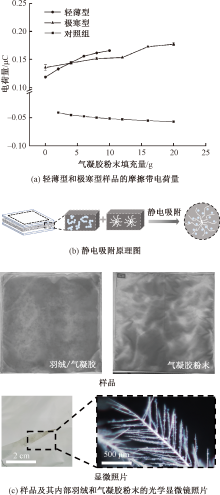
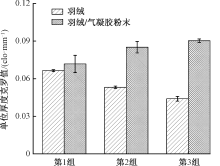
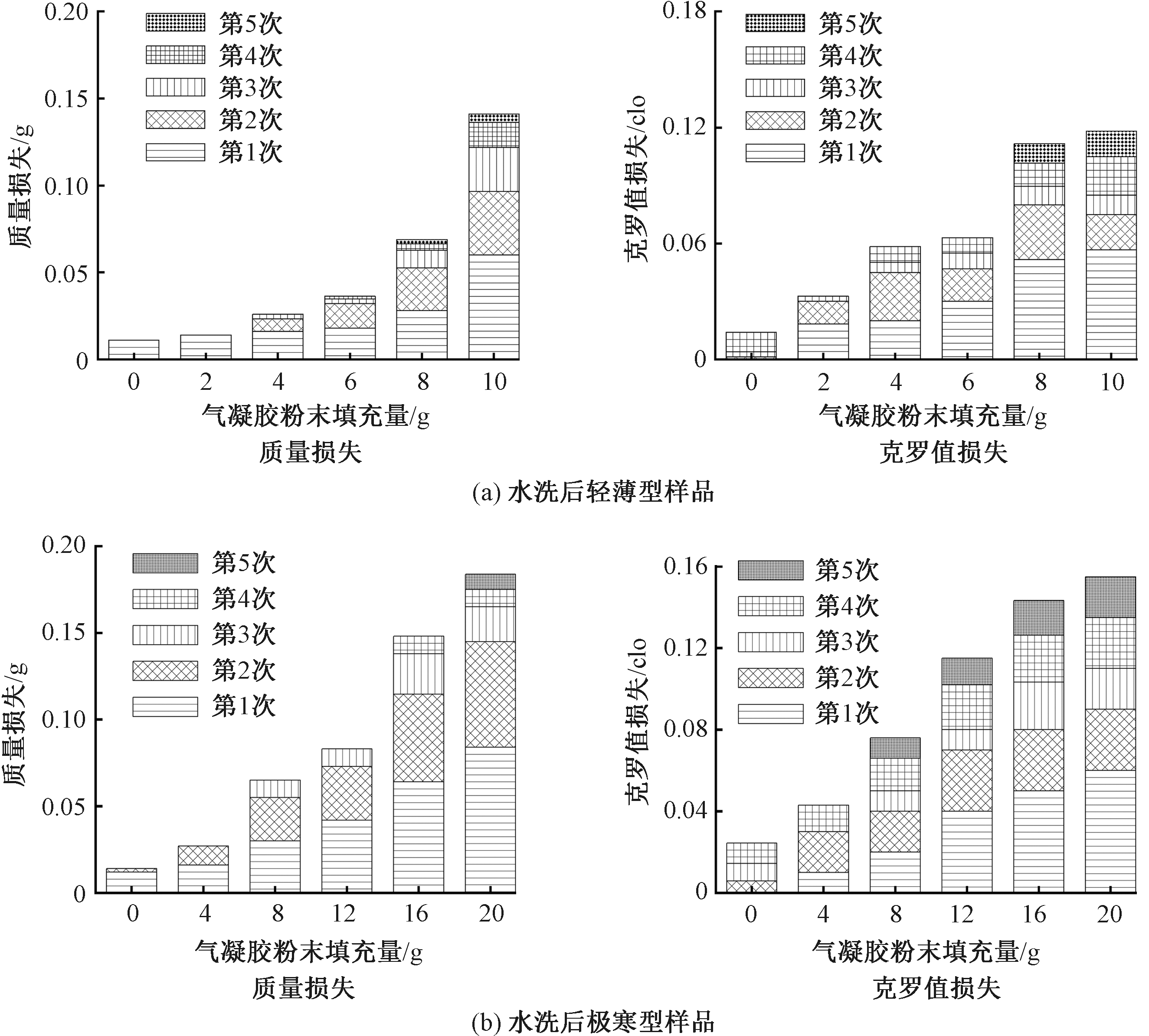
针对传统防寒服装厚重臃肿的缺点,且为有效解决气凝胶粉末填充材料易团聚、掉粉的问题,基于羽绒和气凝胶粉末2种经典保暖材料,巧妙利用羽绒易静电和气凝胶粉末质轻的特点,开发保暖性能更优的复合保暖材料。借助扫描电子显微镜、织物保温仪和全自动缩水率实验机等研究了静电场下羽绒与气凝胶粉末的分散机制和保暖效率。结果表明:在静电场的作用下,样品内SiO2气凝胶粉末均匀分散并吸附在绒丝上,相比于单一羽绒填充样品,气凝胶粉末替换部分羽绒后样品厚度由18 mm减少至11 mm,单位厚度克罗值提升了105.23%,证实羽绒与气凝胶粉末具有协同保暖效应。在轻薄型样品中,单一羽绒样品单位厚度克罗值为0.043 4 clo/mm,加入4.0 g的SiO2气凝胶粉末后,保暖材料的单位厚度克罗值最高达0.056 1 clo/mm,提升了29.26%;在极寒型样品中,单一羽绒样品单位厚度克罗值为0.028 6 clo/mm,加入12.0 g SiO2气凝胶粉末后,复合保暖材料的单位厚度克罗值高达0.039 7 clo/mm,提升了38.86%;复合保暖材料在水洗5次后质量损失仅有0.01 g,克罗值降低了0.02 clo,表现出优良的耐水洗性能。综合而言,与单一羽绒材料相比,羽绒/SiO2气凝胶复合保暖材料可在保证同等保暖效果的情况下有效降低材料厚度。
中图分类号:
| [1] | YANG L, YAN H, LAM J C. Thermal comfort and building energy consumption implications: a review[J]. Applied Energy, 2013, 115: 164-173. |
| [2] | YUNIKEWATY Y, DWI S. The role of green energy technologies development, carbon Finance, carbon tax and economic growth on environmental conditions in ASEAN countries[J]. International Journal of Energy Economics and Policy, 2023, 13(5): 558-565. |
| [3] | APOSTOLOPOULOU-KALKAVOURA V, MUNIER P, BERGSTRöM L. Thermally insulating nanocellulose-based materials[J]. Advanced Materials, 2021, 33(28): 1-17. |
| [4] |
NAKAMURA K. Central circuitries for body temperature regulation and fever[J]. American Journal of Physiology-Regulatory, Integrative and Comparative Physiology, 2011, 301: 1207-1228.
doi: 10.1152/ajpregu.00109.2011 pmid: 21900642 |
| [5] |
KONDO N, SHIBASAKI M, AOKI K, et al. Function of human eccrine sweat glands during dynamic exercise and passive heat stress[J]. Journal of Applied Physiology, 2001, 90: 1877-1881.
pmid: 11299281 |
| [6] |
HARDY J D, DUBOIS E F. Regulation of heat loss from the human body[J]. Proceedings of the National Academy of Sciences of the United States of America, 1937, 23: 624-631.
pmid: 16577831 |
| [7] | SHIBASAKI M, WILSON T E, CRANDALL C G. Neural control and mechanisms of eccrine sweating during heat stress and exercise[J]. Journal of Applied Physiology, 2006. DOI: 10.1002/zamm.200310061. |
| [8] | ZHANG X, CHAO X, LOU L, et al. Personal thermal management by thermally conductive composites: a review[J]. Composites Communications, 2021, 23: 1-18. |
| [9] | D'ALBA L, CARLSEN T H, ÁSGEIRSSON Á, et al. Contributions of feather microstructure to eider down insulation properties[J]. Journal of Avian Biology, 2017, 48(8): 1047-1088. |
| [10] | VENKATESWARA RAO A, HARANATH D. Effect of methyltrimethoxysilane as a synthesis component on the hydrophobicity and some physical properties of silica aerogels[J]. Microporous and Mesoporous Materials, 1999, 30:267-273. |
| [11] | SHEWALE P M, RAO A V, RAO A P. Effect of different trimethyl silylating agents on the hydrophobic and physical properties of silica aerogels[J]. Applied Surface Science, 2008, 254: 6902-6907. |
| [12] | ZHAO S, SIQUEIRA G, DRDOVA S, et al. Additive manufacturing of silica aerogels[J]. Nature, 2020, 584: 387-392. |
| [13] | LIU Z H, DING Y D, WANG F, et al. Thermal insulation material based on SiO2 aerogel[J]. Construction and Building Materials, 2016, 122: 548-555. |
| [14] | GANONYAN N, BENMELECH N, BAR G, et al. Entrapment of enzymes in silica aerogels[J]. Materials Today, 2020, 33: 24-35. |
| [15] | ASHRAF M A. Spectral and structural investigation of silica aerogels properties synthesized through several techniques[J]. Journal of Non-Crystalline Solids, 2021, 571: 1-7. |
| [16] | STEPANIAN C J, GOULD G L, BEGAG R. Aerogel composite with fibrous batting: 2002094426[P]. 2002-07-18. |
| [17] | WU H, CHEN Y, CHEN Q, et al. Synthesis of flexible aerogel composites reinforced with electrospun nanofibers and microparticles for thermal insulation[J]. Journal of Nanomaterials, 2013, 2013: 1-8. |
| [18] | MAZROUEI-SEBDANI Z, KHODDAMI A, HADADZADEH H, et al. Synthesis and performance evaluation of the aerogel-filled PET nanofiber assemblies prepared by electro-spinning[J]. RSC Advances, 2015, 5(17): 12830-12842. |
| [19] | YANG G, LIU X, LIPIK V. Evaluation of silica aerogel-reinforced polyurethane foams for footwear applications[J]. Journal of Materials Science, 2018, 53(13): 9463-9472. |
| [20] | ZOU H, ZHANG Y, GUO L, et al. Quantifying the triboelectric series[J]. Nature Communications, 2019, 10(1): 1-9. |
| [21] | ZOU H, ZHANG Y, GUO L, et al. Quantifying the triboelectric series[J]. Nature Communications, 2019, 10(1): 1-9. |
| [22] | 王琼. 羽绒服材料的配伍变化对保暖性的影响[D]. 上海: 东华大学, 2016:33-39. |
| WANG Qiong. Effect of compounding changes of down jacket materials on warmth retention[D]. Shanghai: Donghua University, 2016:33-39. | |
| [23] | 高晶. 羽绒纤维及其集合体结构和性能的研究[D]. 上海: 东华大学, 2006:49-51. |
| GAO Jing. Research on the structure and properties of down fibers and their aggregates[D]. Shanghai: Donghua University, 2006:49-51. | |
| [24] | 王革辉, 赵媛媛. 洗涤对不同絮料保暖性的影响[J]. 上海纺织科技, 2014, 42 (10): 52-55. |
| WANG Gehui, ZHAO Yuanyuan. Effect of washing on warmth retention of different wadding materials[J]. Shanghai Textile Science and Technology, 2014, 42 (10): 52-55. |
| [1] | 卜凡, 应丽丽, 李长龙, 王宗乾. 羽绒在乳酸/半胱氨酸低共熔溶剂中的溶解行为及其机制[J]. 纺织学报, 2023, 44(10): 24-30. |
| [2] | 谭林立, 秦柳, 李英儒, 邓伶俐, 谢知音, 李时东. 基于超临界二氧化碳的高效低阻聚丙烯熔喷纤维制备及其性能[J]. 纺织学报, 2023, 44(01): 87-92. |
| [3] | 万颖萍, 王宗乾, 王英沣, 杨海伟, 吴开明, 谢伟. 抗菌羽绒的短流程制备及其性能[J]. 纺织学报, 2023, 44(01): 149-155. |
| [4] | 吴佳玥, 吴巧英. 羽绒制品热传递的有限元仿真[J]. 纺织学报, 2022, 43(11): 154-162. |
| [5] | 张文欢, 江舒, 李俊. 羽绒服装系统的面积因子预测及适用性分析[J]. 纺织学报, 2022, 43(11): 148-153. |
| [6] | 吴黛唯, 黄家成, 王云仪. 服装形变对羽绒服隔热能力的影响[J]. 纺织学报, 2022, 43(09): 167-174. |
| [7] | 俞琰, 王西朝, 张瑞云, 李蓉丽, 程隆棣. 云南野生火草纤维及其绒网的结构与性能[J]. 纺织学报, 2022, 43(04): 10-14. |
| [8] | 应丽丽, 李长龙, 王宗乾, 王邓峰, 吴开明, 谢伟, 程欢. 植酸作用下锆离子修饰羽绒及其保温性能[J]. 纺织学报, 2020, 41(10): 94-100. |
| [9] | 张凌云, 钱晓明, 邹驰, 邹志伟. SiO2气凝胶/聚酯-聚乙烯双组分纤维复合保暖材料的制备及其性能[J]. 纺织学报, 2020, 41(08): 22-26. |
| [10] | 马颜雪, 王世娜, 李毓陵, 温润. 方格立衬结构机织物的一次成形设计实践[J]. 纺织学报, 2020, 41(06): 42-47. |
| [11] | 申莹 邓炳耀 刘庆生 夏赛男 姚鹏飞. 不同填充密度的梯度结构复合滤材的制备及其性能[J]. 纺织学报, 2017, 38(07): 23-27. |
| [12] | 曹继鹏 孙鹏子. 棉结在静电场中的运动规律[J]. 纺织学报, 2013, 34(8): 33-0. |
| [13] | 万旺军 邓同乐 计芬芬 葛建 付贤树 邬佳丽. 羽毛绒种类鉴定及气味检测方法研究[J]. 纺织学报, 2013, 34(3): 15-19. |
| [14] | 周岚;汤利桥;俞杭芳;邵建中;. 灰色羽绒的漂白技术[J]. 纺织学报, 2011, 32(1): 59-66. |
| [15] | 吴刚;赵珊红;王华雄;吴俭俭;郭方龙;王力君;谢维斌;宋保国;叶庆富. 加速溶剂萃取-高效液相色谱测定羽绒羽毛中的烷基苯酚与聚氧乙烯醚[J]. 纺织学报, 2010, 31(3): 72-77. |
|
||
 京公网安备11010502044800号