纺织学报 ›› 2025, Vol. 46 ›› Issue (09): 104-111.doi: 10.13475/j.fzxb.20241107501

• 纤维材料 • 上一篇    下一篇

基于近红外光谱和多特征网络的羊毛和羊绒定量检测

朱耀麟1, 李政1(), 张强2, 陈鑫1, 陈锦妮1, 张洪松3   

  1. 1.西安工程大学 电子信息学院, 陕西 西安 710000
    2.河北省产品质量监督检验研究院, 河北 石家庄 050091
    3.上海冉紫实业有限公司, 上海 201800
  • 收稿日期:2024-11-28 修回日期:2025-06-23 出版日期:2025-09-15 发布日期:2025-11-12
  • 通讯作者: 李政(1999—),男,硕士。主要研究方向为羊绒羊毛定性与定量检测。E-mail:m17855081621@163.com
  • 作者简介:朱耀麟(1977—),男,教授,博士。主要研究方向为羊绒羊毛识别。
  • 基金资助:
    榆林市科技局项目(YIKG-2023-04);榆林市科技局2024年产学研项目(2024-CXY-159);陕西省市场监督管理局2025年度省局重点科技研发项目(2025ZDKY01)

Quantitative detection of wool and cashmere based on near infrared spectroscopy and multi-feature network

ZHU Yaolin1, LI Zheng1(), ZHANG Qiang2, CHEN Xin1, CHEN Jinni1, ZHANG Hongsong3   

  1. 1. School of Electronics and Information, Xi'an Polytechnic University, Xi'an, Shaanxi 710000, China
    2. Hebei Research Institution for Product Quality Supervision and Inspection, Shijiazhuang, Hebei 050091, China
    3. Shanghai Ranzi Industry Co., Ltd., Shanghai 201800, China
  • Received:2024-11-28 Revised:2025-06-23 Published:2025-09-15 Online:2025-11-12

摘要:

在不同废旧纺织品中当羊绒或羊毛含量差异较小的情况下,传统检测模型在识别羊绒和羊毛含量时准确率和精度方面表现不佳。为解决这个问题,提出了一种基于近红外光谱和多特征网络的羊绒及羊毛定量检测方法。利用深度学习对羊绒、羊毛的近红外光谱进行分析,通过卷积神经网络(CNN)和长短时记忆网络(LSTM)提取光谱数据的特征吸收峰,同时结合多层感知机(MLP)进行纤维混合含量的定量检测。模型的“黑盒”特征提取过程中,通过卷积层和门控序列,不仅可以提取光谱中的单一波长,还能自动捕捉光谱数据中的连续吸收峰,显著提高了模型的识别精度和准确率,避免了人为特征选择的主观性和复杂性,且发现了人工可能忽略的吸收峰间的时序关系。实验结果表明,该模型在羊绒和羊毛含量检测中的R2值可达(0.945 8±0.029 5)。该方法能够通过自动学习数据中的关键特征,有效提升传统回归模型的检测性能。

关键词: 深度学习, 近红外光谱, 卷积神经网络, 长短时记忆网络, 定量检测, 羊绒, 羊毛

Abstract:

Objective Textiles with similar contents, such as cashmere and wool, are known to be tough to categorize. When their amounts in waste textiles are close, conventional detection models have difficulties to distinguish them. This often results in low accuracy in identifying cashmere and wool. This study aims to build a hybrid CNN-LSTM model combined with local feature extraction with temporal feature extraction, so as to detect cashmere and wool content accurately with near-infrared spectroscopy(NIR). This method is expected to extract the variations of absorption peaks and the relationship between absorption peaks, and then obtain the complex spectral variations.

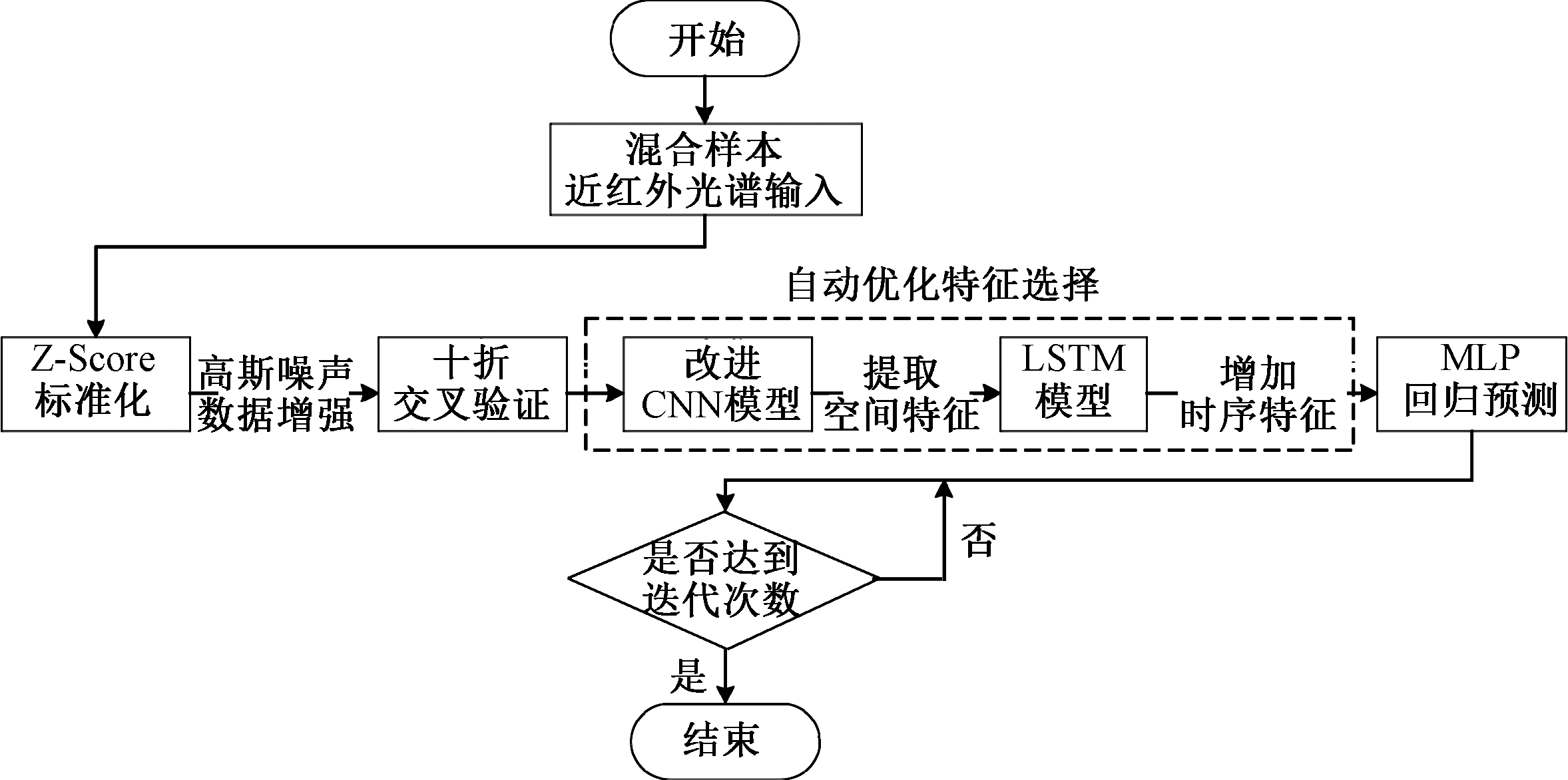
Method Cashmere and wool samples with similar colour radii are collected for preparing mixed samples of cashmere and wool in various ratios using the potassium bromide pressing method. Spectra using a near-infrared spectrometer are obtained to create a database, and the NIR spectral data are nomalized with the Z-Score algorithm, which helps remove differences in magnitude. Gaussian noise data enhancement follows to boost data diversity and the dataset is split using 10-fold cross-validation which is used as input to a hybrid CNN-LSTM model. MLP regression prediction is performed through the convolutional layer and gated sequence.

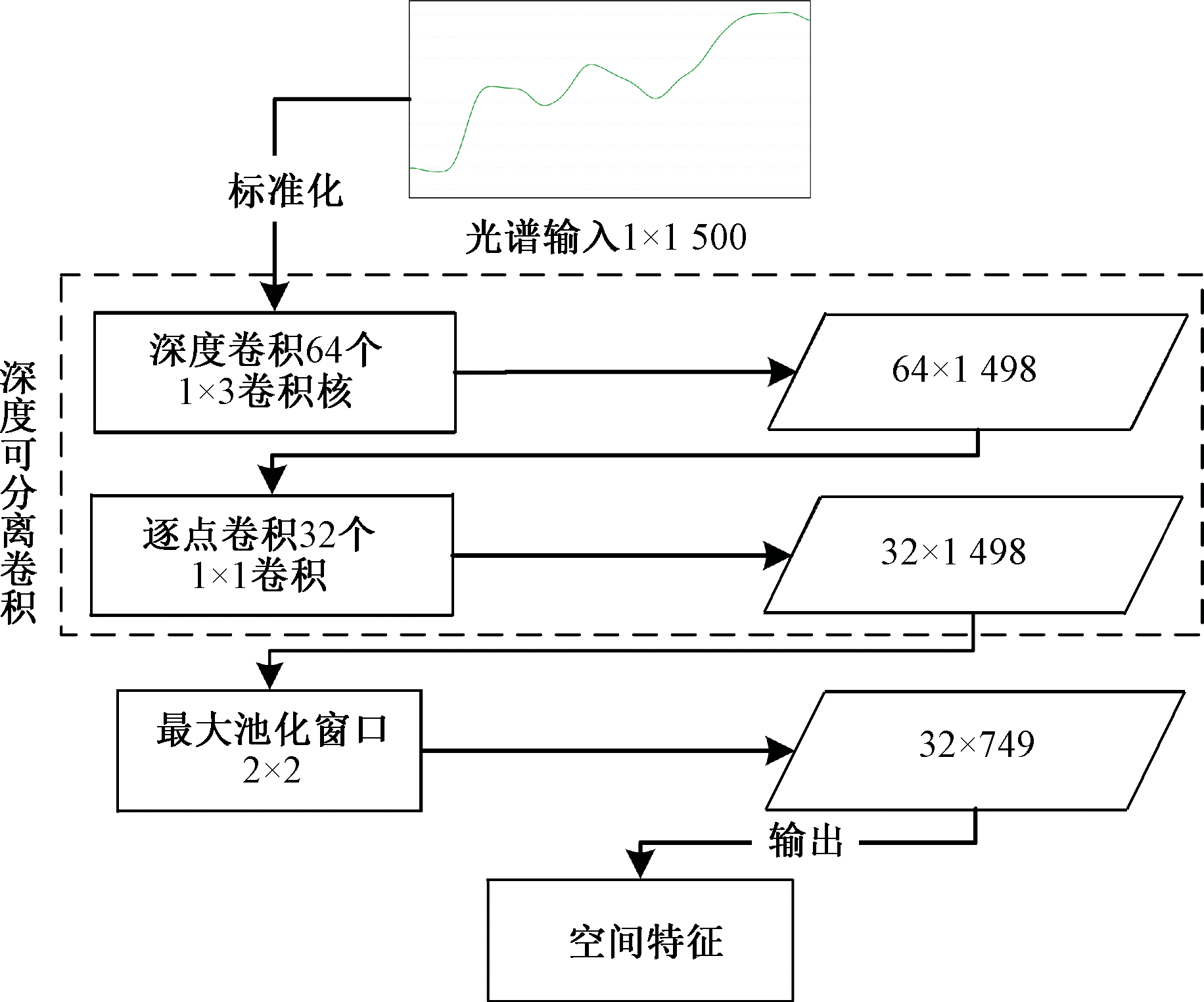
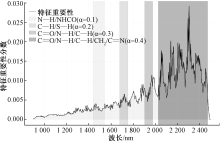
Result In the experiments, the improved CNN-LSTM-MLP model predicts cashmere and wool contents well. The model efficiently pulls out key spatial features from near-infrared spectral data which cuts down on processing time and boosts feature extraction efficiency. It uses depth-separable convolution to first identify peaks from chemical bond vibrations in the near-infrared spectra, and combines these features using stationary point convolution. The LSTM (long short-term memory) layer effectively captures the time-based relationships in spectral data to enhance the model's sensitivity to changes in spectral features. It also preserves contextual information across bands using forgetting gates and memory units. As a result, the model can focus on intensity changes in individual absorption peaks. It also learns patterns among several key bands, such as the connections between absorption peaks from 2 028 to 2 470 nm. By modelling the spectral sequence, LSTM reveals how different absorption peaks relate over time. It boosts the weight of continuous absorption peak bands, and allows it to better spot changes in mixing ratios and peak intensity, even with minor differences. The results show that the improved model predicts more accurately than the conventional methods. In the 10-fold cross-validation, most R2 values on the test set are above 0.95 and the MSE is below 0.01, indicating that the improved CNN-LSTM-MLP model is accurate and stable in analysing near-infrared spectroscopic data. It also offers strong support for quick and accurate detection of cashmere and wool content.

Conclusion The proposed new prediction model for cashmere and wool uses an enhanced CNN-LSTM-MLP architecture in combination with deep separable convolution (DSC) with conventional convolutional neural networks (CNN). This setup effectively extracts spatial features from near-infrared spectral data, and also models temporal features with LSTM layers. Quantitative predictions are achieved using a multilayer perceptron (MLP), and deep separable convolution cuts down the model's computational complexity, keeping rich channel information in the high-dimensional spectral data. The proposed model greatly improves prediction accuracy, and the efficient algorithm results in the need of little computing power to predict cashmere and wool contents. The model performs well in analysing cashmere and wool and it is practically useful for spectral analysis in real production.

Key words: deep learning, near-infrared spectroscopy, convolutional neural network, long short-term memory, quantitative detection, cashmere, wool

中图分类号: 

  • TP391.4

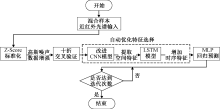
图1

定量检测方法整体预览"

表1

纤维类别及信息"

序号 类型 颜色 直径/μm
1 清河羊毛 白色 19.5
2 赤峰羊毛 白色 19.5
3 陕西羊毛 白色 19.5
4 Albas白羊绒 白色 14.9
5 Alashan羊绒 白色 14.5
6 Hanshan白绒 白色 15.0

图2

样品制备流程"

图3

算法总流程"

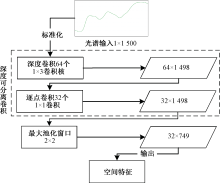
图4

CNN模型结构"

图5

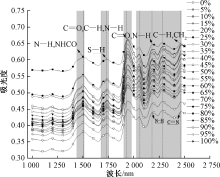
混合样品的近红外光特征波段"

表2

混合样品的分子振动模式及4个特征波段"

特征带/nm 光谱峰/nm 分子振动
1 439~1 542 1 504 N—H第1泛音,
组合拉伸C—H
1 678~1 751 1 733 S—H第1泛音
1 904~1 975 1 931 C=O的第2泛音,
N—H、NH的组合泛音2弯曲
2 028~2 470 2 026,2 180,
2 284
C=O的第2泛音,
N—H的组合拉伸和弯曲,
组合拉伸C—N,N—H的
第2泛音,组合拉伸C≡N

图6

混合样品近红外光谱各波段权重"

表3

10折交叉验证训练结果"

折数 评价指标 折数 评价指标
R2 MAE R2 MAE
1 0.898 0 0.005 1 6 1 0.898 0
2 0.990 4 0.001 8 7 2 0.990 4
3 0.962 7 0.003 1 8 3 0.962 7
4 0.960 6 0.002 6 9 4 0.960 6
5 0.950 2 0.002 5 10 5 0.950 2

图7

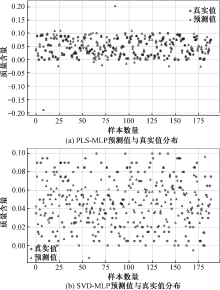
PLS、SVD对比模型实验结果"

表4

主流模型回归预测结果"

方法 R2 MSE
CNN-LSTM 0.945 8±0.029 5 0.003 2±0.001
ViT 0.934 3 0.003 28
TFT 0.873 3 0.007 38
[1] LAURA Navone, KAYLEE Moffitt, KAI-ANDERS Hansen, et al. Closing the textile loop: enzymatic fibre separation and recycling of wool/polyester fabric blends[J]. Waste Management, 2020, 102:149-160.
doi: 10.1016/j.wasman.2019.10.026
[2] 金美菊, 阮勇, 李翔, 等. 基于基因技术的羊绒与羊毛纤维定性鉴别方法[J]. 纺织学报, 2012, 33(8): 19-23.
JIN Meiju, RUAN Yong, LI Xiang, et al. Identification of cashmere and wool by genetic technology[J]. Journal of Textile Research, 2012, 33(8): 19-23.
[3] LUO Junli, LU Kai, CHEN Yonggang, et al. Automatic identification of cashmere and wool fibers based on microscopic visual features and residual network model[J]. Micron, 2021, 143, 103023.
doi: 10.1016/j.micron.2021.103023
[4] XING Wenyu, LIU Yiwen, DENG Na, et al. Automatic identification of cashmere and wool fibers based on the morphological features analysis[J]. Micron, 2020, 128,102768.
doi: 10.1016/j.micron.2019.102768
[5] ZHU Yaolin, DUAN Jiameng, WU Tong. Animal fiber imagery classification using a combination of random forest and deep learning methods[J]. Journal of Engineered Fibers and Fabrics, 2021. DOI: 10.1177/15589250211009333.
[6] ZHU Yaolin, WANG Xingze, GU Meihua, et al. Application of unsupervised feature selection in cashmere and wool fiber recognition[J]. Journal of Natural Fibers, 2024, 21(1), 2311306.
[7] ROLA H H, THOMAS B. Trends in artificial intelligence, machine learning, and chemometrics applied to chemical data[J]. Analytical Science Advances, 2021,2628-5452.
[8] YVES Roggo, PASCAL Chalus, LENE Maurer, et al. A review of near infrared spectroscopy and chemometrics in pharmaceutical technologies[J]. Journal of Pharmaceutical and Biomedical Analysis, 2007, 44(3): 683-700.
pmid: 17482417
[9] ZHOU Jinfeng, WANG Rongwu, WU Xiongying. Fiber-content measurement of wool-cashmere blends using near-infrared spectroscopy[J]. Applied Spectroscopy, 2017, 71(10): 2367-2376.
doi: 10.1177/0003702817713480 pmid: 28537417
[10] CHEN X, LAN Q, ZHU Y, et al. Non-destructive identification of wool and cashmere fibers based on cascade optimizations of interval-wavelength selection using NIR spectroscopy[J]. Journal of Natural Fibers, 2024, 21(1): 2409877.
doi: 10.1080/15440478.2024.2409877
[11] ZHU Y, ZHANG Y, CHEN X, et al. Non-destructive identification of virgin cashmere and chemically modified wool fibers based on fractional order derivative and improved wavelength extraction algorithm using nir spectroscopy and chemometrics[J]. Journal Of Natural Fibers, 2024, 21(1), 2409901.
doi: 10.1080/15440478.2024.2409901
[12] SUN Xiting, YUAN Hongfu, SONG Chunfeng, et al. A novel drying-free identification method of cashmere textiles by NIR spectroscopy combined with an adaptive representation learning classification method[J]. Microchemical Journal, 2019, 149,104018.
doi: 10.1016/j.microc.2019.104018
[13] FANG X, XIN B, ZHAN Z, et al. Classification of wool and cashmere fiber based on LBP and DWT features: performance comparison of random forest, AdaBoost, and KNN classifiers[J]. The Journal of The Textile Institute, 2025,1-13.
[14] GONG Ping, FENG Yuchao, WEI Peiling, et al. Rapid identification of scoured protein fibers using near-infrared spectroscopy with machine learning: a comparison of handheld and benchtop devices[J]. Microchemical Journal, 2025, 208,112398.
doi: 10.1016/j.microc.2024.112398
[1] 郑小虎, 杜思淇, 刘永青, 王健, 陈峰. 基于一维卷积神经网络的棉纱线质量预测[J]. 纺织学报, 2025, 46(09): 120-127.
[2] 张晓婷, 赵鹏宇, 潘如如, 高卫东. 基于深度特征融合的格子织物图像检索方法[J]. 纺织学报, 2025, 46(08): 89-95.
[3] 王青, 姜越夫, 赵恬恬, 赵世航, 刘甲怡. 基于深度学习的纱管位姿估计方法及抓取实验[J]. 纺织学报, 2025, 46(07): 217-226.
[4] 韩智慧, 万爱兰, 洪亮, 高丽忠, 夏风林. 羊毛纱经编整经损伤及其有限元模拟[J]. 纺织学报, 2025, 46(07): 103-110.
[5] 顾孟尚, 张宁, 潘如如, 高卫东. 结合频域卷积模块的机织物图像疵点目标检测[J]. 纺织学报, 2025, 46(05): 159-168.
[6] 朱梦慧, 葛美彤, 董智佳, 丛洪莲, 马丕波. 纬编双面羊毛/涤纶交织物的结构与热湿性能评价[J]. 纺织学报, 2025, 46(05): 179-185.
[7] 朱大全, 崔志华, 高普, 朱杰, 张斌, 朱跃文, 陈维国. 丝光羊毛的芳伯胺化修饰及其室温重氮偶合染色[J]. 纺织学报, 2025, 46(05): 186-194.
[8] 朱文硕, 薛元, 孙显强, 薛惊理, 金光. 基于七基色纤维的羊毛混色纱全色域配色[J]. 纺织学报, 2025, 46(04): 71-80.
[9] 白雨薇, 徐健, 朱耀麟, 丁展博, 刘晨雨. 基于改进YOLOv8的梳棉机棉网上棉结检测方法[J]. 纺织学报, 2025, 46(03): 56-63.
[10] 李欢, 孟文俊, 张京, 姜哲, 卫艺敏, 周曼, 王强. 低共熔溶剂体系中的羊毛靛蓝染料染色[J]. 纺织学报, 2025, 46(03): 123-130.
[11] 郭庆, 毛阳顺, 任亚杰, 刘济民, 王怀芳, 朱平. 基于漆酶一步催化法的羊毛织物原位染色及阻燃功能化[J]. 纺织学报, 2025, 46(02): 161-169.
[12] 黄小源, 侯珏, 杨阳, 刘正. 基于改进深度学习模型的高精度服装样板自动生成[J]. 纺织学报, 2025, 46(02): 236-243.
[13] 蔡丽玲, 王梅, 邵一兵, 陈炜, 曹华卿, 季晓芬. 基于改进堆叠生成对抗网络的传统汉服智能定制推荐[J]. 纺织学报, 2024, 45(12): 180-188.
[14] 刘燕萍, 郭佩瑶, 吴莹. 面向织物疵点检测的深度学习技术应用研究进展[J]. 纺织学报, 2024, 45(12): 234-242.
[15] 史晶晶, 杨恩龙. 喂入提前量对棉/羊毛段彩纱结构及性能的影响[J]. 纺织学报, 2024, 45(12): 67-73.
Viewed
Full text


Abstract

Cited

  Shared   
  Discussed   
No Suggested Reading articles found!