纺织学报 ›› 2026, Vol. 47 ›› Issue (02): 103-110.doi: 10.13475/j.fzxb.20250801101

• 纺织工程 • 上一篇    下一篇

精梳加工方法对涤纶/棉混纺织物舒适性能的影响

任毅1(), 冯清国2, 陈宇恒2, 王彦彦2   

  1. 1 中原工学院 智能服饰与服装学院, 河南 郑州 451191
    2 中原工学院 智能纺织与织物电子学院, 河南 郑州 451191
  • 收稿日期:2025-08-04 修回日期:2025-12-24 出版日期:2026-02-15 发布日期:2026-04-24
  • 作者简介:任毅(1986—),女,讲师,硕士。主要研究方向为纺织面料性能设计。E-mail: renyi13673712@163.com

Impact of combing processing on comfort properties of polyester/cotton blended fabrics

REN Yi1(), FENG Qingguo2, CHEN Yuheng2, WANG Yanyan2   

  1. 1 College of Fashion Technology, Zhongyuan University of Technology, Zhengzhou, Henan 451191, China
    2 College of Intelligent Textile and Textile Electronics, Zhongyuan University of Technology, Zhengzhou, Henan 451191, China
  • Received:2025-08-04 Revised:2025-12-24 Published:2026-02-15 Online:2026-04-24

摘要:

针对传统涤纶/棉混纺工艺难以满足高端织物在质量与舒适性方面的要求,提出一种新的纺纱工艺路线,即将棉纤维及涤纶分别精梳制成精梳条后混和纺纱。分别用新的纺纱工艺路线及传统纺纱工艺路线生产涤纶/棉(65/35)混纺纱线,采用相同的织造及染整工艺制成涤纶/棉混纺织物。测试2种织物的透气性、透湿性、凉感值、表面毛羽及柔软度等舒适性指标。结果表明新的纺纱工艺路线在改善织物舒适性能方面具有显著优势。采用新纺纱工艺路线生产的织物与传统工艺路线生产的织物相比:在热湿舒适性能方面,平均透气率提高9.7%,透气率CV值降低24%,透湿率增加12.6%,透湿率CV值降低55.5%;在触感舒适性方面,凉感值及其CV值分别降低6.8%、51.8%,经、纬向平均柔软度及其CV值分别降低32.9%、10.1%,粗糙度及其CV值分别降低5.4%、16.8%;在毛羽方面,经、纬向平均毛羽长度减少12.5%,其CV值降低56.9%。研究证实,采用涤纶/棉分别经过精梳后再经并条工序混和纺纱的方法,能全面提高混纺织物的舒适性能。

关键词: 纺纱工艺路线, 涤纶/棉混纺织物, 精梳, 热湿舒适性, 触感舒适性, 毛羽

Abstract:

Objective Blended yarns and fabrics can leverage the performance advantages of different fibers, representing a critical direction for the development of high-quality textile materials. To investigate the impact of combing processing on the comfort properties of polyester/cotton blended yarns and fabrics, a novel spinning process route was proposed, where cotton and polyester fibers were combed separately and then blended them during the drawing process to produce polyester-cotton blended yarns that were then used for making fabrics. Through testing and analysis of the comfort properties of such fabrics, the influence of the combing process route on the performance of blended fabrics was explored.

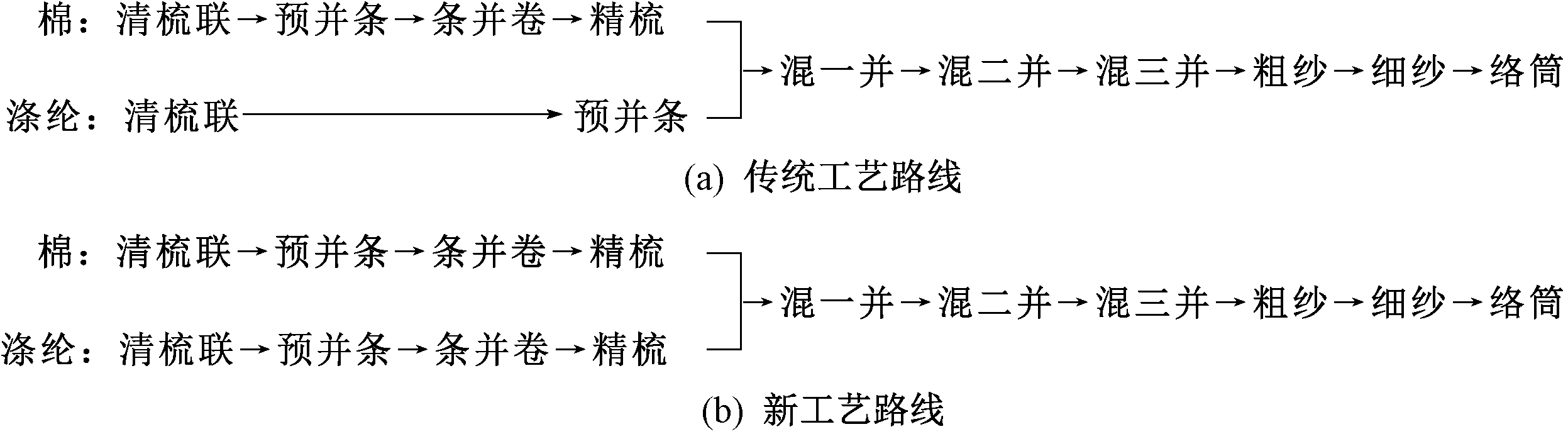
Methods Two different spinning processes were employed to produce polyester/cotton (65/35) blended yarns. For the first process which represent the conventional blended yarn making, the combed cotton fibers were blended with carded polyester slivers during the drawing operation followed by spinning. Following the second process known as the innovative process in this work, the cotton and polyester fibers were combed separately and then blended together during the drawing operation before moving to spinning. The two types of yarns were woven and finished using identical process parameters to produce fabric samples. A comparative analysis of the thermal-wet comfort properties of the two fabrics was conducted to investigate the impact of the combing process route on the comfort properties of the fabrics.

Results Systematic testing and comparison of the performance differences between the two fabrics across multiple comfort indicators revealed that the innovative process offers significant advantages in improving fabric comfort properties. In terms of thermal-wet comfort, compared to the fabric from conventional blended yarn, the fabric made from the innovative blended yarn exhibited a 9.7% increase in average air permeability and a 24% reduction in CV value of air permeability, and a 12.6% increase in moisture permeability and a 55.5% reduction in the CV value of moisture permeability. In terms of tactile comfort, compared to the conventional blended fabric, the innovative blended fabric showed a 6.8% reduction in cool feeling value and a 51.8% reduction in its CV value, a 32.9% decrease in average softness (warp and weft) and a 10% reduction in the softness CV value, a 5.4% reduction in roughness and a 16.8% reduction in its CV value, and a 12.5% reduction in the average length of surface hairiness (warp and weft) and a 56.9% reduction in its CV value. This study confirms that the innovative combing route can comprehensively enhance the comfort properties of the blended fabric.

Conclusion The fabric produced by using blended yarns made through the innovative coming route exhibits significantly improved air permeability and moisture permeability, along with greatly enhanced uniformity in these properties. The fabric softness and softness CV values are markedly reduced, and its smoothness and flatness are significantly improved. Although the cool feeling value slightly decreases, the uniformity of the cool feeling value is significantly enhanced, indicating more uniform and stable temperature sensation when the fabric contacts the skin. It demonstrates the technical advantages brought by the new approach in polyester-cotton blending, which alters the morphological structure of fibers in the yarn and improves yarn uniformity. Notably, the significant reduction in the coefficient of variation for various properties not only reflects the stability of product quality achieved by the innovative process but also highlights its reliability and reproducibility in industrial production, providing essential technical support for the development of high-end functional textiles.

Key words: spinning process route, polyester/cotton blended fabric, combing process, thermal-wet comfort, tactile comfort, hairiness

中图分类号: 

  • TS101.92

图1

涤纶/棉混纺传统工艺与新工艺路线"

表1

精梳工艺参数"

原料
类别
棉卷定量/
(g·m-1)
给棉
方式
给棉长
度/mm
落棉隔
距/mm
顶梳插入
深度
搭接
刻度
条子定量/
(g·m-1)
落纤
率/%
棉纤维 65 前进 4.7 9 0.0 1.0 8.4 15.3
涤纶 63 前进 4.7 10 -0.5 1.8 8.3 4.0

表2

并条、粗纱及细纱工序主要工艺参数"

工序名称 输出纱条线
密度/tex
总牵伸
倍数
后区牵伸
倍数
后区罗拉握
持距/mm
并合
根数
捻系数 速度/
(m·min-1)
锭速/
(r·min-1)
混一并 4 400.0 6.02 1.78 53.0 6 - 100 -
混二并 4 200.0 6.48 1.54 53.0 6 - 100 -
混三并 4 020.0 6.22 1.30 53.0 6 - 100 -
粗纱 590.0 7.05 1.24 60.4 - 80 - 800
细纱 16.6 38.24 1.10 45.9 - 335 - 14 000

表3

新工艺混纺纱与传统工艺混纺纱质量比较"

混纺纱
类别
条干CV
值/%
-50%细节/
(个·km-1)
+50%粗节/
(个·km-1)
+200%棉结/
(个·km-1)
IPI值/
(个·km-1)
强度/
(cN·tex-1)
强度CV
值/%
≥3 mm毛羽数/
(个·m-1)
传统工艺 12.2 0.3 25.1 71.5 96.9 27.5 8.4 4.0
新工艺 11.7 0.2 16.5 51.5 68.2 27.9 8.3 3.8

表4

主要织造工艺参数"

主要
工序
速度/
(m·min-1)
张力/
cN
加压/
cN
总经
根数
上浆
率/%
回潮
率/%
织轴盘
宽/cm
轴筒
个数
整经 600 - 8/6/4 (分段) 7 668 - - 165 12
浆纱 50 - - - 12~14 2~4 - -
织造 600 2 150 - 7 668 - - 165 -

表5

涤纶/棉混纺面料的透气性能"

面料类别 透气率/
(mm·s-1)
透气率
CV值/%
新工艺混纺面料 430.11 3.98
传统工艺混纺面料 392.09 5.24

表6

涤纶/棉混纺面料的透湿率"

面料类别 透湿率/
(g·m-2·d-1)
透湿率
CV值/%
新工艺混纺面料 1 665.96 3.22
传统工艺混纺面料 1 479.76 7.23

表7

涤纶/棉混纺面料的凉感值"

面料类别 凉感值/
(W·cm-2)
凉感值
CV值/%
新工艺混纺面料 0.164 2.53
传统工艺混纺面料 0.176 5.25

表8

涤纶/棉精梳混纺面料的柔软度"

面料类别 方向 柔软度/mm 柔软度CV值/%
新工艺混纺
面料
经向 258.9 2.85
纬向 242.1 2.11
传统工艺混
纺面料
经向 379.3 1.48
纬向 367.2 4.03

表9

涤纶/棉混纺面料的粗糙度"

面料类别 粗糙度/
μm
粗糙度
CV值/%
新工艺混纺面料 4.91 7.9
传统工艺混纺面料 5.19 9.5

表10

涤纶/棉精梳混纺面料的毛羽"

面料类别 毛羽长度/mm CV值/%
新工艺混纺面料 经向0.14 2.19
纬向0.14 2.11
传统工艺混纺面料 经向0.13 1.82
纬向0.19 8.15
[1] 罗玲. 医用压力袜舒适性综合评价方法及模型研究[D]. 上海: 东华大学, 2023: 6-9.
LUO Ling. Comprehensive evaluation method and model research on the comfort of medical compression stockings[D]. Shanghai: Donghua University, 2023: 6-9.
[2] 张慧丹, 余琴. 莱赛尔面料的舒适性评价分析[J]. 棉纺织技术, 2022, 50(8): 61-64.
ZHANG Huidan, YU Qin. Comfort evaluation and analysis of lyocell fabric[J]. Cotton Textile Technology, 2022, 50(8): 61-64.
[3] 关燕, 林旭, 臧勇, 等. Coolplus纤维的吸湿速干性能及其产品的开发[J]. 纺织科学研究, 2002(4):16-19.
GUAN Yan, LIN Xu, ZANG Yong, et al. Moisture absorption and quick drying properties of Coolplus fiber and its product development[J]. Textile Science Research, 2002(4):16-19.
[4] 张一平, 许瑞超, 陈莉娜. 纤维异形度对织物导湿快干性能的影响[J]. 纺织学报, 2006, 27(12): 70-73, 76.
ZHANG Yiping, XU Ruichao, CHEN Lina. Effect of fiber profile on moisture conductivity and quick drying performance of fabric[J]. Journal of Textile Research, 2006, 27(12): 70-73, 76.
[5] 郑丹丹. 异形亲水超仿棉聚酯纤维纺纱工艺与针织物热湿舒适性研究[D]. 上海: 东华大学, 2016: 27-29.
ZHENG Dandan. Study on spinning process and thermal-wet comfort of knitted fabrics made from profiled hydrophilic ultra-cotton-like polyester fiber[D]. Shanghai: Donghua University, 2016: 27-29.
[6] 王革辉, 李学慧, 赵涛, 等. 柔软整理对纯棉针织物服用性能的影响[J]. 针织工业, 2013(11): 47-50.
WANG Gehui, LI Xuehui, ZHAO Tao, et al. Influence of softening finishing on wearability of pure cotton knitted fabric[J]. Knitting Industries, 2013(11): 47-50.
[7] 谢春萍, 王建坤, 任家智. 纺纱工程(上册)[M]. 北京: 中国纺织出版社, 2019:5-20.
XIE Chunping, WANG Jiankun, REN Jiazhi. Spinning engineering:I[M]. Beijing: China Textile & Apparel Press, 2019:5-20.
[8] 任家智. 纺纱工艺学[M]. 上海: 东华大学出版社, 2010:64-67.
REN Jiazhi. Spinning technology[M]. Shanghai: Donghua University Press, 2010:64-67.
[9] 陈宇恒. 涤棉精梳混纺工艺研究[D]. 郑州: 中原工学院, 2016:41-45.
CHEN Yuheng. Research on polyester-cotton combed blending process[D]. Zhengzhou: Zhongyuan University of Technology, 2016:41-45.
[10] 徐铭九, 高兴. 纤维伸直度对输出纱条条干不匀率的影响[J]. 纺织学报, 1989, 10(2): 4-8.
XU Mingjiu, GAO Xing. Influence of fiber straightness on evenness of delivery sliver[J]. Journal of Textile Research, 1989, 10(2): 4-8.
[11] 陈可, 张娣, 吉宜军, 等. 精梳涤纶条含量对涤纶针织物性能的影响[J]. 纺织学报, 2021, 42(9): 66-69.
CHEN Ke, ZHANG Di, JI Yijun, et al. Effect of combed polyester sliver content on properties of polyester knitted fabric[J]. Journal of Textile Research, 2021, 42(9): 66-69.
[12] 陈宇恒, 任家智, 杨天琪, 等. 精梳工艺对涤/粘混纺纱质量的影响[J]. 棉纺织技术, 2023, 51(12):68-71.
CHEN Yuheng, REN Jiazhi, YANG Tianqi, et al. Influence of combing process on quality of polyester/viscose blended yarn[J]. Cotton Textile Technology, 2023, 51(12):68-71.
[13] 郁崇文. 纺纱学[M]. 北京: 中国纺织出版社, 2024: 115-118.
YU Chongwen. Spinning science[M]. Beijing: China Textile & Apparel Press, 2024:115-118.
[14] 任家智. 纺织工艺与设备(上册)[M]. 北京: 中国纺织出版社, 2004:104-110.
REN Jiazhi. Textile technology and equipment (I)[M]. Beijing: China Textile & Apparel Press, 2004:104-110.
[15] 宋冰鹏. 精梳、普梳纱线织物产品性能研究[D]. 郑州: 中原工学院, 2020:9-20.
SONG Bingpeng. Research on the properties of combed and carded yarn fabrics[D]. Zhengzhou: Zhongyuan University of Technology, 2020:9-20.
[1] 刘荣芳, 李新荣, 李理, 袁程栩. 基于谐振腔微扰理论的精梳条条干质量在线微波检测方法[J]. 纺织学报, 2026, 47(01): 223-230.
[2] 沈昕怡, 李家炜, 邵宇, 郭丁滔, 何贵平, 赵磊, 戚栋明, YOUSSEF Yehya Abel-Gawad, KAFAFY Hany Hassan Ahmed Mohamed. 高色牢度反应性聚合物包覆炭黑直喷墨水制备及其印花性能[J]. 纺织学报, 2025, 46(12): 152-162.
[3] 王彪, 李新荣, 刘荣芳, 李理. 棉精梳机分离罗拉传动中直齿轮初始齿隙分析[J]. 纺织学报, 2025, 46(12): 216-223.
[4] 徐丽丽, 腾燕飞, 马丕波, 万爱兰. 户外仿生结构功能面料的开发及其性能[J]. 纺织学报, 2025, 46(11): 94-101.
[5] 蔡丽云, 欧阳承辉, 黄泽洋, 王成成, 关玉, 付少海, 张丽平. 彩色乳胶粒的制备及其在涤纶/棉混纺织物印花中的应用[J]. 纺织学报, 2025, 46(10): 135-142.
[6] 许微辉, 朱婷婷, 万爱兰, 马丕波. 基于仿生结构的抗菌无缝瑜伽服研发及其热湿舒适性[J]. 纺织学报, 2025, 46(10): 187-196.
[7] 刘楚, 张向辉, 张昭华, 牛文鑫, 王诗潭. 皮肤湿感觉的神经传导与脑区响应研究现状[J]. 纺织学报, 2025, 46(10): 247-254.
[8] 王旭真, 任家智, 贾国欣, 杨天琪, 李季平. 精梳过程中棉短纤排除机制及实验研究[J]. 纺织学报, 2025, 46(10): 54-61.
[9] 罗玉玲, 杨喜竹, 王星岚, 郑晓慧, 赵胜男, 常素芹. 以相变包为冷源的冷却服研究进展[J]. 纺织学报, 2025, 46(07): 253-261.
[10] 韩智慧, 万爱兰, 洪亮, 高丽忠, 夏风林. 羊毛纱经编整经损伤及其有限元模拟[J]. 纺织学报, 2025, 46(07): 103-110.
[11] 杨天琪, 任家智, 王旭真, 陈宇恒. 混合精梳纤维卷投料比数学模型构建与应用[J]. 纺织学报, 2025, 46(07): 62-68.
[12] 朱梦慧, 葛美彤, 董智佳, 丛洪莲, 马丕波. 纬编双面羊毛/涤纶交织物的结构与热湿性能评价[J]. 纺织学报, 2025, 46(05): 179-185.
[13] 杨琪, 周晓钰, 季静, 戴宏钦. 化学防护服内湿度调节装置的设计与性能评价[J]. 纺织学报, 2025, 46(05): 262-269.
[14] 马文佳, 刘新金. 牵伸区内纤维变速点分布对半精梳棉条质量的影响[J]. 纺织学报, 2025, 46(04): 56-62.
[15] 姚一婷, 敖利民, 张展望, 苏友朋. 针织呢绒织物绒面性质的测试方法[J]. 纺织学报, 2025, 46(03): 100-108.
Viewed
Full text


Abstract

Cited

  Shared   
  Discussed   
No Suggested Reading articles found!