纺织学报 ›› 2026, Vol. 47 ›› Issue (07): 261-269.doi: 10.13475/j.fzxb.20260100302
宋金洋1,2, 房宽峻1,2( )
)
SONG Jinyang1,2, FANG Kuanjun1,2()
摘要:
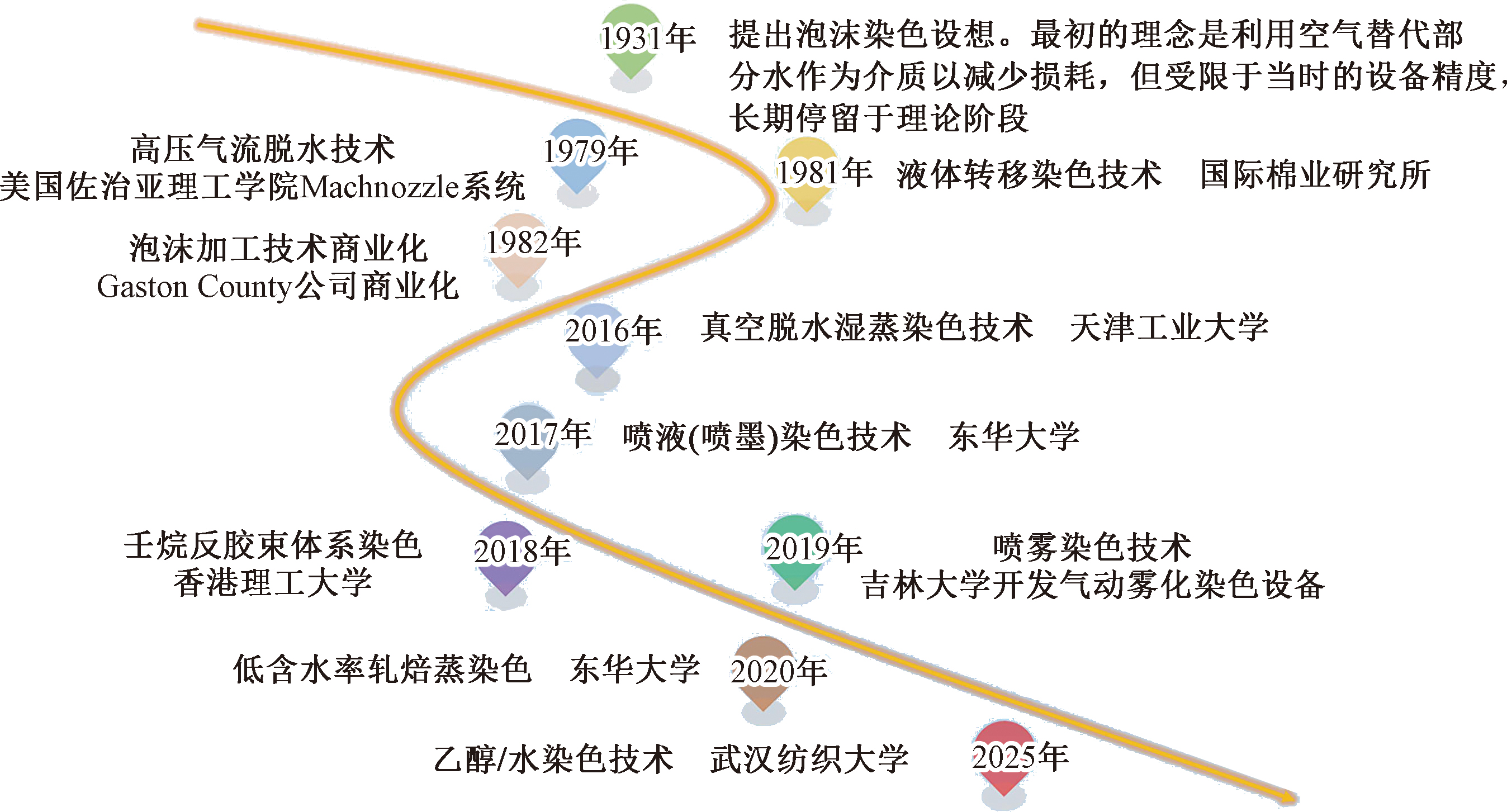
针对传统纤维素纤维活性染料染色工艺中存在的水资源消耗量大与染料利用率低的问题,系统综述了低给液染色技术领域的最新研究进展。通过精确调控织物带液率并优化织物内水分分布状态,可从源头有效抑制活性染料水解动力学过程,进而显著提升染料固着效率。分析并比较了2类主要技术路径:其一为减量式给液途径,借助真空抽吸、高压气流冲击、低温预烘等脱水手段移除多余液体,该路径优势在于初始染液渗透充分、染色均匀性优良,然而其亦面临水资源消耗总量未获实质性削减与脱水单元能耗偏高的技术悖论;其二为计量式给液途径,涵盖泡沫施加、液体转移、喷雾沉积、喷墨打印以及非水介质辅助施液等工艺方式,此类技术展现出极高的资源利用效率,但由于缺乏机械挤压作用,常面临染液渗透性不足与匀染性欠佳的问题。最后指出,未来研究应着重关注染整工艺与装备系统的协同创新,借助数字化手段构建基于织物特征参数的自适应智能给液体系,以驱动印染行业迈向高质量可持续发展之路。
中图分类号:
| [1] | 吴伟, 纪柏林, 毛志平. 活性及分散染料染色新技术[J]. 纺织学报, 2023, 44(5): 1-12. |
|
WU Wei, JI Bolin, MAO Zhiping. Review of new dyeing technologies for reactive dyes and disperse dyes[J]. Journal of Textile Research, 2023, 44(5): 1-12.
doi: 10.1177/004051757404400101 |
|
| [2] |
LEWIS D M. Developments in the chemistry of reactive dyes and their application processes[J]. Coloration Technology, 2014, 130(6): 382-412.
doi: 10.1111/cote.2014.130.issue-6 |
| [3] |
KHATRI A, PEERZADA M H, MOHSIN M, et al. A review on developments in dyeing cotton fabrics with reactive dyes for reducing effluent pollution[J]. Journal of Cleaner Production, 2015, 87: 50-57.
doi: 10.1016/j.jclepro.2014.09.017 |
| [4] |
SHU D W, FANG K J, LIU X M, et al. Cleaner pad-steam dyeing technology for cotton fabrics with excellent utilization of reactive dye[J]. Journal of Cleaner Production, 2019, 241: 118370.
doi: 10.1016/j.jclepro.2019.118370 |
| [5] |
SHU D W, FANG K J, LIU X M, et al. Cleaner coloration of cotton fabric with reactive dyes using a pad-batch-steam dyeing process[J]. Journal of Cleaner Production, 2018, 196: 935-942.
doi: 10.1016/j.jclepro.2018.06.080 |
| [6] | SHORE J. Cellulosics dyeing[M]. Bradford, West Yorkshire: Society of Dyers and Colourists, 1995: 221-223. |
| [7] |
O’NEILL H, PINGALI S V, PETRIDIS L, et al. Dynamics of water bound to crystalline cellulose[J]. Scientific Reports, 2017, 7: 11840.
doi: 10.1038/s41598-017-12035-w pmid: 28928470 |
| [8] |
IGARASHI T, HOSHI M, NAKAMURA K, et al. Direct observation of bound water on cotton surfaces by atomic force microscopy and atomic force microscopy-infrared spectroscopy[J]. The Journal of Physical Chemistry C, 2020, 124(7): 4196-4201.
doi: 10.1021/acs.jpcc.0c00423 |
| [9] |
ZHAO H, CHEN Z, DU X F, et al. Contribution of different state of adsorbed water to the sub-Tg dynamics of cellulose[J]. Carbohydrate Polymers, 2019, 210: 322-331.
doi: 10.1016/j.carbpol.2019.01.087 |
| [10] | 赵涛. 染整工艺与原理-下册[M]. 2版. 北京: 中国纺织出版社, 2020: 42-44. |
| ZHAO Tao. Dyeing and finishing technology and principles-volume II[M]. 2nd ed. Beijing: China Textile & Apparel Press, 2020: 42-44. | |
| [11] |
MAO Z P, YU H, WANG Y F, et al. States of water and pore size distribution of cotton fibers with different moisture ratios[J]. Industrial & Engineering Chemistry Research, 2014, 53(21): 8927-8934.
doi: 10.1021/ie501071h |
| [12] | 龙红霞, 吴伟, 刘娅岚, 等. 纤维素纤维孔道吸湿溶胀行为的分子动力学模拟[J]. 纺织学报, 2025, 46(11): 155-163. |
|
LONG Hongxia, WU Wei, LIU Yalan, et al. Molecular dynamics simulation of hygroscopic swelling behavior of porous cellulose fibers[J]. Journal of Textile Research, 2025, 46(11): 155-163.
doi: 10.1177/004051757604600301 |
|
| [13] | 张鑫卿. 棉织物的活性染料浸轧—真空脱水—汽蒸染色研究[D]. 天津: 天津工业大学, 2017: 97-99. |
| ZHANG Xinqing. Study on reactive dye padding-vacuum dehydration-steaming dyeing of cotton fabric[D]. Tianjin: Tianjin Polytechnic University, 2017: 97-99. | |
| [14] |
ZHANG J F, ZHANG X Q, FANG K J, et al. Effect of the water content of padded cotton fabrics on reactive dye fixation in the pad-steam process[J]. Coloration Technology, 2017, 133(1): 57-64.
doi: 10.1111/cote.2017.133.issue-1 |
| [15] |
ZHANG X Q, FANG K J, ZHANG J F, et al. A vacuum-dehydration aided pad-steam process for improving reactive dyeing of cotton fabric[J]. Journal of Cleaner Production, 2017, 168: 1193-1200.
doi: 10.1016/j.jclepro.2017.09.112 |
| [16] | 张鑫卿, 张健飞, 房宽峻, 等. 活性金黄SRE对棉织物的浸轧-真空脱水-湿蒸染色工艺[J]. 纺织学报, 2017, 38(6): 80-85. |
| ZHANG Xinqing, ZHANG Jianfei, FANG Kuanjun, et al. Padding vacuum-dewatering wet-steaming dyeing of cotton fabric using reactive golden yellow SRE[J]. Journal of Textile Research, 2017, 38(6): 80-85. | |
| [17] | 张鑫卿, 张健飞, 房宽峻, 等. 应用活性蓝19的棉织物低含水率-湿蒸染色工艺[J]. 纺织学报, 2017, 38(2): 129-133. |
| ZHANG Xinqing, ZHANG Jianfei, FANG Kuanjun, et al. Low-water content wet-steaming fixation of cotton fabric padded with reactive blue 19[J]. Journal of Textile Research, 2017, 38(2): 129-133. | |
| [18] | 陈小文. 棉织物活性染料低含潮率轧焙蒸染色研究[D]. 上海: 东华大学, 2021: 10-14. |
| CHEN Xiaowen. Study on a low-moisture content pad-bake-steam technology of cotton fabric dyed with reactive dyestuff[D]. Shanghai: Donghua University, 2021: 10-14. | |
| [19] | 陈小文, 吴伟, 钟毅, 等. 棉织物的活性染料低含水率焙蒸固色工艺[J]. 纺织学报, 2021, 42(7): 115-122. |
| CHEN Xiaowen, WU Wei, ZHONG Yi, et al. Low-moisture content baking and steaming color fixation process for cotton fabrics padded with reactive dyes[J]. Journal of Textile Research, 2021, 42(7): 115-122. | |
| [20] | 吴伟, 陈小文, 钟毅, 等. 硫酸钠在低带液轧-焙-蒸活性染料染色中的作用[J]. 纺织学报, 2020, 41(5): 85-93. |
| WU Wei, CHEN Xiaowen, ZHONG Yi, et al. Role of sodium sulfate in low add-on pad-cure-steam reactive dyeing process[J]. Journal of Textile Research, 2020, 41(5): 85-93. | |
| [21] | 毛志平, 闫英山, 盛守祥, 等. 一种活性染料潮固色染色方法: CN113529440B[P]. 2023-05-12. |
| MAO Zhiping, YAN Yingshang, SHENG Shouxiang, et al. A moisture fixation dyeing method for reactive dyes: CN113529440B[P], 2023-05-12. | |
| [22] | ISLAM M T, ASADUZZAMAN S. Environment-friendly textile finishing[M]//SHABBIR M. Textiles and clothing:environmental concerns and solutions. Hoboken, NJ: John Wiley & Sons, Inc., 2019: 122-123. |
| [23] | 陈英, 宋富佳, 李成红, 等. 少水及无水染色技术的研究进展[J]. 纺织导报, 2021(5): 26-31. |
| CHEN Ying, SONG Fujia, LI Chenghong, et al. Research progress of less water and anhydrous dyeing technology[J]. China Textile Leader, 2021(5): 26-31. | |
| [24] | SIDDIQUE A, KHAWAR M T, XU Z W, et al. Foam dyeing: a review of its potential to reshape sustainable textile processing[J]. Textile Research Journal, 2025: 00405175251324669. |
| [25] | 张晓云, 赵文杰, 冒晓东, 等. 活性染料泡沫染色技术[J]. 染整技术, 2016, 38(2): 12-16. |
| ZHANG Xiaoyun, ZHAO Wenjie, MAO Xiaodong, et al. Foam dyeing technology of reactive dyes[J]. Textile Dyeing and Finishing Journal, 2016, 38(2): 12-16. | |
| [26] |
ZHU D D, WAN Z, ZHAO X Y, et al. Foaming indigo: an efficient technology for yarn dyeing[J]. Dyes and Pigments, 2022, 197: 109862.
doi: 10.1016/j.dyepig.2021.109862 |
| [27] |
MOHSIN M, SARDAR S, AKHTAR K S, et al. Performance enhancement of water and energy efficient foam dyeing and finishing through different foaming agents[J]. Journal of Natural Fibers, 2023, 20(1): 2164102.
doi: 10.1080/15440478.2022.2164102 |
| [28] |
HOQUE E, ACHARYA S, SHAMSHINA J, et al. Review of foam applications on cotton textiles[J]. Textile Research Journal, 2023, 93(1/2): 486-501.
doi: 10.1177/00405175221107400 |
| [29] |
MOHSIN M, SARDAR S, HASSAN M, et al. Novel, sustainable and water efficient nano bubble dyeing of cotton fabric[J]. Cellulose, 2020, 27(10): 6055-6064.
doi: 10.1007/s10570-020-03187-6 |
| [30] |
SHI G G, HUANG Z Y, CAO Y W, et al. Eco-friendly foam dyeing of cellulose fibres using keratin biomacromolecules extracted from waste rabbit hair[J]. International Journal of Biological Macromolecules, 2025, 314: 144075.
doi: 10.1016/j.ijbiomac.2025.144075 |
| [31] | CHOUDHURY A K R. Principles of textile finishing[M]. Duxford: The Textile Insitute, 2017: 11-13. |
| [32] |
MAO X D, ZHONG Y, XU H, et al. A novel low add-on technology of dyeing cotton fabric with reactive dyestuff[J]. Textile Research Journal, 2018, 88(12): 1345-1355.
doi: 10.1177/0040517517700195 |
| [33] | 冒晓东. 新型棉织物活性染料低给液染色研究[D]. 上海: 东华大学, 2017: 20-43. |
| MAO Xiaodong. Research on a novel low add-on technology of dyeing cotton fabric with reactive dyestuff[D]. Shanghai: Donghua University, 2017: 20-43. | |
| [34] | 谈智鑫. 纱线彩点喷染技术及其配色模型研究[D]. 杭州: 浙江理工大学, 2015: 10-21. |
| TAN Zhixin. Study on spray dyeing technology of yarns with color fiber circle and its color matching model[D]. Hangzhou: Zhejiang Sci-Tech University, 2015: 10-21. | |
| [35] |
LIN L N, ZHU W J, ZHANG C, et al. Combination of wet fixation and drying treatments to improve dye fixation onto spray-dyed cotton fabric[J]. Scientific Reports, 2021, 11: 15403.
doi: 10.1038/s41598-021-94885-z pmid: 34321606 |
| [36] |
MULDER R, MORSHED M N, SEIPEL S, et al. Study on hydraulic spray atomizing system as a new resource-efficient dyeing-finishing method for wool fabric[J]. Scientific Reports, 2022, 12: 21814.
doi: 10.1038/s41598-022-26172-4 pmid: 36528699 |
| [37] | 黄涛, 任栋梁. 一种喷雾式地毯染色装置: CN222795945U[P]. 2025-04-25. |
| HUANG Tao, REN Dongliang. A spray-type carpet dyeing device: CN222795945U[P], 2025-04-25. | |
| [38] | 张恒迪. 双流体雾化喷嘴流场数值模拟及布局优化[D]. 上海: 东华大学, 2024: 45-57. |
| ZHANG Hengdi. Numerical simulation of two-fluid atomizing nozzle flow field and layout optimization[D]. Shanghai: Donghua University, 2024: 45-57. | |
| [39] | 许长海, 李梓晨, 蒋晓东, 等. 一种基于静电喷雾技术的羊毛纤维染色方法: CN120401252A[P]. 2025-08-01. |
| XU Changhai, LI Zichen, JIANG Xiaodong, et al. A dyeing method for wool fibers based on electrostatic spray technology: CN1204401252A[P], 2025-08-01. | |
| [40] | 苏国鑫, 师文钊, 刘瑾姝, 等. 棉织物活性染料雾化染色工艺研究[J]. 科学技术创新, 2023(9): 33-36. |
| SU Guoxin, SHI Wenzhao, LIU Jinshu, et al. Atomizing dyeing technology of cotton fabric with reactive dyes[J]. Scientific and Technological Innovation, 2023(9): 33-36. | |
| [41] | 江海. 基于气液两相混合的雾化宽幅喷涂阀的设计及试验研究[D]. 长春: 吉林大学, 2019: 79-128. |
| JIANG Hai. Design and experimental study of atomization wide spray valve based on the gas-liquid two-phase mixing[D]. Changchun: Jilin University, 2019: 79-128. | |
| [42] | 刘建芳, 顾守东, 李风龙, 等. 一种单色内雾化长喷幅喷染设备及其控制系统: CN106702630B[P]. 2023-09-05. |
| LIU Jianfang, GU Shoudong, LI Fenglong, et al. A single-color internal misting long spray-width dyeing equipment and its control system: CN106702630B[P], 2023-09-05. | |
| [43] | 刘建芳, 江海, 顾守东, 等. 一种单色外雾化长喷幅喷染设备及其控制系统: CN106702629B[P], 2023-08-04. |
| LIU Jianfang, JIANG Hai, GU Shoudong, et al. A single-color external atomization long spray-width dyeing equipment and its control system: CN106702629B[P], 2023-08-04. | |
| [44] | 刘旭. 一种喷雾式纺织布染色机喷头调节装置: CN210048953U[P]. 2020-02-11. |
| LIU Xu. A nozzle adjustment device for a spary-type textile fabric dyeing machine:CN210048953U[P].2020-02-11. | |
| [45] | 徐远理. 一种二元喷雾连续汽蒸染色法: CN109837681A[P]. 2019-06-04. |
| XU Yuanli. A binary spray continuous steam dyeing method: CN109837681A[P].2019-06-04. | |
| [46] |
AN Y, MA J R, ZHU Z X, et al. Study on a water-saving and salt-free reactive dyeing of cotton fabrics in non-aqueous medium of liquid paraffin system[J]. The Journal of the Textile Institute, 2020, 111(10): 1538-1545.
doi: 10.1080/00405000.2020.1711552 |
| [47] |
PEI L J, LI H, SHEN J F, et al. Salt-free dyeing of cotton fabric and adsorption of reactive dyes in non-aqueous dyeing system: equilibrium, kinetics, and thermodynamics[J]. Cellulose, 2022, 29(8): 4753-4765.
doi: 10.1007/s10570-022-04576-9 |
| [48] |
TANG A Y, LEE C H, WANG Y M, et al. Dyeing properties of cotton with reactive dye in nonane nonaqueous reverse micelle system[J]. ACS Omega, 2018, 3(3): 2812-2819.
doi: 10.1021/acsomega.8b00032 pmid: 31458557 |
| [49] |
TANG A Y, LEE C H, WANG Y M, et al. Octane-assisted reverse micellar dyeing of cotton with reactive dyes[J]. Polymers, 2017, 9(12): 678.
doi: 10.3390/polym9120678 |
| [50] |
HU W J, WANG X F, CAI M Y, et al. Environmentally friendly salt-free and low-alkaline coloration of lyocell fibers in an ethanol-water mixture with excellent exhaustion[J]. Green Chemistry, 2025, 27(14): 3751-3763.
doi: 10.1039/D5GC00154D |
| [51] |
PERIYASAMY A P, DUTTA S, TEHRANI-BAGHA A R. Solvent-assisted salt-free reactive dyeing of cotton fabric[J]. Cellulose, 2024, 31(11): 7101-7118.
doi: 10.1007/s10570-024-05928-3 |
| [1] | 王鑫杨, 乔曦冉, 徐成书, 王慧杰, 任燕, 韩彬, 徐子铮. 苝二酰亚胺/氧化石墨烯光催化剂的制备及其对活性染料的降解性能[J]. 纺织学报, 2026, 47(07): 27-33. |
| [2] | 刘荷, 赵石磊, 刘赋瑶, 马军, 白媛, 樊威. 纤维素气凝胶在建筑节能领域中的应用研究进展[J]. 纺织学报, 2026, 47(07): 82-92. |
| [3] | 赵君丽, 肖远淑, 陈诚, 李帅, 宋均燕, 单国华. 罗布麻脱胶-染色一浴活性染料筛选及工艺优化[J]. 纺织学报, 2026, 47(02): 195-204. |
| [4] | 白刚, 孙理, 戴淑娇, 沈修宇, 刘艳春. 活性染料染色促进剂的合成及其应用[J]. 纺织学报, 2026, 47(02): 205-213. |
| [5] | 马颖媛, 李建芳, 胡毅. 活性红195在异构烷烃体系中对蚕丝织物的少水染色性能[J]. 纺织学报, 2025, 46(11): 178-187. |
| [6] | 王学林, 胡万锦, 周思婕, 杜立新, 夏良君, 徐卫林. 莱赛尔纤维及其制品颜色构建技术的研究进展[J]. 纺织学报, 2025, 46(11): 247-254. |
| [7] | 金少特, 阎克路, 黄金杰, 陈德芳, 史向阳. 棉散纤维活性染料连续染色技术及其工业化应用[J]. 纺织学报, 2025, 46(10): 129-134. |
| [8] | 赵强强, 王韩星, 张奉轩, 何瑾馨, 周俊, 周兆昌, 董霞. 聚六亚甲基双胍盐酸盐改性对棉织物耐日晒色牢度的影响[J]. 纺织学报, 2025, 46(04): 109-118. |
| [9] | 崔芳, 张鑫卿, 殷斐, 李大伟, 雷苗苗, 谢志勇. 基于泡沫法给碱的粘胶织物活性红24无尿素印花[J]. 纺织学报, 2025, 46(02): 138-144. |
| [10] | 李万新, 舒大武, 安芳芳, 韩博, 任支刚, 单巨川. 碳化钛与三价铁离子协同过硫酸钠对活性染料废水的降解[J]. 纺织学报, 2025, 46(01): 138-147. |
| [11] | 韩博, 王玉霖, 舒大武, 王涛, 安芳芳, 单巨川. 活性染料染色废水的循环染色[J]. 纺织学报, 2023, 44(08): 151-157. |
| [12] | 郭玉秋, 钟毅, 徐红, 毛志平. 拼混活性染料染色多组分定量分析方法[J]. 纺织学报, 2023, 44(07): 141-150. |
| [13] | 吴伟, 纪柏林, 毛志平. 活性及分散染料染色新技术[J]. 纺织学报, 2023, 44(05): 1-12. |
| [14] | 艾丽, 朱亚伟. 液体分散染料研发技术现状及其应用前景[J]. 纺织学报, 2023, 44(05): 220-227. |
| [15] | 齐浩彤, 张林森, 侯秀良, 徐荷澜. 废食用油-水无盐体系活性染色棉织物的服用性能[J]. 纺织学报, 2023, 44(03): 126-131. |
|
||
 京公网安备11010502044800号