纺织学报 ›› 2026, Vol. 47 ›› Issue (06): 104-114.doi: 10.13475/j.fzxb.20250606501
李静丹1,2, 李长丰3, 陈志昊1,2, 王午尧1,2, 秦发祥3, 李思维1,2( )
)
LI Jingdan1,2, LI Changfeng3, CHEN Zhihao1,2, WANG Wuyao1,2, QIN Faxiang3, LI Siwei1,2()
摘要:
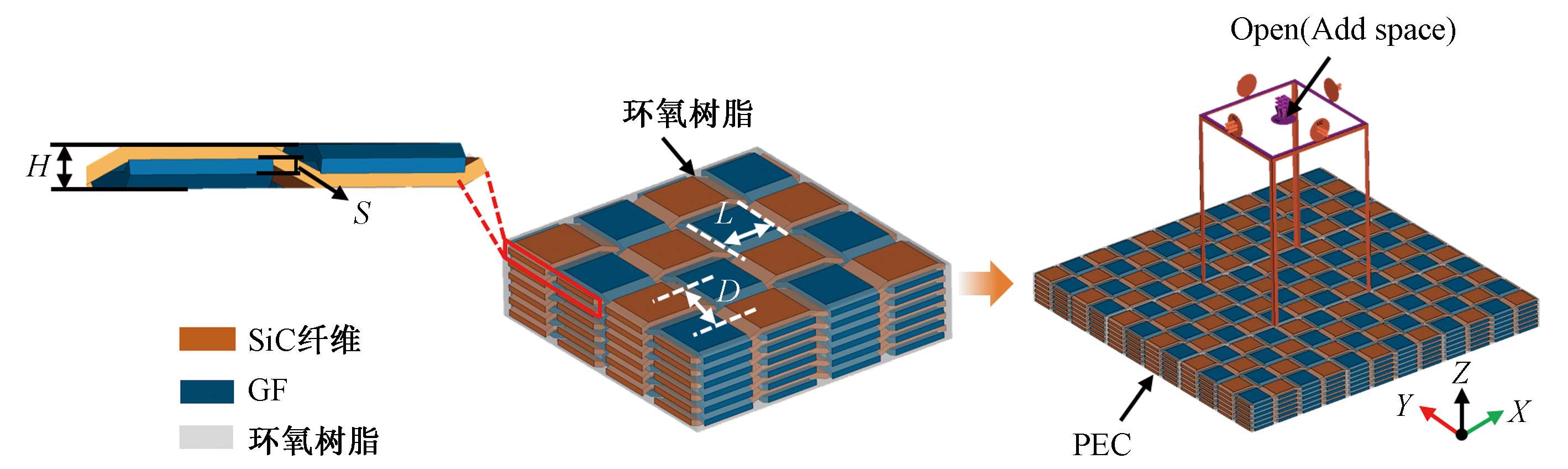
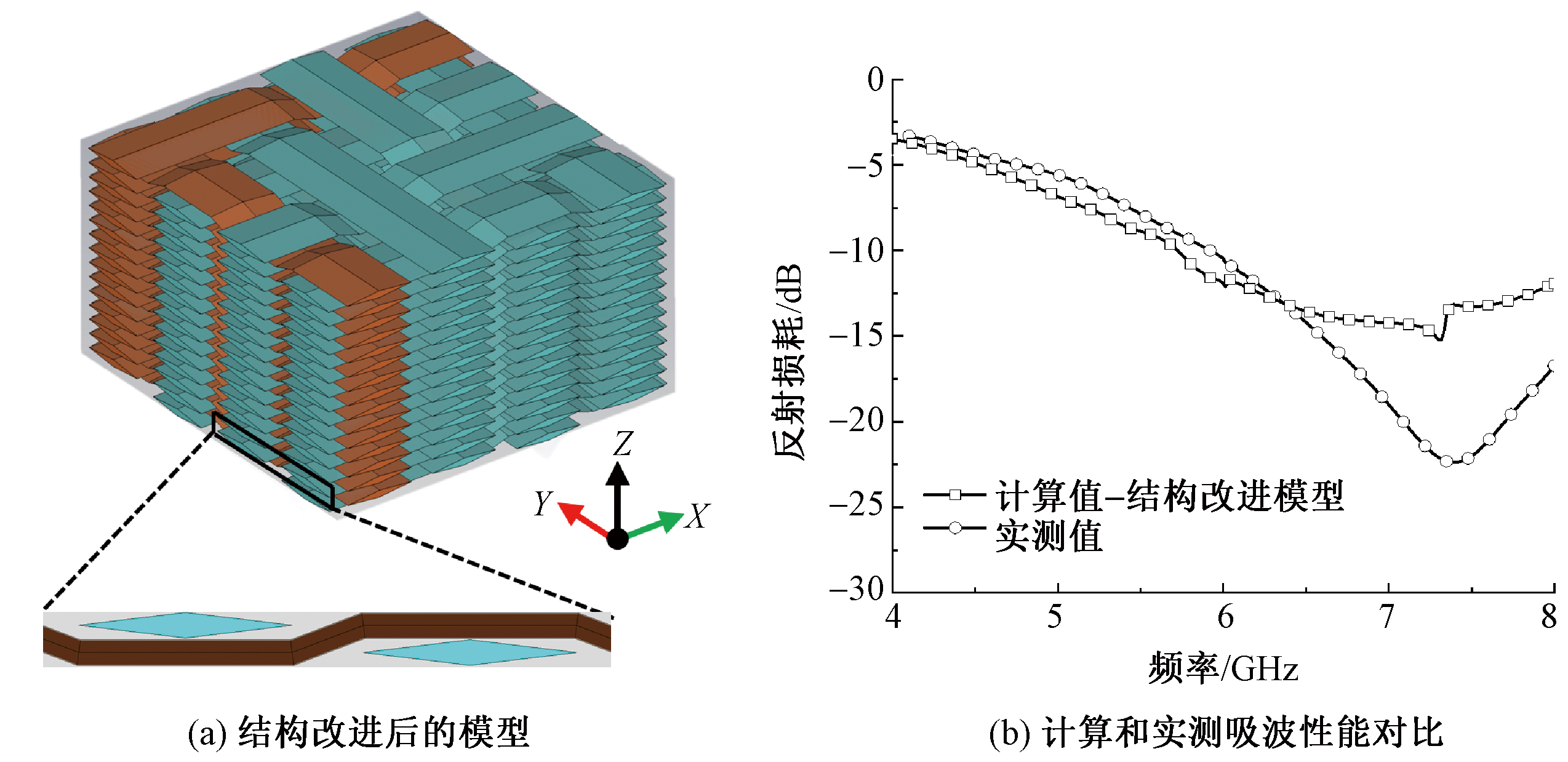
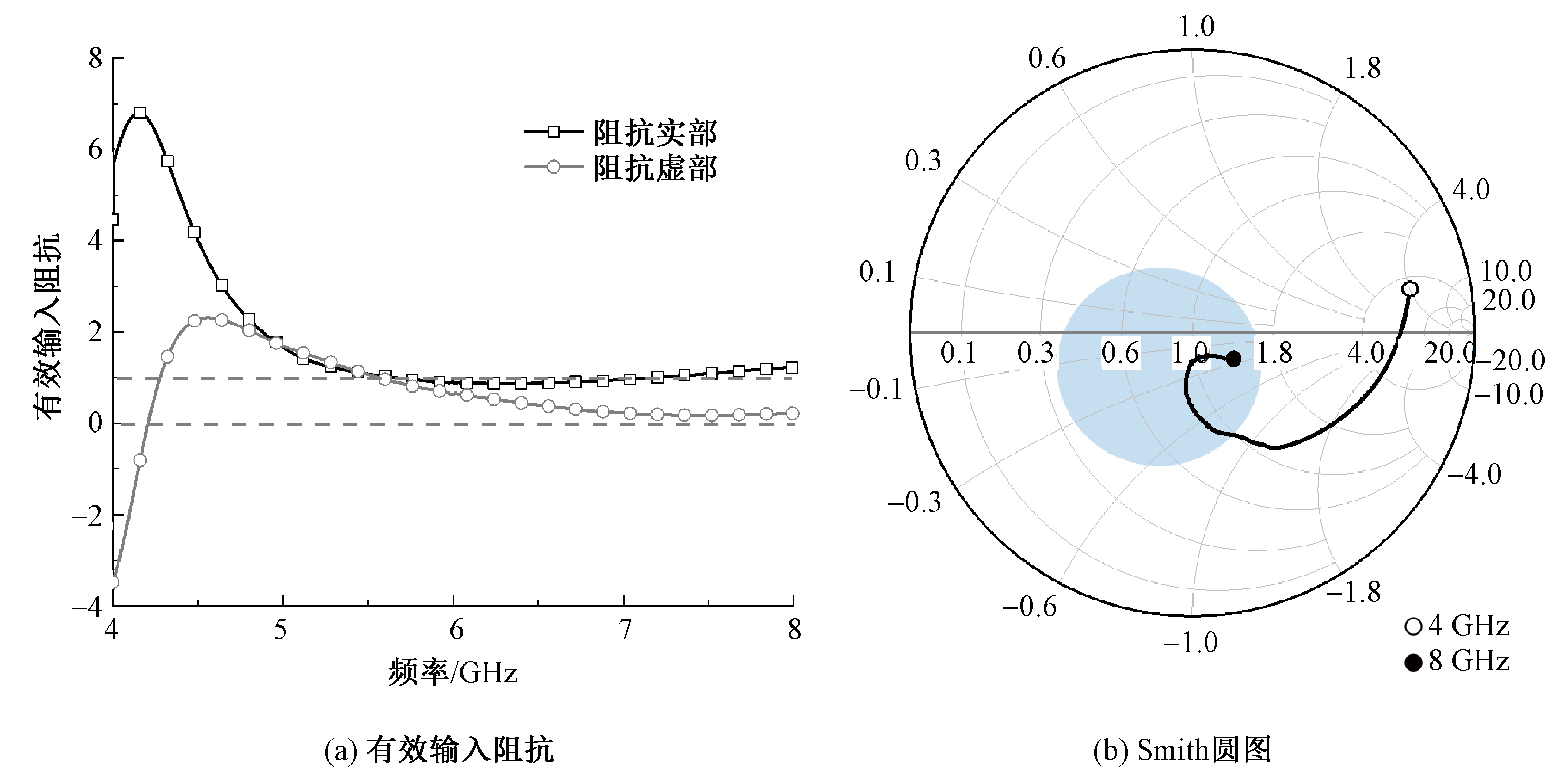
纤维增强复合材料因其优异的力学性能和结构可设计性,在电磁波吸收材料领域得到了广泛应用。为深入分析无机纤维增强树脂基复合材料在8 GHz以下低频段的吸波机制并提升其吸波性能,基于碳化硅(SiC)纤维的吸波特性和玻璃纤维(GF)的透波特性,构建混编周期结构。以C波段(4~8 GHz)为典型频段,结合遗传算法与CST Microwave Studio(CST MWS)三维电磁仿真,对其吸波性能进行优化设计,并通过实验测试进行验证。结果表明,优化后的混编周期结构在该频段内的实测平均反射损耗小于-11.9 dB,且与计算结果吻合较好,其优异吸波性能主要归因于良好的阻抗匹配,以及SiC纤维产生的电导损耗和极化损耗对电磁波的衰减作用。
中图分类号:
| [1] | LI B, LIU M J, ZHONG W X, et al. Partially contacted NixSy@N, S-codoped carbon yolk-shelled structures for efficient microwave absorption[J]. Carbon, 2021, 182: 276-286. |
| [2] | LAN X L, HOU Y, DONG X Y, et al. All-ceramic SiC aerogel for wide temperature range electromagnetic wave attenuation[J]. ACS Applied Materials & Interfaces, 2022, 14(13): 15360-15369. |
| [3] | ISHIKAWA T. Recent developments of the SiC fiber Nicalon and its composites, including properties of the SiC fiber Hi-Nicalon for ultra-high temperature[J]. Composites Science and Technology, 1994, 51(2): 135-144. |
| [4] | CHOLLON G, PAILLER R, CANET R, et al. Correlation between microstructure and electrical properties of SiC-based fibres derived from organosilicon precursors[J]. Journal of the European Ceramic Society, 1998, 18(6): 725-733. |
| [5] | GUO K S, ZHANG W X, ZHANG S N, et al. Optimization of the microwave absorptivity of SiCf/Resin composites in the GHz range[J]. Ceramics International, 2021, 47(13): 18262-18273. |
| [6] | DUAN S C, ZHU D M, DONG J, et al. Enhanced mechanical and microwave absorption properties of SiCf/SiC composite using aluminum powder as active filler[J]. Journal of Alloys and Compounds, 2019, 790: 58-69. |
| [7] | ZHOU Q, YIN X W, YE F, et al. High temperature electromagnetic wave absorption properties of SiCf/Si3N4 composite induced by different SiC fibers[J]. Ceramics International, 2019, 45(5): 6514-6522. |
| [8] | WANG H Y, ZHU D M, WANG X F, et al. Influence of silicon carbide fiber (SiCf) type on the electromagnetic microwave absorbing properties of SiCf/epoxy composites[J]. Composites Part A: Applied Science and Manufacturing, 2017, 93: 10-17. |
| [9] | LI C L, JIANG D Z, ZENG J C, et al. Electromagnetic transmission characteristics of composite frequency selective surfaces coated with conductive polymer-silver paste[J]. Composites Science and Technology, 2014, 90: 32-39. |
| [10] | CHOI W H, KIM J B, SHIN J H, et al. Circuit-analog (CA) type of radar absorbing composite leading-edge for wing-shaped structure in X-band: practical approach from design to fabrication[J]. Composites Science and Technology, 2014, 105: 96-101. |
| [11] | LIU Z, LI M X, LIU P, et al. Optimal preparation and inherent mechanism of advanced integrated structural/electromagnetic wave-absorbing polymer-based composites for aeronautical applications: a review[J]. Polymer Composites, 2025, 46(18): 16621-16637. |
| [12] | CAO M H, CHENG L H, YAN L L, et al. Multifunctional composite structure design for enhancing electromagnetic wave absorption and interlaminar fracture toughness by stitching[J]. Thin-Walled Structures, 2025, 208: 112767. |
| [13] | CHEN M Z, WANG L Y, LIU G, et al. Multi-material continuous fiber reinforced metastructures: innovative design for enhanced broadband electromagnetic wave absorption and robust mechanical load-bearing[J]. Composites Part B: Engineering, 2026, 311: 113190. |
| [14] | LEE S E, LEE W J, OH K S, et al. Broadband all fiber-reinforced composite radar absorbing structure integrated by inductive frequency selective carbon fiber fabric and carbon-nanotube-loaded glass fabrics[J]. Carbon, 2016, 107: 564-572. |
| [15] | ZHANG Q Z, ZHOU W, PANG L, et al. Design and numerical studies of microwave absorption structure based on hybrid weave of fibers with different dielectric properties[J]. Composite Structures, 2023, 323: 117460. |
| [16] | YAJIMA S. Development of ceramics, especially silicon carbide fibres, from organosilicon polymers by heat treatment[J]. Philosophical Transactions of the Royal Society of London Series A, Mathematical and Physical Sciences, 1980, 294(1411): 419-426. |
| [17] | LI Z, HAIGH A, SOUTIS C, et al. Dielectric constant of a three-dimensional woven glass fibre composite: analysis and measurement[J]. Composite Structures, 2017, 180: 853-861. |
| [18] | HAN H, LOU Z C, WANG Q Y, et al. Introducing rich heterojunction surfaces to enhance the high-frequency electromagnetic attenuation response of flexible fiber-based wearable absorbers[J]. Advanced Fiber Materials, 2024, 6(3): 739-757. |
| [19] | HAN T, LUO R Y, CUI G Y, et al. Effect of fibre directionality on the microwave absorption properties of 3D braided SiCf/SiC composites[J]. Ceramics International, 2019, 45(6): 7797-7803. |
| [20] | LIU Y H, HUANG X X, YAN X, et al. Pushing the limits of microwave absorption capability of carbon fiber in fabric design based on genetic algorithm[J]. Journal of Advanced Ceramics, 2023, 12(2): 329-340. |
| [1] | 万雨飞, 王芮杰, 陈伟, 张丽雯, 许福军. 三维间隔玻璃纤维增强酚醛复合材料的制备及其力热协同性能[J]. 纺织学报, 2026, 47(07): 177-185. |
| [2] | 李守振, 查田田, 周伟涛, 斯阳. 耐超高温氧化铝基陶瓷纤维的制备及其成形机制[J]. 纺织学报, 2026, 47(04): 71-79. |
| [3] | 齐梦园, 肖国威, 杜金梅, 许长海, 杨红英. 水性聚氨酯/纳米二氧化硅改性玄武岩纤维织物制备及其性能[J]. 纺织学报, 2026, 47(02): 172-180. |
| [4] | 孔珂欣, 张怡帆, 卢哲, 王哲. 载钴钌原子无机微纳米纤维的制备及其电催化水分解性能[J]. 纺织学报, 2026, 47(02): 26-36. |
| [5] | 史芷丞, 陈凤翔, 王梦云, 白洁, 李娟, 白濛, 伏广伟, 徐卫林. 面向空天应用的高性能无机纤维及制品发展现状及趋势[J]. 纺织学报, 2025, 46(12): 233-242. |
| [6] | 李吉国, 景军锋, 程为, 王永波, 刘薇. 基于机器视觉的玻璃纤维纱团外观缺陷检测系统设计[J]. 纺织学报, 2025, 46(05): 243-251. |
| [7] | 左红梅, 高敏, 阮芳涛, 邹梨花, 徐珍珍. MXene-氧化石墨烯改性碳纤维/聚乳酸复合材料制备及其力学性能[J]. 纺织学报, 2025, 46(01): 9-15. |
| [8] | 王珏, 晏石林, 李永静, 何龙飞, 谢翔宇, 孟晓旭. 剪切变形对各向异性织物主渗透率及浸润特性的影响[J]. 纺织学报, 2024, 45(12): 109-117. |
| [9] | 余晓佩, 沈伟, 陈立峰, 竺铝涛. 玻璃纤维复合材料损伤裂纹修复及其性能评价[J]. 纺织学报, 2024, 45(11): 121-127. |
| [10] | 于雯, 邓南平, 唐湘泉, 康卫民, 程博闻. 静电溶吹微纳无机纤维制备技术及其应用进展[J]. 纺织学报, 2024, 45(07): 230-239. |
| [11] | 杨金鹏, 景军锋, 李吉国, 王渊博. 基于机器视觉的玻璃纤维合股纱缺陷检测系统设计[J]. 纺织学报, 2024, 45(05): 193-201. |
| [12] | 谭晶, 石鑫, 于景超, 程礼盛, 杨涛, 杨卫民. 聚合物热解制备玻璃纤维表面碳纳米涂层及其导电性[J]. 纺织学报, 2023, 44(11): 36-44. |
| [13] | 蔡洁, 王亮, 傅宏俊, 钟智丽. 玻璃纤维/碳纤维织物基复合材料的电磁屏蔽性能[J]. 纺织学报, 2023, 44(02): 111-117. |
| [14] | 竺铝涛, 郝丽, 沈伟, 祝成炎. 基于边界效应模型的玻璃纤维复合材料准脆性断裂性能分析[J]. 纺织学报, 2022, 43(07): 75-80. |
| [15] | 陈锋, 姬忠礼, 于文瀚, 董伍强, 王倩琳, 王德国. 纳米纤维膜润湿性对三明治结构复合过滤材料气液过滤性能的影响[J]. 纺织学报, 2022, 43(05): 63-69. |
|
||
 京公网安备11010502044800号