纺织学报 ›› 2026, Vol. 47 ›› Issue (01): 250-258.doi: 10.13475/j.fzxb.20250601302
张宁讴1,2, 王海龙2, 胡星友2, 孙彬3, 游超瑜1,4( )
)
ZHANG Ningou1,2, WANG Hailong2, HU Xingyou2, SUN Bin3, YOU Chaoyu1,4()
摘要:
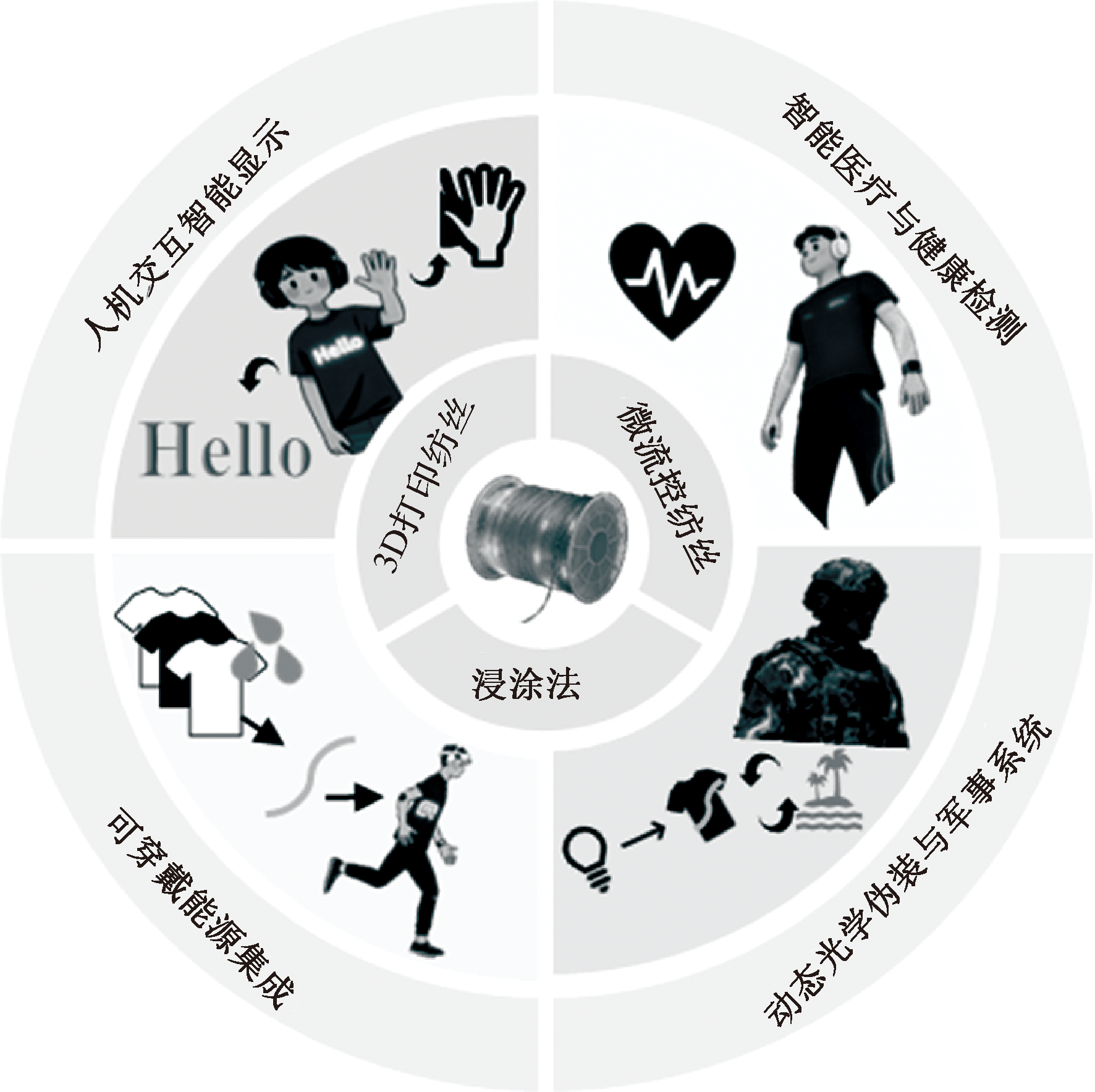
电致发光(EL)纤维作为柔性电子与智能纺织交叉领域的前沿方向,通过将发光功能与纤维形态结合,正推动可穿戴设备、智能织物及人机交互技术向超薄化、高柔性和多功能集成方向跨越发展。针对该领域最新进展,系统梳理了EL纤维从材料设计、结构工艺到纺丝技术等多个维度的研究现状,深入分析了当前面临的多重挑战,包括环境稳定性、机械耐久性、显色单一性及规模化生产瓶颈等问题。目前EL纤维已经在生物医学(柔性光疗绷带)、能源(自供电发光织物)及军事(自适应伪装系统)等领域崭露头角,其与传感、供能模块的深度融合将催生新一代智能交互模式。通过聚焦材料-工艺-器件的协同创新,旨在为EL纤维的材料革新、工艺优化与跨领域应用提供理论支撑与技术路线指引,加速实现从实验室研究向产业化应用的重要跨越。
中图分类号:
| [1] |
CHEN Z Y, ZHOU R H, HUANG J Y, et al. Strain-insensitive pre-stretch-stabilized polymer/gold hybrid electrodes for electrochemiluminescent devices[J]. Advanced Functional Materials, 2024, 34(44): 2406434.
doi: 10.1002/adfm.v34.44 |
| [2] | ZHANG W J, WANG X C, DUAN J, et al. Recent research advances in textile-based flexible power supplies and displays for smart wearable appli-cations[J]. ACS Applied Electronic Materials, 2024, 6(8): 5429-5455. |
| [3] |
YU X X, CHEN L F, ZHANG J Y, et al. Structural design of light-emitting fibers and fabrics for wearable and smart devices[J]. Science Bulletin, 2024, 69(15): 2439-2455.
doi: 10.1016/j.scib.2024.05.042 |
| [4] |
SHI X, ZUO Y, ZHAI P, et al. Large-area display textiles integrated with functional systems[J]. Nature, 2021, 591(7849): 240-245.
doi: 10.1038/s41586-021-03295-8 |
| [5] |
YAN J, WANG H X, WANG X Y, et al. High-performance triboelectric nanogenerators with laser-induced graphene pattern for efficient charge transfer[J]. Applied Surface Science, 2024, 661: 160034.
doi: 10.1016/j.apsusc.2024.160034 |
| [6] |
YONG J, YOUNG P, TAE H, et al. Luminescent composite material fabricated from carbon dots and red phosphors for application to UV-LED chips and metal ion detection[J]. Ceramics International, 2024, 50(5): 7908-7918.
doi: 10.1016/j.ceramint.2023.12.119 |
| [7] |
HWANG Y H, KWON S, SHIN J B, et al. Bright-multicolor, highly efficient, and addressable phosphorescent organic light-emitting fibers: toward wearable textile information displays[J]. Advanced Functional Materials, 2021, 31(18): 2009336.
doi: 10.1002/adfm.v31.18 |
| [8] |
KONG S U, JEON Y, LEE H S, et al. Anode-patterned monorail-structure fiber-based organic light-emitting diodes with long lifetime and high performance for truly wearable displays[J]. Advanced Optical Materials, 2023, 11(13): 2203130.
doi: 10.1002/adom.v11.13 |
| [9] |
SONG Y J, CHO H E, SONG H Y, et al. 77-3: wearable organic light-emitting diode displays: from fibers to textiles[J]. SID Symposium Digest of Technical Papers, 2020, 51(1): 1149-1151.
doi: 10.1002/sdtp.2020.51.issue-1 |
| [10] |
LEE J, GU C Y, CHANG J, et al. Analytic modeling and validation of strain in textile-based OLEDs for advanced textile display technologies[J]. NPJ Flexible Electronics, 2024, 8: 73.
doi: 10.1038/s41528-024-00361-9 |
| [11] |
王利祥. 有机电致发光材料与器件[J]. 科学观察, 2018, 13(5): 36-40.
doi: 10.15978/j.cnki.1673-5668.201805003 |
| WANG Lixiang. Organic electroluminescent materials and devices[J]. Science Focus, 2018, 13(5): 36-40. | |
| [12] |
DIETHELM M, DEVIŽIS A, HU W H, et al. Traps for electrons and holes limit the efficiency and durability of polymer light-emitting electrochemical cells[J]. Advanced Functional Materials, 2022, 32(43): 2203643.
doi: 10.1002/adfm.v32.43 |
| [13] |
KWON S, KIM H, CHOI S, et al. Weavable and highly efficient organic light-emitting fibers for wearable electronics: a scalable, low-temperature process[J]. Nano Letters, 2018, 18(1): 347-356.
doi: 10.1021/acs.nanolett.7b04204 pmid: 29210590 |
| [14] |
COOK J H, AL-ATTAR H A, MONKMAN A P. Effect of PEDOT: PSS resistivity and work function on PLED performance[J]. Organic Electronics, 2014, 15(1): 245-250.
doi: 10.1016/j.orgel.2013.11.029 |
| [15] |
TONGE C, HUDSON Z M. Interface-dependent aggregation-induced delayed fluorescence in bottlebrush polymer nanofibers[J]. Journal of the American Chemical Society, 2019, 141(35): 13970-13976.
doi: 10.1021/jacs.9b07156 pmid: 31441647 |
| [16] |
WEI Q, KLEINE P, KARPOV Y, et al. Conjugation-induced thermally activated delayed fluore-scence (TADF): from conventional non-TADF units to TADF-active polymers[J]. Advanced Functional Materials, 2017, 27(7): 1605051.
doi: 10.1002/adfm.v27.7 |
| [17] |
STEINEGGER A, KLIMANT I, BORISOV S M. Purely organic dyes with thermally activated delayed fluorescence: a versatile class of indicators for optical temperature sensing[J]. Advanced Optical Materials, 2017, 5(18): 1700372.
doi: 10.1002/adom.v5.18 |
| [18] | WANG Z, SHI X, PENG H S. Alternating current electroluminescent fibers for textile displays[J]. National Science Review, 2023, 10(1): nwac113. |
| [19] |
CHUN F J, ZHANG B B, GAO Y Y, et al. Multicolour stretchable perovskite electroluminescent devices for user-interactive displays[J]. Nature Photonics, 2024, 18(8): 856-863.
doi: 10.1038/s41566-024-01455-6 |
| [20] | 梁雯宇, 季东晓, 覃小红. 微纳米纤维包芯纱制备及其电致发光性能[J]. 纺织学报, 2025, 46(1): 42-51. |
| LIANG Wenyu, JI Dongxiao, QIN Xiaohong. Preparation of micro-nanofiber core-spun yarn and its electroluminescent properties[J]. Journal of Textile Research, 2025, 46(1): 42-51. | |
| [21] |
ZHONG J P, HAN M C, LI C M, et al. Facile and scalable fabrication process of electroluminescent filament with high luminescent efficiency[J]. Materials Letters, 2023, 350: 134868.
doi: 10.1016/j.matlet.2023.134868 |
| [22] |
LI G H, SUN F Q, ZHAO S K, et al. Autonomous electroluminescent textile for visual interaction and environmental warning[J]. Nano Letters, 2023, 23(18): 8436-8444.
doi: 10.1021/acs.nanolett.3c01653 pmid: 37690057 |
| [23] | 杨小锐, 杨伟峰, 李克睿, 等. 单电极电致发光纤维的连续制备及其可视化液体传感应用[J]. 发光学报, 2024, 45(7): 1049-1057. |
|
YANG Xiaorui, YANG Weifeng, LI Kerui, et al. Continuous preparation of single-electrode electroluminescent fibers and their visual liquid sensing applications[J]. Chinese Journal of Luminescence, 2024, 45(7): 1049-1057.
doi: 10.37188/CJL.20240067 |
|
| [24] | 赵世康, 王航, 田明伟. 平行电极式电致发光纱线的构筑成型及其水上救援可穿戴应用[J]. 现代纺织技术, 2024, 32(4): 45-51. |
| ZHAO Shikang, WANG Hang, TIAN Mingwei. Construction molding of a parallel electrode electroluminescent yarn and its application in water rescue wearables[J]. Advanced Textile Technology, 2024, 32(4): 45-51. | |
| [25] |
HU X L, ZHANG B, YOU C Y, et al. Non-noble metal electroluminescent fibers for visual monitoring and interaction[J]. Advanced Fiber Materials, 2025, 7(1): 227-239.
doi: 10.1007/s42765-024-00480-y |
| [26] |
PEI Q B, YU G, ZHANG C, et al. Polymer light-emitting electrochemical cells[J]. Science, 1995, 269(5227): 1086-1088.
pmid: 17755530 |
| [27] |
ZHANG Z T, GUO K P, LI Y M, et al. A colour-tunable, weavable fibre-shaped polymer light-emitting electrochemical cell[J]. Nature Photonics, 2015, 9(4): 233-238.
doi: 10.1038/nphoton.2015.37 |
| [28] |
YANG H F, LIGHTNER C R, DONG L. Light-emitting coaxial nanofibers[J]. ACS Nano, 2012, 6(1): 622-628.
doi: 10.1021/nn204055t pmid: 22196130 |
| [29] |
TAN Z K, MOGHADDAM R S, LAI M L, et al. Bright light-emitting diodes based on organometal halide perovskite[J]. Nature Nanotechnology, 2014, 9(9): 687-692.
doi: 10.1038/nnano.2014.149 |
| [30] | 高飞红, 王涵龙, 朱士凤, 等. 钙钛矿量子点纤维的研究进展及展望[J]. 棉纺织技术, 2025, 53(3): 76-81. |
| GAO Feihong, WANG Hanlong, ZHU Shifeng, et al. Research progress and prospect of perovskite quantum dots fiber[J]. Cotton Textile Technology, 2025, 53(3): 76-81. | |
| [31] |
TSAI P C, CHEN J Y, ERCAN E, et al. Uniform luminous perovskite nanofibers with color-tunability and improved stability prepared by one-step core/shell electrospinning[J]. Small, 2018, 14(22): 1704379.
doi: 10.1002/smll.v14.22 |
| [32] |
WANG Z T, FU R, LI F, et al. One-step polymeric melt encapsulation method to prepare CsPbBr3 perovskite quantum dots/polymethyl methacrylate composite with high performance[J]. Advanced Functional Materials, 2021, 31(22): 2010009.
doi: 10.1002/adfm.v31.22 |
| [33] |
LÊ K, VON TOPERCZER F, ÜNLÜ F, et al. Electrospun electroluminescent CsPbBr3 fibers as flexible perovskite networks for light-emitting application[J]. Advanced Engineering Materials, 2023, 25(10): 2201651.
doi: 10.1002/adem.v25.10 |
| [34] | SHAN Q S, WEI C T, JIANG Y, et al. Perovskite light-emitting/detecting bifunctional fibres for wearable LiFi communication[J]. Light: Science & Applications, 2020, 9: 163. |
| [35] |
GAO F H, HU X Y, SUN B, et al. Large-scale and continuous production of perovskite filament for wearable fluorescent textiles[J]. Chemical Engineering Journal, 2024, 502: 158191.
doi: 10.1016/j.cej.2024.158191 |
| [36] |
JAMALI V, NIROUI F, TAYLOR L W, et al. Perovskite-carbon nanotube light-emitting fibers[J]. Nano Letters, 2020, 20(5): 3178-3184.
doi: 10.1021/acs.nanolett.9b05225 pmid: 32353239 |
| [37] |
YU Y R, GUO J H, BIAN F K, et al. Bioinspired perovskite quantum dots microfibers from micro-fluidics[J]. Science China Materials, 2021, 64(11): 2858-2867.
doi: 10.1007/s40843-021-1675-x |
| [38] |
LI J J, CUI T T, YU J F, et al. Stable and large-scale organic-inorganic halide perovskite nanocrystal/polymer nanofiber films preparedviaa greenin situfiber spinning chemistry method[J]. Nanoscale, 2022, 14(33): 11998-12006.
doi: 10.1039/D2NR01691E |
| [39] |
CHENG R, LIANG Z B, ZHU L L, et al. Fibrous nanoreactors from microfluidic blow spinning for mass production of highly stable ligand-free perovskite quantum dots[J]. Angewandte Chemie International Edition, 2022, 61(27): e202204371.
doi: 10.1002/anie.v61.27 |
| [40] | DONG T, ZHAO J, LI G, et al. In situ synthesis of robust polyvinylpyrrolidone-based perovskite nanocrystal powders by the fiber-spinning chemistry method and their versatile 3D printing patterns[J]. ACS Applied Materials & Interfaces, 2021, 13(33): 39748-39754. |
| [41] |
WANG H L, ZHU S F, SHENG J Y, et al. Lead-rivet strategy of growing perovskite nanocrystals for excellent toxicity inhibition and spinning application[J]. Journal of Hazardous Materials, 2024, 475: 134796.
doi: 10.1016/j.jhazmat.2024.134796 |
| [42] |
YANG L Y, LIU Y P, LI X F, et al. Large-scale, stretchable, self-protective, and multifunctional perovskite luminescent filament with ultra-high stabil-ity[J]. Advanced Materials, 2024, 36(25): 2400919.
doi: 10.1002/adma.v36.25 |
| [43] |
LEI C Y, LIU P Y, CHEN K, et al. High-purity multicolor electroluminescent fibers by incorporating with light-conversion perovskite quantum dots[J]. Advanced Optical Materials, 2025, 13(15): 2403573.
doi: 10.1002/adom.v13.15 |
| [1] | 刘一鸣, 李琳, 杜鲜晶, 刘攀, 殷霞, 田明伟. 内螺旋结构弹性导电纱线的制备及其应变不敏感性能的调控[J]. 纺织学报, 2026, 47(01): 115-122. |
| [2] | 邵剑波, 岳欣琰, 陈雨, 韩潇, 洪剑寒. 全针织结构多模态柔性电容传感器的构筑及其传感性能[J]. 纺织学报, 2026, 47(01): 123-131. |
| [3] | 胡崴琳, 白洁, 刘丹, 白濛, 李娟, 李启正. 基于机器学习模型的电子纺织品研究进展[J]. 纺织学报, 2026, 47(01): 268-276. |
| [4] | 王梁宇, 高晓红, 于彩娇, 张雪婷, 杨旭礼. 还原氧化石墨烯/铜纳米颗粒导电棉织物的制备及其传感性能[J]. 纺织学报, 2025, 46(12): 181-187. |
| [5] | 季巧, 于清源, 周爱晖, 马博谋, 徐进, 袁久刚. 细菌纤维素及其复合材料的应用研究进展[J]. 纺织学报, 2025, 46(12): 243-250. |
| [6] | 杨孟晓, 邱小雪, 吴芳, 刘琳, 姚菊明. 蚕丝基导电凝胶纤维的制备及其应变传感性能[J]. 纺织学报, 2025, 46(12): 49-56. |
| [7] | 胡新阳, 王宏志. 聚偏氟乙烯-三氟乙烯共聚物摩擦纳米发电织物制备及其输出功率提升[J]. 纺织学报, 2025, 46(12): 92-100. |
| [8] | 张帆, 蔡再生, 刘慧景, 陆少锋, 黄旭明. 高牢固光致变色棉织物的点击化学法制备及其性能[J]. 纺织学报, 2025, 46(11): 196-202. |
| [9] | 王莎莎, 李超婧, 李彦, 毛吉富, 王富军, 王璐. 智能可穿戴健康纺织品应用研究进展[J]. 纺织学报, 2025, 46(10): 265-273. |
| [10] | 赵捷清, 王瑧, 秦孝天, 王成成, 张丽平. 模拟绿叶颜色变化的温致变色织物制备及其性能[J]. 纺织学报, 2025, 46(09): 19-26. |
| [11] | 傅林, 钱建华, 单江音, 林灵, 卫梦蓉, 翁可欣, 吴晓睿. 银纳米线/聚氨酯纳米纤维膜柔性传感器制备及其性能[J]. 纺织学报, 2025, 46(09): 74-83. |
| [12] | 张楠, 鲁虹. 印刷技术在电子纺织品制造中的应用研究进展[J]. 纺织学报, 2025, 46(07): 244-252. |
| [13] | 刘烨, 王俊胜, 金星. 消防员个人防护装备用智能纺织品研究进展[J]. 纺织学报, 2025, 46(05): 105-115. |
| [14] | 陈枭, 赵继忠, 董凯. 基于接触起电效应的新型机电转化纤维性能提升策略[J]. 纺织学报, 2025, 46(05): 41-48. |
| [15] | 韩力杰, 刘樊, 张其冲. 纤维状水系锌离子电池的研究进展与展望[J]. 纺织学报, 2025, 46(05): 59-69. |
|
||
 京公网安备11010502044800号