纺织学报 ›› 2025, Vol. 46 ›› Issue (12): 49-56.doi: 10.13475/j.fzxb.20250501501
杨孟晓1, 邱小雪1, 吴芳2, 刘琳1( ), 姚菊明1
YANG Mengxiao1, QIU Xiaoxue1, WU Fang2, LIU Lin1(), YAO Juming1
摘要:
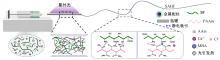
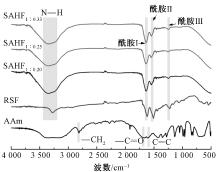
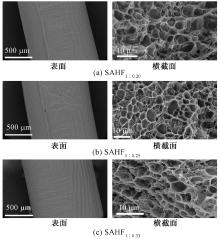
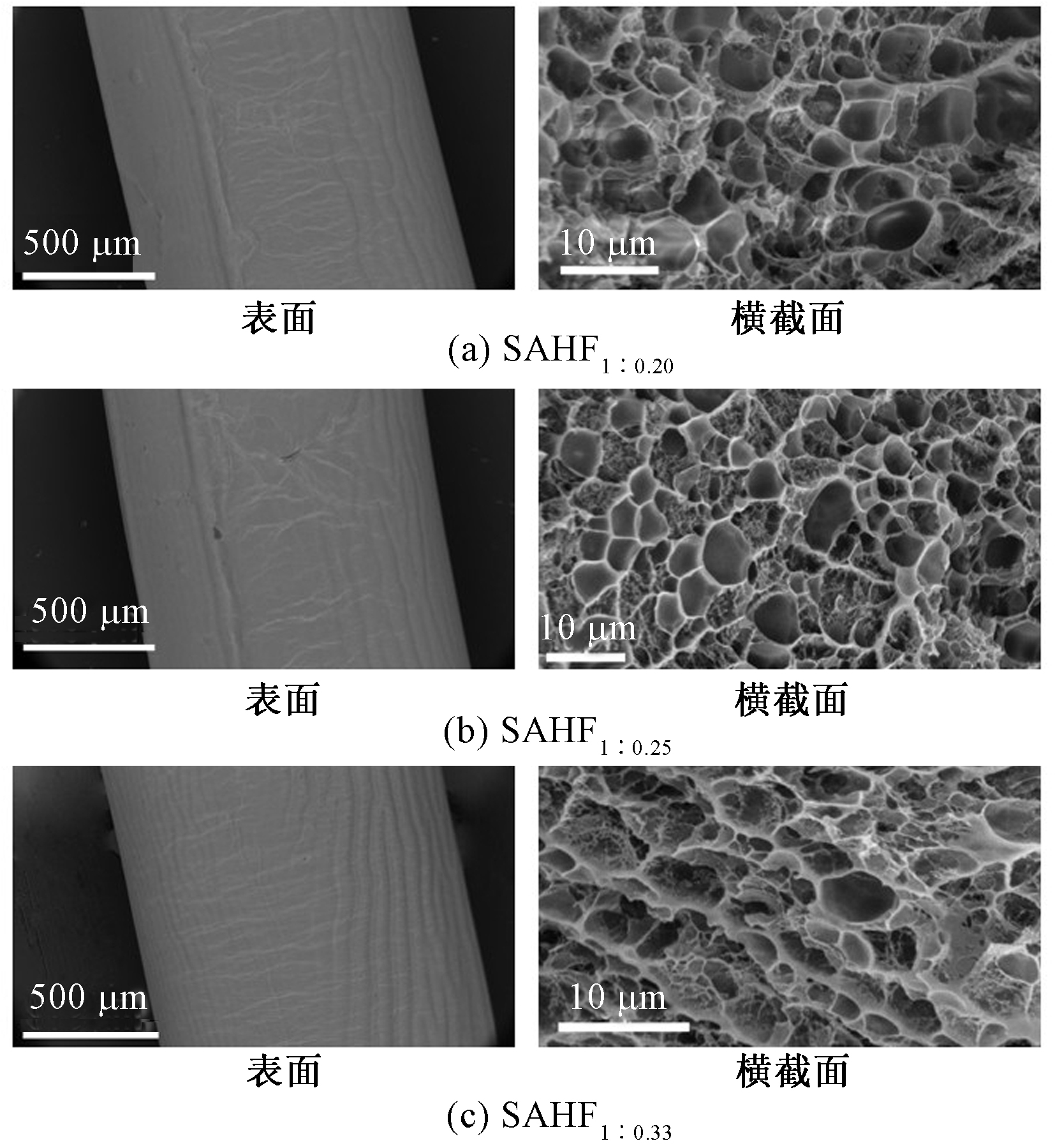
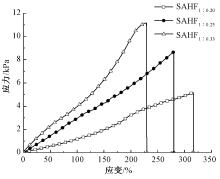
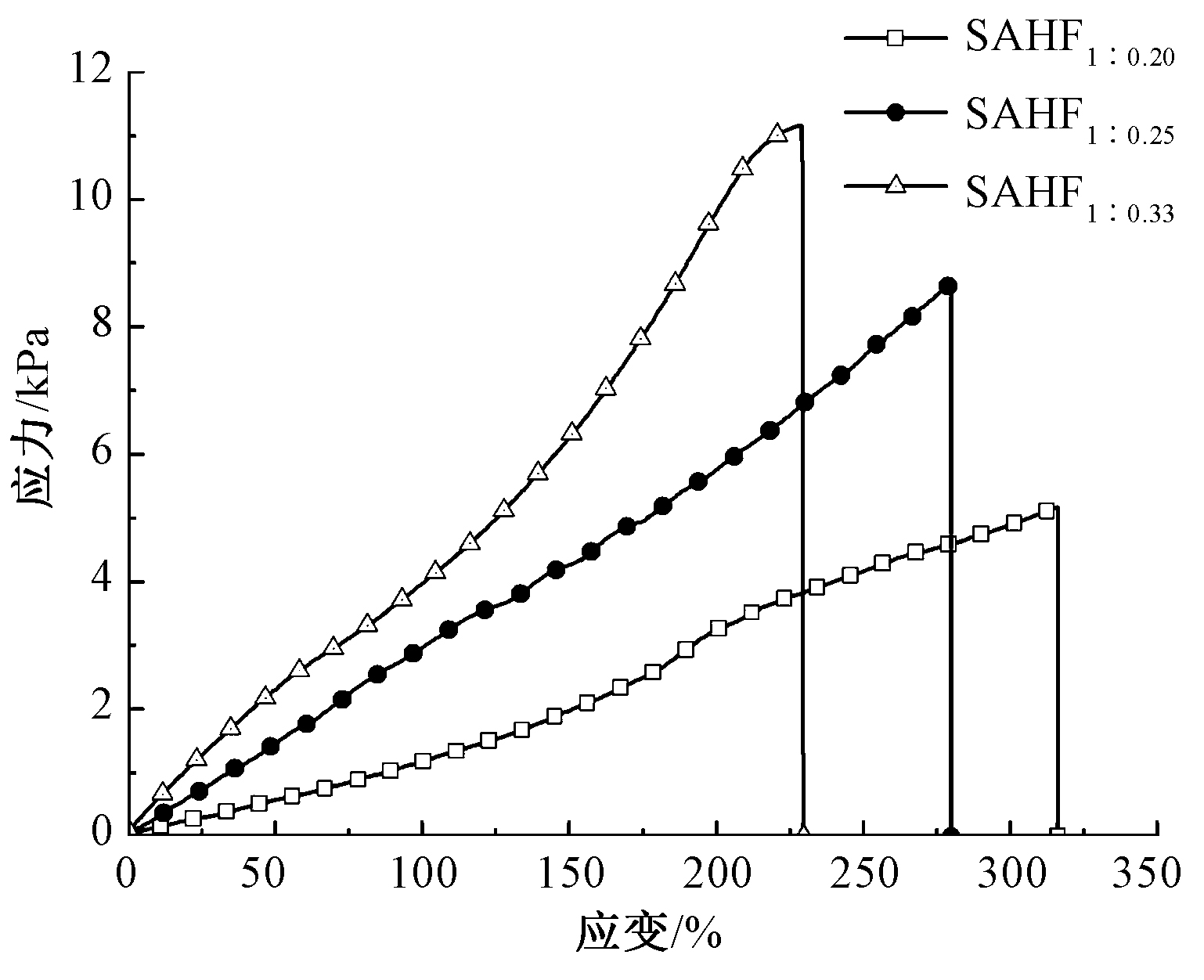
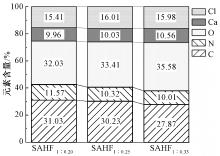
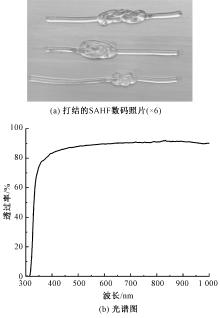
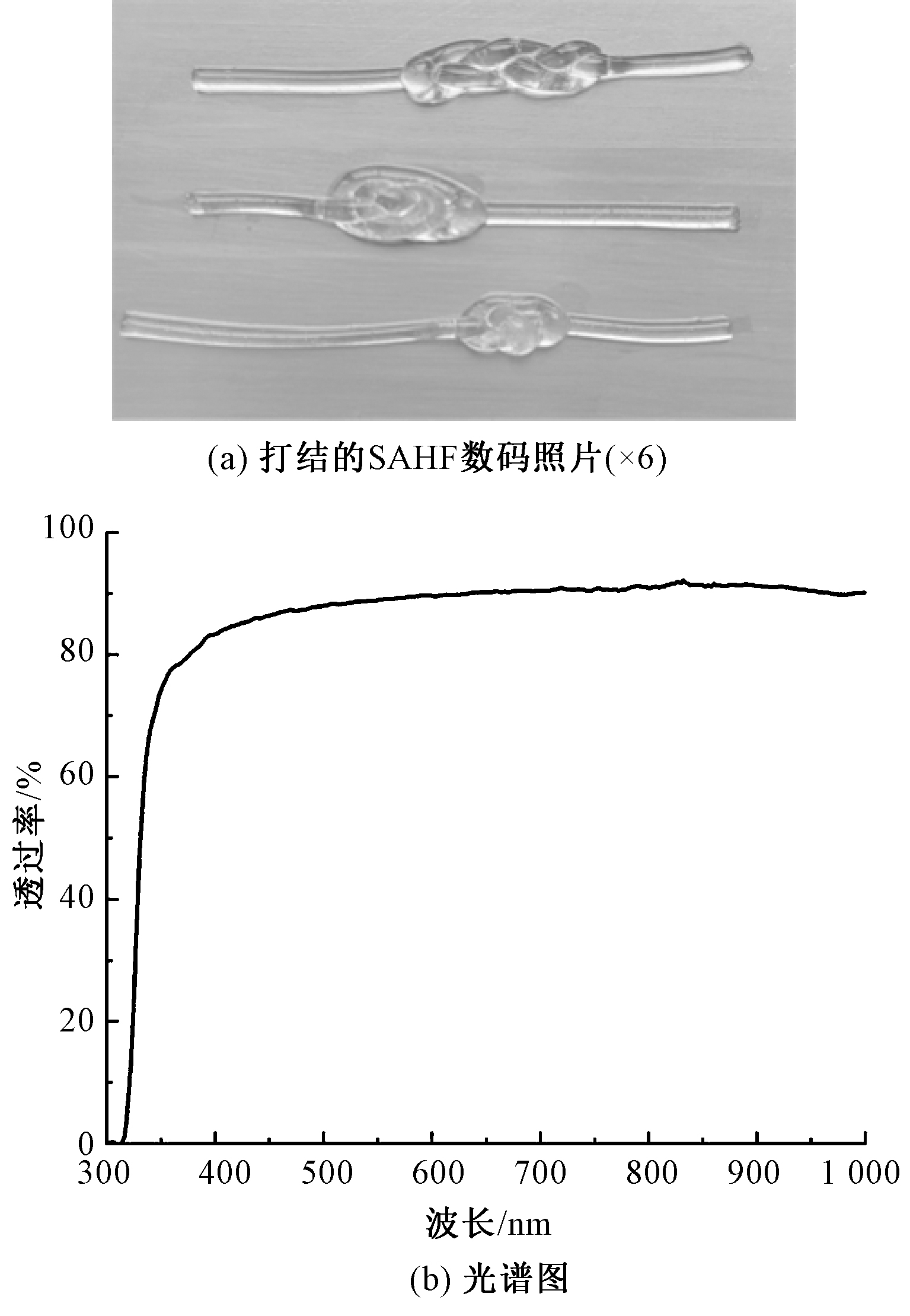
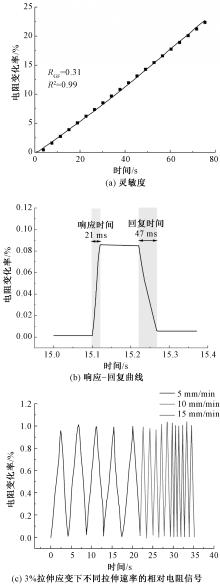
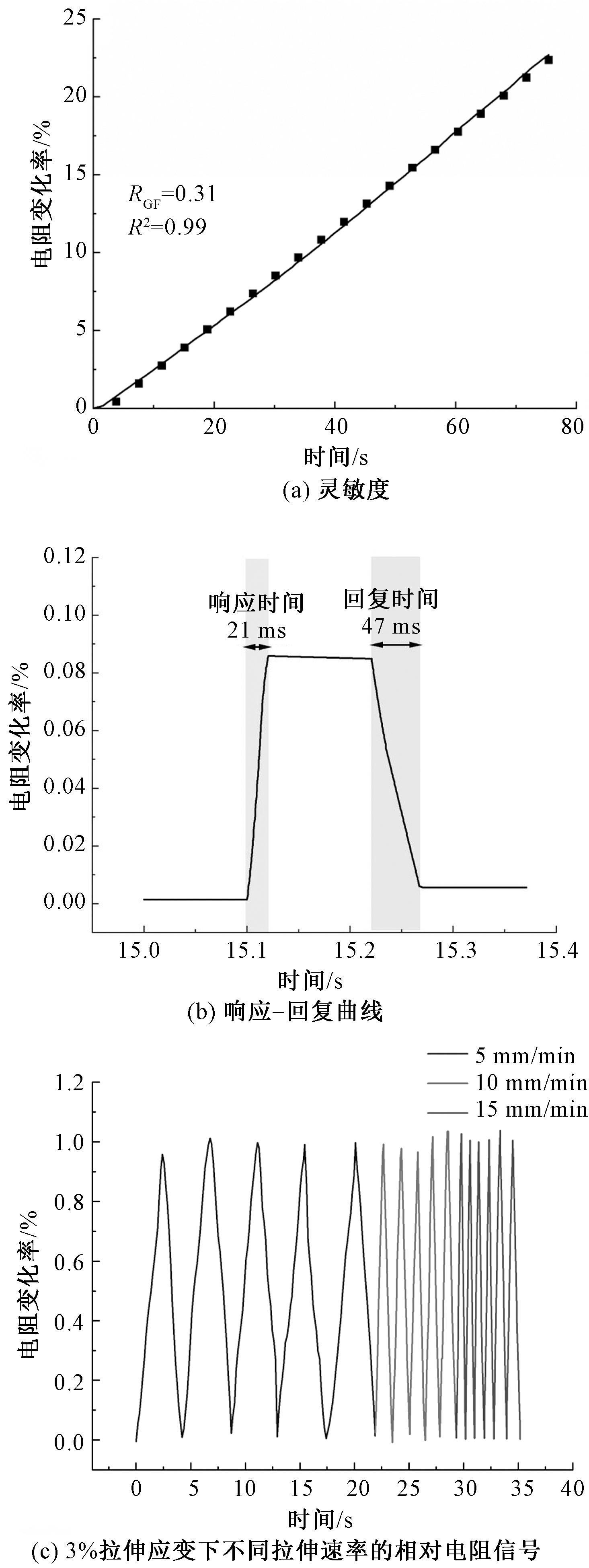
针对碳基导电凝胶纤维不透明和力学延展性差的问题,采用氯化钙-乙醇-水三元溶剂溶解丝素蛋白并作为导电介质,利用紫外光引发诱导单体聚合和自润滑纺丝相结合策略,实现了兼具高透明度和良好柔韧性丝素蛋白-丙烯酰胺导电凝胶纤维(SAHF)的连续化制备。通过调整纺丝液的组成比例,系统优化了纤维的结构与性能。研究结果表明:当丝素蛋白与丙烯酰胺的质量比为1∶0.33时,所制备的SAHF具有最佳的综合性能,其光透过率达91%、拉伸强度达到11.15 kPa、断裂伸长率为224%。氯化钙作为导电物质,与丝素蛋白、聚丙烯酰胺通过金属配位和静电相互吸引作用被整合在SAHF的三维网络结构中,赋予凝胶纤维优良的导电性能,其电导率为0.64 mS/cm。将铜导线与纤维的两端连接组装成应变式传感器后,纤维表现出快速响应/回复(21 ms/47 ms)的特性,可用于精准的动作识别。此外,将SAHF用于监测人体汗液环境中的pH值变化,展现出pH值和电阻信号的强线性关系及优异的稳定性。
中图分类号:
| [1] |
CHEN T, WEI P L, CHEN G Y, et al. Heterogeneous structured tough conductive gel fibres for stable and high-performance wearable strain sensors[J]. Journal of Materials Chemistry A, 2021, 9(20): 12265-12275.
doi: 10.1039/D1TA02422A |
| [2] |
GONG R X, DONG Y J, GE D, et al. Wet spinning fabrication of robust and uniform intrinsically conductive cellulose nanofibril/silk conductive fibers as bifunctional strain/humidity sensor in potential smart dressing[J]. Advanced Fiber Materials, 2024, 6(4): 993-1007.
doi: 10.1007/s42765-024-00404-w |
| [3] |
DING H J, WU Z X, WANG H, et al. An ultrastretchable, high-performance, and crosstalk-free proximity and pressure bimodal sensor based on ionic hydrogel fibers for human-machine interfaces[J]. Materials Horizons, 2022, 9(7): 1935-1946.
doi: 10.1039/D2MH00281G |
| [4] | 明津法, 黄晓卫, 宁新, 等. 丝素蛋白材料制备及应用进展[J]. 丝绸, 2021, 58(2): 20-26. |
| MING Jinfa, HUANG Xiaowei, NING Xin, et al. Preparation and application of silk fibroin materials[J]. Journal of Silk, 2021, 58(2): 20-26. | |
| [5] |
WANG Z, XU X Y, ZHANG K, et al. Continuous phase separation induced tough hydrogel fibers with ultrahigh conductivity for multidimensional soft electronics[J]. Advanced Functional Materials, 2025, 35(3): 2413478.
doi: 10.1002/adfm.v35.3 |
| [6] |
CHEN K, XU J Y, YANG K, et al. Highly conductive and elastic electronic silk fabrics via 3D textile macro-design and microscopic plasma activation for personal care and information interaction[J]. Advanced Fiber Materials, 2025, 7(1): 130-143.
doi: 10.1007/s42765-024-00471-z |
| [7] |
LU H J, ZHANG Y, ZHU M J, et al. Intelligent perceptual textiles based on ionic-conductive and strong silk fibers[J]. Nature Communications, 2024, 15(1): 3289.
doi: 10.1038/s41467-024-47665-y pmid: 38632231 |
| [8] | WU R H, MA L Y, LIU X Y. From mesoscopic functionalization of silk fibroin to smart fiber devices for textile electronics and photonics[J]. Advanced Science, 2022, 9(4): e2103981. |
| [9] | ZHOU Z J, LI P, MAN Z M, et al. Multiscale dot-wire-sheet heterostructured nitrogen-doped carbon dots-Ti3 C2 tx/silk nanofibers for high-performance fiber-shaped supercapacitors[J]. Angewandte Chemie (International Ed), 2023, 62(20): e202301618. |
| [10] |
MA S D, WU Y T, TANG J, et al. A multi-model, large-range flexible strain sensor based on carbonized silk habotai for human health monitoring[J]. Chinese Journal of Polymer Science, 2023, 41(8): 1238-1249.
doi: 10.1007/s10118-023-2924-4 |
| [11] | 李青松. 基于蚕丝蛋白的光、电传感器件的制备及其应用研究[D]. 苏州: 苏州大学, 2019: 70-71. |
| LI Qingsong. Research on fabrication and applications of silk fibroin based optical and electronic sensing de-vices[D]. Suzhou: Suzhou University, 2019: 70-71. | |
| [12] |
FAN W, LEI R X, DOU H, et al. Sweat permeable and ultrahigh strength 3D PVDF piezoelectric nanoyarn fabric strain sensor[J]. Nature Communications, 2024, 15(1): 3509.
doi: 10.1038/s41467-024-47810-7 pmid: 38664454 |
| [13] |
WU S J, GONG C H, WANG Z C, et al. Continuous spinning of high-tough hydrogel fibers for flexible electronics by using regional heterogeneous polymerization[J]. Advanced Science, 2023, 10(36): 2305226.
doi: 10.1002/advs.v10.36 |
| [14] |
WU S J, LIU Z, GONG C H, et al. Spider-silk-inspired strong and tough hydrogel fibers with anti-freezing and water retention properties[J]. Nature Communications, 2024, 15(1): 4441.
doi: 10.1038/s41467-024-48745-9 pmid: 38789409 |
| [15] |
ZHU Z H, LING S J, YEO J, et al. High-strength, durable all-silk fibroin hydrogels with versatile processability toward multifunctional applications[J]. Advanced Functional Materials, 2018, 28(10): 1704757.
doi: 10.1002/adfm.v28.10 |
| [16] |
MÜLLER M Z, BERNERO M, XIE C, et al. Cell-guiding microporous hydrogels by photopolymerization-induced phase separation[J]. Nature Communications, 2025, 16(1): 4923.
doi: 10.1038/s41467-025-60113-9 |
| [17] |
XIA J, LUO J B, CHANG B Y, et al. High-performance zwitterionic organohydrogel fiber in bioelectronics for monitoring bioinformation[J]. Biosensors, 2023, 13(1): 115.
doi: 10.3390/bios13010115 |
| [18] |
SONNER Z, WILDER E, HEIKENFELD J, et al. The microfluidics of the eccrine sweat gland, including biomarker partitioning, transport, and biosensing implications[J]. Biomicrofluidics, 2015, 9(3): 031301.
doi: 10.1063/1.4921039 |
| [19] | GAO F P, LIU C X, ZHANG L C, et al. Wearable and flexible electrochemical sensors for sweat analysis: a review[J]. Microsystems & Nanoengineering, 2023, 9: 1. |
| [20] |
CHOUDHURY S, DEEPAK D, BHATTACHARYA G, et al. MoS2-polyaniline based flexible electrochemical biosensor: toward pH monitoring in human sweat[J]. Macromolecular Materials and Engineering, 2023, 308(8): 2300007.
doi: 10.1002/mame.v308.8 |
| [21] |
ZHONG B W, QIN X K, XU H, et al. Interindividual- and blood-correlated sweat phenylalanine multimodal analytical biochips for tracking exercise metabolism[J]. Nature Communications, 2024, 15(1): 624.
doi: 10.1038/s41467-024-44751-z pmid: 38245507 |
| [1] | 王小虎, 包安娜, 魏静雯, 赵晓曼, 韩潇, 洪剑寒. 基于静电纺丝-静电喷涂协同工艺的跨尺度传感纱一步法制备及其应用[J]. 纺织学报, 2025, 46(12): 101-109. |
| [2] | 王梁宇, 高晓红, 于彩娇, 张雪婷, 杨旭礼. 还原氧化石墨烯/铜纳米颗粒导电棉织物的制备及其传感性能[J]. 纺织学报, 2025, 46(12): 181-187. |
| [3] | 邓晶, 王蕊宁, 孙润军, 张亚娟, 郭海冰, 雷轲. 用于脉搏监测的海藻酸钠改性水性聚氨酯/液态金属导电传感纤维[J]. 纺织学报, 2025, 46(12): 74-82. |
| [4] | 梁治, 姬康瑞, 黎张成, 何钰, 王灿, 侯冲. 热致变色纤维膜的制备及其温度传感性能[J]. 纺织学报, 2025, 46(11): 1-8. |
| [5] | 曾一洪, 付开秀, 王彦, 罗健, 陈国宝. 不同动物来源脱细胞骨骼肌基质-丝素蛋白复合支架理化性质比较[J]. 纺织学报, 2025, 46(11): 43-51. |
| [6] | 张红霞, 齐芳汐, 赵静, 邢毅, 吕治家. 蜂巢结构介电层织物基传感器的一体成形及其性能[J]. 纺织学报, 2025, 46(10): 86-94. |
| [7] | 曾姚, 吕金凤, 王介平, 刘荣鹏, 周婵. 三维蚕丝蛋白支架的应用研究进展[J]. 纺织学报, 2025, 46(09): 258-267. |
| [8] | 高闻语, 陈诚, 奚晓玮, 邓林红, 刘杨. 改性丝素蛋白纤维增强胶原基角膜修复材料的制备及其性能[J]. 纺织学报, 2025, 46(08): 1-9. |
| [9] | 权英, 张爱琴, 张曼, 刘淑强, 张钰晶. 基于三维编织结构的柔性应变传感器制备及其性能[J]. 纺织学报, 2025, 46(08): 136-144. |
| [10] | 王清清, 廖师琴, 魏取福. 光电双响应纱线应变传感器的制备及其性能[J]. 纺织学报, 2025, 46(08): 71-79. |
| [11] | 江淑宁, 杨海伟, 李长龙, 郑天亮, 王宗乾. 低共熔溶剂剥离法制备丝素蛋白纳米原纤及其成膜性能[J]. 纺织学报, 2025, 46(07): 1-9. |
| [12] | 贾潞, 周苏秦, 郭龙灿, 刘淑强, 张瑜. 负载MXene的棉/氨纶导电包芯纱制备及其传感性能[J]. 纺织学报, 2025, 46(07): 96-102. |
| [13] | 于梦菲, 高文丽, 任婧, 曹雷涛, 彭若铉, 凌盛杰. 摩擦纳米发电机用皮芯结构纤维的制备及其性能[J]. 纺织学报, 2025, 46(05): 1-9. |
| [14] | 罗欣, 王磊, 王筱悠, 伍韬, 张贞贞, 张一帆. 丝素蛋白多级结构的自组装机制及其重构材料研究进展[J]. 纺织学报, 2025, 46(03): 225-235. |
| [15] | 刘锦锋, 杜康存, 肖畅, 付少海, 张丽平. 多孔MXene/热塑性聚氨酯纤维的制备及其应力应变传感性能[J]. 纺织学报, 2025, 46(03): 41-48. |
|
||
 京公网安备11010502044800号