纺织学报 ›› 2026, Vol. 47 ›› Issue (02): 214-221.doi: 10.13475/j.fzxb.20250908301
黄雍宝1,2, 王一洲1, 李梦琪1, 万贝贝1, 宋悦1, 杨帆1,2( )
)
HUANG Yongbao1,2, WANG Yizhou1, LI Mengqi1, WAN Beibei1, SONG Yue1, YANG Fan1,2()
摘要:
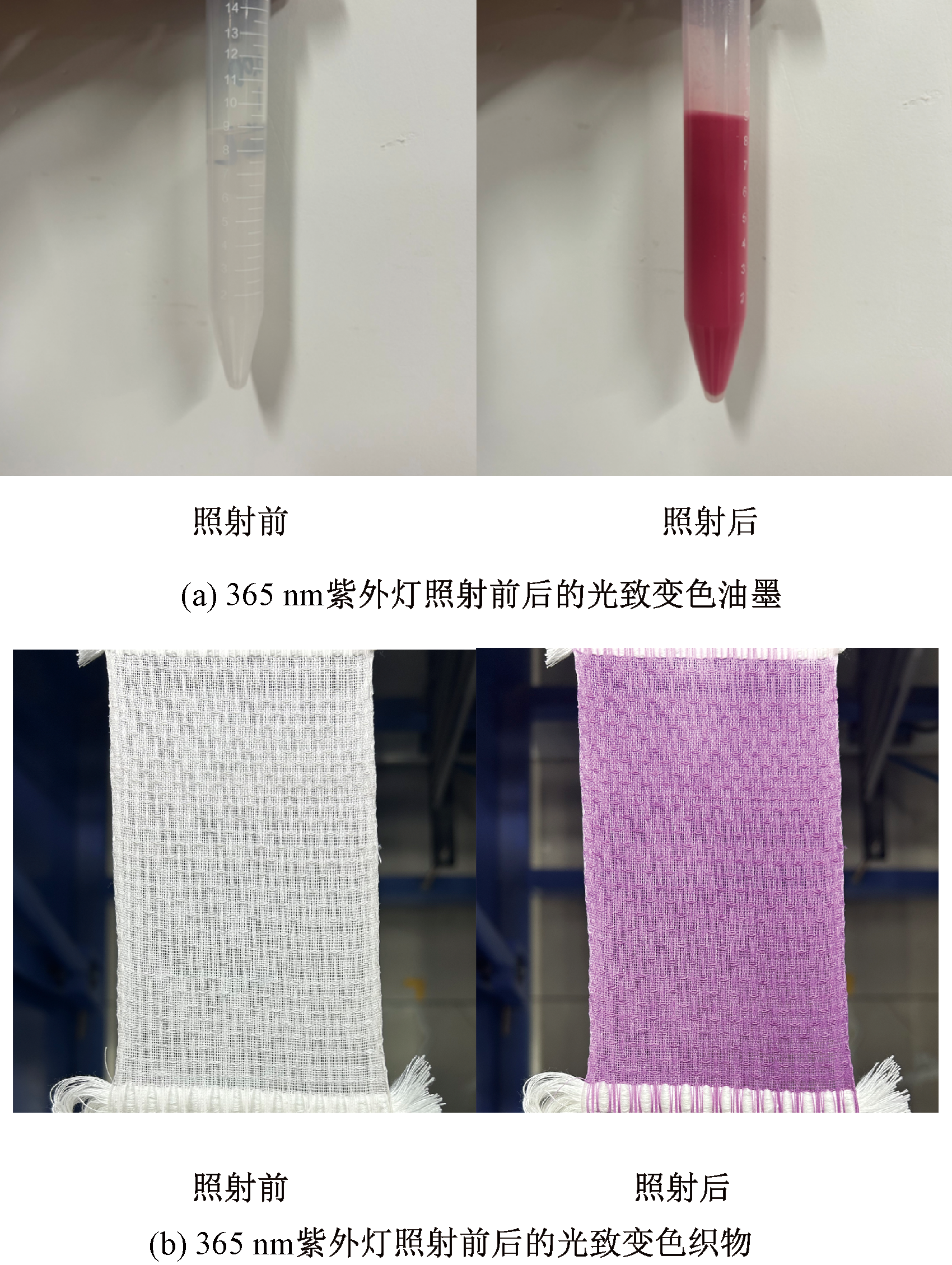
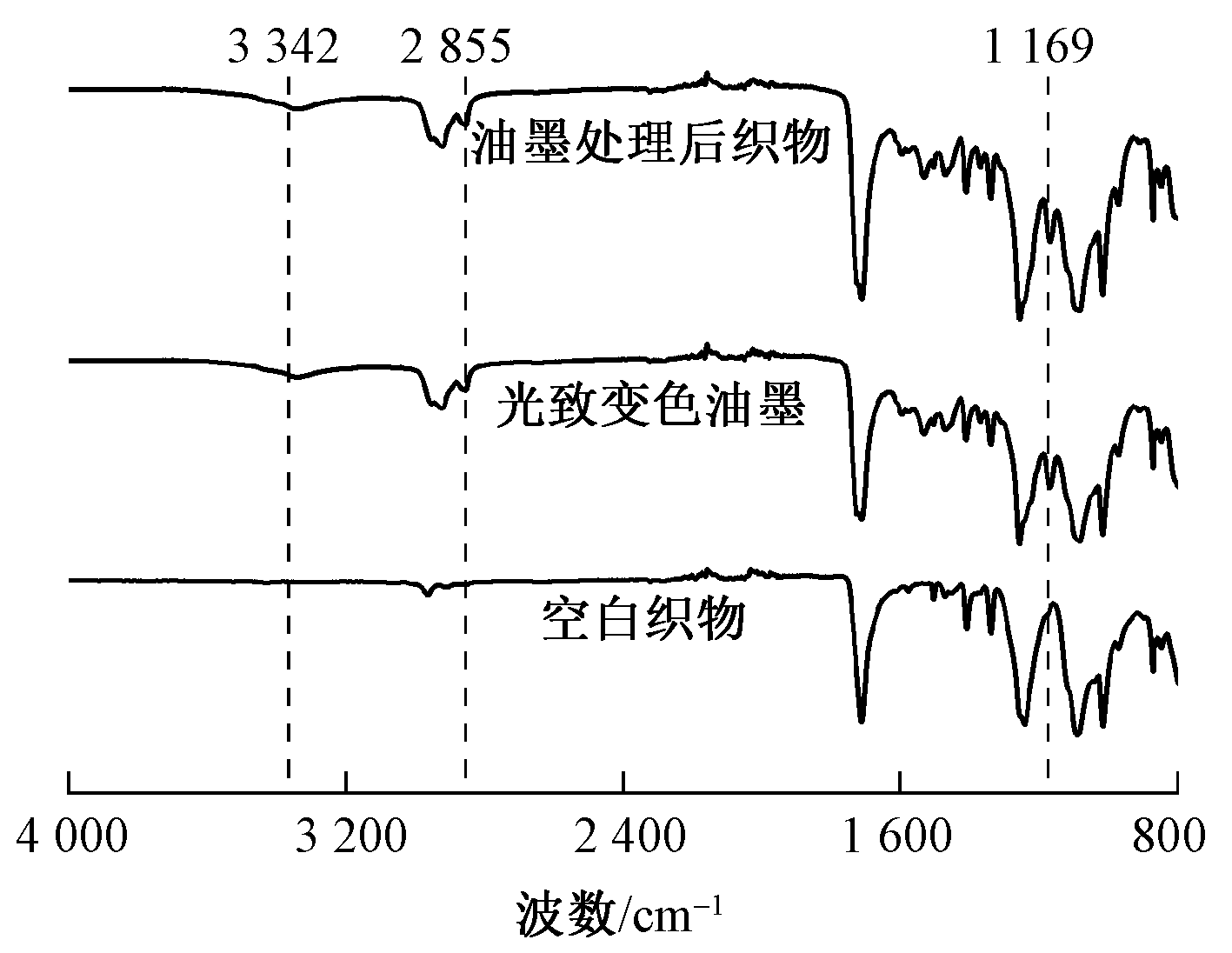
针对传统防伪技术动态响应能力弱与安全性不足的问题,开发了一种新型光致变色织物,并系统评估其在防伪应用中的性能。通过构建硝基苯并螺吡喃-聚甲基丙烯酸酯混合溶剂体系,成功制备出高稳定性的光致变色油墨,并基于该油墨实现了功能性纺织品的制备。对所制备光致变色织物的化学结构、光学性能、透气性、摩擦色牢度、疏水性及防伪性能等进行测试与表征。结果表明:该光致变色织物在紫外光照下1 s内即可迅速显色,移除光源后快速褪色,2 min后完全恢复初始状态,且具备良好的可重复使用性;透气率超过100 mm/s,耐摩擦色牢度达4~5级,无掉色或脱色现象,耐光色牢度为3~4级;接触角大于90°,表现出优良的疏水性能;此外,结合二维码技术设计的双模态动态防伪标签,在紫外光照下可实现动态显色,仅在撤光后30 s的时间窗口内可有效读取二维码信息。该光致变色纺织品的颜色褪变行为难以通过普通印刷技术复制,显著增强了防伪性能,为在高端防伪领域的应用提供了新策略。
中图分类号:
| [1] | GAYIALIS S P, KECHAGIAS E, PAPADOPOULOS G A, et al. Design of a blockchain-driven system for product counterfeiting restraint in the supply chain[M]// Advances in production management systems. production management for the factory of the future. Cham: Springer International Publishing, 2019: 474-481. |
| [2] |
KHALILZADEH R, BABAZADEH-MAMAQANI M, MOHAMMADI-JORJAFKI M, et al. Advanced anticounterfeiting polymer inks for high-level encryption and authentication technologies[J]. Progress in Materials Science, 2025, 153: 101487.
doi: 10.1016/j.pmatsci.2025.101487 |
| [3] |
ZHAN Z K, LI S H, SHEN L, et al. Smart and secure: fluorescent polymers revolutionizing anti-counterfeiting strategies[J]. Advanced Materials Technologies, 2025, 10(23): e01366.
doi: 10.1002/admt.v10.23 |
| [4] |
KUMAR S, BANKA H, KAUSHIK B, et al. A review and analysis of secure and lightweight ECC-based RFID authentication protocol for Internet of vehicles[J]. Transactions on Emerging Telecommunications Technologies, 2021, 32(11): e4354.
doi: 10.1002/ett.v32.11 |
| [5] | DUAN J T, LI G Q, XIONG Y Z, et al. Scalable plasmonic physical unclonable functions empowered by a multi-dimensional expanding strategy[J]. Advanced Photonics Nexus, 2025, 4(1): 016003-016003. |
| [6] |
BIN AHMAD KAYANI A, KURIAKOSE S, MONSHIPOURI M, et al. UV photochromism in transition metal oxides and hybrid materials[J]. Small, 2021, 17(32): 2100621.
doi: 10.1002/smll.v17.32 |
| [7] | 王小艳, 杨书康, 肖国威, 等. 光响应螺噁嗪掺杂长余辉发光纤维的制备及其性能[J]. 纺织学报, 2025, 46(2): 1-9. |
|
WANG Xiaoyan, YANG Shukang, XIAO Guowei, et al. Preparation and performance of photoresponsive long-afterglow phosphorescent fibers with spirooxazine doping[J]. Journal of Textile Research, 2025, 46(2): 1-9.
doi: 10.1177/004051757604600101 |
|
| [8] |
XU C, QIAO Z H, NIU J R, et al. Study on a novel dye with multi-stimulus response based on spiropyran[J]. Dyes and Pigments, 2025, 239: 112775.
doi: 10.1016/j.dyepig.2025.112775 |
| [9] |
HASSAN F, TANG Y Q, BISOYI H K, et al. Photochromic carbon nanomaterials: an emerging class of light-driven hybrid functional materials[J]. Advanced Materials, 2024, 36(32): 2401912.
doi: 10.1002/adma.v36.32 |
| [10] |
SHARMA D, GOYAL S, KUMAR K, et al. Advanced functional spiropyran-based smart materials with rapid and reversible photochromic response for optical sensing applications[J]. Advanced Materials Technologies, 2025, 10(10): 2401288.
doi: 10.1002/admt.v10.10 |
| [11] | 李达, 郭鹍鹏, 张芳, 等. 苯并噻唑偶氮苯化合物的双模式光致变色性能及其在光信息存储中的应用[J]. 高等学校化学学报, 2025, 46(9): 78-84. |
| LI Da, GUO Kunpeng, ZHANG Fang, et al. Dual-mode photochromic properties of a benzothiazole-azobenzene compound and its application in optical information storage[J]. Chemical Journal of Chinese Universities, 2025, 46(9): 78-84. | |
| [12] |
GUPTA I, SINGH S, BHAGWAN S, et al. Rare earth (RE) doped phosphors and their emerging applications: a review[J]. Ceramics International, 2021, 47(14): 19282-19303.
doi: 10.1016/j.ceramint.2021.03.308 |
| [13] |
NEACSU A, CHIHAIA V, ALEXIEV V, et al. Specifics of the molecular conformations and physicochemical properties of merocyanine form of spirooxazine derivative: insights from experimental and molecular dynamics studies[J]. Materials, 2025, 18(11): 2505.
doi: 10.3390/ma18112505 |
| [14] |
WAN J M, XU J, ZHU S Y, et al. Photochromic composites with fast light response, high contrast, and waterproof properties[J]. Journal of Cleaner Production, 2023, 419: 138281.
doi: 10.1016/j.jclepro.2023.138281 |
| [15] | 赵明顺, 陈枭雄, 于金超, 等. 光致变色聚乳酸纤维的纺制及其微观结构与性能[J]. 纺织学报, 2023, 44(7): 10-17. |
| ZHAO Mingshun, CHEN Xiaoxiong, YU Jinchao, et al. Spinning and microstructure and properties of photochromic polylactic acid fibers[J]. Journal of Textile Research, 2023, 44(7): 10-17. | |
| [16] |
MANEA-SAGHIN A M, ION A E, KAJZAR F, et al. Second order nonlinear optical properties of poled films containing azobenzenes tailored with azulen-1-yl-pyridine[J]. Heliyon, 2023, 9(6): e17360.
doi: 10.1016/j.heliyon.2023.e17360 |
| [17] |
LI B S, ZHU W Y, LIU J R, et al. Grafting photochromic spiropyran polymer brushes on graphene oxide surfaces via surface-initiated ring-opening metathesis polymerization[J]. RSC Advances, 2024, 14(6): 3748-3756.
doi: 10.1039/D3RA08076E |
| [18] |
ZHANG M, ZHOU Q, DONG Q S, et al. Electrospun bioactive poly(ε-caprolactone) nanofibrous scaffolds incorporated with natural decellularized bone extracellular matrix for bone regeneration[J]. European Cells and Materials, 2025, 49: 35-54.
doi: 10.22203/eCM.v049a05 |
| [19] |
WANG S P, WU L M, LI H, et al. A Cu2+ triggered reversible photochromic system: the structure photochromic response relationship study and potential applications[J]. Royal Society Open Science, 2023, 10(6): 230121.
doi: 10.1098/rsos.230121 |
| [20] | 李炤中. 具有智能变色特性的电/光响应液晶高分子复合材料的制备与性能研究[D]. 北京: 北京科技大学, 2025. |
| LI Zhaozhong. Research on preparation and performance of electro-/photo-responsive liquid crystal polymer composites with color-changing properties[D]. Beijing: University of Science and Technology Beijing, 2025. | |
| [21] |
LI Y L, ZHANG F, SHEN L Y, et al. Robust and long-lived photochromic textiles with spiropyran derivatives[J]. ACS Applied Optical Materials, 2025, 3(2): 346-357.
doi: 10.1021/acsaom.4c00488 |
| [22] |
欧宗权, 于金超, 潘志娟. 光致变色聚乳酸/聚3-羟基丁酸酯共混纤维的纺制及其结构与性能[J]. 纺织学报, 2024, 45(12): 9-17.
doi: 10.13475/j.fzxb.20230905101 |
|
OU Zongquan, YU Jinchao, PAN Zhijuan. Spinning of photochromic polylactic acid/polyhydroxybutyrate blend fiber and its structure and properties[J]. Journal of Textile Research, 2024, 45(12): 9-17.
doi: 10.13475/j.fzxb.20230905101 |
|
| [23] |
LIN L, MA X Y, XUE X Y, et al. In-situ growth of photochromic microcapsules for the preparation of fast-response, high color-fastness smart textiles[J]. Composites Communications, 2025, 57: 102467.
doi: 10.1016/j.coco.2025.102467 |
| [24] |
ZHANG Y, GAO Z P, LIU F, et al. Electrostatic assembly of photochromic TiO2/phosphomolybdic acid composite nanoparticles for light-responsive rewritable papers[J]. ACS Applied Nano Materials, 2022, 5(9): 13218-13226.
doi: 10.1021/acsanm.2c02954 |
| [25] | 杨梦凡, 王潮霞, 殷允杰, 等. 棉织物的螺吡喃微胶囊印花及其光致变色性能[J]. 纺织学报, 2022, 43(9): 137-142. |
| YANG Mengfan, WANG Chaoxia, YIN Yunjie, et al. Printing and photochromic properties of spiropyran microcapsules on cotton fabrics[J]. Journal of Textile Research, 2022, 43(9): 137-142. |
| [1] | 王何一帆, 吕家安, 孙丰鑫. 全天候热湿自适应织物的分级设计及其性能[J]. 纺织学报, 2026, 47(02): 144-152. |
| [2] | 张苒, 祝仕玲, 王栋, 刘琼珍, 陆莹. 硫化铋/碳纳米管/聚偏二氟乙烯复合温度传感纤维的制备与性能[J]. 纺织学报, 2026, 47(02): 18-25. |
| [3] | 刘一鸣, 李琳, 杜鲜晶, 刘攀, 殷霞, 田明伟. 内螺旋结构弹性导电纱线的制备及其应变不敏感性能的调控[J]. 纺织学报, 2026, 47(01): 115-122. |
| [4] | 邵剑波, 岳欣琰, 陈雨, 韩潇, 洪剑寒. 全针织结构多模态柔性电容传感器的构筑及其传感性能[J]. 纺织学报, 2026, 47(01): 123-131. |
| [5] | 任萧, 潘林洁, 姜海霞, 葛凤燕, 高洪国. 生物质多酚-亚铁离子多色系染料制备及其在棉织物上的应用[J]. 纺织学报, 2026, 47(01): 132-141. |
| [6] | 顾家玉, 张炜栋, 董永春, 孙璇, 徐良军. 银杏叶黄酮对羊毛和蚕丝织物的抗菌整理[J]. 纺织学报, 2026, 47(01): 142-150. |
| [7] | 张宁讴, 王海龙, 胡星友, 孙彬, 游超瑜. 电致发光纤维的技术创新与研究进展[J]. 纺织学报, 2026, 47(01): 250-258. |
| [8] | 胡崴琳, 白洁, 刘丹, 白濛, 李娟, 李启正. 基于机器学习模型的电子纺织品研究进展[J]. 纺织学报, 2026, 47(01): 268-276. |
| [9] | 候志文, 任泽苹, 王晓宁, 张天骄. 棉织物的壳聚糖/海藻酸盐抗菌阻燃整理及其性能[J]. 纺织学报, 2025, 46(12): 171-180. |
| [10] | 王梁宇, 高晓红, 于彩娇, 张雪婷, 杨旭礼. 还原氧化石墨烯/铜纳米颗粒导电棉织物的制备及其传感性能[J]. 纺织学报, 2025, 46(12): 181-187. |
| [11] | 季巧, 于清源, 周爱晖, 马博谋, 徐进, 袁久刚. 细菌纤维素及其复合材料的应用研究进展[J]. 纺织学报, 2025, 46(12): 243-250. |
| [12] | 叶慧, 丛洪莲, 贺海军. 基于二元脂肪酸的中空涤纶相变纤维制备及其性能[J]. 纺织学报, 2025, 46(11): 188-195. |
| [13] | 张帆, 蔡再生, 刘慧景, 陆少锋, 黄旭明. 高牢固光致变色棉织物的点击化学法制备及其性能[J]. 纺织学报, 2025, 46(11): 196-202. |
| [14] | 王莎莎, 李超婧, 李彦, 毛吉富, 王富军, 王璐. 智能可穿戴健康纺织品应用研究进展[J]. 纺织学报, 2025, 46(10): 265-273. |
| [15] | 赵捷清, 王瑧, 秦孝天, 王成成, 张丽平. 模拟绿叶颜色变化的温致变色织物制备及其性能[J]. 纺织学报, 2025, 46(09): 19-26. |
|
||
 京公网安备11010502044800号