纺织学报 ›› 2025, Vol. 46 ›› Issue (11): 118-125.doi: 10.13475/j.fzxb.20240907101
谢宜轩, 钟林, 徐柠浩, 黄晓梅, 曹海建( )
)
XIE Yixuan, ZHONG Lin, XU Ninghao, HUANG Xiaomei, CAO Haijian()
摘要:
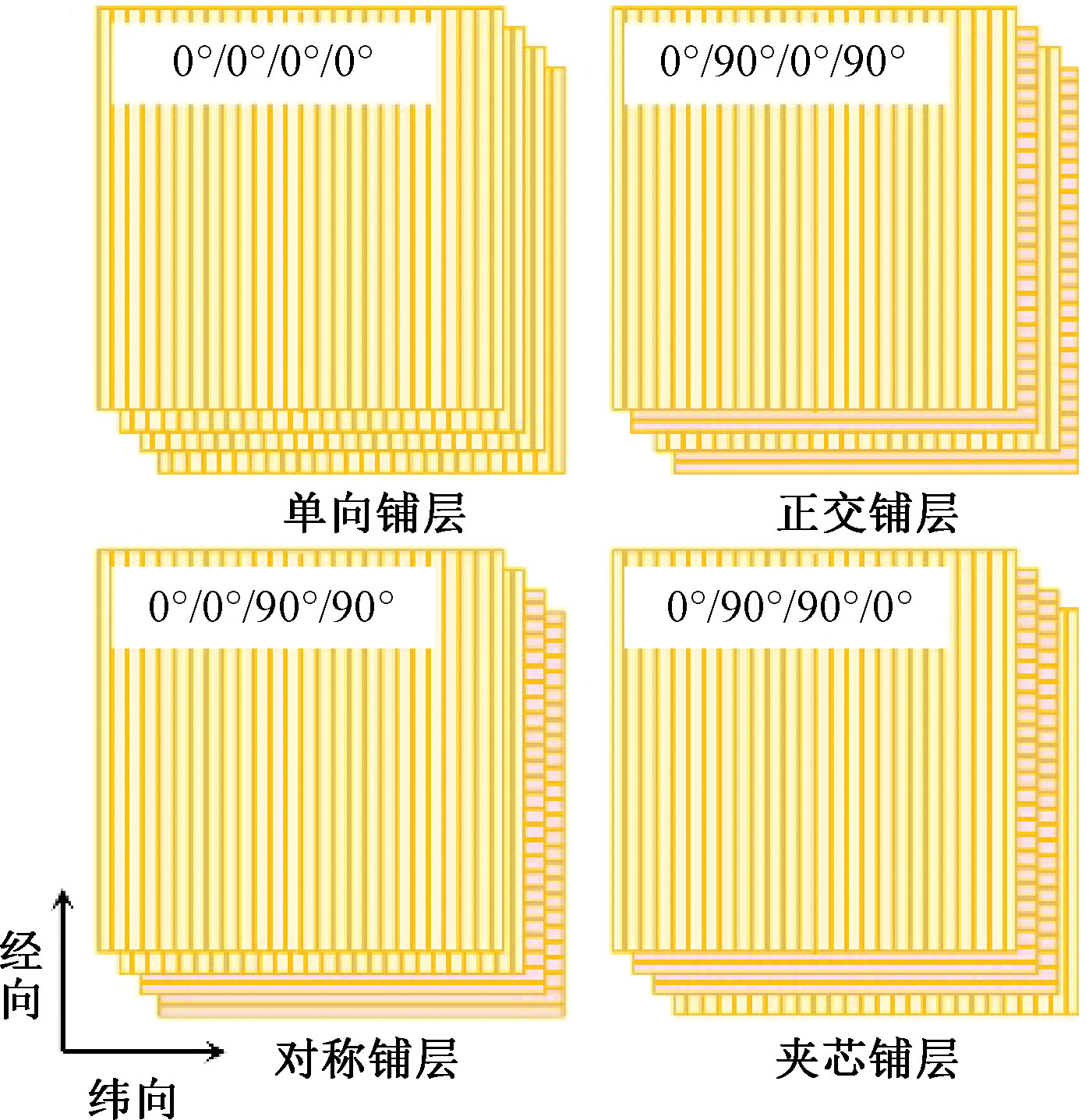
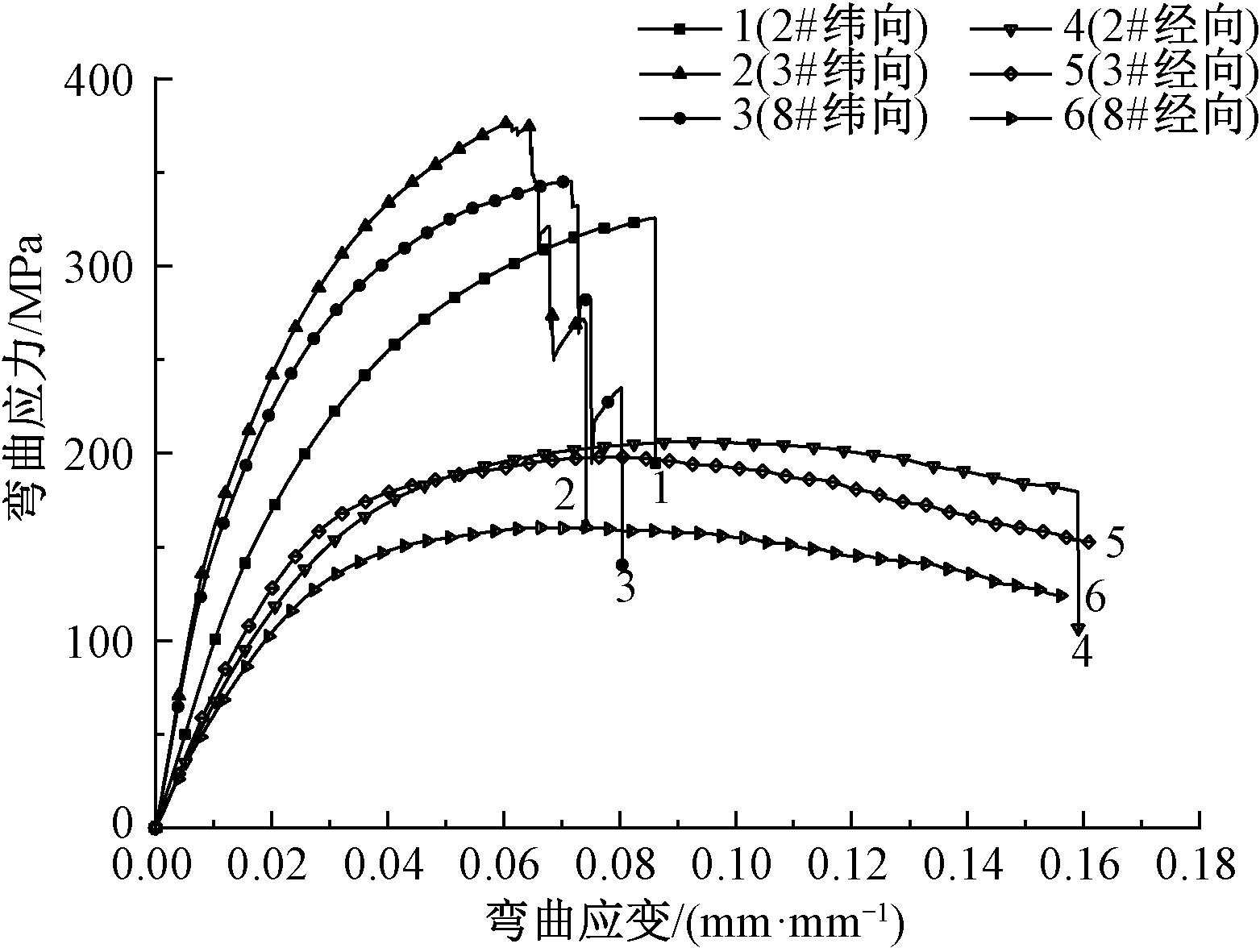
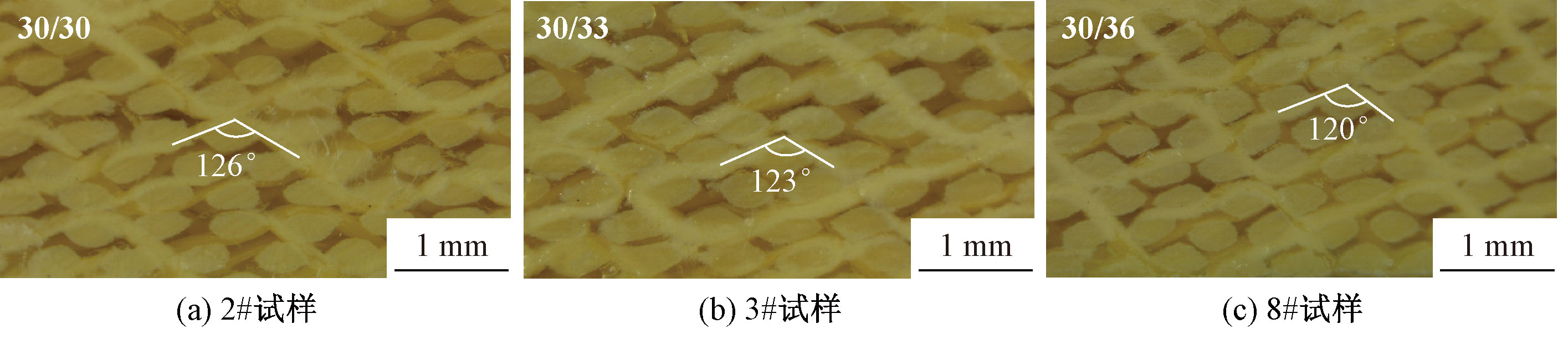
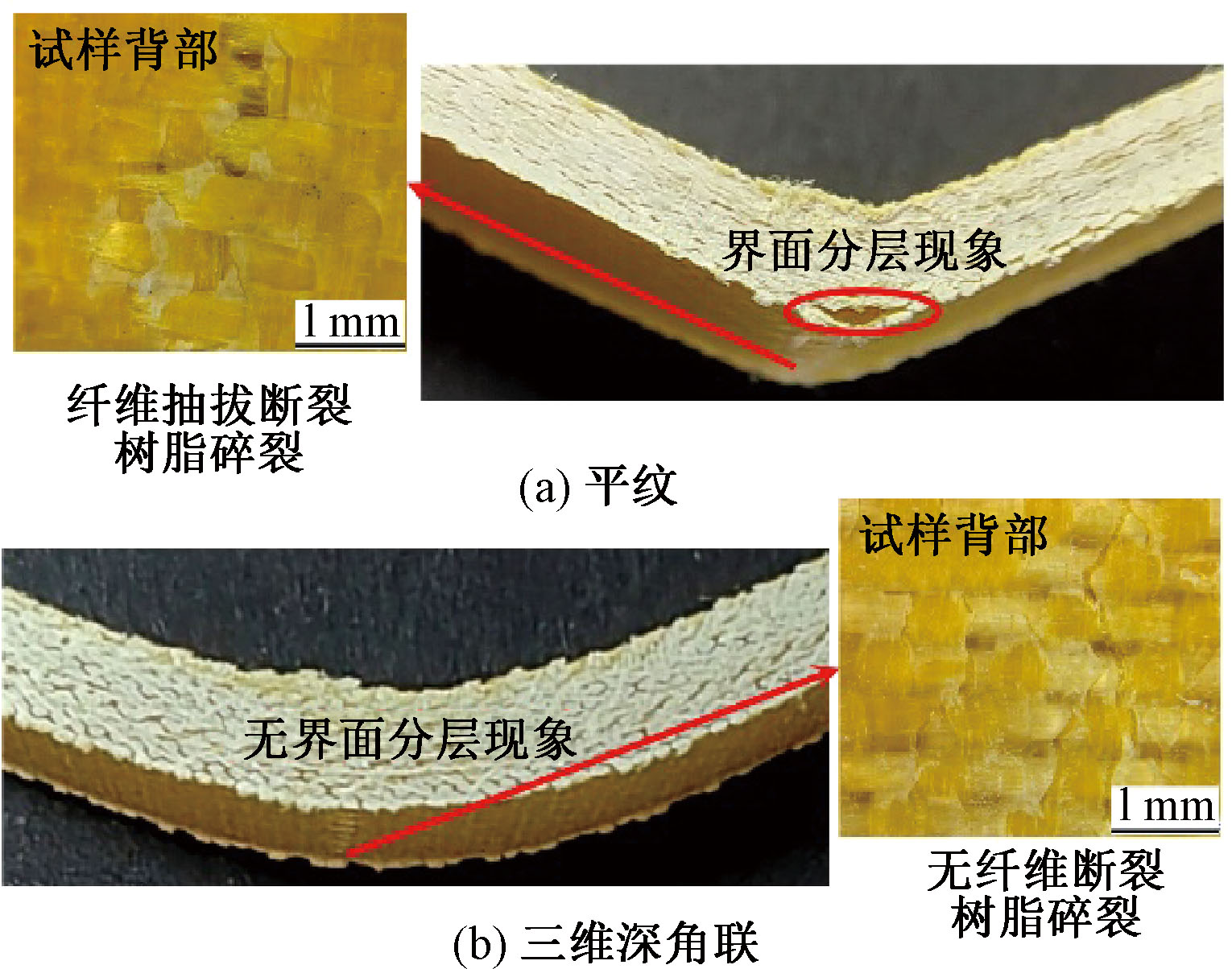
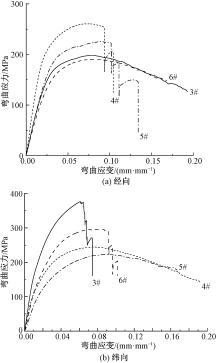
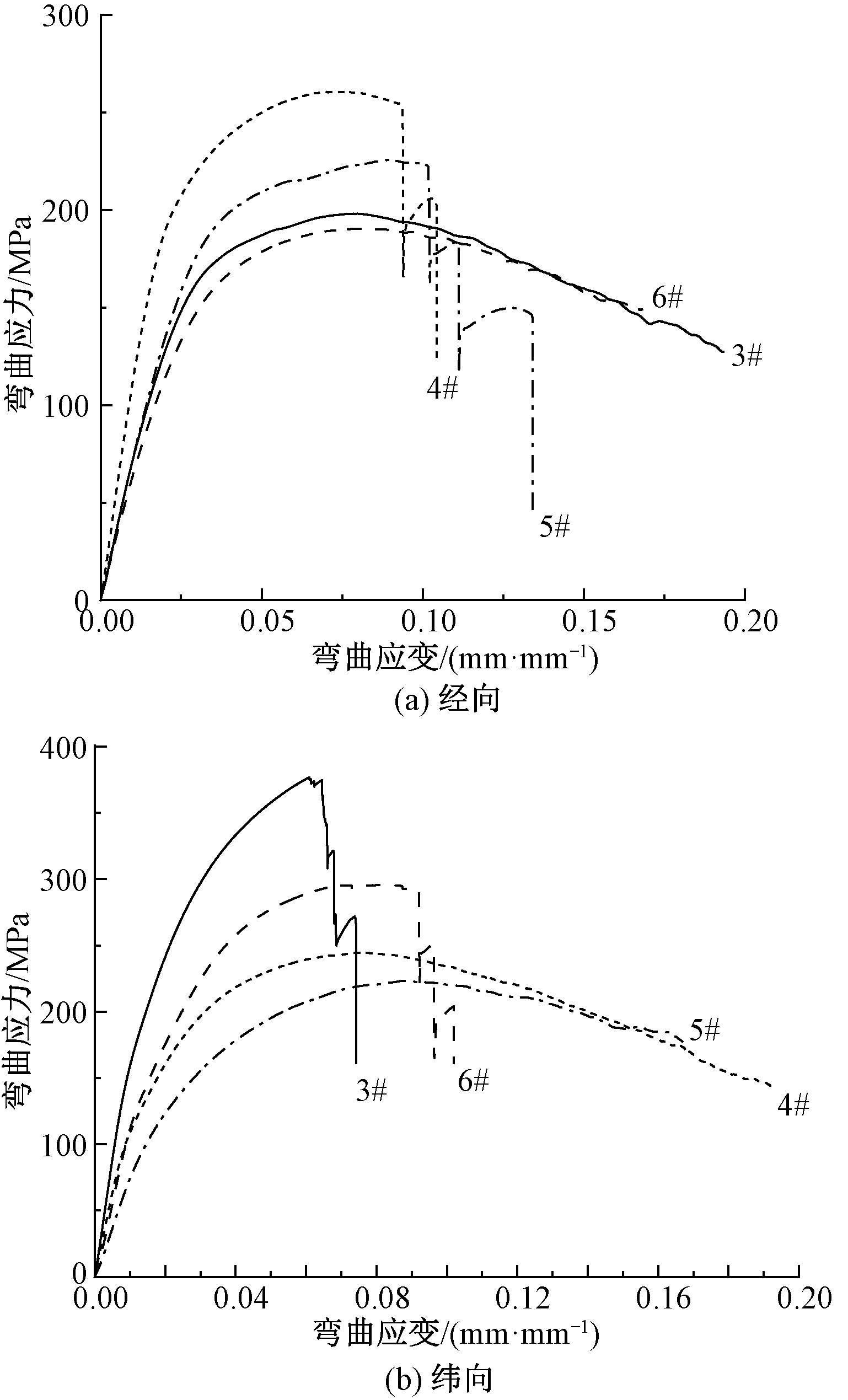
为探究三维机织复合材料的弯曲作用机制,以芳纶织物为增强体,环氧树脂和聚醚胺为基体制备了三维深角联芳纶/环氧树脂复合材料。研究了织物纬密、组织结构以及铺层方式对三维深角联芳纶织物/环氧树脂复合材料弯曲性能的影响。结果表明:当三维深角联芳纶/环氧树脂复合材料承受弯曲载荷时,纬向弯曲性能优于经向;随着纬密增大,材料的纬向弯曲强度、弯曲模量以及经向弯曲模量均呈先升后降的趋势,而经向弯曲强度则呈下降趋势;材料的纬向弯曲性能优于平纹结构,并具有更好的抗分层性。采用正交铺层方式制备的复合材料有利于最大限度地发挥材料弯曲性能的提高潜力,同时减小弯曲性能各向差异。
中图分类号:
| [1] |
DE OLIVEIRA BRAGA F, LOPES P H L M, OLIVEIRA M S, et al. Thickness assessment and statistical optimization of a 3-layered armor system with ceramic front and curaua fabric composite/aluminum alloy backing[J]. Composites Part B: Engineering, 2019, 166: 48-55.
doi: 10.1016/j.compositesb.2018.11.128 |
| [2] |
ELFVERSSON E, HÖGLUND K. Are armed conflicts becoming more urban?[J]. Cities, 2021, 119: 103356.
doi: 10.1016/j.cities.2021.103356 |
| [3] |
DRESCH A B, VENTURINI J, ARCARO S, et al. Ballistic ceramics and analysis of their mechanical properties for armour applications: a review[J]. Ceramics International, 2021, 47(7): 8743-8761.
doi: 10.1016/j.ceramint.2020.12.095 |
| [4] |
WU H L, MIAO C, MU X M, et al. Study on ballistic performance of a spherical cylindrical ceramic armor structure[J]. Journal of Physics: Conference Series, 2023, 2478(7): 072010.
doi: 10.1088/1742-6596/2478/7/072010 |
| [5] |
YE K C, WANG Z J. Twins enhanced mechanical properties of boron carbide[J]. Ceramics International, 2022, 48(10): 14499-14506.
doi: 10.1016/j.ceramint.2022.01.343 |
| [6] |
CHAVES Y S, MONTEIRO S N, NASCIMENTO L F C, et al. Mechanical and ballistic properties of epoxy composites reinforced with babassu fibers (Attalea speciosa)[J]. Polymers, 2024, 16(7): 913.
doi: 10.3390/polym16070913 |
| [7] |
LUZ F S D, GARCIA FILHO F D C, OLIVEIRA M S, et al. Composites with natural fibers and conventional materials applied in a hard armor: a comparison[J]. Polymers, 2020, 12(9): 1920.
doi: 10.3390/polym12091920 |
| [8] |
JARUPONG J, SASRIMUANG S, ARTNASEAW A. Characteristics of bulletproof plate made from silkworm cocoon waste: hybrid silkworm cocoon waste-reinforced epoxy/UHMWPE composite[J]. Science and Engineering of Composite Materials, 2024, 31: 20240006.
doi: 10.1515/secm-2024-0006 |
| [9] |
NURAZZI N M, ASYRAF M M, KHALINA A, et al. A review on natural fiber reinforced polymer composite for bullet proof and ballistic applications[J]. Polymers, 2021, 13(4): 646.
doi: 10.3390/polym13040646 |
| [10] |
BANDARU A K, CHAVAN V V, AHMAD S, et al. Ballistic impact response of Kevlar reinforced thermoplastic composite armors[J]. International Journal of Impact Engineering, 2016, 89: 1-13.
doi: 10.1016/j.ijimpeng.2015.10.014 |
| [11] |
BAO Y G, GAO X J, WU Y C, et al. Research progress of armor protection materials[J]. Journal of Physics: Conference Series, 2021, 1855(1): 012035.
doi: 10.1088/1742-6596/1855/1/012035 |
| [12] |
TAN H C, LIU L L, GUAN Y P, et al. Investigation of three-dimensional braided composites subjected to steel projectile impact: experimental study and numerical simulation[J]. Thin-Walled Structures, 2019, 140: 144-156.
doi: 10.1016/j.tws.2019.03.030 |
| [13] |
HU M Q, ZHANG J J, SUN B Z, et al. Finite element modeling of multiple transverse impact damage behaviors of 3-D braided composite beams at microstructure level[J]. International Journal of Mechanical Sciences, 2018, 148: 730-744.
doi: 10.1016/j.ijmecsci.2018.09.034 |
| [14] |
HUANG T, WANG Y L, WANG G. Review of the mechanical properties of a 3D woven composite and its applications[J]. Polymer-Plastics Technology and Engineering, 2018, 57(8): 740-756.
doi: 10.1080/03602559.2017.1344857 |
| [15] |
DAI S, CUNNINGHAM P R, MARSHALL S, et al. Influence of fibre architecture on the tensile, compressive and flexural behaviour of 3D woven composites[J]. Composites Part A: Applied Science and Manufacturing, 2015, 69: 195-207.
doi: 10.1016/j.compositesa.2014.11.012 |
| [16] |
ZHENG J H, ZHONG L, CHEN H X, et al. Research on bending performance of three-dimensional deep angle interlock kevlar/EP armor material[J]. Materials, 2022, 15(15): 5321.
doi: 10.3390/ma15155321 |
| [17] |
WANG M X, ZHONG L, CAO H J, et al. Research on bending and ballistic performance of three-dimensional ply-to-ply angle interlock kevlar/EP armor material[J]. Materials, 2022, 15(19): 6994.
doi: 10.3390/ma15196994 |
| [18] |
MA P B, JIN L M, WU L W. Experimental and numerical comparisons of ballistic impact behaviors between 3D angle-interlock woven fabric and its reinforced composite[J]. Journal of Industrial Textiles, 2019, 48(6): 1044-1058.
doi: 10.1177/1528083718754903 |
| [19] |
ABTEW M A, BOUSSU F, BRUNIAUX P, et al. Enhancing the ballistic performances of 3D warp interlock fabric through internal structure as new material for seamless female soft body armor development[J]. Applied Sciences, 2020, 10(14): 4873.
doi: 10.3390/app10144873 |
| [20] |
ABTEW M A, BOUSSU F, BRUNIAUX P, et al. Fabrication and mechanical characterization of dry three-dimensional warp interlock Para-aramid woven fabrics: experimental methods toward applications in composite reinforcement and soft body armor[J]. Materials, 2020, 13(19): 4233.
doi: 10.3390/ma13194233 |
| [21] |
AKIL H M, OMAR M F, MAZUKI A A M, et al. Kenaf fiber reinforced composites: a review[J]. Materials & Design, 2011, 32(8/9): 4107-4121.
doi: 10.1016/j.matdes.2011.04.008 |
| [22] |
ABDUL KHALIL H P S, ISSAM A M, AHMAD SHAKRI M T, et al. Conventional agro-composites from chemically modified fibres[J]. Industrial Crops and Products, 2007, 26(3): 315-323.
doi: 10.1016/j.indcrop.2007.03.010 |
| [23] |
AISYAH H A, PARIDAH M T, KHALINA A, et al. Effects of fabric counts and weave designs on the properties of laminated woven kenaf/carbon fibre reinforced epoxy hybrid composites[J]. Polymers, 2018, 10(12): 1320.
doi: 10.3390/polym10121320 |
| [24] |
BANDARU A K, SACHAN Y, AHMAD S, et al. On the mechanical response of 2D plain woven and 3D angle-interlock fabrics[J]. Composites Part B: Engineering, 2017, 118: 135-148.
doi: 10.1016/j.compositesb.2017.03.011 |
| [25] |
SHI J J, CHEN H X, XU N H, et al. The mechanical properties of Kevlar three-dimensional angle-interlock fabrics and composites[J]. The Journal of the Textile Institute, 2025, 116(6): 1102-1114.
doi: 10.1080/00405000.2024.2366704 |
| [1] | 李欣田, 周玄, 王展翾, 杜忠华, 徐立志. 层数与铺层方式对多层芳纶平纹织物抗侵彻性能的影响[J]. 纺织学报, 2025, 46(11): 126-136. |
| [2] | 费旌源, 徐乃库, 肖长发. 水可溃散砂质芯模设计及其在中空异形碳纤维复合材料成型中的应用[J]. 纺织学报, 2025, 46(11): 137-146. |
| [3] | 高龙威, 蒋金华, 陈南梁, 邵慧奇. 经编双轴向碳纤维织物增强复合材料的冲击损伤特性[J]. 纺织学报, 2025, 46(11): 147-154. |
| [4] | 郭艳文, 夏蕊, 黄晓梅, 陈红霞, 曹海建. 经纬向紧度比对三维浅交弯联机织复合材料拉伸性能的影响[J]. 纺织学报, 2025, 46(10): 103-110. |
| [5] | 唐曾华, 李宏杰, 毕思伊, 邵光伟, 蒋金华, 陈南梁, 邵慧奇. 增强结构对碳纤维/热塑性聚氨酯柔性复合材料电磁屏蔽性能的影响[J]. 纺织学报, 2025, 46(10): 111-119. |
| [6] | 顾戚惠, 阳知乾, 王海楼, 魏发云, 张伟. 机织间隔织物增强水泥基复合材料的制备及其力学性能[J]. 纺织学报, 2025, 46(10): 120-128. |
| [7] | 唐春霞, 王一帆, 毛云山, 刘健, 付少海. 电磁屏蔽用纤维素基复合材料结构设计的研究进展[J]. 纺织学报, 2025, 46(09): 36-45. |
| [8] | 陈晴宇, 陆春红, 张斌, 晋义凯, 黄琪帏, 王超, 丁彬, 俞建勇, 王先锋. 碳纤维增强水泥基灌浆料的制备及其性能[J]. 纺织学报, 2025, 46(08): 120-126. |
| [9] | 刘旭东, 宋政吉, 陈世昌, 陈文兴. 改性环氧树脂涂覆聚酰亚胺纤维的表面性能[J]. 纺织学报, 2025, 46(08): 18-27. |
| [10] | 张一帆, 安柳絮, 闫英杰, 邹齐, 刘晓志, 郭俊华, 陈利. 三维机织复合材料T型接头的拉伸性能[J]. 纺织学报, 2025, 46(07): 128-135. |
| [11] | 张毅, 沈殷, 高金霞, 郁崇文. 棕榈纤维吸声复合材料的老化性能[J]. 纺织学报, 2025, 46(06): 127-134. |
| [12] | 顾文敏, 蒋高明, 刘海桑, 李炳贤. 基于网格模型的全成形裙装三维仿真[J]. 纺织学报, 2025, 46(05): 214-221. |
| [13] | 黎靖康, 黄亮, 陈诗诗, 毕曙光, 冉建华, 唐加功. 苄基缩水甘油醚改性环氧类玻璃高分子材料的自修复与再加工性能[J]. 纺织学报, 2025, 46(04): 20-28. |
| [14] | 吕丽华, 潘佳欣, 伍成龙. 废弃玉米芯颗粒的结构及其复合材料吸声性能[J]. 纺织学报, 2025, 46(04): 96-102. |
| [15] | 李皎, 辛世纪, 陈利, 易伟, 陈小明. 双机器人分区针刺成形轨迹规划[J]. 纺织学报, 2025, 46(03): 207-215. |
|
||
 京公网安备11010502044800号