纺织学报 ›› 2025, Vol. 46 ›› Issue (12): 92-100.doi: 10.13475/j.fzxb.20250400801
胡新阳1,2, 王宏志1,2( )
)
HU Xinyang1,2, WANG Hongzhi1,2()
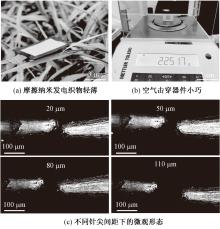
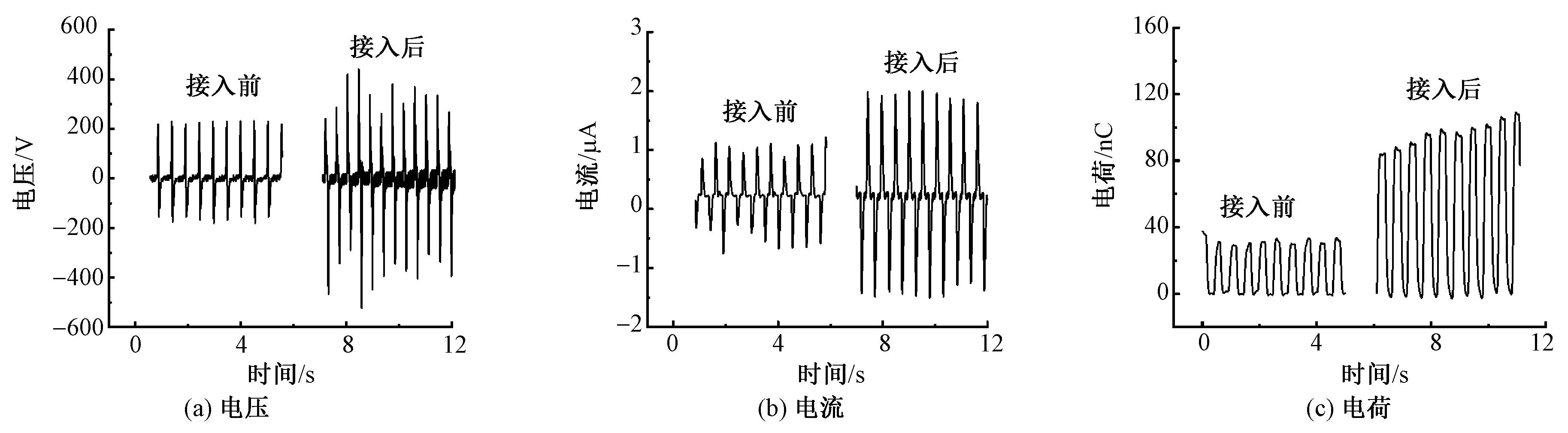
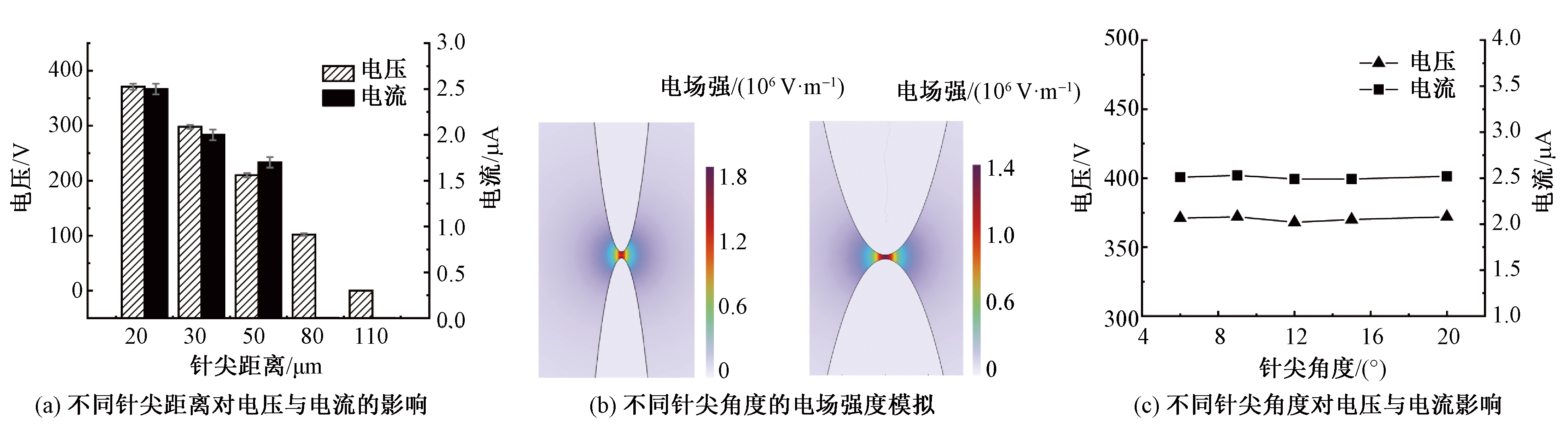
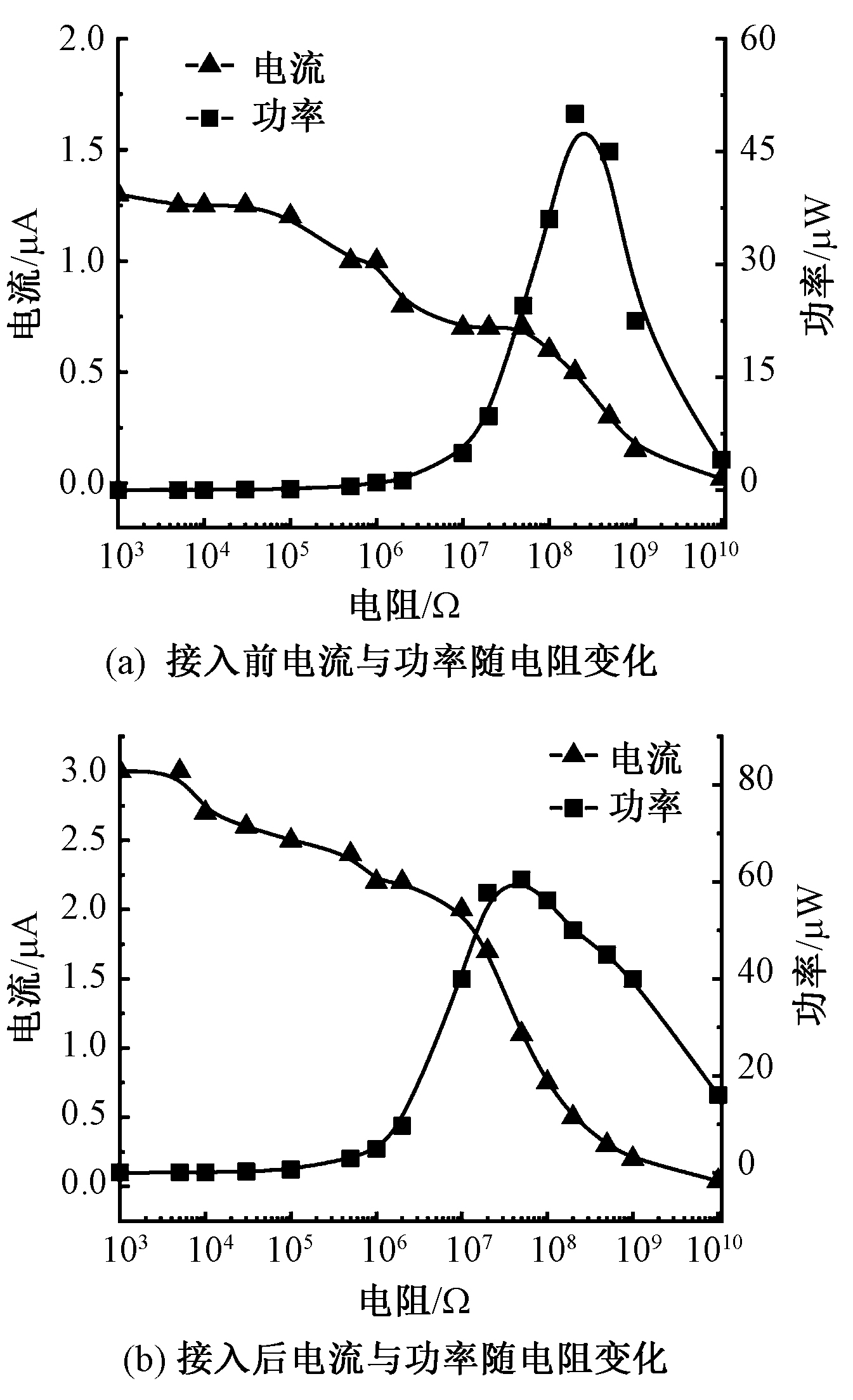
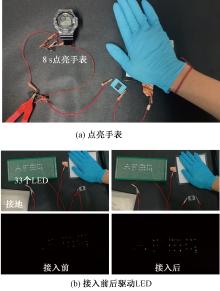
摘要: 针对基于摩擦纳米发电机(TENG)技术的织物存在输出功率较低、灵活性较差的问题,设计了一种接触分离模式的单电极结构TENG织物与一种微型对针状空气击穿器件,采用静电纺丝技术制备纳米纤维堆叠构成织物,并通过精密定位平台控制2枚钨放电针的间距,构造微米级(20~110 μm)的间隙,使摩擦纳米发电织物工作时在外电路形成空气击穿,提升输出功率,并缩小器件尺寸实现高灵活性。同时探讨放电针间距与角度、外部起电条件和环境湿度对输出功率的影响。结果表明:接入空气击穿器件后的TENG织物最高可产生532 V的开路电压和5.9 μA的短路电流,较接入前电压提升1.75倍,电流提升约2倍;接入负载后的最佳匹配电阻降低为击穿前的十分之一,功率提升约1.4倍,且表现出超5 000次的循环稳定性以及不同环境湿度下的服役稳定性,最终可实现点亮33个串联LED灯珠并驱动电子手表工作。
中图分类号:
| [1] |
SALAUDDIN M, SOHEL RANA S M, RAHMAN M T, et al. Fabric-assisted MXene/silicone nanocomposite-based triboelectric nanogenerators for self-powered sensors and wearable electronics[J]. Advanced Functional Materials, 2022, 32(5): 2107143.
doi: 10.1002/adfm.v32.5 |
| [2] |
CHENG T H, SHAO J J, WANG Z L. Triboelectric nanogenerators[J]. Nature Reviews Methods Primers, 2023, 3: 39.
doi: 10.1038/s43586-023-00220-3 |
| [3] |
LV T M, CHENG R W, WEI C H, et al. All-fabric direct-current triboelectric nanogenerators based on the tribovoltaic effect as power textiles[J]. Advanced Energy Materials, 2023, 13(29): 2301178.
doi: 10.1002/aenm.v13.29 |
| [4] |
DONG L, WANG M X, WU J J, et al. Deformable textile-structured triboelectric nanogenerator knitted with multifunctional sensing fibers for biomechanical energy harvesting[J]. Advanced Fiber Materials, 2022, 4(6): 1486-1499.
doi: 10.1007/s42765-022-00181-4 |
| [5] |
ZHAI C, CHOU X J, HE J, et al. An electrostatic discharge based needle-to-needle booster for dramatic performance enhancement of triboelectric nanogenera-tors[J]. Applied Energy, 2018, 231: 1346-1353.
doi: 10.1016/j.apenergy.2018.09.120 |
| [6] | 梁文静, 吴俊贤, 何崟, 等. 基于复合纳米纤维膜的离子传感器制备及其性能[J]. 纺织学报, 2024, 45(4): 15-23. |
| LIANG Wenjing, WU Junxian, HE Yin, et al. Preparation and performance of ion sensors based on composite nanofiber membranes[J]. Journal of Textile Research, 2024, 45(4): 15-23. | |
| [7] | 王宁, 龚维, 王宏志. 面向可穿戴电子产品的自供能摩擦电纺织品研究进展[J]. 纺织学报, 2024, 45(4): 41-49. |
| WANG Ning, GONG Wei, WANG Hongzhi. Research progress on self-supplied friction electric textiles for wearable electronics[J]. Journal of Textile Research, 2024, 45(4): 41-49. | |
| [8] |
SHI W, WANG X L, DIAO W S, et al. Effect of pump voltage on triboelectric properties and air breakdown of sliding-mode triboelectric nanogenerator[J]. Nano Energy, 2025, 137: 110758.
doi: 10.1016/j.nanoen.2025.110758 |
| [9] | SON J H, CHUNG S H, CHA K, et al. Ultrahigh performance, serially stackable, breeze driven triboelectric generator via ambient air ionizing chan-nel[J]. Advanced Materials, 2023, 35(24): e2300283. |
| [10] |
LIU Q, YANG L, HAO Y P, et al. Numerical study of breakdown voltage calculation and discharge characteristics of millimeter-level short air gap with a single water droplet[J]. Plasma Sources Science and Technology, 2024, 33(12): 125015.
doi: 10.1088/1361-6595/ad9eda |
| [11] | 伍凤娟, 刘树林, 王党树. 针电极曲率半径对微间隙空气放电击穿特性的影响[J]. 西安科技大学学报, 2023, 43(5): 1015-1024. |
| WU Fengjuan, LIU Shulin, WANG Dangshu. Influence of needle electrode radius of curvature on the breakdown characteristics of microgap air discharge[J]. Journal of Xi'an University of Science and Technology, 2023, 43(5): 1015-1024. | |
| [12] |
ZOU H Y, ZHANG Y, GUO L T, et al. Quantifying the triboelectric series[J]. Nature Communications, 2019, 10(1): 1427.
doi: 10.1038/s41467-019-09461-x pmid: 30926850 |
| [13] |
WANG J, WU H Y, FU S K, et al. Enhancement of output charge density of TENG in high humidity by water molecules induced self-polarization effect on dielectric polymers[J]. Nano Energy, 2022, 104: 107916.
doi: 10.1016/j.nanoen.2022.107916 |
| [14] |
QIU S C, TENG X H, ZHANG Y X, et al. Wearing comfortable and high electrical output TENGs woven with PTFE core-shell nanofiber yarns[J]. Chemical Engineering Journal, 2025, 505: 159501.
doi: 10.1016/j.cej.2025.159501 |
| [15] |
LI B, YANG Y Y, CHEN J Q, et al. Gas discharge tubes for significantly boosting the instantaneous current and active power of load driven by triboelectric nanogenerators[J]. Nano Energy, 2023, 108: 108200.
doi: 10.1016/j.nanoen.2023.108200 |
| [1] | 刘轲, 王雨曦, 程盼, 朱丽萍, 夏明, 梅涛, 向阳, 周丰, 高飞, 王栋. 多孔磺化氢化苯乙烯-丁二烯嵌段共聚物纤维膜制备及其吸附性能[J]. 纺织学报, 2025, 46(12): 1-10. |
| [2] | 王小虎, 包安娜, 魏静雯, 赵晓曼, 韩潇, 洪剑寒. 基于静电纺丝-静电喷涂协同工艺的跨尺度传感纱一步法制备及其应用[J]. 纺织学报, 2025, 46(12): 101-109. |
| [3] | 高俊, 凌磊, 陈缘, 武丁胜, 林韩蕾, 李振宇, 凤权. 氨基功能化聚丙烯腈纳米纤维膜的制备及其对Cr(Ⅵ)的吸附性能[J]. 纺织学报, 2025, 46(12): 57-65. |
| [4] | 张慧杰, 李登宇, 周轩, 李秀艳, 汪滨, 徐泉. 磺化聚醚醚酮基铁铬液流电池隔膜的制备及其性能[J]. 纺织学报, 2025, 46(12): 83-91. |
| [5] | 舒祖菊, 袁自钰, 周斐, 黄秀文, 王权, 房显龙, 曹美雪. 载姜黄素核壳结构纳米纤维膜的制备及其缓释性能[J]. 纺织学报, 2025, 46(11): 26-33. |
| [6] | 王文淑, 王建刚, 李瀚宇, 王春红, 谭晓璇, 王慧泉. 烷基壳聚糖/聚乙烯醇纳米纤维膜的制备及其止血性能[J]. 纺织学报, 2025, 46(11): 52-60. |
| [7] | 张佃平, 陈琪, 徐登明, 王祚, 王昊. CuO 纳米纤维的制备及其在无酶葡萄糖传感器中的性能[J]. 纺织学报, 2025, 46(11): 61-68. |
| [8] | 吴乐然, 吴霓欢, 李林耿, 钟意, 陈鸿鹏, 汤南. 负载厚朴酚的抗菌纳米纤维膜的制备及其性能[J]. 纺织学报, 2025, 46(10): 30-38. |
| [9] | 毛泽, 高俊, 凌磊, 武丁胜, 陶云, 张春, 李申, 凤权. 聚丙烯腈/聚吡咯纳米纤维膜的制备及其对铬离子的吸附性能[J]. 纺织学报, 2025, 46(09): 57-65. |
| [10] | 刘健, 潘山山, 刘泳汝, 尹兆松, 任康佳, 赵庆浩. 多尖端锯齿状静电纺丝喷头的设计及优化[J]. 纺织学报, 2025, 46(08): 217-225. |
| [11] | 马晓远, 包伟. 防水透湿纳米纤维复合织物研究现状及发展趋势[J]. 纺织学报, 2025, 46(08): 254-262. |
| [12] | 时虎, 王赫, 王洪杰, 潘显苗. 多孔交联纳米纤维基超级电容器隔膜的设计[J]. 纺织学报, 2025, 46(08): 45-52. |
| [13] | 徐丽亚, 汪瑱, 杨鸿杰, 汪蔚. 氧化锌-银/生物基聚酰胺56纳米纤维膜的制备及其抗菌性能[J]. 纺织学报, 2025, 46(07): 37-45. |
| [14] | 贾陈诺瓦, 张勇, 朱威岩, 刘赛, 唐宁. 芯纱种类对聚丙烯腈纳米纤维导电包芯纱性能的影响[J]. 纺织学报, 2025, 46(07): 87-95. |
| [15] | 陈亚娟, 郭瀚宇, 张陈恬, 李欣欣, 张雪萍. 聚乙烯醇/海藻酸钠/锦纶66复合水凝胶包芯纱的制备及其吸湿性能[J]. 纺织学报, 2025, 46(06): 103-110. |
|
||
 京公网安备11010502044800号