纺织学报 ›› 2026, Vol. 47 ›› Issue (02): 144-152.doi: 10.13475/j.fzxb.20250907701
王何一帆1, 吕家安1, 孙丰鑫1,2( )
)
WANG Heyifan1, LÜ Jia'an1, SUN Fengxin1,2()
摘要:
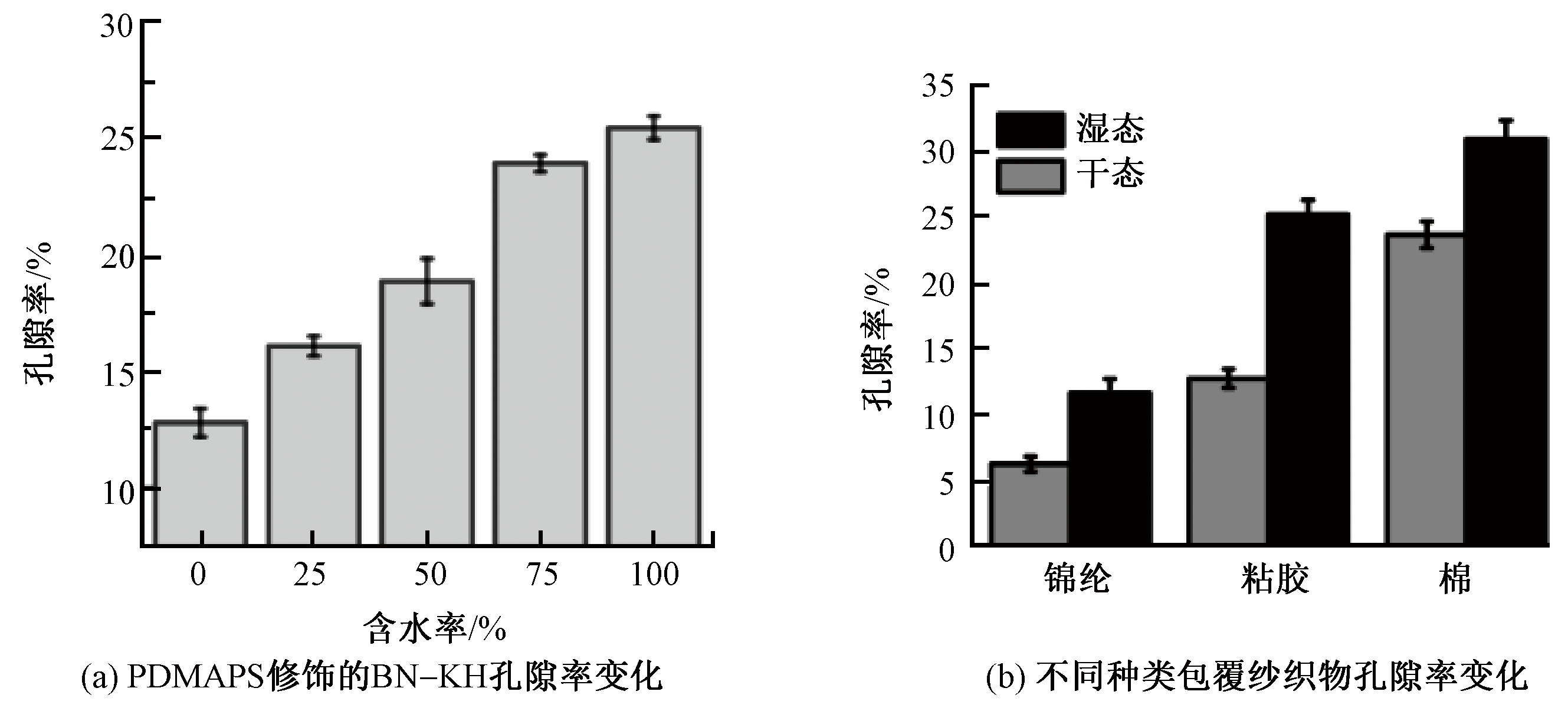
具有动态热湿调控功能的智能纺织品对于在复杂环境中保持人体热舒适、降低气候相关健康风险至关重要。为解决现有热湿管理纺织品依赖于湿度或温度单一响应机制、难以实现精准个体热湿调控的问题,通过纱线多级螺旋与织物线圈手性设计,制备具有结构驱动的湿响应织物;并结合氮化硼(BN)和γ-(甲基丙烯酰氧)丙基三甲氧基硅烷(KH-570)的疏水整理方法以及聚[2-(甲基丙烯酰基氧基)乙基]二甲基-(3-磺酸丙基)氢氧化铵(PDMAPS)共聚物接枝,构建织物表层温敏亲疏两性界面,实现湿度和温度的双响应协同调控。实验表明,织物在干湿状态下的孔隙率可在12.75%~25.25%之间切换,实现热对流、传导和辐射特性的自适应调控。同时,温度调控界面亲疏性行为,实现低温下表面疏水抑制湿响应,高温下转为亲水性增强湿响应。该研究为提升智能纺织品在多变环境中的热湿管理稳定性及个性化调控能力提供了新路径。
中图分类号:
| [1] | 朱星月, 史文路, 胡希丽. 个人热管理织物的研究进展[J]. 棉纺织技术, 2025, 53(6): 105-112. |
| ZHU Xingyue, SHI Wenlu, HU Xili. Research progress of personal thermal management fabric[J]. Cotton Textile Technology, 2025, 53(6): 105-112. | |
| [2] |
YANG M, ZHONG H M, LI T, et al. Phase change material enhanced radiative cooler for temperature-adaptive thermal regulation[J]. ACS Nano, 2023, 17(2):1693-1700.
doi: 10.1021/acsnano.2c11916 |
| [3] | 田文青, 安笑蕊, 张继友, 等. 微胶囊相变材料的消防服舒适性能与防护性能测试研究[J]. 粘接, 2024, 51(8): 112-114, 118. |
| TIAN Wenqing, AN Xiaorui, ZHANG Jiyou, et al. Testing study on the comfort and protective performance of firefighting clothing based on microencapsulated phase change materials[J]. Adhesion, 2024, 51(8): 112-114, 118. | |
| [4] |
LU Y, XIAO X D, FU J, et al. Novel smart textile with phase change materials encapsulated core-sheath structure fabricated by coaxial electrospinning[J]. Chemical Engineering Journal, 2019, 355: 532-539.
doi: 10.1016/j.cej.2018.08.189 |
| [5] |
CHEN Z P, ZHANG Q, DING L P, et al. An infrared-transparent textile with high drawing processed Nylon 6 nanofibers[J]. Nature Communications, 2025, 16: 2009.
doi: 10.1038/s41467-025-57366-9 |
| [6] | 李本辉, 敖书玉, 孙丰鑫, 等. 全天候被动辐射保暖织物的制备及性能表征[J]. 丝绸, 2024, 61(11): 47-55. |
| LI Benhui, AO Shuyu, SUN Fengxin, et al. Preparation and performance characterization of all-weather passive radiation warming fabrics[J]. Journal of Silk, 2024, 61(11): 47-55. | |
| [7] |
WU R H, SUI C X, CHEN T H, et al. Spectrally engineered textile for radiative cooling against urban heat islands[J]. Science, 2024, 384(6701): 1203-1212.
doi: 10.1126/science.adl0653 pmid: 38870306 |
| [8] |
ZENG S N, PIAN S J, SU M Y, et al. Hierarchical-morphology metafabric for scalable passive daytime radiative cooling[J]. Science, 2021, 373(6555): 692-696.
doi: 10.1126/science.abi5484 pmid: 34353954 |
| [9] |
ZHANG L, GUO Y W, MO R L, et al. Hierarchical weaving metafabric for unidirectional water transportation and evaporative cooling[J]. Advanced Functional Materials, 2023, 33(51): 2307590.
doi: 10.1002/adfm.v33.51 |
| [10] | 许微辉, 朱婷婷, 万爱兰, 等. 基于仿生结构的抗菌无缝瑜伽服研发及其热湿舒适性[J]. 纺织学报, 2025, 46(10): 187-196. |
| XU Weihui, ZHU Tingting, WAN Ailan, et al. Development of antibacterial seamless yoga clothes and its thermal-wet comfort based on bionic structure[J]. Journal of Textile Research, 2025, 46(10): 187-196. | |
| [11] |
LIANG J C, DING L, YU Z L, et al. Smart and programmed thermo-wetting yarns for scalable and customizable moisture/heat conditioning textiles[J]. Journal of Colloid and Interface Science, 2023, 651: 612-621.
doi: 10.1016/j.jcis.2023.08.013 pmid: 37562303 |
| [12] |
WANG Y F, LIANG X, ZHU H, et al. Reversible water transportation diode: temperature-adaptive smart Janus textile for moisture/thermal management[J]. Advanced Functional Materials, 2020, 30(6): 1907851.
doi: 10.1002/adfm.v30.6 |
| [13] |
KIM J, IM S, KIM J H, et al. Artificial perspiration membrane by programmed deformation of thermoresponsive hydrogels[J]. Advanced Materials, 2020, 32(6): 1905901.
doi: 10.1002/adma.v32.6 |
| [14] |
LENG X Q, ZHOU X, LIU J Y, et al. Tuning the reversibility of hair artificial muscles by disulfide cross-linking for sensors, switches, and soft robotics[J]. Materials Horizons, 2021, 8(5): 1538-1546.
doi: 10.1039/d1mh00234a pmid: 34846462 |
| [15] |
MU J K, JUNG DE ANDRADE M, FANG S L, et al. Sheath-Run artificial muscles[J]. Science, 2019, 365(6449): 150-155.
doi: 10.1126/science.aaw2403 pmid: 31296765 |
| [16] |
HU J L, IRFAN IQBAL M, SUN F X. Wool can be cool: water-actuating woolen knitwear for both hot and cold[J]. Advanced Functional Materials, 2020, 30(51): 2005033.
doi: 10.1002/adfm.v30.51 |
| [17] |
PENG Y Y, ZHOU X X, WU J, et al. Free-standing single-helical woolen yarn artificial muscles with robust and trainable humidity-sensing actuation by eco-friendly treatment strategies[J]. Smart Materials and Structures, 2022, 31(9): 095017.
doi: 10.1088/1361-665X/ac7fca |
| [18] |
CHEN P N, XU Y F, HE S S, et al. Hierarchically arranged helical fibre actuators driven by solvents and vapours[J]. Nature Nanotechnology, 2015, 10(12): 1077-1083.
doi: 10.1038/nnano.2015.198 pmid: 26367106 |
| [19] | CHOW L, ZHANG Q, HUANG X C, et al. Army ant nest inspired adaptive textile for smart thermal regulation and healthcare monitoring[J]. Advanced Materials, 2025, 37(9): e2406798. |
| [20] | 仇慧丽, 杨群, 陶思轩, 等. 智能导湿涤棉织物的制备及温敏湿热管理行为[J]. 印染, 2024, 50(7): 11-15, 20. |
| QIU Huili, YANG Qun, TAO Sixuan, et al. Preparation and temperature-sensitive humidity management of intelligent moisture permeable polyester/cotton fabric[J]. China Dyeing & Finishing, 2024, 50(7): 11-15, 20. | |
| [21] |
CUMMINGS C, MURATA H, KOEPSEL R, et al. Tailoring enzyme activity and stability using polymer-based protein engineering[J]. Biomaterials, 2013, 34(30): 7437-7443.
doi: 10.1016/j.biomaterials.2013.06.027 pmid: 23849877 |
| [22] | 杨小慧, 汪熙, 周志香, 等. 不锈钢丝/尼龙螺旋线圈型人工肌肉的制备及其性能研究[J]. 化工新型材料, 2024, 52(S1): 236-240. |
| YANG Xiaohui, WANG Xi, ZHOU Zhixiang, et al. Preparation and properties of stainless steel wire/nylon spiral coil artificial muscles[J]. New Chemical Materials, 2024, 52(S1): 236-240. | |
| [23] | 张广昊, 黄佳怡, 冷雪琪, 等. 纤维型人工肌肉的研究进展[J]. 高分子学报, 2022, 53(2): 119-132. |
| ZHANG Guanghao, HUANG Jiayi, LENG Xueqi, et al. Recent progress in fiber artificial muscles[J]. Acta Polymerica Sinica, 2022, 53(2): 119-132. | |
| [24] | 王勇, 曹吉强, 孙安彤, 等. 湿驱动仿生人工肌肉纤维材料的研究进展[J]. 棉纺织技术, 2022, 50(3): 79-84. |
| WANG Yong, CAO Jiqiang, SUN Antong, et al. Research progress of moisture driven biomimetic artificial muscle fiber material[J]. Cotton Textile Technology, 2022, 50(3): 79-84. | |
| [25] | PENG Y Y, SUN F X, XIAO C Q, et al. Hierarchically structured and scalable artificial muscles for smart textiles[J]. ACS Applied Materials & Interfaces, 2021, 13(45): 54386-54395. |
| [26] |
ZHAO Z M, LI H Y, PENG Y Y, et al. Hierarchically programmed meta-louver fabric for adaptive personal thermal management[J]. Advanced Functional Materials, 2024, 34(44): 2404721.
doi: 10.1002/adfm.v34.44 |
| [27] |
QI B, FAN B J, XU B, et al. Enzymatic construction of temperature-responsive PDMAPS-decorated textiles for oil-water separation[J]. Colloids and Surfaces A: Physicochemical and Engineering Aspects, 2023, 656: 130340.
doi: 10.1016/j.colsurfa.2022.130340 |
| [1] | 张曼琦, 孙艳丽, 张晓茹, 李博, 刘哲. 共轭静电纺双模态调温织物的制备及其性能[J]. 纺织学报, 2026, 47(02): 153-161. |
| [2] | 张苒, 祝仕玲, 王栋, 刘琼珍, 陆莹. 硫化铋/碳纳米管/聚偏二氟乙烯复合温度传感纤维的制备与性能[J]. 纺织学报, 2026, 47(02): 18-25. |
| [3] | 黄雍宝, 王一洲, 李梦琪, 万贝贝, 宋悦, 杨帆. 光致变色纺织品的制备及其防伪应用[J]. 纺织学报, 2026, 47(02): 214-221. |
| [4] | 刘一鸣, 李琳, 杜鲜晶, 刘攀, 殷霞, 田明伟. 内螺旋结构弹性导电纱线的制备及其应变不敏感性能的调控[J]. 纺织学报, 2026, 47(01): 115-122. |
| [5] | 邵剑波, 岳欣琰, 陈雨, 韩潇, 洪剑寒. 全针织结构多模态柔性电容传感器的构筑及其传感性能[J]. 纺织学报, 2026, 47(01): 123-131. |
| [6] | 张宁讴, 王海龙, 胡星友, 孙彬, 游超瑜. 电致发光纤维的技术创新与研究进展[J]. 纺织学报, 2026, 47(01): 250-258. |
| [7] | 胡崴琳, 白洁, 刘丹, 白濛, 李娟, 李启正. 基于机器学习模型的电子纺织品研究进展[J]. 纺织学报, 2026, 47(01): 268-276. |
| [8] | 王梁宇, 高晓红, 于彩娇, 张雪婷, 杨旭礼. 还原氧化石墨烯/铜纳米颗粒导电棉织物的制备及其传感性能[J]. 纺织学报, 2025, 46(12): 181-187. |
| [9] | 季巧, 于清源, 周爱晖, 马博谋, 徐进, 袁久刚. 细菌纤维素及其复合材料的应用研究进展[J]. 纺织学报, 2025, 46(12): 243-250. |
| [10] | 张帆, 蔡再生, 刘慧景, 陆少锋, 黄旭明. 高牢固光致变色棉织物的点击化学法制备及其性能[J]. 纺织学报, 2025, 46(11): 196-202. |
| [11] | 王莎莎, 李超婧, 李彦, 毛吉富, 王富军, 王璐. 智能可穿戴健康纺织品应用研究进展[J]. 纺织学报, 2025, 46(10): 265-273. |
| [12] | 赵捷清, 王瑧, 秦孝天, 王成成, 张丽平. 模拟绿叶颜色变化的温致变色织物制备及其性能[J]. 纺织学报, 2025, 46(09): 19-26. |
| [13] | 傅林, 钱建华, 单江音, 林灵, 卫梦蓉, 翁可欣, 吴晓睿. 银纳米线/聚氨酯纳米纤维膜柔性传感器制备及其性能[J]. 纺织学报, 2025, 46(09): 74-83. |
| [14] | 陈廷彬, 蒋鑫, 毛海力, 王成成, 张丽平. 双模式热管理功能性纺织品的制备及其性能[J]. 纺织学报, 2025, 46(07): 160-168. |
| [15] | 刘烨, 王俊胜, 金星. 消防员个人防护装备用智能纺织品研究进展[J]. 纺织学报, 2025, 46(05): 105-115. |
|
||
 京公网安备11010502044800号