Journal of Textile Research ›› 2025, Vol. 46 ›› Issue (06): 63-72.doi: 10.13475/j.fzxb.20231105801
• Fiber Materials • Previous Articles Next Articles
TAN Wenping1, ZHANG Shuo1, ZHANG Qian2, ZHANG Yin1, LIU Runzheng1, HUANG Xiaowei1, MING Jinfa1,3,4( )
)
CLC Number:
| [1] | 汤丰丞, 张伟, 戴家木, 等. 辐射制冷纺织材料的研究进展[J]. 棉纺织技术, 2023, 51(2):76-80. |
| TANG Fengcheng, ZHANG Wei, DAI Jiamu, et al. Research progress of radiation cooling textile material[J]. Cotton Textile Technology, 2023, 51(2): 76-80. | |
| [2] |
SHI M, SONG Z, NI J, et al. Dual-mode porous polymeric films with coral-like hierarchical structure for all-day radiative cooling and heating[J]. ACS Nano, 2023, 17(3): 2029-2038.
doi: 10.1021/acsnano.2c07293 pmid: 36638216 |
| [3] | ZHONG S, YUAN S, ZHANG X, et al. Gierarchical cellulose aerogel reinforced with in situ-assembled cellulose nanofibers for building cooling[J]. ACS Applied Materials & Interfaces, 2023, 15(33): 39807-39817. |
| [4] | XIONG L, WEI Y, CHEN C, et al. Thin lamellar films with enhanced mechanical properties for durable radiative cooling[J]. Nature Communications, 2023, 14(1): 1-9. |
| [5] | SHAN X, LIU L, WU Y, et al. Aerogel-functionalized thermoplastic polyurethane as waterproof, breathable freestanding films and coatings for passive daytime radiative cooling[J]. Advanced Science, 2022. DOI: 10.1002/advs.202201190. |
| [6] | 吕婧, 刘增伟, 程青青, 等. 芳纶纳米纤维气凝胶的研究进展[J]. 纺织学报, 2023, 44(6): 10-20. |
| LÜ Jing, LIU Zengwei, CHENG Qingqing, et al. Research progress of aramid nanofiber aerogels[J]. Journal of Textile Research, 2023, 44(6): 10-20. | |
| [7] | 柳敦雷, 陆佳颖, 薛甜甜, 等. 超疏水隔热聚酯纳米纤维/二氧化硅气凝胶复合膜的制备及其性能[J]. 纺织学报, 2023, 44(7):18-25. |
| LIU Dunlei, LU Jiaying, XUE Tiantian, et al. Preparation and properties of superhydrophobic thermal insulating polyester nanofiber/silica aerogel composite membranes[J]. Journal of Textile Research, 2023, 44(7): 18-25. | |
| [8] | 高国金, 谭文萍, 张倩, 等. PEI@PLA气凝胶制备及其染料吸附性能研究[J]. 棉纺织技术, 2024, 52(2):8-16. |
| GAO Guojin, TAN Wenping, ZHANG Qian, et al. Preparation and dye adsorption properties of PEI@PLA aerogels[J]. Cotton Textile Technology, 2024, 52(2):8-16. | |
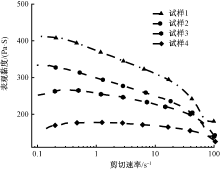
| [9] | 涂学敏. 丙烯腈与衣康酸二元共聚物纺丝溶液的流变性能研究[D]. 上海: 华东理工大学, 2012:19-21. |
| TU Xuemin. Study on rheological properties of spinning solution of acrylonitrile and itaconic acid binary copolymer[D]. Shanghai: East China University of Science and Technology,2012:19-21. | |
| [10] | 荆为龙. 聚合物/无机颗粒复合纤维膜的制备及其辐射制冷性能研究[D]. 青岛: 青岛科技大学,2022:26. |
| JING Weilong. Preparation of polymer/inorganic particle composite fiber film and its radiative refrigeration performance[D]. Qingdao: Qingdao University of Science and Technology,2022:26. | |
| [11] | 曾文超, 孙浩东, 张宗威, 等. 壳聚糖/聚乙烯醇的流变行为及其可纺性研究[J]. 林产化学与工业, 2023, 43(5):25-31. |
| ZENG Wenchao, SUN Haodong, ZHANG Zongwei, et al. Rheological behavior and spinnability of chitosan/polyvinyl alcohol[J]. Chemistry and Industry of Forest Products, 2023, 43(5):25-31. | |
| [12] | MAZUKI N F, NAGAO Y, KUFIAN M Z, et al. The influences of PLA into PMMA on crystallinity and thermal properties enhancement-based hybrid polymer in gel properties[J]. Materials Today: Proceedings, 2022, 49: 3105-3111. |
| [13] | TSUJI H, ARAKAWA Y. Synthesis, properties, and crystallization of the alternating stereocopolymer poly (L-lactic acid-alt-d-lactic acid)[syndiotactic poly (lactic acid)] and its blend with isotactic poly (lactic acid)[J]. Polymer Chemistry, 2018, 9(18): 2446-2457. |
| [14] | HERRERA-KAO W A, LORǏA-BASTARRACHE M I, PÉREZ-PADILLA Y, et al. Thermal degradation of poly (caprolactone), poly (lactic acid), and poly(hydroxybutyrate) studied by TGA/FTIR and other analytical techniques[J]. Polymer Bulletin, 2018, 75: 4191-4205. |
| [15] | KASPRZHITSKII A, LAZORENKO G, KRUGLIKOV A, et al. Effect of silane functionalization on properties of poly (lactic acid)/palygorskite nanocomposites[J]. Inorganics, 2021. DOI:10.3390/inorganics9010003. |
| [16] | 刘天宇, 高琪琪. 左旋聚乳酸/右旋聚乳酸立构复合晶体形状记忆聚合物的制备与性能[J]. 高分子材料科学与工程, 2021, 37(3): 176-183. |
| LIU Tianyu, GAO Qiqi. Preparation and properties of L-polylactic acid/D-polylactic acid stereo-composite crystal shape memory polymers[J]. Polymer Materials Science and Engineering, 2021, 37(3):176-183. | |
| [17] | PAN P, YANG J, SHAN G, et al. Temperature-variable FTIR and solid-state 13C NMR investigations on crystalline structure and molecular dynamics of polymorphic poly (L-lactide) and poly (L-lactide)/poly (D-lactide) stereocomplex[J]. Macromolecules, 2012, 45(1): 189-197. |
| [18] | WANG C, YANG H, CHEN F, et al. Influences of VTMS/SiO2 ratios on the contact angle and morphology of modified super-hydrophobic silicon dioxide material by vinyl trimethoxy silane[J]. Results in Physics, 2018, 10: 891-902. |
| [19] | RENO F, D'ANGELO D, GOTTARDI G, et al. Atmospheric pressure plasma surface modification of poly(D, L-lactic acid) increases fibroblast, osteoblast and keratinocyte adhesion and proliferation[J]. Plasma Processes and Polymers, 2012, 9(5): 491-502. |
| [20] | MRSIC I, BAEUERLE T, ULITZSCH S, et al. Oxygen plasma surface treatment of polymer films: pellethane 55DE and EPR-g-VTMS[J]. Applied Surface Science, 2021, 536: DOI: 10.1016/j.apsusc.2020.147782. |
| [21] | FAN L L, QUAN J Y, ZHANG H, et al. Preparation of hydrophilic UHMWPE hollow fiber membranes by chemically bounding silica nanoparticles[J]. Chinese Journal of Polymer Science, 2021, 39: 189-200. |
| [22] | REDDY N, BERA P, REDDY V R, et al. XPS study of sputtered alumina thin films[J]. Ceramics International, 2014, 40(7): 11099-11107. |
| [23] |
CAI C, WEI Z, DING C, et al. Dynamically tunable all-weather daytime cellulose aerogel radiative supercooler for energy-saving building[J]. Nano Letters, 2022, 22(10): 4106-4114.
doi: 10.1021/acs.nanolett.2c00844 pmid: 35510868 |
| [1] | WANG Wei, GAO Jiannan, PEI Xiaohan, LU Xin, SUN Yinyin, WU Jianbing. Fabrication and oil-water separation efficiency of cellulose/methyltrimethoxysilane aerogel [J]. Journal of Textile Research, 2025, 46(05): 135-142. |
| [2] | SHI Xiaocong, CHEN Li, DU Xun. Preparation of alizarin-polylactic acid/collagen nanofiber membrane and its ammonia detection performance [J]. Journal of Textile Research, 2025, 46(05): 143-150. |
| [3] | CAO Zhanrui, JI Cancan, HE Shanshan, ZHOU Feng, XIANG Yang, GAO Fei, LIU Ke, WANG Dong. Preparation and bovine serum albumin separation of ethylene vinyl alcohol copolymer nanofibrous anion-exchange aerogel [J]. Journal of Textile Research, 2025, 46(04): 29-37. |
| [4] | ZHANG Wenli, LIU Xin, ZHANG Qiaoqiao, ZHI Chao, LI Jianwei, FAN Wei. Preparation and properties of hyperplastic aerogel based on waste linen fabrics [J]. Journal of Textile Research, 2025, 46(04): 47-55. |
| [5] | WANG Biao, LI Yuan, DONG Jie, ZHANG Qinghua. Influences of stress in thermal imidization on structure and properties of polyimide fibers [J]. Journal of Textile Research, 2025, 46(03): 1-8. |
| [6] | ZHANG Huiqin, WU Gaihong, LIU Xia, LIU Shuqiang, ZHAO Heng, LIU Tao. Development and performance evaluation of biodegradable polylactic acid protective masks [J]. Journal of Textile Research, 2025, 46(03): 116-122. |
| [7] | LI Yi, ZHANG Hengyu, GUO Wenzhuo, CHEN Jianying, WANG Ni, XIAO Hong. Preparation of cellulose/Ti3C2Tx aerogel absorbing materials with impedance step gradient layer structure and their absorption properties [J]. Journal of Textile Research, 2025, 46(03): 17-26. |
| [8] | QIAO Sijie, XING Tonghe, TONG Aixin, SHI Zhicheng, PAN Heng, LIU Keshuai, YU Hao, CHEN Fengxiang. Comparison of properties of different polylactic acid materials [J]. Journal of Textile Research, 2025, 46(03): 27-33. |
| [9] | LIU Jinfeng, DU Kangcun, XIAO Chang, FU Shaohai, ZHANG Liping. Preparation of porous MXene/thermoplastic polyurethane fiber and its stress-strain sensing performance [J]. Journal of Textile Research, 2025, 46(03): 41-48. |
| [10] | WANG Xiaoyan, YANG Shukang, XIAO Guowei, DU Jinmei, XU Changhai. Preparation and performance of photoresponsive long-afterglow phosphorescent fibers with spirooxazine doping [J]. Journal of Textile Research, 2025, 46(02): 1-9. |
| [11] | ZHAO Ke, ZHANG Heng, CHENG Wensheng, ZHEN Qi, BU Qingyun, CUI Jingqiang. Melt-blown process and structural characterization of bio-typha polylactic acid medical protective materials [J]. Journal of Textile Research, 2025, 46(02): 51-60. |
| [12] | ZUO Hongmei, GAO Min, RUAN Fangtao, ZOU Lihua, XU Zhenzhen. Preparation and mechanical properties of MXene-graphene oxide modified carbon fiber/polylactic acid composites [J]. Journal of Textile Research, 2025, 46(01): 9-15. |
| [13] | LIU Xia, WU Gaihong, YAN Zihao, WANG Cailiu. Preparation and properties of intelligent phase change thermoregulated polylactic acid fiber membrane [J]. Journal of Textile Research, 2024, 45(12): 18-24. |
| [14] | YANG Teng, SUN Zhihui, WU Siyu, YU Hui, WANG Fei. Preparation and performance of fabric sensor based on polyurethane/ carbon black/polyamide conductive yarn [J]. Journal of Textile Research, 2024, 45(12): 80-88. |
| [15] | OU Zongquan, YU Jinchao, PAN Zhijuan. Spinning of photochromic polylactic acid/polyhydroxybutyrate blend fiber and its structure and properties [J]. Journal of Textile Research, 2024, 45(12): 9-17. |
|
||