纺织学报 ›› 2026, Vol. 47 ›› Issue (04): 154-162.doi: 10.13475/j.fzxb.20250702401

• 染整工程 • 上一篇    下一篇

海岛长丝合成革基布的碱减量工艺及其力学性能

赵立环1,2(), 闫子妍1, 张蓉1, 袁明珠1, 聂秀雯1, 刘新蕊1   

  1. 1 天津工业大学 纺织科学与工程学院, 天津 300387
    2 天津工业大学 先进纺织复合材料教育部重点实验室, 天津 300387
  • 收稿日期:2025-07-10 修回日期:2026-02-23 出版日期:2026-04-15 发布日期:2026-04-15
  • 作者简介:赵立环(1981—),女,副教授。研究方向为新型非织造材料的制备、理论及应用。E-mail:zhaolihuan@tiangong.edu.cn
  • 基金资助:
    天津市科技计划项目(23YFYSHZ00220);中国纺织工业联合会科技指导性计划项目(2021065)

Alkaline deweighting process and mechanical properties of sea-island filament base fabrics for synthetic leather

ZHAO Lihuan1,2(), YAN Ziyan1, ZHANG Rong1, YUAN Mingzhu1, NIE Xiuwen1, LIU Xinrui1   

  1. 1 School of Textile Science and Engineering, Tiangong University, Tianjin 300387, China
    2 Ministry of Education Key Laboratory for Advanced Textile Composite Materials, Tiangong University, Tianjin 300387, China
  • Received:2025-07-10 Revised:2026-02-23 Published:2026-04-15 Online:2026-04-15

摘要:

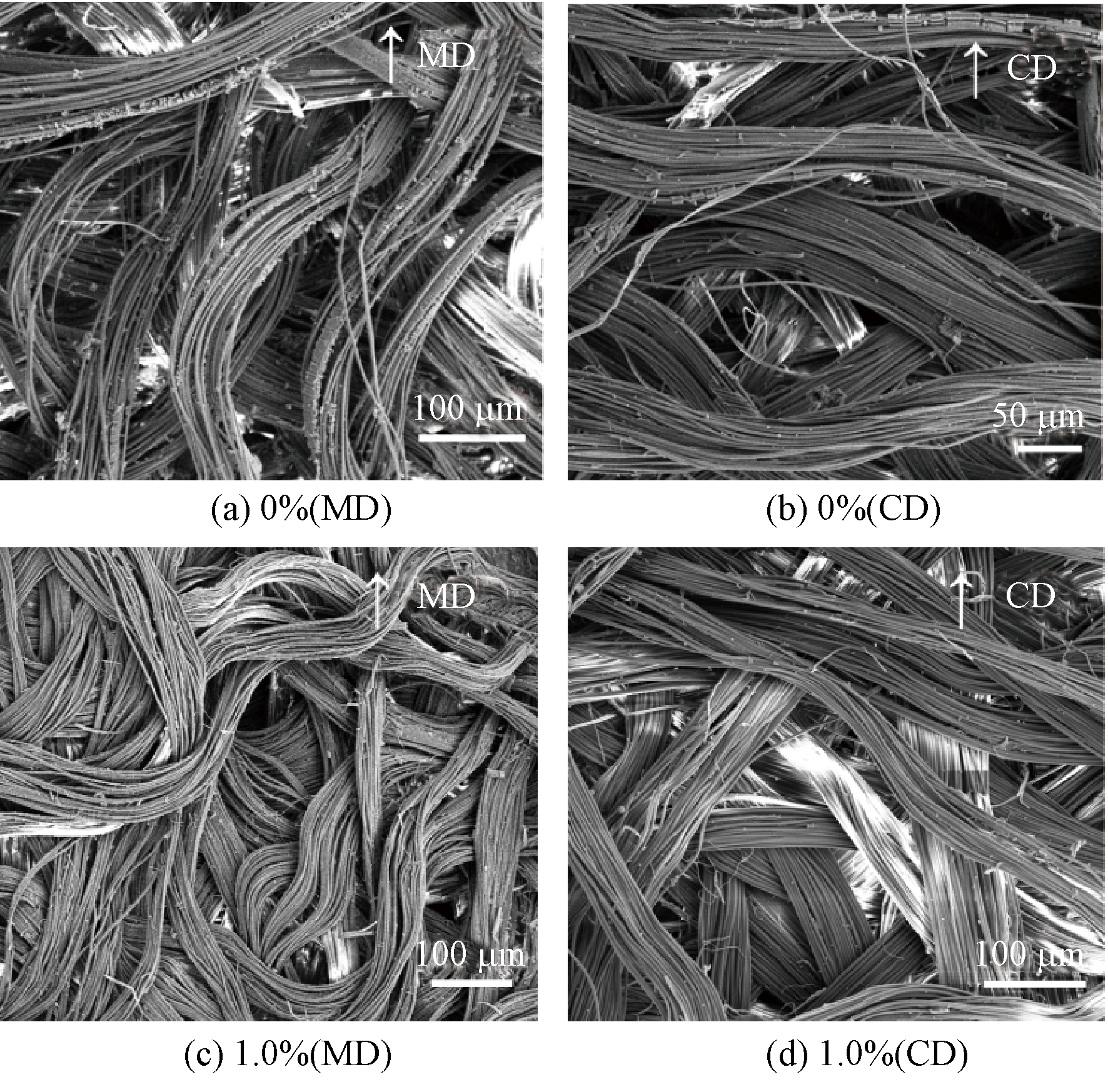
针对目前应用较多的超细纤维合成革(简称超纤革)因以短纤维为原料而导致的生产流程长、能耗大等问题,以纺黏工艺制备的碱溶性聚对苯二甲酸乙二醇酯/聚酰胺6(COPET/PA6)37岛定岛长丝热轧非织造布为超纤革基材,研究了直接影响超纤革物性指标和手感外观的碱减量开纤工艺,并探究了改善纺黏工艺中因长丝沿设备纵向铺网导致的长丝超纤革基布纵横向力学性能差异大的问题。结果表明:以开纤率和质量损失率为评价指标的最佳开纤工艺为碱液质量浓度24 g/L、温度90 ℃、时间30 min;为改善长丝超纤革基布力学性能各向异性的问题,在含浸液中添加1.0%硅油,由于硅油的润滑作用降低了纤维间的摩擦力,显著降低了超纤革基布力学性能的各向异性,在此基础上,采用8%铝单宁与6%栲胶复配交联,在纤维间形成共价键,增强纤维间结合力,从而显著提升了超纤革基布力学性能,同时提高了透湿率,但其透气率及柔软性有所下降。

关键词: 超细纤维合成革, 海岛长丝, 非织造布, 碱减量工艺, 力学性能

Abstract:

Objective To address the lengthy process and high energy consumption of microfiber synthetic leather made from staple fibers, this study employed spunbonded alkaline-soluble copolyester/polyamide 6 (COPET/PA6) island-in-sea filament hot-rolled nonwovens as the substrate. The alkali reduction splitting process, which directly affects the physical-mechanical properties and hand feel, was investigated. Additionally, methods to mitigate the significant anisotropy in mechanical properties were explored.

Method Using weight loss and fibrillation rate as evaluation indices, single-factor experiments were carried out to examine the influences of alkali concentration, treatment temperature and time on the fibrillation of the leather substrate. To improve its mechanical properties, the substrate was pretreated with dimethyl silicone oil, then modified with aluminum tannin and tannin extract as crosslinkers. Orthogonal experiments were designed to optimize the synergistic crosslinking modification of the two crosslinkers.

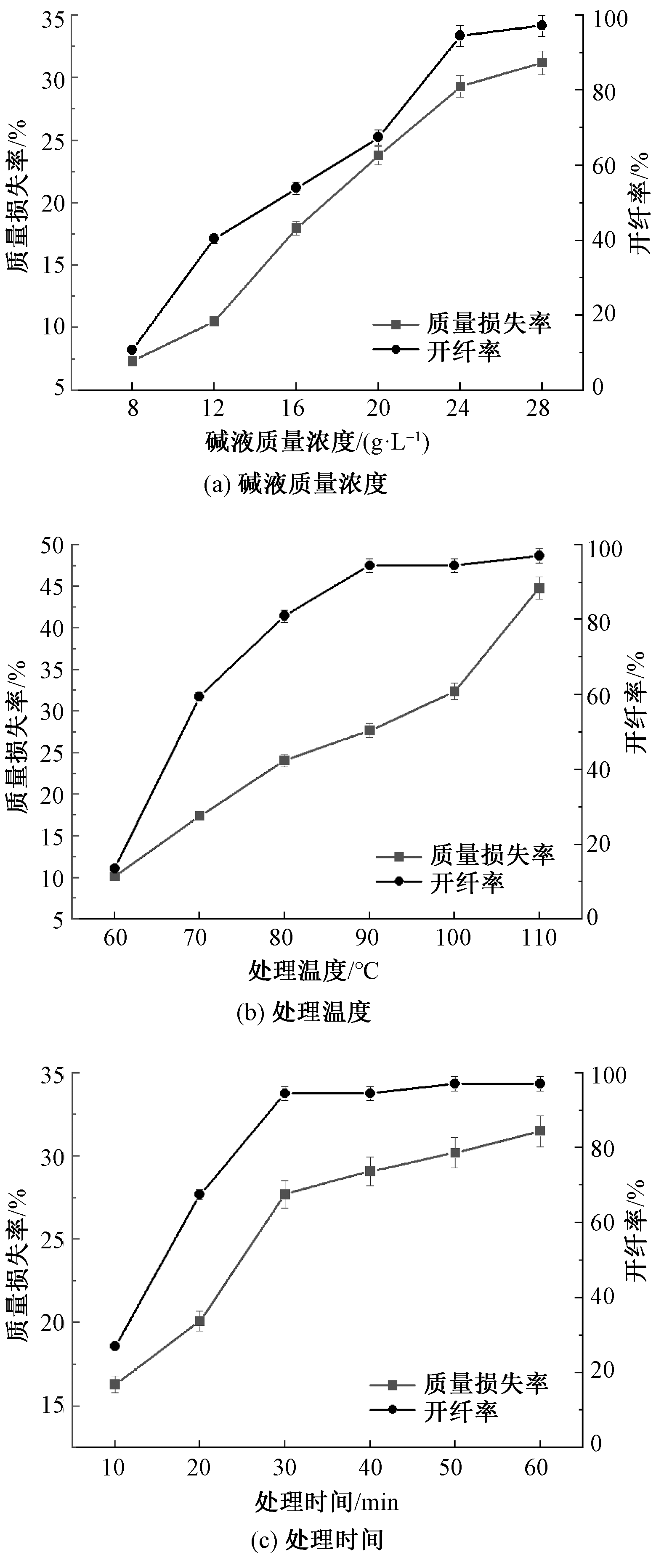
Results In the alkali reduction splitting process, the alkali concentration, treatment temperature, and time significantly influenced the splitting efficacy of the nonwoven substrate. The optimal process parameters were determined as an alkali concentration of 24 g/L, a temperature of 90 ℃, and a duration of 30 min. The splitting effect improved with increasing alkali concentration up to 24 g/L; beyond this level, damage to the substrate occurred. The splitting rate was rapid below 90 ℃ but decreased above this temperature, which also caused substrate damage. As treatment time extended, the splitting effect exhibited two distinct stages, with 30 min as the critical threshold. To address the significant anisotropy in mechanical properties between the machine and transverse directions of the island-in-sea filament microfiber synthetic leather substrate, modification treatments were conducted to enhance the mechanical performance and reduce directional disparity. Experimental results indicated that with 1.0% dimethicone addition, the differences in breaking strength and tearing strength between the two directions reached their minimum. Building on this foundation, the effects of two crosslinking agents-aluminum tannin and wattle extract-on the mechanical properties of the substrate were investigated, and the combined crosslinking modification process was optimized. The optimal formulation was determined to be 8% aluminum tannin combined with 6% wattle extract. Fourier transform infrared spectroscopy confirmed the successful occurrence of crosslinking reactions. Following the combined crosslinking modification, the moisture permeability of the substrate improved, while air permeability and softness exhibited slight reductions.

Conclusion This study successfully established an alkali reduction splitting process for COPET/PA6 island-in-sea filament microfiber synthetic leather substrates, achieving a high degree of openness while minimizing the impact on mechanical properties. Furthermore, a combined crosslinking modification using aluminum tannin and wattle extract effectively mitigated the anisotropy in mechanical properties and enhanced the overall mechanical performance of the filament-based microfiber substrate. The resulting microfiber leather substrate demonstrates potential for applications in garments and decorative materials. This research provides a viable solution to address the challenges of lengthy production processes and high energy consumption associated with conventional microfiber synthetic leather. However, although the combined crosslinking modification effectively improved mechanical properties, it led to a slight decrease in air permeability and softness. Future research should focus on exploring modification techniques to minimize these adverse effects on wear comfort.

Key words: microfiber synthetic leather, island-in-sea filament, nonwoven fabric, alkali deweighting process, mechanical property

中图分类号: 

  • TS174

表1

超纤革基布交联改性工艺"

工序 材料 材料质量
分数/%
温度/
时间/
min
备注
洗涤 2 000 60 60
预处理 甲酸 1 30 30 pH值:2.0~2.5
交联 交联剂
X 60
400 40
碱化 碳酸氢钠 1 25 pH值:4.0~4.5
洗涤 2 000 25 干燥

图1

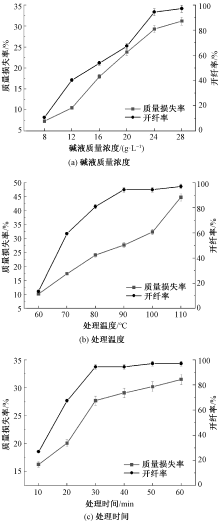
不同碱减量工艺与基布质量损失率和开纤率的关系"

表2

硅油质量分数对超纤革基布力学性能的影响"

硅油/
%
断裂强力/N 断裂伸长率/% 撕破强力/N
MD CD MD CD MD CD
0 80.4 38.7 59.4 76.9 19.5 8.5
0.5 68.3 37.8 51.8 73.0 19.3 15.7
1.0 66.5 50.2 50.7 71.1 17.8 16.1
1.5 72.6 39.1 53.9 57.4 14.0 23.8

图2

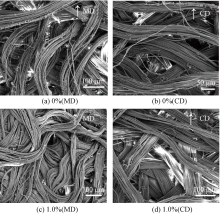
不同质量分数硅油处理后基布拉伸断裂形貌"

图3

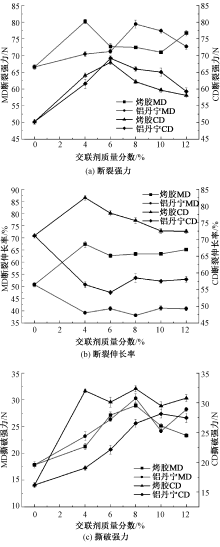
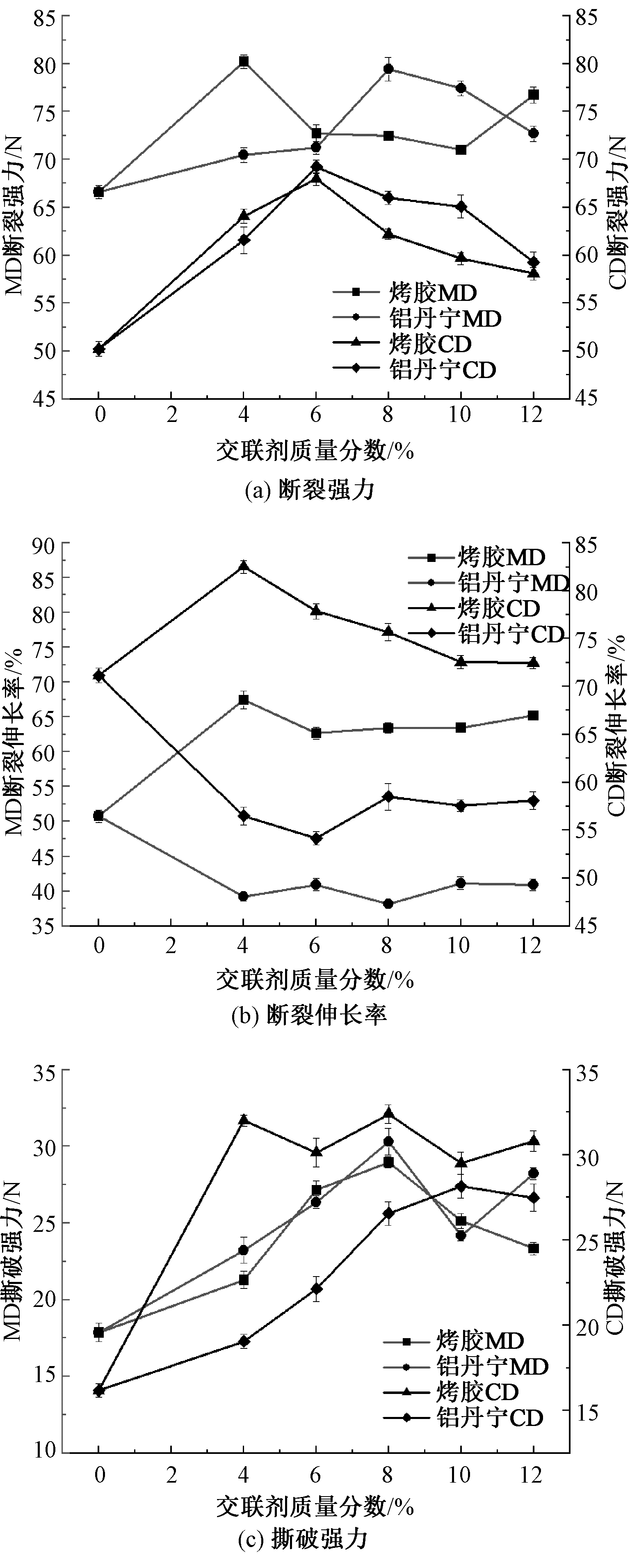
不同交联剂质量分数对基布力学性能的影响"

表3

复配改性海岛长丝超纤革基布力学性能工艺正交试验表"

试验
编号
铝单
栲胶 断裂强力隶属度 断裂伸长率隶属度 撕破强力隶属度 力学性能
综合分
纵横力学性能
差异综合分
MD CD Δ MD CD Δ MD CD Δ
1 1 1 1 0.57 0.15 0.81 0.76 0.58 0.16 0.18 0 3.48 0.73
2 1 2 0.77 1 0.91 0.64 0.24 0.64 0.07 0.62 0.81 3.34 2.36
3 1 3 0.73 0.64 0.71 0.24 0.27 0.47 0.16 0.93 0.63 2.97 1.81
4 2 1 0 0.65 0 0.89 1 0.21 0.67 0 1 3.21 1.21
5 2 2 0.75 0.39 0.46 0.84 0.14 0 0.85 1 0.71 3.97 1.17
6 2 3 0.12 0 0.79 0.56 0.3 1 1 0.93 0.40 2.91 2.19
7 3 1 0.75 0.81 0.84 1 0.38 0.19 0.37 0.23 0.72 3.54 1.75
8 3 2 0.54 0.16 0.67 0.43 0.15 0.75 0.4 1 0.94 2.68 2.36
9 3 3 0.56 0.59 1 0 0 0.54 0 0.52 0.78 1.67 2.32
R 0.73 0.89

表4

不同交联方式超纤革基布力学性能力对比"

交联
方式
断裂强力/N 断裂伸长率/% 撕破强力/N
MD CD Δ MD CD Δ MD CD Δ
铝单宁 76.0 66.7 9.3 40.1 53.7 13.6 26.9 25.5 1.4
栲胶 75.1 64.6 10.5 64.4 78.6 14.2 25.3 31.3 6
复配 69.7 61.4 8.3 66.1 55.6 10.5 41.6 38.1 3.5

图4

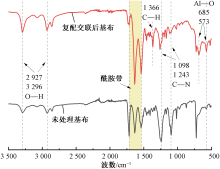
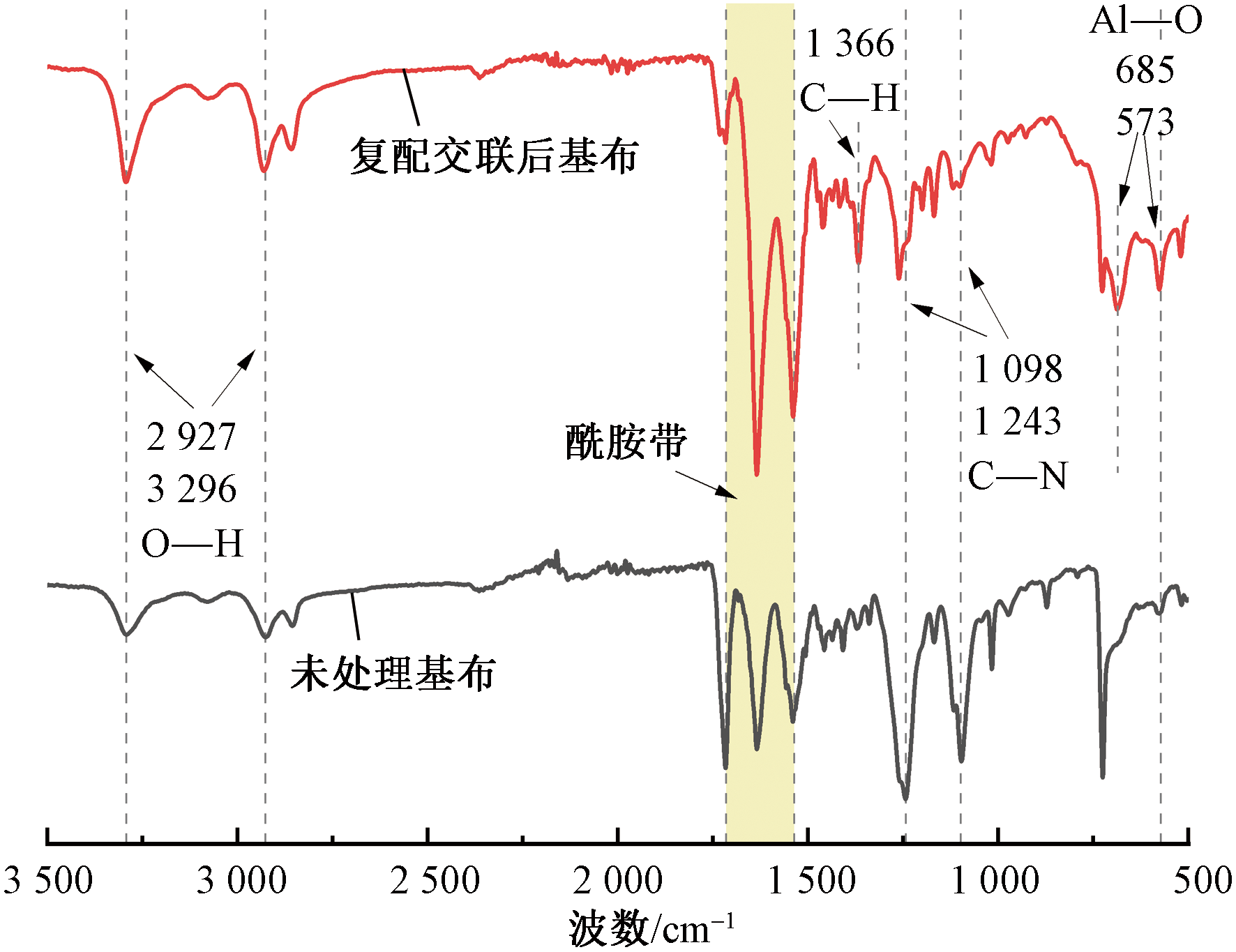
复合交联改性前后基布的红外光谱图"

表5

超纤革基布复配交联前后性能对比"

基布种类 透气率/
(mm·s-1)
透湿率/
(g·(m2·24 h)-1)
弯曲
长度/cm
未处理基布 508.6 6 724 0.12
复配交联
后基布
205.7 7 032 0.19
[1] BASAK S, SHAKYAWAR D B, SAMANTA K K, et al. Development of natural fibre based flexural composite: a sustainable mimic of natural leather[J]. Materials Today Communications, 2022, 32: 103976.
doi: 10.1016/j.mtcomm.2022.103976
[2] LUO F X, ZHONG X, GAO M C, et al. Progress and mechanism of breaking glycoconjugates by glycosidases in skin for promoting unhairing and fiber opening-up in leather manufacture: a review[J]. Journal of Leather Science and Engineering, 2020, 2(1): 12.
doi: 10.1186/s42825-020-00025-0
[3] 朵永超, 钱晓明, 赵宝宝, 等. 超纤革仿天然皮革研究进展[J]. 中国皮革, 2019, 48(3): 41-45, 53.
DUO Yongchao, QIAN Xiaoming, ZHAO Baobao, et al. Advances in microfiber synthetic leather emulating natural leather[J]. China Leather, 2019, 48(3): 41-45, 53.
[4] 杨絮, 柯少剑. 聚氨酯合成革研究进展[J]. 聚酯工业, 2025, 38(2): 71-73.
YANG Xu, KE Shaojian. Research progress of polyurethane synthetic leather[J]. Polyester Industry, 2025, 38(2): 71-73.
[5] 高芳芳. 体育用品用超细纤维合成革基布柔软性能改性方法综述[J]. 中国皮革, 2023, 52(9): 98-101, 105.
GAO Fangfang. Methods of modifying softness of microfiber synthetic leather substrate for sporting goods[J]. China Leather, 2023, 52(9): 98-101, 105.
[6] 马向东. 胶原蛋白对超细纤维合成革基布的改性及其表面亲水性研究[D]. 西安: 陕西科技大学, 2020:7-8.
MA Xiangdong. Study on the modification of microfibre synthetic leather fabrics by collagen and its surface hydrophilicity[D]. Xi'an: Shaanxi University of Science & Technology, 2020:7-8.
[7] 步巧巧, 李荻, 王乐智, 等. 复鞣剂对超细纤维合成革基布的改性研究[J]. 皮革与化工, 2020, 37(4): 8-15.
BU Qiaoqiao, LI Di, WANG Yuezhi, et al. Modification of retanning agent on microfiber synthetic leather base[J]. Leather and Chemicals, 2020, 37(4): 8-15.
[8] DU L, LI Y, ZHU P, et al. Phosphorus hybrid coating for flame-retardant microfiber synthetic leather via sol-gel technique[J]. Surfaces and Interfaces, 2024, 50: 104523.
doi: 10.1016/j.surfin.2024.104523
[9] 黄族健. 车用绒面超纤针刺非织造布的应用及展望[J]. 国际纺织导报, 2021, 49(5): 26-28.
HUANG Zujian. Application and prospect of suede-like superfine fiber needle punched nonwovens for vehicles[J]. Melliand - China, 2021, 49(5): 26-28.
[10] 郝景标, 曹阳, 吴若楠, 等. 海岛与桔瓣长丝非织造布基超纤革的制备及性能[J]. 皮革科学与工程, 2024, 34(6): 64-68.
HAO Jingbiao, CAO Yang, WU Ruonan, et al. Preparation and properties of nonwoven fabric-based suede leather with sea-island and segmented-pie filaments[J]. Leather Science and Engineering, 2024, 34(6): 64-68.
[11] 强涛涛. 合成革化学品[M]. 北京: 中国轻工业出版社, 2016: 42.
QIANG Taotao. Synthetic leather chemicals[M]. Beijing: China Light Industry Press, 2016: 42.
[12] 陈佳孝, 白刚, 潘金红, 等. 开纤对超细纤维合成革基布性能的影响[J]. 中国皮革, 2010, 39(17): 31-33.
CHEN Jiaxiao, BAI Gang, PAN Jinhong, et al. Influence of detaching on performance of superfine fiber synthesis leather[J]. China Leather, 2010, 39(17): 31-33.
[13] 马郭宾. 水溶性聚氨酯加固的合成革基布工艺最优化[D]. 上海: 东华大学, 2008:43-44.
MA Guobin. The study on the optimization craft of waterborne polyurethane binder for nonwoven fabrics as synthetic leather[D]. Shanghai: Donghua University, 2008:43-44.
[14] 赵艳娇, 宋若晨, 潘茹男, 等. 碱溶性聚酯(COPET)多孔纤维的制备及性能[J]. 上海纺织科技, 2023, 51(12): 33-38.
ZHAO Yanjiao, SONG Ruochen, PAN Runan, et al. Preparation of alkali-soluble polyester (COPET) porous fiber and its properties[J]. Shanghai Textile Science & Technology, 2023, 51(12): 33-38.
[1] 杨潇, 章语墨, 李彦, 王璐, 王富军. 糖触抗菌与渗液管理一体化的短纤维重构复合敷料及其性能[J]. 纺织学报, 2026, 47(03): 44-51.
[2] 张纪超, 刘昱辰, 张豪, 耿嘉骏, 蔡硕, 杨茹梦, 刘莹, 魏朋. 单体组分对萘基液晶聚芳酯纤维结构与性能的调控[J]. 纺织学报, 2026, 47(02): 65-72.
[3] 赵泽文, 吕宽, 苏旭中, 孙丰鑫. 短纤纱力学性能的宏细观耦合分析与数值模拟[J]. 纺织学报, 2026, 47(01): 106-114.
[4] 王世豪, 徐晓禹, 郑挺, 王金星, 姚德刚, 王俊, 叶翔宇, 田慧, 李婷, 朱斐超. 碳纤维非织造材料的研究应用及展望[J]. 纺织学报, 2026, 47(01): 240-249.
[5] 王瀚文, 李万鑫, 李晨, 喻麟洁, 王文庆, 董振峰, 魏建斐, 朱志国, 王锐. 金属氯化物对聚酰胺66氢键调控及力学性能的影响[J]. 纺织学报, 2025, 46(11): 9-18.
[6] 顾戚惠, 阳知乾, 王海楼, 魏发云, 张伟. 机织间隔织物增强水泥基复合材料的制备及其力学性能[J]. 纺织学报, 2025, 46(10): 120-128.
[7] 高敏, 程春祖, 徐中凯, 赵庆波, 张东, 代欣欣. 含硅改性磷氮阻燃Lyocell纤维的制备及其性能[J]. 纺织学报, 2025, 46(10): 19-29.
[8] 侯颖慧, 刘肖燕, 柳东辰, 郝矿荣, 邹婷. 基于体外降解的输尿管支架管的多目标优化[J]. 纺织学报, 2025, 46(09): 154-162.
[9] 贾彦军, 高璐, 赵莹莹, 荆兆敬, 郭紫阳, 王海涛, 常娜. 非织造布结构及表面性质对反渗透膜支撑层和分离层性能影响[J]. 纺织学报, 2025, 46(09): 171-180.
[10] 刘美, 崔丽娜, 关福旺, 李甫, 费鹏飞, 马驰, 王华平. 一次性卫生用竹浆纤维水刺非织造材料的疏水改性及其性能[J]. 纺织学报, 2025, 46(09): 188-196.
[11] 高闻语, 陈诚, 奚晓玮, 邓林红, 刘杨. 改性丝素蛋白纤维增强胶原基角膜修复材料的制备及其性能[J]. 纺织学报, 2025, 46(08): 1-9.
[12] 梁锋, 方沿, 张伟华, 唐余玲, 李双洋, 周建飞, 石碧. 基于金属-多酚网络的胶原蛋白基纤维制备及其力学性能[J]. 纺织学报, 2025, 46(08): 10-17.
[13] 陈晴宇, 陆春红, 张斌, 晋义凯, 黄琪帏, 王超, 丁彬, 俞建勇, 王先锋. 碳纤维增强水泥基灌浆料的制备及其性能[J]. 纺织学报, 2025, 46(08): 120-126.
[14] 张新宇, 金小培, 朱金唐, 崔华帅, 吴鹏飞, 崔宁, 史贤宁. 聚乳酸熔喷非织造布热尺寸稳定性提升方法[J]. 纺织学报, 2025, 46(08): 127-135.
[15] 岳航, 鹿超, 王春红, 李瀚宇. 基于主要化学成分的红麻与大麻拉伸强度预测[J]. 纺织学报, 2025, 46(08): 62-70.
Viewed
Full text


Abstract

Cited

  Shared   
  Discussed   
No Suggested Reading articles found!