纺织学报 ›› 2026, Vol. 47 ›› Issue (06): 242-251.doi: 10.13475/j.fzxb.20250803102
胡沛英, 史芷丞, 乔思杰, 王斌昊, 魏全茹, 黄子熙, 陈凤翔( ), 徐卫林
HU Peiying, SHI Zhicheng, QIAO Sijie, WANG Binhao, WEI Quanru, HUANG Zixi, CHEN Fengxiang(), XU Weilin
摘要:
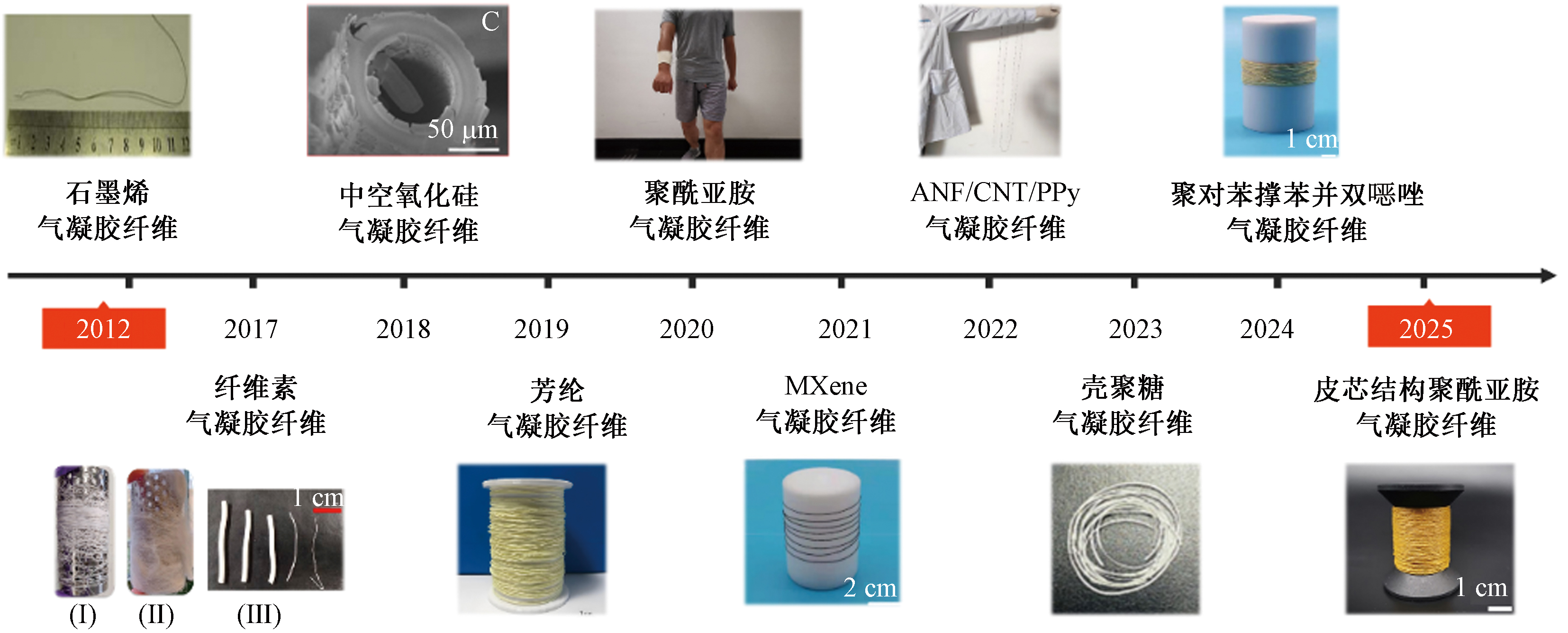
为加速气凝胶纤维材料的实用化进程,系统梳理了该材料的研究现状与发展趋势。首先界定了气凝胶纤维的核心定义,明确了开发高性能气凝胶纤维的战略意义;随后简要回溯其发展历程,为该材料的结构设计与功能演进提供了理论借鉴与实践参考。在此基础上,重点综述了当前气凝胶纤维规模化制备的难点及对应解决路径,深入剖析了制备过程中溶胶-凝胶转变的内在机制;同时系统探讨了其在个人热管理、电磁防护、红外隐身及能源存储等多领域的应用前景,最后针对性分析了当前产业化面临的瓶颈与突破策略。尽管气凝胶纤维在规模化制备效率提升与力学性能优化方面仍存在挑战,但随着新兴凝胶合成技术的迭代突破与先进制造工艺的持续革新,气凝胶纤维具有巨大产业化潜力,未来有望在多功能智能纺织品领域的应用实现突破性发展。
中图分类号:
| [1] | SUN H Y, XU Z, GAO C. Multifunctional, ultra-flyweight, synergistically assembled carbon aerogels[J]. Advanced Materials, 2013, 25(18): 2554-2560. |
| [2] | 赵伦玉, 隋晓锋, 毛志平, 等. 气凝胶材料在纺织品上的应用研究进展[J]. 纺织学报, 2022, 43(12): 181-189, 196. |
| ZHAO Lunyu, SUI Xiaofeng, MAO Zhiping, et al. Research progress in aerogel materials application for textiles[J]. Journal of Textile Research, 2022, 43(12): 181-189, 196. | |
| [3] | LIU R Y, WANG J, LIAO J H, et al. Robust silica-polyimide aerogel blanket for water-proof and flame-retardant self-floating artificial island[J]. Frontiers in Materials, 2021, 8: 659655. |
| [4] | LIU R Y, WANG J, DU Y, et al. Phase-separation induced synthesis of superhydrophobic silica aerogel powders and granules[J]. Journal of Solid State Chemistry, 2019, 279: 120971. |
| [5] | 张莎莎, 蔡牧航, 吕晓静, 等. 静电场协同构象羽绒/二氧化硅气凝胶保暖材料[J]. 纺织学报, 2025, 46(7): 10-18. |
| ZHANG Shasha, CAI Muhang, LÜ Xiaojing, et al. Electrostatic field synergistic conformation of down/silicon dioxide aerogel warmth keeping materials[J]. Journal of Textile Research, 2025, 46(7): 10-18. | |
| [6] | 吕婧, 刘增伟, 程青青, 等. 芳纶纳米纤维气凝胶的研究进展[J]. 纺织学报, 2023, 44(6): 10-20. |
| LÜ Jing, LIU Zengwei, CHENG Qingqing, et al. Research progress of aramid nanofiber aerogels[J]. Journal of Textile Research, 2023, 44(6): 10-20. | |
| [7] | HE H L, LIU J R, WANG Y S, et al. An ultralight self-powered fire alarm e-textile based on conductive aerogel fiber with repeatable temperature monitoring performance used in firefighting clothing[J]. ACS Nano, 2022, 16(2): 2953-2967. |
| [8] | 陈纤, 李猛猛, 赵昕, 等. 纳米芳纶气凝胶纤维的制备与微观结构调控[J]. 纺织学报, 2021, 42(11): 17-23. |
| CHEN Xian, LI Mengmeng, ZHAO Xin, et al. Preparation and microstructure control of aerogel fibers based on aramid nanofibers[J]. Journal of Textile Research, 2021, 42(11): 17-23. | |
| [9] | SHENG Z Z, LIU Z W, HOU Y L, et al. The rising aerogel fibers: status, challenges, and opportunities[J]. Advanced Science, 2023, 10(9): 2205762. |
| [10] | 秦国彤, 门薇薇, 魏微, 等. 气凝胶研究进展[J]. 材料科学与工程学报, 2005, 23(2): 293-296. |
| QIN Guotong, MEN Weiwei, WEI Wei, et al. Progress in the study of aerogels[J]. Journal of Materials Science and Engineering, 2005, 23(2): 293-296. | |
| [11] | KOH L D, CHENG Y, TENG C P, et al. Structures, mechanical properties and applications of silk fibroin materials[J]. Progress in Polymer Science, 2015, 46: 86-110. |
| [12] | CAROTHERS W H, HILL J W. Studies of polymerization and ring formation. xii. linear SUPERPOLYESTERS1[J]. Journal of the American Chemical Society, 1932, 54(4): 1559-1566. |
| [13] | FALCA G, MUSTEATA V E, BEHZAD A R, et al. Cellulose hollow fibers for organic resistant nanofiltration[J]. Journal of Membrane Science, 2019, 586: 151-161. |
| [14] | XU Z, ZHANG Y, LI P G, et al. Strong, conductive, lightweight, neat graphene aerogel fibers with aligned pores[J]. ACS Nano, 2012, 6(8): 7103-7113. |
| [15] | LI G Y, HONG G, DONG D P, et al. Multiresponsive graphene-aerogel-directed phase-change smart fibers[J]. Advanced Materials, 2018, 30(30): 1801754. |
| [16] | LV M, QIN G T, WEI W. Preparation and characterization TiO2 aerogel fibers[J]. Materials Science Forum, 2013, 743/744: 434-437. |
| [17] | MENG S, ZHANG J Y, CHEN W P, et al. Construction of continuous hollow silica aerogel fibers with hierarchical pores and excellent adsorption performance[J]. Microporous and Mesoporous Materials, 2019, 273: 294-296. |
| [18] | DU Y, ZHANG X H, WANG J, et al. Reaction-spun transparent silica aerogel fibers[J]. ACS Nano, 2020, 14(9): 11919-11928. |
| [19] | LI Y Z, ZHANG X T. Electrically conductive, optically responsive, and highly orientated Ti3C2Tx MXene aerogel fibers[J]. Advanced Functional Materials, 2022, 32(4): 2107767. |
| [20] | GUO X, ZHANG Y X, LI J, et al. Wet spinning technology for aerogel fiber: pioneering the frontier of high-performance and multifunctional materials[J]. Advanced Fiber Materials, 2024, 6(6): 1669-1709. |
| [21] | LIU Z W, LYU J, FANG D, et al. Nanofibrous kevlar aerogel threads for thermal insulation in harsh environments[J]. ACS Nano, 2019, 13(5): 5703-5711. |
| [22] | XUE T T, ZHU C Y, FENG X L, et al. Polyimide aerogel fibers with controllable porous microstructure for super-thermal insulation under extreme environments[J]. Advanced Fiber Materials, 2022, 4(5): 1118-1128. |
| [23] | LI M M, GAN F, DONG J, et al. Facile preparation of continuous and porous polyimide aerogel fibers for multifunctional applications[J]. ACS Applied Materials & Interfaces, 2021, 13(8): 10416-10427. |
| [24] | LI X, DONG G Q, LIU Z W, et al. Polyimide aerogel fibers with superior flame resistance, strength, hydrophobicity, and flexibility made via a universal sol-gel confined transition strategy[J]. ACS Nano, 2021, 15(3): 4759-4768. |
| [25] | HU P Y, WU F S, MA B J, et al. Robust and flame-retardant zylon aerogel fibers for wearable thermal insulation and sensing in harsh environment[J]. Advanced Materials, 2024, 36(6): e2310023. |
| [26] | XUE T T, TANG J Y, LIU C, et al. Ultra-strong skin-core polymer aerogel fibers via wet-freeze spinning[J]. Matter, 2025, 8(9): 102155. |
| [27] | SAI H Z, WANG M J, MIAO C Q, et al. Robust silica-bacterial cellulose composite aerogel fibers for thermal insulation textile[J]. Gels, 2021, 7(3): 145. |
| [28] | HUANG J Z, LI J Y, XU X X, et al. In situ loading of polypyrrole onto aramid nanofiber and carbon nanotube aerogel fibers as physiology and motion sensors[J]. ACS Nano, 2022, 16(5): 8161-8171. |
| [29] | LI M M, CHEN X, LI X T, et al. Controllable strong and ultralight aramid nanofiber-based aerogel fibers for thermal insulation applications[J]. Advanced Fiber Materials, 2022, 4(5): 1267-1277. |
| [30] | LI Y Y, CUI W, WANG X, et al. Topological polymer networks-enabled mechanically strong polyamide-imide aerogel fibers for thermal insulation in harsh environments[J]. ACS Applied Materials & Interfaces, 2024, 16(30): 39993-40003. |
| [31] | BAO Y Q, LYU J, LIU Z W, et al. Bending stiffness-directed fabricating of kevlar aerogel-confined organic phase-change fibers[J]. ACS Nano, 2021, 15(9): 15180-15190. |
| [32] | JIANG S, YAN W D, CUI C, et al. Bioinspired thermochromic textile based on robust cellulose aerogel fiber for self-adaptive thermal management and dynamic labels[J]. ACS Applied Materials & Interfaces, 2023, 15(40): 47577-47590. |
| [33] | LIU Z S, SHENG Z Z, BAO Y Q, et al. Ionic liquid directed spinning of cellulose aerogel fibers with superb toughness for weaved thermal insulation and transient impact protection[J]. ACS Nano, 2023, 17(18): 18411-18420. |
| [34] | XUE T T, ZHU C Y, YU D Y, et al. Fast and scalable production of crosslinked polyimide aerogel fibers for ultrathin thermoregulating clothes[J]. Nature Communications, 2023, 14: 8378. |
| [35] | GAI B L, JING Q L, JI Y N, et al. Highly orientated porous Ti3C2Tx aerogel fibers for all-solid-state fiber supercapacitors with ultralight and high gravimetric capacitance[J]. Journal of Power Sources, 2025, 634: 236491. |
| [36] | CUI Y, GONG H X, WANG Y J, et al. A thermally insulating textile inspired by polar bear hair[J]. Advanced Materials, 2018, 30(14): e1706807. |
| [37] | WU M R, SHAO Z Y, ZHAO N F, et al. Biomimetic, knittable aerogel fiber for thermal insulation textile[J]. Science, 2023, 382(6677): 1379-1383. |
| [38] | LI Q H, YUAN Z H, ZHANG C, et al. Tough, highly oriented, super thermal insulating regenerated all-cellulose sponge-aerogel fibers integrating a graded aligned nanostructure[J]. Nano Letters, 2022, 22(9): 3516-3524. |
| [39] | WEN Z, LYU J, DING Y F, et al. Aerogel fibers made via generic sol-gel centrifugal spinning strategy enable dynamic removal of volatile organic compounds from high-flux gas[J]. Advanced Functional Materials, 2024, 34(44): 2407221. |
| [40] | LYU J, LIU Z W, ZHANG X T. Gas-blows-liquid spinning strategy toward mechanically strong, thermally protective, efficiently hemostatic aerogel fibers/fabrics[J]. Small Methods, 2024, 8(10): 2301550. |
| [41] | MIßFELDT F, GURIKOV P, LÖLSBERG W, et al. Continuous supercritical drying of aerogel particles: proof of concept[J]. Industrial & Engineering Chemistry Research, 2020, 59(24): 11284-11295. |
| [42] | HUANG Z Y, WANG B H, SHI Z C, et al. Regenerated cellulose aerogel fibers with lightweight and exceptional mechanical performance for thermal insulation[J]. Small, 2025, 21(25): 2501154. |
| [43] | YUE C X, HU Y H, DI Y B, et al. Strong, tough, shell-cross-linked aramid nanofibrous aerogel fibers for thermally-protective textiles[J]. ACS Applied Nano Materials, 2024, 7(9): 10886-10894. |
| [44] | BO X Y, ZHU H B, HU Y H, et al. Regulated assembly of PBO nanofibers as aerogel fibers for thermal insulation and electromagnetic shielding[J]. Materials Today Chemistry, 2024, 36: 101967. |
| [45] | SONG Y T, ZHANG R, QU M J, et al. Chitosan based aerogel fibers for piezoelectric and moisture electric energy harvesting[J]. Reactive and Functional Polymers, 2024, 195: 105806. |
| [46] | ZHOU X Y, ZHAN Y F, ZHOU J, et al. Plant-inspired high-performance hydrovoltaic electricity generation in Janus aerogel fibers with gradient nanostructures[J]. Advanced Functional Materials, 2025, 35(50): e10747. |
| [1] | 陈佳慧, 李梦鑫, 张旋, 刘龙翔, 阳惠珍, 王文, 于风芹, 王栋. 非对称结构聚乙烯醇湿驱动纤维的制备及其应用[J]. 纺织学报, 2026, 47(07): 120-127. |
| [2] | 包安娜, 洪剑寒. 静电纺丝制备辐射制冷纳米纤维材料的研究进展[J]. 纺织学报, 2026, 47(07): 239-246. |
| [3] | 郭俊滔, 包伟, 刘典波. 用于个人热管理的湿响应针织物研究进展[J]. 纺织学报, 2026, 47(07): 247-253. |
| [4] | 徐雪, 韩非, 李发学, 王学利, 高婷婷, 丁彬, 俞建勇. 面向不同环境的个人热管理纺织品的研究进展[J]. 纺织学报, 2026, 47(06): 252-261. |
| [5] | 冯晓莉, 宫钧耀, 夏良君, 徐卫林. 磁电式柔性传感器研究进展[J]. 纺织学报, 2026, 47(03): 107-117. |
| [6] | 何崟, 郭成, 梁文静, 温德华, 苏建军, 刘皓. 基于共轭纺镀银锦纶包芯纱线的多功能传感器[J]. 纺织学报, 2026, 47(03): 139-147. |
| [7] | 马爽瑜, 张欣宇, 李涵宇, 高守武, 刘红, 田明伟, 陈富星. 用于肌肉疲劳监测的针织电极制备及其性能[J]. 纺织学报, 2026, 47(03): 148-155. |
| [8] | 王业飞, 许子傲, 俞建勇, 丁彬, 李召岭. 个人恒温热管理织物的研究进展[J]. 纺织学报, 2026, 47(03): 208-216. |
| [9] | 薛宝霞, 冯佳昕, 邵子洋, 路佳鑫, 刘晶, 牛梅, 张利. 预交联铜离子对羧甲基纤维素抗菌气凝胶纤维结构与性能的影响[J]. 纺织学报, 2026, 47(03): 52-59. |
| [10] | 曾媛, 龚宸悦, 董凯. 面向智能健康监测的自驱动摩擦电纺织品研究进展[J]. 纺织学报, 2026, 47(03): 87-96. |
| [11] | 罗晓天, 闫静, 贺军, 康卫民. 面向智能健康监测的纺织基摩擦纳米发电机研究进展[J]. 纺织学报, 2026, 47(03): 97-106. |
| [12] | 王何一帆, 吕家安, 孙丰鑫. 全天候热湿自适应织物的分级设计及其性能[J]. 纺织学报, 2026, 47(02): 144-152. |
| [13] | 张曼琦, 孙艳丽, 张晓茹, 李博, 刘哲. 共轭静电纺双模态调温织物的制备及其性能[J]. 纺织学报, 2026, 47(02): 153-161. |
| [14] | 张苒, 祝仕玲, 王栋, 刘琼珍, 陆莹. 硫化铋/碳纳米管/聚偏二氟乙烯复合温度传感纤维的制备与性能[J]. 纺织学报, 2026, 47(02): 18-25. |
| [15] | 黄雍宝, 王一洲, 李梦琪, 万贝贝, 宋悦, 杨帆. 光致变色纺织品的制备及其防伪应用[J]. 纺织学报, 2026, 47(02): 214-221. |
|
||
 京公网安备11010502044800号