纺织学报 ›› 2026, Vol. 47 ›› Issue (06): 252-261.doi: 10.13475/j.fzxb.20250102902
徐雪1, 韩非2, 李发学1, 王学利3, 高婷婷1,3( ), 丁彬3,4, 俞建勇3
XU Xue1, HAN Fei2, LI Faxue1, WANG Xueli3, GAO Tingting1,3(), DING Bin3,4, YU Jianyong3
摘要:
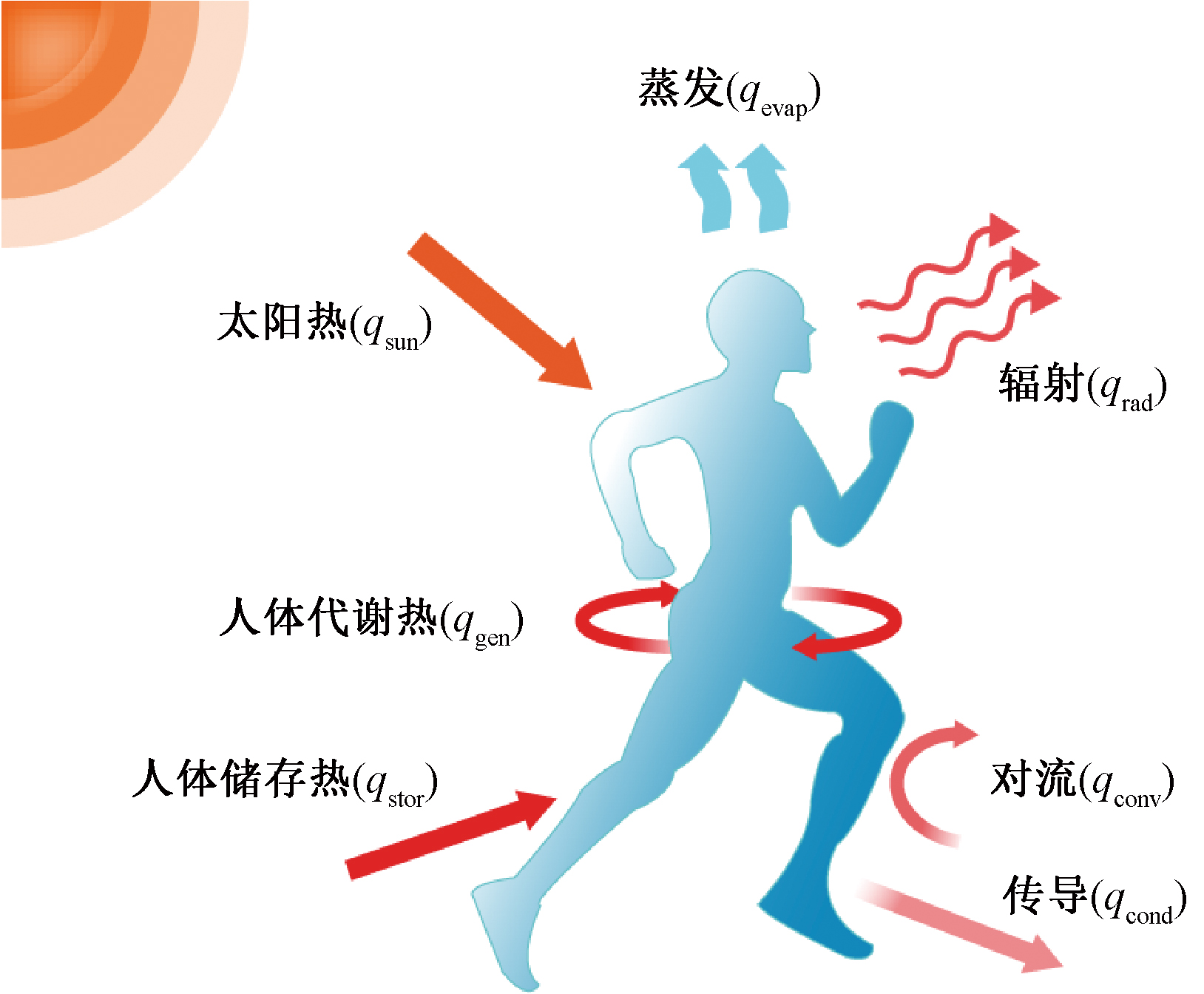
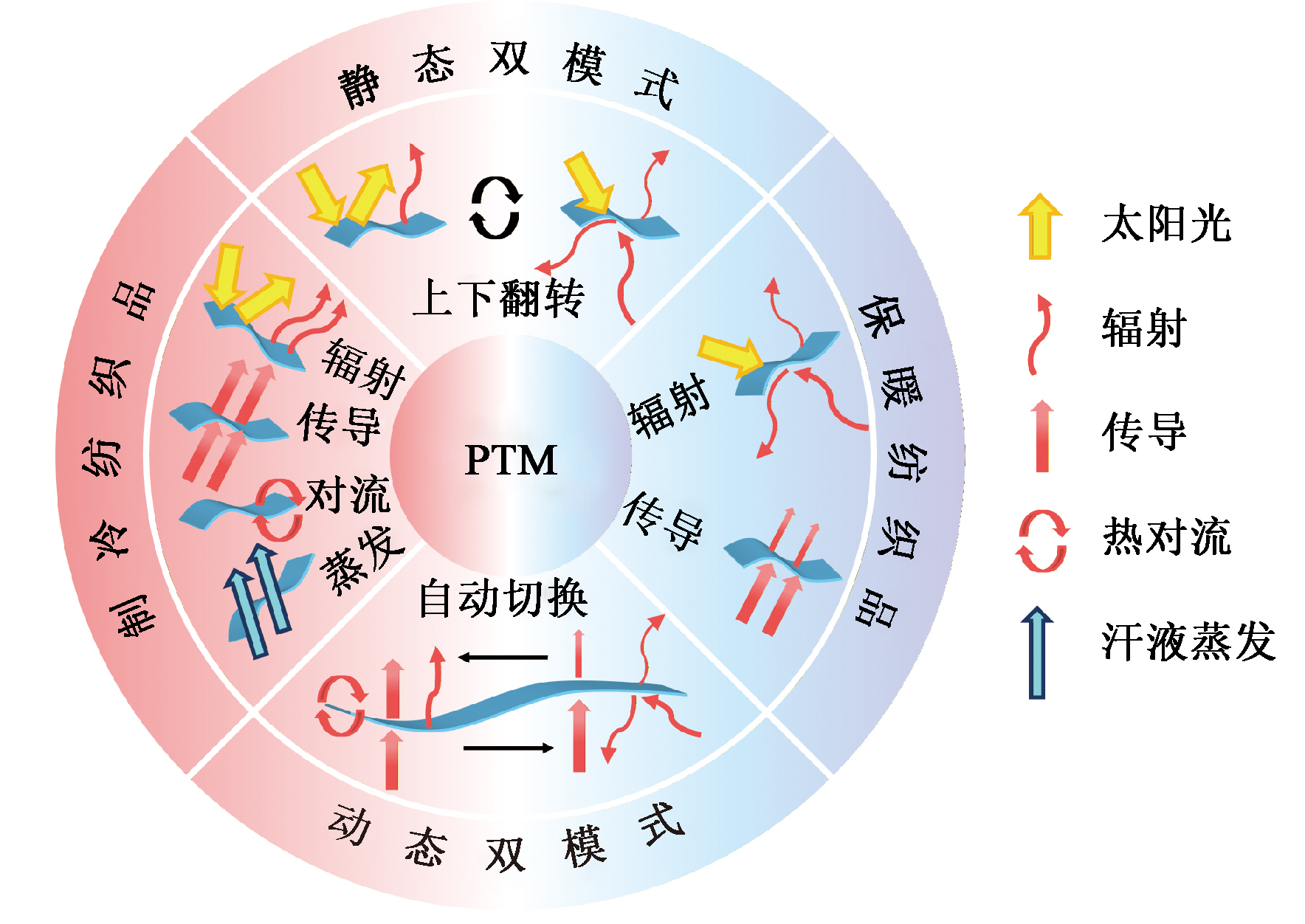
为降低建筑采暖空调能耗,提升人体在复杂环境下的热舒适性,发展低功耗甚至零功耗的个体热调控策略至关重要。首先系统阐释了个人热管理的核心概念与基本机制,并结合人体的主要散热路径,梳理了近年来针对不同服役场景的热管理功能织物的构建策略。在此基础上,重点综述了基于热传导调控、热辐射工程、蒸发冷却以及双模式/多模式协同调温等纺织品的最新研究进展,深入剖析了各类技术的典型应用场景、核心优势及当前面临的瓶颈。最后指出,尽管个人热管理纺织品展现出广阔的应用前景,但其在服用舒适性、色彩丰富度、智能响应水平,以及动态/湿态环境下的标准化评价体系等方面仍面临显著挑战。未来,该领域的研究应聚焦于服用性能优化、多功能智能集成与仿生结构设计,以推动个人热管理技术向更高效、智能、实用的方向迈进。
中图分类号:
| [1] | REN S, HAN M Y, FANG J. Personal cooling garments: a review[J]. Polymers, 2022, 14(24): 5522. |
| [2] | PAKDEL E, NAEBE M, SUN L, et al. Advanced functional fibrous materials for enhanced thermoregulating performance[J]. ACS Applied Materials & Interfaces, 2019, 11(14): 13039-13057. |
| [3] | LAN X, WANG Y, PENG J, et al. Designing heat transfer pathways for advanced thermoregulatory textiles[J]. Materials Today Physics, 2021, 17: 100342. |
| [4] | ALAZAZMEH A, ASIF M. Commercial building retrofitting: assessment of improvements in energy performance and indoor air quality[J]. Case Studies in Thermal Engineering, 2021, 26: 100946. |
| [5] | SHIN M, KIM S, KIM Y, et al. Development of an HVAC system control method using weather forecasting data with deep reinforcement learning algorithms[J]. Building and Environment, 2024, 248: 111069. |
| [6] | International Energy Association. Residential behaviour changes lead to a reduction in heating and cooling energy use by 2030[N/OL]. IEA. (2022-09-26) [2024-03-10]. https://www.iea.org/reports/residential-behaviour-changes-lead-to-a-reduction-in-heating-and-cooling-energy-use-by-2030. |
| [7] | HU R, LIU Y D, SHIN S, et al. Emerging materials and strategies for personal thermal management[J]. Advanced Energy Materials, 2020, 10(17): 1903921. |
| [8] | ZUO X W, ZHANG X J, QU L J, et al. Smart fibers and textiles for personal thermal management in emerging wearable applications[J]. Advanced Materials Technologies, 2023, 8(6): 2201137. |
| [9] | XUE S D, HUANG G H, CHEN Q, et al. Personal thermal management by radiative cooling and heating[J]. Nano-Micro Letters, 2024, 16(1): 153. |
| [10] | FAROOQ A S, ZHANG P. Fundamentals, materials and strategies for personal thermal management by next-generation textiles[J]. Composites Part A: Applied Science and Manufacturing, 2021, 142: 106249. |
| [11] | LEI L Q, SHI S, WANG D, et al. Recent advances in thermoregulatory clothing: materials, mechanisms, and perspectives[J]. ACS Nano, 2023, 17(3): 1803-1830. |
| [12] | HARDY J D, DUBOIS E F. Regulation of heat loss from the human body[J]. Proceedings of the National Academy of Sciences of the United States of America, 1937, 23(12): 624-631. |
| [13] | JOHN E. HALL, MICHAEL E. HALL. Guyton and hall textbook of medical physiology[M]. 15th ed. Philadelphia, PA: Elsevier, 2025: 923-934. |
| [14] | YANG J, ZHANG S S. Three-dimensional simulation of the convective heat transfer coefficient of the human body under various air velocities and human body angles[J]. International Journal of Thermal Sciences, 2023, 187: 108171. |
| [15] | 王丽娟, 刘艳峰, 刘加平. 风速对人体散热特性影响的实验研究[J]. 西安工程大学学报, 2015, 29(5): 567-572. |
| WANG Lijuan, LIU Yanfeng, LIU Jiaping. Experimental research into the effect of air speed on body heat dissipation[J]. Journal of Xi'an Polytechnic University, 2015, 29(5): 567-572. | |
| [16] | ZHANG X H, CHAO X J, LOU L, et al. Personal thermal management by thermally conductive composites: a review[J]. Composites Communications, 2021, 23: 100595. |
| [17] | 史婷婷, 刘东青, 程海峰. 基于红外辐射调控的个人热管理材料研究进展[J]. 复合材料学报, 2023, 40(5): 2480-2494. |
| SHI Tingting, LIU Dongqing, CHENG Haifeng. Research progress of personal thermal management materials based on infrared radiation regulation[J]. Acta Materiae Compositae Sinica, 2023, 40(5): 2480-2494. | |
| [18] | CHEN Z P, ZHANG Q, DING L P, et al. An infrared-transparent textile with high drawing processed Nylon 6 nanofibers[J]. Nature Communications, 2025, 16: 2009. |
| [19] | JIANG S, JIANG S Q, YAN J T, et al. Large-scale continuous production of cellulose/hollow SiO2 composite aerogel fibers for outdoor all-day radiation cooling[J]. Nano Energy, 2025, 136: 110688. |
| [20] | YU H J, LU J Q, YAN J, et al. Selective emission fabric for indoor and outdoor passive radiative cooling in personal thermal management[J]. Nano-Micro Letters, 2025, 17(1): 192. |
| [21] | DONG J W, LIN K, ZHAO W J, et al. Stretchable thermoplastic polyurethane/boron nitride nanosheet fabrics with highly anisotropic thermal conductivity for multi-scenario passive radiative cooling[J]. Advanced Fiber Materials, 2025, 7(3): 841-852. |
| [22] | CHEN J H, JIA K Y, ZHAO Q H, et al. Intelligent polyester metafabric for scalable personal hydrothermal self-adaptive adjustment[J]. Chemical Engineering Journal, 2023, 451: 138875. |
| [23] | PENG Y C, LI W, LIU B F, et al. Integrated cooling (i-Cool) textile of heat conduction and sweat transportation for personal perspiration management[J]. Nature Communications, 2021, 12: 6122. |
| [24] | YAN Z, ZHU G H, FAN D S, et al. Bioinspired metafabric with dual-gradient Janus design for personal radiative and evaporative cooling[J]. Advanced Functional Materials, 2025, 35(2): 2412261. |
| [25] | TIAN Y C, CHEN Y X, WANG S, et al. Ultrathin aerogel-structured micro/nanofiber metafabric via dual air-gelation synthesis for self-sustainable heating[J]. Nature Communications, 2024, 15: 6416. |
| [26] | GUO H Y, LI C C, YU J Y, et al. Tailored fabrics with biomimetic Janus spectral responsiveness for all-weather switchable thermoregulation[J]. Advanced Functional Materials, 2024, 34(45): 2406638. |
| [27] | LI X S, LIU M L, CHEN K, et al. Adaptive fabric with emissivity regulation for thermal management of humans[J]. Nanophotonics, 2024, 13(17): 3067-3075. |
| [28] | ZHANG Q R, CHENG H R, ZHANG S J, et al. Advancements and challenges in thermoregulating textiles: smart clothing for enhanced personal thermal management[J]. Chemical Engineering Journal, 2024, 488: 151040. |
| [29] | ZHANG X P, WANG F, GUO H Y, et al. Advanced cooling textiles: mechanisms, applications, and perspectives[J]. Advanced Science, 2024, 11(10): 2305228. |
| [30] | RAMAN A P, ABOU ANOMA M, ZHU L X, et al. Passive radiative cooling below ambient air temperature under direct sunlight[J]. Nature, 2014, 515(7528): 540-544. |
| [31] | TONG J K, HUANG X P, BORISKINA S V, et al. Infrared-transparent visible-opaque fabrics for wearable personal thermal management[J]. ACS Photonics, 2015, 2(6): 769-778. |
| [32] | PENG Y C, CHEN J, SONG A Y, et al. Nanoporous polyethylene microfibres for large-scale radiative cooling fabric[J]. Nature Sustainability, 2018, 1(2): 105-112. |
| [33] | IQBAL M I, LIN K X, SUN F X, et al. Radiative cooling nanofabric for personal thermal management[J]. ACS Applied Materials & Interfaces, 2022, 14(20): 23577-23587. |
| [34] | ZENG S N, PIAN S J, SU M Y, et al. Hierarchical-morphology metafabric for scalable passive daytime radiative cooling[J]. Science, 2021, 373(6555): 692-696. |
| [35] | WU X K, LI J L, JIANG Q Y, et al. An all-weather radiative human body cooling textile[J]. Nature Sustainability, 2023, 6(11): 1446-1454. |
| [36] | WU R H, SUI C X, CHEN T H, et al. Spectrally engineered textile for radiative cooling against urban heat islands[J]. Science, 2024, 384(6701): 1203-1212. |
| [37] | KALAOGLU-ALTAN O I, KAYAOGLU B K, TRABZON L. Improving thermal conductivities of textile materials by nanohybrid approaches[J]. iScience, 2022, 25(3): 103825. |
| [38] | CANDADAI A A, WEIBEL J A, MARCONNET A M. Thermal conductivity of ultrahigh molecular weight polyethylene: from fibers to fabrics[J]. ACS Applied Polymer Materials, 2020, 2(2): 437-447. |
| [39] | GAO T T, YANG Z, CHEN C J, et al. Three-dimensional printed thermal regulation textiles[J]. ACS Nano, 2017, 11(11): 11513-11520. |
| [40] | MA C, GAO Y, CAO Y X, et al. Hierarchically core-shell nanofiber textiles for personal cooling in hot and humid conditions[J]. Nano Energy, 2024, 123: 109400. |
| [41] | SHOU D H, LI Z Q. Sustainable personal cooling in a warming world[J]. Science, 2025, 389(6763): 877-878. |
| [42] | LI X Q, MA B R, DAI J Y, et al. Metalized polyamide heterostructure as a moisture-responsive actuator for multimodal adaptive personal heat management[J]. Science Advances, 2021, 7(51): eabj7906. |
| [43] | HE J J, ZHANG Q Y, WU Y P, et al. Scalable nanofibrous silk fibroin textile with excellent Mie scattering and high sweat evaporation ability for highly efficient passive personal thermal management[J]. Chemical Engineering Journal, 2023, 466: 143127. |
| [44] | DU P B, ZHAO X S, ZHAN X W, et al. A high-performance passive radiative cooling metafabric with Janus wettability and thermal conduction[J]. Small, 2024, 20(43): 2403751. |
| [45] | TANG L T, LYU B, GAO D G, et al. A wearable textile with superb thermal functionalities and durability towards personal thermal management[J]. Chemical Engineering Journal, 2023, 465: 142829. |
| [46] | CAI L L, SONG A Y, WU P L, et al. Warming up human body by nanoporous metallized polyethylene textile[J]. Nature Communications, 2017, 8: 496. |
| [47] | CHANG J, PANG B, ZHANG H, et al. MXene/cellulose composite cloth for integrated functions (if-Cloth) in personal heating and steam generation[J]. Advanced Fiber Materials, 2024, 6(1): 252-263. |
| [48] | CUI Y, GONG H X, WANG Y J, et al. A thermally insulating textile inspired by polar bear hair[J]. Advanced Materials, 2018, 30(14): 1706807. |
| [49] | WU M R, SHAO Z Y, ZHAO N F, et al. Biomimetic, knittable aerogel fiber for thermal insulation textile[J]. Science, 2023, 382(6677): 1379-1383. |
| [50] | XUE T T, ZHU C Y, YU D Y, et al. Fast and scalable production of crosslinked polyimide aerogel fibers for ultrathin thermoregulating clothes[J]. Nature Communications, 2023, 14: 8378. |
| [51] | HSU P C, LIU C, SONG A Y, et al. A dual-mode textile for human body radiative heating and cooling[J]. Science Advances, 2017, 3(11): e1700895. |
| [52] | LAN C T, MENG J, PAN C X, et al. Hierarchical porous dual-mode thermal management fabrics achieved by regulating solar and body radiations[J]. Materials Horizons, 2024, 11(7): 1760-1768. |
| [53] | ZHANG X A, YU S J, XU B B, et al. Dynamic gating of infrared radiation in a textile[J]. Science, 363(6427): 619-623. |
| [54] | FAN Q C, FAN H W, HAN H Z, et al. Dynamic thermoregulatory textiles woven from scalable-manufactured radiative electrochromic fibers[J]. Advanced Functional Materials, 2024, 34(16): 2310858. |
| [55] | ZHAO Z M, LI H Y, PENG Y Y, et al. Hierarchically programmed meta-louver fabric for adaptive personal thermal management[J]. Advanced Functional Materials, 2024, 34(44): 2404721. |
| [1] | 包安娜, 洪剑寒. 静电纺丝制备辐射制冷纳米纤维材料的研究进展[J]. 纺织学报, 2026, 47(07): 239-246. |
| [2] | 郭俊滔, 包伟, 刘典波. 用于个人热管理的湿响应针织物研究进展[J]. 纺织学报, 2026, 47(07): 247-253. |
| [3] | 郑晶晶, 曹源, 陈佳桦, 吕健元. 聚多巴胺/十八胺/氧化锌协同改性香云纱的超疏水与防紫外线性能[J]. 纺织学报, 2026, 47(05): 172-181. |
| [4] | 张旭, 许云凯, 刘云. 植酸改性茶多酚阻燃涤纶织物的制备及其性能[J]. 纺织学报, 2026, 47(05): 182-189. |
| [5] | 吴雷蕾, 王强, 王平. 纤维表面无机纳米粒子负载及其抗菌机制研究进展[J]. 纺织学报, 2026, 47(04): 255-264. |
| [6] | 王业飞, 许子傲, 俞建勇, 丁彬, 李召岭. 个人恒温热管理织物的研究进展[J]. 纺织学报, 2026, 47(03): 208-216. |
| [7] | 黄雍宝, 王一洲, 李梦琪, 万贝贝, 宋悦, 杨帆. 光致变色纺织品的制备及其防伪应用[J]. 纺织学报, 2026, 47(02): 214-221. |
| [8] | 任萧, 潘林洁, 姜海霞, 葛凤燕, 高洪国. 生物质多酚-亚铁离子多色系染料制备及其在棉织物上的应用[J]. 纺织学报, 2026, 47(01): 132-141. |
| [9] | 顾家玉, 张炜栋, 董永春, 孙璇, 徐良军. 银杏叶黄酮对羊毛和蚕丝织物的抗菌整理[J]. 纺织学报, 2026, 47(01): 142-150. |
| [10] | 候志文, 任泽苹, 王晓宁, 张天骄. 棉织物的壳聚糖/海藻酸盐抗菌阻燃整理及其性能[J]. 纺织学报, 2025, 46(12): 171-180. |
| [11] | 叶慧, 丛洪莲, 贺海军. 基于二元脂肪酸的中空涤纶相变纤维制备及其性能[J]. 纺织学报, 2025, 46(11): 188-195. |
| [12] | 俞世雄, 林参天, 祝顺天, 胡鸿霞, 高彦峰, 马儒军. 辐射热管理织物及其红外光谱设计的研究进展[J]. 纺织学报, 2025, 46(05): 96-104. |
| [13] | 黄田田, 宋媛珠, 赵斌. 单宁酸基阻燃多功能涂层及表面整理Lyocell织物[J]. 纺织学报, 2024, 45(12): 152-158. |
| [14] | 关玉, 王冬, 郭一凡, 付少海. MoS2/MXene阻燃气敏棉织物的制备及其性能[J]. 纺织学报, 2024, 45(12): 159-165. |
| [15] | 王心雨, 郭明明, 张乐乐, 郑伟杰, AMJAD Farooq, 王宗乾. 耐久性抗菌超疏水棉织物的制备及其性能[J]. 纺织学报, 2024, 45(11): 170-177. |
|
||
 京公网安备11010502044800号