纺织学报 ›› 2025, Vol. 46 ›› Issue (10): 129-134.doi: 10.13475/j.fzxb.20250203801

• 染整工程 • 上一篇    下一篇

棉散纤维活性染料连续染色技术及其工业化应用

金少特1, 阎克路2, 黄金杰3, 陈德芳3, 史向阳1()   

  1. 1.东华大学 生物与医学工程学院, 上海 201620
    2.东华大学 国家染整工程技术研究中心, 上海 201620
    3.新昌县艺力机械有限公司, 浙江 绍兴 312500
  • 收稿日期:2025-02-19 修回日期:2025-03-17 出版日期:2025-10-15 发布日期:2025-10-15
  • 通讯作者: 史向阳(1970—),男,教授,博士。主要研究方向为新型纳米材料在生物医学中的应用及绿色染整加工技术。E-mail:xshi@dhu.edu.cn
  • 作者简介:金少特(1985—),男,博士生。主要研究方向为散纤维的连续染色技术。

Continuous dyeing technology for loose cotton fibers with reactive dyes and its industrial application

JIN Shaote1, YAN Kelu2, HUANG Jinjie3, CHEN Defang3, SHI Xiangyang1()   

  1. 1. College of Biological Science and Medical Engineering, Donghua University, Shanghai 201620, China
    2. National Engineering Research Center for Dyeing and Finishing of Textiles, Donghua University, Shanghai 201620, China
    3. Xinchang County Yili Machinery Co., Ltd., Shaoxing, Zhejiang 312500, China
  • Received:2025-02-19 Revised:2025-03-17 Published:2025-10-15 Online:2025-10-15

摘要:

针对棉散纤维活性染料间歇式染缸染色存在效率低、水耗能耗大、用盐量大、废水排放量多的问题,使用研发的散纤维连续染色成套设备提升染色效果。以染色牢度、染色均匀度、固色率和染色深度为评判依据,采用实验室轧车模拟该设备的连续化染色工艺进行单因素探讨,得到较佳的染色工艺参数:活性黑5质量浓度为50 g/L,混合碱(NaOH与Na2CO3质量比为1∶4)质量浓度为20 g/L,室温堆置16 h。采用该工艺在生产型设备上进行产业化验证,结果表明:该工艺染色棉纤维的K/S值为39.86,棉纤维层左、中色差为0.49,右、中色差为0.36,内、外色差为0.27,前、后色差为0.62,各项色牢度与染缸工艺相当;与染缸工艺相比,该技术实现节约用水72%、节约染料31.25%、节约电量48%,节约蒸汽量38%,减少盐用量100%。经计算,散纤维连续染色工艺工作液的染料质量浓度比染缸工艺高3.75倍,纤维表面的染料浓度梯度较高,因此在无需额外加盐的状态下即可完成染料对纤维的上染。

关键词: 棉散纤维, 连续染色, 活性染料, 冷堆, 节水, 节能减排

Abstract:

Objective To address the issues of low production efficiency, high water and energy consumption, excessive salt usage, and significant wastewater discharge associated with the traditional exhausting dyeing method for loose cotton fibers with reactive dyes, the development of a complete set of continuous dyeing equipment for loose fibers could effectively solve this problem. In order to enhance the dyeing performance of this equipment, this study investigates the continuous dyeing technology for loose fibers under laboratory conditions, aiming to explore the optimal process parameters.

Method A laboratory padder dyeing process were employed to simulate the continuous dyeing technology. Taking the color fastness, evenness, fixation rate and color depth as the evaluation indexes, experiments were carried out, and the optimized process were obtained. The experiment on the equipment of XCYL-15 was conducted in a factory. The color parameters and color fastnesses of fibers dyed with the continuous method were compared with those of fibers dyed with the conventional exhausting method. In addition, the economic and environmental benefits were analyzed.

Results The optimized process parameters were identified through laboratory experiments, which are 50 g/L for the concentration of Reactive Black 5, 20 g/L for the concentration of mixed alkali (1∶4 of the mass ratio for NaOH against Na2CO3), 0 sodium sulfate addition, and 16 h stacking time at room temperature. With this optimal condition, the factory experiment was carried out with the XCYL-15 equipment. For the cotton fibers dyed with the continuous dyeing method, the K/S value was 39.86, the color difference ΔE1 between the left and the middle of the cotton fiber layer was 0.49, and the color difference ΔE2 between the right and the middle was 0.36, and the color difference ΔE3 between the inner and outer was 0.27, and the color difference ΔE4 between the front and rear was 0.62, indicating even dyeing of the cotton fiber layer and satisfaction of requirements. The color fastness of cotton fibers dyed via the continuous method was comparable to that of cotton fibers dyed using the traditional exhaust dyeing method. Specifically, the dry rubbing fastness and wet rubbing fastness of cotton fibers dyed by the continuous method were 4-5 and 3-4, respectively. Additionally, the K/S values of cotton fibers dyed by the continuous method and the traditional exhaust dyeing method were 39.86 and 36.57, respectively. However, the dye fixation of the continuous dyeing method reaches 86.5%, much higher than that of the traditional exhausting dyeing method, which is only 70.5%, resulting in high discharge of dyes into the dyeing wastewater. Compared with the traditional exhausting dyeing method, the continuous dyeing method would save 72% of water, 31.25% of dyes, 48% of electricity, 38% of steam, and reduce the salt usage by 100%.

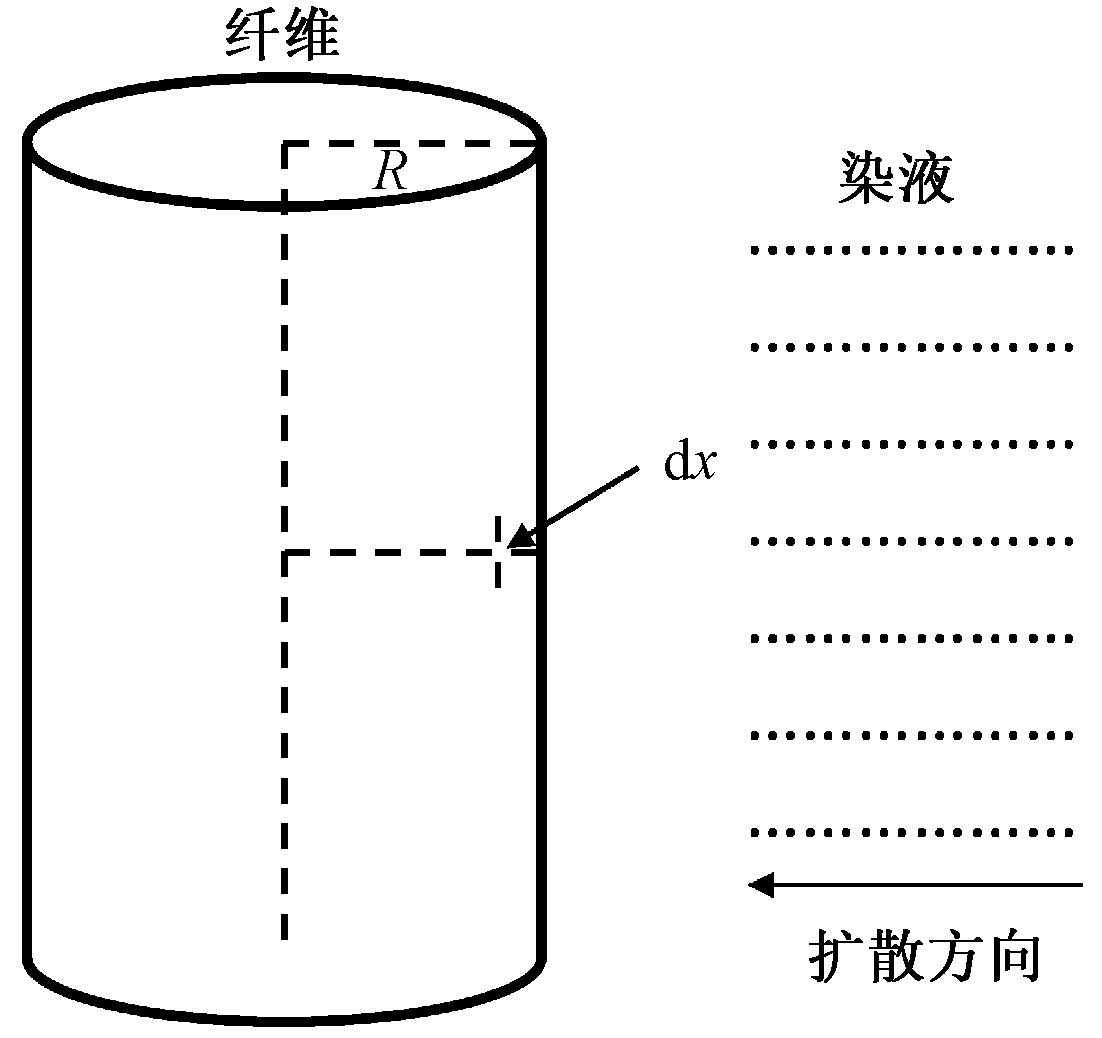
Conclusion By adopting the continuous dyeing method for loose cotton fibers, the dye concentration on the fiber surface is 3.75 times that of traditional salt-containing exhausting dyeing method. According to the Fick's second law, when the dye diffuses into the fiber, the higher the concentration, the greater the concentration gradient along the fiber radial direction. Consequently, the diffusion rate of the dye into the fiber interior is also higher, which is beneficial to the level dyeing. Therefore, the dyeing and fixation of the cotton fibers by the high concentration dye can be completed without the necessity of adding additional salt. This technology will revolutionize the exhausting dyeing process in the cotton color-spinning industry and is of great social, economic, and environmental significance.

Key words: loose cotton fiber, continuous dyeing, reactive dye, cold pad-batch, water saving, energy conservation and emission reduction

中图分类号: 

  • TS193.5

图1

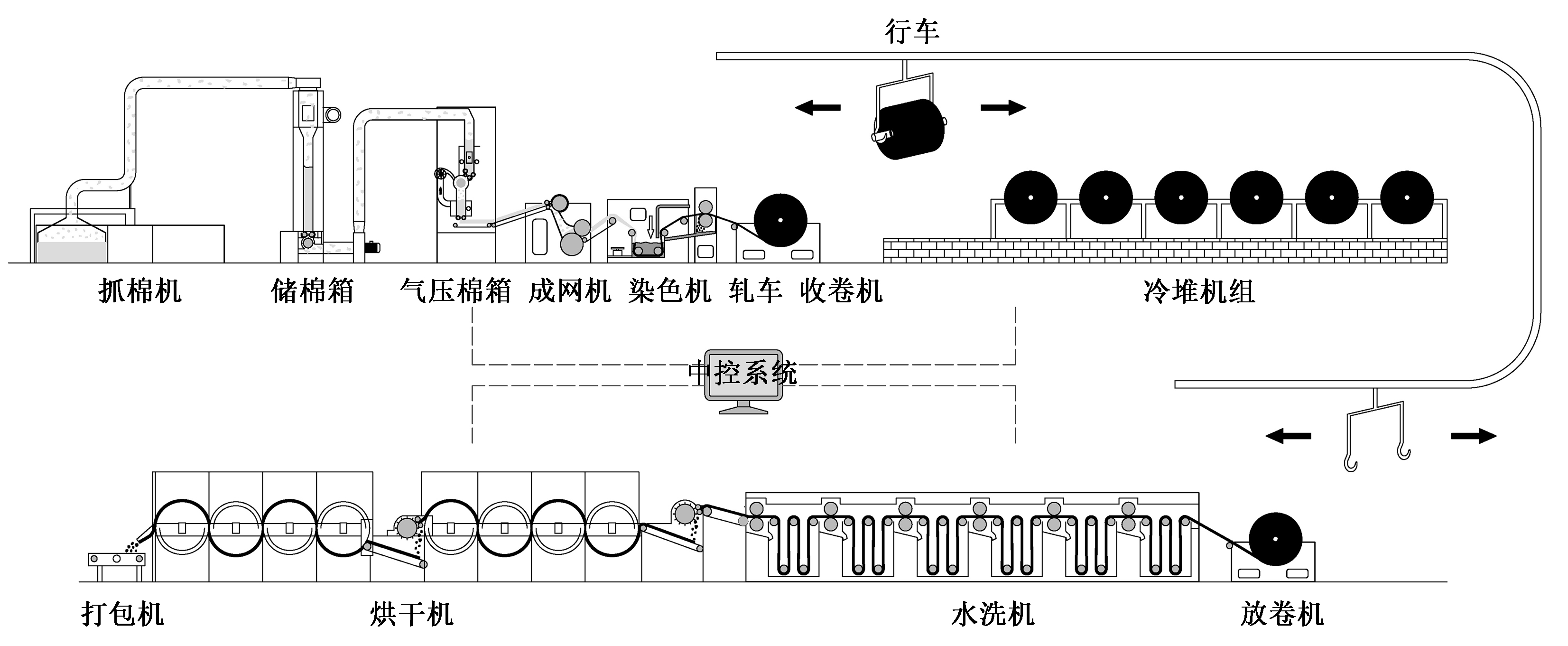
棉散纤维连续染色成套设备工艺流程图"

表1

不同染料质量浓度下棉散纤维的染色性能"

染料质量浓度/
(g·L-1)
固色
率/%
染色性能
K/S ΔE1 ΔE2
20 91.7 19.25 0.39 0.43
30 89.5 27.78 0.45 0.47
40 86.3 32.83 0.51 0.53
50 85.6 39.22 0.56 0.55
60 79.6 40.71 0.66 0.69

表2

不同混合碱质量浓度下棉散纤维的染色性能"

混合碱质量浓度/
(g·L-1)
固色
率/%
染色性能
K/S ΔE1 ΔE2
5 53.8 22.43 0.51 0.55
10 67.1 30.35 0.52 0.43
15 76.7 34.16 0.43 0.50
20 85.1 38.91 0.47 0.52
25 81.6 35.64 0.42 0.38
30 72.8 30.27 0.61 0.57

表3

不同硫酸钠质量浓度下棉散纤维的染色性能"

硫酸钠质量浓度/
(g·L-1)
固色
率/%
染色性能
K/S ΔE1 ΔE2
0 84.7 38.23 0.49 0.53
50 87.2 37.35 0.68 0.73
100 88.2 36.76 0.85 0.89
150 89.7 36.32 1.15 0.97
200 91.2 34.65 1.36 1.55

表4

不同堆置时间下棉散纤维的染色性能"

堆置时间/h 固色率/% 染色性能
K/S ΔE1 ΔE2
4 35.5 15.47 0.85 0.79
8 43.3 20.64 0.71 0.73
12 68.5 33.81 069 0.65
16 87.6 40.87 0.51 0.46
24 89.7 41.25 0.46 0.43

表5

不同染色工艺下棉散纤维的染色性能"

染色
工艺
固色
率/%
耐摩擦色牢度/级 染色性能
干摩 湿摩 棉沾
K/S
ΔE1 ΔE2 ΔE3 ΔE4
连续
染色
86.5 4~5 3~4 4 39.86 0.49 0.36 0.27 0.62
常规
浸染
70.5 4~5 3~4 4 36.57 0.34 0.31 0.43

图2

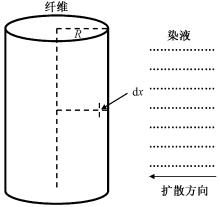
染料向纤维扩散示意图 注:R为纤维半径;dx为纤维径向上的微元距离。"

表6

棉散纤维浸染和连续染色效益对照"

指标 用水
量/t
废水排
放量/t
染料用
量/kg
元明粉
用量/kg
耗电量/
(kW·h)
蒸汽用
量/t
常规浸染 72 72 80 600 650 6.5
连续染色 20 20 55 0 340 4
节约百分
比/%
72 72 31.25 100 48 38
[1] PETER M, ROUETTE H K. Grundlagen der textil veredlung[M]. Germany: Deutscher Fachverlage, 1989:520.
[2] 高卫东. 色纺学[M]. 北京: 中国纺织出版社, 2023: 2.
GAO Weidong. Color spinning science[M]. Beijing: China Textile & Apparel Press, 2023: 2.
[3] 王际平, 吴振华, 裴刘军. 一种超低浴比动态染棉散纤维的方法: CN111041868A[P]. 2020-04-21.
WANG Jiping, WU Zhenhua, PEI Liujun. Method for dynamically dyeing cotton loose fibers with ultralow bath ratio: CN111041868A[P]. 2020-04-21.
[4] 宋心远. 染色理论概述(一)[J]. 印染, 1984, 10(1): 48-53.
SONG Xinyuan. Overview of dyeing theory (I)[J]. China Dyeing and Finishing, 1984, 10(1): 48-53.
[5] 俞巨乐, 胡重法, 高方容, 等. 活性橙13溶液的染料聚集行为[J]. 印染, 2014, 40(10): 1-5.
YU Jule, HU Chongfa, GAO Fangrong, et al. Aggregation behavior of reactive orange 13 in aqueous solution[J]. China Dyeing and Finishing, 2014, 40(10): 1-5.
[6] 赵涛. 染整工艺与原理(下册)[M]. 2版. 北京: 中国纺织出版社, 2020: 20-40.
ZHAO Tao. Dyeing and finishing technology and principles-volume (II)[M]. 2nd ed. Beijing: China Textile & Apparel Press, 2020: 20-40.
[7] 代亚敏. 拉曼光谱技术在纤维素纤维活性染料上染行为研究中的应用[D]. 上海: 东华大学, 2021: 3-10.
DAI Yamin. Application of Raman spectroscopy in the study of dyeing behavior of cellulose fiber with reactive dyes[D]. Shanghai: Donghua University, 2021: 3-10.
[8] 蒋志平, 栾金鑫, 孟胜锋, 等. 一种用于冷轧堆染色的快速打样新方法: CN102787462A[P]. 2012-11-21.
JIANG Zhiping, LUAN Jinxin, MENG Shengfeng, et al. New rapid proofing method for cold pad batch dyeing: CN102787462A[P]. 2012-11-21.
[9] 李付杰, 贾文芹, 孙永祥, 等. 天丝/棉混纺织物冷堆染色[J]. 印染, 2008, 34(9): 16-17.
LI Fujie, JIA Wenqin, SUN Yongxiang, et al. Cold pad-batch dyeing process of Tencel/cotton blended fabric[J]. China Dyeing and Finishing, 2008, 34(9): 16-17.
[10] 王力民, 罗维新, 高鹏, 等. 一种深色纯棉织物多次水洗色牢度的染整工艺:CN200910017616.9[P]. 2010-01-27.
WANG Limin, LUO Weixin, GAO Peng, et al. Dyeing and finishing process for color fastness of dark cotton fabric to multiple washes:CN00910017616.9[P]. 2010-01-27.
[1] 赵强强, 王韩星, 张奉轩, 何瑾馨, 周俊, 周兆昌, 董霞. 聚六亚甲基双胍盐酸盐改性对棉织物耐日晒色牢度的影响[J]. 纺织学报, 2025, 46(04): 109-118.
[2] 崔芳, 张鑫卿, 殷斐, 李大伟, 雷苗苗, 谢志勇. 基于泡沫法给碱的粘胶织物活性红24无尿素印花[J]. 纺织学报, 2025, 46(02): 138-144.
[3] 李万新, 舒大武, 安芳芳, 韩博, 任支刚, 单巨川. 碳化钛与三价铁离子协同过硫酸钠对活性染料废水的降解[J]. 纺织学报, 2025, 46(01): 138-147.
[4] 刘骏韬, 孙婷, 涂虎, 胡敏, 张如全, 孙雷, 罗霞, 纪华. 全棉水刺非织造布的等离子体冷堆脱脂漂白工艺响应面法优化[J]. 纺织学报, 2023, 44(11): 132-141.
[5] 韩博, 王玉霖, 舒大武, 王涛, 安芳芳, 单巨川. 活性染料染色废水的循环染色[J]. 纺织学报, 2023, 44(08): 151-157.
[6] 郭玉秋, 钟毅, 徐红, 毛志平. 拼混活性染料染色多组分定量分析方法[J]. 纺织学报, 2023, 44(07): 141-150.
[7] 艾丽, 朱亚伟. 液体分散染料研发技术现状及其应用前景[J]. 纺织学报, 2023, 44(05): 220-227.
[8] 吴伟, 纪柏林, 毛志平. 活性及分散染料染色新技术[J]. 纺织学报, 2023, 44(05): 1-12.
[9] 齐浩彤, 张林森, 侯秀良, 徐荷澜. 废食用油-水无盐体系活性染色棉织物的服用性能[J]. 纺织学报, 2023, 44(03): 126-131.
[10] 王金坤, 刘秀明, 房宽峻, 乔曦冉, 张帅, 刘冬冬. 双乙烯砜基团活性染料染色对棉织物防皱性能的提升[J]. 纺织学报, 2023, 44(02): 207-213.
[11] 张帅, 房宽峻, 刘秀明, 乔曦冉. 活性染料结构对彩色聚合物纳米球性能的影响[J]. 纺织学报, 2022, 43(12): 96-101.
[12] 邵敏, 王丽君, 李美琪, 刘今强, 邵建中. 非水介质-微水体系中活性染料的水解和键合性能[J]. 纺织学报, 2022, 43(11): 94-103.
[13] 乔曦冉, 房宽峻, 刘秀明, 巩继贤, 张帅, 张敏. 羟乙基甲基纤维素改性对棉和锦纶织物表面性质的差异性影响[J]. 纺织学报, 2022, 43(11): 127-132.
[14] 杨文博, 张傲洁, 刘幽燕, 李青云. 聚氨酯泡沫固定化生物体系对活性蓝4的吸附脱色[J]. 纺织学报, 2022, 43(08): 132-139.
[15] 刘宇, 谢汝义, 宋亚伟, 齐元章, 王辉, 房宽峻. 涤/棉交织物一浴法轧染工艺[J]. 纺织学报, 2022, 43(05): 18-25.
Viewed
Full text


Abstract

Cited

  Shared   
  Discussed   
No Suggested Reading articles found!