纺织学报 ›› 2025, Vol. 46 ›› Issue (11): 26-33.doi: 10.13475/j.fzxb.20250106701
舒祖菊1,2( ), 袁自钰1, 周斐1, 黄秀文1, 王权1, 房显龙1, 曹美雪1
SHU Zuju1,2(), YUAN Ziyu1, ZHOU Fei1, HUANG Xiuwen1, WANG Quan1, FANG Xianlong1, CAO Meixue1
摘要:
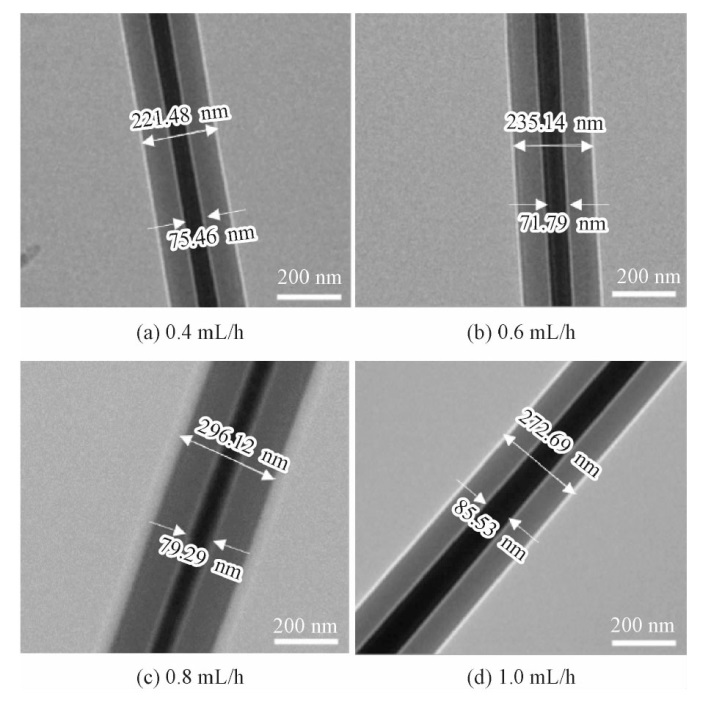
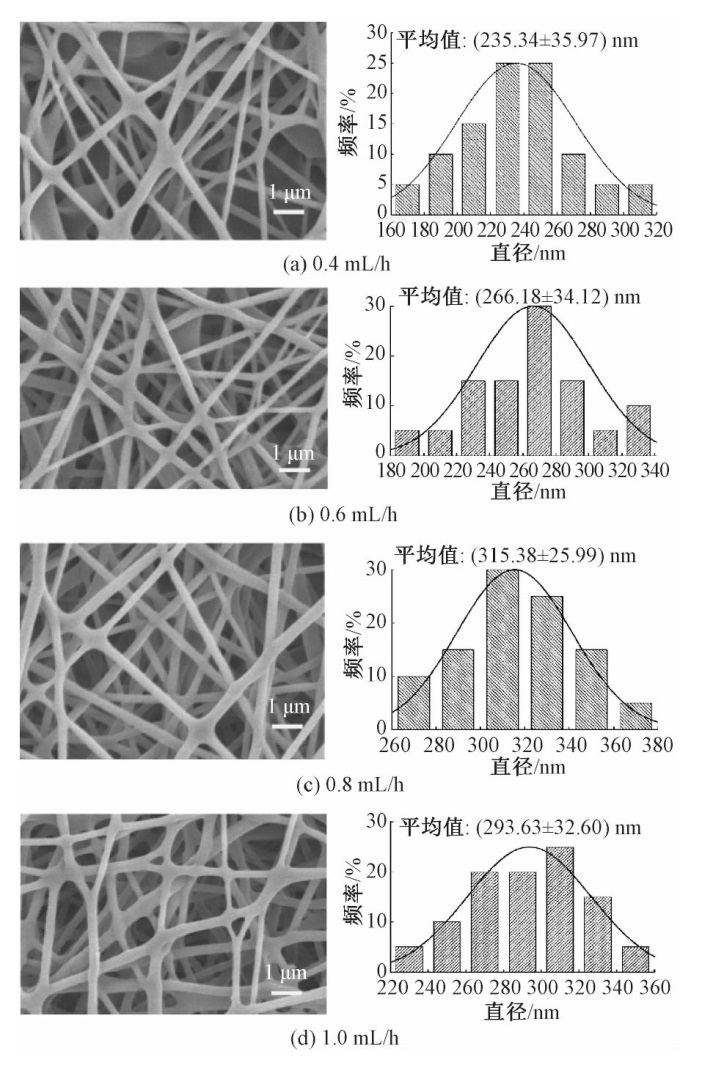
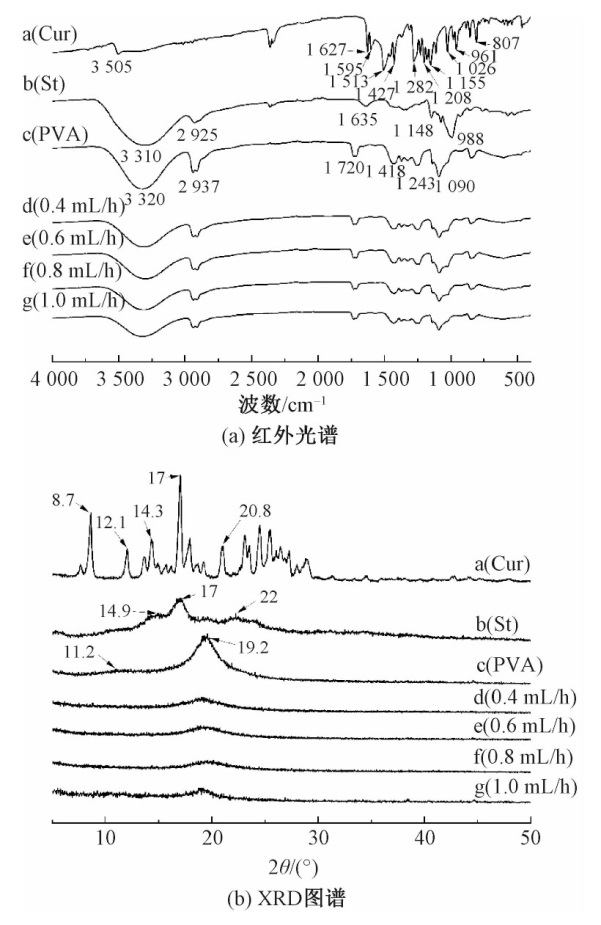
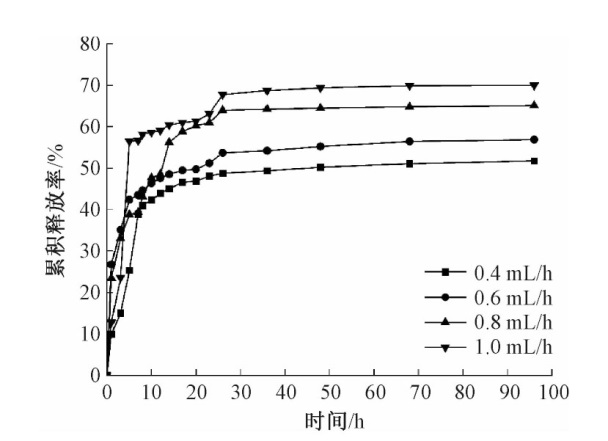
为提高姜黄素的利用率并实现缓释,将其分散到淀粉溶液中获得核层纺丝液,以可降解的聚乙烯醇配制壳层纺丝液,采用同轴静电纺丝技术制备载姜黄素的核壳结构纳米纤维膜,并对纳米纤维膜的形态结构和缓释性能进行表征与测试。结果表明:纳米纤维表面光滑,具有明显的核壳结构;壳层流速直接影响纳米纤维的形态结构,纤维直径和壳层厚度随壳层流速的增加呈先增大后减小的趋势;核层姜黄素以无定形状态存在,核层和壳层组分间存在氢键作用;随着壳层流速增加,负载率减小,包封率先增大后减小,但并未影响姜黄素的有效释放;在初始阶段姜黄素的释放速率较大,24 h后趋于平缓,进入缓释阶段,且在24 h和96 h内的累积缓释率均随壳层流速的提高而增大,均为Fickian扩散。
中图分类号:
| [1] | 邓伶俐. 静电纺丝技术包埋姜黄素研究进展[J]. 中国食品学报, 2022, 22(3):378-387. |
| DENG Lingli. Research progress of curcumin entrapment by electrospinning[J]. Journal of Chinese Institute of Food Science and Technology, 2022, 22(3): 378-387. | |
| [2] | 郭慧, 吴济宏. 姜黄素-PLA复合薄膜的制备及性能研究[J]. 中国医药工业杂志, 2013, 44(9): 896-899. |
| GUO Hui, WU Jihong. Preparation and properties of curcumin-PLA composite membranes[J]. Chinese Journal of Pharmaceuticals, 2013, 44(9): 896-899. | |
| [3] |
TERZOPOULOU Z, MICHOPOULOU A, PALAMIDI A, et al. Preparation and evaluation of collagen-based patches as curcumin carriers[J]. Polymers, 2020, 12(10): 2393.
doi: 10.3390/polym12102393 |
| [4] | 翁玲, 张彦慧, 张若宁, 等. 玉米醇溶蛋白-海藻酸钠纳米颗粒的制备及其负载姜黄素的研究[J]. 中国食品添加剂, 2024, 35(3): 25-34. |
| WENG Ling, ZHANG Yanhui, ZHANG Ruoning, et al. Preparation of zein sodium alginate nanoparticles and their loading with curcumin[J]. China Food Additives, 2024, 35(3): 25-34. | |
| [5] | 钱洋, 张璐, 李晨阳, 等. 静电纺海藻酸钠复合纳米纤维膜制备及其性能[J]. 纺织学报, 2024, 45(8): 18-25. |
| QIAN Yang, ZHANG Lu, LI Chenyang, et al. Preparation and performance of electrospun sodium alginate composite nanofiber membranes[J]. Journal of Textile Research, 2024, 45(8): 18-25. | |
| [6] |
GUO J X, QIU Y, ZHANG J, et al. A review on polysaccharide-based delivery systems for edible bioactives: pH responsive, controlled release, and emerging applications[J]. International Journal of Biological Macromolecules, 2025, 291: 139178.
doi: 10.1016/j.ijbiomac.2024.139178 |
| [7] | 黄思琦, 赵瑞新, 申和峰, 等. 柠檬酸对淀粉/聚乙烯醇复合膜性能的影响[J]. 塑料, 2023, 52(6): 95-99. |
| HUANG Siqi, ZHAO Ruixin, SHEN Hefeng, et al. Effect of citric acid on the properties of starch/PVA composite films[J]. Plastics, 2023, 52(6): 95-99. | |
| [8] | 王明明, 关二旗, 李萌萌, 等. 姜黄素-淀粉纳米微胶囊的研制及其抗氧化研究[J]. 河南工业大学学报(自然科学版), 2022, 43(4): 38-45, 53. |
| WANG Mingming, GUAN Erqi, LI Mengmeng, et al. Preparation of curcumin-starch nano-microcapsules and its antioxidant research[J]. Journal of Henan University of Technology (Natural Science Edition), 2022, 43(4): 38-45, 53. | |
| [9] |
LIU Y H, LIU M Y, ZHANG L L, et al. Preparation and properties of biodegradable films made of cationic potato-peel starch and loaded with curcumin[J]. Food Hydrocolloids, 2022, 130: 107690.
doi: 10.1016/j.foodhyd.2022.107690 |
| [10] |
CARDOSO C S, DE CARVALHO F F, GOMES R C, et al. New approaches to second-degree burn healing: polyvinyl alcohol membrane loaded to arnica combined to laser therapy[J]. Journal of Biomaterials Applications, 2024, 38(10): 1058-1072.
doi: 10.1177/08853282241238609 pmid: 38470813 |
| [11] |
DE LIMA SILVA I D, DE MORAES FILHO L E P T, CAETANO V F, et al. Development of antioxidant active PVA films with plant extract of Caesalpinia ferrea Martius[J]. LWT, 2021, 144: 111215.
doi: 10.1016/j.lwt.2021.111215 |
| [12] |
ZHANG Z L, ZHANG X H, LI Y, et al. Effects of quercetin- and Lactiplantibacillus plantarum-containing bioactive films on physicochemical properties and microbial safety of grass carp[J]. Food Chemistry, 2024, 450: 139472.
doi: 10.1016/j.foodchem.2024.139472 |
| [13] | 王培, 牛丽丽, 李静宇, 等. 负载姜黄素薄膜的制备及缓释性能[J]. 塑料, 2024, 53(6): 28-32, 38. |
| WANG Pei, NIU Lili, LI Jingyu, et al. Preparation and sustained-release properties of curcumin-loaded films[J]. Plastics, 2024, 53(6): 28-32, 38. | |
| [14] | CHAKRABORTY P, RAMAMURTHY J. Fabrication and characterization of electrospun ocimum sanctum and curcumin-loaded nanofiber membrane for the management of periodontal disease: an in vitro study[J]. Cureus, 2024, 16(7): e63678. |
| [15] | ROHANI SHIRVAN A, HEMMATINEJAD N, BAHRAMI S H, et al. A comparison between solvent casting and electrospinning methods for the fabrication of neem extract-containing buccal films[J]. Journal of Industrial Textiles, 2022, 51(1_suppl): 311S-335S. |
| [16] |
李好义, 王逸铭, 丁熙, 等. 静电纺药物负载与应用研究进展[J]. 中国塑料, 2023, 37(12): 60-69.
doi: 10.19491/j.issn.1001-9278.2023.12.010 |
|
LI Haoyi, WANG Yiming, DING Xi, et al. Research progress in electrospinning drug loading and its applications[J]. China Plastics, 2023, 37(12):60-69.
doi: 10.19491/j.issn.1001-9278.2023.12.010 |
|
| [17] |
QIU C, ZHANG J Z, WU B, et al. Advanced application of nanotechnology in active constituents of traditional Chinese medicines[J]. Journal of Nanobiotechnology, 2023, 21(1): 456.
doi: 10.1186/s12951-023-02165-x pmid: 38017573 |
| [18] | 刘嘉炜, 季东晓, 覃小红. 空气过滤用静电纺纳米纤维材料研究进展[J]. 纺织学报, 2024, 45(8):35-43. |
| LIU Jiawei, JI Dongxiao, QIN Xiaohong. Research progress in electrospun nanofiber materials for air filtration[J]. Journal of Textile Research, 2024, 45(8):35-43. | |
| [19] | 孙继帅, 段孟霞, 姜海鑫, 等. 静电纺丝技术包埋生物活性物质用于食品活性包装的研究进展[J]. 食品科学, 2021, 42(19): 299-306. |
|
SUN Jishuai, DUAN Mengxia, JIANG Haixin, et al. Research progress in the encapsulation of bioactive by electrospinning technique for active food packaging[J]. Food Science, 2021, 42(19): 299-306.
doi: 10.7506/spkx1002-6630-20200826-353 |
|
| [20] |
李思程, 张岑, 谌迪, 等. 同轴静电纺丝多级结构纳米纤维的研究进展及其在食品领域的应用现状[J]. 食品科学, 2024, 45(13):300-311.
doi: 10.7506/spkx1002-6630-20230531-285 |
|
LI Sicheng, ZHANG Cen, CHEN Di, et al. Research progress in coaxial electrospinning for the preparation of multi-structure nanofibers and its application in the food industry[J]. Food Science, 2024, 45(13): 300-311.
doi: 10.7506/spkx1002-6630-20230531-285 |
|
| [21] | 王红伟, 王立红, 刘泽梅, 等. 载黄芪甲苷的核壳结构纳米纤维创面敷料的制备及性能[J]. 功能高分子学报, 2024, 37(4):338-346. |
| WANG Hongwei, WANG Lihong, LIU Zemei, et al. Preparation and performance of astragaloside-loaded core-shell nanofiber wound dressing[J]. Journal of Functional Polymers, 2024, 37(4):338-346. | |
| [22] |
李亮, 裴斐斐, 刘淑萍, 等. 聚乳酸纳米纤维基载药敷料的制备与表征[J]. 纺织学报, 2022, 43(11): 1-8.
doi: 10.13475/j.fzxb.20210908508 |
|
LI Liang, PEI Feifei, LIU Shuping, et al. Preparation and characterization of polylactic acid nanofiber drug loaded medical dressings[J]. Journal of Textile Research, 2022, 43(11): 1-8.
doi: 10.13475/j.fzxb.20210908508 |
|
| [23] |
ÖZTEKIN M, AÇıKEL Y S. Novel pH-responsive folic acid-conjugated zein-carboxymethyl cellulose nanoparticles for enhanced and controlled curcumin release[J]. Journal of Pharmaceutical Innovation, 2025, 20(3): 89.
doi: 10.1007/s12247-025-09992-5 |
| [24] | SEIF S, GRAEF F, GORDON S, et al. Monitoring drug release from electrospun fibers using an in situ fiber-optic system[J]. Dissolution Technologies, 2016, 23(2): 6-11. |
| [25] | LAO M, WANG Y J, LI X, et al. Effect of specific surface area and hydrophobicity of electrospun nanofibers on the sustained release performance of diclofenac sodium[J]. Langmuir, 2024: acs.langmuir.4c01909. |
| [26] |
BAYKARA T, TAYLAN G. Coaxial electrospinning of PVA/Nigella seed oil nanofibers: processing and morphological characterization[J]. Materials Science and Engineering: B, 2021, 265: 115012.
doi: 10.1016/j.mseb.2020.115012 |
| [27] |
HAN D, STECKL A J. Coaxial electrospinning formation of complex polymer fibers and their applications[J]. ChemPlusChem, 2019, 84(10): 1453-1497.
doi: 10.1002/cplu.201900281 pmid: 31943926 |
| [28] |
SUN X Z, WILLIAMS G R, HOU X X, et al. Electrospun curcumin-loaded fibers with potential biomedical applications[J]. Carbohydrate Polymers, 2013, 94(1): 147-153.
doi: 10.1016/j.carbpol.2012.12.064 |
| [29] |
JAYAKUMAR A, HEERA K V, SUMI T S, et al. Starch-PVA composite films with zinc-oxide nanoparticles and phytochemicals as intelligent pH sensing wraps for food packaging application[J]. International Journal of Biological Macromolecules, 2019, 136: 395-403.
doi: S0141-8130(19)31972-5 pmid: 31173829 |
| [30] |
AHMED A, NIAZI M B K, JAHAN Z, et al. Enhancing the thermal, mechanical and swelling properties of PVA/starch nanocomposite membranes incorporating g-C3N4[J]. Journal of Polymers and the Environment, 2020, 28(1): 100-115.
doi: 10.1007/s10924-019-01592-y |
| [31] | 李曼, 武丁胜, 魏安方, 等. 静电纺丝聚己内酯/明胶载姜黄素生物活性敷料的制备和性能[J]. 材料导报, 2022, 36(11):233-239. |
| LI Man, WU Dingsheng, WEI Anfang, et al. Preparation and performance of electrospinning curcumin loaded polycaprolactone/gelatin bioactive wound dressing[J]. Materials Reports, 2022, 36(11): 233-239. | |
| [32] | 袁橙, 李英鹏, 吕邵娃, 等. 载桂皮醛同轴静电纺丝纳米纤维膜的构建及性能评价[J]. 军事医学, 2021, 45(3): 185-191. |
| YUAN Cheng, LI Yingpeng, LÜ Shaowa, et al. Preparation and performance evaluation of coaxially electrospun cinnamaldehyde nanofibers[J]. Military Medical Sciences, 2021, 45(3): 185-191. |
| [1] | 王文淑, 王建刚, 李瀚宇, 王春红, 谭晓璇, 王慧泉. 烷基壳聚糖/聚乙烯醇纳米纤维膜的制备及其止血性能[J]. 纺织学报, 2025, 46(11): 52-60. |
| [2] | 张佃平, 陈琪, 徐登明, 王祚, 王昊. CuO 纳米纤维的制备及其在无酶葡萄糖传感器中的性能[J]. 纺织学报, 2025, 46(11): 61-68. |
| [3] | 郭梦瑶, 吴佳庆, 王迎. 全包覆结构聚氨酯膜条带/棉复合纱制备及其力学性能[J]. 纺织学报, 2025, 46(11): 69-76. |
| [4] | 吴乐然, 吴霓欢, 李林耿, 钟意, 陈鸿鹏, 汤南. 负载厚朴酚的抗菌纳米纤维膜的制备及其性能[J]. 纺织学报, 2025, 46(10): 30-38. |
| [5] | 唐春霞, 王一帆, 毛云山, 刘健, 付少海. 电磁屏蔽用纤维素基复合材料结构设计的研究进展[J]. 纺织学报, 2025, 46(09): 36-45. |
| [6] | 毛泽, 高俊, 凌磊, 武丁胜, 陶云, 张春, 李申, 凤权. 聚丙烯腈/聚吡咯纳米纤维膜的制备及其对铬离子的吸附性能[J]. 纺织学报, 2025, 46(09): 57-65. |
| [7] | 傅林, 钱建华, 单江音, 林灵, 卫梦蓉, 翁可欣, 吴晓睿. 银纳米线/聚氨酯纳米纤维膜柔性传感器制备及其性能[J]. 纺织学报, 2025, 46(09): 74-83. |
| [8] | 史蜜, 王文聪, 范雪荣, 高卫东. 聚乙烯醇聚合度和醇解度对棉浆纱性能的影响[J]. 纺织学报, 2025, 46(09): 181-187. |
| [9] | 梁锋, 方沿, 张伟华, 唐余玲, 李双洋, 周建飞, 石碧. 基于金属-多酚网络的胶原蛋白基纤维制备及其力学性能[J]. 纺织学报, 2025, 46(08): 10-17. |
| [10] | 沈忱思, 王欣悦, 李方. 退浆废水预氧化-絮凝一体化处理及资源化技术[J]. 纺织学报, 2025, 46(08): 173-182. |
| [11] | 马晓远, 包伟. 防水透湿纳米纤维复合织物研究现状及发展趋势[J]. 纺织学报, 2025, 46(08): 254-262. |
| [12] | 时虎, 王赫, 王洪杰, 潘显苗. 多孔交联纳米纤维基超级电容器隔膜的设计[J]. 纺织学报, 2025, 46(08): 45-52. |
| [13] | 张利平, 郭羽晴, 丁博, 孙洁. 芳纶纳米纤维/热塑性聚氨酯复合微孔膜与可呼吸覆膜织物制备及其性能[J]. 纺织学报, 2025, 46(07): 19-27. |
| [14] | 徐丽亚, 汪瑱, 杨鸿杰, 汪蔚. 氧化锌-银/生物基聚酰胺56纳米纤维膜的制备及其抗菌性能[J]. 纺织学报, 2025, 46(07): 37-45. |
| [15] | 林玉婷, 许仕林, 胡毅. 多色彩热塑性聚氨酯/聚丙烯腈纳米纤维纱线的制备及其性能[J]. 纺织学报, 2025, 46(07): 78-86. |
|
||
 京公网安备11010502044800号